Faltering Economy in China Dims Job Prospects for Graduates; “The only thing that worries them more than an unemployed low-skilled person is an unemployed educated person”

June 16, 2013

Faltering Economy in China Dims Job Prospects for Graduates

By KEITH BRADSHER and SUE-LIN WONG

HONG KONG — A record seven million students will graduate from universities and colleges across China in the coming weeks, but their job prospects appear bleak — the latest sign of a troubled Chinese economy.

Businesses say they are swamped with job applications but have few positions to offer as economic growth has begun to falter. Twitter-like microblogging sites in China are full of laments from graduates with dim prospects.

The Chinese government is worried, saying that the problem could affect social stability, and it has ordered schools, government agencies and state-owned enterprises to hire more graduates at least temporarily to help relieve joblessness. “The only thing that worries them more than an unemployed low-skilled person is an unemployed educated person,” said Shang-Jin Wei, a Columbia Business School economist. Read more of this post

Record Soybean Glut Is Seen Worsening as China’s Appetite Eases

Record Soybean Glut Is Seen Worsening as China’s Appetite Eases

Soybean imports by China, the biggest buyer, may be lower than official U.S. forecasts, deepening a glut and weighing down prices as global reserves are set to reach a record.

Inbound shipments will be 63 million metric tons in the 12 months starting Oct. 1, less than the U.S. Department of Agriculture’s June 13 projection of 69 million tons, according to the median of 14 estimates of China-based crushers and researchers by Bloomberg. Soybeans, which rose to a record $17.89 a bushel in Chicago during the 2012 drought in the U.S., slumped 14 percent this month and are in a bear market along with corn and wheat. Read more of this post

China’s Bearish ETF Bets Most Expensive in Two Months on concern a local money-market cash crunch will deepen a slump in Asia’s biggest economy.

Bearish ETF Bets Most Expensive in Two Months: China Overnight

Options traders are paying the most in two months to protect against drops in the largest Chinese exchange-traded fund in the U.S. on concern a local money-market cash crunch will deepen a slump in Asia’s biggest economy.

The cost of three-month puts on the iShares FTSE China 25 Index Fund (FXI) soared to the highest since September last week, option data compiled by Bloomberg showed. The 4.3-point premium of puts over calls was the widest since April 17. The Bloomberg China-US Equity Index of the most-traded Chinese stocks in the U.S. slumped the most in four months last week, led by a 16 percent drop in Yanzhou Coal Mining Co. Read more of this post

The Fed Is Tightening, Whether or Not It Wants To

The Fed Is Tightening, Whether or Not It Wants To

The Federal Open Market Committee, the group of central bankers that sets U.S. monetary policy, will meet next week. The members will have to consider the possibility that in trying to clarify their “exit strategy” from quantitative easing and zero interest rates, they’ve tightened policy more than they intend.

Monetary conditions are certainly tightening. The accompanying graph depicts the market’s expectation of the federal funds rate, the baseline short-term interest rate the Fed targets, from now to 2016. It shows that expected rates have risen sharply over the last month. (Expected rates hadn’t moved much before that this year.)

The market had thought last month that, in April 2016, the Fed would have the rate at 0.75 percent. It now thinks it will be 1.15 percent at that time. Since the target rate is set in increments of 0.25, that implies a 60 percent chance of 1.25 percent and a 40 percent chance of 1 percent. Similar hikes have occurred across the board. Read more of this post

Infosys’s Painful Recovery May Take Three Years, 66-year-old Murthy Says

Infosys’s Painful Recovery May Take Three Years, Murthy Says

A sales recovery at Infosys Ltd. (INFO), India’s second-largest software exporter, will take at least 36 months and may be painful, Chairman and co-founder N.R. Narayana Murthy said.

The company will adopt flexible pricing and refocus on winning large outsourcing deals as it looks to boost growth and narrow the lead of bigger rival Tata Consultancy Services Ltd. (TCS), Murthy said yesterday at the annual shareholders meeting in Bangalore.

“There will be some pain along the way,” said Murthy, a billionaire who was voted to the company’s board as a director yesterday. “I request your understanding and patience.” Read more of this post

Water Management Biggest Risk to China Shale Gas, Bernstein Says

Water Management Biggest Risk to China Shale Gas, Bernstein Says

Water management is the biggest challenge to shale gas development in China amid concern that extraction of the fuel will contaminate drinking supplies, according to Sanford C. Bernstein & Co. China’s government will need to find ways of getting capital and technology into its shale-gas sector without compromising environmental standards, said Neil Beveridge, a Hong Kong-based analyst at the consultant. “Despite very little knowledge of fracture stimulation or shale drilling, there is already a perceived concern of potential risks to clean-water contamination,” Beveridge said in an e-mailed report today. “While water is abundant in Sichuan, clean water is less so.” China is the “biggest shale opportunity” outside of the U.S., according to Bernstein. The country has the world’s largest shale gas resources, estimated at 4,746 trillion cubic feet (134.4 trillion cubic meters), it said, citing data from the Ministry of Land and Resources and the U.S. Energy Information Administration. Within China, Sichuan has the largest potential and the Silurian Longmaxi shale is the most prolific, the consultant said. In hydraulic fracturing, or fracking, drillers shoot a mixture of water, sand and chemicals underground to free oil and natural gas trapped in shale-rock formations.

To contact the reporter on this story: Chou Hui Hong in Singapore at chong43@bloomberg.net

South Korea Tightens Capital Flow Checks to Catch Tax Dodgers

South Korea Tightens Capital Flow Checks to Catch Tax Dodgers

South Korea is strengthening supervision of foreign exchange transactions as President Park Geun Hye broadens her country’s part in a global crackdown against tax evasion.

The Financial Supervisory Service and Korea Customs Service will have enhanced rights to investigate cross-border transactions at companies, the Finance Ministry said in an e-mailed statement today. Failure to report details of funds wired, assets acquired or the annual balance in investments may be subject to fines, the statement said.

Policing tax evasion has crept up the political agenda worldwide as governments struggle to pay for social programs amid high unemployment and weak economic growth. U.K. Prime Minister David Cameron yesterday said tax havens under Britain’s legal supervision pledged to fall in line with international agreements on exchange of information, a key topic at a meeting of the Group of Eight nations that begins tomorrow. Read more of this post

Malaysians getting into debt to sustain lavish lifestyles; Civil servants and low-income earners were having bigger household and personal debts than those in the middle and high-income groups

Malaysians getting into debt to sustain lavish lifestyles

Civil servants and low-income earners were having bigger household and personal debts than those in the middle and high-income groups. -The Star/ANN
Sun, Jun 16, 2013
The Star/Asia News Network

PONTIAN – Malaysians are getting themselves deeper into debt, leading to many youths and university graduates becoming bankrupts even as they enter the job market.

Deputy Finance Minister Datuk Ahmad Maslan said civil servants and low-income earners were having bigger household and personal debts than those in the middle and high-income groups.

He said most of those trapped in the debt syndrome were earning below RM3,000 (S$1,205) a month.

“One of the reasons they are borrowing money is to sustain an extravagant lifestyle, including buying things using credit cards. Read more of this post

Thailand’s boom: To the northeast, the spoils

Thailand’s boom: To the northeast, the spoils

Sat, Jun 15 2013

By Paul Carsten and Pairat Temphairojana

UDON THANI, Thailand (Reuters) – Steel girders jut from the low skyline of the Thai city of Udon Thani near the Laos border as workers lay cement for a new shopping mall, one of many illustrating a boom in the Thai economy beyond the bright lights of Bangkok.

The malls, factories and construction sites in Thailand’s northeast are emerging alongside its farms as a potent economic fuel in one of Asia’s top emerging markets. Growth in Thailand, Southeast Asia’s second-biggest economy, has begun to slow, but the economy of the northeast is in the grip of a boom.

The economic renaissance of “Isaan”, Thailand’s poorest and most populous region, has coincided with expansionary policies – from wage increases to farm subsidies – that are enriching an area at the heart of a “red shirt” protest movement that backed Prime Minister Yingluck Shinawatra in a 2011 election. Read more of this post

Bond Sales Slow Amid Climbing Credit Risk in Europe on Stimulus

Bond Sales Slow Amid Climbing Credit Risk in Europe on Stimulus

Sales of corporate bonds in Europe fell to the lowest in two months this week as the cost of insuring the debt against losses rose with investors anticipating a withdrawal of central banks’ stimulus measures.

Coca-Cola HBC AG (CCH), the world’s second-biggest bottler of the soft drink, and Rolls-Royce Holdings Plc (RR/), Europe’s largest maker of aircraft engines, led companies selling 6.3 billion euros ($8.4 billion) of bonds, down from 12.3 billion euros last week and the least since the week ending April 6, according to data compiled by Bloomberg. The Markit iTraxx Europe Index of credit-default swaps protecting against losses on 125 investment-grade borrowers was up four basis points on the week to 108.

Credit investors are concerned the U.S. Federal Reserve will trim its bond-buying program if it sees sustained employment growth, restricting support that has kept borrowing costs near record lows. Bank of Japan policy makers decided not to take additional steps to spur growth or extend the maturity of bank loan facilities earlier this week. Read more of this post

The Plight Of Europe’s Banking Sector, Its €650 Billion State Guarantee, And The “Urgent Need” To Recapitalize

The Plight Of Europe’s Banking Sector, Its €650 Billion State Guarantee, And The “Urgent Need” To Recapitalize

Tyler Durden on 06/15/2013 12:37 -0400

A month ago we quantified that just the overt European bank undercapitalization (excluding spillover effects from counterparty liability and derivative exposure) resulting from non-performing loans, is a staggering €500 billion. These NPLs “reduce the capacity of banks to lend, hindering the monetary policy transmission mechanism. Bad debts consume capital and make banks more risk averse, especially with respect to lending to higher risk borrowers such as SMEs. With Italy (NPLs 13.4%) now following the same dismal trajectory of Spain’s bad debts, the situation is rapidly escalating (at an average of around 2.5% increase per year).” The implied conclusion is that Europe has kicked the can far longer than it should, and as a result its banks have become zombie shell with unprecedented accrued losses, supported explicitly by their various governments, and thus, by the ECB, which is now in the business of preventing sovereign failure (despite its repeated promises otherwise).

And since the topic of quantifying how big the sovereign assistance to assorted banks – both in Europe and the US (which Bloomberg calculated at $83 billion per year) – has become a daily talking point, we are happy to read that Harald Benink and Harry Huizinga have reached the same conclusion as us in their VOX analysis, and further have shown that in Europe the implicit banking sector guarantee by the state is a whopping €650 billion. Read more of this post

Mexico’s Spoiled Rich Kids: The entitled children of the country’s elite are now coming under fire

June 14, 2013, 6:13 p.m. ET

Mexico’s Spoiled Rich Kids

The entitled children of the country’s elite are now coming under fire

By DAVID LUHNOW

The sons and daughters of Mexico’s elite are known as “Juniors.” Filmmaker and former Junior Gary Alazraki explains how to spot a Junior and why he ultimately decided to reject the Junior lifestyle.

You can spot them prowling the streets of Mexico City’s wealthy enclaves in sports cars. The guys wear their hair slicked back and designer shirts with the top three buttons open. The women have expensive bags and sunglasses. They are nearly always followed by a black SUV packed with armed bodyguards.

They are known in Mexico as “Juniors”—the sons and daughters of the country’s elite, young people whose love of brand names is surpassed only by their sense of entitlement. Juniors grow up to dominate the upper echelons of business and politics. They live behind high walls, travel in private jets and seem utterly untouchable—and out of touch in a country that struggles with poverty and violence. Read more of this post

Glocalization of hallyu

2013-06-05 17:21

Glocalization of hallyu

By Shim Jae-yun

Psy seems to have largely failed this time, despite his flamboyant remark over the possible repeat of his success in the United States, following his release of the sensation “Gangnam Style.” “Gentlemen” lagged far behind at 46th on the Billboard Chart as of May 31, compared to the fifth rank on May 4. This is a sharp dip from the second place registered by his previous hit “Gangnam Style.”  Read more of this post

Deutsche Bank “horribly undercapitalized”: U.S. regulator

Deutsche Bank “horribly undercapitalized”: U.S. regulator

3:26am IST

By Emily Stephenson and Douwe Miedema

WASHINGTON (Reuters) – A top U.S. banking regulator called Deutsche Bank’s (DBKGn.DE:Quote, Profile, Research) capital levels “horrible” and said it is the worst on a list of global banks based on one measurement of leverage ratios.

“It’s horrible, I mean they’re horribly undercapitalized,” said Federal Deposit Insurance Corp Vice Chairman Thomas Hoenig in an interview. “They have no margin of error.”

Hoenig, who is second-in-command at the regulator, said global capital rules, known as the Basel III accord, allow lenders to appear well-capitalized when they are not. That is because the rules allow the banks to use complicated measurements of how risky their loans are to determine the capital they must hold, he said. Read more of this post

Bill Gross: Which way for bonds? Mapping a path forward

June 2013

Which way for bonds? Mapping a path forward

William H. Gross

​Q: Can you explain what is happening in markets now?
Gross: In 1980, the Federal Reserve, led by Paul Volcker, tightened the quantitative noose to tame double-digit inflation, fueling an unprecedented tailwind for bond prices. Thirty years later we find ourselves at the other extreme, as central banks print money in the trillions of dollars to stimulate economic growth, and inflation is abnormally low. While we are not likely to see a repeat of that type of bull market any time soon, we also do not believe we are at the beginning of a bear market for bonds. Rather, what we’re seeing is the continuation – and acceleration, in some respects – of the de-levering process, a key distinction that may be getting lost in some of the noise over the past few weeks. The Fed, the Bank of England, and now the Bank of Japan have all committed to holding their easing stance until growth targets are hit. We don’t see the Fed raising rates in a meaningful way for at least the next few years.
That said, we believe caution is warranted not just for fixed income investors, but for investors in all risk assets. Central banks have reached a critical inflection point in which the negatives of their aggressive policies may be outweighing the positives and in fact hampering growth. Where their monetary repression has succeeded, however, is in forcing investors to take increasing amounts of risk, but for lower yields and more volatile returns.

Q: When do you expect the Fed to begin to take its foot off the QE pedal? Are rising rates a concern?
Gross: The Federal Reserve has cited an unemployment rate of 6.5% as its threshold for pulling back on monetary policy. At the same time, Chairman Bernanke wants to avoid the mistake of premature tightening, as occurred disastrously in the 1930s. While we agree with this reasoning, we are concerned by the growing downside of zero-based money and QE policies – among them a worrisome distortion in asset pricing, the misallocation of capital and ultimately a dis-incentivizing of risk taking by corporations and investors. The Fed shares these concerns as well, which is why some members are considering a reduction or tapering of purchases. From a technical perspective, the Fed may also be forced to taper its purchases to match the shrinking U.S. budget deficit. But there’s a difference between a mild reduction and a decision by the Fed to materially scale back its bond purchase program. The economy has yet to achieve escape velocity, and unemployment is still stubbornly high and structural in nature. So while we may see some tapering, possibly by the end of the year, we do not expect the Fed to remove the trough for some time or for this to signal a dramatic increase in rates. Rates will fluctuate over the shorter term, of course, and it’s our job as active managers to effectively position our clients’ portfolio if that occurs. This is something we have done for our investors for decades.
Q: How are you positioning Total Return to navigate this environment?
Gross: While it’s natural to want to reach for higher returns, an investment strategy’s success depends on carefully weighing potential rewards against the long-term costs, using the insights you’ve gathered on the ground and on a macro level through rigorous analysis. Today, given the economic uncertainty and rich market valuations, we think that the fortitude to wait for more attractive opportunities is a valuable attribute. Our goal for the Total Return strategy is to enhance our dry powder, seek prudent alpha and reduce risk – not dramatically, but to average or slightly below-average levels. Fortunately, PIMCO has a wide array of tools at our disposal to accomplish that. So, among other things, we’re avoiding long durations, reducing credit risk away from economically vulnerable companies and sectors, managing volatility and increasing exposure to countries with higher-quality balance sheets such as the U.S., Brazil, Mexico and Australia. And we are seeking out and taking advantage of opportunities in the market. For example, we believe intermediate Treasuries are currently attractively priced at around 2%.

At the forefront, PIMCO’s first and most important objective is preserving our clients’ capital, as it has been since Total Return was launched more than a quarter-century ago. In a market environment such as the one we’re currently navigating, this risk management priority becomes even more essential. In the meantime, we believe our portfolios are well positioned for future opportunities. If “traditional” bond beta is likely to be subdued, as we are forecasting, there are still ways for a resourceful and experienced investment manager to generate alpha from less traditional sectors.

Q: With bond markets so uncertain, what steps can investors  take to ensure they’re prudently pursuing their financial  goals?
Gross: It’s important for investors to remember the reasons they own bonds in the first place – namely for the potential for the preservation of capital, income and growth, relative steadiness and typically low to negative correlations with equities. These needs – which will only become more urgent as millions of baby boomers head to retirement over the next decade and a half – are long term, regardless of what markets are doing today. So fixed income should always have a place in a portfolio. Still, there are ways to navigate challenging markets without feeling stuck. One is to expand your investment universe by going global. Here at PIMCO we like to say that there is no “bond market,” but rather “a market of bonds.” So, you should prize flexibility in your fixed income manager or core bond strategy.

Finally, be patient. Times are challenging, to be sure, but PIMCO has been successfully investing through more than four decades of market and economic cycles, which gives us some perspective, as well as the confidence that we’re going to be around to fight for the next 40 years. We certainly hope our clients take some comfort in that.
Bill Gross: Wounded Heart; Low yields, low carry, future low expected returns have increasingly negative effects on the real economy. Perhaps the beating heart is pumping anemic, even destructively leukemic blood through the system

June 2013

​Wounded Heart

William H. Gross

Joseph Schumpeter, the originator of the phrase “creative destruction,” authored a less well-known corollary at some point in the 1930s. “Profit,” he wrote, “is temporary by nature: It will vanish in the subsequent process of competition and adaptation.” And so it has, certainly at the micro level for which his remark was obviously intended. Once proud, seemingly indestructible capitalistic giants have seen their profits fall short of “everlasting” and exhibited a far more ephemeral character. Kodak, Sears, Barnes & Noble, AOL and countless others have been “competed” to near oblivion by advancing technology, more focused management, or evolving business models that had better ideas more “adaptable” to a new age.  Read more of this post

BOND FUND CARNAGE: Investors Stage An Exodus From Emerging Markets As Equities Suffer Collateral Damage

BOND FUND CARNAGE: Investors Stage An Exodus From Emerging Markets As Equities Suffer Collateral Damage

MATTHEW BOESLER JUN. 14, 2013, 10:31 AM 1,684 2

screen shot 2013-06-14 at 10.27.08 amscreen shot 2013-06-14 at 10.25.14 am

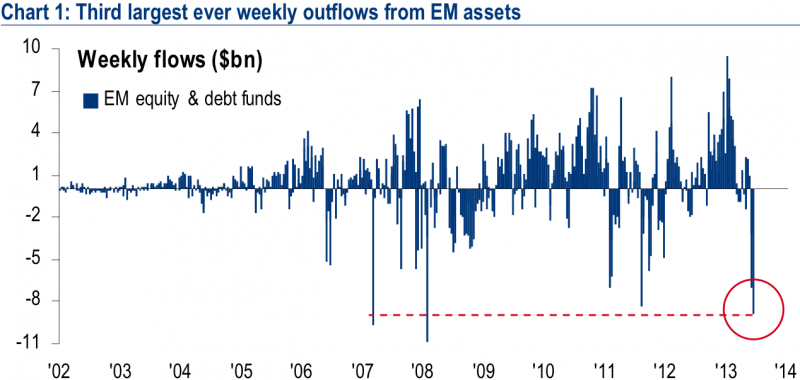
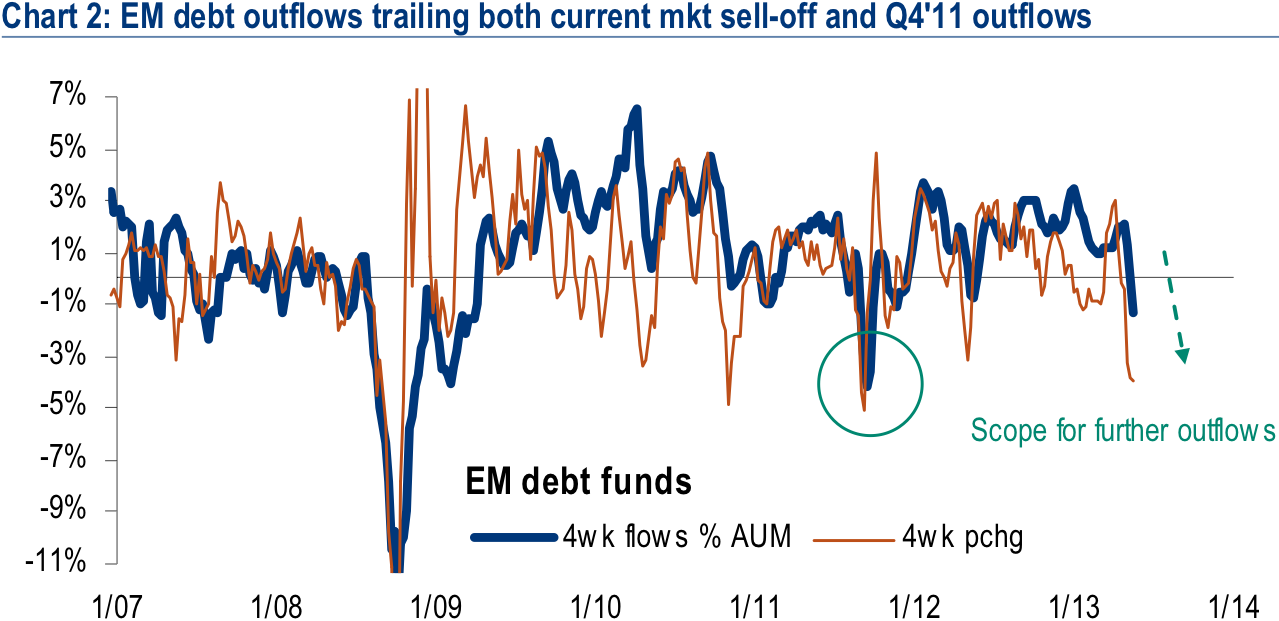
It was another insane week for asset managers. After huge redemptions from bond funds last week – during which investors pulled the most money in a single week from Treasury funds ever – the onslaught of outflows continues. In the week ended June 12, bond funds as a whole saw $14.5 billion in redemptions, the second-largest weekly outflow from the asset class ever – for the second straight week in a row. BofA Merrill Lynch Chief Investment Strategist Michael Hartnett calls it “bond fund carnage,” writing in a note to clients that a “record $27 billion in 2 weeks shows complete washout in fixed income.” Hartnett also flags an “exodus from [emerging markets] assets” – emerging market debt and equity funds saw $9 billion in redemptions, the third largest weekly outflow on record – and calls the $9 billion of redemptions across global equity funds this week “collateral damage … on big ‘risk-off’ trade.”

Read more of this post

The Mortgage Refinancing Boom Is Evaporating Before Our Eyes

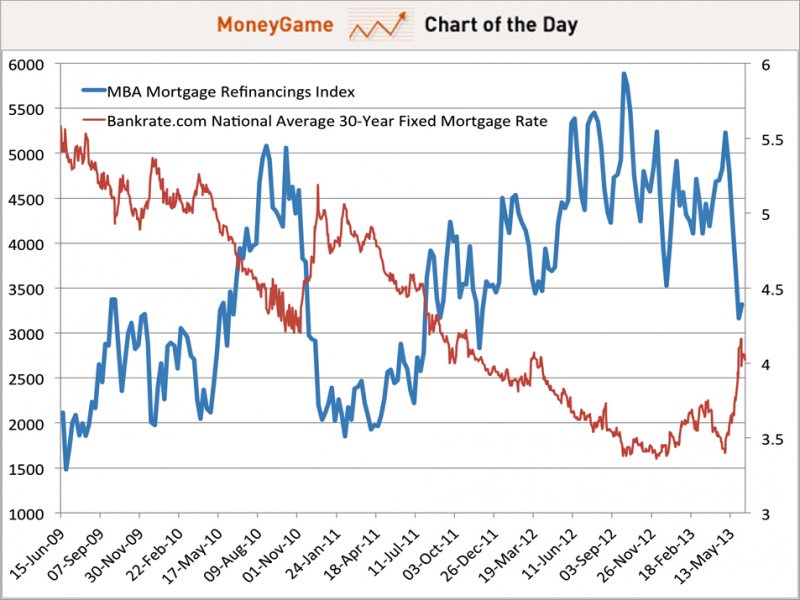
CHART OF THE DAY: The Mortgage Refinancing Boom Is Evaporating Before Our Eyes

MAMTA BADKAR AND MATTHEW BOESLER JUN. 14, 2013, 1:29 PM 2,548 2

cotd-9

Mortgage rates have been climbing for five straight weeks, and the latest data from the Mortgage Banker’s Association shows that the average 30-year fixed rate is now at 4.15%, up from 3.59% in the first week of May.

Meanwhile, the MBA’s refinancings index is down 36% from its peak at the beginning of May.

The rise in mortgage rates has been driven by concerns about when the Federal Reserve will begin to slow its $85-billion-a-month bond purchase program, which is designed to keep interest rates low. Those fears have sparked a sell-off in the Treasury market, which has caused yields on fixed income instruments of all shapes and sizes – including mortgages – to rise. Read more of this post

In Japan, Aversion to Mergers Runs Deep

June 14, 2013, 11:48 a.m. ET

In Japan, Aversion to Mergers Runs Deep

By ATSUKO FUKASE and MAYUMI NEGISHI

BF-AF162_JBLOAT_G_20130614173905

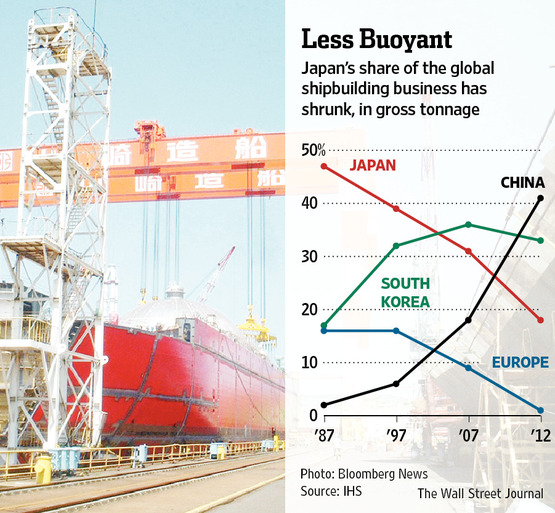
TOKYO—The Japanese government’s new “growth strategy” includes measures designed to encourage consolidation in manufacturing sectors notoriously overcrowded with inefficient companies averse to merging or combining overlapping production lines. A sign of the difficulties that lie ahead in promoting that reform came in the form of a 35-minute boardroom fight this week at Kawasaki Heavy Industries Ltd.,7012.TO +4.25% Japan’s second-largest heavy machinery maker. The battle ended with the ouster of the company’s president in order quash his plans to merge with rival Mitsui Engineering & Shipbuilding Co.7003.TO -5.52% Read more of this post

Stanley Druckenmiller On China’s Future And Investing In The New Normal

Stanley Druckenmiller On China’s Future And Investing In The New Normal

Tyler Durden on 06/14/2013 19:38 -0400

From Goldman Sachs

Stan Druckenmiller is Chairman and Chief Executive Officer of Duquesne Family Office. He founded Duquesne Capital Management in 1981, which he ran until he closed the firm in 2010. Previously, he was a Managing Director at Soros Fund Management, where he served as Lead Portfolio Manager of the Quantum Fund and Chief Investment Officer of Soros

Interview with Stan Druckenmiller

Hugo Scott-Gall: What are the risks of investing in China that are not well understood in your view? Read more of this post

Paulson Gold Fund Falls 13% In May, Down 54% In ’13

Paulson Gold Fund Falls 13% In May, Down 54% In ’13

Jun 11 2013 | 12:19pm ET

Earlier this month, Paulson & Co. said it would restrict the distribution of its Gold Fund’s performance—and for good reason. The $360 million fund—Paulson’s smallest—fell a further 13% in May. The fund, which manages primarily firm founder John Paulson’s own fortune, is down 54% this year. Despite the huge losses, which follow a 25% decline last year, New York-based Paulson urged investors to stick with the gold fund, noting that valuations offer “significant upside.” It added that it would not close the fund, which it has renamed the PFR Gold Funds, using the initials of Paulson and his gold specialists, Victor Flores and John Reade. Paulson has been a gold bug for years, arguing that inflation will soar when the Federal Reserve begins to cut back on its quantitative easing program. But the precious metal last month entered bear-market territory for the first time in a dozen years as the Fed’s bond-buying continues unabated. Paulson, which allows investors to buy gold-denominated shares of all of its funds, said earlier this month that it would stop reporting the gold funds’ results to all investors, complaining that their struggles were overshadowing strong returns by its other, larger products.

Obama’s Lost AAA Brings Falling Yields-to-Deficits on Downgrade

Obama’s Lost AAA Brings Falling Yields-to-Deficits on Downgrade

Ever since Standard & Poor’s stripped the U.S. of its AAA credit rating almost two years ago, the unemployment rate has fallen, household wealth has reached a record and the budget deficit is shrinking. More downgrades may be coming, anyway.

While S&P boosted its outlook for the U.S.’s AA+ grade earlier this week to “stable” from “negative,” Moody’s Investors Service said it’s awaiting lawmakers’ budget decisions this year as it weighs reducing America’s Aaa. Fitch Ratings, which has a “negative” outlook on the U.S., said in February that the debt trajectory isn’t consistent with a AAA borrower. Read more of this post

U.S. plastics from gas threaten European petchem industry

U.S. plastics from gas threaten European petchem industry

6:43am EDT

By Ludwig Burger

FRANKFURT (Reuters) – The oil-dependent European petrochemicals industry could be in for a body blow as U.S. rivals seek to get a wider range of raw materials out of cheap shale gas to make more plastics, coatings and adhesives.

U.S. players including Dow Chemical (DOW.N: Quote,Profile, Research, Stock Buzz) and Enterprise Products Partners (EPD.N: Quote, Profile, Research, Stock Buzz) are building facilities to convert gas into propylene, a key building block for advanced materials that has so far required the oil distillate naphtha as feedstock.

This could further squeeze margins and endanger jobs at European plants that convert naphtha into precursor chemicals ethylene and propylene, the backbone of the more than 130 billion euro ($167 billion) petrochemical industry in Europe. Read more of this post

Singapore most expensive Asian city for visitors

Singapore most expensive Asian city for visitors

English.news.cn   2013-06-14

SINGAPORE, June 14 (Xinhua) — A latest survey shows Singapore is the most expensive Asian city to spend a night, local daily Straits Times reported on Friday. An evening for two costs 495.79 Singapore dollars (396.63 U.S. dollars) in the city state, making it the world’s 14th most expensive city for visitors, according to the survey by travel website TripAdvisor. The survey, known as TripIndex Cities, was based on an overnight stay for two people that would include a return taxi trip, a night’s stay at a four-star hotel, a two-course dinner and cocktails. Some 49 cities were included in the list. Tokyo took the 15th spot globally, with an overnight stay costing travellers 495.64 Singapore dollars (396.51 U.S. dollars). Singapore was the 10th most expensive city worldwide, but remained the priciest Asian city this year. Oslo in Norway came out tops for the most expensive city, costing 717.41 Singapore dollars (573.93 U.S. dollars).

Value is Now Generated Pre-IPO; for companies going public before 2000, almost 75 percent of their eventual market value was realized in the public market, post-IPO; Who would have imagined that Splunk, which started out just analyzing log files, could be worth over $4 billion?

The Right Now Economy: The Next Wave of Startup Success

Mark Siegel6/12/13Follow @msiegel11

[Editor’s Note: Mark Siegel, managing director at Menlo Ventures, was the keynote speaker at IBF’sVenture Capital Investing Conference today in San Francisco. The post below summarizes his talk, in which he argued that the convergence of mobility, cloud infrastructure, social and big data—what he calls the Right Now Economy—sets the stage for $500 billion in venture returns over the next decade.]

Every technology cycle is driven by a huge disruptive new trend in innovation, such as the PC, the Internet/telecom boom, or the rise of social networking. We’re in the midst of the latest cycle, and it’s particularly compelling because it marks the convergence of four important trends: mobile, social, cloud infrastructure and Big Data.

These technological mega-trends have converged to create the real-time marketplaces of the Right Now Economy, which are already disrupting trillions of dollars in aggregate market value and have produced an incredibly fertile area for entrepreneurs to grow ideas into well-funded companies with the potential to take on established stalwarts. Read more of this post

China braces for capital flight and debt stress as Fed tightens; There have been signs of serious stress in China’s interbank lending markets, with short-term SHIBOR rates spiking violently. Bank Everbright missed an interbank payment last week in a technical default

China braces for capital flight and debt stress as Fed tightens

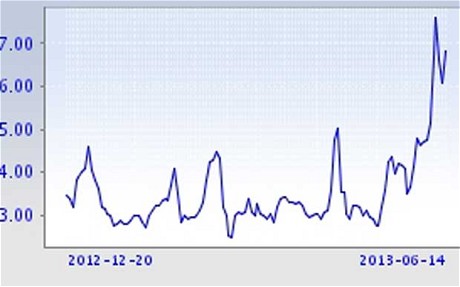
China appears increasingly worried that monetary tightening by the US Federal Reserve could trigger capital flight from the People’s Republic and set off a Chinese corporate debt crisis.

There have been signs of serious stress in China’s interbank lending markets, with short-term SHIBOR rates spiking violently. Photo: Alamy

By Ambrose Evans-Pritchard

1:50PM BST 14 Jun 2013

shiboroneweek_cut_2590358c

A front-page editorial on Friday in China Securities Journal – an arm of the regulatory authorities – warned that capital inflows have slowed sharply and may have begun to reverse as investors grow wary of emerging markets. “China will face large-scale capital outflows if there is an exit from quantitative easing and the dollar strengthens.” it wrote. The journal said foreign exodus from Chinese equity funds were the highest since early 2008 in the week up to June 5, and the withdrawal Hong Kong funds were the most in a decade.

Read more of this post

China estimates fake trade invoicing at S$94 billion in Jan-April

China estimates fake trade invoicing at S$94 billion in Jan-April

SHANGHAI – Fake invoicing inflated China’s official import and export totals by US$75 billion (S$94 billion) in the first four months of this year, local media reported on Friday, citing an internal review by China’s commerce ministry.

BY –

1 HOUR 5 MIN AGO

SHANGHAI – Fake invoicing inflated China’s official import and export totals by US$75 billion (S$94 billion) in the first four months of this year, local media reported on Friday, citing an internal review by China’s commerce ministry.

An alternate estimate found that actual year-on-year export growth for January to April was only about 7 per cent, while import growth was about 6 per cent, the 21st Century Business Herald reported, citing an unidentified source and an internal commerce ministry document.

The second estimate was based on excluding data from the port of Shenzhen, where much of the fraud is suspected to have occurred. Read more of this post

India is Asia’s weakest link in QE-driven rout

India is Asia’s weakest link in QE-driven rout

Thu, Jun 13 2013

By Vidya Ranganathan

SINGAPORE (Reuters) – India is emerging Asia’s canary in the ‘hot money’ mine.

As financial markets sell off on concerns over rising U.S. rates, what happens in India, an economy with slowing growth and a heavy dependence on foreign money, could well determine if this is merely a short-term rout or a full-blown crisis.

India’s rupee currency has weakened the most among emerging markets after the South African rand since May as investors flee assets most vulnerable to the end of super-loose U.S. monetary policy. Read more of this post

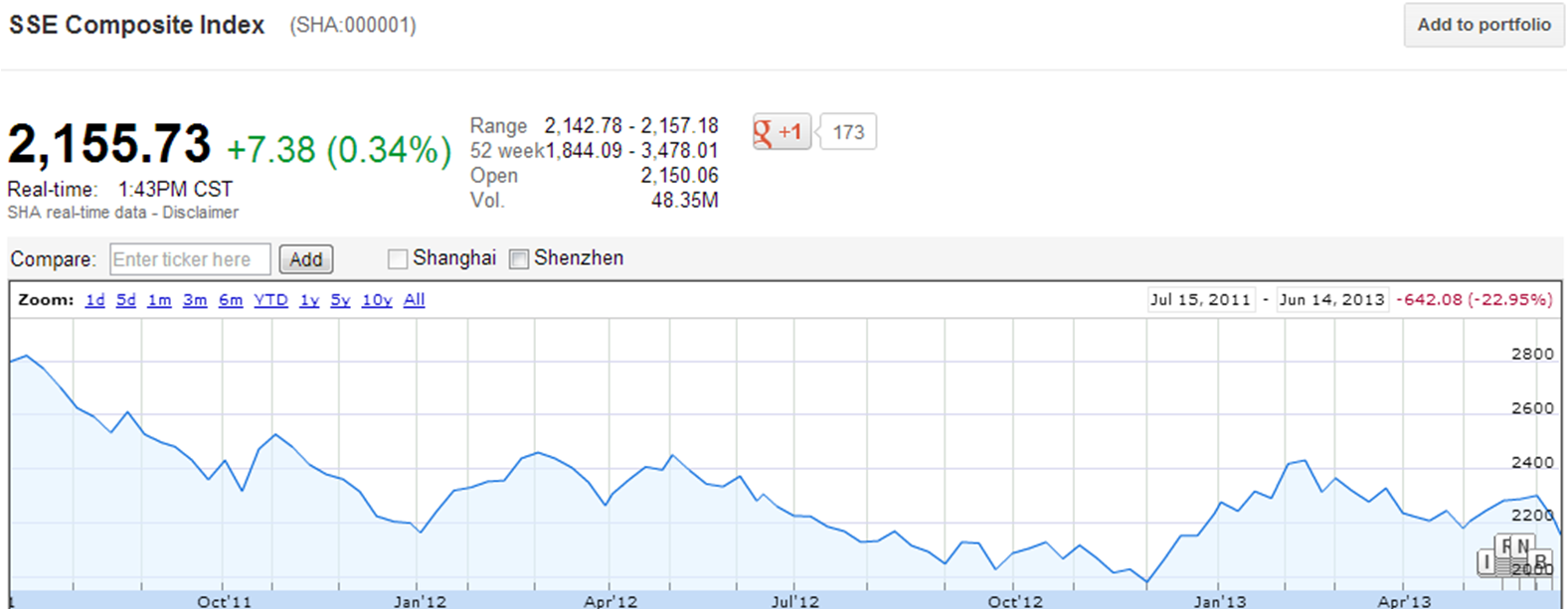
China Debt Sale Fails for First Time in 23 Months on Cash Crunch; The ministry’s last failed auction was in July 2011 and Shanghai index was down 23% subsequently

China Debt Sale Fails for First Time in 23 Months on Cash Crunch

SSE

China’s Finance Ministry failed to sell all of the debt offered at an auction for the first time in 23 months owing to a cash squeeze, according to two traders at finance companies that participate in the sales.

The ministry sold 9.53 billion yuan ($1.55 billion) of 273-day bills, less than the 15 billion yuan target, they said. Agricultural Development Bank of China Co. raised 11.51 billion yuan in a sale of six-month bills last week, less than its 20 billion yuan goal. The seven-day repurchase rate, which measures interbank funding availability, has more than doubled in the past month as banks hoard cash to meet quarter-end capital requirements and capital inflows ease.

“The cash crunch is curbing demand for bonds,” said Chen Ying, a fixed-income analyst at Sealand Securities Co. in Shenzhen. “The crunch may persist if the central bank doesn’t come out to inject more capital into the financial system. If it lasts longer, it may affect issuance of both government and corporate bonds.” Read more of this post

Stock Rout Threatens $10 Billion Asia IPOs as Suntory Nears

Stock Rout Threatens $10 Billion Asia IPOs as Suntory Nears

Slumping stock markets are threatening to disrupt as much as $10 billion of initial public offerings across Asia, as companies from Suntory Holdings Ltd. to Macau Legend Development Ltd. (1680) prepare listings.

Companies are gauging demand or taking orders for as much as $2.5 billion of IPOs in Southeast Asia and $2.3 billion of deals in Hong Kong, according to data compiled by Bloomberg. Suntory is seeking to raise as much as $4.7 billion this month in Japan’s largest first-time share sale since September.

With Asia’s benchmark stock index wiping out the year’s gains, some companies marketing IPOs may be forced to accept lower valuations or delay listings. Hopewell Hong Kong Properties Ltd. scrapped a $780 million offering in the city yesterday while China Harmony Auto Holding Ltd. plunged 16 percent (3836) in the worst Hong Kong debut since February 2012. Read more of this post