China’s proposed ban on the import of low-grade coal is likely to hit small Indonesian producers hard; Indonesia is the world’s biggest exporter of coal for power stations and as much as a third of its exports to China could be blocked if the plan is implemented as currently suggested

June 12, 2013 2:04 pm

Small Indonesian coal miners to be hit by China import ban

By Ben Bland in Jakarta

China’s proposed ban on the import of low-grade coal is likely to hit small Indonesian producers hard but most large miners will only suffer a minimal impact, according to analysts and industry executives.

Indonesia is the world’s biggest exporter of coal for power stations and as much as a third of its exports to China could be blocked if the plan is implemented as currently suggested. Read more of this post

Private investors to be forced to pay for Japan’s bank failures

Last updated: June 12, 2013 10:52 am

Private investors to be forced to pay for Japan’s bank failures

By Ben McLannahan in Tokyo

Japan is to force losses on investors in troubled banks, brokers and insurers, leading efforts by regulators around the world to lighten the burden on taxpayers.

Under new legislation cleared by Japan’s parliament on Tuesday, holders of new types of preferred shares or subordinated bonds will face losses, or mandatory conversion to common stock, if the Financial Services Agency deems the issuer insolvent.

The FSA will gain its powers to trigger so-called “bail-in” clauses on these instruments – which are compliant with new Basel III rules on bank capital – as early as next spring, assuming that the bill becomes law. Read more of this post

The day the central banks lost control

June 12, 2013 4:13 pm

Markets Insight: Central bank loss of control leads to EM tumble

By Ralph Atkins in London

Fears of stimulus withdrawal trigger rising bond yields but central banks could change tactics, Ralph Atkins

Tear gas and riot police fill Istanbul’s Taksim Square. Investors fret about the growth outlook in India and China. But these were not the main factors behindsharp falls this week in emerging economies’ bond prices, and corresponding rises in yields. Read more of this post

Brainpower alone cannot save India’s growth model; The problems at Infosys raise questions about its role at a national level

June 12, 2013 4:59 pm

Brainpower alone cannot save India’s growth model

By David Pilling

The problems at Infosys raise questions about its role at a national level

For Infosys, a pioneer of India’s outsourcing revolution, the world used to be flat. Now it is looking more pear-shaped.

It was Nandan Nilekani, a co-founder of Infosys, who first put the idea in Thomas Friedman’s head that the world was flattening. Mr Friedman, who was wowed by the oasis of calm and sophistication he found at the company’s shiny Bangalore campus, recalls Mr Nilekani telling him: “Tom, the playing field is being levelled.”

That led him to think about how technology was rendering distance and borders increasingly irrelevant, and accelerating the process by which hundreds of millions of people in emerging countries were pressing into the global workforce. Read more of this post

Nostalgia Swells for Mandela Era; As Markets Fall, South Africans Lament Nation’s Dimmed Prospects

Updated June 12, 2013, 7:46 p.m. ET

Nostalgia Swells for Mandela Era

As Markets Fall, South Africans Lament Nation’s Dimmed Prospects; Statesman Responds to Treatment

By PATRICK MCGROARTY, DEVON MAYLIE and PETER WONACOTT

WO-AO138_MANDEL_G_20130612181507

JOHANNESBURG—With their former president in the hospital and their nation’s economic promise unfulfilled, South Africans are suffering from a powerful moment of Nelson Mandela nostalgia.

On Wednesday, President Jacob Zuma elicited rare across-the-aisle cheers from parliament when he said the 94-year-old statesman was responding to treatment after five days in a Pretoria hospital for a lung infection. “We are very happy with the progress that he is now making following a difficult few days,” Mr. Zuma said in Cape Town.

Mr. Zuma’s comments lightened what has been a hard week for South Africa. On Tuesday—amid both the latest news of Mr. Mandela’s failing health and declines in emerging-market assets across the globe—South Africa’s rand fell to a four-year low against the dollar. The Johannesburg Stock Exchange posted its steepest one-day drop in 20 months. Read more of this post

In Southeast Asia, the Web Gets Tangled Amid Dissent

Updated June 12, 2013, 8:42 p.m. ET

In Southeast Asia, the Web Gets Tangled Amid Dissent

By CHUN HAN WONG

WO-AO149_ASIAWE_G_20130612185114

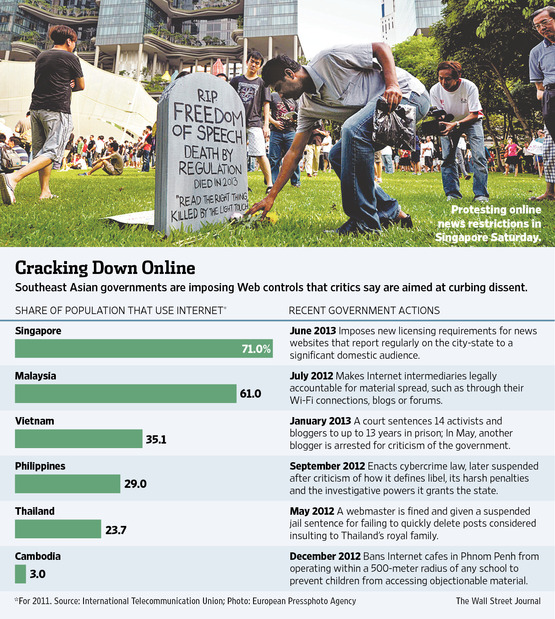
Southeast Asian governments are reaching for new legal tools and raw state powers as the Internet increasingly enables younger citizens to criticize their long-serving political leaders.

Not all these countries are as effective as China and its famed “Great Firewall,” which filters everything from microblog posts to ordinary Internet searches. But the speed with which countries such as Singapore, Malaysia, Cambodia and Vietnam are moving to impose Web controls is worrying human-rights advocates, who fear further curbs on Internet freedoms could suppress free speech and strip these economies of their vitality. Read more of this post

Cosco Highlights Doubts Over China Deals; why investors in Hong Kong-listed units of Chinese state giants are sometimes concerned that the interests of the parent companies come first in asset sales

Jun 12, 2013

Cosco Highlights Doubts Over China Deals

By Joanne Chiu

AM-AY953_AMONEY_NS_20130612130603

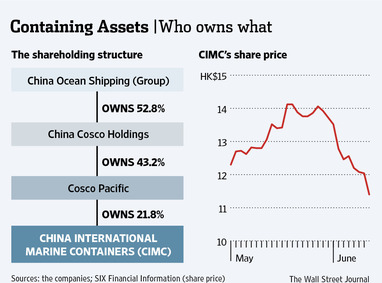
Cosco Pacific Ltd. 1199.HK -3.49%’s plan to sell its stake in a container maker back to its parent sheds light on why investors in Hong Kong-listed units of Chinese state giants are sometimes concerned that the interests of the parent companies come first in asset sales.

On Thursday, shareholders of the port operator will vote on a plan to sell its 21.8% stake in China International Marine Containers 000039.SZ -3.29%(Group) Co. to its ultimate parent: state-controlled China Ocean Shipping (Group) Co., or Cosco Group. CIMC has been hurt by the rout in trade since the financial crisis, but is still the world’s largest container maker and accounts for almost a fifth of Hong Kong-listed Cosco Pacific’s earnings. Read more of this post

Bank Indonesia raised its benchmark interest rate by a quarter of a percentage point to 6%, the second time in two days the central bank has surprised market participants

June 13, 2013, 3:36 a.m. ET

Bank Indonesia Raises Benchmark Rate Again

By FARIDA HUSNA And I MADE SENTANA

AI-CB567_INDORA_NS_20130613042103

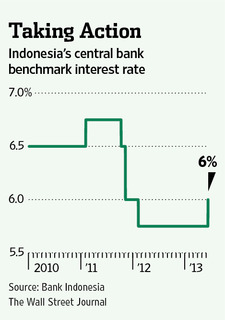
JAKARTA—Bank Indonesia raised its benchmark interest rate by a quarter of a percentage point to 6%, as it works to rein in inflation expectations and support a weakening rupiah following recent outflows.

It is the second time in two days the central bank has surprised market participants as it is widely perceived to be dovish, after having kept the benchmark rate at a historic low since February 2012.

Late Tuesday, the bank raised its overnight deposit rate by 0.25 percentage point to 4.25%, effective Wednesday, to improve sentiment toward the rupiah. The currency has fallen against the U.S. dollar to its lowest since 2009 as foreign investors pulled money from emerging markets, and as domestic investment decisions are influenced by the prospect of slowing growth. Read more of this post

Debt Makes Comeback In Buyouts

Updated June 12, 2013, 6:45 p.m. ET

Debt Makes Comeback In Buyouts

By MATT WIRZ

MI-BW555_EQUITY_NS_20130612183911

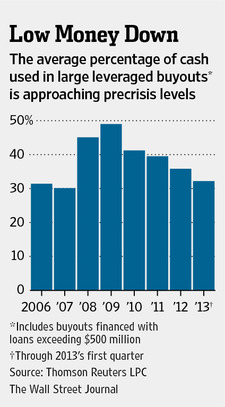
Shareholders in BMC Software Inc. BMC -0.18% will receive $6.9 billion to sell the corporate-software developer to a group of private-equity firms. But the buyers, led by Bain Capital LLC and Golden Gate Capital, only intend to pay $1.25 billion in cash out of their own pockets. The rest will come from debt raised by BMC to finance its takeover.

The little-noticed acquisition is another milestone in the return of cheap debt and higher-risk deals to Wall Street: The cash put down by BMC’s private-equity buyers is the lowest as a percentage of the purchase price of any buyout with loans exceeding $500 million since 2008, according to data-provider Thomson Reuters LPC. Read more of this post

Madoff Evoked in N.Z. as Ponzi Scheme Loses $317 Million

Madoff Evoked in N.Z. as Ponzi Scheme Loses $317 Million

New Zealand charged a 63-year-old financial adviser with running the biggest Ponzi scheme ever alleged in the South Pacific nation.

The Serious Fraud Office and Financial Markets Authority allege David Ross defrauded investors of about NZ$400 million ($317 million) through his closely-held Ross Asset Management Ltd., which collapsed in November last year. He will face four charges of false accounting and one of theft in the Wellington District Court, the agencies said in a joint statement today.

“It’s yet to be seen if he’s New Zealand’s Bernie Madoff, but the amounts were high by New Zealand standards and hurt a lot of people,” said Wellington barrister Kevin Sullivan. Read more of this post

Danger Maps Backed by Alibaba Pinpoint Chinese Pollution; “Real-estate agents and websites who want to boost transactions won’t tell you this kind of information”

Danger Maps Backed by Alibaba Pinpoint Chinese Pollution

As pollution concerns rise in China, Liu Chunlei is boosting environmental awareness among the nation’s 564 million Internet users with help from the charitable arm of Alibaba Group Holding Ltd (ALIBABZ).

Danger Maps, a website Liu started last year, allows people to look up sites such as toxic-waste treatment facilities, oil refineries and power plants. Liu has plotted about 6,000 pollution sources based on government data and user input on Baidu Map, China’s equivalent of Google Maps.“Real-estate agents and websites who want to boost transactions won’t tell you this kind of information,” said Liu, 35, who created Danger Maps after learning that the Shanghai apartment he bought in 2007 was near a landfill — something he wasn’t informed of when negotiating the purchase. Read more of this post

Hong Kong Chief Executive Pledges Property Curbs to Stay; “This is not the time to relent.”

Hong Kong Chief Executive Pledges Property Curbs to Stay

Hong Kong, the world’s most expensive home market, will not ease its real-estate curbs until there’s a steady supply of new properties as the government seeks to address concerns that it favors developers.

Earlier actions have brought down prices and rents, and the government can do more if needed, Chief Executive Leung Chun-ying, 58, said in an interview in New York.

“There’s a voice out there in the Hong Kong community that the government should ease off,” the former property surveyor said yesterday. “This is not the time to relent.” Read more of this post

Emerging-Market Bond Anxieties Surging by Most Since 2008

Emerging-Market Bond Anxieties Surging by Most Since 2008

The biggest drop in perceived creditworthiness for emerging-market borrowers since the credit crisis is deepening as speculation intensifies that central banks will scale back record stimulus.

Prices on the Markit CDX Emerging Markets index, a credit-default swaps benchmark for debtor nations from Latin America to the Middle East and Asia, have tumbled 4 cents in the two weeks through yesterday to 107 cents on the dollar. The decline is the biggest since the failure of Lehman Brothers Holdings Inc. reverberated across financial markets and caused the index to plunge 6.7 cents in the period ended Nov. 18, 2008. Read more of this post

Indonesia’s Delayed Fuel Decision Haunts Rupiah: Southeast Asia

Indonesia’s Delayed Fuel Decision Haunts Rupiah: Southeast Asia

Indonesia’s government needs to rein in fuel subsidies that have spurred a current-account deficit to support efforts by the central bank to stabilize the weakening rupiah, economists say.

Rupiah forwards rose the most in a year yesterday after Bank Indonesia increased the rate it pays lenders on overnight deposits and said it was ready to buy government debt in the secondary market to maintain monetary stability. Still, the spot rate weakened 0.3 percent to 9,860 a dollar, the most since May 16, according to prices from local banks compiled by Bloomberg. Read more of this post

Emerging markets at risk when loose policies end: World Bank

Emerging markets at risk when loose policies end: World Bank

8:53pm EDT

WASHINGTON (Reuters) – The World Bank said eventual monetary tightening in advanced economies could crimp growth in emerging markets as interest rates rise, lowering the nations’ potential output by as much as 12 percent.

That long-term risk is likely greater than the short-term impact from volatility in emerging market currency and bond markets, as traders try to position themselves for when the U.S. Federal Reserve begins its exit from ultra-loose monetary policies, said Kaushik Basu, the World Bank’s chief economist. Read more of this post

After emerging corporate bond boom, default risks on rise

After emerging corporate bond boom, default risks on rise

12:49pm EDT

By Sujata Rao

LONDON (Reuters) – The $1 trillion market in emerging corporate bonds could be headed for a surge in defaults if company earnings in swiftly depreciating roubles or pesos fail to keep pace with dollar-based debt repayments. As the U.S. Federal Reserve considers when to turn off its printing presses, emerging currencies have crashed to multi-year lows against the dollar. That rout is a big risk for corporate debt, which has gone from being a sideshow of the sovereign bond market to an asset class that surpasses U.S. junk debt in size. As past decades show, a surging dollar can make trouble for emerging markets, rapidly pushing up debt service costs. Read more of this post

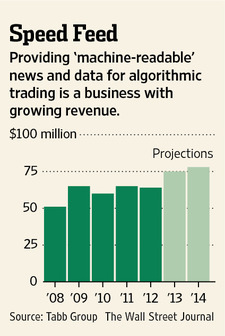
Traders Pay for an Early Peek at Key Data

June 12, 2013, 8:28 p.m. ET

Traders Pay for an Early Peek at Key Data

By BRODY MULLINS, MICHAEL ROTHFELD,TOM MCGINTY and JENNY STRASBURG

P1-BL868_INDICA_NS_20130612190005

On the morning of March 15, stocks stumbled on news that a key reading of consumer confidence was unexpectedly low.

One group of investors already knew that. They got the University of Michigan’s consumer report two seconds before everyone else.

Infinium Capital Management, a high-speed trading firm in Chicago, used the information to launch a wave of trading in futures contracts, in just one example of the activity that followed. In a single second, according to a Wall Street Journal analysis, traders from various firms bet nearly seven million shares that equity markets would decline—which was exactly what happened when news of the survey became widely known. Read more of this post

What’s Behind Shift in Global Markets: The tectonic plates of the world economy are shifting, raising the question of whether markets are experiencing a bumpy return to a new normal or new period of volatility

Updated June 11, 2013, 7:41 p.m. ET

Global Tumult Grips Markets

Question for Investors: Bumpy Return to Normal or New Volatility as Central Banks Step Back?

By DAVID WESSEL

P1-BL853_TURMOI_G_20130611182709 NA-BW768A_TURMO_G_20130611191507

The tectonic plates of the world economy are shifting, moving the yield on the 10-year Treasury to the highest level in more than a year and shaking financial markets from Tokyo to Mumbai and Johannesburg to São Paulo. For the past few years, the global economy, struggling to recover from a financial crisis, has relied on a few constants: The U.S. would print plenty of money and keep interest rates very low. China would provide a lot of demand and vacuum up commodities from around the world. And Japan was largely irrelevant. Suddenly, all three of those are being questioned in markets, triggering paroxysms in stocks, bonds, commodities and—particularly, in the past couple days—the currencies of emerging markets. The big questions hanging over markets and the global economy now: Is this is the inevitably bumpy beginning of a welcome return to normal—a world in which the U.S. economy doesn’t need big and repeated doses of monetary stimulus, Japan grows again and China’s economy gently slows to a sustainable speed? Or is it a harbinger of more volatility in financial markets—perhaps the result of a misreading of the Federal Reserve’s policy intentions by the markets or a premature move by the Fed to cut back on easy money—that yields an unwelcome increase in market interest rates before the U.S. economy achieves what Fed Chairman Ben Bernanke once called “escape velocity”? Read more of this post

Export slowdown threatens emerging Asia’s credit-fuelled boom

Export slowdown threatens emerging Asia’s credit-fuelled boom

6:20am EDT

By Stuart Grudgings

KUALA LUMPUR (Reuters) – A deepening slump in exports is sending tremors through Asia, threatening to undermine some booming emerging economies that have surged ahead in recent years on a heady combination of easy credit, buoyant consumer demand and strong domestic investment.

Export growth throughout Asia has sagged in recent months, hit by slackening demand from the United States, Europe and China and by slumping commodity prices. Leading indicators are also pointing to weaker factory activity in the coming months.

The slowdown is being felt most keenly by Southeast Asian countries whose strong domestic economies are sucking in imports more rapidly and which now face sharp deteriorations in their trade balances that could spook investors. Read more of this post

Japan grapples with lack of entrepreneurs; “Too few companies get started and too many unprofitable companies are staying in business. We need to increase Japan’s metabolism.”

June 12, 2013 5:43 am

Japan grapples with lack of entrepreneurs

By Ben McLannahan in Tokyo

All Hiromi Yamaguchi wanted to do was to sell coffee to pinball addicts. But to get his business up and running he had to convince the health ministry that pushing carts around pachinko parlours would not violate hygiene laws. The former Daiwa Securities employee then spent more than a year persuading a prefectural police chief that serving hot drinks from a trolley was not a gateway to hard liquor and mob violence. Only then could Mr Yamaguchi build a business that has morphed into JP-Holdings, Japan’s largest private provider of childcare centres and a stock market darling. “I was told I was very persistent,” chuckles Mr Yamaguchi, 52, now president. Read more of this post

China Plans Soil Survey to Map Pollution Levels Across the Country After Toxic Cadmium Rice Scare

June 12, 2013, 1:02 p.m. ET

China Plans Soil Survey After Rice Scare

By BRIAN SPEGELE

BEIJING—China said it will conduct nationwide sampling of soil in order to map pollution levels across the country following recent revelations that portions of the country’s rice supply were tainted with the toxic metal cadmium.

The official Xinhua news agency, citing China’s Ministry of Land and Resources, said late Wednesday that the government would conduct the survey, though it wasn’t clear when or whether results would be released to the public. Read more of this post

Singapore Bonds Decline to Become Second-Worst Debt Market in the World

Singapore Bonds Decline to Become Second-Worst Debt Market

By Kenneth Foo – Jun 12, 2013

Singapore bonds fell for a fourth day, making their loss for the past three months the second-biggest in the world, as investors gird for the possibility that the U.S. Federal Reserve could slow bond purchases. The price of Singapore’s 3.125 percent note due in September 2022 tumbled to S$107.30 as of 3:27 p.m. local time from S$108.24 yesterday, based on data compiled by Bloomberg and the Monetary Authority of Singapore. The yield rose 10 basis points, or 0.1 percentage point, to 2.24 percent, a level not seen since July 2011. “The only reason for this is the speculation of Fed tapering,” said Michael Wan, an economist at Credit Suisse Group AG in Singapore. “There’s pretty much a sell-off across all countries and markets.” The Bloomberg Singapore Sovereign Bond Index (BSIN) has declined 2.4 percent over three months. The only other sovereign index among 33 tracked by Bloomberg that fell more was Slovenia’s with a 4.3 percent decline. The Bloomberg U.S. Treasury Bond Index fell 0.2 percent. The Fed buys $85 billion of Treasuries and mortgage-backed securities each month to support the economy by putting downward pressure on borrowing costs. It will probably reduce its purchases to $65 billion a month at its Oct. 29-30 meeting, according to the median estimate in a Bloomberg survey of 59 economists last week. To contact the reporter on this story: Kenneth Foo in Singapore at kfoo23@bloomberg.net

Asia’s ticking time bonds; Time to cut and run?

Asia’s ticking time bonds; Time to cut and run?

1:28am EDT

By Saikat Chatterjee and Umesh Desai

HONG KONG (Reuters) – Efforts to make the global financial system safer could be making Asia more – not less – vulnerable to any credit market shocks, leaving bond traders worried that a sharp selloff since late May could turn into a rout. Low global interest rates have made it easier than ever to sell new bonds denominated in dollars, euros or yen, resulting in a boom in issuance that has made Asia and its companies ever more dependent on debt. But the market for trading those bonds is slowly drying up, leaving it susceptible to a sharper selloff if holders of these so-called G3 bonds decide it is time to head for the exit. “The issue is that if any of them choose to sell their holdings, the market may not have the capacity to absorb these flows. If we reach a stage like that then liquidity could dry up very quickly and that can have a spiraling effect,” said Dhimant Shah, a fund manager at Mackenzie Investments in Singapore. Read more of this post

A business owner fleeing 800 million yuan in debt from China’s Jiangsu highlights financial transparency issues the city is having

Company Head Flees 800 Million Yuan Debt – Economic Observer Online 

By Jing Tian (景天)
Issue 623, June 10, 2013

Xu Cailiang (许才良), owner of Rong Tai Oil Technology Ltd. (融泰石油科技股份有限公司), fled to the U.S. last month leaving behind 800 million yuan in debt. A source at the local financing office said that the company was founded in 2007 in Jiangyin (江阴), Jiangsu and has been losing money ever since. It’s been able to receive loans from banks because of its close relationship with Jiangyin City Construction and Comprehensive Development Ltd. (江阴市城镇建设综合开发有限公司), also known as City Constriction. “The owner of Rong Tai and the owner of City Constriction are the same person: Xu Cailiang,” the source said. The state-run City Construction was founded in 1984 and Xu became its CEO in 1998. Then in 2007, he bought it for 20 million yuan in cash and became the company’s sole shareholder. Xu was also a supervisor in Jiangyin Agricultural Bank, one of Rong Tai’s investors. City Construction provided 470 million yuan to Rong Tai as a loan guarantee on top of a 3.2 million yuan deposit and a mortgage guarantee allegedly worth 763 million yuan. However, according to a source in a local bank, the mortgage written in the loan application was much higher than the actual value. Two similar cases have happened in Jiangyin within the past six months. A local official said that the economic environment of Jiangsu is much less transparent than that of its neighbor, Zhejiang, making problems like these less likely to be discovered before it’s too late. Jiangyin, a town with 34 public corporations, has been held up as a model for economic development in recent years. However, it’s likely that the city’s economy isn’t as healthy as it appears on the surface.

China microlenders get death threats as they try to recover bad loans; “Some of the borrowers are steel traders, toy makers, or plain loan sharks. Everything is fine when the economy grows robustly and liquidity is plentiful.”

China microlenders get death threats as they try to recover bad loans

Saturday, 08 June, 2013, 12:00am

Jane Cai in Beijing xuejun.cai@scmp.com

Threatening messages are routine for Miao Qiang these days.

“A killer from Beijing will take your life if you don’t withdraw the lawsuit,” a message on his mobile phone reads.

Miao, co-owner of a microcredit company in Jiangsu province, laughs helplessly. He has brought a dozen companies and individuals to court since the beginning of the year as loan defaults surged. But little of the money has been collected. Read more of this post

If you can’t buy them, bankrupt them; Private Equity Capitalizes on Chinese Firms’ Depressed Shares

JUNE 11, 2013, 9:10 AM

Private Equity Capitalizes on Chinese Firms’ Depressed Shares

By NEIL GOUGH

HONG KONG – If you can’t buy them, bankrupt them.

Three months ago, Ambow Education Holding, a troubled operator of tutoring centers in China that was listed on the New York Stock Exchange, was the target of a $108 million privatization bid by Baring Private Equity Asia.

On Monday, Baring emerged as one of several big shareholders that had succeeded in pushing Ambow into provisional liquidation by a court in the Cayman Islands, where the company is registered, after a dispute with management over an investigation into possible financial misconduct. Read more of this post

India’s Small-Change Problem; Ever been given a candy instead of a rupee for change? Here’s why.

June 12, 2013, 11:02 AM

India’s Small-Change Problem

Top of Form

By Anant Vijay Kala

If you’ve shopped in India you likely know the problem. You go to a store to buy a few things and when it’s time to pay, you hand over the cash. But the cashier’s run out of change. Instead of the few rupees you’re owed, the cashier gives you one or two candies, or a stick of chewing gum, to make up the shortfall. You want those coins, the exchange doesn’t feel quite fair – and it’s bad for your teeth – but you’re reluctant to make a fuss. And so you walk out, feeling a little short-changed. If this chimes with you, then you’re not alone. A survey conducted in 2012 by the Reserve Bank of India, in response to complaints from the public, found that 44% of people in 12 Indian cities had the same experience; candies instead of coins for change. Read more of this post

Becoming ‘Asia Literate’: Learn Chinese, but Don’t Stop There

JUNE 11, 2013, 2:20 AM

Becoming ‘Asia Literate’: Learn Chinese, but Don’t Stop There

By SUE-LIN WONG

BEIJING — While studying abroad at Peking University in Beijing, Andrew Stead didn’t expect to find a job at Burton, one of the top snow boarding brands in the world.

“In my spare time on exchange, I would go skateboarding around Beijing with friends, including one who worked at Burton. A few months later, I was offered a job at their Beijing office because of my interest in snowboarding and China,” said Mr. Stead, 23, who is majoring in engineering and finance and speaks solid Chinese. He plans to return to Beijing after he graduates soon from an Australian university.

Governments are increasingly recognizing the opportunities that exist for people like Mr. Stead who are able to marry technical skills or hobbies with “Asian literacy.” Also called “global competence,” it represents an understanding of other cultures and languages; but China isn’t the only nation in Asia and people should also be looking more broadly, to Japan, India and Indonesia, to name just three other places, according to some experts. Read more of this post

China Audit Office Shines Light On Local Government Debt

June 11, 2013, 5:56 PM

Audit Office Shines Light On Local Government Debt

In recent years, China’s local governments have borrowed trillions of yuan from banks, the bond market andshadow lenders in order to build infrastructure, housing, and improve government services. That spending has helped prop up economic growth, but little is known about the quality of debt and the local governments’ ability to repay it.

On Monday, the National Audit Office of the People’s Republic of China posted on its website the highlights of an audit into the debt holdings of 36 local governments at the end of 2012, providing rare insight into one of the greater challenges facing China’s financial system. Read more of this post

Norway’s biggest bank is warning investors not to underestimate the risks lurking in Scandinavia’s largest junk bond market

Bankers Spot Cracks in Norway High Risk Bond Boom: Nordic Credit

Norway’s biggest bank is warning investors not to underestimate the risks lurking in Scandinavia’s largest junk bond market.

Magnus Piene, DNB ASA (DNB)’s global head of offshore, says surplus liquidity flowing into Western Europe’s biggest oil producer may lead to a repeat of the spate of defaults Norway saw at the height of the financial crisis in 2009.

“I see early signs of this coming up again and it’s merely a function of excess liquidity,” Piene said in an interview in Oslo. “Instead of putting money into a bank with poor-yielding deposits, you put them into these high risk projects that you may consider low risk — wrongly in some cases, I would say. All that liquidity is pushing people to do things they shouldn’t be doing.” Read more of this post