Crazy Eddie fraudster says SEC can’t keep up; Corporate audits don’t work, give investors false sense of security

June 7, 2013, 6:01 a.m. EDT

Crazy Eddie fraudster says SEC can’t keep up

Corporate audits don’t work, give investors false sense of security

By Ronald D. Orol, MarketWatch

WASHINGTON (MarketWatch) — Securities regulators are overwhelmed by the volume of fraud and insider-trading violations and don’t have the resources to pursue criminals effectively.

MW-BC651_Sam_An_20130513120933_MG

Former Crazy Eddie CFO Sam Antar.

So says Sam Antar, a felon and former chief financial officer of Crazy Eddie Inc., a well-known criminal enterprise from the 1980s that cost many people their life savings and was even featured on “Saturday Night Live.”

Antar, 56, now teaches FBI agents and Justice Department officials about white-collar crime and how to spot it. He spoke to MarketWatch about the economics of white-collar crime; why he thinks “audit” is a fraudulent term; and why short sellers, along with well-compensated whistleblowers, are best at ferreting out fraud.

Here’s what he had to say:

MarketWatch: You were the CFO of Crazy Eddie, a criminal enterprise passing itself off as a New York electronics retailer in the 1980s. Can you tell me about It?

Sam Antar: It was an 18-year fraud with two parts. As a private company we understated income by skimming money to steal the sales tax and evade income taxes. As a public company we did the opposite: We overstated our income to sell stock at inflated prices. The reason you do that is because as a public company you get a bigger bang for the buck by overstating income and overstating your taxes than understating income and understating taxes. That’s because as a private company you are not trading stock. As a public company your stock trades at a multiple of earnings. Let’s say I understate income by a million dollars, I may save $400,000 in taxes. But if I overstate my income by the same million dollars and overpay taxes by $400,000; that $600,000 in overstated net income, if the stock is trading at 30 times earnings, increases the value of the company by $18 million. It is the economics of white-collar crime: Overpaying taxes and overstating income is better as a public company.

MW: As CFO of Crazy Eddie, you were involved in a lot of the accounting fraud. Do you think auditors are equipped to find fraud?

S.A.: I do not believe that most auditors are adequately trained to find fraud and do battle with fraudsters of my former caliber. Documents don’t commit fraud; the people controlling the documents commit fraud. For example, most auditors are not taught fraud psychology — the behavioral dynamics of fraud. Auditors are rarely taught about emotional manipulation and misdirection used by fraudsters to manipulate their behavior during audits and successfully carry out their crimes. They are unprepared for the psychological games played by fraudsters. Read more of this post
Traders Said to Rig Currency Rates to Profit Off Clients; Employees have been front-running client orders and rigging WM/Reuters rates by pushing through trades before and during the 60-second windows when the benchmarks are set

Traders Said to Rig Currency Rates to Profit Off Clients

Traders at some of the world’s biggest banks manipulated benchmark foreign-exchange rates used to set the value of trillions of dollars of investments, according to five dealers with knowledge of the practice.

Employees have been front-running client orders and rigging WM/Reuters rates by pushing through trades before and during the 60-second windows when the benchmarks are set, said the current and former traders, who requested anonymity because the practice is controversial. Dealers colluded with counterparts to boost chances of moving the rates, said two of the people, who worked in the industry for a total of more than 20 years. Read more of this post

The US Treasury will have to pay a positive real interest rate on new 10-year borrowing for the first time in 18 months; TIPS inflation-adjusted or “real” Treasury yield pushed above zero from minus 0.75 per cent as recently as April

June 11, 2013 6:53 pm

Fears of QE3 slowdown drive Treasury rates up

By Michael MacKenzie in New York and Robin Harding in Washington

The US Treasury will have to pay a positive real interest rate on new 10-year borrowing for the first time in 18 months as investors get cold feet about a possible slowing of the Federal Reserve’s bond buying programme.

Bond investors are ditching Treasury inflation-protected securities, or Tips, pushing the inflation-adjusted or “real” Treasury yield above zero. It was minus 0.75 per cent as recently as April. Read more of this post

Apple $17 billion bonds lose 9% in six weeks. Will Apple’s $17bn debt sale in April turn out to be the “AOL buys Time Warner”moment of the three-decade bond market bull run?

June 11, 2013 9:53 am

Apple bonds lose 9% in six weeks

By Stephen Foley and Michael Mackenzie in New York

Investors are nursing losses of up to 9 per cent on Apple’s record-breaking $17bn bond offering, less than six weeks after the securities landed in their portfolios.

The technology giant tapped the white-hot bond market for the largest debt fundraising to date on April 30, but a sharp turn in interest rates has caused a sell-off in corporate bonds and wiped hundreds of millions of dollars off the value of the offering.

Apple sold $3bn of bonds maturing in 2043, locking in a low interest rate of 3.9 per cent for the next 30 years, but the market price of these bonds had fallen to 90.36 per cent of face value in late trading on Monday, according to Trace data. Read more of this post

An exodus from emerging markets threatens to hurt the financing and growth prospects of developing economies that have come to rely on large inflows of foreign capital in the wake of the global financial crisis

Updated June 11, 2013, 6:05 p.m. ET

Money Flows Out of Emerging Markets

By ALEX FRANGOS and DANIEL INMAN in Hong Kong and PATRICK MCGROARTY in Johannesburg

AM-AY936_EMFLOW_NS_20130611134503AI-CB513_EMFLOW_G_20130611133904

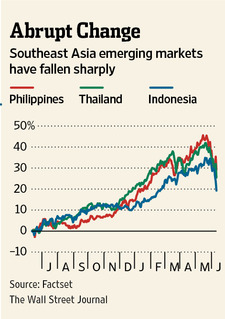
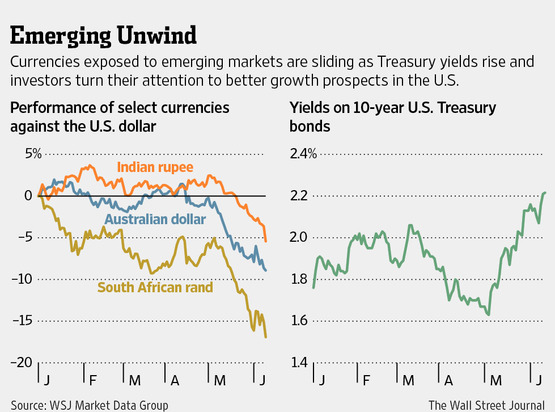
Money streamed out of emerging markets, destabilizing currencies, sinking stocks and creating headaches for policy makers already worried about faltering growth.

In the latest signs of turmoil, highflying stock markets fell in Asia, while currencies in India, Thailand and Indonesia reeled in the face of a surging U.S. dollar.

Some emerging-market currencies rebounded in New York trading hours but others remained weaker on the day. The volatile trading reflected the difficulties investors face in trying to predict when developed-world banks might start to withdraw stimulus and how such moves would ripple across global markets. Read more of this post

Across China, local governments are pushing ambitious spending projects that add to concerns about wasteful capital investment and rising debts

June 11, 2013, 1:30 p.m. ET

Across China, the Itch to Spend Is Strong

WO-AO132_CINVES_NS_20130611181513

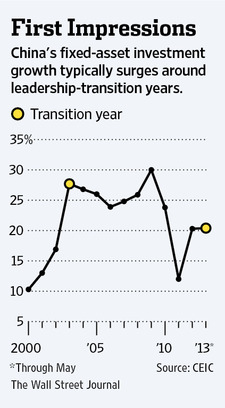
BEIJING—As leaders in Beijing remain cautious about stimulating China’s economy out of a slowdown, local governments are taking no chances, pushing ambitious spending projects that add to concerns about wasteful capital investment and rising debts.

It isn’t clear how many of these undertakings—which include everything from highways to subways—will end up with funding. But the push illustrates Beijing’s challenge as it attempts to rebalance the world’s No. 2 economy to make it less dependent on such massive investment plans.

A total of 16 provinces and two municipalities representing more than 60% of China’s gross domestic product have issued statements since the start of the second quarter proclaiming the importance of investment projects in driving growth and urging lower levels of government to use all means to accelerate plans in the months ahead. Read more of this post

UPS is expanding its health-care shipping services in China, as it pursues a larger foothold in a lucrative market with limited access to foreign delivery companies; The largest distributors in the U.S. control approximately 90% of the health-care logistics market

June 11, 2013, 12:36 p.m. ET

UPS Bulks Up in China

Delivery Firm Seeks Deals to Broaden Health-Care Shipping Efforts

By LAURIE BURKITT

SHANGHAI—United Parcel Service Inc. UPS -0.81% is expanding its health-care shipping services in China, as it pursues a larger foothold in a lucrative market with limited access to foreign delivery companies.

Atlanta-based UPS is seeking acquisitions to broaden its health-care supply chain in China, enabling it to transport medical devices and pharmaceuticals in China to companies such as drug maker Merck & Co., said Jim Barber, the president of UPS International. The company operates a facility in Shanghai as well as a new 237,000-square-foot storage and distribution center in the coastal city of Hangzhou, China. Read more of this post

Chinese local governments are padding their balance sheets with billions in fake assets

Chinese local governments are padding their balance sheets with billions in fake assets

By Gwynn Guilford @sinoceros 10 hours ago

Even China’s most prominent cities and provinces are increasingly relying on high-risk and murky forms of borrowing. That’s according to a new report from China’s National Audit Office on the finances of 36 provincial and municipal governments(link in Chinese). The report covered the governments of cities including Shanghai, Chongqing and Tianjin, and the provincial governments of Guangdong, Jiangsu and others. Here’s a roundup of the most notable numbers:

Local government debt hasn’t gone up much recently… or so it might seem. At the end of 2012, those 36 local governments had racked up $628 billion in debt, a 12.9% increase on what they’d amassed by the end of 2010. That’s not exactly shocking. But there are hints that the debt of some local governments may be threatening to spiral out of control: 12 of them saw their debts rise 20% or more. Plus, as China Real Time estimates, the report probably only covers 25-30% of total local government debt.

A sizable part of some local governments’ debt is dubious “shadow lending.” Nearly 16% of the total debt accrued by 13 local governments since 2010—$36 billion—came from trust loans and other sketchy financing, which channels lending off bank balance sheets. That could be higher—the report said financing through these channels is easy to conceal. It also noted that these are especially risky since rates tend to be much higher than those of banks—up to 17.5% annually.  Read more of this post

The price of love: Dowry map of China goes viral

The price of love: Dowry map of China goes viral

Staff Reporter

2013-06-08

1306041726102436--ss2-180501_copy1

The map shows the different amounts of dowry money expected in different parts of the country. (Internet photo)

In traditional Chinese culture, a man must first provide a dowry to his wife’s family before getting married. The practice has persisted into the present day, and a map showing the average amount required in different parts of China has gone viral online, with many internet users saying that they cannot afford a wife, reports the Henan-based news website Dahe.

The Dowry Map of China divides the country into five zones in terms of the amount expected by a bride’s family — 1 million yuan (US$163,000), 500,000 yuan (US$80,750), 100,000 yuan (US$16,300), and 10,000 yuan (US$1,600), and zero yuan. Read more of this post

Tamil Nadu: Can eccentric politics continue to deliver prosperity? Why are so many Tamil politicians ex-film stars?

Tamil Nadu

A successful show begins to pall

Can eccentric politics continue to deliver prosperity?

Jun 8th 2013 | CHENNAI |From the print edition

20130608_ASC740

IMAGINE a place run by film stars—vain, power-hungry, paranoid, adored. Imagine they had been in charge not for the duration of a reality television series but for decades in a territory containing 72m people and one of the world’s largest cities. It would be a disaster zone, wouldn’t it? Think again, and welcome to Tamil Nadu, one of India’s great success stories—and a state run by actors. It is the ultimate celebrity experiment.

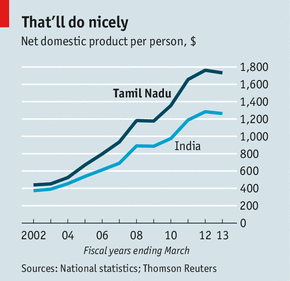
Tycoons and foreign bosses are infatuated by Gujarat, a hard-charging western state where the trains run on time. Policy wonks admire Bihar, an eastern badland that is getting its act together. But India’s most consistent economic performer is in its deep south (see chart). Tamil Nadu has the third-biggest GDP of any state and has grown faster and richer than most.

It is as industrialised as Gujarat—Hyundai, Ford and Renault, among others, churn out a third of all cars made in India there, while the state’s looms dominate the national textile industry. It is also as socially progressive as famously lefty states like Kerala. Compared with the Indian average, more people can read, fewer babies die, and fewer folk are poor in Tamil Nadu. Read more of this post

After two years of relentless buying overseas, Japanese companies are taking a breather in mergers and acquisitions

Jun 11, 2013

Japanese M&A Takes a Step Back

By Isabella Steger

After two years of relentless buying overseas, Japanese companies are taking a breather in mergers and acquisitions.

AM-AY924_AMONEY_NS_20130611113004

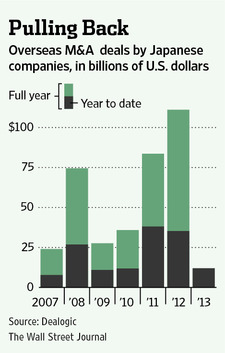
Japanese outbound M&A has dropped 67% this year from a year earlier, according to data provider Dealogic, with just $11.9 billion in announced deal volume, the lowest level since 2009. In the same period in 2012, $35.3 billion in deals had been announced.

Deal sizes have also become noticeably smaller this year. In the same period last year, the biggest deal was the $5 billion acquisition by advertising giant Dentsu Inc. 4324.TO -2.38% of U.K.-based Aegis PLC, followed by a string of multibillion-dollar deals. Only two transactions announced this year by Japanese companies were valued at more than $1 billion—the biggest being the $2.6 billion acquisition by Orix Corp. 8591.TO -4.34% for Dutch asset manager Robeco Group ROBA.AE -1.02% from Rabobank in February. Read more of this post

Fast Retailing, operator of the casual clothing chain Uniqlo, has become the unlikely symbol of volatility in Japanese stocks

June 11, 2013, 2:23 p.m. ET

Fast Retailing: The Stock That Wags the Nikkei

By MAYUMI NEGISHI And BRADFORD FRISCHKORN

AM-AY929_UNIQLO_NS_20130611122703

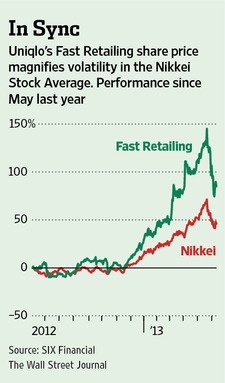
TOKYO—Fast Retailing Co., 9983.TO -1.44% operator of the casual clothing chain Uniqlo, has become the unlikely symbol of volatility in Japanese stocks, pulling with it the Nikkei Stock Average in its incandescent rise and sudden drop.

Shares in Fast Retailing, headed by Japan’s richest billionaire, Tadashi Yanai, more than doubled in 2013 to an all-time high of ¥44,400 before shedding 33% as Japanese equities markets underwent a severe correction stretching from late May to early June. Shares closed Tuesday at ¥31,250, down about 30%, and off 2.5% for the day, compared with a 1.45% loss for the overall Nikkei.

Neither the rise nor fall had much to do with the business performance of the maker of T-shirts and thermal underwear. The key was Fast Retailing’s 9.4% weighting on the Nikkei average—the highest of all 225 stocks in the index and more than the combined weighting of Japan’s four biggest companies by market capitalization. Read more of this post

S Korean women struggle in workforce; Only about 10 per cent of all managerial positions are held by women, and the gender pay gap is 39 per cent, making it the highest in the OECD

June 11, 2013 9:20 am

S Korean women struggle in workforce

By Song Jung-a

Mrs Kim has been thinking about quitting her job at a Seoul brokerage for a while, as she finds it hard to juggle her career and two pre-school children.

Like many South Korean office workers, Mrs Kim leaves home before 7am and returns after 7pm. While long work days are common in Korea – which has the longest working hours in the OECD – they are tough for mothers with young children.

“Sometimes days pass by without even saying ‘hi’ to my children when I get too busy,” says the 38-year-old. “Then I become more sceptical about continuing my work.”

She is not alone. Korean women have to overcome many obstacles at work after marriage and child birth. On top of the long hours, the lack of childcare and the male-dominated business culture force many to leave the workforce. Read more of this post

VF Corp, whose portfolio of clothing brands includes North Face, Wrangler, Timberland, laid out an ambitious new five-year target that would be the envy of almost anyone in the apparel industry

June 11, 2013, 5:43 p.m. ET

VF Lays Out Ambitious Growth Plan

By ANDRIA CHENG

VF Corp., VFC +0.57% whose portfolio of clothing brands includes North Face, Wrangler, Timberland and others, on Tuesday laid out an ambitious new five-year target that would be the envy of almost anyone in the apparel industry. The Greensboro, N.C., company, projects that sales will increase almost 60% to $17.3 billion over the next five years. The company already has a track record for strong growth: Last year sales hit $10.9 billion, up 42% over the five-year period from 2008, when sales totaled $7.64 billion. Given its strategy of buying labels to spur growth, acquisitions will continue to play a role as it aims for a five-year compounded annual sales target of 10%, with 8% “organic” growth and 2% growth anticipated from acquisitions. Read more of this post

Ferrari repositions for a one-horse race in ultra-luxury stakes; By creating a cult of exclusivity for their most expensive products, consumers will often shop for items lower down its retail chain in order to buy into brand exclusivity

June 11, 2013 4:32 pm

Ferrari repositions for a one-horse race in ultra-luxury stakes

By Rachel Sanderson in Maranello

At its headquarters amid the cherry orchards and Lambrusco vineyards of Emilia Romagna, Ferrari has built a reputation as haven of prosperity in recession-wrackedItaly. This year, while much of Italian business splutters, Ferrari is adding 250 jobs and handing out bonuses of at least €8,500 to its workers. But Luca di Montezemolo, 65, aristocratic chairman of the flame-red sports car maker, wants to pull even further away from the crowd. After a record €350m in trading profits in 2012 and on the cusp of the launch of its $1.3m LaFerrari, Ferrari plans to ensure its future success not by increasing output but by cutting back production this year by 400 cars to around 6,900 vehicles. Sitting at his red-leather topped desk at Ferrari HQ in Maranello, Mr Montezemolo sweeps back his signature floppy hair as he argues that after a record year for the business it is the ideal time to switch gear on strategy. “I’m talking about fewer cars but this does not mean fewer revenues or profits,” he says. “We want to increase the exclusivity of Ferrari. We want to maintain the value of the used car market. We want to develop the rest of the business like licensing and products.” Read more of this post

Hedge funds battered in quant arms race; Trend-following strategies sputter in volatile markets

June 11, 2013 5:53 pm

Hedge funds battered in quant arms race

By Sam Jones, Hedge Fund Correspondent

At the end of this month, a team of Cantabrigian hedge fund quants will attempt to wipe out rivals from Switzerland – in a computer game. Cantab Capital (assets under management: $6bn) will fight Zug’s Amplitude Capital in Battlefield 3. The gaming shoot out, part of an online league, is the smaller scale and lesser known version of two wars being fought between the biggest names in the quant hedge fund world. The other is more high stakes. A “quant” arms race, involving tens of billions of dollars, is on for big managers to find new markets and new models in which, and with which, to make money and outshine their rivals. Quant hedge funds have always been motivated to stay ahead of their peers, but in the past few years the struggle has intensified for good reason. So-called “trend-following” strategies – which have historically been at the core of what firms such as Man, Winton Capital, Cantab or BlueCrest Capital do – have sputtered since 2010, wrongfooted by range-bound, volatile prices in the futures contracts they trade linked to bonds and equities. Trend following does as it says: funds’ computers look for consistent moves in futures instruments and then follow them, up or down, until the trend reverses. Read more of this post

Australia’s covered bond boom is waning less than two years after the market started as yield-hungry buyers more than double purchases of RMBS

Australian Covered Bond Boom Wanes as RMBS Sales Double

Australia’s covered bond boom is waning less than two years after the market started as yield-hungry buyers more than double purchases of residential mortgage-backed securities.

Issuance of the debt, backed by the borrower and mortgages that stay on its balance sheet, fell 64 percent to $9.9 billion this year, data compiled by Bloomberg show. The decline in Australian offerings outpaced a 41 percent slump from banks worldwide, according to the data.

Renewed appetite for RMBS, as the market recovers after being decimated by the 2008 U.S. subprime collapse, has seen sales surge while banks reserve covered-bond allowances for when market conditions worsen. Commonwealth Bank of Australia (CBA)’s 2017 covered securities offered just 33 basis points more than swaps last month, compared with a 47 basis-point premium on shorter-dated unsecured notes sold by Westpac Banking Corp., Bloomberg-compiled data show. Global financial debt pays a 141 basis-point spread, Bank of America Merrill Lynch data show. Read more of this post

Swedish Credit Drives Frenzy in Dragon Tattoo Quarter

Swedish Credit Drives Frenzy in Dragon Tattoo Quarter

One of Stockholm’s most popular attractions is a guided tour of the Soedermalm district streets featured in Stieg Larsson’s bestselling book “The Girl With The Dragon Tattoo.” Buying a home in the former working-class neighborhood is far less accessible.

A one-bedroom, 55-square meter (592-square feet) apartment in Hoegalidsgatan, in the neighborhood where Larsson’s troubled heroine Lisbeth Salander grew up, sold last month for 3.75 million kronor ($569,000), 17 percent above the listing price, after a bidding war involving nine parties.

That level of demand is typical in the Swedish capital, where a shortage of construction, a population boom and mortgage rates below 3 percent have pushed prices in central Stockholm up 35 percent since early 2009. Borrowing for home purchases has in turn fueled record household debt across the country. That’s sparking concern among policymakers over potential damage to the economy and preventing the central bank from cutting rates, even as Sweden’s exporters say action must be taken to weaken the currency to protect thousands of jobs. Read more of this post

Nestle’s Nespresso to Face New Mondelez Copycat Capsule

Nestle’s Nespresso to Face New Mondelez Copycat Capsule

Mondelez International Inc., (MDLZ) the world’s second-biggest coffee maker, will start selling Nespresso-compatible capsules across Europe this fall, posing the sternest competitive challenge yet to the Nestle SA (NESN) brand. Mondelez, based in Deerfield, Illinois, will sell the knock-off capsules under its Jacobs and Carte Noire brands in Germany, France, Austria and Switzerland in the second half of 2013, Roland Weening, vice president of strategy, marketing and innovation, said in an interview in London yesterday. The move brings a deep-pocketed entrant to the fastest-growing part of the $80 billion global coffee market at a time when Nespresso’s growth has slowed. Nestle, of Vevey, Switzerland, has filed patent-infringement lawsuits against some rivals that introduced capsules compatible with Nespresso machines, yet to date has not been able to stem the flow of copycat capsules from producers including D.E Master Blenders 1753. (DE) That comes as Nestle has said sales growth this year may be at the low end of its long-term target. Read more of this post

Forget Revolution. More Like Renovation. At many U.S. manufacturing plants, the winds of change have barely caused a ripple

Updated June 10, 2013, 12:18 p.m. ET

Forget Revolution. More Like Renovation.

At many U.S. manufacturing plants, the winds of change have barely caused a ripple

By JAMES R. HAGERTY

IV-AA412B_STEAM_G_20130610120910

CLEVELAND—As part of reparations exacted after World War II, U.S. authorities confiscated a metal-forging press made in Germany during the 1930s. The 62-foot-tall machine was taken apart, shipped across the Atlantic and reassembled at a plant operated here by Alcoa Inc. AA +0.36% More than 60 years later, Alcoa is still using that press to squeeze hot aluminum alloys into dies for aircraft wheels and brakes. Computerized controls have been added and many parts updated, but the basic iron structure and other original parts remain. “It was very well-designed by the Germans,” says Eric Roegner, a senior Alcoa executive whose duties include overseeing the plant Alcoa’s cavernous Cleveland Works forging plant is a reminder that manufacturers often choose to make do with equipment that is decades old, instead of rushing to buy the latest technology. They find it can make more economic sense to renovate old machinery than risk investing in something entirely new—especially in a slow-growing market like the U.S. “In manufacturing, people won’t spend money unless there’s a guaranteed return on investment,” says Craig Resnick, a vice president at ARC Advisory Group, a Dedham, Mass., consulting firm that specializes in industrial automation. Often, he says, it is difficult to know precisely how much will be gained by installing new equipment. And there is a nagging worry: What if the new stuff doesn’t work? Read more of this post

China Everbright Bank placed itself directly in the firing line when reports it had defaulted started to circle

Swimming naked in China

David Keohane

| Jun 10 12:19 | 5 comments | Share

China Everbright Bank placed itself directly in the firing line of terrible puns last week when reports it had defaulted started to circle.

Thankfully, Anne Stevenson-Yang from J Capital read into the news a bit further than most:

The interbank defaults last Thursday provided definitive, if indirect, proof that the cash coming into China is for financial investment and interest arbitrage. It masquerades as a trade surplus but is not. With the tightening of the domestic central bank credit window, Chinese banks are heavily dependent on these inflows for the cash they need to roll over loans. That is why the banks immediately went into distress when regulators decided to clamp down on fraud on the trade account. Read more of this post

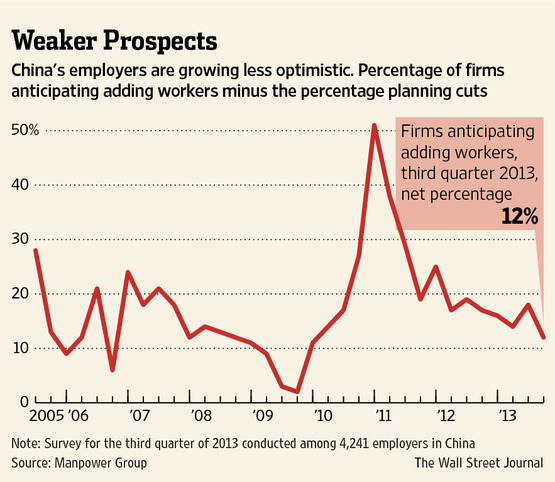
Strains Show in China’s Job Market; Labor Strife Increases as High Wages, Low Demand Send Some Employers Packing, While Others Close

Updated June 11, 2013, 2:27 a.m. ET

Strains Show in China’s Job Market

Labor Strife Increases as High Wages, Low Demand Send Some Employers Packing, While Others Close

WO-AO102A_CLabo_G_20130610181508

BEIJING—A wave of strikes and worker protests in China’s southern export belt is a fresh sign that slowing growth and rising wages have started to pinch the labor market on the world’s factory floor.

China Labour Bulletin, a Hong Kong-based labor group, has recorded 201 cases of labor disputes, including strikes, in the first four months of the year in China, almost double the number of cases in the same period last year. In the export hub of Shenzhen alone, 17 cases have been recorded. Read more of this post

Shock over departure of creative director behind Mulberry’s rise to top

Shock over departure of creative director behind Mulberry’s rise to top

Shares plunge 8% on news of Emma Hill’s decision to quit after rumoured row with company’s chief executive

Simon Neville and Lauren Cochrane

The Guardian, Monday 10 June 2013 22.56 BST

MULBERRY Emma HillMulberry shares graphic

Emma Hill has announced her intention to quit Mulberry. Photograph: Mulberry

The woman widely credited with transforming Mulberry from a quiet British fashion house into a must-have global brand has shocked the luxury goods world, and the City, by announcing her intention to quit, in a move that wiped nearly £40m off the company’s value. Emma Hill joined Mulberry as creative director at the depth of the recession in 2008 and, hitching the firm’s conservative reputation to hipster royalty such as Alexa Chung and Lana Del Rey, helped spur a fivefold increase in its share price. Mulberry issued a terse confirmation that one of the industry’s most successful partnerships is coming to an end, amid rumours of a falling out between Hill and the chief executive, Bruno Guillon, over the company’s direction. Read more of this post

Australian Dollar Plunges as Home Loans Dive; Australia Insolvencies Hit Record

Australian Dollar Plunges as Home Loans Dive; Australia Insolvencies Hit Record; Worst is Yet to Come

Posted: 10 Jun 2013 08:32 PM PDT

Mike “Mish” Shedlock

Curve Watchers Anonymous has its eye on the Australian dollar. As expected, it has taken a big dive in conjunction with a housing bust and a slowdown in China that impacts the demand for commodities.

The only thing surprising to me about this plunge is how long it took, but here we are.
Aussie Falls to Lowest in More Than Two Years
Bloomberg reports Aussie Falls to Lowest in More Than Two Years as Home Loans Slow

Australia’s dollar fell to the lowest in more than two years versus the greenback after home-loan approvals grew at the slowest pace in three months, boosting the case for further cuts to borrowing costs. Read more of this post

Global shale resources are vast enough to cover more than a decade of oil consumption, according to the first-ever US assessment of reserves from Russia to Argentina.

June 10, 2013 7:53 pm

World has 10 years of shale oil, reports US

By Gregory Meyer in New York

Global shale resources are vast enough to cover more than a decade of oil consumption, according to the first-ever US assessment of reserves from Russia to Argentina.

The US Department of Energy estimated “technically recoverable” shale oil resources of 345bn barrels in 42 countries it surveyed, or 10 per cent of global crude supplies. The department had previously only provided an estimate for US shale reserves, which it on Monday increased from 32bn barrels to 58bn. Read more of this post

Fitch warns on risks from shadow banking in China; “A 1 percent NPL ratio has little signaling value when 36% of all outstanding credit resides outside Chinese banks’ loan portfolios”

Fitch warns on risks from shadow banking in China

12:56pm EDT

FRANKFURT (Reuters) – China’s unregulated shadow banking sector poses an increasing risk to the country’s financial stability that could spread to other countries, credit rating agency Fitch said on Monday. China has tens of thousands of non-bank lenders that are providing increasing amounts of credit to businesses and government outside the mainstream, regulated banking sector, a situation that is stoking systemic risk, Fitch said. There is little visibility on where the money is going, who is lending it or what the credit quality of assets is, meaning traditional warning signs of trouble will not function properly. “It is a wild west atmosphere in many respects and that is one of the reasons why we are so worried,” Fitch Senior Director Charlene Chu told a conference in Frankfurt. Regulators had little insight into the non-bank sector. “It is a material risk because a growing amount of credit is being extended through channels that they don’t have transparency or control over,” Chu said. Read more of this post

Pimco Wary on Asia Junk Debt as Slowdown Hurts Company Profits

Pimco Wary on Asia Junk Debt as Slowdown Hurts Company Profits

Investors should be wary of high-yield borrowers as slowing growth in Asia threatens profitability, according to Pacific Investment Management Co., manager of the world’s biggest fixed-income fund.

Companies in Asia outside Japan almost tripled junk bond sales to $19.2 billion this year compared with $6.85 billion during the same period in 2012, data compiled by Bloomberg show. China’s economy will slow to average 6 percent to 7.5 percent annual expansion during the next five years from 9 percent the past five, weighing on the region’s growth, according to a report from Newport Beach, California-based Pimco.

“The slow-growth landscape favors higher-quality credits and warrants caution on higher yielding names that could become impaired in an environment where profits will be challenged,” Tokyo-based Tomoya Masanao, the head of portfolio management for Japan, wrote in the report due for release today. “The emphasis should move away from risk assets that have benefited purely from the central bank liquidity wave in which valuations have become detached from fundamentals.” Read more of this post

India Rate-Cut Room Dented as Rupee Drops Most in Asia to Record; “Currency stability has become a new worry”

India Rate-Cut Room Dented as Rupee Drops Most in Asia to Record

The slump in the rupee to a record low has narrowed the Reserve Bank of India’s scope to cut interest rates next week for a fourth straight meeting. Governor Duvvuri Subbarao will keep the repurchase rate at 7.25 percent on June 17, 10 of 18 analysts said in a Bloomberg News survey. The rest called for a reduction to 7 percent. The currency’s 6.6 percent drop versus the dollar this quarter, the biggest in Asia, threatens to make imports more expensive. The rupee reached its weakest level yesterday, weighed down by an unprecedented current-account deficit, the slowest Indian economic expansion in a decade and speculation the dollar will gain if the U.S. scales back monetary stimulus. Subbarao said May 30 that depreciation may stoke inflation and increase the cost of servicing foreign-currency debt.

“Currency stability has become a new worry,” said Rajeev Malik, an economist at CLSA Asia-Pacific Markets in Singapore. “A rate cut is unlikely to do much in reviving growth, but it will renew the pressure on the rupee to weaken further.” Read more of this post

Hard part begins in Myanmar’s quest for foreign investment; “Actually there isn’t that much investment coming in,” Nobel Peace laureate and opposition leader Suu Kyi

Hard part begins in Myanmar’s quest for foreign investment

NAYPYITAW — In a cramped auditorium in Myanmar’s capital, pro-democracy champion Aung San Suu Kyi had a message for the world’s business elite: Her country is teeming with foreign investors scouting for opportunities in one of Asia’s final frontier markets, but not many are actually investing.

BY –13 HOURS 3 MIN AGO

NAYPYITAW — In a cramped auditorium in Myanmar’s capital, pro-democracy champion Aung San Suu Kyi had a message for the world’s business elite: Her country is teeming with foreign investors scouting for opportunities in one of Asia’s final frontier markets, but not many are actually investing.

Interviews with foreign and local business leaders on the sidelines of last week’s World Economic Forum in the Myanmar capital, Naypyitaw, show why.

Shoddy infrastructure, opaque regulations, red tape, recent bouts of sectarian violence and lingering uncertainty over US sanctions are hampering large-scale foreign investment in the country, strategically nestled between India and China. “Actually there isn’t that much investment coming in,” Nobel Peace laureate and opposition leader Suu Kyi told reporters. Read more of this post

Casino Dubai’s Rebound Pitch Ignored by Global Investors

Casino Dubai’s Rebound Pitch Ignored by Global Investors

Dubai is back with the big plans. What it doesn’t have are the biggest property investors.

Surging home prices in parts of Dubai and rebounding shopping and tourism markets are prompting developers to announce projects on a scale not seen since the emirate’s property market collapsed in 2008. So far, sovereign wealth, pension and insurance funds are staying away even as they splurge on real estate elsewhere.

“It’s a thin market and it has a reputation of being something of a casino,” said Richard Price, chief executive for Asia at CBRE Global Investors, which manages $93 billion of property assets. “I struggle to think of any real client appetite for exposure.” Read more of this post