History may repeat itself for Mexico, Peru as Fed eyes exit

History may repeat itself for Mexico, Peru as Fed eyes exit

Sun, Jun 9 2013

By Krista Hughes

MEXICO CITY (Reuters) – Mexico and Peru’s popularity among foreign investors means they are among the emerging market economies most exposed to losses when the United States finally moves to take its foot off the monetary accelerator. History shows that when U.S. interest rates jump – widely anticipated when the Federal Reserve begins reducing its $85 billion a month bond purchases – new foreign investment in Peruvian and Mexican financial assets drops by almost two-thirds. Bonds in Brazil, Colombia and Peru also sold off and major Latin American currencies fell on average 5.5 percent on the mere hint of a limit to the cheap cash that has pushed many emerging markets to record highs. Read more of this post

Thousands of people attended prayers to celebrate what would have been the 92nd birthday of the late Indonesian President Suharto in Solo, Central Java

Suharto’s Birthday Keeps Discussion Alive

By Imron Rosyid Taufikur on 11:36 pm June 9, 2013.

SAN7046-1024x695

A guide gives a tour around Suharto’s memorial park in Bantul, Yogyakarta, which was unveiled on Saturday. (JG Photo/Aiera Maharani)

Thousands of people attended prayers to celebrate what would have been the 92nd birthday of the late President Suharto in Solo, Central Java, on Saturday. Read more of this post

Spain’s ownership web set to untangle

June 9, 2013 12:53 pm

Spain’s ownership web set to untangle

By Miles Johnson in Madrid

Spain

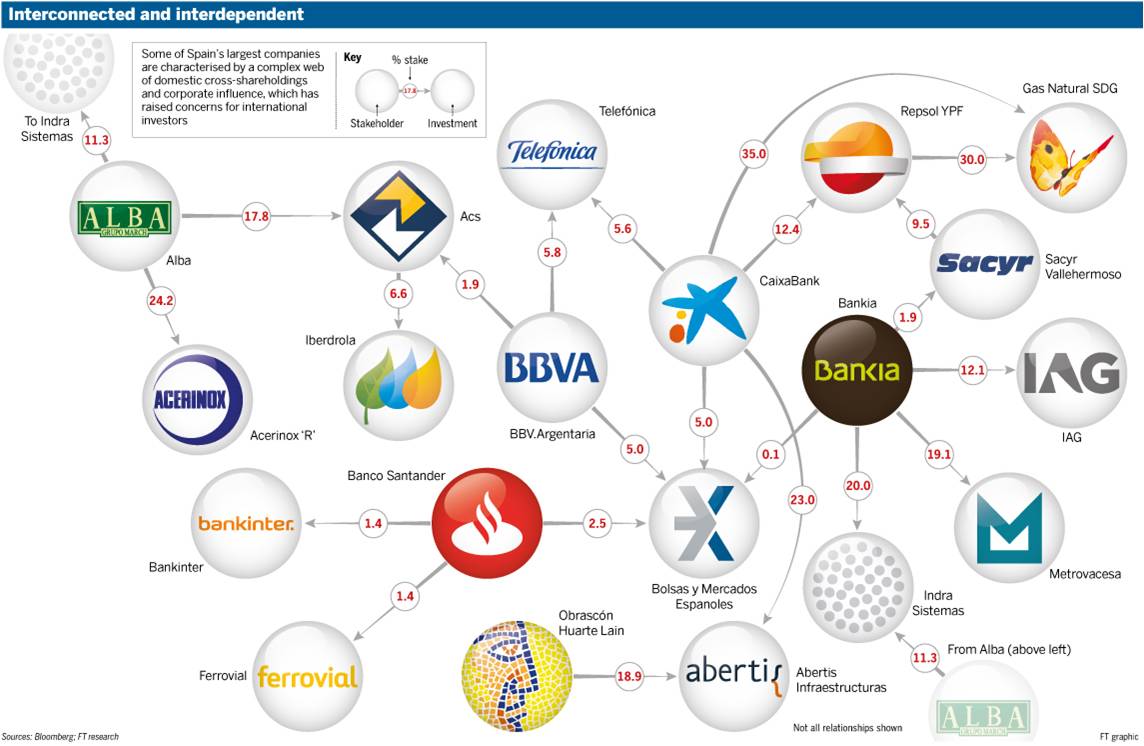
Spanish business, it is said, can be a small place. Whether they are sharing bottles of rioja at upmarket Madrid restaurants, or the same classrooms, or even the same blood, large parts of the country’s business elite have ties that stretch back generations. This cosy, interconnected world is epitomised by the nexus of cross-shareholdings between banks and many of Spain’s largest companies, largely constructed during the past two decades. Out of the 35 companies in the Ibex stock index, 15 are connected to another member though a significant shareholding. If Bankia, the nationalised savings bank recently dropped from the index, were included, that figure would rise to 19. With the financial crisis having ripped through the balance sheets of the caja system, corporate Spain is undergoing an upheaval. As capital-strapped lendersare forced to sell non-core holdings, this long-standing and complicated web of cross-shareholdings is at risk of disappearing. Read more of this post

The 50 Best Performing S&P 500 Stocks in 2013

The 50 Best Performing S&P 500 Stocks in 2013

FRIDAY, JUNE 7, 2013 AT 02:03PM

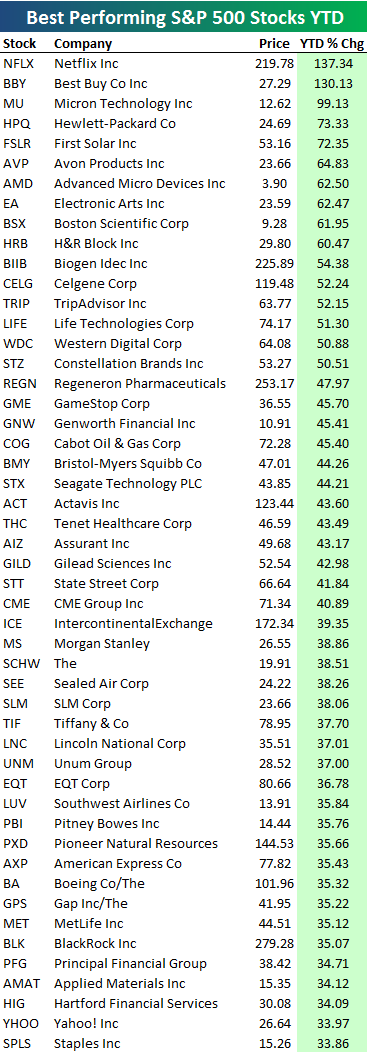
As of 2 PM today, the average stock in the S&P 500 is up 16.94% so far in 2013.  And nearly all stocks in the index are up on the year.  Of the 500 members, 453 of them are in the green this year, while just 47 are in the red. Below is a list of the 50 best performing stocks in the S&P 500 year to date.  As shown, two stocks — Netflix (NFLX) and Best Buy (BBY) — are up more than 100%.  Go figure! Micron (MU) ranks third with a YTD gain of 99.13%, followed by Hewlett-Packard (HPQ) at 73.33% and First Solar (FSLR) at 72.35%.  AVP, AMD, EA, BSX and HRB round out the top ten. One stock that’s clearly not on the list of 2013’s best performing stocks is Apple (AAPL).  Apple is actually down 16.98% YTD, ranking it as the 7th WORST stock in the index on the year.

bestspxytd


Imperial Family’s car woes sparked Toyota whistleblower; What if a car crash hurt or even killed Crown Prince Naruhito, Japan’s heir to the Imperial throne?

Imperial Family’s car woes sparked Toyota whistleblower

The giant carmaker insists it has overcome its deadly 2009-11 crises; critics say problems have just been buried

BY DAVID MCNEILL

SPECIAL TO THE JAPAN TIMES

JUN 9, 2013

In 2008, Toyota faced an embarrassing problem: The Imperial Family’s luxury Century Royal, used to carry Crown Prince Naruhito around Japan, was a dud. Memos flew back and forth between managers and senior engineers trying to find the cause of what appeared to be a speed-control fault. “This is a very difficult situation,” fretted one engineer. “The Imperial Household Agency feels there is risk if it should recur.”

The unspoken concern was clear: What if a crash hurt or even killed Japan’s heir to the Imperial throne?

The problem seemed rooted in electronics — but its solution was elusive, even to all those trained minds. Toyota replaced the gas pedal, the throttle system and the engine computer at its own expense. Read more of this post

Dark sides of Toyota’s drive to be No. 1

Dark sides of Toyota’s drive to be No. 1

BY DAVID MCNEILL

SPECIAL TO THE JAPAN TIMES

JUN 9, 2013

Like most corporate giants, Toyota isn’t all squeaky clean. Yet in their book “Toyota no Shotai” (“The True Colors of Toyota”) published in Japanese in 2006, Hajime Yokota and Makoto Sataka catalog the Japanese media’s timidity when it comes to covering the nation’s top advertiser.

In May 2004, an accident resulting in death occurred in Toyota’s Tsutsumi factory in the city of Toyota, Aichi Prefecture. Yet, as the book details, the mainstream media ignored the event for months, along with allegations made by the victim’s father that it was the result of Toyota’s emphasis on efficiency.

The book also references how, after a Toyota employee murdered his wife and child in 1992, editors in the mainstream media mostly ignored his connections to Toyota — instead referring to him as “a resident of the city of Toyota.” Read more of this post

Toyota has “lost something. It used to have this godlike reputation for quality. But now it has shown that it has feet of clay”; “Toyota said we were all one big family. But now they are betraying us.”

How even the mightiest can sometimes succumb to their own success

BY DAVID MCNEILL

SPECIAL TO THE JAPAN TIMES

JUN 9, 2013

Toyota was famously slow to respond to the glut of claims of sudden acceleration problems afflicting some of its vehicles — at least until a now-notorious recording of an emergency 911 call made from one of the passengers stuck in 45-year-old California Highway Patrolman Mark Saylor’s speeding Lexus on Aug. 28, 2009.

“We’re doing 120 (mph [193 kph]). We’re in trouble … we can’t … there’s no brakes,” said the caller, moments before the car crashed at a San Diego intersection and burst into flames, killing everyone inside — Saylor, his wife, daughter and brother-in-law. Read more of this post

Google’s growth in India is being hampered by poor technological infrastructure that is unable to keep pace with the demands of hundreds of millions of new internet users

June 9, 2013 11:29 pm

Google highlights India bandwidth threat

By James Crabtree in Mumbai

Google’s growth in India is being hampered by poor technological infrastructure that is unable to keep pace with the demands of hundreds of millions of new internet users, says the US-based search group’s Indian head. India is the world’s third most populous online nation, with 150m net users, while the country is likely to surpass the US for second place behind China during the next two years. But a combination of sluggish bandwidth and counterproductive government policy threaten to slow India’s online economy, says Rajan Anandan, Google’s managing director in India. “The single biggest constraint to the growth of the internet in India is bandwidth. It’s patchy. You don’t have a lot of speed,” Mr Anandan says. “It is very, very important that we solve the bandwidth infrastructure problems. That is priority number one, two, three and four.” Read more of this post

South Korea’s conglomerate STX bankruptcy filing is a reminder of the prolonged slump in the marine-transport business; STX Group has $9 billion in total debt

June 9, 2013, 11:44 a.m. ET

STX Bankruptcy Filing Reflects Global Slump in Shipping

By KYONG-AE CHOI and KANGA KONG

SEOUL—The bankruptcy filing by what once was a major profit driver of one of South Korea’s conglomerates is a reminder of the prolonged slump in the marine-transport business. STX Pan Ocean Co., 028670.SE -14.93% the bulk-transportation unit of STX Group,011810.SE -2.03% the country’s 13th-biggest company by assets, filed for court receivership Friday after failing to find a buyer. STX Group had put up for sale its almost 36% interest in STX Pan Ocean, but no buyers came forward. The company, which is listed in Seoul and Singapore, was valued at $231 million in early April but that fell to $170 million by the end of last week. “A combination of a sharp decline in freight rates, a delayed industry recovery, oversupply of ships due to an increased production at Chinese shipyards and higher fuel costs drove up debt and squeezed margins,” STX Pan Ocean said Friday. The decline in the shipping and shipbuilding industries since the 2008 financial crisis has hit STX Group particularly hard. About 90% of the group’s sales come from those businesses. Its other main business, construction, also has been hit by the global economic downturn. “Even if a company ran one of the three businesses—shipping, shipbuilding and construction—it would be hard to survive today. STX has all of them,” said an executive who left STX late last year. STX Group, with more than 10 trillion won, or $9 billion, in total debt, has sold 1.13 trillion won in assets as part of a 2.5 trillion won asset sale plan announced in May of last year. STX has said it would continue to cut its workforce, wages and benefits. It has already cut the number of executives and annual salaries by around a fifth. Read more of this post

The rise of the real collateral ‘mining’ business; The market has under-estimated the degree to which commodity producers, by means of collateral manufacturing, have been propping up commodity prices the past five years

The rise of the real collateral ‘mining’ business

Izabella Kaminska | Jun 05 21:45 | 12 comments | Share

FT Alphaville was cordially invited to talk about the collateralisation of commodities at two separate conferences this past month. We thank IHS Global and the Association des Economiste Quebcois for the opportunity. The crux of our argument was that you can’t really understand what’s going on in commodity markets unless you appreciate that commodities are no longer a pure consumption-based market. More to the point, that marginal prices are increasingly being dictated by the market’s alternative collateral, store-of-value, and safe-asset role in the global economy. This is being fuelled by a general scarcity of quality collateral in the market. For those interested, a copy of our presentation slides can be found here.

To summarise the key points:

The market has under-estimated the degree to which commodity producers, by means of collateral manufacturing, have been propping up commodity prices the past five years. Collateral manufacturing refers to the distinct production of commodities to cater to the demands of the financial sector, rather than to real consumable physical demand. In some way, commodity producers have been playing the role of property developers in what might otherwise be described as the subpriming of commodities. Just like property developers in the naughties, commodity producers have been producing commodities in response to demand that would not be there if not for subsidisation by an investment class keen to overpay for exposure to the asset class. Read more of this post

For Australia, the Asian Century might be already over after just 13 years

Our Asian future requires a change of mind

June 10, 2013

Matthew Kidman

A structural shift is on, and we have to capitalise on it rather than throw our hands in the air and blame the government.

Politicians and economists have us convinced that we are now in the Asian Century. Asia is the new version of the ”sleeping giant” that has been awoken from its 600-year slumber and is rapidly becoming the driving economic force of the 21st century. A changing of the guard from North America to a dynamic population of close to 4 billion led by the industrious Chinese.

For Australia, the Western culture attached to Asia, this is viewed as a fabulous opportunity to enhance our already prosperous existence, while other Westerners such as Europe and the US slowly fall by the wayside. Read more of this post

The Philippine Stock Exchange (PSE) is trimming its listing boards to two, with emphasis on making sure companies planning to go public are viable

PSE trims listing boards to two

By Neil Jerome Morales (The Philippine Star) | Updated June 9, 2013 – 12:00am

MANILA, Philippines – The Philippine Stock Exchange (PSE) is trimming its listing boards to two, with emphasis on making sure companies planning to go public are viable.

The operator of the country’s sole stock exchange said the Securities and Exchange Commission has approved the PSE’s rules creating the two-board system: the Small, Medium and Emerging (SME) board and the Main Board. Read more of this post

Yum! Brands struggling to revive Little Sheep, once the largest hot pot chain in China which it acquired for $587m in May 2011

Yum! Brands struggling to revive Little Sheep hot pot chain

Wu Jui-ta and Staff Reporter

2013-06-10

CC16X0070H_2011資料照片_N71_copy1

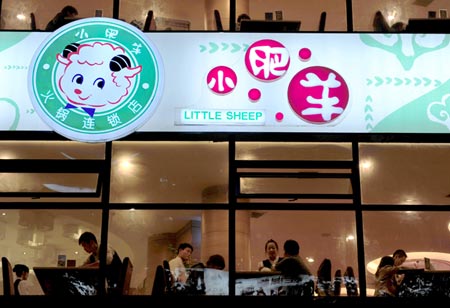
Little Sheep, once the largest hot pot chain in China, saw its sales and revenue fall last year after it was acquired by US fast good giant Yum! Brands, reports our Chinese-language sister paper Commercial Times. The chain is now now feeling the pinch of a shrinking clientele and declining sales, and is dragging down the overall performance of the fast good giant. Last year, the group’s overall sales in China rose annually by 24% to 6.9 billion yuan (US$1.1 billion), while its food-sector profit in China rose by 18.1% year-on-year, according to Yum! Brands figures. It overall profits last year also saw an increase of 18.5%, excluding the poor performance of the Little Sheep chain. Yum! Brands has attempted to change the image of Little Sheep since its acquisition in 2011, hiking up its prices across China late last year in an attempt to reestablish it as a high-end restaurant chain. The average cost of eating at the restaurant rising from 70 yuan (US$11) to over 90 yuan (US$15). Industry insiders said that the move to increase prices is the direct cause of the restaurant’s poor performance, as it has driven many of its old clients away, adding that Yum! Brands may have to reevaluate their business model for the chain.

Yum’s Little Sheep: tasty meal or indigestion?

Thursday, 06 June, 2013, 5:16pm
Comment›Blogs
Doug Young

An interesting new Chinese media report is questioning whether US fast food giant Yum (NYSE: YUM) is spoiling the Little Sheep chain of hot pot restaurants it acquired just a year ago. The numbers released by Yum certainly don’t look very so-so, and comments by an unnamed restaurant official don’t paint a very rosy picture either for Little Sheep under Yum’s management. But it’s probably still too early to say whether this acquisition will be a success, and I would still be willing to bet we’ll see Little Sheep start making some new and exciting moves later this year.  Read more of this post

China’s domestic beauty and personal care firms fighting back international rivals

China’s domestic beauty and personal care firms fighting back international rivals

Staff Reporter

2013-06-10

Domestic firms within China’s beauty and personal care industry have gradually taken back some of the lost ground from international rivals, grabbing back 25% of the market share to reach a total 45%, while foreign brands such as Procter & Gamble and Unilever continue to underperform, Beijing’s Economic Observer reports.

Guangzhou Blue Moon, which grabbed just 14% of China’s laundry detergent market in 2007, has now taken 63% of the market share, while other domestic brands such as the cosmetics and personal health care product maker Softto has also seen a positive turn around in the market. Read more of this post

65% of Chinese said that fortune involves immoral practices, as only morally degraded people can amass a big fortune, while the remaining 35% believed that fortune involves skill, as only hard-working people can become rich

Fortune linked to immorality: survey

Staff Reporter

2013-06-10

According to an online survey regarding the concept of fortune in China, 65% of the respondents said that fortune involves immoral practices, as only morally degraded people can amass a big fortune, while the remaining 35% believed that fortune involves skill, as only hard-working people can become rich, according to Phoenix New Media, who conducted the report.

The survey results conform to the negative views concerning wealth prevailing in Chinese society, as China’s increased polarization between rich and poor has lead many to become anti-rich, believing the country’s most wealthy must act immorally to amass their fortunes. Read more of this post

Huaxi village is a microcosm of China’s predicament. Like China itself, Huaxi can no longer rely entirely on its struggling steel mills, real estate projects. So the village’s autocratic leaders build a hotel taller than the Chrysler Building in the middle of nowhere but many of those staying there are villagers who pay their way with subsidies from the authorities

Last updated: June 9, 2013 7:28 pm

Economy: Out of proportion

By Jamil Anderlini

A model village that is proving to be a microcosm of the nation

Dizzying heights: Huaxi village has built a hotel taller than the Chrysler Building but many of those staying there are villagers who pay their way with subsidies from the authorities

On a clear day, you can see the 72-storey Longwish Hotel from more than 20km away, rearing up above the lush paddy fields of Huaxi village in southern Jiangsu province.

The ostentatious skyscraper, with 826 rooms, cuts an incongruous sight in a village of only 2,100 people; it is even crowned with a giant golden ball holding a revolving restaurant staffed by elegant waitresses from North Korea. Taller than New York’s Chrysler Building and the Shard in London, Longwish was completed in 2011 at a cost of more than Rmb3bn ($490m). The only problem is that it is hard to fill so many rooms. During a quiet lunchtime, the North Korean waitresses perform traditional dances for a handful of inattentive locals who now live in the hotel with the help of subsidies from the village authorities. Read more of this post

Beijing’s New War on the Constitution; Xi Jinping and other ‘neo-Dengists’ are re-asserting the Party’s position above the law

June 9, 2013, 2:04 p.m. ET

Beijing’s New War on the Constitution

Xi Jinping and other ‘neo-Dengists’ are re-asserting the Party’s position above the law.

By MINXIN PEI

The weekend’s meeting between U.S. President Barack Obama and Chinese President Xi Jinping naturally focused attention on nettlesome security issues, such as cyber espionage and North Korea, that have highlighted the fragility of U.S.-China relations in recent months. But the California summit, however useful it was, is a less important event than the ongoing ideological battle in Beijing that concerns where Mr. Xi plans to take China and what his much-touted “China dream” is really about.

Little noticed by the outside world, the Chinese propaganda machine has, since mid-May, launched a ferocious campaign against the idea of constitutional rule. Nearly all the most important official newspapers, such as the People’s Daily, the People’s Liberation Army Daily, and Party Construction (a journal published by the party’s Department of Propaganda) , have carried lengthy articles denouncing the idea of constitutional rule as bourgeois and subversive. In the Chinese context, “constitutional rule” means no more than placing the Communist Party under the rule of the existing Chinese constitution. But even such a modest proposal seems too radical. The party’s message in response is becoming clear: The Communist Party is above the constitution. Read more of this post

China’s Leaders Face Test of Growth Resolve After May Slowdown

China’s Leaders Face Test of Growth Resolve After May Slowdown

China’s new leaders face a test of their resolve to forgo short-term stimulus for slower, more-sustainable growth after May trade, inflation and lending data trailed estimates, signaling weaker global and domestic demand.

Industrial production rose a less-than-forecast 9.2 percent from a year earlier and factory-gate prices fell for a 15th month, National Bureau of Statistics data showed yesterday in Beijing. Export gains were at a 10-month low and imports dropped after a crackdown on fake trade invoices while fixed-asset investment growth moderated and new yuan loans declined. Read more of this post

China is moving to stem a surge in credit that could produce a wave of bad debts and financial failures, but it risks slowing the world’s second-largest economy

Updated June 9, 2013, 8:15 p.m. ET

Slower China Credit Is Risk to Growth

Government’s Measures to Stem a Previous Surge in Borrowing Could Hamper Economic Expansion

By BOB DAVIS

AI-CB451_CECON_NS_20130609112404

BEIJING—China is moving to stem a surge in credit that could produce a wave of bad debts and financial failures, but it risks slowing the world’s second-largest economy.

Total social financing, China’s widest measure of credit, fell by about one-third to 1.19 trillion yuan ($194 billion) in May from April, the second month of substantial decline, the People’s Bank of China said Sunday. And new bank loans, a subset of total social financing, also have fallen substantially in the past two months.

Total social financing consists of all manner of financing including banks, trusts, financing companies, trade credit, corporate bonds, certain kinds of interbank lending and informal lending by individuals, among other kinds of credit. Read more of this post

No Easy Solution for World’s Traffic Woes, Experts Find

No Easy Solution for World’s Traffic Woes, Experts Find

By Nivell Rayda on 11:13 am June 9, 2013.
Leipzig, Germany. Faced with budget constraints due to the global financial and economic slowdown, funding infrastructure is a major issue for governments around the world, requiring decision makers and academics to find innovative funding sources and solutions.

Speaking at a three-day summit held by the International Transport Forum in Leipzig, Dave Wetzel, chairman of the Professional Land Reform Group in the United Kingdom, said that the key was to get money from those benefiting most from infrastructure and transportation projects — land owners instead of people using the various modes of transportation. Read more of this post

If there were a large rise in bond yields, investors would not be cushioned by high bond coupons as they were in 1994, when coupons of 8% were common, compared with 2% or lower

June 7, 2013 6:31 pm

Why bonds aren’t heading for a repeat of 1994

By Jim Leaviss

A more open Fed has given up the power to shock, says Jim Leaviss

Like many bond investors, I  remember 1994  well. I was working on the gilt desk at the Bank of England, and having seen only steadily falling yields in my career,it felt like carnage. But you might be surprised at how modest the losses for bond investors actually were that year. Although the benchmark US interest rate went from 3 per cent to 5.5 per cent, the US Treasury Bond index saw losses of just 3.2 per cent. These were recouped in spades in 1995, when Treasuries returned 18.6 per cent. Many investors see strong parallels between the situation in the US back then, and today. After years of fantastic returns for bond investors, could the Federal Reserve be thinking of raising rates, or exiting itsquantitative easing programme? However, the situation today is different. On the negative side, if there were a large rise in bond yields, investors would not be cushioned by high bond coupons as they were in 1994, when coupons of 8 per cent were common, compared with 2 per cent, or lower, today. So total returns for today’s bonds for the same rise in yields would be much less. Read more of this post

Emerging market companies are getting three times as much funding from the bond markets as they are from bank syndicates, the biggest gap in at least a decade

June 9, 2013 7:08 pm

EM groups look to bonds rather than banks

By Michael Stothard in London

Emerging market companies are getting three times as much funding from the bond markets as they are from bank syndicates, the biggest gap in at least a decade, as regulatory changes prompt structural shifts in global corporate funding.

Companies based in Asia, Africa and Latin America borrowed half as much from banks in the second quarter compared with the same period last year, while marketborrowing has risen by two-thirds, according to Dealogic. Read more of this post

Emerging market jolt puts deficit countries at risk

Emerging market jolt puts deficit countries at risk

Fri, Jun 7 2013

By Natsuko Waki and Sujata Rao

LONDON, June 7 (Reuters) – Major developing countries with big foreign financing needs are acutely vulnerable to the risk of a sudden stop in investment flows which has unnerved emerging markets in recent weeks.

Emerging economies such as South Africa, Indonesia, India, Turkey and Poland are on the front line as investors reconsider exposure to markets which have attracted trillions of dollars of cheap money printed by developed world central banks.

Waves of stimulus cash have barrelled into emerging bonds rather than equities, leaving countries with heavy financing needs – especially in local currency debt – vulnerable to any abrupt withdrawal. Read more of this post

These CDO Names Don’t Cry ‘Wolf’? The CDO comeback is déjà vu for some investors burned by collateralized debt obligations that blew up during the financial crisis

Updated June 9, 2013, 7:49 p.m. ET

These CDO Names Don’t Cry ‘Wolf’

By JEANNETTE NEUMANN

MI-BW460_CDONAM_DV_20130609182456

The CDO comeback is déjà vu for some investors burned by collateralized debt obligations that blew up during the financial crisis. But history probably won’t repeat itself in one peculiar way. Creators of the deals are showing little interest in bestowing them with the sort of aspirational, exuberant, mythological, over-the-top and sometimes inexplicable names common before the crisis hit.

Creative License: Names of some CDOs sold to investors before the credit crisis hit

Bonifacius LTD.: “Bonifacius” means “good fate” in Latin

Empyrean Finance: “The highest heaven or heavenly sphere,” according to Merriam-Webster

Pampelonne CDO II LTD.: Refers to a swanky beach in the Mediterranean resort of Saint-Tropez

Sunrise CDO I LTD.: Got the nickname “Sunset” because of losses

Zohar III LTD.: “Zohar” means “brightness” and is the definitive work of Kabbalah Read more of this post

Gazprom’s Demise Could Topple Putin; In May 2008, Gazprom’s market capitalization was $369 billion; $83 billion now.

Gazprom’s Demise Could Topple Putin

No large company in the world has been so spectacularly mismanaged as Russia’s state-dominated natural-gas corporation Gazprom OAO. (GAZP) In the last decade, its management has made every conceivable mistake.

Even so, Russian President Vladimir Putin denies the very existence of a crisis and maintains his support for Alexei Miller, the chief executive officer since 2001. Gazprom’s situation is serious not only because it is Russia’s biggest company by market value, but because Putin is its real chairman. Where Gazprom goes, so does Russia and the Putin government.

In May 2008, Gazprom was one of the world’s most valuable companies with a market capitalization of $369 billion. Miller boasted that it would be the first global company to reach $1 trillion. Today, its market value has plummeted to $83 billion and the decline continues. Although it claimed the largest net income of any global company in 2011 at $44.5 billion and still at $38 billion in 2012, its price-earnings ratio has dropped to a fatally low 2.4 for 2013. It has no credibility with shareholders. Read more of this post

In China, fake European wine more worrying than tariffs

In China, fake European wine more worrying than tariffs

The amount of knock-offs on the market may increase as Beijing investigates wine imports from the European Union. -Reuters
Terril Yue Jones
Sun, Jun 09, 2013
Reuters

BEIJING – Bruno Paumard, the cellar master at a vineyard in China, can’t stop laughing while describing a bottle of supposedly French wine a friend gave him two years ago. It’s white wine, with a label proclaiming it is from the vineyards of Romanee-Conti, the bottle bearing the logo that is on bottles of Chateau Lafite-Rothschild, and declares its origin as Montpellier in southern France. Domaine de la Romanee-Conti, better known for highly prized and highly priced vintages from France’s Burgundy region, makes only a tiny amount of white wine, labelled Montrachet. It has nothing to do with the equally prestigious Lafite, which is from the Bordeaux region, and neither brand is produced anywhere near Montpellier. “It’s the most magnificent example of a hijacked brand of wine I’ve ever seen,” says Paumard, who works with Chateau Hansen in China’s Inner Mongolia. “It doesn’t get better than that.” Read more of this post

Demand For Lunch with Warren Buffett Crashes By 71% As Charity Lunch Raises Least In 6 Years

Demand For Warren Buffett’s Company Crashes By 71% As Charity Lunch Raises Least In 6 Years

Tyler Durden on 06/08/2013 12:20 -0400
Warren Buffet Glide Foundation Lunch_0

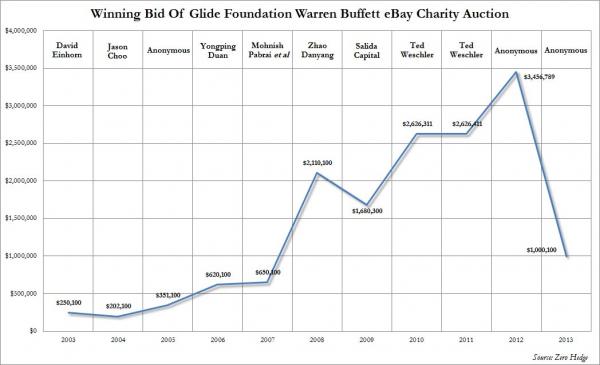
Demand for Warren Buffett, the investor, peaked in 2012 when an anonymous donor bid $3,456,789 for the annual Glide Foundation’s eBay lunch with the Octogenarian of Omaha. Demand for Warren Buffett, 82, the Obama tax and fairness advisor, however, is a mere fraction as the stunned Glide Foundation found out last night when the final bid for the “Power Lunch for 8 with Warren Buffett to Benefit GLIDE Foundation” auction closed at the lowest possible 6 digit increment, or an embarrassing $1,000,100. This was the lowest demand to have lunch with Buffett since 2007.This is a stunning result considering that with every passing year, for obvious reasons, the likelihood of many more such “power lunches” drops exponentially. We hope Buffett-demand is not a proxy leading indicator for the stock market or else a 71% plunge is coming. The San Francisco Business Times reports on the stunned response:

Glide stunned as Warren Buffett lunch raises just $1 million

The last few minutes of bidding for the annual charity lunch with Warren Buffett are normally happy ones for supporters of San Francisco’s Glide Foundation. In recent years, last-minute bidding has regularly pushed the price to record levels. Last year’s lunch for eight almost tripled in the final minute of bidding, closing at $3.46 million. With bidding nearing the $1 million mark by mid-afternoon Friday, expectations ran high that the lunch with the Berkshire Hathaway Chairman and CEO could cross $4 million for the first time. But as the auction closed at just $1,000,100, some attending the invitation-only countdown party at Restaurant Lulu in San Francisco could be heard speculating that a glitch must have occurred. At the party, I asked Alan Marks, eBay’s communications chief, about the possibility of a glitch. He defended the integrity of the auction. Read more of this post

Welcome return of bond volatility

June 7, 2013 5:24 pm

Welcome return of bond volatility

By Michael Mackenzie in New York

Long a benign indicator, the temperature gauge of the US bond market is flashing on the dashboards of investors; volatility is back and it should be welcomed not feared. Thanks to the Federal Reserve staking out a flexible approach to scaling back its $85bn a month bond-buying programme, bond prices have been fluctuating to a degree not seen since the US debt ceiling fracas during the summer of 2011. Trading in currencies, equities and emerging markets has also felt the lash from bigger swings this week, leading up to the release of employment data on Friday. The creation of 175,000 new jobs last month only fans uncertainty as to when the Fed may look to reduce its hefty bond buying later in the year. It means the turmoil we have seen across markets is not going to fade any time soon as investors take a hard look at their bond portfolios. This is particularly so as their benchmark, the Barclays US Aggregate Index, has registered a slide of around 1 per cent, its worst performance at this stage of the year since the savage bear market of 1994. Read more of this post

Inflation figures for services reflect different economic trend than those for goods

Inflation: Beyond goods and people

Jun 5th 2013, 17:11 by R.A. | WASHINGTON

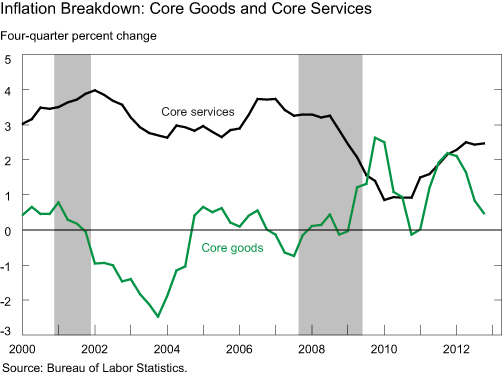
THE datasphere is bursting with inflation indexes (inflation inflation?). The Bureau of Labour Statistics provides consumer and producer prices while the Bureau of Economic Analysis gives us all manner of deflators. There are headline and core series (the latter stripping out especially volatile prices). One can look at price indexes for personal consumption expenditures (PCE), core PCE, “market-based” PCE, and core market-based PCE. There are chained indexes. The Cleveland Fed computes up median and “16% trimmed-mean” CPI. These different indexes provide a check on each other, and are often good at highlighting particular sorts of trends in the data. And new research by economists at the New York Fed suggests another way of chopping up inflation figures that looks especially informative. As it turns out, goods prices and services prices tend to behave very differently, with important implications for macroeconomic policy. A post at the New York Fed’s Liberty Street blog discusses the issue. You can see the divergence in core goods inflation and core services inflation in the chart below:

goodsandservices Read more of this post

China’s foreign ports: The new masters and commanders; China’s growing empire of ports abroad is mainly about trade, not aggression

China’s foreign ports: The new masters and commanders; China’s growing empire of ports abroad is mainly about trade, not aggression

Jun 8th 2013 | COLOMBO |From the print edition

20130608_IRM958_0

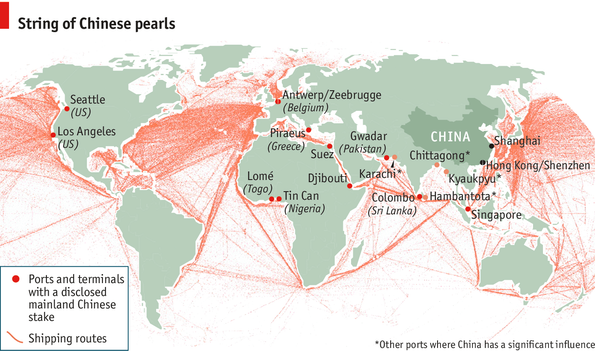
FROM the ground, Colombo’s port does not look like much. Those entering it are greeted by wire fences, walls dating back to colonial times and security posts. For mariners leaving the port after lonely nights on the high seas, the delights of the B52 Night Club and Stallion Pub lie a stumble away. But viewed from high up in one of the growing number of skyscrapers in Sri Lanka’s capital, it is clear that something extraordinary is happening: China is creating a shipping hub just 200 miles from India’s southern tip.

The old port is cramped and stuffed full of containers. To its left, a vast new breakwater curves into the ocean. Alongside it a Chinese ship has just delivered three giant Chinese cranes (see picture) to a new container terminal built by a Chinese company and run by an entity controlled by another Chinese firm. The terminal opens in July and will be complete in April 2014. The old port took centuries to reach its present capacity. China will have almost doubled it in under 30 months. Operated at full capacity, it would make Colombo one of the world’s 20 biggest container ports. Read more of this post