Challenging domination of oil’s powerful few

May 15, 2013 8:05 pm

Challenging domination of oil’s powerful few

By Ajay Makan in London

For decades the physical oil market has been the unregulated preserve of a few powerful companies. But in the wake of the Libor scandal, it is subject to intense scrutiny. Energy companies including BP, Royal Dutch Shell and Statoil, the majors raided by the European Commission on Tuesday in a probe into possible price rigging, have long dominated the trade. A handful of large commodity trading houses, hedge funds and investment banks are the other big participants. The market is not overseen by governments or exchanges, but by companies such as Platts, a price reporting agency (PRA) which publishes daily assessments that are gospel in the world of physical commodities. That gives Platts, a unit of the New York-listed McGraw Hill Financial, which was also raided on Tuesday, huge influence. According to Platts, its daily assessment of dated Brent, as the physical North Sea oil market is known, is the reference price for 60 per cent of crude traded worldwide. Dated Brent also underpins exchange-traded derivatives used by airlines to hedge prices and, along with taxes, Platts’ crude and product prices determine the price of petrol at the pump. The power of Platts has not gone unnoticed. Read more of this post
Vietnam must ditch state-sponsored crony capitalism

Last updated: May 15, 2013 8:03 pm

Vietnam must ditch state-sponsored crony capitalism

By David Pilling

For a country in its demographic sweetspot, the economy is not growing fast enough

The country has just emerged from a scandal that exposed virulent corruption at the heart of the Communist party. There is a pressing need to reform state-owned enterprises – behemoths of inefficiency, patronage and powerful vested interests. The internet is awash with stories about arbitrary land grabs, prisoners of conscience and the antics of the party’s privileged offspring. It sounds like China, but this is Vietnam, another one-party state where the economic and social aspirations of the people are bumping up noisily against a rigid and flawed political system. Read more of this post

India: Patents and precedents; Pharmaceutical companies fear that the battle raging in India over patents will inspire other countries to change their laws

May 15, 2013 8:12 pm

India: Patents and precedents

By Amy Kazmin

Pharmaceutical companies fear that the battle raging in India over patents will inspire other countries to change their laws

Meena, a 45-year-old New Delhi widow with a 10-year-old son, was diagnosed with potentially fatal blood cancer in 2010. To control it, her doctors prescribed an Indian*- made generic version of Novartis’ leukaemia drug. But her body stopped responding to it and Meena was advised to switch to a more expensive drug, Sprycel, a second-line cancer drug made by Bristol-Myers Squibb. Sprycel costs Rs160,000 ($2,900) per month, far out of reach for a woman living on her late husband’s Rs17,000 monthly pension. A solution appeared to be at hand last May when Natco, an Indian generic drugs company, started selling its own version of Sprycel for Rs9,000 a month. A charity helped Meena to buy it. But Meena’s ability to obtain potentially lifesaving medicine became tied up in a dispute pitting the interests of the world’s largest drugmakers – who spend $70bn annually developing drugs – and generic manufacturers in the developing world. Read more of this post

Indonesians mark the 15th anniversary of the fall of Suharto

Editorial: Indonesia Must Rise to Future Challenges

By Jakarta Globe on 1:00 am May 16, 2013.
As Indonesians mark the 15th anniversary of the fall of Suharto, they have every right to be proud of how far their nation has come. On May 21, 1998, Indonesia was a nation in crisis and on the verge of being balkanized. The government was in disarray and the economy was in free fall.

Riots, looting and mass demonstrations had erupted in major cities across the country. Money was fleeing the country and businessmen ran for the exit. The future looked bleak and chaos was the order of the day.

Fifteen years on, Indonesia is a nation transformed. It is the darling of foreign investors and a member of the G-20 group of largest economies in the world. It is a thriving democracy and a respected voice in regional and global affairs. Businesses are booming and a young middle class is rising.

Those chaotic days seem a distant memory now as a free press and an engaged civil society have led to political stability. The country has had two rounds of free and direct presidential and parliamentary elections without violence. Read more of this post

China ministry urges end to “forcible” land requisition; About 90,000 “mass incidents” – a euphemism for social unrest – occur each year in China, of which some two-thirds are triggered by land-related disputes

China ministry urges end to “forcible” land requisition: paper

Tue, May 14 2013

SHANGHAI (Reuters) – China’s land ministry has issued an emergency notice calling for an end to forced, illegal land requisitions, the state-run People’s Daily reported on Wednesday, stepping up efforts to defuse one of the biggest sources of public protest in China. The Ministry of Land Resources issued the notice in reaction to what the newspaper, the ruling Communist Party official publication, said had been a spate of violent land grabs. It called on regional authorities to re-examine and standardize land acquisition procedures. “Illegal acts of forcible land acquisition must be severely punished,” it said. China is rife with stories of regional governments and construction companies using strong-arm tactics to force residents to move, often with inadequate compensation, to make way for lucrative property developments. Forced evictions and land requisitions, which are widely thought to enrich officials unfairly at the expense of residents, have sparked tens of thousands of street protests and clashes over the years. The ministry said regions should conduct in-depth research into the problems behind current land disagreements and come up with targeted policies to handle them, ensuring that farmers are properly compensated, the paper said. About 90,000 “mass incidents” – a euphemism for social unrest – occur each year in China, of which some two-thirds are triggered by land-related disputes. The government has vowed repeatedly to crack down on illegal land grabs, but to little apparent effect.

Asia-Pacific Company Debt to Dwarf Developed Markets, S&P Says

Asia-Pacific Company Debt to Dwarf Developed Markets, S&P Says

Asia-Pacific corporate borrowing will exceed combined debt from the U.S., Canada, U.K. and euro zone in four years amid a surge in Chinese funding demand, according to Standard & Poor’s.

Non-financial entities in the region will probably borrow between $25 trillion and $27 trillion from 2013 to 2017, about half of the bonds and loans that will be sought globally in that period, S&P wrote in a report published today. That would boost Asia-Pacific debt to as much as $32 trillion by 2017, exceeding the projected $31 trillion total for the four North American and Western European economies, the ratings company said.

Issuers from Australia, China, Hong Kong, India, Indonesia, Japan, Korea, Malaysia, Singapore, and Thailand have sold $113.5 billion of U.S. dollar-denominated bonds in 2013, the most ever raised within the first five months of a year, data compiled by Bloomberg show. Assets held by China’s banks swelled 17 percent from a year earlier to 141.3 trillion yuan ($23 trillion) as of March 31, the China Banking Regulatory Commission said on its website yesterday. Read more of this post

Cancer Treatment’s Brutal Side Effects May Be Minimized

Cancer Treatment’s Brutal Side Effects May Be Minimized

Chemotherapy, radiation and the use of radioactive follow-up tests aren’t needed for some cancers, according to two studies that add to a growing debate on ways to lessen side effects and lower patient costs.

One study, in 1,800 men, found that chemo or radiation immediately following surgery in testicular cancer made no difference in long-term survival. A second, in 537 patients, determined that patients treated for the most common kind of lymphoma aren’t helped by expensive surveillance scans afterward that use radioactive tracers.

The two findings were released today in advance of the American Society of Clinical Oncology’s annual meeting in Chicago, set to begin May 31. They are the latest among recent studies aiming to fine-tune cancer care to eliminate the hair loss, fatigue, nausea and damaged DNA tied to the therapy while suggesting new ways to slow rising costs.

“The economics of health care and the quality of care are really being looked at more closely than in the past,” said Phil Kantoff, a professor of medicine at Harvard Medical School in Boston. “Why are you doing this? If the answer is ‘that’s what we do,’ rather than ‘there’s a study that shows we save lives this way,’ that’s not good.” Read more of this post

Longer Odds for Short-Selling Success

May 15, 2013, 4:35 p.m. ET

Longer Odds for Short-Selling Success

By JUSTIN LAHART

MI-BV992_SHORTH_NS_20130515170904

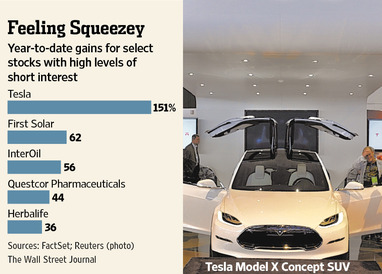
Most investors know that shorting a stock, or betting it will fall in value, entails the chance of huge losses. But knowing that is nothing like seeing it in action. The ramp higher in Tesla TSLA +1.92% shares in the days since the electric-car maker reported a first-quarter profit has served as a vivid reminder of just how dangerous a game shorting stocks can be. It may also signal a shift to a kind of market environment that can prove particularly treacherous for those on the short side. Even before Tesla reported, investors heavily short the shares had to be feeling queasy. In the time since Tesla said in early April that it had beaten its first-quarter deliveries target, its shares had risen 47%. When the stock jumped after the earnings report, the “short squeeze” looks as if it got unbearable. Investors raced to buy back shares they had sold short. That intensified the stock’s move higher, prompting even more pessimistic investors to throw in the towel. Tesla’s shares rose 53% in three trading days, taking its market value to a peak of $10.1 billion, from $6.4 billion. In turn, shares of other heavily shorted companies, likeInterOil IOC +1.39% and Questcor Pharmaceuticals, QCOR -9.46% also rallied. That is an indication some traders are actively looking to buy stocks with high short interest, posing an additional risk for short sellers.

Read more of this post

Private equity funds have struggled to offload investments made before the financial crisis and are taking longer to pay out to investors

Fund managers fail to offload investments following crisis

Filed 15 hours ago

LONDON – Private equity funds have struggled to offload investments made before the financial crisis and are taking longer to pay out to investors, research showed on Wednesday. Data from research firm Prequin showed that companies sold by funds in 2012 were held for an average of 5 years, compared to an average holding period of 3.9 years for companies sold in 2008. “Fund managers are still struggling to sell investments for a sufficient profit that were purchased at peak prices during the buyout boom, and consequently are holding portfolio companies for longer,” said Ignatius Fogarty, Head of Private Equity Products at Prequin. Just 33 percent of the capital investors chipped into deals made in 2007 has been returned in the last six years, compared to a 95 percent pay back rate in the six years after 2001.


Do Canadians love real estate too much?

Do Canadians love real estate too much?

Garry Marr | 13/05/15 | Last Updated: 13/05/15 6:57 PM ET
If you want to include your home as part of your asset mix, Canadians may not be such bad savers after all.

Chris asks: I have a large mortgage ($327,000) and I have been thinking a lot lately about a plan to pay it off by age 50. I’m 34, married, and my wife and I have a two-year-old son. We are responsible financially and our only other debt is for one car payment. Read more here.

The net worth of Canadians keeps rising — it reached $199,700 per capita at the end of the fourth quarter of 2012. But that wealth is being generated from our flourishing property prices, something that financial planners haven’t always considered in a retirement planning scenario. Read more of this post

isintegration or integration, both painful for eurozone; “There is no happy ending to this euro crisis. There is no winner, there are only losers”

Disintegration or integration, both painful for eurozone

by Jiang Hanlu, Huang Jihui

2013-05-15

NEW YORK, May 15 (Xinhua) — Leading economists have painted a grim outlook for the euro zone at a forum here, with one saying there will be no winners, no matter what course of action is taken.

“More integration will be painful for everyone, and disintegration will be also very painful. Whichever way is chosen, it will be very painful,” Andreas Hoefert, chief global economist with UBS Wealth Management Research, told the American Business Forum on Europe on Monday.

“There is no happy ending to this euro crisis. There is no winner, there are only losers,” he said. Read more of this post

Sovereign wealth funds from resource-rich countries controlling more than $500bn of assets operate with no disclosure, limiting their accountability and increasing the risk of corruption, a leading transparency watchdog has said

May 15, 2013 11:48 pm

Watchdog raises fears over wealth funds

By Ed Crooks in New York

Sovereign wealth funds from resource-rich countries controlling more than $500bn of assets operate with no disclosure, limiting their accountability and increasing the risk of corruption, a leading transparency watchdog has said. The Revenue Watch Institute, a New York-based group backed by charitable foundations and rich-country governments, published research on Wednesday showing that eight large funds, including the investment authorities of Qatar, Kuwait and Libya, disclosed no details at all about their assets, transactions or investments. Those eight funds are estimated to have assets worth $539bn. Other funds, including Saudi Arabia’s, which controls an estimated $530bn, and Nigeria’s, have little disclosure or political accountability.

Read more of this post

Why Hedge Funds’ Criticism of the Fed May Be Right

MAY 15, 2013, 12:15 PM

Why Hedge Funds’ Criticism of the Fed May Be Right

By JESSE EISINGER

The economics world has been having a lot of fun with hedge fund managers.

After several such managers at a recent conference denounced the aggressive money-printing policies of Ben S. Bernanke, the Federal Reserve chairman, the economic blogosphere rose up to mock them.

Many hedge fund managers have been predicting that high inflation and fleeing creditors would send interest rates skyrocketing. Stanley Druckenmiller, Paul Singer, J. Kyle Bass and David Einhorn — all big names in the investing world — have warned against the supposedly runaway central banker. Mr. Druckenmiller said that Mr. Bernanke was “running the most inappropriate monetary policy in history.” Read more of this post

As Baht Rises, Thai Tycoons Spend

Updated May 15, 2013, 8:00 p.m. ET

As Baht Rises, Thai Tycoons Spend

By JAMES HOOKWAY

Dhanin Chearavanont, billionaire chairman of CharoenPokphandGroup, says the stronger baht isn’t good for exports, but it is “a good opportunity for change.”

BANGKOK—Fifteen years ago, Thailand and other Asian countries let their currencies slide, using cheap exports to help lift them out of a devastating economic slump. Today, Thailand’s currency is soaring, and some of its tycoons are going on a buying spree. As Japan has moved to drive down the yen to power up its own exports, billions of dollars in funds have flowed into Thailand and other emerging markets in search of higher yields. That is pushing up the value of local currencies against major global counterparts such as the U.S. dollar and Japanese yen. It also is giving businesses a new, and sometimes perplexing, opportunity: purchasing power. The Thai baht has risen as much as 6% against the dollar since the beginning of the year and many economists predict further gains, leading some businessmen to reckon the best response is to borrow heavily in dollars to expand their businesses. Chief among them is Dhanin Chearavanont, who turned a seed business into Thailand’s largest conglomerate, making himself the country’s richest man in the process. Read more of this post

Easy Money: Too Much of a Good Thing?

Updated May 15, 2013, 1:41 p.m. ET

Easy Money: Too Much of a Good Thing?

By DAVID WESSEL

NA-BW388_CAPITA_G_20130515104804

WSJ Global Economics Editor David Wessel joins the News Hub with a look at what we know and what we don’t know about central banks, easy money, asset purchases and bubbles. Photo: Getty Images.

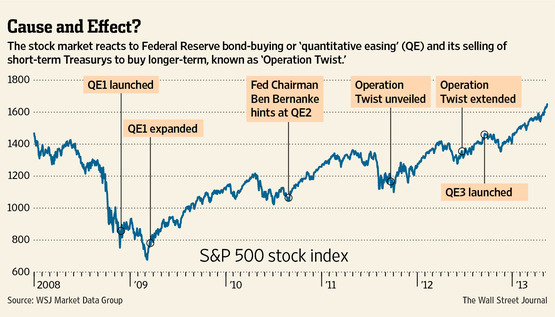
The Dow Jones Industrial Average has risen 14% since the Federal Reserve launched a third round of bond buying in September. The Stoxx Europe 600 index has climbed 22% since the president of the European Central Bank vowed in July to do “whatever it takes” to save the euro. Japan’s Nikkei has risen 22% since the Bank of Japan unveiled its big bond-buying initiative in April—and more than 50% since the election of a new government that campaigned on installing an aggressive central banker. There were, of course, other drivers behind the stock-market gains. But there’s little doubt that when central banks print lots of money (or hint they will), they push up stocks, bonds, houses and other assets. Indeed, that was part of the plan: Boost asset prices so businesses and consumers will spend more readily. Did the central banks’ efforts work? Did struggling economies get a lift? And has the Fed, which acted more forcefully than others, overdone it? Is it blowing another bubble already? Read more of this post

Asia’s biggest casino company SJM Executives to Sell Shares Worth as Much as $57M

SJM Executives to Sell Shares Worth as Much as $57M

Two senior executives of SJM Holdings Ltd. (880), Asia’s biggest casino company by revenue, are seeking to raise as much as HK$440 million ($57 million) in a share sale after the stock surged to a record. Chief Executive Officer Ambrose So and Chief Operating Officer Ng Chi Sing are offering 20 million shares at HK$21.50 to HK$22 each, a discount of 2.2 percent to 4.4 percent to yesterday’s close, terms for the deal show. Deutsche Bank AG (DBK) is joint book runner, according to the term sheet. Read more of this post

Malaysia Prime Minister Najib Cabinet Rewards Base as Chinese Sidelined: Southeast Asia

Najib Cabinet Rewards Base as Chinese Sidelined: Southeast Asia

Malaysia Prime Minister Najib Razak stocked his Cabinet with party stalwarts, after the ruling coalition’s biggest ethnic Chinese partner said it wouldn’t accept ministerial posts following its poor election showing.

Najib tapped leaders of his ruling United Malays Nasional Organisation for key positions before party polls later this year that will determine whether he stays on as prime minister. He also gave posts to the heads of Malaysia’s biggest bank, a corruption watchdog and a Hindu rights group. Two of the new line-up are Chinese, compared with more than a dozen previously.

“The Cabinet reflects a prime minister concerned about retaining the premiership and the presidency of UMNO,” said Edmund Terence Gomez, a professor at the University of Malaya in Kuala Lumpur. “I don’t see any move in the direction to talk about reconciliation and transformation and inclusivity in this cabinet.”

Najib’s coalition retained power in the May 5 election even after losing a majority of the popular vote for the first time since 1969, which the prime minister attributed to a loss of support from Chinese voters. Besides an ethnic divide, his administration faces a weakening economy, with Malaysia’s growth slowing to less than 5 percent for the first in seven quarters. Read more of this post

Euro-Style Bail-In Plan Means Bondholder Wipe-Out: Brazil Credit

Euro-Style Bail-In Plan Means Bondholder Wipe-Out: Brazil Credit

Brazil is drafting rules that would wipe out some creditors of failing banks in an effort to avoid taxpayer rescues, echoing European proposals to make bondholders shoulder more costs after three bailouts in as many years.

The central bank said May 6 it had prepared a draft of a “bail-in” proposal that would impose losses on holders of subordinated and unsecured bonds in case of insolvency and use their investments to revive the lenders. The measure would boost funding costs for the nation’s investment-grade banks, which currently pay a near record-low 3.77 percent on average to borrow dollars in the bond market, according to Carlos Thadeu de Freitas Gomes, a former central bank director.

The proposal, similar to one being considered by European Union lawmakers, comes after seven Brazilian banks became insolvent in the past three years and the deposit insurance fund spent 3.8 billion reais ($1.9 billion) to rescue Banco Panamericano SA. The rules would clarify risks for investors, save taxpayer money, and shield policy makers from political pressure to rescue lenders that took excessive risks, even as it pushes up costs for financial firms, said Freitas, now the chief economist at the National Commerce Confederation.

“It’ll help establish order and more transparency,” Freitas said in a telephone interview from Rio de Janeiro. “Investors know that, if there is a bankruptcy, they will have to cover the costs.” Read more of this post

US Government Begins BitCoin Crackdown

US Government Begins BitCoin Crackdown

Tyler Durden on 05/15/2013 14:02 -0400

As we first noted here (regulation) and here (supervision), the US government has been gradually encroaching on the independence and freedom of the virtual currency. This week, as The Washington Post reports, the government escalated. The feds took action against Mt. Gox, the world’s leading Bitcoin exchange. Many people use Dwolla, a PayPal-like payment network, to send dollars to their Mt. Gox accounts. They then use those dollars to buy Bitcoins. On Tuesday, Dwolla announced that it had frozen Mt. Gox’s account at the request of federal investigators.

It’s the first federal action against the currency. CNet has confirmed that the asset seizure was initiated by Homeland Security Investigations (which among other things is responsible for enforcing the laws associated with money laundering and drug smuggling).

As this crackdown begins, many argue that “you can’t put the genie back into the bottle,” as far as shutting down the ‘network’ of open source transactions; but as one Bitcoin enthusiast added (sadly), “I hate to say it, but the Bitcoin community needs to start lobbying, it needs to start educating policymakers, lobbyists and influencers about the pros of Bitcoin and the impossibility or the difficulty in getting rid of all the bad uses.” Read more of this post

Will Fed “Taper” Talk Crush Chinese Property Prices?

Will Fed “Taper” Talk Crush Chinese Property Prices?

Tyler Durden on 05/15/2013 21:01 -0400

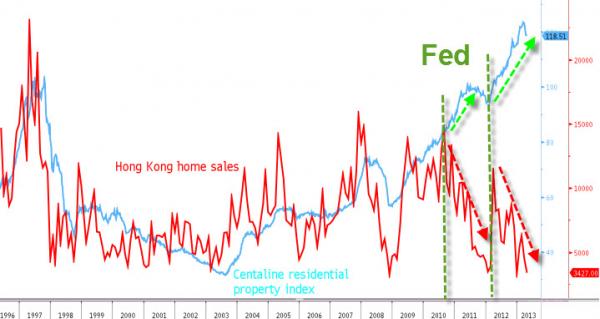
When the Fed extended its guidance for extremely low rates to 2014 and later, none of the Chinese government’s measures to deter property speculation could deter ‘homebuyers’ from bidding up prices. However, as the chart below shows, the disconnect between home prices (extreme highs) and home sales (near lows) has never been greater and with the Chinese looking to further control speculation at the same time as a Fed that is increasingly jawboning a slowing to its easy money policy, the prices of Hong Kong property has begun to drop in recent weeks. As Bloomberg notes, prices have fallen 4.2% from a record reached in mid-March, compared with a 77% contraction in sales from their post-global financial crisis peak in 2010.  The prices of property is explicitly deterring the ‘urban dream’ that we explained here, but any sustained drop in property prices (given the shadow lending and collateralization this bubble represents) leaves China once again between a bubble-pricking rock and an inflationary (social unrest harboring) hard place. The Hong Kong dollar’s peg to the U.S. counterpart has kept borrowing costs in the city at near-record lows, underpinning a 109% gain in home prices since the beginning of 2009, even as the government imposed several property curbs to cool demand. Hong Kong property prices relative to sales…

20130515_china1_0

Massive fund outflow challenges China’s forex management

Massive fund outflow challenges China’s forex management

Staff Reporter

2013-05-15

The influx of hot money and outflow of funds via various channels in China underscores the increasing challenge to the country’s foreign exchange management system, reports the Beijing-based China Economic Weekly. According to Jones Lang LaSalle, a multinational real estate service firm, overseas commercial property investments by Chinese investors have jumped by 33% last year to US$4 billion and may reach US$5 billion by the end of this year. The investments coincide with an increase of Chinese nationals choosing to emigrate, a group which totaled more than 150,000 people in 2011. The huge amount of funds flowing out of the nation via various channels are reportedly due to the official restriction on outward forex remittance, which is capped at US$50,000 per person a year. The People’s Bank of China, aware of the futility of efforts to stem the outflow of money, recently summoned representatives from a number of foreign banks, including HSBC, Citibank, Standard Chartered, and DBS, to discuss the establishment of a system governing offshore investments by Chinese nationals, the China Economic Weekly said. The government also discussed the issue during a meeting of the National People’s Congress Standing Committee on May 6, and will now aim to monitor cross-border fund movements, which currently evades government inspection. Liu Jinchuan, a financial expert, said that underground channels for fund outflows include underground financiers, assets transferred via trade and investment, money laundering via offshore casinos and offshore bank cards. There are many brokers for overseas investments in Shenzhen, on the border with Hong Kong, with many of them operating as local underground financiers, the paper said. Adi (pseudonym), a money broker, said that the State Foreign Exchange Administration, while capable of controlling the cross-border movement of large amounts of funds, is powerless to regulate the movement of smaller amounts of money, equivalent to several millions or tens of millions of renminbi. Adi said he can remit funds out of the country within half an hour of receiving notice from his clients, for which he charges a fee of 0.8%-1.5%, adding that the transfer of large-scale funds can be carried out in installments. Chinese investors have also been funneling funds abroad via foreign trade, such as bloating import prices or underreporting export prices, especially in the case of hi-tech products. The underground outflow of funds via foreign-trade channels explains in part the increase of Hong Kong’s export value, which shot up by 74.2% year-on-year to US$105.6 billion in the first quarter of this year, much higher than its import figures.

That sighing sound you hear from China… is strategists everywhere cutting their GDP forecasts

That sighing sound you hear from China

Kate Mackenzie

| May 15 09:45 | 1 comment | Share

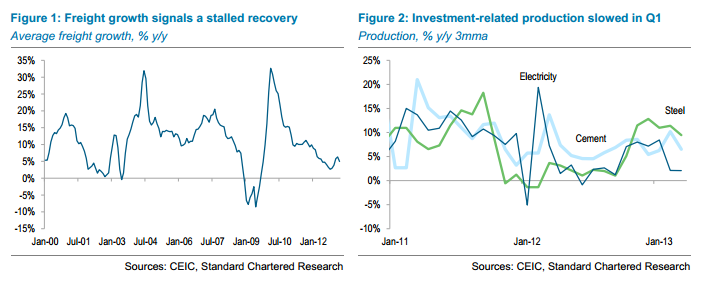
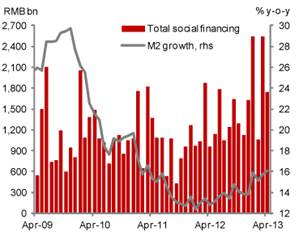
… is strategists everywhere cutting their GDP forecasts. Last week Standard Chartered’s China economist Stephen Green and his team slashed their 2013 forecast to 7.7 per cent from 8.3 per cent. Their 2014 forecast was cut to 7.5 per cent from 8.2 per cent. Today, BAML’s Ting Lu cut to 7.6 for both 2013 and 2014, from 8 per cent and 7.7 per cent, respectively. It seems that April data has dampened any hopes that the Q1 surprise of just 7.7 per cent growth was due to simple base effects such as a missed leap year day or variations in the Chinese New Year holiday. Here are charts of Green et al’s favoured indicators suggesting that this economy won’t be powering back to 8 per cent levels of growth: What went wrong? Green cites a slow and patchy real estate recovery and pressure on local government investment vehicle cash flows, plus slow land sales outside big cities. BAML’s Lu says that, unusually, the quarter-on-quarter rate will keep rising: To be sure, we continue to expect a recovery of sequential growth; however, we have decided to revise down quarterly year-over-year GDP growth as well as annual growth in 2013E. More specifically, we maintain the view that sequential growth (QoQ, seasonally adjusted but not annualized) could bounce from 1.6% in 1Q to around 1.9%-2.0% in 2Q-4Q this year, but we cut quarterly YoY growth to 7.7%, 7.6% and 7.5% in 2Q, 3Q and 4Q (vs 7.7% at 1Q13) from the previous 8.1%, 8.0% and 8.0% respectively. Interesting, but we’re not sure of the significance of the non-annualised quarter-on-quarter figures; it’s true the non-annualised figures have moved around a lot since they were first published a couple of years ago, but most countries give annualised figures so figures like 1.9 per cent growth probably aren’t going to float many people’s boats. Lu however argues that the focus on the year-on-year figures might leave investors overly spooked and, in turn, lead to a more bullish tone if/when the focus shifts. We’re a little more sceptical that the favoured data points change any time soon, considering China’s main quarterly GDP growth number is already quite unusual. Another bullish theory was that the surge in credit growth, particularly in March, might just take some time to generate more growth. Credit data for April however showed that even if that’s the case, it’s not a sustained surge anyway:  Finally, the chance of a renewed stimulus push looks ever less likely (not that many pundits have been openly expecting this anyway). From Bloomberg News: “To achieve this year’s targets, the room to rely on stimulus policies or government direct investment is not big — we must rely on market mechanisms,” Li said in a May 13 speech broadcast to officials around the country, according to a transcript published last night on the central government’s website. Relying on government-led investment for growth “is not only difficult to sustain but also creates new problems and risks,” he said. Incidentally, Green says big stimulus is unlikely unless unemployment begins to look like a problem. Makes sense.

China-Freight-and-investment-to-April-2013-StanChartChina-Electricity-and-construction-starts-StanChartChina-TSF-and-M2-April-2013-Nomura

Trade between Hong Kong and Guangdong artificially skewed; Firms inflate trade data to cash in on currency exchange gains

Firms inflate trade data to cash in on currency exchange gains

Staff Reporter

2013-05-15

Many Chinese trading firms have been inflating their performance without the knowledge of the local banking system, Shanghai’s First Financial Daily has reported. The news comes in the wake of unusually high import and export data which was recorded during both March and April and prompted China’s State Administration of Foreign Exchange to issue a notice that it will enhance inspections of firms’ transactions and adjust policies for goods which leave the country. China’s bilateral trade with Hong Kong jumped 66% year over year for the first four months ending April 30. The mainland’s exports to Hong Kong grew 92.9% in March from the same period a year ago, which is the highest growth reported since March 1995. Many companies are found to have made up or adjusted their import data in order to receive foreign currency loans and increase their credit limit from local banks, the report said. Many banks in China offer currency clearing services for international firms as part of the central government’s policies to help domestic firms expand globally and to internationalize the renminbi. The special clearing service is a win-win for both the companies and the banks. The services generate certain revenue for trading firms, which helps them cut down on overall expenses, and also helps the banking sector earn service fees. Companies have to make a full down payment, which translates into sizable and virtually risk-free deposits for banks, said a risk manager at a bank in Shenzhen, who wished to remain anonymous due to the sensitive nature of the issue. The practice may result in the banks’ loose regulations on trading firms’ applications for the clearing service, he said. There is mounting speculation that the growing trading figures might be inflated by companies that routinely moved goods in and out of special trade zones to claim tax rebates. For the first four months ending April 30, exports from Guangdong province rose 35.6% from a year ago. Of that increase, Shenzhen’s share accounted for more than 90% of the growth due to the city’s special trade zones which allow for smoother processing for exports.

Trade between Hong Kong and Guangdong artificially skewed

Staff Reporter

2013-05-14

China’s total trade reached 6.12 trillion yuan (US$995 billion) in the first quarter of the year, marking year-on-year growth of 13.4%, after excluding the effects of foreign exchange. The country recorded an 8.4% increase in exports for the quarterly period ending March 31, the Guangzhou-based Southern Weekly reports. Read more of this post

Sham shampoo: China’s market for impersonal care products; A 400ml bottle passing itself off as Procter & Gamble’s Pert shampoo sells for 10 yuan (US$1.60) per bottle while the genuine article sells for US$5.30

Sham shampoo: China’s market for impersonal care products

Staff Reporter

2013-05-15

The market for personal care products is a breeding ground for knockoffs in China, with manufacturers cashing in on the low costs and high returns involved, reports Shanghai’s First Financial Daily.

Rural areas in Henan, Guizhou and Anhui provinces have become the epicenter for cheap imitations of personal care products. Mo Lei (pseudonym), an Anhui-based entrepreneur who primarily trades in counterfeit goods, said that there are knockoff factories everywhere in China and there are also wholesale markets that primarily deal with fakes.

A 400ml bottle passing itself off as Procter & Gamble’s Pert shampoo sells for 10 yuan (US$1.60) per bottle at local retailers, while the genuine article sells for 32.80 yuan (US$5.30) for the same amount. Read more of this post

Legend Holdings, which owns Lenovo Group, the world’s second-largest PC maker, is planting itself deeper into the agricultural sector with Joyvio Group

Legend puts down deeper roots in agribusiness

Staff Reporter

2013-05-15

Legend Holdings, which owns Lenovo Group, the world’s second-largest PC maker, is planting itself deeper into the agricultural sector with Joyvio Group, which specializes in investment in and operation of related businesses in the area of modern agribusiness, the Beijing-based The Economic Observer reports. By using satellite technology to manage its farms, Joyvio can immediately see the condition of its crops. It has installed GPS on its drug-injecting carts to monitor pesticide sprays. Read more of this post

Did some traders have advance knowledge of huge Sony revamp and make big money?

Published: Wednesday May 15, 2013 MYT 9:02:00 AM

Did some traders have advance knowledge of huge Sony revamp and make big money?

NEW YORK: A surge in option market bets on Sony Corp just before a large hedge fund investor announced a big stake and called for a major restructuring of the company has raised concerns that some traders may have had advance word of the news.

U.S.-listed shares of Sony Corp <6758.T> jumped 9.9 percent to close at $20.76 after Daniel Loeb’s Third Point hedge fund said on Tuesday it accumulated more than 6 percent of Sony’s shares – a stake worth $1.1 billion – making it the largest shareholder in Japan’s biggest electronics company.

But on Monday, the day before that announcement, trading volume in Sony options soared by more than seven times the average daily activity in the last three months. Volume in its stock rose to 6.1 million shares, more than doubling the average 2.7 million shares over the past 25 days. Read more of this post

How Can We Tell If ‘Abenomics’ Is Working?

How Can We Tell If ‘Abenomics’ Is Working?

Japan is in the midst of a grand experiment to revivify its economy through a three-pronged campaign of monetary easing, fiscal stimulus and structural reforms. The markets have noticed: The Nikkei stock index has gained more than 70 percent while the yen has become more than 22 percent cheaper relative to the dollar and the euro since mid-November. At the same time, the difference in yields between 5-year Japanese government bonds and their inflation-indexed equivalents has widened by more than a percentage point.

All of this has led some observers to declare that Japanese expectations about inflation and growth have been transformed, thereby leading to a resurgence of domestic spending, hiring and investment. It’s unclear, however, that this has actually happened.

Let’s start with the obvious: Wages, prices, retail sales and industrial production are all flat or falling. On the bright side, the earnings outlook for Japanese firms is much better than it was six months ago, both in absolute terms and relative to firms in other rich countries. Those forecasts, however, are predicated on the belief that the Japanese economy will live up to the hype. Read more of this post

BMWs Cheaper Than Hyundais on Tariffs Imperil Korean Maker; “Customers who were loyal to the brand for over 20 years are breaking away. It shows that imported brands are now perceived as something accessible.”

BMWs Cheaper Than Hyundais on Tariffs Imperil Korean Maker: Cars

Lee Tack Young says Hyundai Motor Co. (005380)’s luxury vehicles are oversized, overpriced gas guzzlers. So he opted for a more modest alternative: a BMW 528i.

Foreign brands have seen their share of South Korea’s market for premium vehicles surge to 41 percent from 28 percent in the past two years, according to Korean industry groups, as lower tariffs make their cars cheaper and local buyers abandon a decades-long preference for domestic brands.

“I was looking for a quality car that wasn’t too big,” said Lee, president of Cosmetic Engineering, a packaging-machinery maker near Seoul. The 65-year-old’s last seven cars were all Korean, starting with a Hyundai Excel in the 1980s.

This time, he chose his 71 million won ($64,000) BMW over an 85 million won K9 from Hyundai affiliate Kia Motors Corp. (000270) “Unless Hyundai and Kia change and offer me more variety and better quality, I don’t see any reason to go back,” Lee said.

The shift has made South Korea a growth market for Bayerische Motoren Werke AG, Daimler AG (DAI)’s Mercedes-Benz, and Volkswagen AG (VOW)’s Audi. Their gains are coming at the expense of Seoul-based Hyundai and Kia, which count on sales of luxury vehicles in their home market for much of their earnings. Read more of this post

Chinese Suggestions for Improving Internet Disappear

Chinese Suggestions for Improving Internet Disappear

Chinese president Xi Jinping may claim to be interested in hearing the voice of his people, but it’s increasingly clear that this openness doesn’t always extend to people on the Internet.

On Sunday night, billionaire real-estate developer Pan Shiyi tweeted to his 15.3 million followers on Sina Weibo, China’s leading social-media platform: “Soon I might meet a top government Internet regulator,” he announced. “Anything you’d like me to pass along?” By 7:48 a.m. the next morning the tweet had been re-posted 3,455 times and generated 3,891 comments.

Few things irritate Chinese netizens as much as how their government acts on the Internet: blocking access to many foreign websites, censoring content and comments on Chinese websites and directing paid commentators to promote the government’s viewpoint. Over the past few days, the accounts of at least three prominent microbloggers were deleted, and one suspended, including accounts that belonged to Murong Xuecun, the pen name of Hao Qun, a novelist with 1.85 million followers on his Sina Weibo account when it was yanked. Read more of this post

China Corporate Debt to Overtake U.S. Within Two Years, S&P Says; China will need more than $8 trillion for refinancing during the five years, accounting for half of such needs in the Asia-Pacific region

China Corporate Debt to Overtake U.S. Within Two Years, S&P Says

Chinese corporate borrowing will probably exceed that of U.S. companies within the next two years, according to Standard & Poor’s.

Non-financial institutions from the world’s second-largest economy will need $18 trillion of debt during the five years ending 2017, the ratings company said in a report yesterday. That’s 34 percent of the $53 trillion in bonds and loans S&P estimates will be sought globally and compares with $13 trillion forecast for U.S. companies.

Chinese and Hong Kong borrowers sold $41.2 billion of U.S. dollar-denominated bonds since December, the busiest start to a year on record, according to data compiled by Bloomberg. Cnooc Ltd. (883), the nation’s biggest offshore energy explorer, raised $4 billion this month with the largest offering out of Asia in a decade, as it looks to replace part of a loan used to acquire Canada’s Nexen Inc.

“High levels of investment, primarily in manufacturing, real estate, and infrastructure, have supported the country’s strong economic growth rate, particularly over the past five years – and credit is fueling this investment,” S&P said in the report. “While China is now on a lower growth trajectory than in the prior decade, the trajectory is still very high by global standards.”

China’s economic expansion unexpectedly slowed to 7.7 percent last quarter from a year earlier, losing momentum from the 7.9 percent expansion in the previous three months, according to the statistics bureau. Read more of this post