China Encourages Foreign Auto Investment in Policy Reversal

China Encourages Foreign Auto Investment in Policy Reversal

China said it will encourage foreign investment in vehicle manufacturing in its western region, reversing a policy to remove automaking from a list of industries qualifying for government incentives.

Starting June 10, foreign auto investment will be given preferential treatment, the National Development and Reform Commission and Ministry of Commerce said in a joint statement today, without giving more details. The policy was among measures taken to encourage labor-intensive projects in the central and western regions, which attracted $19.2 billion in overseas investment last year, according to the statement.

The announcement follows official figures this week that showed foreign direct investment growth slowed in April, highlighting concern at the outlook for the world’s second-biggest economy. Giving foreign automakers preferential treatment in building plants may allow companies like Volkswagen AG (VOW) and General Motors Co. (GM) to accelerate expansion in China, increasing competition for local companies. Read more of this post

McDonald’s Seen Overhauling U.S. Menu From 145 Choices; “They can’t make the food fast enough”; “Part of the reason why Chipotle works so well is that it’s simple”

McDonald’s Seen Overhauling U.S. Menu From 145 Choices

The Angus burger is going away, and it may not be the only McDonald’s dish on the chopping block.

The world’s largest restaurant chain has also considered axing Caesar salads, the McSkillet Burrito, the Southern Style Biscuit and steak bagels, according to a franchisee e-mail obtained by Bloomberg News. While the Angus burger contains as many as 820 calories and costs $4, the culling isn’t simply about offering healthier fare and cheaper items. It’s an effort by McDonald’s Corp. (MCD) to streamline a menu that has expanded by 70 percent to about 145 items since 2007 — straining kitchen staff, gumming up service and spoiling customers for choice.

“It’s gotten to the point where the operation has kind of broken down and that’s all a symptom of the complication of the menu,” said Richard Adams, a San Diego-based restaurant franchisee consultant and former McDonald’s store owner. “They can’t make the food fast enough.” Read more of this post

Three Asian Democracies, One Lame-Duck Problem

Three Asian Democracies, One Lame-Duck Problem

Voters in the Philippines appear to have delivered a resounding victory to President Benigno Aquino in midterm elections. The son of former President Corazon Aquino looks set to control both houses of Congress, giving him a mandate to continue his reform policies. His biggest worry now is making them stick.

In the first half of his six-year term, Aquino arrested his predecessor on corruption charges, faced down the business lobby to pass revenue-raising taxes on cigarettes and liquor, and challenged the powerful Catholic Church by providing free contraceptives to slow population growth. His payoff: investment-grade credit scores for the first time, the support of almost three-quarters of the electorate and even a place on Time magazine’s list of 100 most influential people.

It may seem odd, then, that with three years left in his term, some pundits are already calling Aquino a lame duck. Rivals know the president can’t run again; all that Aquino has accomplished could easily be undone by a successor more interested in self-enrichment than good governance. He not only needs to push forward with his reforms now, while he has a popular tailwind, but also must make sure that his foes can’t easily roll them back once he’s gone. Read more of this post

Singh’s Growth Push Imperiled as Graft Scandals Rattle: Economy

Singh’s Growth Push Imperiled as Graft Scandals Rattle: Economy

Indian Prime Minister Manmohan Singh’s latest skirmish with corruption risks setting back efforts to spur growth, worsening a legislative logjam under a government set to pass the fewest bills ever in a full term.

Singh, 80, is grappling with renewed allegations that he has allowed corruption to fester after separate graft probes led to the May 10 dismissal of the law and railways ministers. Parliament ended two days early last week as opposition parties demanding the men’s resignation blocked proceedings, with proposals to open up the country’s pension and insurance industries to overseas investment still stalled.

At stake is Singh’s ability to extend an eight-month push to revive Asia’s No. 3 economy that included allowing more foreign investment in aviation and retail, measures for which parliamentary approval weren’t required. With just the monsoon and winter sessions left this year before a general election in 2014 and India’s expansion at a decade low, the government is running out of time to complete its legislative agenda. Read more of this post

Thailand’s asset management industry is voted the third best in the world, according to a global investor survey, behind US and South Korea

Thai fund industry ranked 3rd in the world

The Nation May 17, 2013 2:05 pm

Thailand’s asset management industry is voted the third best in the world, according to a global investor survey announced today by the Securities and Exchange Commission. Thailand follows the US and South Korea. It scores well in terms on regulatory framework and tax structure and improvement in selling activities and intermediary role. Yet, Thailand still has to improve some areas, particularly the information disclosure. Morningstar’s survey covers investors in 24 countries, ranked Thailand at the “B” level, putting it on par with the Netherlands, Singapore and Taiwan. This is chiefly thanks to tax incentives like capital gain tax waiver and tax deduction on investment in long-term mutual funds.This raised the scores in the regulatory and tax category above the average level. However, some limitations need to be addressed, like the ones on local funds’ overseas investment and the direct offering of overseas funds to Thai investors. In the fee and expense category, the scores are higher than the average., as most funds do not levy fees on unit trust transactions. In the disclosure category, Thailand wins a moderate score. Absent from Thai funds’ prospectus are trading cost, the names of fund managers and their experiences as well as investment data of the funds under the managers’ control. Thailand scores the lowest points in the selling and intermediary category, though the 2013 result is better than the previous year. Most funds are now sold via bank branches, limiting access for some investors. Less than 20 per cent of mutual funds is sold through non-bank channels.  “The research reflects the continued development in the Thai asset management industry. There is still much to be done, though,” said SEC Secretary-General Vorapol Socatiyanurak.

S&P: Asia’s Unfinished Homework: Rebalancing Growth To Make It Sustainable

Asia has unfinished homework: S&P

The Nation May 17, 2013 1:00 am

Although Asia’s trade and current account surpluses have declined recently, the evidence is mixed on whether the indicators have improved for the right reason, according to Standard & Poor’s Ratings Services. In its report on “Asia’s Unfinished Homework: Rebalancing Growth To Make It Sustainable,” S&P said the region has been accused of having “mercantilist tendencies” for its role in the unhealthy global imbalances. Paul Gruenwald, chief economist for Asia-Pacific, said China often gets the lion’s share of the blame for Asia’s surpluses. “When the indicators in Asia are scaled by GDP, we see that size matters,” he said. “It’s easier for a small economy to run a large surplus or deficit, and the ‘big guys’ don’t look so dominant when we scale the data. “If we scale China’s current account and foreign currency reserves by GDP, the country doesn’t appear so uniquely guilty of generating the types of macroeconomic outcomes typically associated with the conventional wisdom about Asia’s contribution to global imbalances,” he said. Asia’s unfinished homework is to rebalance to a more consumption-driven economic model. “Note that it isn’t about simply consuming more. Consumption has been trending higher in all the economies in our sample. The key is for private consumption to grow faster than GDP. Only then will the consumption-to-GDP ratio rise,” he said.

Aussie Dollar dives like a ‘falling knife’

Dollar dives like a ‘falling knife’

May 17, 2013 – 3:39PM

Glenda Kwek
1_dollar-620x349353-aud-commodity-300x0

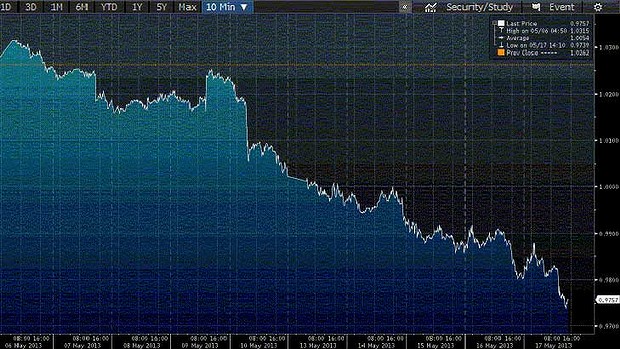
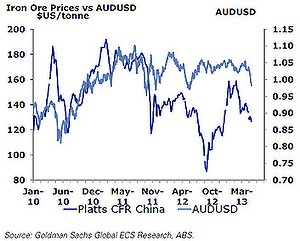
On the way down … the Australian dollar over the past 10 trading sessions. In just 10 days, the Australian dollar has fallen from US103¢ to US97.4¢. The sudden fall has been so sharp one currency strategist described it as a ”falling knife”. The dollar has now fallen for five weeks in a row, and is on track for its worst weekly fall this week since November 2011. So what’s been driving the recent drop, and should we expect a rebound any time soon, if at all? Australian dollar … commodity price trends suggest that the currency should be trading closer to 80 US cents than parity, Goldman Sachs analysts say. In short, the first trigger was the sudden rallying of the US dollar against the yen and other currencies last Thursday night in New York. The US dollar broke through the significant psychological barrier of 100 yen and sent its Australian counterpart into free fall. That pushed the dollar past its own psychological barrier of US101.50¢ and it didn’t take long for the currency to drop through parity on Friday night. The Australian currency continued to fall over the past week, while the greenback has kept strengthening. This is not the first time the Australian dollar has broken out of the 102 to 106 US cents range it has been mostly trading in over the past two years. In September 2011 and May 2012, the currency fell below parity with the US dollar but lifted again shortly after.

Turning point

But currency strategists said the Australian dollar appeared to have reached a turning point, and talk of it bouncing back to above-parity levels was looking less likely.

”The big difference between this fall and the falls in the last couple of years is that they were driven by risk aversion, big falls in asset prices and global growth confidence associated with the European currency crisis,” RBS currency strategist Greg Gibbs said.

”This time, the Australian dollar has fallen in a risk-positive environment, and in some ways, it makes it feel more permanent.”

As optimism grows about the US economy amid growing expectations the US Federal Reserve could wind back its ”quantitative easing” money-printing strategy by the end of this year, investors were once again turning to other fundamentals that drive the Australian dollar, such as the Chinese economy, commodity prices, and the mining investment outlook, Mr Gibbs said.

And all of these indicators have been weak of late.

Stars align for drop

”Iron ore since the peak in February of this year … has lost a fifth of its value. Importantly, coking coal prices have weakened fairly significant too. The spot price of coking coal from the highs in February has dropped by 18 per cent,” Westpac chief currency strategist Robert Rennie said.

”When two or our key export commodities – coking coal and iron ore – lose a fifth of their value, that obviously implies that we should see some weakness in the currency.”

Mr Gibbs said investors now viewed the Australian dollar as reconnecting with commodity price movements.

The Japanese selling of the Australian dollar has also been weighing it down. Japanese investors were net sellers of Australian bonds last year – the first time since 2005 – while becoming record buyers of European bonds.

Given Japan’s influence in the debt market – where it contributes about 10 per cent of all portfolio investment in debt securities, the sell-off could also lower the dollar, HSBC analysts said.

Also fuelling the recent lows are the federal government’s announcement of budget deficits in the next few years, soft domestic economic indicators and the imminent peak of the mining investment boom, Goldman Sachs analysts said in a research note, adding they had reduced their 12-month Australian dollar forecast to 90 US cents.

No longer a safe haven?

At the same time, another change is occurring.

The Australian dollar, along with commodities such as gold, has functioned as a safe haven amid the global economic turmoil over the past few years. They have provided an avenue for higher yield as compared to other investment assets.

But as the recent plunge in gold prices showed, optimism about the US economy and its outlook was driving investment away from safe havens like the Australian currency and gold, and back into other investment vehicles such as the US equities market and greenback.

Already, the lack of increased inflation as economies printed more of their currency over the past few years meant investors felt they no longer needed to pile into the Australian dollar and use it as a hedge, like gold, against global inflation, ANZ currency strategist Andrew Salter said.

”Despite the truly considerable increase in global money supplies the world over, central banks have been largely successful in keeping inflation near target and consumer and business expectations in check,” Mr Salter said.

What‘s next?

All eyes will be on Federal Reserve chairman Ben Bernanke as he speaks on Saturday in the US at a graduation ceremony, and testifies to Congress’ joint economic committee on the US economic outlook on Wednesday.

Any indication that suggests the Federal Reserve is open to winding back its bond-buying program – part of how it has been pumping money into the economy – could push the US dollar higher, and its flipside, the Australian dollar, down.

The falling Australian dollar could pare back expectations of a Reserve Bank rate cut in June.

Financial markets were pricing in a 19 per cent chance of a cut next month, and  the chance of at least one more cut by the end of this year.

Meanwhile, a 6 per cent decline in the exchange rate (the past 10 days has seen it decline by 5.6 per cent) could have the same impact as a 100 basis points interest rate cut, boosting economic growth by about 100 basis points over a couple of years, Barclays chief economist Kieran Davies said in a research note today.
Denmark Shelves Euro Goal Indefinitely as Crisis Scars Too Deep

Denmark Shelves Euro Goal Indefinitely as Crisis Scars Too Deep

Denmark is shelving indefinitely its euro adoption goal as Prime Minister Helle Thorning-Schmidt says an exchange rate peg without full European monetary membership is proving the best currency regime for the Nordic nation.

A euro referendum “in this election term is unrealistic,” Thorning-Schmidt said yesterday in an interview in Stockholm. “I don’t think it makes any sense to discuss the option of a euro referendum in the next term” set to run from 2015 to 2019, she said. Read more of this post

U.K. commercial real estate investors may be unable to refinance about half of their 198 billion pounds ($303 billion) of bank loans as property values fall

U.K. Property Loans Seen Facing 92 Billion-Pound Refinancing Gap

U.K. commercial real estate investors may be unable to refinance about half of their 198 billion pounds ($303 billion) of bank loans as property values fall, a survey by De Montfort University shows.

About 92 billion pounds of remaining bank loans are “likely to be unrefinancable on terms available in today’s lending market,” according to the survey of 78 lenders, which was published today. The amount of the loans is too high compared with the real estate backing them, the report by the Leicester, England-based university said.

Banks and other lenders cut U.K. commercial real-estate lending by 7.7 percent last year as they repaired balance sheets damaged by losses and tried to meet regulatory requirements, De Montfort estimates. Almost a quarter of all property loans are now in “severe distress” because the outstanding debt is higher than the value of the real estate after the worst-located and lowest-quality buildings in the U.K. depreciated further last year. Read more of this post

Chief executives and the itch to quit

Thu, May 16 2013

By Andrew Callus

LONDON, May 16 (Reuters) – On approaching his 60th birthday this year, long-serving Tullow Oil boss Aidan Heavey told staff he felt “like two 30 year-olds”.

A handful of recent shock departures by 50-something chief executives at European blue chip companies – none of them under any obvious pressure to quit – suggest some of his peers either lack that vigour, or want to channel it elsewhere.

Peter Voser is giving up one of the world’s most challenging CEO roles at Royal Dutch/Shell next year, before his 55th birthday, in pursuit of a “lifestyle change”.

Swiss engineering group ABB’s 55-year old boss Joe Hogan is also going, for “private reasons”. Pierre-Olivier Beckers, 53, is walking out on Belgian retailer Delhaize , and Paul Walsh, 57, is waving goodbye to drinks multinational Diageo. Read more of this post

Central banks saved world economy, now beware the fallout

Published: Friday May 17, 2013 MYT 11:30:00 AM

Central banks saved world economy, now beware the fallout

WASHINGTON: Central banks got it right when they saved the world economy, but their unprecedented actions risk disruptive cross-border spillovers and potentially heavy losses when the time comes to reverse course, the IMF said on Thursday.

In its most detailed survey so far of the dramatic measures taken to counter the damage from the 2007-2009 financial crisis, International Monetary Fund staff repeated earlier assessments that the steps had worked but face diminishing returns.

However, in new research, they also said central banks could face severe losses when they begin to withdraw the extraordinary sums of money they have pumped into financial systems around the world. Read more of this post

Kuroda Faith Waning Halts Debt Deals as Forecasts Blown; “BOJ policy has become more unpredictable”

Kuroda Faith Waning Halts Deals as Forecasts Blown: Japan Credit

Bank of Japan Governor Haruhiko Kuroda’s stimulus policies pushed bond yields above analyst forecasts for the first time since at least July as the widest price swings in a decade halted two debt offerings.

Benchmark 10-year Japanese government bond yields reached 0.92 percent yesterday, the highest since April 2012. That put the rate above the 0.7 percent year-end forecast by analysts in a Bloomberg News survey. The rate later pared gains after the central bank announced a 2.8 trillion yen ($27.4 billion) infusion of funds. Analyst forecasts for 10-year Treasury yields are at 2.2 percent compared with the current 1.93 percent.

Kuroda’s doubling of bond purchases last month to achieve 2 percent inflation in two years has failed to cap borrowing costs, with the 10-year yield rising the most since August 2003 in the three sessions through May 14. Toyota Industries Corp. (6201) joined Lixil Group Corp. (5938) in canceling debt sales this week due to market volatility, casting doubt on the BOJ’s plan to boost investment and growth by keeping borrowing costs low.

“It’s probably not realistic for the BOJ to think that it can keep bond yields low despite monetary easing aimed at 2 percent inflation because it buys” lots of JGBs, said Takeshi Minami, chief economist in Tokyo at Norinchukin Research Institute Co. That’s “contradictory,” he said. Read more of this post

Bill Gross: “We See Bubbles Everywhere”

Bill Gross: “We See Bubbles Everywhere”

Tyler Durden on 05/16/2013 14:25 -0400

It is only logical that when one of the smarter people in finance warns that he “sees bubbles everywhere” that he should be roundly ignored by those who have no choice but to dance. Because Bernanke and company are still playing the music with the volume on Max, and if not for POMOthere is always FOMO. However, if there is any doubt why this “rally is the most hated ever”, here are some insights from the Bond King from an interview with Bloomberg TV earlier today: “We see bubbles everywhere, and that is not to be dramatic and not to suggest they will pop immediately. I just suggested in the bond market with a bubble in treasuries and bubble in narrow credit spreads and high-yield prices, that perhaps there is a significant distortion there. Having said that, it suggests that as long as the FED and Bank of Japan and other Central Banks keep writing checks and do not withdraw, then the bubble can be supported as in blowing bubbles. They are blowing bubbles. When that stops there will be repercussions. It doesn’t mean something like 2008 but the potential end of the bull markets everywhere. Not just in the bond market but in the stock market as well and a developing one in the house market as well.” Read more of this post

Are Japanese Banks On The Verge Of Insolvency? A 100 basis point (parallel) rise in market yields would lead to mark-to-market (MTM) losses of 20% of Tier-1 capital for regional banks and 10% for the major banks

Are Japanese Banks On The Verge Of Insolvency?

Tyler Durden on 05/16/2013 13:13 -0400

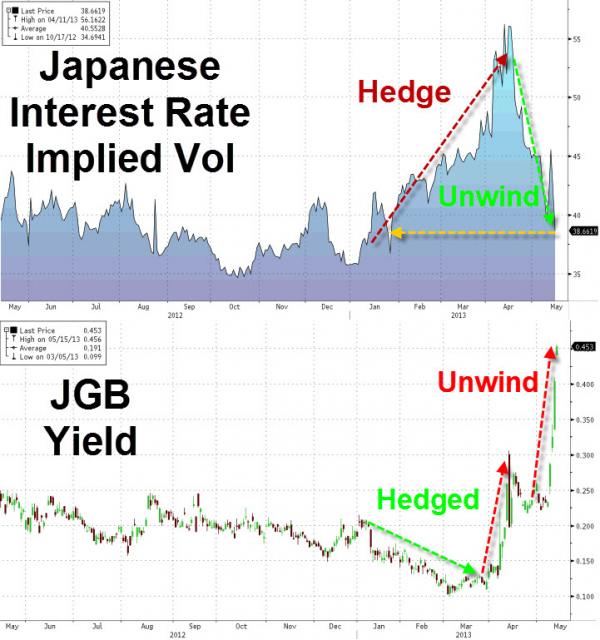
We have long discussed the problem that the Japanese government faces if interest rates in the troubled nation rise (cost of debt financing will swamp revenues in a vicious circle); but now it seems there is another – just as vicious – problem (that the BoJ is set to discuss according to Nikkei). The inability of the BoJ to ‘control’ Japanese interest rates (JGB rates spiking unprecedentedly day after day) has put the banking system in a lot of trouble. As we explained recently the banks appeared to initially ‘hedge’ their huge JGB positions but now appear to recognize that first out wins and are reducing exposure overall (YTD -3.7% according to local data). The reason – simple – as the IMF explains via the BoJ – according to BOJ estimates (footnote 4), a 100bp (parallel) rise in market yields would lead to mark-to-market (MTM) losses of 20% of Tier-1 capital for regional banks and 10% for the major banks. He who sells first wins…

We said previously: This is what is going on in JGBs… JGBs were able to rally since smart money was hedging significantly (and not selling) but once the initial clusterfuck exploded after the BoJ meeting (and protection costs soared), it seems clear that JGBs just became far too expensive to hold given their risk and so protection was unwound and positions were reduced… which is why we are now seeing JGB yields jumping… and as the IMF explains: JGB market exposures represent one of the central macrofinancial risk factors. This risk reflects the possible impact on public debt sustainability of changes in yields and related effects on investor confidence; the increased role of the private financial sector in covering government borrowing needs; the prospect that ongoing demographic shifts will reduce private saving; and growing household interest in investing abroad. Interest rate risk sensitivity is especially prevalent in regional banks and insurance companies (JGBs representing about 70 percent of life insurers’ securities holdings and 90 percent of insurance cooperatives’ securities holdings). In addition, the main public pension scheme, as well as Japan Post and Norinchukin bank, also have large JGB exposures. According to BOJ estimates, a 100 basis point (parallel) rise in market yields would lead to mark-to-market (MTM) losses of 20 percent of Tier-1 capital for regional banks (not taking into account net unrealized gains on securities), against 10 percent for the major banks. Surely all this has been provisioned for somehow. Or not?

20130514_JGB1_0

From Brooklyn to California, Housing Bubble Threat Grows

From Brooklyn to California, Housing Bubble Threat Grows

Just a year since the U.S. housing market hit bottom after the biggest plunge in eight decades, signs of excess are re-emerging.

An open house for a five-bedroom brownstone in Brooklyn, New York, priced at $949,000 drew 300 visitors and brought in 50 offers. Three thousand miles away in Menlo Park, California, a one-story home listed for $2 million got six offers last month, including four from builders planning to tear it down to construct a bigger house. In south Florida, ground zero for the last building boom and bust, 3,300 new condominium units are under way, the most since 2007.

The U.S. spring homebuying season has been marked by a frenzy of demand fueled by the Federal Reserve’s drive to push down borrowing costs, a scarcity of listings and Wall Street’s new appetite for foreclosed homes. While values remain well below their peak, economists including Stan Humphries of Zillow Inc. (Z) and Mark Vitner of Wells Fargo & Co. assert prices in some areas are rising at an unsustainable pace — a dramatic shift from early 2012, when billionaire Warren Buffett said housing “remains in a depression.” Read more of this post

S&P has cut its rating on Berkshire Hathaway by one notch, citing the company’s dependence on its core insurance operations for most of its dividend income

Updated May 16, 2013, 9:53 a.m. ET

S&P Cuts Rating on Berkshire Hathaway

By ERIK HOLM

Warren Buffett’s Berkshire Hathaway Inc. BRKB -0.68% had its credit rating cut one notch to double-A by Standard & Poor’s, which cited the conglomerate’s reliance on its insurance operations.

The downgrade comes after S&P revised the criteria it uses to evaluate the creditworthiness of insurers. The ratings company said the move was fueled by Berkshire’s “dependence on its core insurance operations for most of its dividend income.”

Berkshire-owned railroad Burlington Northern is the only non-insurance subsidiary to provide a “significant portion of the total dividends paid from the operating companies to the holding company,” S&P said. Read more of this post

Reality meets Jim Chanos’s China bearish call

May 16, 2013, 8:01 a.m. EDT

Reality meets Jim Chanos’s China call

By Kirk Spano

Jim Chanos has been famously bearish on China for several years now. While Chinese stocks have underperformed during that time, their markets have not outright collapsed. Recently, Chanos pointed out that credit and capital issues in China have gotten worse. In short, credit has expanded into a slowing economy, setting up the potential for many creditors not to be repaid. But is Chanos wrong?

Chanos, in a recent presentation, noted a multitude of problems in China including, economic inefficiencies, real-estate and credit bubbles, questionable “audited” numbers, inflation, ghost cities, money laundering and broad corruption by the ruling elite, among other issues. All of these factors, Chanos says are leading to a greater dilemma, soon to come, in China. Read more of this post

Just How Useless Is the Asset-Management Industry?

Just How Useless Is the Asset-Management Industry?

by Justin Fox  |   8:00 AM May 16, 2013

Writing under a pseudonym in the Financial Analysts Journal in 1960, mutual fund executive Jack Bogle made “The Case for Mutual Fund Management.” Bogle took the track records of four leading mutual funds going back to 1930 and compared them to the performance of the Dow Jones Industrials. Not only had the four beaten the Dow, handily, but during the period from 1950 through 1956, for which the brokerage Arthur Wiesenberger & Co. (the Lipper/Morningstar of its day) had calculated mutual fund volatility, all but one of them had fluctuated less than the Dow.

“[M]utual funds in general have met the test of time, and performed in keeping with their stated policies and goals,” Bogle concluded.

As tests go, Bogle’s had its flaws. The fact that four funds (they’re not named in the article, but Bogle once told me they were Massachusetts Investors Trust, Investors Incorporated — now Putnam Investors — State Street, and Wellington) that had survived since 1930 had performed well didn’t say anything about the performance of the many funds that didn’t survive, or the new ones that popped up in the 1950s. But it’s quite possible he was right that the tiny mutual fund industry of the 1930s, 1940s, and early 1950s had served its investors admirably. Read more of this post

The short arm of the SEC: Chinese executives of reverse-merger RINO who inflate revenue 15-fold and exproprirate $100m are given a minor fine of $250,000

The short arm of the SEC

Paul Murphy

| May 16 10:30 | 3 comments | Share

So, there was evidence this week that the US authorities might finally be getting to grips with the Chinese reverse merger scandal, whereby a string of Chinese companies exploited lax listing rules to shake down naive American investors. Executives at RINO International, a steel industry supplier, have been charged by the SEC with inflating revenues 15 fold in their US filings, while some of the proceeds from a reverse merger and $100m cash raising in 2007 were diverted to buy a house in Orange County, two Mercedes Benz cars and also funded shopping trips to the Chanel and Valentino stores in Beverley Hills. Most of the rest of the money was dispatched to China. Chief executive Dejun “David” Zou and chairman Jianping “Amy” Qiu have been charged under 10 sections of the Securities Exchange Act. So will they be looking at jail time? Nope. Without admitting or denying the claims against them, RINO, Zou, and Qiu consented to the entry of a judgment permanently enjoining them from violations of the respective provisions of the Securities Act and Exchange Act. Zou and Qiu agreed to pay civil penalties of $150,000 and $100,000, respectively… In addition, Zou and Qiu consented to entry of an order prohibiting them from serving as officers and directors of a public company for a period of ten years. Separately, Zou and Qiu have agreed to pay back the cash spent on the Orang County house in settlement of class action suite. But that’s it. The $100m has gone and the penalty is a minor fine and a directors’ ban. Quite a few American fraudsters will wish they’d enjoyed similarly benign treatment at the hands of the US authorities. There reality here, of course, is that the SEC will consider itself lucky to have reached any sort of settlement with Zou and Qiu. The regulator’s powers don’t reach as far as it would like the world to think.

Top Hedge Fund Manager Predicts A Collapse In The Art Market; “These $90 million paintings won’t go from 90 to 70, it will go from 90 to eight.”

Top Hedge Fund Manager Predicts A Collapse In The Art Market

Sam Ro | May 16, 2013, 6:44 AM | 1,490 | 4

Michael Novogratz, the head of Fortress Investment Group, appeared on CNBC yesterday. Among other things, he talked about what he considered to be an ongoing bubble in art. “Art is 100 percent a bubble—I mean it has all the markings for a bubble,” said Novogratz. “Prices have gone parabolic. You go to any of the art shows and you know even the cheap stuff that was $10,000 two years ago is now $80,000.” Novogratz and the CNBC crew were responding to a story on the recent Sotheby’s auction where Barnett Newman’s “Onement VI” sold for a stagger $43.8 million. “These $90 million paintings, you know, they might be worth eight one day,” added Novogratz. “They won’t go from 90 to 70, it will go from 90 to eight.” Investors skeptical of traditional financial assets have flocked to alternative assets like art and gems in their efforts to store their wealth.

Sony’s $100 Billion Lost Decade Supports Loeb Breakup

Sony’s $100 Billion Lost Decade Supports Loeb Breakup

By Angus Whitley, Brooke Sutherland and Naoko Fujimura – May 16, 2013

Sony Corp. (6758) has a $100 billion reason to consider Daniel Loeb’s breakup proposal.

Loeb, whose Third Point LLC hedge fund just took a $1.1 billion stake in Sony, is pushing the Tokyo-based company to sell as much as 20 percent of its entertainment business and focus on the “considerable and underappreciated value” of its electronics unit. After Loeb’s proposal sparked the biggest rally in Sony shares in more than four years, the $21 billion company still languishes at a cheaper valuation relative to profit than 90 percent of similar-sized consumer electronics makers, according to data compiled by Bloomberg yesterday.

Loeb is approaching Sony after shareholders lost more than $100 billion in market value since 2000. CLSA Asia-Pacific Markets said Sony would be worth 28 percent more in a separation. While estimates from Macquarie Group Ltd.’s Damian Thong fall short of Loeb’s targeted 60 percent stock gain, the analyst said the activist’s claim that spinning off the entertainment unit and boosting its profitability may raise the company’s market value by about 30 percent “seems reasonable.”

“Sony is a chronic underperformer,” Joshua Strauss, Chicago-based co-manager of the Appleseed Fund at Pekin Singer Strauss Asset Management Inc., which oversees about $1 billion, including investments in Japan and Korea, said in a telephone interview. “Should they spin off the entertainment division? Would it create shareholder value? Probably. When you do that sort of thing, the sum of the parts is greater than the whole.” Read more of this post

Chinese economy replaces EU debt crisis as investors’ top concern

Chinese economy replaces EU debt crisis as investors’ top concern

Staff Reporter 2013-05-16

Predictions that China’s economy will face a hard landing leading to a commodity collapse has replaced the European sovereign debt crisis as one of the main concerns of international and domestic investors, with many reducing their investments in emerging markets and commodities to invest in Japanese and European equities, reports our sister paper Want Daily.

A report released by the Bank of America Merrill Lynch earlier in the month showed that many investors are currently forecasting a weakening Chinese economy, with those feeling positive about the country’s economic outlook dropping by 8%. It is the first negative figure in fourteen months, while 25% of the fund managers surveyed considered a hard landing a possibility in China, a sharp increase from the 18% recorded last month.

Approximately 29% of the fund managers have already reduced their investments in China’s commodity market, while investments in Japanese equities have increased for the seventh consecutive month, surpassing the 31% recorded in May 2006. Read more of this post

Bentley Luxury-Car Sales in China Cool; Global luxury goods market to cool in 2013: Bain

May 15, 2013, 11:07 a.m. ET

Bentley Luxury-Car Sales in China Cool

By COLUM MURPHY

BEIJING—The maker of Bentley luxury cars is the latest high-end auto maker to warn that ebbing confidence among Chinese consumers and a government-led drive against conspicuous consumption has hurt demand for its expensive rides. Read more of this post

China in innovation challenge to Europe

May 16, 2013 12:03 am

China in innovation challenge to Europe

By Chris Bryant in Frankfurt

Europe’s business leaders fear its industry will fall behind China in technological innovation within a decade as the economic crisis undermines one of the continent’s competitive advantages.

More than two-thirds of business leaders surveyed by Accenture, the consultancy, on behalf of BusinessEurope, the business lobby group, said China would reach or pull ahead of Europe in innovation by 2023.

Weak demand caused by Europe’s economic crisis has sent industrial production into decline, while corporate reluctance to delve into cash reserves is holding back new investment, training and R&D. Read more of this post

Beijing signals concerns at rising unemployment

May 15, 2013 4:35 pm

Beijing signals concerns at rising unemployment

By Jamil Anderlini in Beijing

China’s newly installed leaders have signalled their concern about rising unemployment in the slowing Chinese economy with several carefully stage-managed public appearances this week.

On Tuesday, Chinese President Xi Jinping paid a surprise visit to a job fair in the eastern city of Tianjin while Premier Li Keqiang warned the country faces an unprecedented challenge in finding jobs for a record number of university graduates.

In a nationwide teleconference on Monday that was widely reported in state media on Wednesday, Mr Li said that nearly 7m tertiary students would enter the job market in July in China, the largest number in the country’s history.

He said it was an “important task” to find jobs for all these graduates, who make up a demographic considered potentially threatening to Communist Party rule if they become disaffected in large numbers. Read more of this post

China’s companies spurn directive to pay 30% dividend; Just 60 per cent of China’s biggest listed-companies met the dividend guidelines, a blow for attempts to build credibility in China’s equity markets

May 16, 2013 5:48 am

China’s companies spurn directive to pay 30% dividend

By Josh Noble in Hong Kong

Just 60 per cent of China’s biggest listed-companies met the dividend guidelines laid out by the Shanghai stock exchange earlier this year, a blow for attempts to build credibility in China’s equity markets.

Of the members of the FTSE A50 index, only 30 companies paid a dividend of over 30 per cent during the most recent earnings season, according to data compiled by Markit.

In January, the Shanghai bourse told listed companies to return at least 30 per cent of profits to shareholders“because of a definite gap between cash dividend ratios for Shanghai-listed companies and those in mature markets”. Read more of this post

China is addicted to debt and shows few signs of kicking the habit, says Francis Cheung

Thursday, May 16, 2013

China is addicted to debt and shows few signs of kicking the habit, says Francis Cheung

Credit can be like steroids for developing countries. Pump loans to businesses and governments, and they will be better able to tap into the latent opportunities of an undeveloped economy.

But as Francis Cheung, head of China and Hong Kong strategy at brokerage CLSA, points out, China has become addicted to debt to fuel growth. And like habitual steroid use, eventually growing debt will threaten the health of the overall system.

Cheung authored a report earlier this month sounding the alarm on how the levels of debt are piling up with no sign of slowing while bringing fewer benefits to the economy. More than half of China’s total debt was added in the past four years, the bulk of which came from shadow banking and bonds. The country’s debt level sits at roughly 205% of GDP as of 2012.

On the sidelines of the CLSA China Forum 2013 in Beijing earlier this week, Cheung spoke to CHINA ECONOMIC REVIEW about where the biggest risks lie and their possible solutions, even if it’s unlikely they’ll be enacted Read more of this post

Chairman of Sinovel has resigned as of one of the country’s largest makers of wind turbines struggles amid an industry downturn

05.15.2013 18:20

Head of Sinovel Resigns amid Company Struggles

Wei Chiyuan steps down as chairman after pursuing reforms that could not keep firm profitable during industry downturn

By staff reporter Pu Jun

(Beijing) – The chairman and acting president of Sinovel Wind Energy Group Co. has resigned as of one of the country’s largest makers of wind turbines struggles amid an industry downturn. Read more of this post

Hukou Age Limits Anger Graduates; A new policy prevents college graduates who are too old from getting Beijing residence

Hukou Age Limits Anger Graduates

By Liu Jinsong (刘金松) and Hu Dan (胡丹)
Issue 619, May 13, 2013
When Zhang Xin (a pseudonym) went online to find information about getting a Beijing hukou (household registration), he came across an agency saying that it would cost 220,000 yuan for people “within the age limit.” But for people over the “age limit,” it would cost an additional 40,000 yuan for them to work around “new rules.”

Zhang will finish his master’s degree at Peking University this June, and has already signed a contract with a well-known international company. Many people in his situation can obtain a Beijing hukou through their job so that they access certain social services within the city. Zhang Xin had counted on this.

However, the “age limits” mentioned by the online agency was the first mention he’d heard of any new rules. He thought it might be a scam, so he went to the company he was set to work for, as well as the employment office at his university. They all said they hadn’t heard of any age limits on obtaining a hukou. But after searching more online, Zhang found that the agency wasn’t a scam. Many others were facing the same problem. Read more of this post

Ping An’s investment in Chinese cosmetics company Jahwa turns sour; public is keen to know what went wrong with to the seemingly perfect investment

Ping An’s investment in Jahwa turns sour

Staff Reporter

2013-05-16

After Ge Wenyao stepped down as chairman of Shanghai Jahwa United, a listed Chinese cosmetics company, the public is keen to know what went wrong with to the seemingly perfect investment made by the Ping An Trust, a strategic investor that was introduced into the business by Ge himself. Read more of this post