Everyone Will Be Debating The WSJ Story About The Fed Considering Ways To End QE

Everyone Will Be Debating The WSJ Story About The Fed Considering Ways To End QE

Joe Weisenthal | May 12, 2013, 7:22 PM | 2,992 | 16

Futures are down modestly in early Sunday trading, and one possibility for that is the story that came out after the bell on Friday in the Wall Street Journal from Fed whisperer Jon Hilsnerath titled Fed Maps Exit From Stimulus. The gist: The Fed is seriously thinking about how it might begin the QE wind-down process. Given the widespread belief that Fed stimulus is a major tailwind for the market, talk of QE wind-down is invariably something of a negative. In tonight’s “Closing Print” note, Mike O’Rourke from JonesTrading thinks the article’s existence is pretty significant.

He writes:

The WSJ’s Jon Hilsenrath published a story Friday evening titled “Fed Maps Exit From Stimulus – Timing of Wind-Down Is Uncertain, but Focus Is on Managing Unpredictable Market Expectations.”  We suspect the twitter taper caper on Thursday opened the window for the FOMC to provide some clarity as to where policy stands.  Here are some key questions.  Is this story important?  Can it be taken at face value and should markets move?  The answer is yes, yes and yes.  The WSJ placed the article prominently on the cover of the Saturday edition, so they believe they have an important story.  It is a Hilsenrath story, and in the post-recession QE era the Fed has used him to foreshadow almost every major monetary policy move. Finally, in a tape where QE is the dominant theme, any indication of policy slowing or reversing course is meaningful.  Read more of this post
China’s Data Manipulation In One Chart, And Why The Real Data Implies Weakest GDP Growth In Over 20 Years

China’s Data Manipulation In One Chart, And Why The Real Data Implies Weakest GDP Growth In Over 20 Years

Tyler Durden on 05/12/2013 13:31 -0400

China exports_0

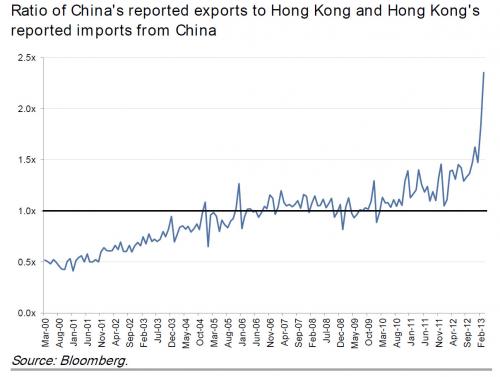
By definition, exports from country A have to equal imports from country B. Unless country A is China. Then, central planning magic happens, as can be seen in the chart below showing the misreporting of Chinese exports to HK compared to HK’s reported imports from China, which is just the latest nail in the coffin of Chinese economic data “integrity.” The issue, however, is that since China manipulates its data “upward”, as does the rest of the civilized, “unmanipulating” world, none of the ‘very serious people‘ have any incentive in calling China out – because suddenly all the world’s growth data may fall under the microscope, as perhaps it should – after all it was less than two years ago that we observed that the entire world was exporting over $300 billion more than it was importing (numbers which should net to zero), leading us to wonder if it was aliens that were importing all the excess Louis Vuitton bags… So for those actually interested, here is Sean Corrigan of Diapason breaking down the true numbers behind China’s economy, who using real export and import data ex-manipulation and fudging, that China’s reported 7.7% GDP would translate into a 5.5% Q1 GDP growth, the lowest rate of growth in 20 years! Read more of this post

China Officials Seek Career Shortcut With Feng Shui

May 10, 2013

China Officials Seek Career Shortcut With Feng Shui

By DAN LEVIN

sub-fengshui-articleLarge

In Hunan Province, a boulder was placed outside a government building to create better feng shui for superstitious civil servants.

ZOUMAJIE, China — Outraged peasants protesting land grabs. Jilted mistresses plotting revenge. Provincial investigators seeking out graft.

For top officials at the local land resources bureau beleaguered by these and other headaches, there could only be one explanation for the miasma of misfortune they believed was threatening their careers last year: the pair of ferocious stone lions that guarded the state-owned China Tobacco building across the street from their offices.

An official confided that the secret weapon the land bureau used was feng shui, the ancient practice of arranging objects and designing architecture to improve one’s health, prosperity and luck. For proof, he nodded toward a stone wall in the parking lot that was built to block the feline statues’ harmful qi, or energy.

“Our bureau wasn’t doing so well until we erected the barrier last year,” said the official, who gave only his last name, Chen. “Now things are a lot better.” Read more of this post

The Son also Rises: nepotism doesn’t disappear in China, it just gets a promotion

The Son also Rises: nepotism doesn’t disappear in China, it just gets a promotion

Monday, 13 May, 2013, 12:00am

News›China

CHINA BRIEFING

Wang Xiangwei xiangwei.wang@scmp.com

The history of graft in China has come full circle amid reports of children of powerful officials stepping into their parents’ shoes

Throughout Chinese history, the expression ya nei originally meant palace guards but later referred generally to children of government officials. In traditional Chinese opera and drama, they are immortalised as the worst of the worst – vile, violent and corrupt. Dressed in silk and drooped in gold, ya nei roamed the streets, beating people for no particular reason or kidnapping young girls and forcing them to become concubines. They usually escape punishment thanks to their powerful fathers and relatives. Today, such characters may go by a different name, guan er dai – the second-generation government officials, or princelings, particularly those of top mainland leaders. While they may no longer go around beating people or abducting girls, they invariably take advantage of their parents’ power and influence to enrich themselves or their families. Judging by the rising number of reports in state media, the guan er dai are now using their nepotistic connections for what is termed “riding a rocket” – being promoted rapidly through government or party ranks to fill positions that, usually, have been vacated by their parents. Read more of this post

Ancient Buddhist temple in China bogged down by fake monks and debt

Ancient Buddhist temple in China bogged down by fake monks and debt

Sunday, 12 May, 2013, 7:31pm

Patrick Boehler

A provincial city’s ambitious plans for turning an ancient Buddhist temple near Xian into the world capital of Buddhism and listing it on a stock exchange have stagnated, leaving the temple surrounded by fake monks and sham Buddha statues.

Famen Temple houses a Buddhist relic. Photo: AP[1]In an investigative report [2], the Guangzhou-based Southern Weekly documents how the project involving the 1,700-year-old Famen Temple in Shaanxi province – which boasts the ownership of Buddha’s finger bone – went horribly wrong.

Now, fake monks from Hubei province roam a nearby scenic park that opened in 2009 and that tourists and pilgrims mistaken as part of the temple. The impostors get commission for collecting donations to the Shaanxi Famen Charitable Foundation. But clueless visitors do not know the foundation is a front for the operating company of the park, Shaanxi Famen Temple Scenic Park Cultural Industrial Group, and is not related to the temple, the weekly reported last week. Read more of this post

European companies wrote off a record €350bn in bad debt last year, more than the annual GDP of Austria, Denmark or Finland.

May 12, 2013 11:03 pm

European groups write off record €350bn in bad debt

By Richard Milne, Nordic Correspondent

European companies wrote off a record €350bn in bad debt last year, more than the annual GDP of Austria, Denmark or Finland.

The amount of write offs increased 7 per cent in the past year and 27 out of the 31 countries surveyed by Intrum Justitia, a Swedish credit management company, saw either a worsening in credit conditions, or no change. The debt amounts to 3 per cent of all outstanding invoices in European companies.

“It is the highest level of bad debt losses so far, and the forecast is bleak. Three per cent of all receivables; think of the net profit margin of companies in Europe and that is a big part of it,” Lars Wollung, Intrum Justitia’s chief executive, told the Financial Times. Read more of this post

Valuable as Art, but Priceless as a Tool to Launder Money

May 12, 2013

Valuable as Art, but Priceless as a Tool to Launder Money

By PATRICIA COHEN

According to the air bill slapped on the crate that arrived at Kennedy International Airport from London, an unnamed painting worth $100 was inside. Only later did federal investigators discover that it was by the American artist Jean-Michel Basquiatand worth $8 million. This painting, known as “Hannibal” after a word scribbled on its surface, was brought into the United States in 2007 as part of a Brazilian embezzler’s elaborate effort to launder money, the authorities say. It was later seized at a Manhattan warehouse by federal investigators who are now preparing to return it to Brazil at the behest of law enforcement officials there. The painting’s seizure was a victory in the economy-rattling, billion-dollar fraud and money laundering case of Edemar Cid Ferreira, a former Brazilian banker who converted some of his loot into a 12,000-piece art collection. Read more of this post

Student Debt and the Crushing of the American Dream

MAY 12, 2013, 9:09 PM

Student Debt and the Crushing of the American Dream

By JOSEPH E. STIGLITZ

A CERTAIN drama has become familiar in the United States (and some other advanced industrialized countries): Bankers encourage people to borrow beyond their means, preying especially on those who are financially unsophisticated. They use their political influence to get favorable treatment of one form or another. Debts mount. Journalists record the human toll. Then comes bewilderment: How could we let this happen again? Officials promise to fix things. Something is done about the most egregious abuses. People move on, reassured that the crisis has abated, but suspecting that it will recur soon.

The crisis that is about to break out involves student debt and how we finance higher education. Like the housing crisis that preceded it, this crisis is intimately connected to America’s soaring inequality, and how, as Americans on the bottom rungs of the ladder strive to climb up, they are inevitably pulled down — some to a point even lower than where they began. Read more of this post

Coal barons see assets fade as prices slump in China; Heavy Industry’s Reverberating Slump

Coal barons see assets fade as prices slump in China

Staff Reporter

2013-05-12

The assets of Chinese coal mine owners are gradually diminishing as coal prices slump, a trend which has also resulted in their company’s stock prices declining, reports the Shenzhen-based New Fortune monthly. Many coal millionaires have attracted attention for the public flaunting of their wealth. A notable example was when Xing Libin, chairman of Liansheng Energy Group, spent 70 million yuan (US$11.3 million) to stage a lavish wedding party for his daughter in March last year. The wedding party caused a public outcry in Shanxi province, the largest coal-producing region in China where the average income is only 5,807 yuan (US$950) a year, said the report. The golden days for mine owners seem to be numbered as the government began streamlining the industry in 2008, and cut the number of firms from 2,200 to just 130 through incorporations and mergers, and brought 70% of them under the control of state enterprises. It was reported that private owners,whose mines were taken over by big state enterprises were compensated to the tune of 600 billion to 1 trillion yuan (US$97-$161 billion) in total. Many smaller business owners have little expertise outside of the coal industry. They are expected to quickly spend their newly gained wealth and fade from the nation’s business circles because they will likely not invest their wealth wisely, said the magazine. Only the big coal companies with advanced technology and abundant capital could survive in the reshaped industry, said the report.

Heavy Industry’s Reverberating Slump

By Yu Huapeng (于华鹏)  
Issue 617, April 29, 2013

After two days in Qingdao, Hong Daoqing (洪道清) failed to persuade Qingdao Iron & Steel Company to order any coking coal from him.
Just as he was feeling completely frustrated, Hong’s telephone rang with more bad news from Manager Ma at Laiwu Iron & Steel Company. Ma told him that his company had shut off four blast furnaces and the rest were just working at half capacity.  Read more of this post

Electric car development could be sidelined in China; Chinese carmakers have spent lots of money developing electric cars — development that may have been a waste of resources

Electric car development could be sidelined in China

Staff Reporter

2013-05-12

Carmakers could sideline electric cars to make way for the promotion of hybrid cars in China’s automobile industry, reports Guangzhou’s 21st Century Business Herald, citing executives at last week’s Shanghai International Car Show. At this year’s biennial show, only the venture between BYD and Daimler, Mercedes-Benz, Shanghai Volkswagen, and Dongfeng Nissan introduced pure electric cars, while the majority introduced new hybrid car models, according to the paper. According to official figures, carmakers sold 12,791 new-energy cars in China last year, including 11,375 electric cars, a rise of 98.8% from the previous year and 1,416 hybrid cards, up by 103.9% due to a low base last year. China’s electric car market is reportedly losing money, however, and its true scale is currently unknown, said independent automobile commentator Zhong Shi, adding that Chinese carmakers have spent lots of money developing electric cars — development that may have been a waste of resources. Read more of this post

Why the Chinese government is choosing to let its debt crisis continue to spiral out of control

Why the Chinese government is choosing to let its debt crisis continue to spiral out of control

By Gwynn Guilford @sinoceros 6 hours ago

chinese-scary-loans1

For around a year now, the Chinese government has been trying to curb “shadow banking,” as lending to local government investment proxies and other insolvent vehicles through difficult-to-trace channels is known. Shadow banking is now thought to be as big as 36 trillion yuan ($5.8 trillion), according to JP Morgan. There’s been more shaking this last week. The government rolled out two new policies directed in most part at limiting the creation of wealth management products (WMPs), which securitize a good deal of shadow banking financing, selling the products on to retail investors. As of the end of March, WMPs had securitized debt worth of 8.2 trillion yuan. Will this have more effect than the measures taken so far? Not necessarily, says Patrick Chovanec, chief strategist at Silvercrest Asset Management and expert on China’s economy. “[The government has been saying] ‘We need to crack down on risks in interbank and shadow lending.’ Obviously there’s a growing awareness of risks,” he tells Quartz. “But if you look at what has happened since [the new administration effectively took over] in October, there’s been a renewed credit boom to try to prop up investment. That’s what policy has been in practical terms with almost no control over expansion of shadow credit.” Read more of this post

Bullish yuan herd leaves China fundamentals in the dust

Bullish yuan herd leaves China fundamentals in the dust

Sun, May 12 2013

By Gabriel Wildau

SHANGHAI (Reuters) – Investors convinced China’s currency is once again a one-way bet upward should think again: signs of slowing economic growth could cut short the yuan’s rally. Investors and companies have been pouring funds into China in recent months, helping send the yuan to a series of record highs. But with evidence of a slowdown mounting, investors thinking of joining the rush into yuan would do well to remember 2011 and 2012, when fears of a Chinese hard landing sent the yuan, or renminbi, tumbling. Read more of this post

Hong Kong has world’s most expensive retail space; Rents were 50% higher than for similar districts such as upper Fifth Avenue in Manhattan and more than four times the rate in similar areas in London and Paris

Hong Kong has world’s most expensive retail space: report

12:06am EDT

By Ilaina Jonas

NEW YORK (Reuters) – There’s expensive and then there’s Hong Kong.

The Asian shopping haven in the first quarter kept its crown as having the world’s highest rent for prime retail properties, at nearly 50 percent more than for similar districts such as upper Fifth Avenue in Manhattan. Rents were more than four times the rate in similar areas in London and Paris, according to a report by global property advisor CBRE Group Inc. The 10 most expensive cities for retailers benefit from strong demand and modest new supply, a recipe for stable record-high prime rental rates, the report released on Sunday showed. In some markets, such as Hong Kong and London, the sky-high rents have prompted some newcomers to look nearby. For example, in London, Mayfair has benefited from those priced out of Bond Street. Annual retail rent in high-end shopping areas in Hong Kong averaged $4,328 per square foot (36,351 euros per square meter). Read more of this post

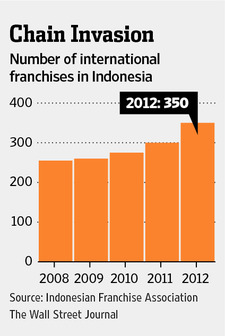
Indonesia to Big Chains: Share the Wealth; under the new rules, any convenience store or other retailer with more than 150 stores and any restaurant or café with more than 250 outlets will have to bring in additional Indonesian partners

May 12, 2013, 8:39 p.m. ET

Indonesia to Big Chains: Share the Wealth

By ERIC BELLMAN

MK-CD152_INDOCH_NS_20130512174803

JAKARTA, Indonesia—A jump in the number of chain stores in Indonesia has triggered a backlash from regulators and owners of small shops, concerned that homegrown entrepreneurs could get elbowed out of the country’s economic growth. For decades, Torikin did a brisk business selling batteries, cigarettes, cold drinks and instant coffee from his cart in central Jakarta. Then a brightly lighted store sprouted in the vacant lot where he had been setting up shop. He had never heard of 7-Eleven or its Slurpee frozen drinks. But in the past year he has watched almost all of his customers defect to the chain store, with its wide selection and low prices. “There is no way I can compete,” says Mr. Torikin, who, like many Indonesians, uses only one name. “Office workers that bought cigarettes from me for years, now just walk right past me on the way to that store. They say ‘Hello,’ but they don’t buy anything.” Mr. Torikin says his sales plunged to around $5 a day from roughly $100. Now he is looking for a new spot to set up, far from a Western-style convenience store.

Hoping to protect and enrich small-shop owners like Mr. Torikin, Indonesia has been implementing rules to force large chains to share their success. The new rules could change expansion plans for such chains as KFC, Starbucks SBUX +1.18% and 7-Eleven. Read more of this post

Doubts come to surface about ‘the decade of Latin America’

May 12, 2013 12:58 pm

Doubts come to surface about ‘the decade of Latin America’

By John Paul Rathbone, Latin America Editor

First, in March, an Argentine Pope; then, last week, a Brazilian appointed to lead the World Trade Organisation. Latin America, long associated with default, dictatorships and disgrace, seems to be riding high and enjoying its growing global clout.

Since 2003, the region’s $6tn economy has almost doubled its share of world economic output to 8 per cent. At the same time, the middle class has grown by 50m people while inequality has shrunk – a unique feat. For some, the region is now enjoying what Sir Martin Sorrell, head of advertising group WPP, hailed in 2010 as “the decade of Latin America”.

But now, in the fourth year of its decade, Latin America, lulled by recent success, risks taking its eye off the reform ball and losing its way. Read more of this post

The lust for Latino lucre: How American firms are chasing the elusive Hispanic dollar

The lust for Latino lucre: How American firms are chasing the elusive Hispanic dollar

May 11th 2013 | LOS ANGELES |From the print edition

20130511_WBC579

ONE in six Americans is Hispanic. In politics, ignoring the Latino vote is suicidal, which is why the Republican Party is at last getting serious about immigration reform. In business, ignoring Latino tastes is equally daft, which is why American firms are at last getting serious about pursuing the Hispanic dollar. Read more of this post

All Signs Suggest The College Bubble Has Finally Burst

All Signs Suggest The College Bubble Has Finally Burst

Rob Wile | May 11, 2013, 7:04 PM | 5,492 | 17

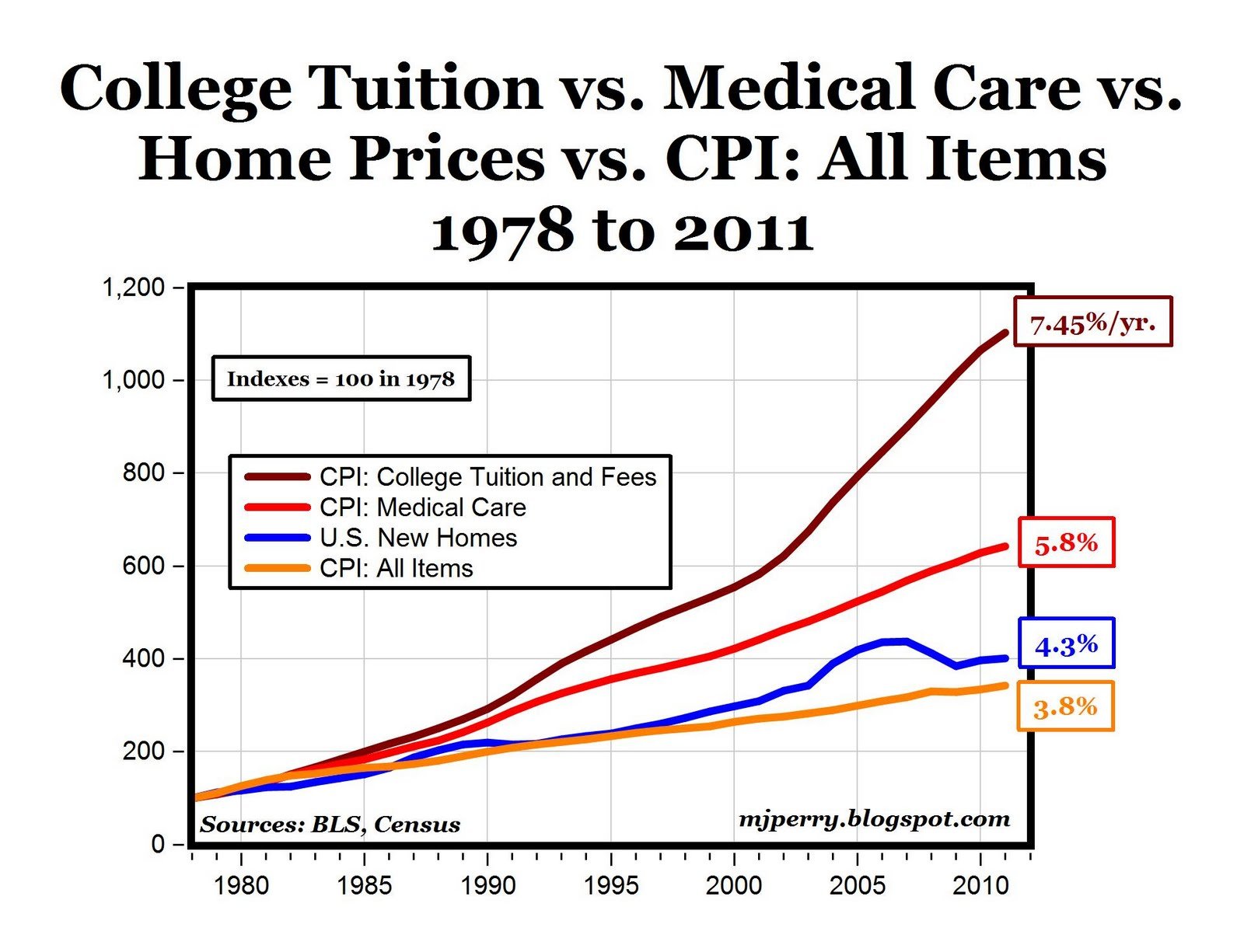
This week, the Wall Street Journal’s Ruth Simon reported private colleges are now offering record financial assistance to keep classrooms full. Some schools are now seeing just 20% of the students they accepted actually enrolling, versus the usual rate of 33%. So they have increased the “tuition discount rate”— the price after grants and scholarships  —  to an all-time high of 45%. Meanwhile, the median sticker price increased just 3.9% last fall, the smallest gains in 12 years. And at public schools, the sticker price climbed just 4.8%, also a 12-year low. For the Washington Examiner’s Michael Barone, this makes it official: the college bubble has finally burst: Applicants are negotiating bigger discounts than they used to. Market competition has kicked in. What has happened is that in a recessionary and sluggish economy potential customers have been figuring out that a college diploma may not be a good investment — particularly if it entails six-figure college loan debt that cannot be discharged in bankruptcy. The Millennial Generation that voted so heavily for Barack Obama — 66 to 32 percent in 2008, 60 to 37 percent in 2012 — has had a hard time finding jobs, even with diplomas in hand. Especially if their degrees are in gender studies or similar fields beloved of academics. Moody’s Investors Service Managing Director John Nelson basically agrees, telling Simon,  “we have hit a tipping point on price.” It was a long time coming. Check out this chart from AEI’s Mark Perry showing the rising cost of tuition outpacing basically every other good in American society for nearly two decades: Barone goes a bit further than we would about the bust’s implications (he writes that administrators actively believed they were “above market forces” and could make investment decisions accordingly).

college-10

Buffett declares bonds are “terrible investments”; “people could lose a lot of money if they’re in long-term bonds”

May 10, 2013 5:56 pm

Alternatives to Buffett’s ‘terrible’ bonds

By Elaine Moore

Warren Buffett, America’s best-known investor and the world’s fourth-richest person, has made his feelings about bonds clear, declaring them “terrible investments”.

Speaking on US television this week, the chief executive of Berkshire Hathaway said that many investors had been drawn to bonds because their prices tend to rise as interest rates fall. But, he warned, when the situation changes “people could lose a lot of money if they’re in long-term bonds”.

Talk of a “bond bubble” and a “great rotation” away from bonds and towards equities is not new. But bonds are still popular. The best selling sector for Individual Savings Accounts (Isa) money in the most recent tax year was the Sterling Strategic Bonds, according to the Investment Management Association. But in recent months investors have started to put more money in equities than bonds. Read more of this post

Mattel Continuously Innovates to Keep Barbie Alive in a Tech World

Mattel Continuously Innovates to Keep Barbie Alive in a Tech World

by Abram Brown | May 11, 2013

US_Barbie.indd

In an era when iPad apps and videogames practically demand children’s attention, Mattel continues to lead by innovating with its old-school plastic playthings

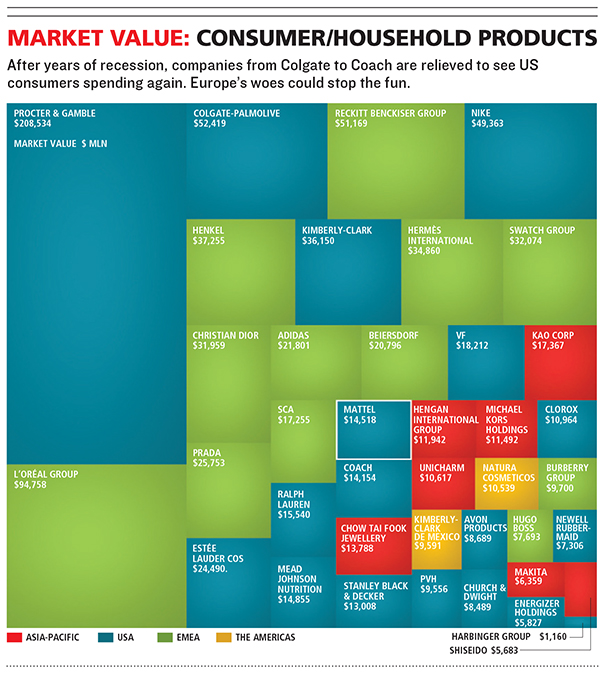
Head 10 minutes south of Los Angeles international airport on the 405, exit at El Segundo and you’ll blunder upon a 200,000-square-foot concrete bunker lurking among the strip malls in this seedy bit of Los Angeles County. The low-slung structure, surrounded by a black iron fence, was once an aircraft parts factory. It now houses the design laboratories of Mattel, Inc, the world’s largest toymaker, and deep inside the high-security facility, a crack 12-person team of screenwriters, computer animators, comic book artists and industrial designers are busy engineering the next great American toy: Max Steel.  In physical form, Steel will be a 6-inch plastic superhero action figure, with a well-developed  backstory: His mission is to harness the turbo energy he possesses to morph into different cyborg forms and save the world from monsters bearing names like Elementor and Dredd. And, just like Superman, he has a mild-mannered alter ego: Maxwell McGrath, a 16-year-old high school kid with brown hair and a square jaw. The Max Steel doll won’t be appearing on US retail shelves until August, but his launch is already well under way. Pull up maxsteel.com and you can play the Max Steel: Hero’s Journey videogame, watch videos introducing him or download a Max Steel mask. In March, a Max Steel cartoon premiered on Disney’s XD digital cable and satellite channel and will soon be available in more than 100 different markets worldwide. Toys used to spring from entertainment. Now entertainment supports the toys. “Having an action hero that’s on for a steady basis—on television, on webisodes, on digital—is going to create a more consistent demand for that product,” says Mattel’s chairman and chief executive, Bryan Stockton. Read more of this post

Man vs. Machine: The Great Stock Showdown

Updated May 10, 2013, 8:25 p.m. ET

Man vs. Machine: The Great Stock Showdown

By MARK HULBERT

It has always been difficult for investors to consistently beat index funds. It has been nearly impossible lately. And there’s a double whammy: The small number of advisers who outperform the market rarely can keep doing so. One big culprit, experts say: the rise of sophisticated computer-trading programs. Consider the 51 advisers out of more than 200 on the Hulbert Financial Digest’s list who beat the market in the decade-long period that ended April 30, 2012, as measured by the Wilshire 5000 Total Market index, including reinvested dividends. Of that group, just 11—or 22%—have outperformed the overall market since then. That’s no better than the percentage that applies to all advisers, regardless of past performance. Over the past year, on average, the group has lagged the Wilshire index by 6.2 percentage points. In other words, going with a recent market beater doesn’t increase your odds of future success. Read more of this post

Wikipedia’s crystal ball: Hedge funds must raise their game to beat web analytics

May 10, 2013 6:58 pm

Wikipedia’s crystal ball

Hedge funds must raise their game to beat web analytics

First it was the factory worker who was made obsolete by technology. Now it is the hedge fund manager who looks increasingly redundant – and not just any hedgie but Wall Street’s finest. The Financial Times this week revealed that tips given by the best and brightest at last year’s Ira Sohn conference – where the industry’s stars offer their investment advice to raise money for charity – failed to outperform a passive US tracker fund. But even trackers struggle to compete with Wikipedia or Google. Academics have found a direct correlation between market movements and the number of visitors to articles on companies or financial topics. Wikipedia, the online encyclopedia, is best for predicting when the market is about to tumble, according to a paper published this week by academics from Warwick Business School, University College London and Boston University. The more page views on financial subjects, the greater the chance the Dow Jones index will fall. Last month the same team found that a trading strategy based on Google searches for the words debt, profit and loss could deliver well above average returns. Read more of this post

Cooper Union recently announced that it would begin charging tuition, a decision made after decades of bad financial choices and recent treacherous markets

May 10, 2013

How Cooper Union’s Endowment Failed in Its Mission

By JAMES B. STEWART

Since Peter Cooper’s heirs gave the Cooper Union for the Advancement of Science and Art the land under the Chrysler Building in 1902, the school’s endowment has enabled it to offer students a high-quality, tuition-free education through two world wars, the Great Depression and multiple stock market crashes and financial crises. So why does Cooper Union now find itself forced to charge tuition of an estimated $20,000 a year, abandoning what many consider its most important legacy? This week, angry students were occupying the president’s office in protest. They might be even angrier to learn that some of their future tuition dollars could be going to support wealthy hedge fund managers who oversee some of the school’s $666.7 million endowment.

Cooper Union may be an extreme example, but it’s hardly the only college suffering from a combination of decades of bad decisions and recent treacherous markets. Its endowment was typical of the many endowments and pension funds that took the plunge into so-called alternative investments like hedge funds, which have lured investors with the promise of generous and steady returns in both good times and bad. And compared with many universities, Cooper Union did a good job managing its endowment through the recent financial crisis. As recently as 2009, the school maintains, it ranked first among all American universities for endowment performance. Read more of this post

Mediocre results have raised questions about the very basis of the hedge fund industry

May 10, 2013 7:05 pm

Finance: In search of the big idea

By Dan McCrum and Sam Jones

Mediocre results have raised questions about the very basis of the hedge fund industry

Lincoln Center, home of the Metropolitan Opera and the New York Philharmonic, exchanged art for avarice this week. Taking the stage of Avery Fisher Hall, where Leonard Bernstein used to conduct, was a very select group of performers: the billionaire virtuosos of the hedge fund world. Gathered there were investors who had made big money by making bold calls. Some had made money by taking on governments: Stanley Druckenmiller made a fortune helping George Soros drive sterling out of the European exchange rate mechanism, while Paul Singer, founder of Elliott Management, last year attempted to repossess an Argentine naval vessel to settle a debt. There were also corporate agitators with ambitious ideas. David Einhorn of Greenlight Capital has spent this year fighting Apple over its cash pile. Bill Ackman of Pershing Square wants to shake up Procter & Gamble, the US consumer goods group. The investors were there to promote their latest big ideas and perhaps move markets in their favour, to gain some good publicity and to benefit a good cause. Each man – there were no women – pitched an investment idea from their portfolio to a sold-out crowd of investors, all for a charity set up to honour the late Ira Sohn, a financial analyst who died of cancer at 29. But they also came to get the next big idea, that elusive concept that will generate “alpha” – the hedge fund term for beating markets. Read more of this post

Currency Funds Falter as Policies Shift; “All the old models that said currencies should do X if Y happens are not working.”

Updated May 10, 2013, 9:40 p.m. ET

Currency Funds Falter as Policies Shift

By MATTHEW WALTER

BF-AE953_FXFUND_NS_20130510160903

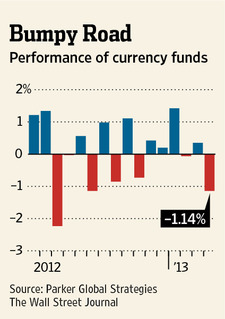
Foreign-exchange funds suffered their worst performance in 10 months in April, as currency managers struggled with a market frequently swayed by central-bank policies. The Parker Global Currency Managers index, which tracks the performance of funds in which the firm invests, fell 1.14% last month. The decline left the index up just 0.57% in the first four months of the year. Even as the easy monetary policies at major central banks have fueled a bumper year for investors in a broad range of assets, from Japanese stocks to European bonds, funds that mainly invest in currencies have underperformed, and there are signs that their clients are losing patience. Investors pulled $1.5 billion from currency funds in the first three months of 2013, even as they piled into hedge funds as a whole at their fastest clip in almost three years, according to Hedge Fund Research Inc. Foreign-exchange funds had $14.4 billion under management in March, down 58% from their peak in 2007. Investors and analysts say the outflows from currency funds are a sign that large asset managers are skeptical that financial markets have truly found their footing. Currency funds proved especially vulnerable when central banks stepped into the market to stimulate growth and calm panics, often with measures that involved printing money or deliberately weakening exchange rates. Investors say they see no sign that central banks are relaxing in their new role policing markets. Read more of this post

China’s Import Data Doubted by Nomura as Tariff Revenue Slumps

China’s Import Data Doubted by Nomura as Tariff Revenue Slumps

China’s “surprisingly strong” import growth in the first four months may have been inflated by fake invoices as companies circumvented capital controls to move funds into China, according to Nomura Holdings Inc.

A 28 percent slump in the value of import tariffs in the first quarter compared with a year earlier casts doubt over the credibility of official data that show imports (CNFRIMPY) rose 8 percent in the period, economists Zhang Zhiwei in Hong Kong and Wendy Chen in Shanghai wrote in a research note today. The two indicators have generally moved in tandem in the past, they said.

Skepticism over import figures in the world’s second-biggest economy adds to concerns that the nation’s trade data are inaccurate after analysts at Bank of America Corp. and Royal Bank of Scotland Group Plc said export figures this year were inflated by fabricated reports. Hot money flooding into China helped push the yuan to a 19-year high yesterday and regulators this week announced a crackdown on companies using trade reports to disguise speculative inflows.

“Some companies may have moved products between Hong Kong and China’s special trade zones to circumvent capital controls and move funds into China,” the Nomura economists wrote. “Such trade is free of import tariffs, so it pushes up imports and exports but not import duties.” Read more of this post

Berkshire CEOs Spend Quietly, Match Buffett on Heinz Deal; “Warren’s not a manager,” Iscar’s Wertheimer said. “He’s a teacher for all of us.”

Berkshire CEOs Spend Quietly, Match Buffett on Heinz Deal

Warren Buffett stole headlines when he committed $12.1 billion in a deal to take ketchup maker HJ Heinz Co. (HNZ) private this year. Managers at his Berkshire Hathaway Inc. (BRK/A) spent as much in 2012 while attracting less attention.

Executives who gathered last week for Berkshire’s annual meeting in Omaha, Nebraska, said in interviews that they plan to spend even more this year as they upgrade a rail network and energy utilities, expand manufacturing capacity and hunt for additional acquisitions.

Buffett, 82, relies on chief executive officers of the operating units to make deals and invest in plant and equipment to build the businesses and widen their competitive advantage. That helps slow the accumulation of cash and reduces the need for Buffett, Berkshire’s chairman and CEO, to find other uses for the money.

“If I don’t take my own cash flow and reinvest, all I do is add to his problems,” said James Hambrick, CEO of chemical maker Lubrizol, which Berkshire bought in 2011.

Hambrick’s unit plans to spend about $1.4 billion over the next three years as it replaces equipment and adds capacity to manufacture products like chlorinated polyvinyl chloride, a plastic that’s used for pipes in buildings. Even after similar spending and acquisitions in recent years, Lubrizol has still sent money to Omaha for Buffett to allocate, Hambrick said. Read more of this post

Bernanke Warns of ‘Important Risks’ in Wholesale Funding Markets

Bernanke Warns of ‘Important Risks’ in Wholesale Funding Markets

Federal Reserve Chairman Ben S. Bernanke said risks persist in wholesale funding markets used frequently by Wall Street brokers to finance securities trading.

“Important risks remain in the short-term wholesale funding markets,” Bernanke said today in the text of a speech at a Chicago Fed banking conference. “One of the key risks is how the system would respond to the failure of a broker-dealer or other major borrower.”

Bernanke outlined how the Fed has overhauled risk monitoring since a collapse in mortgage finance triggered a crisis in 2008 that led to the worst recession since the Great Depression.

“More work is needed to better prepare investors and other market participants to deal with the potential consequences of a default by a large participant in the repo market,” Bernanke said. He said that the “possibility of a run” on money-market funds remains. Read more of this post

Correlation between S&P 500 and Initial Jobless Claims

The Most Beautiful Correlation In The Market Continues To Work Perfectly

Joe Weisenthal | May 10, 2013, 4:52 AM | 6,664 | 18

We’ve been posting this chart for ages, and been marveling forever at how beautiful it is, and it just never ceases to amaze us. The relationship between initial jobless claims (red line) and the S&P 500 (blue line) has held remarkably strong for years now. Initial jobless claims hit a brand new post-crisis low yesterday, and of course, the S&P 500 is making brand new highs. Showing this chart is the perfect counterpoint to anyone saying that this is all a “Fed-driven” market and that there’s no real-economy improvement to back it up.

sandpvsinitialclaimsmay10

Swiss Watches Unworn as China Tackles Graft: Chart of the Day

Swiss Watches Unworn as China Tackles Graft: Chart of the Day

ilhcfBeXmkFc

China’s love affair with glitzy Swiss timepieces is ending, as President Xi Jinping’s campaign against corruption makes targets of wearers.

The CHART OF THE DAY shows Chinese imports of Swiss-made watches tumbled 24 percent in the first quarter from a year earlier for a third straight decline, while shipments to Hong Kong sank 9.3 percent, according to trade data from Switzerland. The lower panel compares shares of Hengdeli Holdings Ltd. (3389) and Emperor Watch & Jewellery Ltd. (887), the biggest watch retailers traded in Hong Kong, versus the Hang Seng Index, Swatch Group AG and Cie. Financiere Richemont SA, the owner of the Cartier brand. Read more of this post

Vietnam’s Star Is Dimming; the strategy that got Vietnam this far — a China-like heavy reliance on state-owned enterprises and top-down planning — is now holding the nation back

Vietnam’s Star Is Dimming

Like other would-be tiger economies, Vietnam faces a trifecta of new threats: a crisis-paralyzed Europe, a faltering America, and a newly spendthrift Japan. Yet the biggest risk to the nation’s future may be old-fashioned nostalgia.

It has been 27 years since Hanoi launched the “Doi Moi” reforms that allowed privately owned companies to participate in the economy and opened key sectors, such as agriculture. The rapid growth that followed propelled Vietnam toward the realm of middle-income nations, transforming the onetime war zone into a case study for development and poverty reduction. Now, though, Vietnam’s 1986 blueprint for a “socialist-oriented market economy” is looking dated.

Recent data show the strategy that got Vietnam this far — a China-like heavy reliance on state-owned enterprises and top-down planning — is now holding the nation back. Vietnam is losing ground on global competitiveness league tables while growth has slowed to about 5 percent, the lowest rate since 1999. To recover, the country needs to do precisely what it has avoided doing thus far: build a truly vibrant and innovative private sector that can diversify growth and create prosperity. Read more of this post