Celltrion, Korea’s largest manufacturer of biosimilars, plunged on news that its chief is under investigation for alleged involvement in stock price manipulation

013-05-09 16:53

CEO scandal hits Celltrion stocks

By Yi Whan-woo

130509_p19_CEO2 130509_p19_CEO1

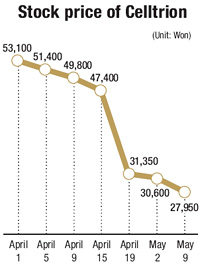
The price of stock in Celltrion plunged on news that its chief is under investigation for alleged involvement in stock price manipulation.

The country’s largest manufacturer of biosimilars closed at 27,950 won per share on the tech-laden KOSDAQ, Thursday, down 2,000 won or 6.68 percent from the previous day. It closed at 53,900 on March 29. The Financial Supervisory Service (FSS) is investigating the company and its chairman Seo Jung-jin for allegedly having ties with speculative investors who have been engaged in short-selling the firm’s shares. Read more of this post

The London market only needs transparent and ethical companies; A continuing flow of bad news from former FTSE favourites, ENRC and Bumi, is raising significant questions about London’s future as stockmarket to the world’s leading growth companies

The London market only needs transparent and ethical companies

A continuing flow of bad news from former FTSE favourites, ENRC and Bumi, is raising significant questions about London’s future as stockmarket to the world’s leading growth companies.

In the eyes of some, recent developments at ENRC and Bumi are symptomatic of the LSE being too aggressive in its efforts to attract foreign companies Photo: AFP

By Dr Roger Barker

5:05PM BST 09 May 2013

The London Stock Exchange’s ambitious vision has been to attract dynamic enterprises from emerging economies onto the London market, where they can benefit from the UK’s respected corporate governance regime. This combination of growth and good governance should, in theory, represent a compelling proposition for investors.

But in the eyes of some, recent developments at ENRC and Bumi are symptomatic of the LSE being too aggressive in its efforts to attract foreign companies. Perhaps inevitably, there has been a call for tighter regulation. In contrast to most UK-listed firms, emerging market enterprises typically have large controlling shareholders rather than dispersed ownership. Such shareholders can potentially use their voting power to overrule the board of directors and disadvantage minority shareholders, particularly through related party transactions which may favour their wider business interests. This type of conflict has been at the heart of recent boardroom disputes at ENRC and Bumi. Read more of this post

Too Much Trust in Local Finances: It would seem Chinese local governments didn’t get the memo about reining in credit risks

May 9, 2013, 5:57 PM

Too Much Trust in Local Finances

AM-AY442_CTRUST_NS_20130508120303

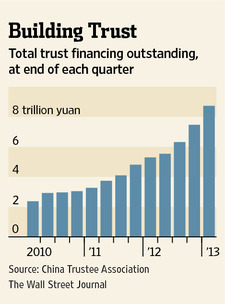
It would seem Chinese local governments didn’t get the memo about reining in credit risks.

According to data issued Wednesday by the China Trustee Association, a government-backed industry body, trust companies funneled 461 billion yuan ($75.2 billion) worth of new funding to infrastructure projects in the first three months of 2013 (here in Chinese http://www.xtxh.net/sjtj/15547.html)–-more than in the preceding six months combined.

In the third and four quarters of 2012, trusts — a type of wealth management company common in China – provided a total of 458.3 billion yuan worth of new infrastructure financing.

The massive expansion in lending to infrastructure projects – most of which likely went to investment platforms backed by local governments – comes as Beijing grows increasingly uneasy about the level of local government debt. Read more of this post

China’s Fiddled Figures: It’s hard to reform an economy you don’t fully understand

May 9, 2013, 12:49 p.m. ET

China’s Fiddled Figures

It’s hard to reform an economy you don’t fully understand.

Trade data released Wednesday painted a rosy picture of the Chinese economy. But the closer everyone looks, the more doubts emerge.

Officially, exports picked up enough to create a trade surplus worth $18.2 billion, compared to a deficit of $900 billion in March. Total exports supposedly increased 14.7% compared to April 2012, up from the 10% year-on-year growth notched in March. This sparked hopes in some quarters that disappointing GDP growth in the first three months of the year was a blip.

Yet China’s export data don’t match what other countries report they import from China. That’s because Chinese exporters overstate the value of goods to conceal the repatriation of earnings stockpiled overseas. Firms are circumventing capital controls to speculate on the rising yuan, and also to seek higher returns on risky wealth management products offered by banks at home. This inflow shows up as artificially inflated exports. Read more of this post

$58Bln Hot Money Channeled into Mainland From Hong Kong Disguised as Trade Payments

Analysis: $58Bln Hot Money Channeled into Mainland From Hong Kong Disguised as Trade Payments

05-10 13:18 Caijing

Details of April trade report and anecdotal evidence have prompted many to believe that China’s trade data was significantly inflated by companies fiddling their invoices to bring funds onshore to chase yield.

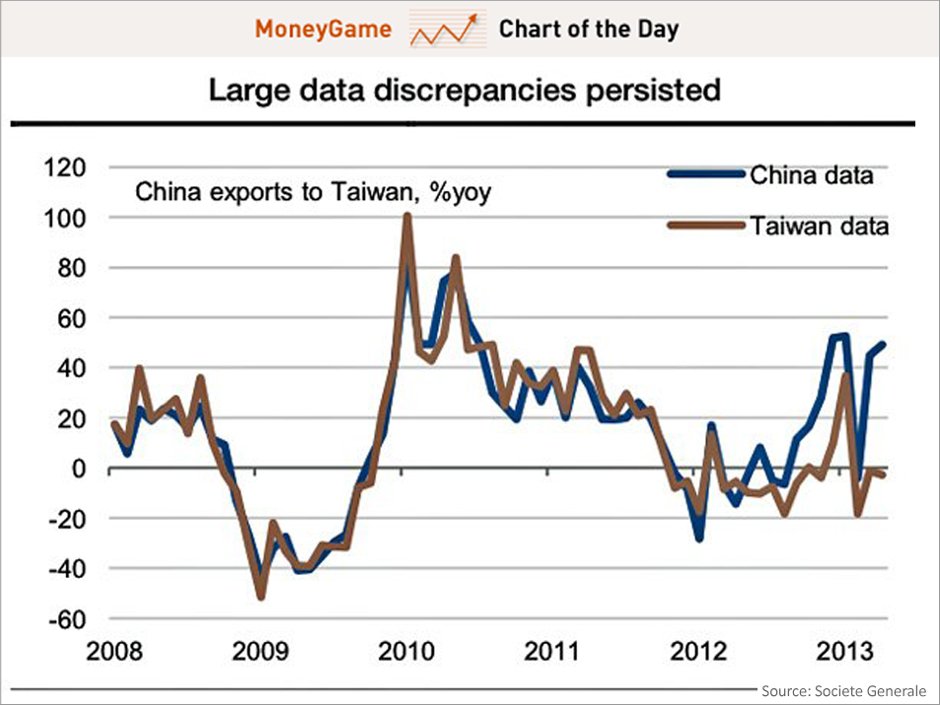
Alleged distortions on China’s export data may have dented hopes for markets starved for upbeat Chinese data, with analysis showing speculative capital inflows disguised as trade payments could hit 58 billion U.S. dollars. Details of April trade report and anecdotal evidence have prompted many to believe that China’s trade data was significantly inflated by companies fiddling their invoices to bring funds onshore to chase yield. Official data showed Wednesday that April exports grew by 14.7 percent from a year earlier, beating a market consensus of 9.2 percent gain and March’s 10.0 percent increase. Exports to Taiwan rose 49.2 percent to $4.26 billion in April, the customs said, while Taiwan data indicates imports from the Chinese mainland fell 2.7 percent year-on-year to $3.57 billion.

Read more of this post

China Should Ditch Shanzhai or the culture of knock-offs

China Should Ditch Shanzhai  

Economic Observer Online – In-depth and Independent

By EO’s Editorial Board
Issue 618, May 6, 2013
After a five-year court battle, Adidas has finally settled with Adivon (阿迪王), a Chinese sportswear company with a name and logo that is very similar to that of the global brand. Adivon has agreed to transfer its Chinese trademarks and triangular logo to the German multinational and has agreed to never use them again.

Meanwhile, another unfinished lawsuit has aroused even more attention. This one is between Qiaodan Sports Company Limited (乔丹体育) and former NBA basketball player Michael Jordan. The pronunciation of the two names in Chinese is the same. The Chinese sportswear company maintains that is has not infringed upon the Air Jordan trademark and isactually now suing Jordan for suing them two years ago just as Qiaodan was set to debut on the stock market. Qiaodan Sports argues that the Chinese name Qiaodan (乔丹) is only a translation of the common surname “Jordan.” The company also argues that the brand actually chose the name because it means “plants in the south” (南方之草木) in Chinese. As one online commentator put it, Qiaodan’s attempts to justify their use of the brand was “ridiculous” (神解释) or to put it another way, the company was “speaking blindly with eyes wide open” (睁着眼说瞎话). This kind of explanation shows both a lack of respect for the facts and is also an insult to the intelligence of consumers. For most people familiar with sport, the Chinese word “qiaodan” is clearly linked to Michael Jordan. That a Chinese company can be so bold as to claim that there is not relation is connected to the fact that up until now, Chinese culture has given too much leeway to a culture of knock-offs or shanzhai (山寨) as it’s referred to in Chinese. Read more of this post

China’s bond market regulator closed off a loophole that allowed banks that sell high-yielding wealth management products (WMPs) to evade regulatory requirements by moving money between the WMP accounts they manage and their own prop accounts

China issues new rules targeting wealth management fund pools: sources

2:30am EDT

By Yong Xu and Pete Sweeney

SHANGHAI (Reuters) – China’s bond market regulator closed off a loophole on Friday that allowed banks that sell high-yielding wealth management products (WMPs) to evade regulatory requirements by moving money between the WMP accounts they manage and their own proprietary accounts, bond traders at four Chinese banks told Reuters. The four traders, who spoke on condition of anonymity because they are not authorized to speak to media, told Reuters the China Government Securities Depository Trust & Clearing Co Ltd (CDC) and the Shanghai Clearing House had jointly notified commercial banks they could no longer trade bonds between their own proprietary accounts and the WMPs they manage for clients. The rules will go into effect Friday afternoon, the sources said. “Yesterday we could do it, today everybody has to undo it; it’s new regulation after new regulation,” said one of the traders. Read more of this post

Colleges Soak Poor Students to Funnel Aid to Rich

Colleges Soak Poor Students to Funnel Aid to Rich

By John Hechinger and Janet Lorin – May 8, 2013

U.S. colleges such as Boston University are using financial aid to lure rich students while shortchanging the poor, forcing those most in need to take on heavy debt, a report found.

Almost two-thirds of private institutions require students from families making $30,000 or less annually to pay more than $15,000 a year, according to the report released today by the Washington-based New America Foundation.

The research analyzing U.S. Education Department data for the 2010-2011 school year undercuts the claims of many wealthy colleges that financial-aid practices make their institutions affordable, said Stephen Burd, the report’s author. He singled out schools — including Boston University and George Washington University — that appear especially pricey for poor families.

“Colleges are always saying how committed they are to admitting low-income students — that they are all about equality,” Burd said in a phone interview. “This data shows there’s been a dramatic shift. The pursuit of prestige and revenue has led them to focus more on high-income students.” Read more of this post

Tough Times Ahead for 100-Yen Stores

May 9, 2013, 3:13 p.m. ET

Tough Times Ahead for 100-Yen Stores

By MAYUMI NEGISHI

MI-BV882_YENSTO_G_20130509155407

TOKYO—Japanese investors and exporters may be cheering the dollar’s return to the ¥100 mark, but for the thousands of “100 Yen” discount stores around the country, it signals tough times ahead.

The 100-yen shops have become representative of a deflationary Japan, thriving by astonishing customers with the purchasing power of the ¥100 coin. They offer everything from cellphone chargers to fake eyelashes for the same low price. Their business model has centered on a strong yen pushing down prices of the imported goods that fill their shelves.

But now the Bank of Japan has declared a new war on deflation, and a primary side effect of its primary weapon—a massive monetary easing—has been a vastly cheaper yen. That is starting to erode already razor-thin profit margins for the discounters.

“A five yen difference is huge,” said Yasuaki Ikeda, manager of two US.Mart 100-yen stores in Tokyo. He imports 90% of his products, 80% of them from China. “When the cost of 100 chopsticks moves from ¥80 to ¥85, I have to ask suppliers to pack fewer chopsticks,” he said. Read more of this post

Berkshire Sells Debt to Buyers Buffett Pities; “Berkshire issuing debt is effectively an efficient way to short the bond market.”

Berkshire Sells Debt to Buyers Buffett Pities: Corporate Finance

Berkshire Hathaway Inc.’s $1 billion note sale shows that while Chief Executive Officer Warren Buffett may pity investors who’ve stuck with bonds as yields fall to record lows, he’ll sell them as much debt as they want.

The company’s Berkshire Hathaway Finance Corp. sold five-and 30-year securities offering the company’s lowest coupons for those maturities ever. Berkshire, whose holdings span insurance, railroads, newspapers and manufacturing, has reduced its bond investments to $28.6 billion from $34.1 billion in the last three years, regulatory filings show.

Berkshire isn’t buying corporate bonds, Buffett, 82, said during a May 4 interview with Bloomberg Television’s Betty Liu after the company’s annual meeting in Omaha, Nebraska. With the average yield on U.S. corporate debt having fallen to a record low 3.35 percent this month from more than 11 percent in 2008, the second-richest American said at the meeting he has empathy for savers who depend on bond interest.

“Buffett’s views on current interest rates are pretty clear,” said Richard Cook, co-founder of Cook & Bynum Capital Management LLC in Birmingham, Alabama, which oversees about $270 million including Berkshire shares. “Berkshire issuing debt is effectively an efficient way to short the bond market.” Read more of this post

Insight: New York authorities in wave of pension payment deferrals

Insight: New York authorities in wave of pension payment deferrals

9:28am EDT

By Edward Krudy

NEW YORK (Reuters) – For Niagara Falls, a city in New York staring at the prospect of insolvency in the face of a weak local economy and soaring employee costs, diverting money earmarked for pensions to cover short-term spending needs seemed like the only option. “We don’t like doing it, so this is sort of a last ditch strategy for us,” Mayor Paul Dyster told Reuters in an interview. Postponing pension payments was the way to avoid cutting back on town services, he said. Dyster is not alone. A poster child for the struggling upstate economy, Niagara Falls is now one of around 200 New York municipalities, counties and other public employers that delayed more than $1 billion in pension contributions last year as they struggled to plug budget shortfalls. The delay in contributions mirrors steps taken some years ago in other states like New Jersey and Illinois, both now grappling with massive pension funding troubles. The problem is national. Nearly half of all public plans did not make their required contributions last year and had self-declared unfunded liabilities of around $834 billion, according to Wilshire Consulting. Read more of this post

Keep on, or enough already? Fed officials spar over QE3

Keep on, or enough already? Fed officials spar over QE3

Thu, May 9 2013

By Ann Saphir, Luciana Lopez and Jonathan Spicer

SAN FRANCISCO/NEW YORK (Reuters) – Little over a week after U.S. Federal Reserve policymakers overwhelmingly endorsed a plan to keep buying bonds to spur economic growth and hiring, they are airing their differences over their super-easy policy.

“I think we should try as hard as we can” to turn things around, Chicago Federal Reserve Bank President Charles Evans said in an interview on Bloomberg TV, in a forceful defense of the bond-buying program, known as QE3 because it is the Fed’s third round of quantitative easing since the Great Recession. Read more of this post

“Bond God” Gundlach says yield-seekers at risk if interest rates rise; “If interest rates rise up to 5 percent on the 10-year Treasury, you are going to get killed in a lot of these types of vehicles”

Gundlach says yield-seekers at risk if interest rates rise: CNBC

Filed 12 hours ago

NEW YORK – Jeffrey Gundlach, star bond investor and the head of DoubleLine Capital LP, said on Thursday that investors who are fleeing bonds in favor of alternatives offering higher yields could suffer losses if interest rates rise.

“If interest rates rise up to 5 percent on the 10-year Treasury, you are going to get killed in a lot of these types of vehicles,” Gundlach, the chief executive and chief investment officer of DoubleLine Capital, told cable television network CNBC. Using master limited partnerships as an example, he said such investments have a lot of leverage and interest-rate risk.

Los Angeles-based DoubleLine Capital has $59 billion in mostly fixed-income assets. Read more of this post

Paying for the great urbanization of China

Paying for the great urbanization of China

BY HAL HARVEY | 8 MAY 2013

Article Highlights

  • China is in a historic transformation, adding hundreds of millions of people to its urban centers, but its new cities have been built in ways that waste energy and create congestion.
  • It is in the interest of other countries that Chinese urban development decisions be well made, because they will affect resource markets and climate change worldwide.
  • To support the design, transportation and other reforms needed to create livable and healthy cities, China must change its method of financing urban infrastructure.

Consider the impact Pierre L’Enfant had when he laid out Washington, DC, or when Robert Moses worked his plans for New York, or when Daniel Burnham designed Chicago. These planners set patterns that have affected us ever since: They significantly determined how we get around, how our work and home lives connect, whether we live in welcoming neighborhoods, how much traffic congestion we suffer, and more. Their influence reaches into the industrial metabolism as well, as design choices affect our energy and material consumption. And the patterns persist for many decades. Read more of this post

Is There Political Peril in Letting China’s Cities Grow? China’s Vision for a ‘New’ Urbanization

May 9, 2013, 10:05 PM

Is There Political Peril in Letting China’s Cities Grow?

Chinese leaders since Mao Zedong have been wary of letting China’s largest cities reach megacity proportion. The usual reason cited is the fear of turning Beijing, Shanghai and other such cities into Latin American-style slums. But Ohio State University political scientist Jeremy Wallace says there may be another reason: regime survival. In a study of authoritarian regimes between 1946 and 2004 (pdf), he finds that “regimes with capital cities that dominate the urban landscape fail nearly four years sooner and face 60% greater death rates.” Read more of this post

Girl power: As the supply of female factory-workers dwindles, blue-collar women gain clout

Girl power: As the supply of female factory-workers dwindles, blue-collar women gain clout

May 11th 2013 | SHENZHEN |From the print edition

SITTING around a restaurant table, six workers discuss the progress of their labour action. Five of them are women, as are most of their several hundred colleagues who have been occupying the toy factory since mid-April. They have been sleeping on floors, braving rats and mosquitoes, to stop the owner shutting down the factory without giving them fair compensation. Those at the table are all migrants from the countryside. A couple are tearful. All are angry and determined not to give way. In Guangdong province, where nearly 30% of China’s exports are made, women usually far outnumber men on labour-intensive production lines such as those at the toy factory in the city of Shenzhen, next to Hong Kong. Rural women are hired for their supposed docility, nimble fingers and attention to mind-numbing detail. But in recent years Guangdong’s workforce has changed. The supply of cheap unskilled labour, once seemingly limitless, has started to dry up. Factory bosses are now all but begging their female workers to remain. At the same time the women who have migrated to the factory towns have become better-educated and more aware of their rights. In labour-intensive factories, stereotypes of female passivity are beginning to break down.

Read more of this post

Cucinelli Becomes Billionaire Knitting $1,920 Cardigans

Cucinelli Becomes Billionaire Knitting $1,920 Cardigans

Brunello Cucinelli, the 59-year-old founder of the luxury fashion house that bears his name, has become a billionaire.

Knitwear brand Brunello Cucinelli SpA (BC) has more than doubled in value since its initial public offering in Milan last April, giving Cucinelli a net worth of at least $1 billion, according to the Bloomberg Billionaires Index. He has never appeared on an international wealth ranking.

“From the beginning we hoped for a positive and gentle listing,” Cucinelli said by phone from his Milan showroom through a translator. “Investors appreciate our quality, our positioning in the absolute luxury market and our Italian heritage.”

The Solomeo, Italy-based company, which sells $4,530 suede jackets and $1,920 cashmere cardigans, had sales of $360 million in 2012, up 15.6 percent in a year. It forecast “modest double-digit” revenue growth for 2013, Bloomberg News reported in February.

“It is chic sportswear where the quality of the finishing is very high,” Armando Branchini, founder of Milan-based luxury consultant Intercorporate, said in a telephone interview. “Cucinelli offers couture finishing, elegance and sophistication and yet you can wear it in a very casual way.”

Cucinelli’s 63 percent stake is valued at $947 million. He collected more than $90 million selling shares in the IPO. Read more of this post

Chinese Women Aren’t Taking Buffett’s Advice on Gold; “It’s almost Mother’s Day. My mother bluntly told me to buy her gold.”

Chinese Women Aren’t Taking Buffett’s Advice on Gold

On Sunday afternoon, a microblogger in Beijing logged into Sina Weibo, China’s leading social media platform, to gossip about the “auntie” next door. It’s a broad term of respect for an older woman, and his followers understood precisely what he meant when he tweeted, “The auntie next door used all of her retirement savings to buy gold. When asked what she’d do if prices keep dropping, she replied that if everyone kept buying gold, the price wouldn’t drop…”

This might strike a conservative investor as reckless. But in China, where gold has long been a national obsession, a mid-April record crash in global gold prices has been seen as an unprecedented buying opportunity. According to reports in China, Chinese have purchased 300 tons of gold worth more than $16 billion since the crash. Read more of this post

SocGen: Nearly Every Company We Met ‘Admitted’ That Chinese Trade Is About More Than Moving Goods + Chart of the Day: China Exports to Taiwan

SocGen: Nearly Every Company We Met ‘Admitted’ That Chinese Trade Is About More Than Moving Goods

Sam Ro | May 8, 2013, 8:48 AM | 2,044 | 

The better-than-expected Chinese trade data has everyone crying foul. Nomura’s Zhiwei Zhang, Bank of America Merrill Lynch‘s Weijun Hu and Ting Lu, and Societe Generale’s Wei Yao have all pointed to discrepancies between China’s numbers and the numbers of its trading partners. Furthermore, all point to companies using inflated bills as a way to circumvent strict Chinese capital controls and move money in and out of the mainland. “In 1Q13, China’s export data were heavily distorted due to over-reporting by exporters who might bring in hot money through fake exports and arbitrage the differential between CNH/USD and CNY/USD by moving goods in and out of HK,” said BAML’s Hu and Lu. SocGen’s Yao is actually having a hard time finding people who aren’t engaged in this practice. “As for reasons, our observation from the trips to the mainland led us to believe that there is indeed a large amount of speculative capital flows,” wrote Yao in a note to clients. “Nearly all corporates we met admitted that they were conducting some forms of interest rate arbitrage on the expectation of further yuan appreciation.”

CHART OF THE DAY: It Doesn’t Take A Genius To See Something Fishy In China’s Trade Data

Sam Ro | May 8, 2013, 7:29 AM | 4,509 | 4

Earlier today, China published its official April trade figures. And while the numbers for both imports and exports were much stronger than expected, experts have been left scratching their heads over the unusual discrepancies. For one thing, exports surged 14.7% year-over-year even as exports to the U.S. fell by 0.7%. Exports to the EU fell by 6.4%. In a note to clients, Nomura’s Zhiwei Zhang attributed it to companies trying to get around strict Chinese capital controls. “We believe exports to destinations like Hong Kong, a major financial hub, are likely being over-invoiced in an attempt to circumvent capital controls and bring foreign capital into China,” said Zhang who pointed out that exports to Hong Kong surged by 57.2%. Societe Generale’s Wei Yao agrees with Zhang.  “As for reasons, our observation from the trips to the mainland led us to believe that there is indeed a large amount of speculative capital flows,” wrote Yao in a note to clients. “Nearly all corporates we met admitted that they were conducting some forms of interest rate arbitrage on the expectation of further yuan appreciation.” But Hong Kong wasn’t the only discrepancy. Yao noted a whopper in the Taiwan numbers. “Head-scratching discrepancies in bilateral data comparison persisted on both sides of the ledger,” she wrote. “Compared with the data from Taiwan – the only economy besides China that has published the complete set of April data – growth of mainland exports to Taiwan was 57.7 ppt faster based on China’s data (+49.2% yoy vs. -2.7% yoy) and that of mainland’s imports from Taiwan was 58.6ppt faster (+55.7% yoy vs. -2.9% yoy)! The gaps narrowed only marginally from March.” No wonder people question the reliability of the data.

moneygame-cotd-050813

Corporate auditors would be required to look more closely at insider business deals, like those used in many Chinese company frauds, under a rule the US audit regulator has proposed

Thursday May 9, 2013

US audit watchdog wants more scrutiny

WASHINGTON: Corporate auditors would be required to look more closely at insider business deals, like those used in many Chinese company frauds, under a rule the US audit regulator has proposed.

The Public Company Accounting Oversight Board’s (PCAOB) rule takes aim at socalled “related party transactions,” or deals between a company and corporate insiders. These kinds of transactions have played a role in many accounting frauds. Read more of this post

All Malaysian-listed China firms end in the red after listing

Most Bursa-listed China firms end in the red

LIM CIAN YAI

Published: 2013/05/09

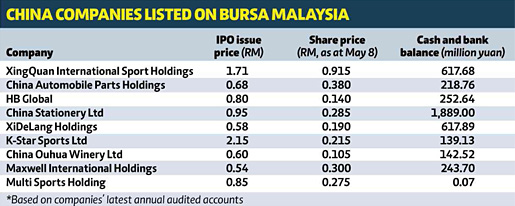
KUALA LUMPUR: China-based companies listed on Bursa Malaysia mostly ended the trading day in the red yesterday, following HB Global Ltd’s investor alert announcement on Tuesday.

This is the first time a China company listed here has reported to the stock exchange a wide discrepancy between its unaudited results and that prepared by its external auditors. Bursa Malaysia leapt into action yesterday, directing HB Global to appoint a special auditor to probe the company’s affairs, particularly its financials, and identify any irregularities.

pix_bottom Read more of this post

Beijing Puzzles Over Urban Growth; Government Entertains Debate on How to Manage Population Gains as It Seeks Lift From Bigger Cities

Updated May 8, 2013, 7:55 p.m. ET

Beijing Puzzles Over Urban Growth

Government Entertains Debate on How to Manage Population Gains as It Seeks Lift From Bigger Cities

By BOB DAVIS

WO-AN688_CURBAN_G_20130508183017

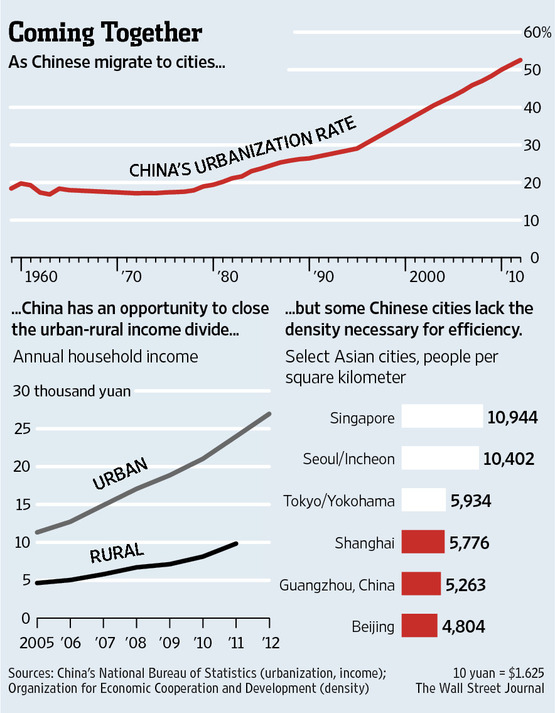
BEIJING—China’s new leaders are counting on urbanization to remake the economy but have tried to limit the flow to the country’s largest cities, fearing that a surge in migration could turn them into Latin American-style slums. Some urbanization specialists inside and outside China argue that the fear is largely misplaced. The problem with Beijing, Shanghai and other Chinese megacities, they say, is that they aren’t even more densely packed—or better planned. Adding more people to Beijing, for example—on top of the 18 million or so who already live here—would encourage better public transportation, boost land prices so high that factories would move away, and attract talented people with fresh ideas, according to these specialists. Imagine, say, Manhattan or Tokyo. “We have to let the market play a bigger role in the development of cities and dismantle barriers” to urban growth, said He Fan, a senior economist at the Chinese Academy of Social Sciences, the government’s most prestigious think tank. “People prefer to move to larger cities because there is more opportunity there.” Angel Gurría, secretary-general of the Organization for Economic Cooperation and Development, is another big-city booster. “When you see the situation in the large urban conglomerations, you say, ‘Let’s stop the growth,’ ” he said during an interview in Beijing. “But you probably don’t want to stop the growth [because] a well-organized, predictable process of urbanization allows for a much better allocation of resources.” Urban planners talk about “agglomeration” effects—the idea that cities gain by having people more tightly packed. That’s because travel by car becomes impractical and is replaced by public transportation. Also, old-line industries are forced to relocate because of rising prices, and lightly polluting service industries take their place. The influx of people brings an energy to a city that helps create new businesses and investment. Read more of this post

Will Health-Care Law Beget Entrepreneurs? Thousands of would-be entrepreneurs want to start their own businesses, but are shackled to their current employer by the need for affordable health insurance

Updated May 8, 2013, 7:59 p.m. ET

Will Health-Care Law Beget Entrepreneurs?

By EMILY MALTBY and ANGUS LOTEN

Thousands of would-be entrepreneurs are itching to start their own businesses, but many are shackled to their current employer by health-care benefits they don’t think they could otherwise afford. Economists call this phenomenon “job lock,” or “entrepreneurship lock.”

But the pressure some Americans feel to cling to a corporate job chiefly for the health insurance could, conceivably, ease in coming years. Under provisions of the health-care law, new-business owners will be able to get coverage through public marketplaces, or “exchanges,” beginning in October, for policies that will take effect starting in January. Read more of this post

Yen’s Slide No Panacea For Japan Inc.

May 7, 2013, 10:59 p.m. ET

Yen’s Slide No Panacea For Japan Inc.

By AARON BACK

Japanese Prime Minister Shinzo Abe has weakened the yen and sent stocks soaring. Boosting long-term earnings growth for Japanese companies will be more difficult. Increasing domestic consumption is an important objective of Mr. Abe’s plan. But much depends on the impact of a weaker yen on Japan’s export-focused businesses. In the current fiscal year, companies on the main Tokyo stock exchange could see profits jump 30% to 40% year-over-year if the yen averages between 100 and 115 to the dollar, saysCitigroup C +2.45% . The yen’s slide has two main effects on corporate earnings. First, revenue earned overseas is immediately worth more in yen terms. Nomura’s survey of large Japanese nonfinancial companies that have reported earnings for the three months ended March 31 shows profits up 7.7% on the previous year. That is down from a 33.2% jump in the previous quarter, though some major companies haven’t reported yet. The second benefit is that Japanese companies should become more competitive as the cheaper yen means foreigners pay less for the country’s exports. While this should boost sales volumes, not all exporters will be able to take advantage.

Take Canon 7751.TO -0.29% . Revenue from its imaging business fell 1.8% year-over-year in the three months to March 31. The fall would have been 14% but for the effect of the weakening yen. But Canon faces fundamental problems that can’t be fixed by currency movements. The company’s core digital-camera business is in decline because amateur photographers can now snap photos with increasingly high-resolution smartphones. In addition, because Canon mainly competes with other Japanese camera makers like Nikon 7731.TO -0.14% and Olympus, 7733.TO -1.10%its rivals will also benefit from the yen’s slide. Read more of this post

Weeds Grow in the Stock Market’s Yield of Dreams; Investors’ intense focus on dividends could yield problems for them later on

May 7, 2013, 5:35 p.m. ET

Weeds Grow in the Stock Market’s Yield of Dreams

By JUSTIN LAHART

Investors’ intense focus on dividends could yield problems for them later on.

Usually when the Federal Reserve is in easing mode, investors set their sights on the stocks of companies whose fortunes are most likely to rise fastest with rising economic growth. But with the Fed sopping up $85 billion in Treasurys and mortgage bonds each month—and driving yields across a spectrum of bonds lower in the process—the hunt for investments that can provide a modicum of income has intensified. So the shares of companies with a history of paying dividends, which investors more typically eschew when the Fed’s foot is on the gas, have been in favor. Read more of this post

Mao Zedong’s granddaughter and her husband appear on the latest rich list as survey suggests that who, not what, you know is still important

Mao Zedong granddaughter on rich list, prompting debate

Thursday, 09 May, 2013, 12:00am

Cary Huang in Beijing cary.huang@scmp.com

Mao Zedong’s granddaughter and her husband appear on the latest rich list as survey suggests that who, not what, you know is still important

The addition of the granddaughter of Mao Zedong to a list of the richest Chinese – along with a survey suggesting that graduates from well-connected families tend to find better jobs – has triggered fresh debate about political connections and personal wealth.

With family assets estimated at 5 billion yuan (HK$6.25 billion), Kong Dongmei , granddaughter of the late leader, and husband Chen Dongsheng are 242nd on the 2013 New Fortune 500 Rich List [1], media reports said yesterday. Read more of this post

HK vs Beijing: A Battle to Become Art Capital of China

May 8, 2013

A Battle to Become Art Capital of China

By KEVIN HOLDEN PLATT

BEIJING — The sometimes-tense relationship between Hong Kong and Beijing appears set to move to another front: the world of art.

With the National Art Museum of China — or Namoc — planning to open in a new building in 2017, and Hong Kong projected to open its M+ museum in a new cultural district about the same time, the cities could emerge as twin titans of contemporary Chinese culture.

Namoc attracted some of the world’s leading architects, including Zaha Hadid, Frank Gehry and Jean Nouvel, to its design contest for the new museum in Olympic park in Beijing. Xie Xiaofan, a deputy director at Namoc, informally announced at theE.U.-China High Level Cultural Forum in November that Mr. Nouvel’s design had been selected, although the decision is subject to the approval of China’s new leadership. Read more of this post

Brazil has plenty of entrepreneurs but many lack ambition when it comes to expanding companies

May 8, 2013 7:27 pm

A spirit for enterprise

By Joe Leahy

When Linda Rottenberg moved to Latin America in the 1990s, she was surprised to find there was no word for “entrepreneur” in the local Spanish or Portuguese. Ms Rottenberg, president of Endeavor, a global non-governmental organisation that supports entrepreneurship, says every university student she met wanted to work for the government. Over the years, however, with the opening of the region’s economies and the rise of its stock markets, that attitude has changed so much that a Portuguese word for entrepreneur has emerged: empreendedor. “One of my favourite days was when the editor of a Portuguese dictionary told me he was adding the word for ‘entrepreneur’,” Ms Rottenberg said recently, before the Global Entrepreneurship Conference, a summit for service providers in the field, which was held in Rio de Janeiro.

Few people, particularly the participants milling around the conference, would question the existence of a Brazilian entrepreneurial spirit. On the global stage, there is Brazil’s most prominent entrepreneur, Jorge Paulo Lemann, who is teaming up with Warren Buffett to buy Heinz. Or Embraer, the world’s third-largest commercial aircraft maker, which continues to practise “intrapreneurship” by taking risks on new products and investing in fresh business lines. At home, there are businessmen such as Andre Esteves, who is building BTG Pactual, the country’s biggest independent investment bank, or Peixe Urbano, the collective buying platform that is Brazil’s version of Groupon. The idea of the entrepreneur has become such a celebrated part of Brazilian culture that one of the main characters in Avenida Brasil, a popular soap opera, was an entrepreneur selling hair products developed in her shop in a favela.

But in a country dominated by huge companies, some state run and most recipients of state credit, how much is this idea of the great Brazilian entrepreneur myth or reality? Rather than patting itself on the back, should Brazil, facing increasing doubts over its international competitiveness, be doing much more to foster entrepreneurship? “You need more Embraers, you need more Brazilian companies participating in higher value-added production chains,” says Paulo Sotero, director of the Brazil Institute at the Woodrow Wilson International Centre for Scholars in Washington. Read more of this post
Norges, the world’s largest sovereign wealth fund, is fleeing out of inflation-linked bonds in a sign of how many large investors are souring on the asset class

May 8, 2013 4:44 pm

Norway’s oil fund dumps inflation-linked bonds

By Richard Milne in Oslo and Robin Wigglesworth in London

The world’s largest sovereign wealth fund is fleeing out of inflation-linked bonds in a sign of how many large investors are souring on the asset class. Norway’s oil fund has cut its holdings of inflation-linked bonds by 73 per cent in the past year and almost halved them in the first three months of this year alone. Yngve Slyngstad, head of the oil fund, told the Financial Times that, in theory, inflation-linked debt was one of the ways investors could hedge the risk of negative real yields in government bond portfolios. But he added that the oil fund was in fact reducing its exposure to inflation-linked bonds sharply because it had concluded that it was not a big enough market. Read more of this post

University endowments trim holdings in US Treasuries from as much as 30 per cent in 2008-09 to zero in some cases, fearing they could be caught flat-footed by a reversal of the Federal Reserve’s low interest-rate policy

May 8, 2013 7:34 pm

University endowments trim holdings in US Treasuries

By Henny Sender in New York

Some of the smartest money in America is getting out of US government debt. Many university endowments have scaled back their holdings of Treasury securities from as much as 30 per cent in 2008-09 to zero in some cases, say people familiar with their investment strategies. The sell-off reflects a big change in the way fund managers view US government debt. The traditional attraction of Treasuries for US investors was that they were certain to be repaid. But with interest rates at such low levels, investors worry that bond prices could fall dramatically. “Treasuries were a core holding,” said one university fund manager. “Now everyone is holding less than 5 per cent.” The fear on campuses is that universities, which profited in recent years from the rally in Treasury prices, could be caught flat-footed by a reversal of the Federal Reserve’s low interest-rate policy. “If you think you can change allocations quarter by quarter, and you believe rates will be low for longer, and you think you can make a quick switch, then maybe it is OK,” the university fund manager said. “But that isn’t the way we invest. Today government bonds should come with a warning about interest rate risk.” Princeton’s $17bn endowment has converted its Treasury holdings to cash, according to published reports. Duke’s $5.5bn endowment has also shifted from Treasuries to US stocks with high dividends and emerging market equities, a person familiar with the university fund said. Last week, Cornell’s $5bn endowment decided to reduce its investments in Treasury securities to just over 3 per cent of assets. As of June last year, Yale’s $19bn endowment had only 4 per cent of its holdings in Treasuries. “Yale is not particularly attracted to fixed income assets as they have the lowest expected returns of the seven asset classes that make up the endowment,” the university’s fund said in its annual report. According to one survey of 831 US universities, the average endowment lost 0.3 per cent in the fiscal year ending June 2012, with gains on holdings of government debt offsetting losses elsewhere in their portfolios. By contrast, endowments earned an average return of 19.2 per cent in the year to June 2011.