Fees for hedge funds and private equity: Down to 1.4 and 17; The cost of investing in alternative assets is falling-slowly

Fees for hedge funds and private equity: Down to 1.4 and 17; The cost of investing in alternative assets is falling—slowly

Feb 8th 2014 | From the print edition

image001

PHOENICIAN merchants kept a fifth of the profits generated from their seafaring adventures and paid out the rest to their financiers. So claimed Alfred Winslow Jones, the manager of the first modern hedge fund, who in the 1950s used the (perhaps apocryphal) precedent to finagle a 20% cut from his backers. Other managers subsequently added a 2% annual charge on the assets they invested to arrive at the “2 and 20” formula that became the standard for both hedge funds and private equity. Investors, who have long suspected that this arrangement enriches managers faster than their clients, are belatedly fighting back. They have succeeded in amending the formula to something more like “1.4 and 17”, at least for newcomers to the business (see chart). Read more of this post

Japan’s trading houses look to new markets

February 10, 2014 3:04 am

Japan’s trading houses look to new markets

By Ben McLannahan in Tokyo

In the coastal town of Kushimoto, on the southern-most tip of Japan’s main island of Honshu, Mitsubishi Corp is rearing tuna.

The Tokyo-based company used to buy every bluefin it sold, fished out of the Atlantic or Mediterranean or closer to home. But last August it started selling its own, raised from juveniles artificially hatched three or four years earlier. Read more of this post

Why We Can’t Afford to Not Care About Politics

Why We Can’t Afford to Not Care About Politics

By Josua Gantan

 on 6:32 pm February 9, 2014.
Bad leaders are elected by good citizens who don’t vote. Sixteen years after the reformation in 1998, political apathy remains a threat to Indonesia’s democracy. The number of non-voters is on the rise. In 2004, the number of absent voters was at 23.3 percent, during the 2009 presidential election it increased to 39 percent. When probed deeper, disenchantment with the government underlies the political apathy that prevails among the people. Yet, there are strong reasons why Indonesians need to be politically engaged despite all the reasons to think otherwise. Read more of this post

Chinese credit crackdown felt overseas

February 9, 2014 7:21 pm

Chinese credit crackdown felt overseas

By Henny Sender in New York

China’s vast development bank has begun asking some international clients to postpone drawing down previously committed credit lines, in moves that highlight how strains on the country’s financial system are reverberating abroad. Read more of this post

China to Create Unified Pension System

China to Create Unified Pension System

Plan Looks to Provide More Central Government Funding to Poorer Regions

LIYAN QI

Updated Feb. 7, 2014 10:07 a.m. ET

BEIJING—China pledged Friday to create a unified pension system to boost consumption and encourage labor mobility, a step toward empowering its vast rural poor.

China’s State Council, or cabinet, said it planned to create a unified pension system for residents in both rural and urban areas. Funding would come from contributions from individuals, the central government, local governments and social institutions, the State Council said on the central government’s website. Read more of this post

Move Over, Rickshaw: Cambodia Launches Public Buses

Move Over, Rickshaw: Cambodia Launches Public Buses

By Suy Se

 on 2:17 pm February 9, 2014.

Phnom Penh. Motorcycles, cars, tuk-tuks and the humble rickshaw dominate its traffic-clogged roads, but now the Cambodian capital Phnom Penh is launching a new weapon in the fight against chronic congestion: its first public buses in over a decade. Read more of this post

New Regulations Leave Buyout Shops Out on Their Own

February 9, 2014, 6:06 p.m. ET

New Regulations Leave Buyout Shops Out on Their Own

By Ryan Dezember

Most private-equity firms have to raise funds by sending executives around the world to drum up interest from investors. For years, executives at Ridgemont Equity Partners never had to leave Charlotte, N.C., home to both the buyout firm and its lone backer: Bank of America Corp. Read more of this post

Let weak banks die, says eurozone super-regulator

February 9, 2014 7:00 pm

Let weak banks die, says eurozone super-regulator

By Claire Jones, Sam Fleming and Alice Ross in Frankfurt

The eurozone’s new chief banking regulator has warned that some of the region’s lenders have no future and should be allowed to die, heralding a far tougher approach to the supervision across the currency bloc. Read more of this post

George Soros picks up $5.5bn as Quantum Endowment fund soars

February 9, 2014 10:00 pm

George Soros picks up $5.5bn as Quantum Endowment fund soars

By James Mackintosh

George Soros’s Quantum Endowment fund had its second-best year ever in dollar terms in 2013, adding $5.5bn to the billionaire’s fortune and putting Quantum back in top place among the most successful hedge funds of all time. Read more of this post

Emerging markets need a lasting solution to cure their woes

Updated: Monday February 10, 2014 MYT 9:38:04 AM

Emerging markets need a lasting solution to cure their woes

BY YAP LENG KUEN

At the moment, it would appear that Asian central banks are picking up the bill to steel their economies in the face of capital outflows.

Indonesian and Indian authorities have improved their defences against rapid outflows, but their governments have failed to tackle supply bottlenecks and market rigidities that fuel inflation and limit room for policy manoeuvre, said Reuters, quoting economists. Read more of this post

Corporate America’s battle with activist investors is increasingly being fought across the deal table rather than the boardroom, according to new research.

February 9, 2014 6:59 pm

Activist investors force higher price takeovers

By Ed Hammond in New York

Corporate America’s battle with activist investors is increasingly being fought across the deal table rather than the boardroom, according to new research. Read more of this post

MAS-SGX measures: more can be done; Scope for improvement with regard to manipulation and disciplinary action

PUBLISHED FEBRUARY 10, 2014

MAS-SGX measures: more can be done

Scope for improvement with regard to manipulation and disciplinary action

R SIVANITHY SIVAN@SPH.COM.SG

SENIOR CORRESPONDENT

Welcome proposals: The measures are consistent with SGX’s oft-stated preference for a disclosure-based, ‘buyer beware’ regime. – PHOTO: BLOOMBERG

THE moves proposed by the Monetary Authority of Singapore (MAS) and the Singapore Exchange(SGX) on Friday targeting speculative trading inpenny stocks are welcome since all are aimed at improving the quality of listings, transparency and levelling the playing field for small investors. Read more of this post

The Fed’s waning magic in the age of Yellen; With a forecast year of take-off in danger of faltering, the central bank has run out of ammunition

February 9, 2014 6:06 pm

The Fed’s waning magic in the age of Yellen

By Edward Luce

With a forecast year of take-off in danger of faltering, the central bank has run out of ammunition

image002-1

Every chairman of the US Federal Reserve seems to get hit by a crisis in their first year. For Paul Volcker in 1979 it was raging inflation. For Alan Greenspan it was the 1987 “Black Monday” meltdown. And for Ben Bernanke in 2006 it was the bursting of the US housing bubble. Whatever might blindside Janet Yellen, she starts off with a problem that affected none of her predecessors: the Fed has run out of ammunition. Moreover the one remaining weapon the Fed thinks it has – the hocus-pocus of “forward guidance” – is a gun that fires blanks. Read more of this post

Europe Stunned, Angry As Switzerland Votes To Curb Immigration

Europe Stunned, Angry As Switzerland Votes To Curb Immigration

Tyler Durden on 02/09/2014 13:28 -0500

This wasn’t supposed to happen. At a time when the European Union, reeling from the ongoing near collapse of the Eurozone, has been preaching its key benefits – the removal of borders and the free transit of labor – moments ago Switzerland, with a tiny majority of 50.4%, voted in favor of new immigration curbs which requires the government to set an upper limit for foreigners, risking a backlash from the (utterly toothless) European Union. Read more of this post

Chastened HTC turns to cheaper smartphones in search for profit

Chastened HTC turns to cheaper smartphones in search for profit

4:15pm EST

By Michael Gold and Sinead Carew

TAIPEI/NEW YORK (Reuters) – Smarting from growing losses, Taiwanese phone maker HTC Corp says it will expand its range of cheaper products as it fixes off-target marketing for its premium smartphones. Read more of this post

Taking On Thailand’s Crisis With a Bit of Western Bite

Taking On Thailand’s Crisis With a Bit of Western Bite

By THOMAS FULLERFEB. 8, 2014

image003

Winyu Wongsurawat, left, working on his low-budget political satire show with his sister, Janya Wongsurawat, and Nattapong Tiendee, in their studio in Bangkok on Thursday. Agnes Dherbeys for The New York Read more of this post

Big Pizza Chains Use Web Ordering To Slice Out Bigger Market Share; Many Mom-and-Pop Shops Lack Resources to Compete Online

Big Pizza Chains Use Web Ordering To Slice Out Bigger Market Share

Many Mom-and-Pop Shops Lack Resources to Compete Online

JULIE JARGON

Feb. 6, 2014 9:19 p.m. ET

The rise of online ordering is putting corner pizzerias in peril, as big chains have invested in sophisticated systems that let customers order and pay without having to call. Julie Jargon reports, and Alex “Bugsy” Lyudmir of Rizzo’s Fine Pizza shops shares how his small chain is trying to keep up. Read more of this post

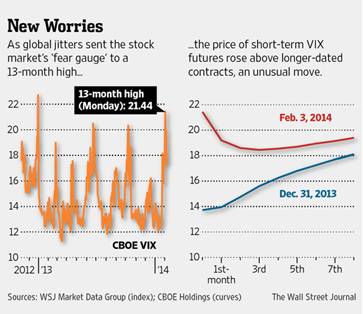
Investors Arm for Imminent Tremors; Cost to Protect Against Short-Term Volatility Is On the Rise

Investors Arm for Imminent Tremors

Cost to Protect Against Short-Term Volatility Is On the Rise

KAITLYN KIERNAN

Feb. 6, 2014 7:36 p.m. ET

image003-2

Stocks rose sharply on Thursday but options investors are bracing for more wild swings in the coming weeks.

For the past 10 days, options investors have paid more to protect themselves against volatile share-price moves in the coming weeks than to guard against swings a few months from now. Read more of this post

Banks set trading limits for WeChat’s financial service

Banks set trading limits for WeChat’s financial service

Peng Wei-lin and Staff Reporter

2014-02-09

Many banks in China have restricted the amount of money their clients can transfer to Li Cai Tong, a popular internet financial service, to avoid a possible funds shortfall, which has led to criticism among their clients. Read more of this post

How to Save Detroit: The Motor City needs help. Why not turn it into Hong Kong?

How to Save Detroit

The Motor City needs help. Why not turn it into Hong Kong?

P. J. O’ROURKE

Jan. 9, 2014 1:12 p.m. ET

image001-31

Detroit is beautiful—though you probably have to be a child of the industrial Midwest, like me, to see it. As you may have heard, the city is in trouble. At the end of the 2013 fiscal year, Detroit had a balance sheet with liabilities of $9.05 billion. The city’s emergency manager, Kevyn Orr, estimates long-term debt at $18 billion. Read more of this post

The Case for a Higher Minimum Wage; An increase would help 27.8 million people. It would also help balance power in the workplace.

The Case for a Higher Minimum Wage

By THE EDITORIAL BOARDFEB. 8, 2014

The political posturing over raising the minimum wage sometimes obscures the huge and growing number of low-wage workers it would affect. An estimated 27.8 million people would earn more money under the Democratic proposal to lift the hourly minimum from $7.25 today to $10.10 by 2016. And most of them do not fit the low-wage stereotype of a teenager with a summer job. Their average age is 35; most work full time; more than one-fourth are parents; and, on average, they earn half of their families’ total income. Read more of this post

Business as usual in Sarawak; Taib’s anticipated departure as chief minister has not convinced many that it would bring about a change in the way wealth is distributed in the state. But would that really be the case?

Updated: Saturday February 8, 2014 MYT 11:22:00 AM

Business as usual in Sarawak

BY M SHANMUGAMGURMEEET KAUR, AND YVONNE TAN

image002-4

Taib’s anticipated departure as chief minister has not convinced many that it would bring about a change in the way wealth is distributed in the state. But would that really be the case? Read more of this post

The Greater the Turmoil, the Stronger the Dollar. Again. A familiar pattern is back in currency markets, even if U.S. policy is fueling some of the world’s financial problems

The Greater the Turmoil, the Stronger the Dollar. Again.

FEB. 8, 2014

By JEFF SOMMER

Chronic problems have been flaring up in financial markets lately, and some of them may emanate from the United States. Yet none of these issues have seriously damaged the exalted status of what Washington Irving once called “the almighty dollar.” Read more of this post

Why Emerging Markets Should Look Within: Self-inflicted political wounds, more than global economic tides, appear to be shaking nations like Argentina, Turkey, Ukraine and Thailand.

Why Emerging Markets Should Look Within

FEB. 8, 2014

By TYLER COWEN

In recent weeks, Argentina, Turkey, Ukraine and Thailand have endured plunging currencies, capital flight and political disruptions in varying combinations. While they have all been affected by global economic tides, these nations are facing crises because of problems in their national governance. And if we look elsewhere around the world, we find that governance has been re-emerging as a major factor behind success or failure in many emerging nations. Read more of this post

How Dangerous Is China’s Credit Bubble for the World?

How Dangerous Is China’s Credit Bubble for the World?

Tyler Durden on 02/08/2014 18:33 -0500

Submitted by Pater Tenebrarum of Acting-Man blog,

Global Meltdown Predicted by Charlene Chu

Following on the heels of a report that appeared in the Telegraph on the topic, William Pesek at Bloomberg has recently also written an article about Charlene Chu (formerly with Fitch, nowadays with private firm Autonomous Research) and her opinions on China’s shadow banking system and the dangers it represents. The article is ominously entitled “China, the Death Star of Emerging Markets”.  Read more of this post

Investors Still Chasing Low Quality, But Graham Value In US, Japan

Investors Still Chasing Low Quality, But Graham Value In US, Japan

by Saul GriffithFebruary 07, 2014, 3:15 pm

The January sell-off exposed the fact that investors were still pushing money into low quality stocks compared to quality names.

“Despite the very weak market performance in the latter part of January, it was still the low quality names that showed the best returns overall last month, whilst managing positive absolute performance in many regions,” says a research report from SocGen analysts Andrew Lapthorne, Rui Antunes, John Carson, Georgios Oikonomou, Michael Suen and Josh Cherian. “Low quality did underperform during the market decline, as you would expect, but the extent of the “risk-off trade” was not enough to offset the strong outperformance of low quality earlier in the month.” Read more of this post

Government-to-government trade: Unbundling the nation state; Countries have started to outsource public services to each other

Government-to-government trade: Unbundling the nation state; Countries have started to outsource public services to each other

Feb 8th 2014 | From the print edition

NIGERIAN pineapple for breakfast, Peruvian quinoa for lunch and Japanese sushi for dinner. Two centuries ago, when David Ricardo advocated specialisation and free trade, the notion that international exchange in goods and services could make such a cosmopolitan diet commonplace would have seemed fanciful. Read more of this post

If Brazilians find themselves in a tight spot, they say they are in a saia justa (a tight skirt); Brazil’s president has left herself little room for economic manoeuvre ahead of a difficult re-election campaign

Brazil’s president has left herself little room for economic manoeuvre ahead of a difficult re-election campaign

Feb 8th 2014 | From the print edition

IF BRAZILIANS find themselves in a tight spot, they say they are in a saia justa (a tight skirt). Although she usually prefers trouser suits, that is precisely where Dilma Rousseff finds herself. Later this month she will launch her campaign to win a second term in a presidential election due on October 5th. Normally at this stage of the political cycle, as in the run-up to elections in 2006 and 2010, the government would be ramping up spending. But when Ms Rousseff spoke to the World Economic Forum in Davos last month, with the São Paulo stockmarket and the real dipping along with other emerging economies, she felt impelled to stress her commitment to being strait-laced. Read more of this post

Into the melting pot: The rapid rise of mixed-race Britain is changing neighbourhoods-and perplexing the authorities

Into the melting pot: The rapid rise of mixed-race Britain is changing neighbourhoods—and perplexing the authorities

Feb 8th 2014 | From the print edition

ZADIE SMITH, a novelist born to a black Jamaican mother and a white British father, recently recalled that when she was growing up in Willesden Green, a London district with a large immigrant population, “nothing could be more normal than a mixed-race girl”. The surprise, she said, was entering publishing and finding that people thought it unusual. Nobody could get that impression now: Britons are mixing at extraordinary speed. Read more of this post

Nanomanufacturing in America: Small but imperfectly formed

Nanomanufacturing in America: Small but imperfectly formed

Feb 7th 2014, 14:00 by P.H.| WASHINGTON D.C.

VACUUM TUBES, semiconductors and the internet have changed how we live; now nanotechnology promises a similar revolution. Nanocoatings that make it impossible for liquid to even touch a treated surface are transforming material science. Carbon nanotubes can help artificial muscles behave like the real thing, while nanoscale drug delivery can target cancer cells with deadly accuracy. Concrete infused with nanofibres can be self-sensing, enabling roads and bridges to be monitored remotely for structural weakness or traffic volumes. Read more of this post