Jobless college graduates top 3 mil

2014-02-03 18:47

Jobless college graduates top 3 mil.

By Kim Tae-jong
image001-11

The number of college graduates who are “economically inactive” surpassed 3 million for the first time, government data showed Monday.
According to Statistics Korea, the number of people who have college degrees, but gave up searching for  jobs soared to 3.08 million last year, up 3.2 percent from the previous year.
The number has been on a steady increase because of an increased number of university graduates. It stood at 1.59 million in 2000 but surpassed the 2 million mark in 2004. Read more of this post

Imax Faces a Threat in China; Not only could competitors in China cut into its potential market share there, but Imax has charged in several courts that the Chinese system relies on technology that was blatantly stolen from its offices

Imax Faces a Threat in China

By MICHAEL CIEPLYFEB. 2, 2014

LOS ANGELES — “We’ve got the future under control,” contends OmniCorp, the giant technology corporation in “RoboCop,” a blockbuster remake set for release by Sony Pictures and MGM next month.

But can Imax Corporation, the movie studios’ business ally, say the same about its dealings inChina? Read more of this post

Emerging markets are badly served by ETFs

February 2, 2014 2:44 pm

Emerging markets are badly served by ETFs

By John Authers

Investment vehicles have helped to create another boom and bust cycle

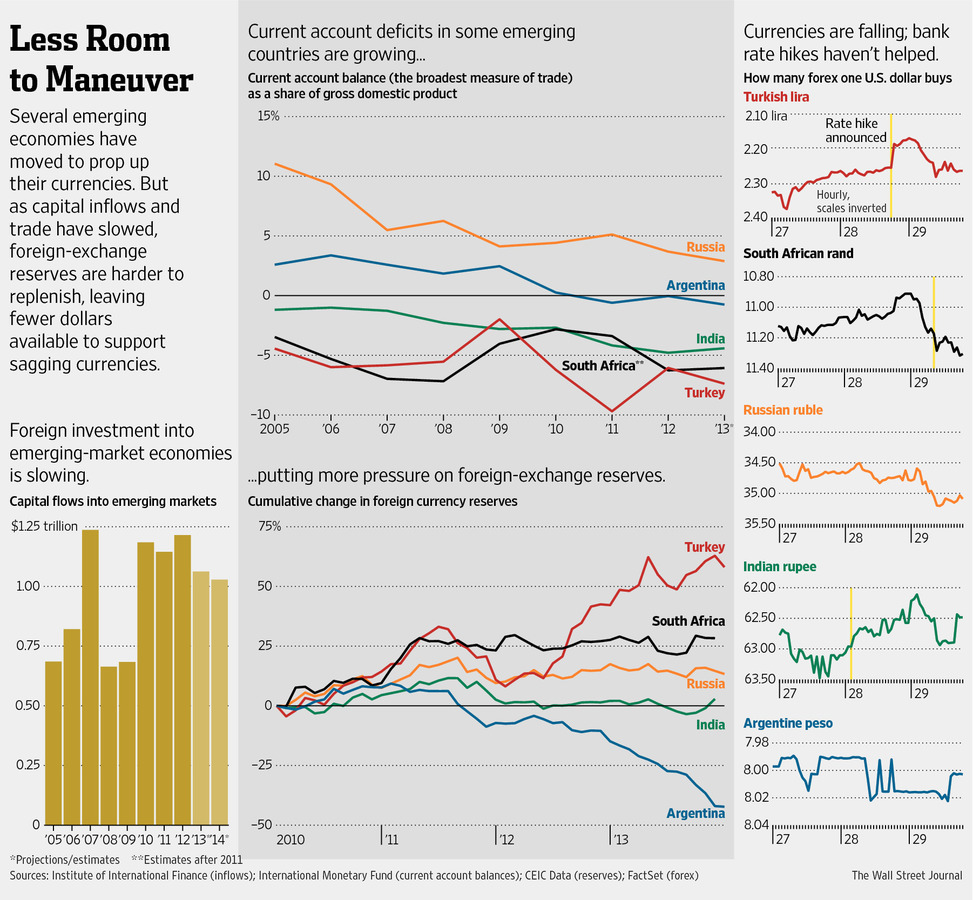
Money is flowing out of the emerging markets. A debate is raging over whether this is the fault of the US Federal Reserve, which has effectively encouraged investors to bring their money back home. Read more of this post

Moocs in transition: Not so massive, open or even online

Moocs in transition: Not so massive, open or even online

February 2, 2014 11:32 pmby Richard Waters

Like any widely hyped online phenomenon, Moocs – massive open online courses – are facing a reality-test.

Hardly anyone who starts one of the online courses actually finishes it. But even if the formula is being rethought, the potential impact on education hasn’t diminished. Read more of this post

Entrepreneurship education needed in China; The country’s business schools should adopt western tactics and have start-up labs

January 31, 2014 1:33 pm

Entrepreneurship education needed in China

By Mike Bastin

The country’s business schools should adopt western tactics and have start-up labs

Many countries in the west have pinned their hopes on start-ups and family-run enterprises to help kick-start the economy. China is no exception. Read more of this post

Europe will feel the pain of emerging markets; The last thing the global economy needs is a resurgence of the European debt crisis

February 2, 2014 8:40 pm

Europe will feel the pain of emerging markets

By Wolfgang Münchau

The last thing the global economy needs is a resurgence of the European debt crisis

So much for “crisis over”. After the US subprime meltdown and the explosion of eurozone sovereign debt yields, we are now confronting a classic emerging marketcurrency crisis with possible repercussions in other parts of the global economy. Read more of this post

Fate of emerging markets is intertwined with US Fed’s actions

Updated: Monday February 3, 2014 MYT 8:05:37 AM

Fate of emerging markets is intertwined with US Fed’s actions

BY YAP LENG KUEN

LIKE it or not, the fate of the emerging markets is intertwined with the actions of theUS Federal Reserve (Fed), which has been a big-time player in providing liquidity via its bond purchases.

Now that the Fed is into its monthly bond withdrawals, the finger is being pointed at it for the emerging markets’ fall-off. Read more of this post

Will Long Working Hours Stymie ‘Womenomics’?

February 3, 2014, 11:00 AM

Will Long Working Hours Stymie ‘Womenomics’?

MITSURU OBE

As a 33-year-old working mother of two, Mizue Terasaki knows what it’s like to commute on a crowded train with a baby and a stroller. “It’s very hard,” she says.

“Why do I continue working?” she once asked in a monthly column she writes for the finance ministry’s public relations magazine. “I can get neither work nor child-rearing done to my satisfaction.” Read more of this post

Australia’s Big 4 banks are global unknowns

Australia’s Big 4 banks are global unknowns

February 3, 2014 – 1:21PM

Max Mason

image001-7

Australia’s big four banks may rank among the most profitable in the developed world, but when it comes to brand value they trail their better known foreign peers. Read more of this post

Hidden truths: How Reputation.com helps sanitise its 1.6 million client’s online reputation

Hidden truths: How Reputation.com helps sanitise its 1.6 million client’s online reputation

February 1, 2014

Fake versions of yourself online? Anna Funder doesn’t mind the idea, but mass disinformation has its drawbacks.

Recently we took the children to the Spy Museum in Washington DC. All the expected natty James Bond devices were there: a camera in a shoe brush, a .22 calibre pistol in a cigarette, a cyanide pill in the arm of some 1970s spectacles. And more. Read more of this post

Ban banks from wealth management; Economist say banks should get out of wealth management and consumer protection should be improved

Ban banks from wealth management: economists

February 1, 2014

Clancy Yeates

Economists also see no role for banks in wealth management.

David Murray’s financial system inquiry should examine ways to beef up consumer protection and improve disclosure standards for retail investors, some of the country’s top economists say. Read more of this post

Private-Equity Firms’ Fees Get a Closer Look; Industry May Be Underpaying Taxes by Misrepresenting Payments

Private-Equity Firms’ Fees Get a Closer Look

Industry May Be Underpaying Taxes by Misrepresenting Payments

MARK MAREMONT

Feb. 2, 2014 4:48 p.m. ET

Gregg D. Polsky, a tax-law professor, has long been a thorn in the side of the private-equity industry. Now he is at it again.

In 2009, Mr. Polsky wrote an article criticizing a strategy that allowed many fund executives to save on taxes by converting ordinary fee income into capital gains taxed at substantially lower rates. The Internal Revenue Service later started examining the propriety of the practice, called a management-fee waiver, and recently said it plans to issue new guidance on it. Read more of this post

Free People, Anthropologie Stores Fuel Urban Outfitters’ Growth

Free People, Anthropologie Stores Fuel Urban Outfitters’ Growth

Company Boasts Savvy Management, Increasing Earnings and a Strong Balance Sheet

SANDRA WARD

Feb. 1, 2014 8:22 p.m. ET

Always an upstart and maverick in the retail industry, Urban Outfitters URBN -0.39% ‘ performance this past holiday season also made it stand out.

Its same-store sales rose a year-on-year 3% for the two months ended Dec. 31. That was a sharp contrast to many of its peers, which posted steep declines—especially those catering to fickle and fiscally challenged teens.

Yet, the gain was less than the 5% anticipated by Wall Street, and disappointed investors sold off the shares.

They focused on the 6% decline in same-store sales posted by the Philadelphia-based company’s flagship chain, Urban Outfitters, which accounts for about 45% of overall sales.

image001-6

While the company cited a difficult retailing environment for the sales slide, it mainly blamed its own fashion misses, narrow product offerings, and lack of a clear popular fashion trend, which prompted heavier-than-usual discounting. Rompers, jumpsuits and sweatshirt dresses didn’t catch on among the college-age hipster crowd that Urban Outfitters targets. Read more of this post

The Great Chinese Internet Crash; The Internet suffered perhaps its largest crash of all time on Jan. 21, when most of China’s 500 million Web users were unable to get online for up to eight hours

The Great Chinese Internet Crash

Web freedom is the best answer to Beijing’s foreign media crackdown.

Updated Feb. 2, 2014 4:21 p.m. ET

The Internet suffered perhaps its largest crash of all time on Jan. 21, when most of China’s 500 million Web users were unable to get online for up to eight hours. Nine days later New York Times NYT -2.68% reporter Austin Ramzy was forced to leave China, the latest in a string of foreign journalists denied work visas by the Beijing government. What these stories have in common is worth understanding—especially in Washington. Read more of this post

Report Hints of Strength of Anti-Reform Sentiment in Myanmar

Report Hints of Strength of Anti-Reform Sentiment in Myanmar

SHIBANI MAHTANI AND MYO MYO

Feb. 2, 2014 8:13 a.m. ET

YANGON, Myanmar—A committee looking at potential changes to Myanmar’s Constitution says most people who weighed in don’t want to alter the clause that prevents opposition leader Aung San Suu Kyi from assuming the presidency. Read more of this post

Nearly Half Of America Lives Paycheck-To-Paycheck

Nearly Half Of America Lives Paycheck-To-Paycheck

Tyler Durden on 02/01/2014 14:45 -0500

While stocks are still near record highs and the inventory-stuffed picture of economic growth for the US ticks up to its fastest pace in 2 years,Time reports that a study (below) by the Corporation for Enterprise Development (CFED) shows nearly half of Americans are living in a state of “persistent economic insecurity,” that makes it “difficult to look beyond immediate needs and plan for a more secure future.” In other words, too many Americans are living paycheck to paycheck… but their findings get worse. Read more of this post

Market Cornered: JPMorgan Owns Over 60% Notional Of All Gold Derivatives

Market Cornered: JPMorgan Owns Over 60% Notional Of All Gold Derivatives

Tyler Durden on 02/01/2014 20:03 -0500

Perhaps the only question we have after seeing the attached table, which shows that as of Q3, 2013 JPMorgan owned $65.4 billion, or just over 60% of the total notional ($108.2 billion) of all gold derivatives in the US, is whether the CFTC will pull the “our budget was too small” excuse to justify why it allowed Jamie Dimon to ignore any and all position limits and corner the gold market? Read more of this post

Indonesia bids to woo carmakers away from Thailand

Indonesia bids to woo carmakers away from Thailand

Sunday, February 2, 2014 – 06:00

Wahyudi Soeriaatmadja

The Straits Times

Honda opened its second car manufacturing factory in Indonesia this month, and Datsun is set to follow suit in April.

Toyota is also looking at expanding production in Indonesia, officials say, as ongoing political uncertainty in Thailand sees businesses and investors look elsewhere in the region. Read more of this post

Pakistan’s privatization tsar embarks on quest to revive economy

Pakistan’s privatization tsar embarks on quest to revive economy

6:55pm EST

By Mehreen Zahra-Malik

ISLAMABAD (Reuters) – Mohammad Zubair was on a cruise dinner with Pakistani Prime Minister Nawaz Sharif in Thailand when he was offered the hardest job of his life: privatizing a huge chunk of the economy while fighting resistance from the opposition and trade unions. Read more of this post

Australia’s home-brewed inflation a hangover for central bank

Australia’s home-brewed inflation a hangover for central bank

2:34pm EST

By Wayne Cole

SYDNEY (Reuters) – The laudable desire of Australians to be well educated and healthy is proving an expensive one as escalating costs add to inflationary pressures even as the broader economy slows. Read more of this post

Global automakers scour India’s backroads in search of dream market

Global automakers scour India’s backroads in search of dream market

4:26pm EST

By Aradhana Aravindan

MUMBAI (Reuters) – For global automakers, the dusty backroads of rural India could be the new El Dorado.

As economic torpor suffocates demand for new cars in India’s megacities, incomes are growing faster in small towns and country areas. That’s pushing the likes of General Motors (GM.N: QuoteProfileResearchStock Buzz) and Honda Motor Co (7267.T: QuoteProfile,ResearchStock Buzz) to fan out in search of buyers in places where fewer than 20 people in every thousand own a car – for now. Read more of this post

Race-religion rhetoric in Malaysia reaches new heights

Race-religion rhetoric in Malaysia reaches new heights

Sunday, February 2, 2014 – 06:00

Carolyn Hong

The Straits Times

MALAYSIA – A recent spate of vandalism targeting Christian sites has pushed the raging race-religion rhetoric to a new level, leaving Malaysians uncertain as to the direction the country is heading. Read more of this post

‘Reshoring’ is all the rage as allure of ‘Made in China’ fades

‘Reshoring’ is all the rage as allure of ‘Made in China’ fades

Sunday, Feb 02, 2014

Jeremy Au Yong

The Straits Times

Mr Craig Wolfe, 61, has been in the rubber duck business for over a decade. And for all that time, the ducks – even those designed to resemble American sports stars and presidents – were made in Shenzhen, China. Read more of this post

America is no less socially mobile than it was a generation ago

America is no less socially mobile than it was a generation ago

Feb 1st 2014 | WASHINGTON, DC | From the print edition

AMERICANS are deeply divided as to whether widening inequality is a problem, let alone what the government should do about it. Some are appalled that Bill Gates has so much money; others say good luck to him. But nearly everyone agrees that declining social mobility is a bad thing. Barack Obama’s state-of-the-union speech on January 28th dwelt on how America’s “ladders of opportunity” were failing (seearticle). Paul Ryan and Marco Rubio, two leading Republicans, recently gave speeches decrying social immobility and demanding more effort to ensure poor people who work hard can better their lot. Read more of this post

Microfinance: Poor service; Tiny loans are getting more expensive

Feb 1st 2014 | From the print edition 

Microfinance: Poor service; Tiny loans are getting more expensive

INTEREST on the minuscule loans made by microfinance outfits has always been high, but over the past few years it has become even higher. A recent paper, using data on over 1,500 microfinance institutions (MFIs) from around the world, shows that for the smallest loans, typically less than $150, the average rate climbed steadily from 30% in 2004 to 35% in 2011.* Read more of this post

Emerging markets: Locus of extremity; Developing economies struggle to cope with a new world

Emerging markets: Locus of extremity; Developing economies struggle to cope with a new world

Feb 1st 2014 | HONG KONG | From the print edition

THE central bank of Turkey boasts an impressive art collection, including a canvas by Erol Akyavas entitled “Locus of Extremity”. That was pretty much where the central bank found itself at midnight on January 28th. Turkey’s currency, the lira, had fallen by 13% against the dollar in the previous six weeks, one of the worst casualties of a broader sell-off in emerging-market assets. Prices were rising (by 7.4% in the year to December) and yet the political pressure to suppress interest rates remained firm. At its unscheduled, nocturnal meeting, the central bank dramatically simplified and tightened monetary policy, raising what will henceforth be its key rate from 4.5% to 10%. Read more of this post

Despite their immense wealth, the Saudis are not happy

Despite their immense wealth, the Saudis are not happy

Feb 1st 2014 | RIYADH | From the print edition

MONEY can buy many things: luxury, influence, security—and even time. How frustrating, then, to be vastly rich but never quite to get what you want. Such is the dilemma faced by the world’s richest family, the Al Sauds of Saudi Arabia. Read more of this post

Making High-Speed Trains Work in the U.S. High-speed rail could work in the U.S., but planners need to follow some simple rules

Making High-Speed Trains Work in the U.S.

High-speed rail could work in the U.S., but planners need to follow some simple rules

TOM ZOELLNER

Jan. 31, 2014 9:40 p.m. ET

High-speed trains have always been a tough sell in the U.S. The technology is as old as Sputnik, but Congress and the states chose to keep the focus on interstate highways in the late 20th century. American critics still complain that bullet trains are too expensive, too underutilized and potentially unsafe. Read more of this post

‘Frontier Markets’ Rope In Investors; Off-the-Beaten-Path Arenas Attract Fund Managers Hoping to Ride Their Years of Rapid Growth

‘Frontier Markets’ Rope In Investors

Off-the-Beaten-Path Arenas Attract Fund Managers Hoping to Ride Their Years of Rapid Growth

DAN KEELER

Updated Jan. 31, 2014 8:35 p.m. ET

Some investors are finding refuge from the recent emerging-markets turbulence in an unexpected place: even less-developed economies.

These “frontier markets” are luring money managers who are willing to delve into smaller markets with more difficult trading conditions in order to gain exposure to robust economic growth.

Because they are off the beaten path, frontier markets haven’t been swept up in the selloff that has pummeled emerging markets. Countries such as Nigeria, Pakistan and Bangladesh didn’t see much of the cash that poured into emerging markets after the financial crisis, when low-interest-rate policies in richer economies sent investors in search of better returns in the developing world.

Instead, frontier markets have seen a steady trickle of investment from fund managers hoping to ride years of rapid growth. As a result, these economies have come through relatively unscathed even as investors pull out of larger emerging markets such as Turkey and South Africa.

The MSCI Frontier Market Index is up 1.3% so far this year, compared with a 6.6% decline in the MSCI Emerging Market Index. Last year, frontier markets rose 16%, while emerging markets fell 12%.
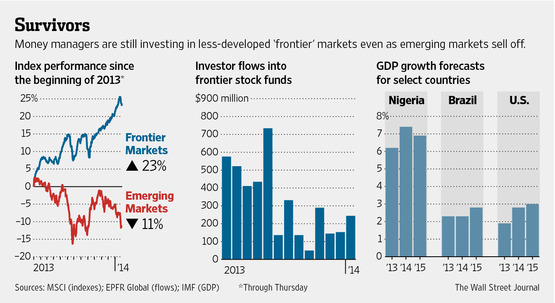
image001-31

Funds that buy frontier stocks in January drew in $244 million through Jan. 29, the most since October, according to EPFR Global. Over the same period, investors yanked $11.6 billion from emerging-market funds. Read more of this post

Investors Look Toward Safer Options as Ground Shifts

Investors Look Toward Safer Options as Ground Shifts

TOM LAURICELLA , KATIE MARTIN and TOMMY STUBBINGTON

Updated Jan. 29, 2014 10:37 p.m. ET

image001-30

Just one month into 2014, investors from Illinois to Istanbul are finding the tide going out fast for stocks and other riskier investments. Read more of this post