Chinese Property Firms’ Junk Bonds Started 2014 Fast but Have Soured

Chinese Property Firms’ Junk Bonds Started 2014 Fast but Have Soured

FIONA LAW

Jan. 27, 2014 6:11 a.m. ET

Chinese issuers of junk bonds got off to a fast start in 2014, but concerns about weakening economic growth and the likelihood of a high-profile loan default are putting investors off.

Chinese real-estate developers in particular opened up a wide lead on the Asian pack in terms of high-yield bond issuance in advance of the Year of the Horse, but now they are leading the way regionally in a broader emerging-market selloff.

Chinese property developers raised a combined $4.55 billion by issuing junk, or non-investment-grade, bonds in the first three weeks of the year, accounting for 11 of 12 such issues in Asia outside Japan, according to data provider Dealogic. That is not far off the record pace set in the same period last year, when Chinese companies issued $5.87 billion in junk bonds. Meantime, total junk bonds for Asia, excluding Japan, shrank 40% to $4.77 billion.

The Chinese firms sought to extend the pattern, set over the past two years of tapping bond buyers who were on the hunt for higher yields in growth markets against a backdrop of ultralow interest rates globally amid central banks’ loose monetary policy. But unlike last year, when bond prices soared, the new debt has turned sour immediately after issuance.

KWG Property Holding Ltd. 1813.HK -0.73% , a large developer, saw its five-year bond fall roughly 2% from its issue price, while notes from CIFI Holdings (Group) Co.0884.HK +0.63% , a smaller player, fell around 5% within a couple days of its issuance. Bond prices of peers who issued debt with investment-grade ratings also softened: China Overseas Grand Oceans Group Ltd.’s five-year bond, for example, fell by around 1%.

“Obviously Asia cannot escape from global emerging-market weakness, despite the fact that most Asian countries are not battling the same level of currency volatility or political instability seen in some other emerging regions,” said Mark Reade, credit desk analyst at Mizuho Securities Asia Ltd. “Chinese high-yield bonds have been harder-hit than their investment-grade counterparts as tight onshore liquidity conditions have stoked concerns about a deluge of offshore high-yield supply, not to mention rising refinancing risk among smaller, weaker corporates.”

Investors have veered sharply away from risky assets in global emerging markets, with Argentina’s peso and Turkey’s lira having taken serious knocks last week.

In China, property bonds started getting squeezed after a weaker-than-expected initial reading on manufacturing activity last week, exacerbated by mounting pressure that could lead to an unprecedented default on a trust product sold by Industrial & Commercial Bank of China Ltd. Bond prices are off their their lows since news emerged Monday that China Credit Trust Co., the Chinese lender behind a troubled $500 million investment product, appeared to have found a way to pay back investors.

Real-estate developers in the country needing funds to acquire land or build projects but unable to secure loans or raise cash onshore given the government’s effort to rein in a housing bubble, tend to tap offshore markets for funding when they are favored by foreign investors. Housing prices in China picked up modestly in December compared with November, according to the latest data, and most property firms still see healthy cash flow amid robust contract sales, analysts say.

But Morgan Stanley warns that these property firms are vulnerable to tighter credit conditions in the domestic market and slower sales growth. The Wall Street bank recommends reducing exposure to Chinese high-yield bonds in favor of higher-rated issues.

In a sign of just how shaky the country’s debt market has become, Dalian Wanda Commercial Properties Co.—one of China’s biggest real-estate players, which has an investment-grade rating—sold a $600 million 10-year bond with 7.25% yield, even higher than rates offered on some junk bonds. The company is eager to secure funding ahead of any spike in global interest rates, a person close to the deal said. Higher rates are widely anticipated as the U.S. Federal Reservescalesback its bond-buying program

, a process known as “tapering.”

“The market is really choppy these days,” with the preponderance of news stories weighing on market sentiment, said Gordon Ip, a fixed-income portfolio manager at Value Partners Group Ltd. 0806.HK +0.39% , which manages $10.5 billion of assets.

Value Partners didn’t participate in the recent Chinese junk-bond issues, as “we think their pricings were too expensive” given the respective companies’ fundamentals and the macroeconomic environment, he said, adding that he is parking some of his funds in more “defensive” assets, such as bonds issued by banks for capital replenishment.

Reduced appetite for junk bonds, both in China and in the rest of Asia, is part of a “macro theme that developed markets continue to fare better than emerging markets,” said Arthur Lau at PineBridge Investments, which manages $69.1 billion of assets globally.

“Funds, especially retail funds, are pulling out from emerging markets, especially those invested in marginal credit such as Mexico, Turkey, Indonesia and India, which are vulnerable to U.S. tapering,” he said. “So far this year, though, we still see institutional funds continuing to flow into Asia, but at a much slower pace. We are more selective in tapping junk bonds, and wouldn’t buy them across the board.”

What Will AAPL’s Profit Margins Be? Just Ask Foxconn… And Discover A Stunning Development In China-US Wage Parity

What Will AAPL’s Profit Margins Be? Just Ask Foxconn… And Discover A Stunning Development In China-US Wage Parity

Tyler Durden on 01/27/2014 15:23 -0500

In just over an hour Apple will report earnings which are expected to be a sole silver lining among the otherwise dreary retail landscape of the fourth quarter. However, those curious for an advance glimpse of what AAPL’s margins may be are advised to look no further than its chief supplier – Taiwanese mega contract manufacturer FoxConn, with over 1.2 million employees on the mainland. The reason Foxconn may be of interest is that as Reuters reports, as a result of soaring wages on the mainland, and in its ongoing strategy to keep worker compensation as razor thin as possible, the fabricator is now actively looking to expand outside of China. Among the places considered? Indonesia of course. And, drumroll, the United States! In other words, from the perspective of Foxconn, US labor now has greater wage competitiveness than China.

From Reuters:

Beset by rising costs and labour unrest in China, Chairman Terry Gou told employees on Sunday that Foxconn is considering diversifying away from its manufacturing heartland. The world’s largest contract maker of electronic goods has little choice if it’s to protect margins and stay ahead of peers who have adapted the Foxconn playbook into their own success stories.

“The U.S. is a must-go market,” said Gou, speaking at the group’s annual party on Sunday to mark the end of the Chinese year. Many customers and partners have asked Foxconn to open shop in the U.S., Gou said, with an eye on advanced manufacturing much closer to their home base.

At the same time, Indonesia will be a top priority this year as a potential production base with attractive costs and skills. That would tie in with Foxconn’s deal to design and market phones in the country with BlackBerry Ltd as the Canadian company seeks to reverse its decline in the smartphone business.

“Foxconn has no choice but to do it,” said Danny Lee, a fund manager of Mega Financial Holding’s fund unit. “China is no longer a manufacturing hub for companies worldwide, especially so for the PC industry.”

In the U.S., Foxconn businesses like flagship unit Hon Hai Precision Industry Co Ltd, Foxconn Technology Co Ltd and FIH Mobile could take advantage of geographical proximity to open up new deals with partners like Apple as they develop new gadgets.

“I think they’re looking more closely at the U.S. in order to move closer to some of their biggest clients. Obama is also really pushing to return manufacturing to America and boost employment opportunities,” said Kuo Ming-Chi, an analyst at Taipei-based KGI Securities.

This is indeed a stunning development: recall that we asked, rhetorically, back in May 2011 “With China Forecast To Reach Wage Parity With The US In Five Years, Is A New Manufacturing Golden Age Coming To The US?” Or some time in early 2016. Well, nearly 3 years later, we get the first proof that wage parity may indeed be coming, and much faster than previously expected.

Is the Fed to thank for this imminent manufacturing renaissance? Recall what we said in 2011:

the more the Fed exports inflation, paradoxically the faster the US manufacturing job base would see a long overdue renaissance.Which certainly means that the Fed will never stop with its monetary easing stimulus until such time as labor costs in the two countries, on whatever subjective metric is dominant, finally hit parity. The only question, as noted above, is what will China do in the interim as it realizes the Fed has put it in check – will China focus on developing its middle class, with an outcome being the mirror image of the current Nash equilibrium, in which the Chinese middle class would buy from the US, or will China defect before the “export country” to “consumer class” transition is complete and everything falls apart.

It is quite possible that while China was napping, the Fed’s exporting of wage inflation just succeeded to get the US to relative wage parity with China – something most considered impossible as recently as 5 years ago. However, if indeed true, this means that the Chinese response will only have more urgency now that it suddenly may find itself competing with workers from places such as the US.

In the meantime, if Foxconn’s margins have indeed collapsed as the above would seem to suggest, watch as they pass through these rising labor costs to its marquee clients. Like Apple. For the answer if this indeed happened, we will know in just about an hour.


The world’s biggest salmon farmer, Norway’s Marine Harvest, is looking to rally U.S. investors around the aquaculture sector’s role in meeting a substantial portion of the world’s growing need for food

Marine Harvest Seeks to Garner Interest From U.S. Investors

Company Seeking Organic Growth Together With Mergers, Acquisitions

KJETIL MALKENES HOVLAND

Jan. 27, 2014 8:22 a.m. ET

OSLO—The world’s biggest salmon farmer, Norway’s Marine HarvestMHG.OS -1.06% is looking to rally U.S. investors around the aquaculture sector’s role in meeting a substantial portion of the world’s growing need for food through increased fish production.

Marine Harvest will be listed on the New York Stock Exchange Tuesday, joining U.S.-listed protein companies that may be more familiar to American investors, including Tyson Foods Inc. TSN -0.35% and Sanderson Farms Inc. SAFM -1.86% It will be the first listing abroad by one of the many companies in Norway’s booming aquaculture industry.

“There are many U.S.-listed protein companies. We want to be the first one based on protein from the ocean,” Marine Harvest Chief Executive Alf-Helge Aarskog said. He noted that some of the key land-based protein farmers are priced higher than Marine Harvest.

Marine Harvest isn’t seeking to raise new funds through the listing of American Depository Receipts on the Big Board. It’s looking instead to attract more interest—including broadening its appeal to institutional investors who have previously been limited in their ability to invest. “We want to grow even faster,” Mr. Aarskog said, adding that his company would like to couple organic growth with mergers and acquisitions and farm species in addition to salmon.

Food producers are among a number of agricultural-related companies benefiting from a predicted rise in demand for food. Farmed fish, representing only 9% of the global fish production for human consumption in 1980, are now responsible for 47% of the stock, according to the United Nations’ Food and Agriculture Organization.

The Oslo-based farming giant, which produces more salmon than any other company in the world, has a market capitalization of 31.1 billion Norwegian kroner ($5.1 billion). Marine Harvest has been expanding from fish farming into fodder production via acquisitions, and it has established facilities in Asia while also constructing a new fodder plant in Norway.

The company, forged from a merger in 2006 with Pan Fish ASA and Fjord Seafood ASA, is 27% owned by Geveran Trading Co., an entity controlled by shipping magnate John Fredriksen.

Norway’s fish-farming industry has seen rapid growth over the past 40 years, becoming the second-largest fish exporter after China as of the beginning of this decade. And times have been good for the industry’s key players. Mr. Aarskog said that “2013 was a good year for salmon prices.” While production volumes remain steady, “demand is growing,” with more people eating sushi and smoked salmon.

The rise of fish farming comes amid concerns about overfishing in the world’s oceans. Captured-fish volume has stabilized at around 90 million tons annually, while the output of farmed fish has expanded by 60 million tons, or 12 times its volume in the three decades ending in 2010, the U.N.’s FAO said.

Growth has come with concerns. Fish farmers, including Marine Harvest, face threats that include disease, fish escape, tighter regulations and the need to use lower-protein vegetable fodder as global overfishing limits access to higher-protein feedstock. Major investments are also needed to fight parasites, Mr. Aarskog said.


Gandhi Fails to Impress in TV Interview Debut

January 27, 2014, 11:39 PM

Gandhi Fails to Impress in TV Interview Debut

NIHARIKA MANDHANA

In the first extended television interview of his political career on Monday night, Rahul Gandhi probably didn’t win many converts.

Fielding sharp questions from TV anchor Arnab Goswami, Mr. Gandhi, who is now leading the electoral charge of India’s ruling Congress party, offered nary a sound bite. He avoided passionate responses and wasn’t goaded into attacking his main adversary, opposition leader Narendra Modi of the Bharatiya Janata Party.

Instead, Mr. Gandhi struck a wonky tone, articulating what he said was a long-term agenda to revamp his own party and India’s political system, which he called closed and predatory, doing too little to help the hundreds of millions of poor in the world’s second-most-populous country.

Mr. Gandhi, the fourth generation scion of the Nehru Gandhi family, said he disliked the widespread prevalence of dynastic politics in India. On his own position of privilege, Mr. Gandhi said he hadn’t chosen to be born in India’s most politically powerful family, but was now faced with a choice, he said, between walking away and sticking around to drive change.

Mr. Gandhi brushed aside as “superficial” questions about recent corruption scandals or how he would lead his party to victory in the forthcoming general elections, which are due by May. He said repeatedly his party would win the elections, but added that he wasn’t afraid of defeat.

“What I was scared of,I lost,” he said, referring to the assassinations of his grandmother Indira Gandhi and his father Rajiv Gandhi. “I’m not scared of anything,”

Mr. Gandhi said he would remain single-minded in his effort to change Indian politics. He repeatedly emphasized the need to transform the way candidates are picked to fight elections, the concentration of political power in a few hands and barriers to the empowerment of women.

“He laid out a 20 year plan to change politics, but didn’t quite spell out how he would do it or what his party would do in the interim,” said Ashok Malik, a Delhi-based political analyst.

When asked specific questions, Mr. Gandhi sought to draw the conversation back to what he saw as the fundamental questions. Mr. Gandhi complained that he hadn’t been asked about “how we will build this country or how we will empower our youngsters.”

Siddharth Varadarajan, an analyst, said in a televised interview that Mr. Gandhi had failed to turn his call for change into a concrete plan addressing real political questions.

“He is unwilling to engage the politics today,” Mr. Varadarajan said.

Mr. Gandhi didn’t offer his opinion of Narendra Modi, the opposition Bharatiya Janata Party’s prime ministerial candidate. He accused Mr. Modi’s government of “abetting and pushing” deadly riots in Gujarat in 2002, but didn’t offer specifics.

On several questions on a series of corruption allegations involving his party’s governments and leaders in the last decade, Mr. Malik said he seemed out of his depth.

“But then, when you’re going to be asked about 10 years of a government’s time in office and 60 years of your party’s work, you can’t be entirely prepared,” Mr. Malik said


Indian Investors Lose Faith; Country’s Retail Stockholders Are Dumping Shares After Years of Nursing Losses

Indian Investors Lose Faith

Country’s Retail Stockholders Are Dumping Shares After Years of Nursing Losses

SHEFALI ANAND

Jan. 27, 2014 6:11 p.m. ET

MUMBAI—India’s blue-chip stocks have held up relatively well in the recent emerging-market selloff. But that is little consolation to the country’s retail investors, who are dumping shares after years of nursing losses.

Many individual investors in the world’s second-most-populous country have grown disillusioned with paltry returns on shares of small and midsize companies. Although these companies account for the vast majority of the stocks listed on the Bombay Stock Exchange, they have fallen behind the 30-share benchmark Sensex index since the 2008 financial crisis. Many of these firms have struggled to grow amid a sharp slowdown in India, and some are struggling to repay debt taken on when India’s economy was booming in the mid-2000s.

Individual investors in India in the past have been a key driver of the country’s stocks, and the absence of many of these investors from the latest run-up raises questions about the prospect of further meaningful gains and exposes the market’s vulnerability to fleet-footed global investors.

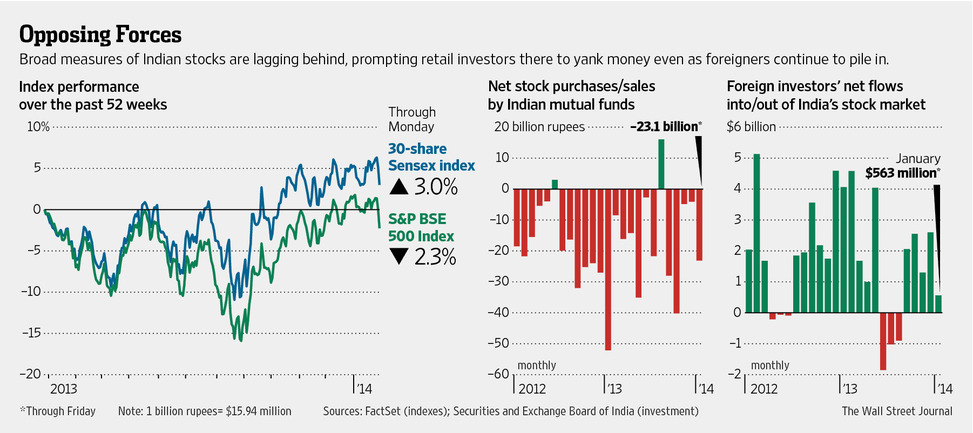
The Sensex hit a fresh record Thursday, the same day the MSCI Emerging Markets Index slid on weak Chinese economic data. India’s blue-chip index is down 3.1% since then, compared with a 4.6% decline in the MSCI.

India’s broader S&P BSE 500 index in recent days has trailed the Sensex and is 15% below its record set in January 2008. Another index that reflects share-price performance of medium-size companies remains 38% below its 2008 record.

From the start of September through Friday, Indian mutual funds, a proxy for the behavior of individual investors, unloaded $1.6 billion of shares, representing an acceleration of selling from earlier in the year, according to data from the Securities and Exchange Board of India.

In the same period, foreign institutional investors poured about $9 billion into Indian stocks, according to the regulator. This represents a pickup in buying by global fund managers, many of whom are betting the growth outlook for India’s downtrodden economy will brighten if federal elections in the spring usher in reform-minded lawmakers.

Analysts and strategists attribute the rise in Indian shares in past months partly to these foreign inflows.

But many retail investors aren’t convinced that the gains will stick. India’s economy is forecast to rise 4.8% in the year ending March 31 by trade association Federation of Indian Chambers of Commerce and Industry. That would be the worst showing since 2003.

Phiroj Uttaray, a 34-year-old engineer in the eastern state of Orissa, first invested in stocks in 2005. Mr. Uttaray bought mostly smaller companies, such as wind-turbine maker Suzlon Energy Ltd. 532667.BY +2.15% and engineering firm and property developer Hindustan Construction Co. 500185.BY +1.73% Both companies are wrestling with heavy debt burdens, which have crimped profits. In the span of a year, shares of Suzlon Energy rose almost 50%, closing at a record 2,273 rupees ($36.23) on the National Stock Exchange in early January 2008. Wednesday, the stock closed at 10.25 rupees.

Mr. Uttaray has seen the value of his portfolio of shares fall more than 85% since 2008, and lately has been paring his holdings. “I’ve lost faith,” he says.

image001-3

Out of the 500 companies in the S&P BSE 500 index, 30 companies have attracted two-thirds of foreign-investor inflows since 2012 through Sept. 30, 2013, according to estimates by BNP Paribas Securities India. Some, but not all, of the 30 companies are components of the Sensex.

These companies, such as HDFC Bank Ltd. 500180.BY +0.07% , software firm Tata Consultancy Services Ltd. 532540.BY +0.30% , and cigarette maker ITC Ltd.500875.BY -1.11% , remain a draw for foreign investors because they are perceived to be better-managed and have less exposure to the unpredictable nature of India’s politics and domestic economy.

Anjun Zhou, managing director and head of Multi-Asset Research at Mellon Capital Management Corp., which oversees $350 billion of assets, expects Indian shares to benefit from a faster pace of growth boosted by a rise in exports. The money manager holds Indian shares, mostly blue chips.

But Ms. Zhou says domestic investors’ flagging participation in India’s stock market could discourage global investors from boosting their own exposure. “We do monitor what domestic investors are doing, and we try to understand the reason behind their caution,” she says.

Not all domestic investors are staying away. Mumbai banker Raj Sen, 39, says his portfolio of individual stocks has lost value since 2011, but he has since turned to buying stock mutual funds instead to capture a larger swath of the market. He believes stocks will rise over the longer term as increasing consumption by India’s one-billion-plus population drives economic growth.

“Opportunity is still there,” Mr. Sen says.

Still, many of India’s retail investors are waiting for the right moment to sell.

Mansukhlal Mehta, 73, has been investing his retirement savings in stocks since 2000. He says the value of his stock investments has been halved in the past five years, and he expects more tough times ahead.

“I feel that things are not going to go that well,” says Mr. Mehta. Small investors and their brokers, he says, “are all crying, every day.”


Trading on Abenomics

Trading on Abenomics

Japan needs to stop worrying and learn to love imports.

Jan. 27, 2014 11:58 a.m. ET

News that Japan in 2013 notched its biggest trade deficit since 1985 is shaking a country long accustomed to being a big-time exporter. Much of the angst is overdone. But there are some important lessons in the data for Prime Minister Shinzo Abe as his economic revival program enters its second year.

The merchandise trade deficit for the year came to 2.4% of GDP, despite some decline in December. Exports started to pick up a bit as anemic recoveries in Europe and the U.S. grind on and trade ties with China rebuild after political tensions over territorial disputes. The key point is that the eye-grabbing headline numbers are mainly an artifact of Mr. Abe’s weak-yen policy. This helps explain the increase in exports and imports, although not in the way many suppose.

Conventional wisdom holds that a weaker yen allows Japan Inc. to boost export volumes by cutting its foreign-currency prices and gobbling up market share abroad. Yet Japanese companies have instead booked higher yen-denominated profits on a falling volume of exports. Note that while exports in 2013 fell 1.5% compared to 2012 when measured in units shipped, measured by value they increased 9.5%. The weak yen also boosted the value of imports, which increased some 15% when measured by yen-denominated value but grew only 0.4% in volume.

That is not to downplay the significance of the yen-denominated trade deficit. The quantity of yen Japanese are earning and spending matters, not least to the Japanese themselves. But understanding the monetary aspect of the trade data explains why Mr. Abe’s monetary policies won’t fix the economy, and what he should be doing instead.

On the corporate side, companies have enjoyed a weak-yen windfall over the past eight months, and the central bank’s Tankan survey suggests managers are starting to believe the yen may remain around its current level for the longer term rather than rebounding to its pre-Abe strength. That would normally encourage companies to invest in new capacity.

But managers also recognize that manufacturing is an increasingly dicey proposition in Japan. Costs remain high, and in the case of imported inputs are rising thanks to yen weakness. An aging population coupled with strong popular resistance to immigration suggest manufacturing labor will be ever-harder to come by.

This helps explain why, while corporate investment has picked up somewhat in recent months, companies are holding back and are reluctant to commit themselves to wage hikes. Despite more generous one-time bonuses, nominal wages are more or less stagnant.

That means real wages are falling, thanks to the inflation Mr. Abe’s monetary policy is starting to create, as evidenced by the run-up in import values. Households also face a three-percentage-point hike in the consumption tax come April. Little wonder that consumer confidence has fallen significantly after an initial bout of enthusiasm when Mr. Abe launched his revival plan.

The trade deficit by itself isn’t worrying. An aging society such as Japan’s inevitably will import more than it produces, while exporting capital to earn returns that allow it to pay for its imports. But the growing gap between Abenomics and reality is a problem.

The weak yen was supposed to stimulate exports, which was supposed to stimulate corporate investment and wage growth, which was supposed to stimulate domestic consumption. That chain hasn’t materialized. Instead, companies are earning more today but still worry about their future amid weak export volumes, while households are saddled with inflation fears.

Mr. Abe might instead try “leaning in” when it comes to the trade deficit. His most important proposal to date would do precisely that: If Japan signs on to a Trans-Pacific Partnership multilateral trade deal, it will open the economy to an unprecedented amount of imports. The new competition will stimulate more of the corporate investment Japan needs in long-sheltered and highly inefficient domestic-facing service industries.

This might be a tough sell for a public long accustomed to thinking of Japan first and foremost as a high-tech factory for the world, and for investors with a similar mindset. But the recent run of trade deficits is a reminder that change will come to Japan one way or another. Mr. Abe’s real challenge is to align economic policies to reality before reality strikes back.


Some Thais Want Their Political Rivals to Stop Playing the Royal Card

Some Thais Want Their Political Rivals to Stop Playing the Royal Card

JAMES HOOKWAY

Jan. 27, 2014 7:40 p.m. ET

PATHUM THANI, Thailand—For decades, Thais have looked to King Bhumibol Adulyadej to referee political disputes. But with the king now 86 years old, some people here say it’s time to sort out their own problems.

Elevated to almost divine status with the help of the military during the Cold War, King Bhumibol has interceded during flashpoints over the years. Sometimes he has sided with street protesters demanding more democracy and accountability; at others, he has endorsed autocratic military rulers.

Unlike some other Asian royal houses that have faded into the background or, in Nepal’s case, been abolished, Thailand’s monarchy is still part and parcel of everyday life here, despite not having any formal power.

The royal anthem is played before sporting events and before films in movie theaters, while Thai TV news summarizes the family’s activities each day at 8 p.m. Thailand’s lèse-majesté laws penalize criticism of the royal family with prison terms of up to 15 years.

But as King Bhumibol enters the twilight of his long reign, the political divides here in Southeast Asia’s linchpin economy are widening as protesters, many of them invoking the name of the king, try to check the growing power of the country’s elected leaders. And some supporters of the populist government say it is time to stop using the king’s name for political leverage.

“We’re not really supposed to talk about these things in Thailand,” says Wutthipong Kotchathammakhun, a leader of a pro-government “Red Shirt” splinter group here, just north of Bangkok. “But we want people to understand how the establishment is using ‘the sky’ to grab power for itself,” he says, using a common term to refer to the royal family.

The king himself has remained silent on the monthslong standoff playing out on the streets of Bangkok.

The clash represents an almost existential struggle to determine what kind of country Thailand should be in the 21st century. On one side are Thailand’s traditional power bases in the military and technocratic political parties, and in the rival camp are supporters of populist politicians backed by billionaire businessman Thaksin Shinawatra.

In recent weeks, tens of thousands of mostly urban, middle-class protesters have massed on the streets of Bangkok, led by Suthep Thaugsuban, a brawny, 64-year-old political deal maker who has reinvented himself as the leader of what he calls “the people’s revolution.” The crowds are calling for Mr. Thaksin’s younger sister, Prime Minister Yingluck Shinawatra

, to quit and allow an unelected council to take over and shape Thailand’s democracy to a form more to their liking.

Ms. Yingluck has said she won’t resign and plans to press ahead with new elections set for Sunday, which she is widely expected to win and which the opposition has vowed to boycott.

The protesters aren’t coy about invoking the name of King Bhumibol. During frequent parades around Bangkok’s busy business district, many wear yellow head bands declaring “I Love the King.” Some of their placards accuse Mr. Thaksin, who was overthrown as prime minister in 2006 and now lives abroad, of plotting to usurp the king’s powers—a charge Mr. Thaksin has consistently denied, and which the king hasn’t publicly commented on.

The Thai army also has a strong and visible attachment to the monarchy.

But the more the demonstrators play the royal card—by making lèse-majesté allegations or simply waving royalist placards—the more they risk undermining the institution in the eyes of millions of Thais who have repeatedly voted for the Shinawatras.

“Everything the royalists do is working against the long-term interests of the monarchy,” says David Streckfuss, a Thailand-based scholar and author. “The lèse-majesté laws, trying to secure the positions: any of it, really, is bad for the monarchy.”

Mr. Wutthipong, a rapid-fire talk-show host on a community radio station, leads one of the most visible groups that sprang up to demand the return of democracy after the 2006 coup.

Better known by his nickname, Koh-Tee, he has a yen for donning a beret a la Argentine revolutionary Che Guevara and has constructed a makeshift open-air stage in Pathum Thani. Here, he and his followers complain about Mr. Suthep’s persistent invocation of the king, who has remained silent on the most recent political conflict.

“The royalists don’t want an election. They know they will lose, so they try to seize power any way they can,” Mr. Wutthipong, 49 years old, says, handing out Buddhist amulets to protect security guards at the rear of the stage. He has been questioned by police and released without charge in connection to clashes with Mr. Suthep’s supporters in Pathum Thani.

Other Red Shirt leaders such as Nattawut Saikeua have warned of a mass uprising if the military seizes power again.

Mr. Suthep says he is arguing only for an interim government to pursue his contentious reform plans before elections are held, and aims to prevent the Feb. 2 vote from going ahead. One protester was killed in clashes with Red Shirts Sunday after Mr. Suthep’s supporters tried to stop advance voting, adding to the nine people who already have lost their lives in political violence in recent months.

China’s investment/GDP ratio soars to a totally unsustainable 54.4%. Be afraid.

China’s investment/GDP ratio soars to a totally unsustainable 54.4%. Be afraid.

Posted on 24 January 2014 by Mike Riddell

image001-1

Once upon a time, Western opinion leaders found themselves both impressed and frightened by the extraordinary growth rates achieved by a set of Eastern economies. Although those economies were still substantially poorer and smaller than those of the West, the speed with which they had transformed themselves from peasant societies into industrial powerhouses, their continuing ability to achieve growth rates several times higher than the advanced nations, and their increasing ability to challenge or even surpass American and European technology in certain areas seemed to call into question the dominance not only of Western power but of Western ideology. The leaders of those nations did not share our faith in free markets of unlimited civil liberties. They asserted with increasing self-confidence that their system was superior: societies that accepted strong, even authoritarian governments and were willing to limit individual liberties in the interest of the common good, take charge of their economies, and sacrifice short-run consumer interests for the sake of long-run growth would eventually outperform the increasingly chaotic societies of the West. And a growing minority of Western intellectuals agreed.

The gap between Western and Eastern economic performance eventually became a political issue. The Democrats recaptured the White House under the leadership of a young, energetic new president who pledged to “get the country moving again” – a pledge that, to him and his closest advisers, meant accelerating America’s economic growth to meet the Eastern challenge.

The passage is the opening to the highly readable and hugely influential 1994 paper The Myth of Asia’s Miracle. The period referenced is the early 1960s, the dynamic president was John F. Kennedy (read Bill Clinton), and the rapidly growing Eastern economies were the Soviet Union and its satellite nations (read East Asia). Author Paul Krugman took on the prevalent East Asian euphoria by drawing disturbing parallels between the unsustainable way that the Asian Tigers were managing to generate supersonic growth, and how the recently obsolete Soviet Union had also once achieved seemingly miraculous growth rates. Krugman’s paper gained widespread attention at the time (even more so post the 1997 Asian crisis), and succeeded in refocusing attention on the concept of productivity. It mattered not what the growth rate was, but how it was achieved.

To explain this and briefly summarise, consider what actually drives economic growth. Growth accounting shows that GDP per capita growth comes from two main sources; inputs and efficiency. The ‘inputs’ can be split into labour (e.g. growth in employment) and capital (e.g. the accumulation of physical capital stock such as machines and buildings). But long term, sustained per capita economic growth tends to come not from increases in the ‘inputs’, but from increases in efficiency, of which the main driver is technological progress. Nobel Laureate Robert Solow showed in his seminal 1956 paper that technological progress had accounted for 80% of US per capita growth between 1909 and 1949, although more recent studies have suggested a still substantial figure of more like 45-55% thereafter.

Krugman pointed to previous research showing that the Soviet Union’s rapid growth had not been due to efficiency gains. Indeed, the USSR was considerably less efficient than the US, and showed no signs of closing the gap. Soviet growth had been solely due to the ‘inputs’, and input-driven growth has diminishing returns (e.g. there is a finite number of workers you can educate). The USSR’s growth was largely ‘built on perspiration rather than inspiration’.

In a similar way, the Asian Tigers’ rapid growth was due to an ability to mobilise resources. There was no great improvement in efficiency, and no ‘miracle’ – it could be fully explained by the employed share of the population rocketing, education improving dramatically, and an enormous investment in physical capital (in Singapore, investment as a share of output jumped from 11% to more than 40% at its peak). But these were one time changes; they weren’t repeatable.

Fast forward to 21st century China.

There is a perception that China’s rocketing growth rate has always been reliant on heavy investment, but that’s not the case. Investment, or capital formation, has of course been an important driver, but the ‘pre 2008’ China did achieve rapid productivity gains thanks to the rise of the private sector and technological catch-up as the economy slowly began to open its borders.

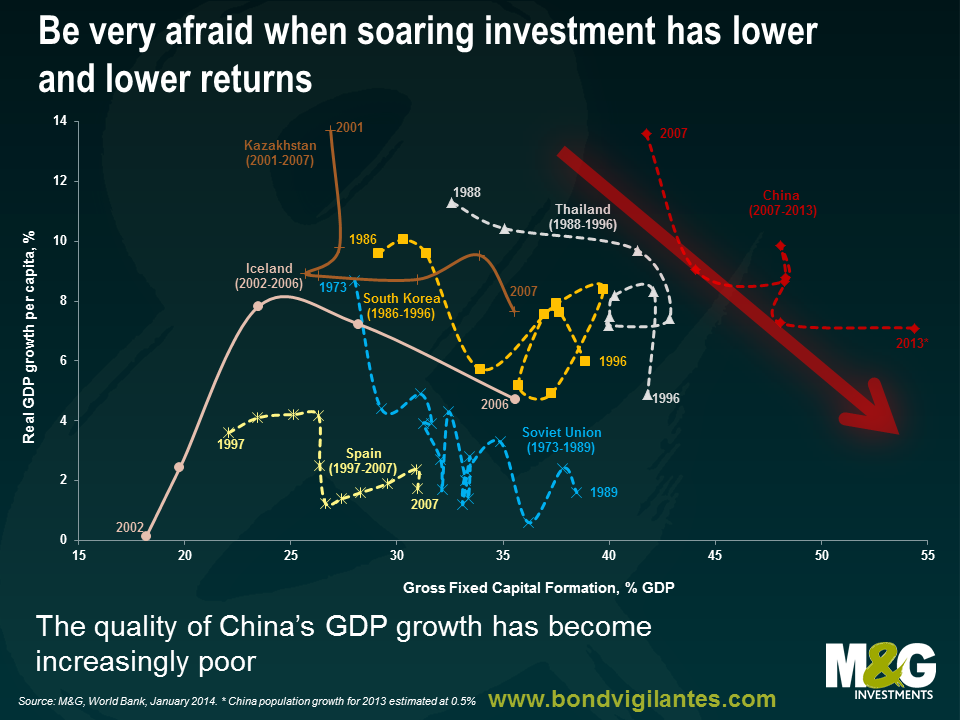
In the chart below, I’ve looked at how much the world’s biggest economies have invested as a percentage of their GDP, and compared this to the countries’ GDP per capita growth rates. Countries with higher investment rates tend to have higher GDP growth rates and vice versa, which is intuitive and supports the discussion above. Since the 1990s, most (but not all) emerging/developing countries have been positioned towards the top right hand side with higher investment and higher growth rates, and the more advanced economies have typically been towards the bottom left with lower investment and lower growth rates. In one extreme you have China, where investment has averaged over 40% of GDP, and the GDP per capita growth has averaged a phenomenal 9.5%. The fact that China’s growth rate is well above the trend line in the chart is indicative of the productivity gains that China has achieved over the period as a whole on average. The country with the weakest investment rate is the UK.

Post 2008’ China looks a different animal. Productivity and efficiency seems to be plummeting, where GDP growth is becoming dangerously reliant on the ‘inputs’, namely soaring investment. We’ve all heard about how China’s leaders desire a more sustainable growth model, featuring a rebalancing of China’s economy away from investment and export dependence and towards one that is more reliant on domestic demand and consumer spending (e.g. see the 12th 5 year plan covering 2011-2015 or the Third Plennum). In practice, what we’ve instead consistently seen is an inability or unwillingness to meaningfully reform, where any dip in economic growth has been met with yet another wave of state-sponsored overinvestment. (Jim recently blogged about economist Michael Pettis’ expectation that China long term growth could fall to 3-4%, a view with which I have a lot of sympathy. Please see also If China’s economy rebalances and growth slows, as it really must, then who’s screwed? for an additional analysis of the implications of China’s economic slowdown).

It was widely reported earlier this week that China’s 2013 GDP growth rate fell to a 13 year low of 7.7%, a slowdown that seems to have continued into 2014 with the release of weak PMI manufacturing reading yesterday. But much more alarming is how the makeup of China’s growth has changed: last year investment leapt from 48% of China’s GDP to over 54%, the biggest surge in the ratio since 1993.

The chart below puts China’s problems into perspective. As already demonstrated, there is a strong correlation between different countries’ investment rates and GDP growth rate. There also tends to be a reasonable correlation over time between an individual country’s investment rate and its GDP growth rate (Japan’s experience from 1971-2011 is a good example, as shown previously on this blog). Over time, therefore, a country should be broadly travelling between the bottom left and top right of the chart, with the precise location determined by the country’s economic model, its stage of development and location in the business cycle.

It should be a concern if a country experiences a surge in its investment rate over a number of years, but has little or no accompanying improvement in its GDP growth rate, i.e. the historical time series would appear as a horizontal line in the chart below. This suggests that the investment surge is not productive, and if accompanied by a credit bubble (as is often the case), then the banking sector is at risk (e.g. Ireland and Croatia followed this pattern pre 2008, Indonesia pre 1997).

But it’s more concerning still if there is an investment surge accompanied by a GDP growth rate that is falling. This is where China finds itself, as shown by the red arrow.

Part of China’s growth rate decline is likely to be explained by declining labour productivity – the Conference Board, a think tank, has estimated that labour productivity growth slowed from 8.8% in 2011 to 7.4% in 2012 and 7.1% in 2013. Maybe this is due to rural-urban migration slowing to a trickle, meaning fewer workers are shifting from low productivity agriculture to higher productivity manufacturing, i.e. China is approaching or has arrived at the Lewis Turning Point (see more on this under China – much weaker long term growth prospects from page 4 of our July 2012 Panoramic).

However the most likely explanation for China’s surging investment being coupled with a weaker growth rate is that China is experiencing a major decline in capital efficiency. Countries that have made the rare move from the top left of the chart towards the bottom right include the Soviet Union (1973-1989), Spain (1997-2007), South Korea (1986-1996), Thailand (1988-1996) and Iceland (2004-2006). Needless to say, these investment bubbles didn’t end well. In the face of a labour productivity slowdown, China is trying to hit unsustainably high GDP growth rates by generating bigger and bigger credit and investment bubbles. And as the IMF succinctly put it in its Global Financial Stability Report from October 2013, ‘containing the risks to China’s financial system is as important as it is challenging’. China’s economy is becoming progressively unhinged, and it’s hard to see how it won’t end badly.

This entry was posted in Countriesmacro and politics and tagged emergingmacro & politics byMike Riddell

. Bookmark the permalink.

Mobile Karaoke App Changba Adds Live Broadcast, Closer to YY Music’s Business Model

Mobile Karaoke App Changba Adds Live Broadcast, Closer to YY Music’s Business Model

By Tracey Xiang on January 26, 2014

Changba, the most popular mobile Karaoke app in China, added a live-singing feature for users to have friends to sing together, just like in a room of a brick-and-mortar Karaoke club.

Unlike in the offline world that only invited friends can join in a Karaoke party, all the singing parties on Changba are open to every user. Named ‘Karaoke show in private rooms’, the channel in Changba shows all the singing parties. Any user is allowed to open a room and rooms can be searched by room numbers.

In each room, you can choose to sing songs or just listen to others’ singing and buy virtual gifts to singers you like. Participants in a room can leave comments or chat with each other or invite other users to join in.

The live-singing feature is almost the same with the model of YY Music, 9158, 6.cn and a handful of others. An investor of such a service once told me that fans feel more encouraged to buy virtual gifts to singers during live shows. The revenue growth of YY Inc. has been driven by the live singing show business. So far Changba is the only one of those above-mentioned that started and has been focusing on mobile. YY Music moved slower on mobile, but the company said in late 2013 that they found it easier to make money on mobile than previously thought.

Prior to this live broadcast feature, Changba users needed to record singing first and save on the platform. Their audiences can buy them virtual gifts when listening to the recorded songs. Changba began monetization one year ago through virtual gift sales and planned to make money from potential advertisers.

Other revenue sources include mobile gaming, premium service subscriptions and emoticon sales. Changba announced 100 million registered users in October last year with 30 million being monthly active.


As Internet TV Grows Popular, Regulator Mulls Show of Force

01.24.2014 16:55

As Internet TV Grows Popular, Regulator Mulls Show of Force

People like the idea of getting programs and movies from the Net, but the media watchdog is not as amused

By staff reporter Qin Min

(Beijing) – Chinese companies have been busily tapping the potential of the Internet protocol television (IPTV) business over past year. More than 20 new Internet TV screens and streaming boxes have been launched by various companies.

At the end of 2013, Tencent Holdings rushed to launch its IPTV product, Weixin TV, in partnership with Internet video content provider iCNTV and manufacturer Skyworth. Earlier in the year, e-commerce giant Alibaba Group released a set-top streaming box developed with content provider Wasu Digital TV Media Group Co., and Baidu Inc also released its IPTV and streaming box based on its video subsidiary iQIYI.

Internet companies have shown they are ambitious about exploring the growing market, one that also involves appliance manufacturers, telecom operators and broadcasting companies. However, behind the excitement are some uncertainties because regulators are mulling gradually tightening controls.

A Free-for-All

In mid-December, the State Administration of Press, Publication, Radio, Film and Television, the country’s media watchdog, held a symposium on IPTV oversight with representatives from various industry players.

“The meeting lasted an afternoon,” one attendee said. “The essence was strengthening oversight of the IPTV market.”

The implication, the meeting participant said, was that authorities thought IPTV services had crossed the line.

A broadcast industry source said that the IPTV market is too disorderly, with all sorts of content, including foreign programs, available. The industry, at least in the eyes of some, has circumvented regulation on content and the media regulator is considering updating its polices.

IPTV service is subject to a policy set out in 2011 in the so-called Document 181. The policy separated IPTV service operations into two parts: the integrated broadcasting platform and the content service platform.

The former is responsible for program integration and broadcast control, and the latter is responsible for program content review and copyright management. The idea was to put IPTV service in a manageable environment separate from ordinary Internet activity.

To date, seven institutions have obtained integrated broadcast licenses, and 10 have obtained content service licenses. Document 181 stipulates that all IPTV content should be placed on content service platforms and then broadcast through the integrated broadcast platforms. But most IPTV products have breached this provision, carrying programs directly from the Net.

“This made broadcast regulators unhappy,” the industry source said. “They’re bound to strengthen oversight.”

About 10 million streaming boxes were sold in 2013, the source said, and less than 20 percent of them had partnered with licensed parties. Meanwhile, about 26 million IPTV sets were sold, most of which use content platforms run by manufacturers. Many of the products allow users to download a variety of applications and content directly from the Internet.

This sort of free-for-all indeed seems to be spurring the media regulator to act, but “right now, in what form, when and how the policy will be introduced has not been decided,” an official at the watchdog said.

A source close to regulators said the rules would focus on cracking down on unauthorized streaming boxes, misconduct at online video aggregation websites, and the connection between IPTV producers and licensed parties. He expects they will be introduced in early February.

“Previously (the watchdog) was only responsible for oversight of content,” an executive at a video website said. “This time people are saying they want to manage everything from software to hardware, so much that they don’t rule out enforcing the law in conjunction with other ministries and commissions.

“It hopes to reference radio and television broadcasting management approaches to regulate IPTV.”

The Debate

Many online video companies are nervous about the possibility of intensified oversight, and argue that if it is too strict it will not be conducive to the development of the industry. The main question, it seems, is whether IPTV service should be supervised according to Internet or television.

A source in the industry said computers, mobile phones and televisions are simply different broadcast channels, and standards should be unified.

“Think about it. The same group of people can watch content on a computer or mobile phone during the day, but at night they can’t watch it on television,” the source said. “Isn’t that funny?”

Zhuo Yue, president of Wasu’s Internet business unit, says the IPTV industry is still in its early stages. Document 181 has been misread at times, he said, and many companies have crossed the line with out-of-control content. If control and guidance of the industry are not stepped up in the early stages, uncivilized growth of the entire industry will be the likely result, leading to price wars, illegal services of inferior quality and excessive competition. From this perspective, tighter regulation is understandable, Zhuo said.

Liu Miao, president of online video site and IPTV producer Letv’s government affairs department, said that that the industry is on the verge of breaking out and may impact many traditional industries. He, too, argues that the time is ripe for clearer rules.

Zhang Zejing, an analyst at Hong Yuan Securities, put it another way:

“Fundamentally speaking, licenses represent profit.”

The problem is authorities awarded licenses to seven state broadcasting institutions, but many of these agencies have, in effect, “rented out” the licenses to private companies, established joint ventures or signed contractual joint operations under which they do not have to pay for costs but can get substantial income.

“The capital threshold for independent operators of integrated broadcast control platforms is high,” Zhang said. “Estimated investment is a billion yuan to cover 2 million beta users.

A manufacturer of IPTV hardware suggested that the regulator should encourage private companies and market liberalization, going so far as to say: “They should launch a pilot program for private companies to operate content services platforms.”

Many industry sources also say private companies with copyrights, funds and operating capabilities deserve the confidence of regulators and they should be allowed to operate content platforms.

Despite the calls for more industry liberalization, ideology presents a tricky “red line” – no pun intended – in a country where the Communist Party insists on having the final say on what is acceptable in media and art. However, amid the rise of the IPTV business, regulation has proved thorny. The story, it seems, is to be continued.


E-Investing Spurs Banks to Raise Interest Rates for Deposits

01.24.2014 16:45

E-Investing Spurs Banks to Raise Interest Rates for Deposits

As investors empty their accounts in favor of Net funds like Yu E Bao, many big financial institutions have begun ‘to mount an all-out counterattack’

By staff reporters Zhang Yuzhe and Liu Zhuozhe

(Beijing) – Many big banks in the country have moved to offer the highest possible interest rates for deposits despite the central bank’s advice they not do this.

The lenders had to act because they were losing customers fast to the emerging league of high-yield money market funds offered by Internet companies such as Alibaba Group and Tencent Holdings, an executive at a large bank said.

The benchmark annual interest rates on three-month to five-year term deposits range from 2.6 to 4.75 percent. Banks are allowed to raise them by up to 10 percent, but most large ones set theirs lower than the limit. Most of the money market funds, meanwhile, carry yields higher than 5 percent and offer convenient, free withdrawals.

Bank deposits have been siphoned off into investment funds, including Alibaba’s Yu E Bao, which last year rose in value by an average of 3 million yuan every minute. In less than seven months, it has grown into the country’s largest public fund, with more than 250 billion yuan in investment as of January 15.

“The pressure of the deposits shifting was enormous,” the executive said, “We have no choice but to mount an all-out counterattack.”

The central bank advised the Big Four banks and the Bank of Communications not to increase their deposit interest rates. This advice came in the form of “window guidance,” where the regulator tells banks what to do but the requirements are often not mandatory.

The headquarters of China Construction Bank has delegated the authority to offer maximum interest rates to as low as branches on the city level, a source with knowledge of the matter said. The notice did not set any threshold on the size savings accounts must be to enjoy the higher interest rates, meaning that branch officials can make that decision, too.

Bank of Communications recently raised its interest rates to the ceiling for term deposit accounts with at least 30,000 yuan. Bank of China has done the same, raising interest rates for one-, three- and five-year term deposits of at least 50,000, 100,000 and 200,000 yuan, respectively, to 10 percent above their benchmark interest rate.

Bankers say they are frustrated with Yu E Bao and the like because the funds they sucked away are reinvested into banks in the form of interbank deposits.

“Technically the money is still in the bank, but now here comes Yu E Bao, which does not do anything but shifts money around and forces banks to abruptly raise the cost of deposits from 0.35 percent (for demand deposits) to 7 percent,” a banker said.

The current set of benchmark interest rates has been in effect since July 2012. Since Yu E Bao was launched in June, many small and medium-sized banks have also raised their deposit interest rates to the ceiling.


Vietnam’s Ex-Banker Gets Life Over $230m Fraud Case

Vietnam’s Ex-Banker Gets Life Over $230m Fraud Case

By Agence France-Presse

 on 6:34 pm January 27, 2014.
image003-3

Huynh Thi Huyen Nhu, 37, is led out of the courtroom at a local People’s Court House in Ho Chi Minh City on Jan. 27, 2014. (AFP PhotoVietnam News Agency)

Hanoi. A Vietnamese court Monday sentenced a former banker to life in prison for a fraud involving more than $230 million, one of the communist country’s largest-ever such cases.

Huynh Thi Huyen Nhu, 37, was convicted alongside 22 other defendants who were given sentences of up to 20 years in prison after a three-week trial ended Monday, a clerk at the People’s Court in the southern metropolis of Ho Chi Minh City told AFP.

Nhu raised some $231 million in loans from individuals, companies and other banks when she worked for the state-run Vietnam Joint Stock Commercial Bank for Industry and Trade (Vietinbank).

She claimed to be raising funds on the bank’s behalf, the Tuoi Tre newspaper reported.

Nhu forged some 200 documents and hired other people to counterfeit the official stamps of Vietinbank and other companies in order to obtain the loans, the report said.

The court ordered Nhu to return all the money she had stolen, it added.

Nhu had racked up debts by making a series of disastrous investments in real estate and then “turned to swindling” in order to repay her debts, it said.

The judge dismissed her lawyer’s argument that former employer Vietinbank should take responsibility and compensate clients for their losses, VNExpress reported.

“(Nhu) was the gang leader who took all responsibilities and Vietinbank knew nothing about her fraudulent acts,” the report said.

Vietnam is one of the world’s most corrupt nations, according to watchdogs.

Corruption, mismanagement and inefficiency at state-run companies — a pillar of the communist country’s economy — are seen as fueling longstanding economic woes.

The country’s leaders have pledged to tackle corruption amid rising public anger, leading to a recent series of high-profile trials of former officials and bankers for corruption, fraud and embezzlement.

In November a former banker and his business associate at a large state bank were sentenced to death for embezzling $25 million.

Two former top executives at scandal-hit national shipping company Vinalines were sentenced to death in December for embezzlement as the group almost collapsed under some $3 billion of debt.


China Trust “Bailout” To “Unidentified Buyer” Distorts Market As “Risks Are Snowballing”

China Trust “Bailout” To “Unidentified Buyer” Distorts Market As “Risks Are Snowballing”

Tyler Durden on 01/27/2014 10:35 -0500

In a 2-line statement, offering very few details, ICBC’s China Credit Trust Co. said it reached an agreement to restructure the CEG#1 that ha sbeen at the heart of the default concerns in recent weeks. The agreement includes a potential investment in the 3 billion-yuan ($496 million) product but didn’t identify the source of funds, or confirm whether investors would get all of their money back. The media is very excited about this entirely provisional statement and we note, as Bloomberg reports, investors in the trust product must authorize China Credit Trust to handle the transaction if they want to recoup their principal which will involve the sale of investors’ rights in the trust at face value (though no mention of accrued interest). As BofAML notes, however, “the underlying problem is a corporate sector insolvency issue…  there may be many more products threatening to default over time,” and while this ‘scare’ may have raised investors’ angst, S&P warns “a bailout of the trust product [leaves] Chinese authorities with a growing problem of moral hazard,” and they have missed an opportunity  for “instilling market discipline.”

1) ICBC issues a 2 line statement on a CEG#1 restructuring – no details and no comments from anyone involved

China Credit Trust Co. said it reached an agreement to restructure a high-yield product that sparked concern over the health of the nation’s $1.67 trillion trust industry…

Beijing-based China Credit Trust’s two-line statement on its website didn’t identify the source of funds, or say whether investors would get all of their money back.

2) Investors claim they “could” be able to sell their rights to the CEG#1 trust to an “unidentified buyer” at par (though receive no accrued interest as far as is clear)

Industrial and Commercial Bank of China Ltd. told investors of a China Credit Trust product facing possible default about an offer in which they can receive back their full principal, according to an investor with direct knowledge of the offer.

Rights in the 3 billion-yuan ($496 million) product issued by China Credit Trust Co. can be sold to unidentified buyers at a price equal to the value of the principal invested, according to one investor who cited an offer presented by ICBC and asked to be identified only by his surname Chen.

China Credit Trust earlier said it reached an agreement for a potential investment and asked clients of ICBC, China’s biggest bank, to contact  their financial advisers.

3) “A default was bound to lead to systemic risks that China is unable to cope with, so in that sense a bailout is a positive step to stabilize the market,”

As one analyst noted, the PBOC is running scared…

“It indicates the government still won’t tolerate any ultimate default and retail investors will continue to be compensated in similar cases.”

4) This confirms S&P’s recent warning that “A bailout of the trust product would leave Chinese authorities with a growing problem of moral hazard,” and an opportunity for “instilling market discipline” will have been missed.

…said Xu Gao, the Beijing-based chief economist at Everbright Securities Co. Still, implicit guarantees distort the market and “delaying the first default means risks are snowballing,” he said.

5) of course, China may have shown its moral hazard hand on this occasion but as BofAML warns, “We suspect that, at a certain point, the involved parties will be either unwilling or unable to bail them out [again], which may trigger a credit crunch…The underlying problem is a corporate sector insolvency issue…  there may be many more products threatening to default over time.”

There are plenty more trust products facing maturity/default in the short-term…

image001

The most volatile part of the system is the financial market and the weakest link of the financial market is shadow banking. Within the shadow banking sector, we believe that the trust market faces the biggest default risk because credit quality here is among the lowest. The stability of the shadow banking sector is based on public confidence and any meaningful default will chip away some of the confidence. We suspect that trust defaults by private borrowers may work on public sentiment gradually while any LGFV trust default may immediately trigger significant market volatility. 2Q & 3Q this year will be another peak trust maturing period.


China’s Default That Wasn’t

AARON BACK

Jan. 27, 2014 9:26 a.m. ET

Those who hoped a high-profile default would deliver a needed shock of moral hazard into China’s financial system will be disappointed. The question is whether investors are getting the message anyway.

Like clockwork, a mysterious third party has sprung to the rescue, allowing China Credit Trust to repay the principle on high-yield investment products tied to a struggling coal miner. Savers will miss some interest payments and get a lower effective yield, but otherwise escape unharmed. So does the reputation of Industrial and Commercial Bank of China601398.SH -1.18% the country’s largest commercial lender, which sold the trust products to clients.

In a $9.4 trillion economy, a nearly $500 million set of trust products appears too big to fail.

The hand of the state seems to be at work. Officials in the miner’s home province were actively involved in coming up with a solution, The Wall Street Journal reported. The bailout involves the third-party investor taking an equity stake in the coal company, which came only after the company suddenly gained approval to restart a closed mine.

In China, this kind of result is typical. More than 20 trust products valued at a total of more than $3.9 billion have run into payment issues since 2012, according to UBS economist Wang Tao. In around half of these cases, investors were paid back by trusts or third-party guarantors, while others have been caught up in lengthy legal processes.

There are signs that the publicity around the case may help educate investors on risks in the system. ICBC Chairman Jiang Jianqing said on CNBC he hoped such a learning process was taking place. So should ICBC shareholders. If pressured by customers or the government to take such products onto its balance sheet, the bank would see a substantial erosion of capital ratios.

According to Nomura economist Zhiwei Zhang, sales of trust products in January are down nearly 70% from December and 50% from a year earlier as investors shrink from risk. This will intensify credit stress, making it harder for trusts to roll over short-term loans to stressed borrowers. Expect more such episodes.

This is all part of the difficult process to allow genuine failures in the Chinese financial system, ostensibly what the Communist Party leadership meant when it said markets should play a “decisive role” in the economy. For the past several months, new awareness of risk has showed up in financial prices, with yields on interbank loans and government bonds rising and becoming more volatile.

Like many times before, an unknown hero rode to the rescue in this credit drama. But at least some Chinese investors may be slowly waking up to the fact that there aren’t enough white knights to save everyone.


Shadow Lender Strives to Avert Loss

China Credit Trust Co. Appears to Have Found a Way to Pay Back Investors

LINGLING WEI

Updated Jan. 27, 2014 4:04 a.m. ET

BEIJING—China avoided a potentially destabilizing hit to its creaky financial system after a major shadow lender arranged a bailout for buyers of an investment product that was on the verge of going bust.

Analysts said the fact that investors will avoid a financial hit—and that it remains unclear who will pay the tab—risks sending a message that reckless investing and lending can continue with impunity, analysts said. That, they said, could ultimately damage the financial system.

China Credit Trust Co. told investors on Monday that it will restructure the loan behind a 3 billion yuan ($496 million) high-yielding investment product that is scheduled to come due on Jan. 31. Under the restructuring, the roughly 700 investors in the product would get their principal back but not the last of three interest payments, according to two investors who have been notified of the payment plan.

China Credit said it made the move by swapping the debt for equity in the borrower, a struggling coal-mining company. The equity was then purchased by an investor it didn’t name. China Credit officials confirmed the payment plan, as well as its notice to investors, but declined to comment further.

The move could help calm near-term market jitters over what are known as trust products, a pillar of China’s non-bank shadow-banking system. Had China Credit missed the Jan. 31 payment, the trust product would have become the first to result in significant losses for investors and could have shaken confidence in China’s financial system.

But the restructuring leaves unanswered long-term questions about China’s financial health, analysts say. “The underlying issue is that there is too much debt in the system that has gone to wasteful projects,” says David Cui, China strategist at Bank of America Merrill Lynch.

“At a certain point, the involved parties will be either unwilling or unable to bail out [troubled investors or borrowers], which may trigger a credit crunch,” Mr. Cui says.

Lending by shadow bankers—an assortment of trust companies, insurers, leasing firms and other informal lenders—rose 43% last year from 2012, to 5.165 trillion yuan, data from China’s central bank show, becoming a major factor in China’s rising debt levels.

The shadow banks raise funds by offering yields far higher than are available from ordinary bank deposits, lending to borrowers considered too risky for traditional banks, such as heavily indebted local governments, property developers, coal producers and other companies in sectors burdened by overcapacity.

Some traditional banks in China sell investment products on behalf of these informal lenders as a way to offer higher yields to customers. China’s largest bank by assets,Industrial & Commercial Bank of China Ltd. 601398.SH -1.18% , sold the China Credit Trust product to investors but has said repeatedly it isn’t responsible for the risk.

Economists and analysts worry that China’s shadow bankers are introducing risks into its financial system by backing projects that may never pay off and failing to disclose fully what they are asking investors to fund. They say that because banks sometimes sell problem loans to such lenders, but then have to provide credit to the purchasers, the shadow system appears to give banks a way to get rid of problem loans, but doesn’t really do so.

“Chinese banks have already accumulated high credit risks on their balance sheets. But distorted growth in shadow banking could lead to further unintended buildup of credit risks that banks may not fully appreciate,” says Liao Qiang, an analyst at Standard & Poor’s. “Certain parts of the shadow-banking sector, notably trust companies, may prove to be the weak link of China’s financial system.”

China’s economic slowdown could expose more such problems. Government data show that the pace of factory production slowed in December and a purchasing managers’ index indicated that the manufacturing sector had begun to contract in January. China’s economy expanded by 7.7% in 2013, faster than other major economies but well below the double-digit gains of the past 30 years.

Government officials worry that a hit to investors will lead to highly publicized protests and could undermine faith in the overall financial system. In the case of the product sold by China Credit, local government officials have played an active role in putting together the restructuring plan, according to people with direct knowledge of the matter.

China Credit, which is about 33% owned by state-controlled People’s Insurance Company (Group) of China Ltd., sold the product, called “Credit Equals Gold No. 1”, in 2011 through ICBC. It offers annualized returns of between 9% and 11%.

The trust firm then lent the funds to an obscure coal-mine operator in northern China’s Shanxi province, called Zhenfu Energy Group. The company is owned by Wang Pingyan, a farmer turned entrepreneur. As coal prices plunged and some of his mines were forced to shut down due to accidents and local protests, Mr. Wang found himself short of cash to pay off creditors. Mr. Wang, who has been detained by authorities in connection with his financing activities, couldn’t be reached for comment. A representative for his company declined to comment.

China Credit warned investors earlier this month that it might not be able to repay them when the product matures at the end of the month. Last week, China Credit disclosed that the coal company had received key government permission to reopen a mine and that another coal project has won support from local authorities and the community, according to a document reviewed by The Wall Street Journal. Obtaining licenses will permit the mines to start operating and generate revenues.

Europe treads softly in challenging big banks’ power

Europe treads softly in challenging big banks’ power

4:13am EST

By John O‘Donnell and Huw Jones

BRUSSELS/LONDON (Reuters) – Europe will consider how to challenge the dominance of its big banks this week, but any new rules to isolate risky trading will take years to begin and there will be no attempt to split off market betting from deposit taking.

In a blueprint expected on Wednesday, the European Commission will outline how trading by banks can be walled off from customers’ cash, but the debate among countries, many of whom are skeptical of the need to change, starts only in 2015.

After the collapse of Wall Street’s Lehman Brothers in 2008, world leaders pledged to tackle banks that were ‘too big to fail’ to shield taxpayers.

Yet in the more than six years of crisis that toppled banks in Europe and sucked in countries from Greece to Spain, little progress has been made, and the size of banks such as Germany’s Deutsche Bank (DBKGn.DE:QuoteProfileResearchStock Buzz) or France’s BNP Paribas (BNPP.PA: QuoteProfileResearchStock Buzz) remains Europe’s Achilles heel in the event of another crash.

Their vast scale is also blamed for fuelling risky trading and growth in the multi-trillion dollar derivatives market.

The proposed new rules, which are still many years off, signal that European policymakers have largely backed down in the face of banking resistance.

On Wednesday, the European Commission is set to outline its proposals for a new law, including a ban on trading by banks using their own funds and separating other types of trading from the ‘safe’ side of banking – taking deposits.

If agreement is reached, which is also in doubt, the rules would only take effect in 2017, some two years after similar action in the United States.

BUCKLE UNDER PRESSURE

The fact that it has taken so long to even broach the issue signals that, except in crisis, the political will is lacking.

“The pressure has been so high from the banks that the Commission’s proposal will be very limited. It won’t change anything,” said Monique Goyens, director general of consumer group Beuc, who was a member of an advisory group on the issue led by Finnish central bank governor Erkki Liikanen.

“The ‘too big to fail’ that we wanted to address is not going to be addressed if this does not have more teeth.”

Liikanen recommended mandatory separation of banks’ ‘proprietary’ trading with their own funds and other market betting into a separate legal entity. It would have its own capital to cushion risks but would remain within the bank.

On this count, the EU draft law is set to go further, and, like the Volcker Rule in the United States, ban banks from engaging in such trading, which has shriveled in any case.

The U.S. rule, however, applies to all banks, while in the EU it will only apply to lenders above a certain size, taking in the top 30 or so banks.

In the EU draft, other types of trading, such as derivatives, should be put in a separate division, as Liikanen suggested. The United States has a similar set-up, known as the “push out rule”, forcing some commodity, derivatives and equity trades to be walled off.

Crucially, however, the EU law stops short of physically breaking up big banks into retail and wholesale units, a step critics say is needed to remove the too-big-to-fail threat.

Germany and France, which are determined to shield their flagship lenders from any such shake-up, have repeatedly attacked the plans, privately warning Brussels last week not to overstep the mark.

Deutsche Bank, one of Europe’s largest banks, has total assets of more than 1.6 trillion euros – two thirds the size of Germany’s economy – and lends to the country’s top companies.

France has resisted interference in the structure of its big banks, including BNP Paribas and Credit Agricole (CAGR.PA: QuoteProfileResearchStock Buzz). Paris sees these ‘national champions’ as critical in financing their economy as well as a bulwark against foreign investors making inroads into its financial system.

France and Germany want the European Commission to soften the separation rules for non-proprietary trading to avoid crimping the flow of credit. They also do not want to ban proprietary trading.

‘NUCLEAR’ THREAT

Britain will also oppose any law from Brussels that would crimp its ability to decide how to deal with its biggest banks. It wants the retail arms of banks to hold more capital, with some risky trading kept within the wholesale arm.

The result is a patchwork of different reforms globally.

In Europe, with elections to the European Parliament in May and a changeover of the EU Commission’s top officials later in the year, nothing will happen for now.

“This proposal serves only as food for discussion and will have to be presented to the newly elected European Parliament,” said one EU official.

Germany and France’s line of argument closely follows that of industry, which claims that regulatory interference could damage their ability to lend to the economy. But Thierry Philipponnat, a former investment banker who leads Finance Watch, which campaigns for tighter regulation, challenged this.

“European banks lent only 28 percent of their balance sheets to households and corporations, with the remaining going into financial markets and, in particular, derivatives,” he said, pointing to an 80 percent surge in the size of the banking system during the decade to 2011.

“The paradox is that if you are big, you get implicit state support because you are too big to fail. And so you grow even bigger with risky activity that makes the entire system more fragile.”

Even banking lobbyists privately concede that big banks pose a risk. “We’ve done the equivalent of closing a few coal-powered power stations but created a number of nuclear reactors,” said one. “If they go belly up, God help us.”


China and Taiwan officials set a date for talks next month, the United Daily News reported today, paving the way for the first official government-to-government meetings since a civil war six decades ago

First Chinese-Taiwan Government Meeting Set, Daily Reports

China and Taiwan officials set a date for talks next month, the United Daily News reported today, paving the way for the first official government-to-government meetings since a civil war six decades ago.

The head of Taiwan’s Mainland Affairs Council, Wang Yu-chi, will meet with the head of China’s Taiwan Affairs Office, Zhang Zhijun, on Feb. 16 in the mainland city of Nanjing, the Taipei-based newspaper reported, citing an unidentified person. Nanjing was China’s capital before the civil war forced Chiang Kai-shek’s Kuomintang Party to flee to Taiwan in 1949, ceding power to Mao Zedong’s Communists. Taiwan and the mainland have been governed separately since then, with the island’s constitution retaining the Republic of China’s name and territorial claims.

“The meeting is a considerable breakthrough because this is the first time that two government officials are going to meet in their formal capacities, representing a certain level of mutual recognition,” said Joseph Cheng, a political science professor at the City University of Hong Kong.

President Ma Ying-Jeou, speaking on an official visit to Honduras, said the meeting is an “inevitable” step in cross-strait relations, the Central News Agency reported yesterday.

A Nanjing meeting would be the latest sign of reconciliation in a relationship that saw the mainland fire missiles into the stretch of water between them in 1996 before Taiwan’s first democratic presidential election. Ma’s presidency, which began in 2008, ushered in warmer ties as he moved away from the independence-leaning policies of his predecessor, Chen Shui-bian.

Counterparts Meeting

Wang, Taiwan’s Mainland Affairs Council minister, declined to comment when contacted by telephone today. He is scheduled to give an annual media briefing tomorrow ahead of the Lunar New Year. The ruling Kuomintang Party said earlier in December that Wang was planning to meet his China counterpart in February.

Asked about the report today, Chinese Foreign Ministry spokesman Qin Gang referred questions to the Taiwan Affairs Office. Three calls to the office today rang unanswered.

At the Nanjing meetings, Wang and Zhang of China’s Taiwan Affairs Office will discuss topics including the establishment of cross-strait representative offices, access for each side’s news media, and cross-strait economic restructuring, according to United Daily News.

Bali Interaction

Wang and Zhang “interacted” in October at the Asia-Pacific Economic Cooperation summit in Bali, Indonesia, and addressed one another by their formal titles, according to the Taipei Times. Chinese President Xi Jinping said at the summit that China and Taiwan should avoid passing on their political impasse from one generation to the next.

The meeting would be a departure from previous practice of contact through non-governmental organizations. In 1993, Taiwan’s Straits Exchange Foundation and China’s Association for Relations Across the Taiwan Straits held the first public meeting since 1949. Other non-government representatives, such as then-Chairman of the Nationalist party, Lien Chan, and former Taiwan Vice President Vincent Siew, have met with Chinese presidents.

“The meeting could replace the SEF and ARATS white gloves,” said Ting Jen-fang, professor of politics at Taiwan’s National Cheng Kung University, said Jan. 20. “This is a step toward recognizing each other’s government and its legitimacy, which hasn’t happened in the past.”

Closer Ties

Separately today, Taiwan’s Investment Commission said it approved “in principle” applications by seven companies to invest $263.6 million in petrochemical production in China. Approval depends on the companies enhancing research and development in Taiwan and shipping products back to the island, the commission said on its website.

The Communist Party and the Kuomintang have never reached a formal peace agreement ending their conflict. China, which considers Taiwan part of its territory, has said it will take the island by force if necessary. Taiwan’s Ministry of National Defense said in an October report that China could mount a successful invasion of Taiwan by 2020.

“Beijing certainly is eager for this kind of meeting because Beijing hopes to have some kind of political dialog leading to formal peace agreement,” said Cheng of the City University of Hong Kong.

To contact the reporters on this story: Chinmei Sung in Taipei at csung4@bloomberg.net; Adela Lin in Taipei atalin95@bloomberg.net

Gandhi Aide Sees Toilets Helping Congress to Surprise India Win

Gandhi Aide Sees Toilets Helping Congress to Surprise India Win

India’s ruling Congress party may promise voters legal rights to basic facilities like toilets, drinking water and housing in a bid to surprise pollsters and win a third term in elections due by May, a senior leader said.

Meeting needs of the “common man” will propel Congress to victory in a nation where more than half of 1.2 billion people don’t have a toilet in their homes, according to Digvijay Singh, a party executive helping to devise campaign strategy. Opinion polls show Congress set for its worst-ever performance, with the main opposition Bharatiya Janata Party winning the most seats.

“We proved you wrong in 2004, we proved you wrong in 2009 and we will prove you wrong in 2014 also,” Singh, a member of the party’s top decision-making body helmed by Sonia Gandhi and her son Rahul Gandhi, said in a Jan. 24 interview at his New Delhi home. “We have done extremely well, but failed in taking credit.”

Prime Minister Manmohan Singh’s party is banking on rural support and alliances with regional parties to extend its decade-long rule of Asia’s third-largest economy. It has boosted rural wages with higher guaranteed crop prices and employment programs even as Asia’s fastest inflation and the slowest economic growth in a decade erodes support in urban areas.

Digvijay Singh, a confidante of Rahul Gandhi who isn’t related to the prime minister, didn’t say who would provide the toilets, drinking water and housing — all promises he said would probably be included in the party’s campaign manifesto to be released next month. Congress has passed legal mandates for people to get subsidized food, free education and greater access to information.

‘Too Late’

“Whatever policies or programs Congress party announces now won’t succeed as it is too late,” said Sanjay Kumar, a New Delhi-based analyst at the Centre for the Study of Developing Societies. “The BJP has already taken the momentum.”

Standard & Poor’s has warned India’s credit rating may be cut to junk unless the general election leads to a government capable of reviving economic growth that slowed to 5 percent in the last fiscal year. The government will meet its budget deficit target of 4.8 percent of gross domestic product in the financial year ending March 31, the narrowest in six years, Finance Minister Palaniappan Chidambaram said in a Jan. 23 interview.

India’s rupee, which has fallen about 14 percent against the dollar in the past year, completed its worst week since August on concern regional economic weakness and the prospect of further U.S. stimulus cuts will spur fund outflows. The current account deficit will narrow to about $56 billion this fiscal year from a record $88 billion, Reserve Bank of India Governor Raghuram Rajan said in November.

Defecate Outdoors

More than half of India’s people defecate outdoors, compared with 4 percent in China and 7 percent in both Brazil and Bangladesh, according to the United Nations’ Children Fund. Only a quarter of Indian homes have drinking water on the premises, it said. About 1.8 million Indians have no homes, while 65 million people live in slums, census data shows.

Digvijay Singh, 66, said Congress has reduced poverty in India, home to the most poor people on earth. Food output climbed to a record high in the year ending June 2012 as increased literacy, rural roads and mobile-phone connections boosted productivity.

“Investors must realize you cannot keep this country’s growth if you keep this country poor,” Singh said. “They must understand that public spending in poverty alleviation, public spending in health and education, has brought poor people into the middle class.”

Poverty Falls

India has seen the number of rural people living on less than 816 rupees ($13) per month — the official poverty line — fall by about a third during Singh’s tenure to 217 million people in March 2012, according to the Planning Commission. Rural wages after inflation rose 6.8 percent per year on average in the five years through March 2012 after falling in the previous five years, a Ministry of Agriculture report showed.

At the same time, consumer prices have stayed elevated, accelerating 9.87 percent in December. Rajan will leave the benchmark repurchase rate unchanged at 7.75 percent tomorrow, according to 36 of 39 economists in a Bloomberg News survey. Three predict a quarter-point move to 8 percent.

The BJP is set to win 188 seats in the 545-member lower house, surpassing the 182 seats it won in 1999, according to a C-Voter poll for India Today published on Jan. 23. Congress may get as few as 91 seats versus 210 now, dropping to its lowest on record, the poll said, without providing a margin of error. A separate survey on Jan. 24 showed the BJP winning as many as 210 seats, with a maximum of 108 for Congress.

Common Man

Congress has sought to appeal to the “common man,” known as aam aadmi in Hindi, in the past two elections. Last month, an upstart party called Aam Aadmi trounced Congress in the Delhi state election to form the government and is winning new supporters daily, further clouding the outcome for an election in which no party is forecast to win a majority.

BJP prime minister candidate Narendra Modi has “no substance,” Singh said, while Rahul Gandhi is “extremely decisive, forthright and has a vision for the country.” The Congress party earlier this month declined to make Gandhi its formal prime minister candidate, a move Modi saw as a signal the party would lose the election.

Singh said Congress is in talks with potential coalition partners in Bihar and Uttar Pradesh, two key states where the BJP seeks to pick up ground. Picking up allies in those states could help Congress deny the BJP a victory, according to Satish Misra, a political analyst at the Observer Research Foundation, a New Delhi-based policy group.

“We are aggressively going to campaign on our accomplishments,” Singh said. “No other government has ever given so much power to the common man.”

To contact the reporters on this story: Bibhudatta Pradhan in New Delhi at bpradhan@bloomberg.net; Abhijit Roy Chowdhury in New Delhi at achowdhury11@bloomberg.net

How Constraining Are Limits to Arbitrage? Evidence from a Recent Financial Innovation

How Constraining Are Limits to Arbitrage? Evidence from a Recent Financial Innovation

Alexander Ljungqvist, Wenlan Qian

NBER Working Paper No. 19834
Issued in January 2014
Limits to arbitrage play a central role in behavioral finance. They are thought to interfere with arbitrage processes so that security prices can deviate from true values for extended periods of time. We describe a recent financial innovation that allows limits to arbitrage to be sidestepped, and overvaluation thereby to be corrected, even in settings characterized by extreme costs of information discovery and severe short-sale constraints. We report evidence of shallow-pocketed “arbitrageurs” expending considerable resources to identify overvalued companies and profitably correcting overpricing. The innovation that allows the arbitrageurs to sidestep limits to arbitrage involves credibly revealing their information to the market, in an effort to induce long investors to sell so that prices fall. This simple but apparently effective way around the limits suggests that limits to arbitrage may not always be as constraining as sometimes assumed.

Asia Hedge Fund PCA Investments, Backed by China Sovereign Wealth Fund, Has Shut Down

Asia Hedge Fund PCA Investments Has Shut Down

China Sovereign-Wealth Fund Was Hedge Fund’s Only Major Outside Investor

MIA LAMAR

Updated Jan. 26, 2014 10:59 a.m. ET

A hedge fund with financial backing almost entirely from China’s giant sovereign-wealth fund closed down last week less than three years after it was launched, according to people familiar with the matter.

PCA Investments was formed in 2011 and attracted notice for the involvement of China Investment Corp., the country’s $575 billion sovereign-wealth fund, which is tasked with investing part of China’s vast foreign-exchange reserves. PCA had operations in both Hong Kong and Beijing.

The involvement of one of the world’s largest sovereign-wealth funds with a hedge fund startup with no record of performance was unusual. CIC is better known for investing in established funds.

People familiar with the fund said CIC was PCA’s only major outside investor, adding even more opaqueness to the privately run firm, which was estimated by these people to be managing more than $500 million.

PCA was founded by Hang Hu and former Merrill Lynch executive Wing Lau, who left the firm last year.

The reason for the fund’s closure wasn’t known. A call to PCA’s Hong Kong office wasn’t returned and CIC representatives didn’t respond to request for comment late Sunday.

The sovereign-wealth fund is going through management changes, with a new chairman, Ding Xuedong, appointed last year amid China’s leadership change and its president, Gao Xiqing, set to be succeeded by Executive Vice President Li Keping.

A website for PCA describes it as a “multiasset and multistrategy” investment firm running an Asiawide equities strategy, a global fixed-income strategy and a global macro strategy, the latter a catchall phrase for funds that try to predict and profit from global economic trends.

The closure goes against the current interest in Asian hedge funds, many of which are catching the eye of investors with strong performances. Average returns for funds last year investing in Asia excluding Japan beat peers in the U.S. and Europe for the second year running, rising 13% versus an 8% average return for the industry, according to data from industry tracker Eurekahedge.

Emerging market oil groups out of favour

January 26, 2014 11:01 pm

Emerging market oil groups out of favour

By Ed Crooks in New York

National oil companies from emerging economies have fallen out of favour on stock markets over the past year relative to western energy groups, as the North American shale revolution continues to attract investors.

Companies such as PetroChinaPetrobras of Brazil and Gazprom and Rosneft of Russia all suffered significant falls in their share prices in 2013, while Chevron andExxonMobil of the US, and Total, BP and Royal Dutch Shell from Europe all rose.

The combined market value of state-controlled national oil companies’ shares fell 15 per cent, while the value of the large western groups rose 9 per cent, according to IHS, the analysis group.

The figures mark a reversal from the prevailing trends of the 2000s, when it seemed that national oil companies, with greater access to resources and government support, would inevitably eclipse the western groups.

Daniel Trapp of IHS said: “With the national oil companies, investors are asking where their priorities lie. Are they with shareholders, or will they follow the government’s priorities?”

The boom in US shale oil and gas production has created an alternative for investors concerned about the risk in state-controlled companies.

Among the best-performing companies last year, according to an analysis published by IHS on Monday, were some of the largest producers of US shale oil: EOG ResourcesContinental Resources and Pioneer Natural Resources.

The markets have also rewarded companies such asOccidental Petroleum and Hess that are moving to cut back their global exposure and focus on North American production.

The largest western oil groups were slow to develop shale production and have been paying the price, with Shell and others forced to write down the value of their assets.

However, they have been acquiring skills that should leave them better placed to develop shale resources than their rivals from emerging economies, which are generally even further behind.

Concerns about increased supplies of US shale oil putting downward pressure on prices have been a particular issue for Petrobras, which is facing the challenge of developing Brazil’s difficult deep water oilfields, and concerns about political interference. Its shares fell 24 per cent last year.

Other companies that thrived in 2013 included the large oil services groups that have the skills and technology needed for shale oil and gas production, includingSchlumbergerHalliburton and Baker Hughes.

They were hit by overcapacity in the industry in 2011-12, but markets for oil services have now tightened.


ESPN’s Internet Rollout Tests Television Cash Cow; Sports Channel Seeks to Profit From Demand for Online Video Without Pushing Away Pay-TV Customers

ESPN’s Internet Rollout Tests Television Cash Cow

Sports Channel Seeks to Profit From Demand for Online Video Without Pushing Away Pay-TV Customers

SHALINI RAMACHANDRAN, AMOL SHARMA and MATTHEW FUTTERMAN

Jan. 26, 2014 11:02 p.m. ET

BRISTOL, Conn.—In the control room of ESPN’s headquarters, a row of screens shows video feeds going out to cable providers for each of its television channels. But a growing part of ESPN’s future lies across the room, where a similar setup tracks transmissions to the Internet.

On a recent Saturday, technicians were busy streaming several dozen games, some at the same time as they were on television and others that weren’t televised at all. Damon Phillips, in charge of the service, used a tablet computer to monitor how many people were watching online.

“I’m obsessed with this,” he said, pointing to the usage tally, which he starts checking at 5:30 a.m. while on his exercise bike. “I look at it all day long.”

The app, called WatchESPN, is part of an aggressive push by ESPN into online services as pay television matures. ESPN pioneered sports TV on that medium and for three decades rode a steady rise in U.S. cable and satellite TV subscriptions. These now have leveled off and appear to be contracting. ESPN is at the forefront of the TV industry’s efforts to expand into Internet distribution.

image001-1

The company, which generates about 40% of majority owner Walt Disney Co.’s operating profits, sees the app as a way to cash in on growing demand for online video. But with its TV offerings still lucrative, ESPN is walking a fine line, trying to avoid doing anything that might encourage customers to drop their pay-TV subscriptions.

It is a challenge others in the business also are wrestling with. ESPN’s strategy is to allow only pay-television subscribers to stream games that air on ESPN TV channels.

The sports network has devised a complex business model. Although the app is delivered over the Internet, ESPN collects money for the app from pay-TV providers such as cable companies, which pay for the right to offer it to their customers. For ESPN, a second revenue stream comes from advertising on the app.

The WatchESPN app also includes a strictly online channel, called ESPN 3, that shows lower-profile sports such as rugby, polo and small-college athletics. For that, in most markets, users don’t need to be pay-TV subscribers.

The dual strategy results from years of experimentation and debate inside ESPN, and in the industry more broadly, over how to deal with the saturation of the pay-TV industry and thirst for online video. Time Warner Inc. TWX -2.04% ‘s HBO, for instance, has said it might offer a version of its HBO Go app to Internet users for a subscription fee, depending how the pay-TV industry evolves, though for now HBO plans to continue limiting access to subscribers who pay for the premium channel.

Most network owners, including ESPN, say the risk of cannibalizing their pay-TV businesses is too great to offer stand-alone online subscription services. It isn’t clear they could charge enough to be as profitable as deals with pay-TV providers. Revenue from mobile advertising, while growing, isn’t nearly enough to replace TV ad dollars. Media companies also would have to take on customer-service responsibilities now handled for them by cable and satellite companies.

Yet content providers face the reality of weakening pay-TV subscriptions. ESPN lost roughly 1.5 million subscribers between September 2011 and September 2013, according to Nielsen data provided by the company. Part was from dropped pay-TV subscriptions and part from downgrades to lower-cost packages not including ESPN. The company says the changes haven’t affected its TV ratings materially.

image002-1

ESPN President John Skipper calls the losses “marginal,” given that the sports network reaches into 98.4 million households. Still, he doesn’t dismiss the threat.

“Pressure on the system provides peril for ESPN,” Mr. Skipper said in an interview. “But ESPN, as long as the system doesn’t break up, is in fine position.” He said WatchESPN makes pay-TV subscriptions more valuable.

Several hurdles lie in ESPN’s online path. Professional sports leagues, which already collect huge sums for TV rights, see an opportunity in the next decade from selling their digital rights or offering games via their own streaming-video services. For ESPN, acquiring streaming rights is complicated and becoming more costly.

Pay-TV providers such as cable companies, for their part, are likely to push back as ESPN, which is already the most expensive cable-TV network, raises its prices to offer WatchESPN.

Limiting the online viewing of TV channels to pay-TV subscribers, a strategy also pursued by most other TV-channel owners, carries risks. Besides excluding customers who have “cut the cord,” it excludes “cord nevers”: sports fans, mostly younger, who have never subscribed to a cable or satellite service.

And if operators such as cable companies pass on to subscribers the fees ESPN charges them, the higher cost could prompt more to disconnect. Some pay-TV executives say rising prices are a major reason customers bow out.

Mr. Skipper, a 59-year-old former Spin magazine executive who took the helm of ESPN in 2012, acknowledged a “dissonance” between its instinct to disseminate its content as widely as possible and the usage restrictions designed to safeguard the core television business. “There’s no denying there’s a certain element of protection and defense,” he said.

image003-1

Though the company has internally considered a stand-alone broadband offering, “it’s not close yet.”

As for what ESPN’s endgame is, Mr. Skipper said the company plans a lot of online experimentation, but its priority is to protect pay-TV profits: “Our calculation right now is we’re going to ride this. We’re going to ride it as long as it makes sense.”

ESPN still has growth opportunities in TV, Mr. Skipper added, including a new college sports network it is launching this year with the Southeastern Conference and expansion in Latin America.

ESPN first tried online distribution in the early 2000s, well before most other networks. Leading the effort was Sean Bratches, who dealt with cable and satellite companies. Known for his vast cuff link collection and coordinated ties and pocket handkerchiefs, Mr. Bratches cut an unlikely figure for a technology innovator.

He came up with an unorthodox initial business model for ESPN: It would charge the providers of high-speed Internet service a per-subscriber fee to make sports available online to their customers.

The idea faced opposition internally from executives who wanted a more traditional Web approach of giving away content while making money on ads. Mr. Bratches argued that ESPN could extend to the Internet its cable model of earning money from both ads and subscriptions. He prevailed, and in 2001 ESPN launched its first broadband service.

It struggled to gain traction. Some Internet-service providers balked, not used to paying for content. ESPN executives blamed the rough start also on their website’s clunky design and lack of live events. To lift usage, they started putting online some games airing on their flagship TV channel.

But by 2010, when ESPN began a round of contract renewals with pay-TV distributors such as cable companies, the industry’s subscriber growth had slowed sharply. Both sides worried that making TV content available online could encourage more pay-TV subscribers to disconnect. In negotiations with Time Warner CableTWC -0.63% ESPN hashed out a deal to combat that with the limit on online access.

The result was the WatchESPN app. Its simple design, which grew out of a paper sketch by Mr. Skipper, allowed tablet and smartphone users to tap on-screen boxes to play ESPN channels. It launched on mobile devices in April 2011.

The earlier broadband service, by then named ESPN 3, could be accessed through the new app, but phased out televised games. It has charted a new course as a place for thousands of events that the company has the rights to but that don’t make it to TV, such as cricket and collegiate gymnastics. ESPN has enlisted some colleges to handle production of their own events, to expand offerings while keeping costs down.

Though ESPN 3 can be accessed without a pay-TV subscription in most markets, the company is careful not to market it as a product for cord cutters.

“We want to be conscientious that we don’t overplay our hand,” Mr. Bratches said in an interview at his New York office, stuffed with all manner of sports paraphernalia: books on Jerry West and Muhammad Ali, football helmets, a bowling pin, a punching bag and baseball bats.

The WatchESPN app has been downloaded 25 million times. Its viewership remains far below television’s. Some 26 million people watched college football’s national championship game Jan. 6 on television, but just 773,000 saw it online with WatchESPN.

Still, as ESPN has renewed deals with cable and satellite operators, it has cited the app as a justification for rate increases. Its flagship channel is already by far TV’s costliest, at $5.54 a month, according to market researcher SNL Kagan.

Access to the app raises the price. Time Warner Cable and Verizon Communications Inc.VZ -0.48%

‘s FiOS service, which offer the app to their subscribers, pay ESPN 19 cents more per subscriber each month than does Dish Network Corp. DISH -1.28% , which doesn’t support the app, according to papers from a court case involving ESPN and Dish last year. Dish is currently in negotiations with ESPN for a contract renewal.

DirecTV has balked so far at ESPN’s asking price for streaming video access, said a person familiar with the matter. However it is likely to negotiate for those rights when its contract with ESPN expires at the end of this year.

At ESPN, the broadband push has meant a cultural shift for a TV-centric company.

Getting software engineers to move to ESPN offices in the sleepy Connecticut town of Bristol wasn’t easy. A key hire last year was Ryan Spoon, an eBay Inc. alum and former venture capitalist, who has hired veterans of major Silicon Valley companies.

Now a team of ESPN engineers is developing algorithms to link online programming options to users’ tastes and affinity for certain teams, sports or cities. ESPN executives have taken product advice from the likes of Apple Inc. AAPL -1.82% Chief Executive Tim Cook, a fan of the Auburn Tigers, and Google Inc. GOOG -3.13% Chief Business Officer Nikesh Arora, a fan of cricket.

In ESPN’s control room, balloons on an overhead screen track how heavily WatchESPN is being used around the country, while analysts monitor bandwidth usage to make sure the video streams don’t hiccup en route to users.

Getting streaming rights can be problematic. ESPN has had the right to televise Monday Night Football since 2006 and struck a deal with the National Football League in 2010 that allowed streaming of the game to desktop, laptop and tablet computers. Yet ESPN can’t stream it to smartphones.

Mobile-phone rights to the Monday game weren’t on the table when ESPN last renewed its deal with the NFL. Verizon owns the streaming rights to Monday night, Sunday night and Thursday night NFL games, and has just agreed to a four-year contract extension that will also allow people to watch Sunday afternoon home-market games on mobile phones.

ESPN keeps having to pay leagues more. In the contract it negotiated with the NFL in 2011, the network agreed to pay an average of $1.9 billion a year, up 58% from before. And last year, ESPN and Major League Baseball reached an eight-year deal that, at $700 million a year, was double the earlier price. Streaming rights were a factor in the increase, said a person familiar with the matter.

ESPN is working on perfecting sales of ads for the app. It says it sold app ads to some 200 brands in 2013. But these haven’t been enough to fill every available ad break.

Partly that is because the technology to serve up ads into the app isn’t yet very advanced and can’t always find spots of the proper length to insert. When TV viewers see commercials, app users are sometimes shown filler material.

ESPN is talking to broadband providers about other Internet products, such as an ultra-high-definition version of its TV channels that would be offered only to people who upgrade to faster tiers of broadband.

“We innovate with the consumer in mind and with the philosophical default that we are going to adopt new things,” Mr. Skipper said. “We are not going to resist.”


One in Three Audits Fail, PCAOB Chief Auditor Says

January 24, 2014, 3:12 PM ET

One in Three Audits Fail, PCAOB Chief Auditor Says

EMILY CHASAN

Senior Editor

More than one in three audits inspected by the U.S. government’s audit watchdog were so deficient the auditors shouldn’t have signed off, an official said this week.

While the Public Company Accounting Oversight Board inspects audits where is suspects problems, the high failure rate is raising questions about whether auditors are getting adequate training and oversight to provide high quality audits for investors.

“When we look at an audit, the rate of failure has been in a range of around 35 to 40%,” Martin Baumann, chief auditor of the Public Company Accounting Oversight Board said on Thursday in comments to a New York State Society of CPAs conference.  In those cases, the watchdog said it found that auditors did not have sufficient evidence to support their opinions.

That doesn’t necessarily mean the underlying corporate financial statements are incorrect, but the audit failures could start to undermine investor confidence, Mr. Baumann said. “Investors are relying on the audit,” he said.

The board is working on creating audit quality indicators so that firms could potentially measure their performance against a common standard in the future, Mr. Baumann said. It expects to issue a concept release on the indicators in the first quarter.

The PCAOB has found five common trouble spots for auditors: complex “fair value” measurements for hard-to-price financial instruments, management’s estimates, revenue recognition policies, internal controls, and relying too heavily on the use of data prepared by the company being audited.

“In many cases [auditors were] just taking the report that management prepared and using that as evidence without getting behind what that’s all about,” Mr. Baumann said.

The board’s inspections are the finding problems — at both large and small audit firms — stemmed from ineffective supervision, ineffective quality reviews and monitoring, a lack of professional skepticism, and inappropriate tone at the top of the audit firm.

“Most industries have some way in which they monitor the quality of their products,” Mr. Baumann said.


Italy launches big privatisation push

January 26, 2014 6:03 pm

Italy launches big privatisation push

By Guy Dinmore in Rome and Rachel Sanderson in Milan

Italy’s coalition government has embarked on what it calls its largest privatisation programme since the late 1990s with a plan to raise €12bn, but questions are already being raised over the value of state-owned companies to be put on the block and why only minority stakes are to be sold.

“We want to hurry up and take advantage of this market window,” Fabrizio Pagani, senior economic adviser to prime minister Enrico Letta, told the Financial Times on Sunday, confirming that the four sales would be made through initial public offerings.

Details of the privatisation programme were outlined after a cabinet meeting late on Friday, with Mr Letta saying proceeds would allow Italy to reduce its crippling public debt of over €2tn for the first time in six years.

The government intends to retain controlling stakes by selling 40 per cent of postal services operator Poste Italiane and 49 per cent of air traffic controller Enav.

Separately, Cassa Depositi e Prestiti (CDP), a Treasury-controlled funding vehicle which manages the postal savings deposits taken by Poste Italiane and also operates a strategic investment fund, plans to sell stakes in Fincantieri, Europe’s largest shipbuilding group, and Sace, an export credit agency.

Also to go are the government’s four per cent holding in energy group Eni; a 13 per cent stake inSTMicroelectronics, a semiconductor manufacturer which is partially owned by the French government; Grandi Stazioni which manages Italy’s largest railway stations, and CDP holdings in Snam and Terra, operators of the gas and electricity grids.

“This is the largest privatisation programme since the 1990s, when Italy prepared to enter the euro,” Mr Pagani said.

However the sell-off, pushed by the European Commission, depends on a period of political stability to see the legislation through parliament. Mr Letta’s nine-month-old coalition aims to stay in office until 2015 but has to navigate the danger of snap general elections this May if Matteo Renzi, leader of Mr Letta’s Democratic party and aspiring prime minister, fails to make progress with his agenda of sweeping institutional reforms.

The government’s intention to retain majorities in key companies, such as Poste Italiane, may help placate trade unions and leftwing parties but has raised questions over the validity of the process.

“When the government keeps control of the company and shares it with the unions, leaving an old bureaucrat to run the company, I don’t call this a privatisation,” commented Francesco Giavazzi, economics professor at Milan’s Bocconi university.

“It is a bit of a wishy washy process of privatisation as the state has said it only plans to sell minority stakes,” said a senior banker, saying sales of energy group Eni and utility Enel – not on the agenda – would be more appealing.

Bankers were also sceptical about the sale of Enav because of the parlous state of the Italian airline industry and political sensitivities.

Fabrizio Saccomanni, finance minister, said the 40 per cent stake in Poste Italiane could raise from €4bn to €4.8bn, while the partial sale of Enav could yield €1bn. The government has previously set a total target of €12bn for its privatisation programme.

The sale of Poste Italiane, which employs 144,000 workers, is the most controversial, with the government aiming for an IPO by as early as July. Leftwing trade unions have already voiced objections. Susanna Camusso, leader of the CGIL federation, has warned that past lessons taught that privatisations were “not the way to help the economy”.

The more moderate CISL union has welcomed the planned sale, which the government says will make shares available to employees and could leave unions with representation on the board. Mr Pagani said shares could be offered to workers at a discount “to get the support of employees and unions”.

Poste Italiane’s privatisation has been on the agenda of successive governments. The group reported a net profit of €1bn in 2012 on revenues of €24bn, with €19bn coming from its financial and insurance services. Massimo Sarmi, the chief executive, who is lobbying to keep his post after the sale, has said the group would be sold as a whole, rather than broken up.

Bankers remain sceptical that Poste Italiane will be ready to float this year, given its close relationship with the state. This was highlighted last year when, under pressure from the government, Mr Sarmi agreed to acquire a 19.5 per cent stake in Alitalia in a recapitalisation that saved the privately owned airline from bankruptcy.

Fincantieri is expected to be first off the block. Banks launched their pitches to manage the IPO last week. Mr Pagani said part of the proceeds would be reinvested in the shipbuilder while the CDP could make a special dividend to the Treasury that would also go towards debt reduction.


First HSBC Halts Large Withdrawals, Now Lloyds ATMs Stop Working; Furious Backlash Forces HSBC To Scrap Large Cash Withdrawal Limit

First HSBC Halts Large Withdrawals, Now Lloyds ATMs Stop Working

Tyler Durden on 01/26/2014 14:43 -0500

Update: things are back to normal – Lloyds will gladly accept your deposits again:

First HSBC bungles up an attempt at pseudo-capital controls by explaining that large cash withdrawals need a justification, and are limited in order “to protect our customers” (from what – their money?), which will likely result in even faster deposit withdrawals, and now another major UK bank – Lloyds/TSB – has admitted it are experiencing cash separation anxiety manifesting itself in ATMs failing to work and a difficult in paying using debit cards. Sky reports that customers of Lloyds and TSB, as well as those with Halifax, have reported difficulties paying for goods in shops and getting money out of ATMs.

All three banks are under the Lloyds Banking Group which said: “We are aware that some customers are unable to use their debit cards either to make purchases or to withdraw money from ATMs. “We are working hard to resolve this as swiftly as possible and apologise for any inconvenience caused.”

Further from SkyNews, TSB, which operates as a separate business within the group, issued a statement saying: “We are aware that some TSB customers are unable to use their debit cards either to make purchases or to withdraw money from ATMs. “This has impacted all Lloyds Banking Group brands. We are working hard to resolve this and unreservedly apologise for any inconvenience caused.”

TSB chief executive Paul Pester said in a tweet: “My apologies to TSB customers having problems with their cards. I’m working hard with my team now to try to fix the problems.”

Clients were not happy:

On the microblogging site, one TSB customer Nicky Kate said: “Really embarrassed to get my card declined while out shopping, never had any problems with lloyds then they changed my account.”

Hannah Smith: “I am a TSB customer with a Lloyds card still (like everyone else). And I’ve been embarrassed three times today re: card declined.”

Another customer Julia Abbott said: “Lloyds bank atm and card service down. 20 mins on hold to be told this. Nothing even on website. Shoddy lloyds. … shoddy.”

Helen Needham said: “#lloyds bank having problems with there card service… Can’t pay for anything or get money out!”

Another Twitter user wrote: “This problem is also affecting Halifax debit cards as I found out trying to pay for lunch with my wife!”

And Jane Lucy Jones tweeted Halifax, saying: “Why can’t I get any money out of any cashpoints, what is going on?

What is going on is known as a “glitch” for now, and perhaps as “preemptive planning” depending on who you ask. Sure, in a few months in may be called a bail-in (see Cyprus), but we will cross that bridge when we get to it.


Furious Backlash Forces HSBC To Scrap Large Cash Withdrawal Limit

Tyler Durden on 01/26/2014 13:23 -0500
Following the quiet update that HSBC had decided to withhold large cash withdrawals from some if its clients – demanding to know the purpose of the withdrawal before handing over the customers’ money – it appears the anger among the over 60 thousand readers who found out about HSBC’s implied capital shortfall just on this website, has forced HSBC’s hands.

The bank issued a statement (below) this morning defending their actions – it’s for your own good – but rescinding the decision – “following feedback, we are immediately updating guidance to our customer facing staff to reiterate that it is not mandatory for customers to provide documentary evidence for large cash withdrawals.” After all the last thing the bank, which over the past few years has been implicated in aiding an abetting terrorists and laundering pretty much anything, wants is an implied capital shortfall to become an all too explicit one.

Via HSBC – Statement On Large Cash Withdrawals

25 Jan 2014

As a responsible bank we ask our customers about the purpose of large cash withdrawals when they are unusual and out of keeping with the normal running of their account. Since last November, in some instances we may have also asked these customers to show us evidence of what the cash is required for. The reason being we have an obligation to protect our customers, and to minimise the opportunity for financial crime. Large cash transactions have inherent security issues and leave customers with very little protection should things go wrong, by asking customers the right questions, we can explore whether an alternative payment method might be safer and more convenient for them.

However, following feedback, we are immediately updating guidance to our customer facing staff to reiterate that it is not mandatory for customers to provide documentary evidence for large cash withdrawals, and on its own, failure to show evidence is not a reason to refuse a withdrawal. We apologise to any customer who has been given incorrect information and inconvenienced.

Indeed, as one HSBC customer exclaimed, “you shouldn’t have to explain to your bank why you want that money. It’s not theirs, it’s yours.”

Banish ‘inequality’ from the economist’s lexicon; True equality may not not even be possible in death – Mozart was buried in a paupers’ grave

January 23, 2014 12:58 pm

Banish ‘inequality’ from the economist’s lexicon

By Samuel Brittan

True equality may not not even be possible in death – Mozart was buried in a paupers’ grave

An American philosopher, CL Stevenson, coined the term “persuasive definition” for attempts to smuggle in contentious views in the guise of defining terms. An example would be defining democracy in terms of universal franchise. We now have a danger, not so much of persuasive definitions as of persuasive abstract nouns, the one most in vogue being “inequality”.

This has become a cliché subject in the social sciences. The assumption being smuggled in is that equality is a normal state of affairs, departures from which have to be justified.

In fact this type of discussion actually harms those whom it is intended to benefit. For once it is realised that true equality is possible only in the grave (and maybe not even there – Mozart was buried in a paupers’ cemetery) it is all too easy to divert attention from genuinely disturbing changes in the distribution of income and wealth.

Debating points against egalitarians are not hard to find. Whose income is meant to be equalised, the individual citizen or the family? Are those with limited capacity for satisfaction – whether for physical or psychological reasons – to be given more or less than the average?

Non-egalitarians used to make great play with sums purporting to show how little the average citizen – or even those at the bottom of the income and wealth distribution – would gain if the better-off were deprived of their excess earnings or wealth. This led to the charge that egalitarians were motivated by jealousy and envy. More positively it was said that “a rising tide lifts all boats”. An unemployed labourer in the west has access to all manner of services, from television to modern medical treatments, unavailable to King Edward VII.

This line of defence is no longer available. Some estimates suggest, for instance, that there has been no rise in average US real wages since 1970. In the UK there has been similar stagnation or worse. Even in relatively egalitarian Scandinavian countries there has been a squeeze on real earnings.

One can speculate forever on the forces behind these trends. One of the plausible candidates is the impact of new technology, which has put the squeeze on a mass of workers, white-collar as well as manual. But I doubt if this would have been enough without the impact of globalisation, which has brought billions of poorer workers from Asia into competition with their brethren in Europe and North America. Some academics say that there has been an increase in inequality inside certain countries offset by greater equality between them. But that is only to redescribe the problem.

More video

Many of the remedies advanced by the left would only make things worse. And the right are inclined to copy them. For instance, in Britain we have had the strange spectacle of a conservative chancellor, who is not on the progressive wing of his party, urging a rise in the minimum wage. A medical acquaintance of mine, with no pretensions to economic expertise, immediately saw through this ploy. If earnings rose, more tax would be gathered. Even if many of those immediately affected were below the tax threshold, an increase at the bottom might raise the whole earning structure in nominal terms and thus benefit the exchequer.

There was a time when rightwing academics were quick to point out that an increase in the cost of labour would put more people out of work. In any case, tackling the problem by pushing up wages would increase costs and make matters worse. This could be offset by devaluations. But what would then become of the inflation targets on which governments have set such store? And would real wages benefit? A devaluation is normally regarded as a way of cutting real wages by the back door.

Many of the other suggestions for easing the pressure on the mass of wage-earners belong to the list of worthy policies that have been espoused by most governments since the end of the second world war, if not even earlier. Some of them echo the less successful aspects of Franklin Roosevelt’s New Deal, an example being the rebuilding of union strength.

I would look at much simpler ideas. Inequality on most conventional measures would be reduced if tax thresholds affecting the poor were raised and selected social security benefits increased. Whether the cash for these changes should come from more taxes on the middle and upper ranges or be paid out of budget deficits ought to depend on the economic conjuncture, a simple piece of economics that George Osborne, UK chancellor, refuses to understand.

How far one can use fiscal measures to distribute income and wealth more evenly depends in part on the geographical scale of the action. A government of a small or medium-sized country acting on its own does risk losing entrepreneurs to foreign lands where taxes are lower; but the more countries act in concert the less likely these bolt-holes are to be used.


A Lawyer and Partner, and Also Bankrupt; For the last 40 years, all firms had to do was answer the phone from clients and lease more office space. That run is over

The rising economic pressures on non-equity law firm partners

BY KENNETH ANDERSON

January 25 at 3:10 pm

New York Times business page columnist James B. Stewart has a profile in today’s paper, “A Lawyer and Partner, And Also Bankrupt,” recounting how a Manhattan partner at the now-gone Dewey & LeBoeuf law firm, Gregory M. Owens, gradually slid into personal bankruptcy on December 31, 2013.  It’s a candid profile, filled with many personal details of an upper middle class professional in financial distress, on the one hand, and offering a dismaying assessment of the structural economic pressures on the highly compensated senior lawyers at many of the large New York and other big city law firms in the United States, on the other.  Although Owens filed for bankruptcy, he is in fact employed – no longer as an equity partner, however, but as a non-equity “service” partner, at White & Case. That’s the firm to which his mentor (the equity partner rainmaker who had brought about the M&A deals on which Owens had done much of the detailed, technical work) departed before Dewey & Leboeuf collapsed.

The article contains a lot of personal financial information – salary, alimony and child support, rent, etc.  I suppose one could spend a lot of time picking over the details and primly lecturing Owens on what he should have done differently, how he’s misspending his money, or why someone who made $356,000 in 2013 should scarcely be a pity project in the Times.  But that’s too vulture-ish for me, and I’m sure I’m not alone in thinking, “There, but for the grace of God …” — more so, in that though the article doesn’t exactly say, it’s hard not to think that financial and professional turmoil had something to do with the breakup of Owens’ marriage.

But Stewart wrote the column, presumably, and Owens revealed his personal and financial situation, in an effort to explain something that goes beyond one individual’s story — the article aims to illuminate structural economic issues that have emerged in the last few years in large-firm, high-end law practice.  These lawyer positions were long understood to be a haven in a heartless world for certain smart, technically skilled, professionals, once they achieved a certain level of seniority — but a haven  no longer.  Indiana University law professor William Henderson, who has certainly done as much as any academic to try and understand the business models of the legal profession and law schools, takes this as a cautionary tale of the many new uncertainties in big firm law practice compared to earlier decades:

“In almost any other context, $375,000 would be a lot of money,” said William Henderson, a professor at the Indiana University School of Law and a director of the Center on the Global Legal Profession. “But anyone who doesn’t have clients is in a precarious position. For the last 40 years, all firms had to do was answer the phone from clients and lease more office space. That run is over. The forest has been depleted, as we say, and firms are competing for market share. Law firms are in a period of consolidation and, initially, it’s going to take place at the service partner level. There’s too much capacity.” He added that law firm associates and summer associates had also suffered significant cuts, which has culled the ranks of future partners.

Professor Henderson goes on to talk in the article about the implications for law schools, which are seeing rapid fall-off in LSAT takers and applications to schools.  As he has said in many venues, the pressures on Big-Law business models are not cyclical and merely an overhang of the 2008 recession; the shifts are structural and the returns are simply not, and won’t be, what they were.  Although some would contest that big law firm practice is undergoing a genuinely structural shift, I think it is pretty widely accepted in the legal marketplace.  But significantly lower returns even to big firm, high end law practice eventually has to have an impact on law school business models, to the extent that they have priced themselves to students on the basis of certain expectations (themselves likely always unrealistic) about the returns to lawyers from legal education


A Lawyer and Partner, and Also Bankrupt

JAN. 24, 2014

By JAMES B. STEWART

Anyone who wonders why law school applications are plunging and there’s widespread malaise in many big law firms might consider the case of Gregory M. Owens.

The silver-haired, distinguished-looking Mr. Owens would seem the embodiment of a successful Wall Street lawyer. A graduate of Denison University and Vanderbilt Law School, Mr. Owens moved to New York City and was named a partner at the then old-line law firm of Dewey, Ballantine, Bushby, Palmer & Wood, and after a merger, at Dewey & LeBoeuf.

Today, Mr. Owens, 55, is a partner at an even more eminent global law firm, White & Case. A partnership there or any of the major firms collectively known as “Big Law” was long regarded as the brass ring of the profession, a virtual guarantee of lifelong prosperity and job security.

But on New Year’s Eve, Mr. Owens filed for personal bankruptcy.

According to his petition, he had $400 in his checking account and $400 in savings. He lives in a rental apartment at 151st Street and Broadway. He owns clothing he estimated was worth $900 and his only jewelry is a Concord watch, which he described as “broken.”

Mr. Owens is an extreme but vivid illustration of the economic factors roiling the legal profession, although his straits are in some ways unique to his personal situation.

The bulk of his potential liabilities stem from claims related to the collapse of Dewey & LeBoeuf, which filed for bankruptcy protection in 2012. Even stripping those away, his financial circumstances seem dire. Legal fees from a divorce depleted his savings and resulted in a settlement under which he pays his former wife a steep $10,517 a month in alimony and support for their 11-year-old son.

But in other ways, Mr. Owens’s situation is all too emblematic of pressures facing many partners at big law firms. After Dewey & LeBoeuf collapsed, Mr. Owens seemingly landed on his feet as a partner at White & Case. But he was a full equity partner at Dewey, Ballantine and Dewey & LeBoeuf. At White & Case, he was demoted to nonequity or “service” partner — a practice now so widespread it has a name, “de-equitization.”

Nonequity partners like Mr. Owens are not really partners, but employees, since they do not share the risks and rewards of the firm’s practice. Service partners typically have no clients they can claim as their own and depend on rainmakers to feed them. In Mr. Owens’s case, his mentor and protector has long been Morton A. Pierce, a noted mergers and acquisitions specialist and prodigious rainmaker whom Mr. Owens followed from the former Reid & Priest to Dewey, Ballantine to Dewey & LeBoeuf and then to White & Case.

“It’s sad to hear about this fellow, but he’s not alone in being in jeopardy,” said Thomas S. Clay, an expert on law firm management and a principal at the consulting firm Altman Weil, which advises many large law firms. “For the past 40 years, you could just be a partner in a firm, do good work, coast, keep your nose clean, and you’d have a very nice career. That’s gone.”

Mr. Clay noted that there was a looming glut of service partners at major firms. At the end of 2012, he said, 84 percent of the largest 200 law firms, as ranked by the trade publication American Lawyer, had a class of nonequity or service partners, 20 percent more than in 2000. And the number of nonequity partners has swelled because firms have been reluctant to confront the reality that, in many cases, “they’re not economically viable,” Mr. Clay said.

Scott A. Westfahl, professor of practice and director of executive education at Harvard Law School, agreed that service partners faced mounting pressures. “Service partners need a deep expertise that’s hard to find anywhere else,” he said. “Even then, when demand changes, and your specialty is no longer hot, you’re in trouble. There’s no job security.” He added that even full equity partners were feeling similar pressures as clients demanded more accountability. “Partners are being de-equitized,” he said, as Mr. Owens was. “That’s a trend.”

Mr. Owens specializes in financing and debt structuring in mergers and acquisitions, a relatively narrow expertise where demand rises and falls with the volume of merger and acquisition deals that his mentors generate. Former colleagues (none of whom would speak for attribution) uniformly described him as a highly competent lawyer in his specialty and, as several put it, “a lovely person” who relishes spending time with his son. But he does not seem to be the kind of alpha male — or female — who can generate revenue, bring in clients and are generally prized by large law firms.

At Dewey & LeBoeuf, Mr. Owens’s name was perennially among a group of partners who were not making enough revenue to cover their salaries and overhead, according to two former partners at the firm. But each time, the powerful Mr. Pierce, then the firm’s vice chairman, protected Mr. Owens, they said.

“He was very good at what he knew,” a former Dewey & LeBoeuf partner said. “But he wasn’t built to adapt. To make it as a law firm partner today, you have to periodically reinvent yourself.”

As partners were leaving Dewey & LeBoeuf in droves as it neared bankruptcy in 2012, Mr. Pierce went to White & Case. Mr. Owens followed, but this time as a salaried lawyer, not an equity partner, even though he has the title of partner.

A spokesman for White & Case said Mr. Owens and Mr. Pierce had no comment. Neither did the firm.

Mr. Owens has been well paid by most standards, but not compared with top partners at major firms, who make in the millions. (Mr. Pierce was guaranteed $8 million a year at Dewey & LeBoeuf.) When Mr. Owens first became a partner at Dewey, Ballantine, he made about $250,000, in line with other new partners. At Dewey & LeBoeuf, his income peaked at over $500,000 during the flush years before the financial crisis. In 2012, he made $351,000, and last year, while at White & Case, he made $356,500. He listed his current monthly income as $31,500, or $375,000 a year. And he has just over $1 million in retirement accounts that are protected from creditors in bankruptcy.

How far does $375,000 a year go in New York City? Strip out estimated income taxes ($7,500 a month), domestic support ($10,517), insurance ($2,311), a mandatory contribution to his retirement plan ($5,900), and routine expenses for rent ($2,460 a month) transportation ($550) and food ($650) and Mr. Owens estimated that he was running a small monthly deficit of $52, according to his bankruptcy petition. He has gone back to court to get some relief from his divorce settlement, so far without any success.

In his petition, Mr. Owens said he didn’t expect things to get any better in 2014.

And they could get worse. The most recent deal on White & Case’s website in which Mr. Owens played a role was the relatively modest $392 million acquisition of the women’s clothing retailer Talbots by Sycamore Partners, in which Mr. Owens (working with Mr. Pierce) represented Talbots. That deal was announced in May 2012. The White & Case spokesman did not provide any examples of more recent deals.

“In almost any other context, $375,000 would be a lot of money,” said William Henderson, a professor at the Indiana University School of Law and a director of the Center on the Global Legal Profession. “But anyone who doesn’t have clients is in a precarious position. For the last 40 years, all firms had to do was answer the phone from clients and lease more office space. That run is over. The forest has been depleted, as we say, and firms are competing for market share. Law firms are in a period of consolidation and, initially, it’s going to take place at the service partner level. There’s too much capacity.” He added that law firm associates and summer associates had also suffered significant cuts, which has culled the ranks of future partners.

All this “has had a huge effect on law school enrollment,” Professor Henderson said.

Mr. Clay, the consultant, said many firms had been slow to confront the reality that successful service partners were probably going to need to work more hours than rainmakers, not fewer, to justify their mid- to high-six-figure salaries. Many of them “seem to have felt they had a sinecure,” Mr. Clay said. “They’re well paid, didn’t have to work too hard, they had a nice office, prestige. It’s a nice life. That’s O.K., except it’s not the kind of professional life that will do much for a firm. These nonequity positions were never meant to be a safe place to rest and not work as hard as everyone else.”

And these lawyers may have to give up the pretense that they’re law firm partners. In his bankruptcy petition, Mr. Owens describes himself as a “contract attorney,” which has the virtue of candor.

“From a prestige standpoint, being called a partner is something that’s very important to people,” Mr. Westfahl observed. “Lawyers tend to be very competitive, and like all people, titles and status matter. But to the outside world, where people think all partners are equal, it’s deceptive. And inside the firm, everyone knows the real pecking order. When people see that partners are treated disparately, it causes unnecessary dissonance and personal frustration.”


Seoul mulls bankruptcy system for local gov’ts

2014-01-26 11:00

Seoul mulls bankruptcy system for local gov’ts

South Korea is considering introducing a bankruptcy system for highly indebted local administrations to make them more responsible for fiscal soundness, the home affairs ministry said Sunday.
Under the envisioned system, local administrations may be declared bankrupt when they are unable to pay back matured debts for 30 days or more, according to the Ministry of Security and Public Administration.
“The ministry began a study on introducing a bankruptcy system so that local governments will take greater responsibility for their finances,” a ministry official said.
The planned system is designed to enable local governments saddled with debt to recover their financial health and normally provide administrative services, he added.
But it is still undecided whether the central government will declare bankruptcy for financially troubled municipalities or allow local administrations to apply for insolvency, the official said.
In his New Year’s press conference, Hwang Woo-year, the chief of the ruling Saenuri Party, said the party may weigh the introduction of such a system as part of efforts to make local governments more financially sound.
However, experts said the ministry’s plan may face strong opposition because it could undermine the autonomy of local governments, the backbone of home rule. (Yonhap)

Growth of foreign investors in S. Korean stock market slows to 10-yr low

2014-01-26 11:02

Growth of foreign investors in S. Korean stock market slows to 10-yr low

The rise in the number of foreign investors in South Korea’s stock market slowed to a 10-year low last year, the financial watchdog said Sunday.
According to the Financial Supervisory Service (FSS), the number of foreign investors in the local market came to 37,611 in 2013, up 5.4 percent from the previous year.
Such a rise marks a continuation of recent increases, but the lowest on-year gain since 2003.
Of all foreign investors here, 26.3 percent, or 9,904, were individual investors with foreign businesses and institutions making up the rest.
Despite a rise in the number of foreign investors, the amount of foreign investment dropped significantly, apparently reflecting the waning popularity of the local market to foreign investors.
Foreign investors purchased some 4.72 trillion won (US$4.37 billion) worth of listed shares in South Korea last year, down 73.2 percent from 17.63 trillion won in 2012, according to the FSS.
As of the end of last year, American investors and firms owned some 171.35 trillion won worth of listed shares here, accounting for 39.6 percent of the total owned by foreign investors.
British firms and investors followed with 42.46 trillion won worth of shares, making up 9.8 percent of the total owned by foreign investors.   (Yonhap)

Steven Rattner: The Myth of Industrial Rebound

The Myth of Industrial Rebound

JAN. 25, 2014

Steven Rattner

WITH metronomic regularity, gauzy accounts extol the return of manufacturing jobs to the United States.

One day, it’s Master Lock bringing combination lock fabrication back to Milwaukee from China. Another, it’s Element Electronics commencing assembly of television sets — a function long gone from the United States — in a factory near Detroit.

Breathless headlines in recent months about a “new industrial revolution” and“the promise of a ‘Made in America’ era” suggest it’s a renaissance. This week, when President Obama gives his State of the Union address, he will most likely yet again stress his plans to strengthen our manufacturing base.

But we need to get real about the so-called renaissance, which has in reality been a trickle of jobs, often dependent on huge public subsidies. Most important, in order to compete with China and other low-wage countries, these new jobs offer less in health care, pension and benefits than industrial workers historically received.

In an article in The Atlantic in 2012 about General Electric’s decision to open its first new assembly line in 55 years in Louisville, Ky., it was not until deep in the story that readers learned that the jobs were starting at just over $13.50 an hour. That’s less than $30,000 a year, hardly the middle-class life usually ascribed to manufacturing employment.

This disturbing trend is particularly pronounced in the automobile industry. When Volkswagen opened a plant in Chattanooga, Tenn., in 2011, the company was hailed for bringing around 2,000 fresh auto jobs to America. Little attention was paid to the fact that the beginning wage for assembly line workers was $14.50 per hour, about half of what traditional, unionized workers employed by General Motors or Ford received.

With benefits added in, those workers cost Volkswagen $27 per hour. Consider, though, that in Germany, the average autoworker earns $67 per hour. In effect, even factoring in future pay increases for the Chattanooga employees, Volkswagen has moved production from a high-wage country (Germany) to a low-wage country (the United States).

All told, wages for blue-collar automotive industry workers have dropped by 10 percent, after adjusting for inflation, since the recession ended in June 2009. By comparison, wages across manufacturing dropped by 2.4 percent during the same period, while earnings for Americans in equivalent private-sector jobs fell by “only” 0.5 percent. (To be fair, including benefits, compensation for manufacturing workers remains above that of service employees.)

These dispiriting wage trends are a central reason for the slow economic recovery; without sustained income growth, consumers can’t spend.

Low wages are not the only price that America pays for its manufacturing “renaissance.” Hefty subsidies from federal, state and local government agencies often are required. Tennessee provided an estimated $577 million for Volkswagen — $288,500 per position! To get 1,000 Airbus jobs, Alabama assembled a benefits package of $158 million.

Now Boeing has just used the threat of moving to a nonunion, low-wage state to win both a record subsidy package — $8.7 billion from Washington State — and labor concessions.

Over objections from their local leadership, union workers approved a new contract that would freeze pensions in favor of less generous 401(k) plans, reduce health care benefits and provide for raises totaling just 4 percent over the eight-year term. (Boeing’s stock price rose by over 80 percent last year.)

FOR all the hoopla, the United States has gained just 568,000 manufacturing positions since January 2010 — a small fraction of the nearly six million lost between 2000 and 2009. That’s a slower rate of recovery than for nonmanufacturing employment. “We find very little real evidence of a renaissance in U.S. manufacturing activity,” a recent Morgan Stanley report stated, echoing similar findings from Goldman Sachs.

If anything, the challenges to American manufacturing have grown, as less developed countries have become more adept. In Mexico, where each autoworker earned $7.80 per hour in 2012, auto industry officials say productivity is as high as in the United States, where total compensation costs were $45.34 per hour. No surprise then that in 2013, Mexican automobile production was 50 percent higher than seven years earlier, while output in the United States was at the same 2006 levels.

For the United States to remain competitive against countries like Mexico, productivity must continue to rise. But unlike past gains in productivity, these improvements in efficiency are not being passed along to workers.

And these necessary productivity gains often take the place of hiring more workers; the United States remains the world leader in agriculture while employing less than 2 percent of Americans.

Advanced manufacturing — a sector that many advocate as a path for the United States to remain relevant at making things — also involves a high degree of efficiency, meaning not as many hires and particularly, not as many of those old-fashioned, middle-class, assemble-a-thousand-pieces jobs.

Moreover, the lead that the United States has in some advanced manufacturing areas — notably aerospace — is being compromised by growing capabilities of workers elsewhere. Bombardier is now assembling Learjets in Mexico, and later this year Cessna will start delivering Citation XLS+ business jets that were put together in China.

Similarly, while America’s energy boom will provide an incentive for manufacturers to locate here, don’t count on cheap natural gas to fuel an employment boom. According to a 2009 study, only one-tenth of American manufacturing involved significant energy costs.

While we shouldn’t expect manufacturing to save our economy, we needn’t despair. Among other things, we need to get over the notion that service jobs are invariably inferior. The United States remains a world leader in service industries like education and medicine. Not only do these fields generate well-paying jobs, but they also help with our balance of trade: when foreigners come to America to be educated or treated, those services are tallied as exports.

Manufacturing has been an emotional American touchstone since George Washington wore a wool suit that had been woven in Hartford, Conn., to his first inauguration to illustrate the importance of making stuff at home. We do need to maintain an industrial presence, but perhaps not for the obvious reasons.

For one thing, companies often locate research and development facilities — stuffed with high-paying jobs — near their manufacturing facilities. In addition to jobs, R&D yields high-value intellectual property that spills over into still more innovation and employment. And not surprisingly, every manufacturing position requires an additional 4.6 service and supplier positions to support it.

The challenge for the United States is particularly acute because manufacturing now accounts for just 12 percent of our economy, down from a peak of 28 percent in 1953 and on a par with France and Britain as the least industrialized of major economies.

While keeping that share from dipping further should be a priority, we should be careful to avoid raising false hopes (like Mr. Obama’s unrealistic second-term goal of creating a million manufacturing jobs) and pursuing ill-conceived policies (such as special subsidies for manufacturing).

The president’s proposals — unveiled over the last several years — include the two most important elements of a sensible manufacturing strategy: more training focused on the skills needed by employers and increased spending on research and development.

The United States work force is simultaneously overqualified (15 percent of taxi drivers are college graduates) and underqualified (we rank in the bottom half of many comparisons of developed countries).

When Volkswagen arrived in Chattanooga, it found that not enough eager applicants had the requisite technical skills, so it established a German-style training system (including three-year apprenticeships) at the factory.

As for research and development, the fiscal tightening by the federal government has prevented more investment in this critical area, the exact opposite of what is required. At the same time, while subsidies to draw jobs have become a necessary evil, we should be rigorous about analyzing the value of these costs. And we must stop short of excessive meddling in the private sector, and particularly the notion of picking winners. (Think Solyndra or Fisker.)

Mr. Obama skirted this problem by proposing to create 45 “manufacturing innovation institutes,” which bring together companies, universities and government experts in a kind of laboratory setting to help develop advanced manufacturing strategies.

While these institutes are not going to turn the tide, they might help at the margin. But like the president’s other proposals, they have been largely ignored by Congress. (The White House managed to establish a pilot center in Youngstown, Ohio, and another is coming in Charlotte, N.C.)

Manufacturing would benefit from the same reforms that would help the broader economy: restructuring of our loophole-ridden corporate tax code, new policies to bring in skilled immigrants, added spending on infrastructure and, yes, more trade agreements to encourage foreign direct investment and help get closer to Mr. Obama’s seemingly unattainable goal of doubling our exports.

Those who see a brighter manufacturing picture for the United States argue that wages are rising more rapidly elsewhere, not just in China and Brazil but also in Japan, Germany and France. But just like the “feel good” stories, celebrating this fact ignores the reality that the flip side of wages’ rising faster elsewhere means they are rising more slowly here.

And that is the essence of our challenge: In a flattened world, there will always be another China.

Beijing’s Bad Air Would Be Step Up For Smoggy Delhi; India’s unusual mix of polluted air, poor sanitation and contaminated water may make the country among the most dangerous in the world for lungs

Beijing’s Bad Air Would Be Step Up For Smoggy Delhi

By GARDINER HARRIS

JAN. 25, 2014

NEW DELHI — In mid-January, air pollution in Beijing was so bad that the government issued urgent health warnings and closed four major highways, prompting the panicked buying of air filters and donning of face masks. But in New Delhi, where pea-soup smog created what was by some measurements even more dangerous air, there were few signs of alarm in the country’s boisterous news media, or on its effervescent Twittersphere.

Despite Beijing’s widespread reputation of having some of the most polluted air of any major city in the world, an examination of daily pollution figures collected from both cities suggests that New Delhi’s air is more laden with dangerous small particles of pollution, more often, than Beijing’s. Lately, a very bad air day in Beijing is about an average one in New Delhi.

The United States Embassy in Beijing sent out warnings in mid-January, when a measure of harmful fine particulate matter known as PM2.5 went above 500, in the upper reaches of the measurement scale, for the first time this year. This refers to particulate matter less than 2.5 micrometers in diameter, which is believed to pose the greatest health risk because it penetrates deeply into lungs.

But for the first three weeks of this year, New Delhi’s average daily peak reading of fine particulate matter from Punjabi Bagh, a monitor whose readings are often below those of other city and independent monitors, was 473, more than twice as high as the average of 227 in Beijing. By the time pollution breached 500 in Beijing for the first time on the night of Jan. 15, Delhi had already had eight such days. Indeed, only once in three weeks did New Delhi’s daily peak value of fine particles fall below 300, a level more than 12 times the exposure limit recommended by the World Health Organization.

“It’s always puzzled me that the focus is always on China and not India,” said Dr. Angel Hsu, director of the environmental performance measurement program at the Yale Center for Environmental Law and Policy. “China has realized that it can’t hide behind its usual opacity, whereas India gets no pressure to release better data. So there simply isn’t good public data on India like there is for China.”

Experts have long known that India’s air is among the worst in the world. A recent analysis by Yale researchers found that seven of the 10 countries with the worst air pollution exposures are in South Asia. And evidence is mounting that Indians pay a higher price for air pollution than almost anyone. A recent study showed that Indians have the world’s weakest lungs, with far less capacity than Chinese lungs. Researchers are beginning to suspect that India’s unusual mix of polluted air, poor sanitation and contaminated water may make the country among the most dangerous in the world for lungs.

India has the world’s highest death rate because of chronic respiratory diseases, and it has more deaths from asthma than any other nation, according to the World Health Organization. A recent study found that half of all visits to doctors in India are for respiratory problems, according to Sundeep Salvi, director of the Chest Research Foundation in Pune.

Clean Air Asia, an advocacy group, found that another common measure of pollution known as PM10, for particulate matter less than 10 micrometers in diameter, averaged 117 in Beijing in a six-month period in 2011. In New Delhi, the Center for Science and Environment used government data and found that an average measure of PM10 in 2011 was 281, nearly two-and-a-half times higher.

Perhaps most worrisome, Delhi’s peak daily fine particle pollution levels are 44 percent higher this year than they were last year, when they averaged 328 over the first three weeks of the year. Fine particle pollution has been strongly linked with premature death, heart attacks, strokes and heart failure. InOctober, the World Health Organization declared that it caused lung cancer.

The United States Embassy in Beijing posts on Twitter the readings of its air monitor, helping to spur awareness of the problem. The readings have more than 35,000 followers. The United States does not release similar readings from its New Delhi Embassy, saying the Indian government releases its own figures.

In China, concerns about air quality have transfixed many urban residents, and some government officials say curbing the pollution is a priority.

But in India, Delhi’s newly elected regional government did not mention air pollution among its 18 priorities, and India’s environment minister quit in December amid widespread criticism that she was delaying crucial industrial projects. Her replacement, the government’s petroleum minister, almost immediately approved several projects that could add considerably to pollution. India and China strenuously resisted pollution limits in global climate talks in Warsaw in November.

Frank Hammes, chief executive of IQAir, a Swiss-based maker of air filters, said his company’s sales were hundreds of times higher in China than in India.

“In China, people are extremely concerned about the air, especially around small children,” Mr. Hammes said. “Why there’s not the same concern in India is puzzling.”

In multiple interviews, Delhiites expressed a mixture of unawareness and despair about the city’s pollution levels. “I don’t think pollution is a major concern for Delhi,” said Akanksha Singh, a 20-year-old engineering student who lives on Delhi’s outskirts in Ghaziabad, adding that he felt that Delhi’s pollution problems were not nearly as bad as those of surrounding towns.

In 1998, India’s Supreme Court ordered that Delhi’s taxis, three-wheelers and buses be converted to compressed natural gas, but the resulting improvements in air quality were short-lived as cars flooded the roads. In the 1970s, Delhi had about 800,000 vehicles; now it has 7.5 million, with 1,400 more added daily.

“Now the air is far worse than it ever was,” said Anumita Roy Chowdhury, executive director of the Center for Science and Environment.

Indians’ relatively poor lung function has long been recognized, but researchers assumed for years that the difference was genetic.

Then a 2010 study found that the children of Indian immigrants who were born and raised in the United States had far better lung function than those born and raised in India.

“It’s not genetics; it’s mostly the environment,” said Dr. MyLinh Duong, an assistant professor of respirology at McMaster University in Hamilton, Ontario.

In a study published in October, Dr. Duong compared lung tests taken in 38,517 healthy nonsmokers from 17 countries who were matched by height, age and sex. Indians’ lung function was by far the lowest among those tested.

All of this has led some wealthy Indians to consider leaving.

Annat Jain, a private equity investor who returned to India in 2001 after spending 12 years in the United States, said his father died last year of heart failure worsened by breathing problems. Now his 4-year-old daughter must be given twice-daily breathing treatments.

“But whenever we leave the country, everyone goes back to breathing normally,” he said. “It’s something my wife and I talk about constantly.”

The Gadfly of Greenwich Real Estate; Amid dozens of unsold mega-mansions, a real estate agent sees a glut of greed

The Gadfly of Greenwich Real Estate

By LANDON THOMAS Jr.JAN. 25, 2014

As he drives his white pickup truck past the manors that crowd the hills and meadows along Round Hill Road in Greenwich, Conn. — a town that has long signified what it means to be rich in America — Christopher Fountain snorts.

One of the gaudy estates is owned by a hedge fund kingpin now residing in prison; others belong to a real estate investor just coming out of prison and an investment adviser who steered his clients and their billions to Bernard L. Madoff. Then, to cap it off, a guy in an 8,000-square-foot mansion is charged with crushing his wife’s skull in with a baseball bat.

This is “Rogues Hill Road,” or so Mr. Fountain has called this 3.5-mile stretch of asphalt. “All these aspirational schnooks came out here thinking that they had really made it,” said Mr. Fountain, a real estate broker, blogger and lifelong Greenwich resident. “But then the tide went out and what you are left with is a bunch of crooks.”

Believe it or not, Mr. Fountain actually makes a living brokering mega-mansion real estate deals to these so-called schnooks, among others.

And his blog, For What It’s Worth, has attracted a cult following among those he lampoons — the financial titans who can afford to plunk down $5 million or more on a house but who nonetheless seem to appreciate his scabrous take on Greenwich residents’ run-ins with the law, debt-fueled implosions or plain old bad taste.

Indeed, Mr. Fountain would seem to spend as much time selling schadenfreude as houses.

The essence of his complaint — that decades of easy money and ceaseless greed have created a glut of unsalable houses that will remain a blight on his hometown for many years — highlights one of the more curious anomalies of today’s explosion in asset prices.

Though the Federal Reserve’s policy of rock-bottom interest rates over the last few years has revived the value of many of the nation’s subdivisions and sent stocks soaring to historic highs, it has prompted only modest interest in the over-the-top Greenwich mansion, a classic emblem of quick riches.

Mr. Fountain likes to point to the prominent Greenwich characters in the public spotlight as part of the problem. Topping Mr. Fountain’s list of homeowners are Raj Rajaratnam, the hedge fund executive now serving an 11-year prison sentence on charges of insider trading, and Frederic A. Bourke Jr., co-founder of Dooney & Bourke, the high-end handbag accessories store, who has just been imprisoned for bribery and whose house is on the market for $13 million.

He also likes to skewer Walter Noel, a founder of Fairfield Greenwich, the investment firm that raised more than $8 billion for Mr. Madoff and subsequently became the target of investigations. Mr. Noel’s 175 Round Hill address is just across the road from Mr. Bourke’s home. The estate of Steven A. Cohen, whose hedge fund pleaded guilty to insider trading charges in November, is six miles east of Round Hill Road.

Mr. Fountain includes in his gallery plenty of lesser-known people pushed into bankruptcy after overreaching, borrowing millions to build 15,000-square-foot houses that no one wanted to buy.

Mr. Fountain’s contention that the legal and financial troubles bedeviling Greenwich big shots have contributed to this slump — a view that is hotly disputed by his more established competitors — is more anecdotal than scientific. Still, the numbers are stark.

According to Trulia, the real estate website, the average price per square foot of a four-bedroom house sold in Greenwich in the last three months was $442, down 40 percent from a year ago and 11 percent from 2009.

Mr. Fountain says that more than 43 houses are on the market for at least $10 million — many of them unsold for more than a year.

What will it take to sell them?

“My rule of thumb now is divide the asking price by two,” he said. “Although the owner’s ego always makes that very hard to do.”

Mr. Fountain began to vent on his blog about two years ago.

“I’m sure Greenwich attracted some nefarious characters back in the ’50s and ’60s, but the past decade has seen just a parade of sad sack crooks,” Mr. Fountain wrote in a cri de coeur about how the 100-acre pastures and graceful mansions of his youth had been replaced by garish castles squeezed onto four-acre lots.

This was especially true, he felt, of Round Hill Road. “The road, to me, represents all that is sordid in our modern business world, money-grubbing poseurs putting on airs, until the handcuffs are slapped on.”

It is tempting to dismiss this as an old-money lament from someone who missed out on the past decade’s asset boom. While Mr. Fountain’s father rode the train into Grand Central every morning to a Wall Street job at White Weld, a white-shoe investment firm that is now defunct, his own career path has been rockier.

After practicing law in Bangor, Me., Mr. Fountain returned to Greenwich, where he spent most of his time defending small investors suing big Wall Street banks over dubious investment advice. He quit his job in 2000 after publishing his first book, “The New Millionaire’s Handbook: A Guide to Contemporary Social Climbing.” But his writing career stalled, and in 2001 he beat a retreat to selling houses. At the age of 60, Mr. Fountain has had three careers over the last decade and now rents a modest farmhouse in North Stamford, Conn., about 10 miles from Round Hill Road.

Nevertheless, his outbursts over new-money excesses in Greenwich have struck a vein, attracting readers who, Mr. Fountain says, include not just bankers and local real estate mavens but also followers in Europe and Asia. Cliff Asness, the billionaire hedge fund manager, has commented on the blog, and Mr. Fountain’s taste for Greenwich gossip makes him all the more appealing.

“Fountain is great,” said a defense lawyer for a legally encumbered Greenwich resident who has come in for punishment on the blog. “He is really catnip for all of us.”

One investment banker who recently used Mr. Fountain to sell and buy a house appreciates his forthrightness.

“If he thinks the house you are trying to sell is worth $1 million and not $5 million he will tell you,” said the banker, who spoke on condition of anonymity because his firm did not permit him to speak to the press. “Plus, his blog is hilarious.”

Much of it consists of his rightward-leaning libertarian and politically incorrect rants in which he mercilessly sends up — in equal measure — what he sees as the big-government vanities of the Obama administration and the arrogance of those who think they have arrived just because they could secure a $10 million mortgage.

With his raspy growl of a voice, his pickup truck and his trusty bow and arrow, which he deploys when deer-hunting season rolls around, Mr. Fountain might be as close as Greenwich comes to a redneck. And even if it is all a bit of an act, the shtick — selling real estate requires self-promotion of one kind or another — has been great for his business.

“The hedgies love me — it’s amazing how successful you can be if you tell the truth,” he said. “Last year was great, but it really kicked off when I started going on about Walter Noel and Rogues Hill Road.”

Still, in the competitive Greenwich market, where 1,000 people out of a population of 61,000 are licensed to sell houses, there are those who wonder if Mr. Fountain’s footprint is as big as he contends. While the $20 million in sales that he and his business partner generated in 2012 put him in the top tier of the local broker pool — 2013 was a harder slog, he says — some rival agents say his presence was hardly felt in previous years.

They also reject his assertion that the market for big-ticket houses is in terminal decline.

“It really bothers me when he talks about the market like this because it is just not true,” said David Ogilvy, the longstanding dean of the mansion market in Greenwich, who also has suffered his share of pokes on the blog.

To prove his point, Mr. Ogilvy ticks off his firm’s sales in recent months: $13.4 million, $14.5 million, $24 million.

But other real estate agents say large houses often sell for far less than the asking price these days.

“This is still a buyer’s market,” said W. Harry Pool, a longtime investment banker turned real estate broker at Halstead Property in Greenwich. “If you want to sell your $10 million house, you really have to have the best $10 million house out there.”

When he is not hunched over a laptop or in pursuit of deer, Mr. Fountain spends most of his days cruising around town in his pickup.

“I mean this is insanity — it’s just a garish pile of bricks,” he growled in the fall, as he drove past yet another 10,000-square-foot, slightly worse for wear and quite empty house. Like so many of its ilk, the house had been slapped together in a few months by a highly leveraged speculator; unable to pull in the $9 million needed to clear his debts, he had to surrender it to the bank.

And who signed off on the mortgage? “Patriot Bank, of course,” Mr. Fountain said, spitting the words.

Of the many that have suffered a whipping from Mr. Fountain over the years, few have been subjected to as much sustained abuse as Patriot National Bank, the small regional lender that is based nearby, in Stamford, and bankrolled some of Greenwich’s most egregious mortgage disasters.

“Patriot was in a pretty bad place when we took over,” concurred Michael A. Carrazza, whose investment firm, Solaia Capital Advisors, rescued the bank in 2010 and restored it to good health. About one-third of the bank’s loan portfolio, he said, consisted of nonperforming loans belonging to those owning high-end houses in and around Greenwich. Many of the loans went to highflying Wall Street titans, but a surprising number were directed to other borrowers, like Jianhua Tsoi, an acupuncturist and aspiring artist, who borrowed $40 million to build at least five houses in and around Greenwich, few of which he was able to sell.

Another Patriot borrower was Dominick DeVito, a builder and renovator of big homes who, when he took up residence on Round Hill Road in 2005, had already served a term in prison for real estate fraud.

After a profitable run, he became overextended, borrowing $6 million from Patriot in 2006 to build and flip his most spectacular house yet.

When the market collapsed, Mr. DeVito’s bankers got cold feet, shut down his credit line and took possession of his nearly completed house. In 2009, he was sent to prison again on mortgage charges related to his earlier real estate activities in New York.

That Mr. DeVito — an Italian-American kid from the rougher side of Eastchester, N.Y., and with no college education — would end up on Greenwich’s most prestigious thoroughfare is in itself a bit of a curiosity.

“I mean I was a paint contractor,” said Mr. DeVito in an interview last year, as he took in the swimming pool, the rolling green hills and the white picket fence from the front porch of his house. “Now I am on Round Hill Road?”

Since his release from prison in early 2013, Mr. DeVito has jumped back into the real estate game with a vengeance — plying the back roads of Greenwich in search of unloved mansions that he might snap up, tear down and sell for a profit.

“I am done with the banks, though,” he said. Instead, he is looking to rich people in Greenwich to put up the cash, with profits to be split down the middle.

“I mean,” he said with one of his signature, flashing white grins, “it’s not rocket science, is it?”

For the Wall Street types, however, headline-grabbing failure is harder to brush off.

Consider Joseph F. Skowron III, known as Chip, whose $8 million house is on 16 Doubling Road, just a few miles east of Round Hill Road. A hedge fund investor, he was caught in 2011 doling out envelopes of cash in return for nonpublic stock tips and was sent to prison for five years. Once worth around $20 million, he left behind a wife, four small children and a garage once full of high-end sports cars.

Having already paid $7.7 million in fines to the United States government, Mr. Skowron was ordered last month to pay $24 million in past wages — beyond the $10 million he has already paid to his former employer, Morgan Stanley.

When a guy named Chip, with a dimple in his chin and a luxurious home on the edge of the local country club, commits and then admits to an egregious financial crime, the knives come out quickly.

“How warped can a guy get just to accumulate a 10-car collection of speedsters and a big Greenwich house,” wrote Mr. Fountain on his blog late last year, no doubt exaggerating the number of cars Mr. Skowron owns. “He now has plenty of time to ponder that question. Chump.”

Peter Tesei, the town’s first selectman, is quick to point out that a vast majority of Greenwich’s 61,000 residents are citizens in good standing. But even some of those have their pasts. And perhaps no one is better qualified to add a bit of heft to Mr. Fountain’s thesis than David A. Stockman, who was the budget whiz kid of the Reagan administration.

In his 712-page book, “The Great Deformation,” Mr. Stockman argues that the relentless money-printing of the Federal Reserve has created a pernicious cycle of greed and excess.

“This is just not sustainable — the bubbles are getting bigger and the busts are becoming more traumatic,” Mr. Stockman said. “And with each subsequent reflation the wealth and income is flowing into a smaller set of hands at the very tippy-top of the economic ladder.”

Mr. Stockman speaks from experience.

In the 1990s, he was a top executive at the private equity shop Blackstone and erected a 15,000-square-foot estate in the gated Greenwich community of Conyers Farm.

When the debt bubble burst in 2007, Mr. Stockman’s final private equity play — a car parts supplier — failed spectacularly. Federal prosecutors charged him with fraud but withdrew the case two years later.

In 2012, Mr. Stockman put his trophy home — with its 11 bathrooms, swimming pool and tennis court — on the market, asking $19.75 million.

Weak as the market was, the listing was removed — and Mr. Fountain is not surprised.

“For $9 million, it’s a nice little house,” he said. “But these types of houses don’t age well. There is just too much horse crap out there on the polo fields.”