World’s cheapest computer costing just $25 has astonished its British creators by selling almost 1.5 million units in 18 months

World’s cheapest computer gets millions tinkering

By Judith Evans | AFP News – Sun, Jul 21, 2013

photo_1374378770461-1-HD

Japanese engineer Shota Ishiwatari displays the humanoid robot “Rapiro” which works with a “Raspberry Pi” in Tokyo on July 8, 2013. Raspberry Pi, the world’s cheapest computer, costing just $25 (£17, 19.50 euros), has astonished its British creators by selling almost 1.5 million units in 18 months

It’s a single circuit board the size of a credit card with no screen or keyboard, a far cry from the smooth tablets that dominate the technology market. But the world’s cheapest computer, costing just $25 (£17, 19.50 euros), has astonished its British creators by selling almost 1.5 million units in 18 months. The Raspberry Pi is now powering robots in Japan and warehouse doors in Malawi, photographing astral bodies from the United States and helping to dodge censorship in China. “We’re closing in on one and and half million (sales) for something that we thought would sell a thousand,” said Eben Upton, executive director of the Raspberry Pi Foundation. “It was just supposed to be a little thing to solve a little problem. “We’ve sold many more to children than we expected to sell, but even more to adults. They’re using it like Lego to connect things up.” The device, which runs the open-source Linux operating system, was designed as an educational tool for children to learn coding. But its potential for almost infinite tinkering and customisation has fired up the imaginations of hobbyists and inventors around the world. Read more of this post

The next Google: LeadBolt dominates app advertising, serving five billion ads a month in 100 different countries. Now, Microsoft has come knocking

Found: the next Google

July 19, 2013

Christopher Niesche

Andrew-Scarborough-300x0

LeadBolt dominates app advertising, serving five billion ads a month in 100 different countries. Now, Microsoft has come knocking.

Andrew Scarborough is driving LeadBolt’s domination of the global market for app ads. Google might rule the massive online advertising market at the moment. But Australian company LeadBolt is hot on its heels and starting to dominate the fast-growing app advertising market. The business is a mobile advertising network that runs a platform that allows advertisers to put ads into free mobile phone apps. The advertising revenue goes to the app developers with LeadBolt taking a commission along the way. This year, smart phone users around the world will download 80 billion (yes, billion) apps, and that number is forecast to double to 160 billion by 2017. Read more of this post

Online Shopping Site ModCloth’s Vintage Threads Lift Sales Past $100 Million

ModCloth’s Vintage Threads Lift Sales Past $100 Million

For Eric and Susan Koger, the husband-and-wife duo who founded online shopping site ModCloth Inc. as high school sweethearts, a division of labor has always been clear: he’s tech and she’s fashion.

That balance helped ModCloth stand out in a sea of e-commerce rivals and expand sales to “well over” $100 million last year, according to Chief Executive Officer Eric Koger, 29. It also informed a push into wireless devices, which now account for nearly half of visits to its store, he said. Read more of this post

Google’s New $35 Chromecast Device Streams to TVs; Google gets deeper into hardware with new tablet, TV gadget

July 24, 2013, 1:40 PM

Google’s New $35 Chromecast Device Streams to TVs

OB-YH628_0724ch_D_20130724134000

Mario Queiroz, Vice President of Product Management at Google, holds up a new Google Chromecast SDK as he speaks during a special event at Dogpatch Studios on July 24, 2013 in San Francisco.

By Amir Efrati and Greg Bensinger

Google GOOG -0.10% unveiled a device to help people connect their TVs to mobile devices so that they can view and listen to Web content on the biggest screen in their homes. The two-inch device, called Chromecast, looks like a thumb drive and is based on Google’s ChromeOS software. The device, available today for $35 at Bestbuy.com Amazon.com AMZN -0.70% and the Google Play store, also works with Apple mobile devices. Chromecast will allow people to select YouTube video content using their Web-connected tablet, for instance, and have it play on their television. It echoes similar technology from Apple called Airplay and from Microsoft MSFT +0.44% called Smartglass. Read more of this post

Chinese Consumption Goes Digital; In the U.S., e-commerce is the icing for retailers. In China it is the cake

July 24, 2013, 12:46 p.m. ET

Chinese Consumption Goes Digital

In the U.S., e-commerce is the icing for retailers. In China it is the cake.

FRANK LAVIN

Speculation over when Chinese online giant Alibaba will launch its initial public offering is again drawing attention to the country’s burgeoning e-commerce industry. Alibaba’s sales are larger than Amazon’s and eBay‘s EBAY +0.89% combined, and its retailing site Tmall boasts more than 500 million registered customers. If China is going to rebalance its economy toward domestic consumption, clearly the Internet will play a big role. This poses a challenge for foreign firms: How can they get in on this act, too? In important respects, e-commerce will fuel China’s greater opening to foreign consumer products. There is no simpler, faster or less expensive way for foreign firms to establish a national retail presence in this sprawling continental market. But online retailing can also be a trap for the unwary. Read more of this post

Cracking the Mysteries of the Male Shopper; As More Men Shop Online, Retailers Like East Dane Try to Understand Them

July 24, 2013, 7:06 p.m. ET

Cracking the Mysteries of the Male Shopper

As More Men Shop Online, Retailers Like East Dane Try to Understand Them

CHRISTINA BINKLEY

The male clothes shopper, long an enigma, is increasingly being spotted online, and the folks at ShopBop are ready for the chase. The women’s-clothing site, owned by Amazon, has been observing the way guys shop online. As a result, its new men’s site, East Dane, which is to debut in September, will look and function very differently from ShopBop. For instance, it will show models mostly from the neck down, present bigger product photos, and include in every order a strip of packing tape to ease a potential return. Read more of this post

Mining Silicon Valley’s Culture: Big Companies Set Up Outposts in Search of New Ideas but Some Falter

July 24, 2013, 7:49 p.m. ET

Mining Silicon Valley’s Culture

Big Companies Set Up Outposts in Search of New Ideas but Some Falter

RACHAEL KING and STEVEN ROSENBUSH

In roughly the past two years, Target Corp., TGT +0.10% General Electric Co.,GE -0.36% Ford Motor Co., F +2.54% Johnson & Johnson JNJ -0.06% and other big companies have opened outposts in or near Silicon Valley in search of ideas and exposure to new technologies not likely to be created in places like Fairfield, Conn., or Detroit. Such companies spent decades watching from the sidelines as Silicon Valley startups developed into some of the fastest-growing and most influential companies of their time. Not surprisingly, companies from around the world—including retailers and old-line industrial giants—ventured to California to tap some of Silicon Valley’s culture based on risk taking, speed, innovation and both hypercompetition and collaboration. Read more of this post

Billion-Dollar E-Commerce Flash Sales Startup Zulily Hires Banks For Possible IPO

Billion-Dollar E-Commerce Startup Zulily Hires Banks For Possible IPO

ALISTAIR BARRREUTERS JUL. 24, 2013, 3:40 PM 1,286

SAN FRANCISCO (Reuters) – Zulily hired investment banks in recent weeks to advise the fast-growing e-commerce company on a possible initial public offering, according to two people familiar with the situation.

Zulily, a “flash sales” company founded by former Blue Nile executives Mark Vadon and Darrell Cavens, tapped Goldman Sachs, Citigroup’s investment bank and Bank of America Merrill Lynch, for the IPO push, according to one of the people. Read more of this post

How Microsoft spent a decade asleep on the job

How Microsoft spent a decade asleep on the job

BY JOHN NAUGHTON

THE OBSERVER

JUL 23, 2013

LONDON – Once upon a time, a young man named Bill had a vision. He saw “a PC on every desk, and every machine running Microsoft software.” And lo, it came to pass, and the company Bill cofounded became a gigantic machine for making money, and Bill became the richest man on Earth.

This agreeable outcome was arranged in a most ingenious way. The tedious business of making computer hardware was left to others — so-called “original equipment manufacturers” (OEMs), who sweated away in Taiwanese and other jungles manufacturing machines that attracted ever-smaller profit margins. All Microsoft did was to write the software for the operating system and the Office applications that transformed OEM hardware from expensive paperweights into something that could do useful corporate work. Read more of this post

Moves to rein in online portals for perpetrating unfair business practices are gaining momentum in Korea

2013-07-24 17:06

Reining in portals

Moves to rein in online portals for perpetrating unfair business practices are gaining momentum. On Tuesday, the ruling Saenuri Party organized a meeting to listen to small venture companies that complained about damage from Naver’s dominance in the Internet search engine market. The governing party is introducing a bill to tackle antitrust issues raised by the nation’s largest portal which has a 75 percent share of the local online market. Read more of this post

Google Translate now supports handwriting input in 45 languages

Google Translate now supports handwriting input in 45 languages

By EMIL PROTALINSKIWednesday, 24 Jul ’13, 11:02pm

pngbase6442d71369feb6ecca-730x563

Google today launched handwriting input for Google Translate. The feature, which currently support 45 languages, lets you translate a written expression even if you don’t know how to type it out on a keyboard. If you’re getting a feeling of déjà vu, don’t worry: Google brought handwriting input to Google Translate for Android back in December 2012. Earlier this year, Google updated its Google Input Tools for the desktop by adding new virtual keyboards, input method editors, and transliteration input tools. Now it’s time to bring handwriting to the Web. Read more of this post

Mobile app car service Uber is starting to look like a lifestyle brand

Uber is starting to look like a lifestyle brand

By JP Mangalindan, Writer July 23, 2013: 6:37 PM ET

The rapidly expanding car service is trying to expand its mission.

FORTUNE — Ask Travis Kalanick about the future of Uber, and he’ll tell you that it has become a brand that transcends its original mission. “Today, we’re in the business of delivering cars,” Kalanick said onstage at this year’s Brainstorm Tech conference. In the year-and-a-half sinceFortune profiled Kalanick, Uber has rapidly expanded into new markets, despite regulatory hiccups in cities like Washington D.C. and New York. But the serial entrepreneur, who previously cut his teeth on startups like the file-sharing service Red Swoosh in the early 2000s, also pointed out Uber has dabbled — and continues to do dabble — in other services. Last Friday, Uber worked with ice cream trucks and served up on-demand dessert in 33 cities; this Valentine’s Day, it delivered rose bouquets. And at previous South by Southwest conferences, the startup served up barbecue in a similar fashion. (The latter wasn’t much of hit however, something Kalanick told Fortune that had more to do with cold weather.) Read more of this post

For Tech Start-Ups, Sublets Upon Sublets in Manhattan

July 23, 2013

For Tech Start-Ups, Sublets Upon Sublets in Manhattan

By C. J. HUGHES

To understand how the current office market for technology companies can resemble a Russian nesting doll, with layer upon layer of increasingly smaller subleases, it might help to consider the upper stories of 568 Broadway in SoHo. In the cast-iron former sewing factory, Scholastic, the publisher, is subletting two floors of space to Foursquare, a social media company. In turn, Foursquare is subletting one of those floors to a handful of other tech firms, including Fueled, which designs apps for phones. And Fueled has divided its column-lined room as a co-working space, where $650 a month gets a renter a seat and unlimited snacks from jars along a wall. Read more of this post

Scores of Korean startups are wooing local consumers with a new business model: receive a new set of cosmetics or other products for the cost of a prepaid subscription fee

2013-07-23

ShoeDazzle-like firms spring up

By Choi Kyong-ae

Scores of Korean startups are wooing local consumers with a new business model, monthly online subscription services. The business model offers a simple message to consumers: sign up, and once a month you’ll be able to receive a new set of cosmetics or other products for the cost of a prepaid subscription fee. The concept began in the U.S. where companies such as Butch Box, ShoeDazzle and Wittlebee deliver cosmetics, shoes and clothes for children, respectively, each month via mail to the doorstep of their subscribed members.  In Korea, GLOSSYBOX was the first subscription service provider when it entered the “most dynamic” market among Asian countries in June 2011. The German company made inroads into Japan and China later. Read more of this post

Marubeni announced plans to launch services that will make it possible for people in Asia to purchase Japanese fruit and vegetables with just one click

Food looms large as trading houses plot overseas forays under new pact

BY HIROKO NAKATA

STAFF WRITER

JUL 23, 2013

When Marubeni Corp. announced in May it plans to launch services that will make it possible for people in Asia to purchase Japanese fruit and vegetables with just one click, it received dozens of phone calls from potential domestic partners, including prefectures keen to sell their local produce. Japan lacks solid channels to export fresh food, the firm realized. Under the plan, people in southern China, Taiwan and Macau will be able to order Japanese farm produce and other types of food online or through TV shopping programs next year. Marubeni wants to eventually expand the service to Southeast Asia. Read more of this post

Taobao Shopping Is What Makes Alibaba’s Smart TV Business Different

Taobao Shopping Is What Makes Alibaba’s Smart TV Business Different

By Tracey Xiang on July 23, 2013

AlibabaTV

Alibaba announced the long-rumored custom Android system for TV and a set-top box, Wasu Rainbow, today, with the latter going on sale in two to three months. It partners with Wasu Media, one of the several state-authorized content providers, to stream online videos onto Smart TV screens. As to the Smart TV sets, manufacturers including Skyworth and Changhong have been on board to make TVs with the system. Alipay, Alibaba’s payments service, has been integrated into it that users currently can make orders from Juhuasuan, its group-buying service, from such an Alibaba TV. But Taobao and Tmall haven’t been available yet. Just like all other Android-powered Smart TVs, Alibaba’s includes an app market and allows displaying content from smartphones.

Read more of this post

Voice recognition is useful. Beyond Verbal has raised $1 million to prove that emotion recognition could be too

Voice recognition is useful. Beyond Verbal has raised $1 million to prove that emotion recognition could be too

BY NATHANIEL MOTT 
ON JULY 23, 2013

Anyone could tell you that communication isn’t necessarily what you say but how you say it. We have evolved to communicate through our gestures, posture, pitch, and cadence as well as our vocabularies, allowing us to convey different emotions without necessarily changing the words we use. Humans can pick up on those signals fairly easily. Machines can’t — and that’s exactly what Beyond Verbal, an Israel-based startup, is trying to change.

The company, which previously raised a $2.8 million seed round led by Genesis Angels, is today announcing that it has raised a $1 million follow-on round led by Winnovation to continue developing its emotion recognition software. The round will allow the company to refine its product and introduce APIs that will allow developers of other services to incorporate such emotion recognition tech into their own products. Read more of this post

The secret to e-commerce in countries with few credit cards: cash on delivery

The secret to e-commerce in countries with few credit cards: cash on delivery

By Rowan Moore Gerety July 23, 2013

Rowan Moore Gerety is a writer and radio reporter based in Los Angeles and edits the African Makers collection on Medium.

A version of this post originally appeared on the African Makers collection on Medium.

DO NOT SHIP TO NIGERIA. This warning and others like it fill the advice threads posted by users on Ebay. It’s advice that most sellers on Ebay have opted to follow, and the pattern has driven African consumers to a variety of workarounds, leading people like Ethan Zuckerman to lend a hand as international couriers: I routinely bring goods to Ghana and Nigeria that friends in those countries have ordered and sent to my office, because they can’t get them delivered to their homes. It’s very strange when people you’ve met only over Twitter send you iPads so you can bring them to Nigeria… Drawing on the work of sociologist Jenna Burrell in a post called Who let all those Ghanaians on the Internet, Zuckerman catalogues the various forms of exclusion of African users by online companies around the world, from the “failure to include” users who have no access to credit cards, to the “purposeful exclusion” of entire ranges of IP addresses from African countries, which are blocked from accessing their sites. Burrell’s examples from her fieldwork in Ghana include Amazon, Ebay, and Paypal, and several of the major players in online dating. Read more of this post

Alibaba Building China Delivery Net in Shift to Consumers

Alibaba Building China Delivery Net in Shift to Consumers

In her apartment in Tibet, Lu Ping sits back and clicks an order for about 1,000 yuan ($161) of cosmetics. At the other end of China, online retailer Jian Weiqing receives the order in his office near a Shanghai airport and prepares Lu’s shipment, which will arrive in the distant province within four days. Standing between the two is Alibaba Group Holding Ltd., the Chinese Internet juggernaut heading toward what analysts expect to be the biggest initial public offering since Facebook Inc. (FB)

After starting as a business-to-business marketplace where companies trade anything from shoelaces to steel, Alibaba has morphed into a far more consumer-focused operation. The company now gets the bulk of its sales and most of its growth selling to individuals across China, from villagers in places without supermarkets and malls to sophisticated consumers in Beijing and Shanghai seeking to avoid pollution and traffic. Read more of this post

Twitter Expands Ad Tool for Marketers Seeking TV Viewers; After watching coordinated ads on TV and Twitter, users were 58% more likely to purchase products and services and 27% more likely to mention brands

Twitter Expands Ad Tool for Marketers Seeking TV Viewers

Twitter Inc., the microblogging site, expanded a service that lets advertisers direct promotions to viewers who tweet about shows they’re watching on television.

The ad-targeting service, first introduced in May for a limited number of marketers, is now available to all those running national campaigns in the U.S., the San Francisco-based company said on its blog today. Twitter is courting television advertisers in its bid to reach $1 billion in sales by 2014. Read more of this post

For the mobile Internet, tomorrow belongs to Asia

For the mobile Internet, tomorrow belongs to Asia

3:06pm EDT

By Jeremy Wagstaff and Lee Chyen Yee

SINGAPORE (Reuters) – After five years of explosive growth sales of high-end smartphones have hit a plateau and the $2 trillion industry – telecom carriers, handset makers and content providers – is buckling up for a bumpier ride as growth shifts to emerging markets, primarily in Asia.

While carrier subsidies have helped drive sales of high-end devices in mature markets, the next growth chapter will be in emerging markets where cost-conscious users demand cheaper gadgets and cheaper access to cheaper services. Read more of this post

Alibaba to Offer Smart TV Operating System to Lure More Users

Updated July 23, 2013, 4:20 a.m. ET

Alibaba Joins ‘Smart TV’ Race

‘Smart’ TV Systems Seen as the Next Battleground for Tech Companies

BEIJING—Alibaba Group Holding Co. said on Tuesday it developed a “smart” TV operating system that would allow users to shop and pay their bills via their TVs, and that it would release a set-top box in coming months.

In a news release, the closely held Chinese electronic commerce company said it developed the set-top box with Wasu Media Holding Co. 000156.SZ -1.68% The box will be released in the next few months, said Li Yiqing, Wasu Media’s president and chairman. The two companies didn’t disclose a price. Read more of this post

Japanese animators look abroad as home market ages; The animation market was worth about $14 billion in 2011, of which $2.7 billion was from the overseas market

Japanese animators look abroad as home market ages

Kwanchai Rungfapaisarn
The Nation July 23, 2013 1:00 am

Hiromichi Masuda, right, chairman of the database working group of the Association of Japanese Animations, and Panida Dheva-aksorn, left, managing director of Byte In A Cup, join the signing ceremony yesterday for Video Market Corporation

Thailand’s byte in a cup gets foot in door with licensing deal for “The Salads” Faced with a rapidly greying society at home, Japan’s animation industry has taken a dramatic turn to exports, especially to emerging markets such as Brazil, Chile, Columbia and some African nations. “Our strategy is to increase revenue for Japanese animations via market expansion to new foreign countries,” said Hiromichi Masuda, chairman of the database working group at the Association of Japanese Animations. In Japan, animation series on television have been gradually losing popularity because of the fall in births and rise in the elderly population. About 20 per cent of the population there is over 60. The animation market was worth about 1.4 trillion yen (Bt430 billion) in 2011, of which 270 billion yen was from the overseas market. About 220 titles of Japanese animations were produced last year, particularly for TV series and films.  Read more of this post

Korea’s BC Card expands overseas business; charges no fee on overseas card use

2013-07-22 18:56

BC Card expands overseas business

By Park Ji-won

BC card is expanding, aiming to become the world’s leading payment services provider by bolstering its “Global Card” service. Global Card is the first Korean card that can be used around the world. 3.3 million of these cards have been issued as of last month. Like Visa, Master and JCB credit cards, BC is the only Korea-based card to offer this service. BC says it introduced the Global Card in response to the high fees that other cards charge Korean customers, even in their own country. While the BC charges no commission, Visa and Master impose fees on Korean customers even when they are using the cards inside the country. Read more of this post

The slow, steady progress of Google+, Cloud, Maps and more in the enterprise

The slow, steady progress of Google+, Cloud, Maps and more in the enterprise

BY FRITZ NELSON 
ON JULY 22, 2013

This is Part 2 of our inside look at how Google is starting to compete in the enterprise. Read Part 1, “Google wants to own enterprise, but it’ll do it Google style.

Most of Google’s visible activity around the enterprise has centered on Google Apps for Business, which has gone toe-to-toe with Microsoft Office and made admirable progress, with some 5 million customers. Nevertheless, Microsoft Office maintains a 90 percent market share. Google’s less visible work-in-progress revolves around the success of Google+, Android, Google Maps, and even Google Drive in the enterprise; and of course, the newly available Google Compute Engine (GCE). Read more of this post

Tapping into the smart beer market; Weissbeerger’s Alcohol Analytics provides real-time data from hundreds of flow meters on beer taps to reveal consumption statistics and trends

Tapping into the smart beer market

Weissbeerger’s Alcohol Analytics provides real-time data from hundreds of flow meters on beer taps.

16 July 13 16:23, Tzahi Hoffman

Israeli start-up Weissbeerger Ltd. has embarked on the path taken by mobile phones, television, and cars, and plans making the beer tap smart. The company’s product enables bars and pubs to save money, boost beer revenue, and to better manage the supply chain. Weissbeerger is a unique start-up that offers an alcohol monitoring system. Its Alcohol Analytics, which is already in use at pubs and breweries, is a kind of EKG that provides breweries with real-time data from hundreds of flow meters on beer taps in bars and restaurants, to reveal consumption statistics and trends. Read more of this post

Growing online businesses on wobbly management grounds

Growing online businesses on wobbly management grounds

Staff Reporter

2013-07-23

Several stores, which became famous on Taobao, are facing a crisis as traditional brands have also opened their stores on other online shopping platforms, according to QQ.com. Only brands such as Handuyishe, Liebo and Afu have remained strong. Spanish clothing retailer Zara and British fashion chain Topshop are expected to open their official flagship online stores on Tmall. Clothing chains such as Gap, Uniqlo and Forever 21 have already started selling their products on the online platform. Handuyishe CEO Zhou Yingguang told QQ.com that the competition on Taobao.com would intensify during the next decade, especially in the clothing industry.

Read more of this post

Software eats the world, charges for the privilege

Software eats the world, charges for the privilege

Cardiff Garcia

| Jul 22 17:24 | 3 comments | Share

Debatepic1-e1374509582850 Debatepic2-e1374509600410 Debatepic3-e1374509621703

Charlie Warzel writes at Buzzfeed:

Since its beginning, the internet and a broad, loose conception of “freedom” have been inextricably linked. The “first web page,” authored by Tim Berners Lee, described the web as a “wide-area hypermedia information retrieval initiative aiming to give universal access to a large universe of documents.” The notion of a “free and open internet” has animated some of the web’s biggest movements, from open-source software to Wikipedia to, in some cases, outright theft. Broadband connections grew popular, leaving users continuously logged on. Regular internet users soon came to expect that almost every type of media they once paid for — music, movies, news — would be available for free, legally or otherwise. Read more of this post

3D printing will explode in 2014, thanks to the expiration of key patents

3D printing will explode in 2014, thanks to the expiration of key patents

By Christopher Mims @mims July 21, 2013

Here’s what’s holding back 3D printing, the technology that’s supposed to revolutionize manufacturing and countless other industries: patents. In February 2014, key patents that currently prevent competition in the market for the most advanced and functional 3D printers will expire, says Duann Scott, design evangelist at 3D printing company Shapeways. These patents cover a technology known as “laser sintering,” the lowest-cost 3D printing technology. Because of its high resolution in all three dimensions, laser sintering can produce goods that can be sold as finished products. Read more of this post

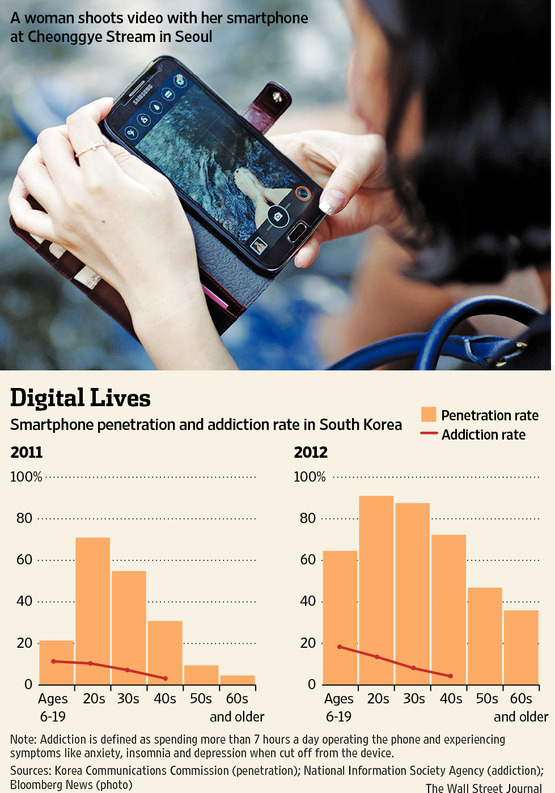
A Rising Addiction Among Youths: Smartphones; In many South Korean schools, teachers routinely collect mobile devices from their students during school hours

July 22, 2013, 5:44 p.m. ET

A Rising Addiction Among Youths: Smartphones

By IN-SOO NAM

PJ-BP480_SKADDI_G_20130722144632 AI-CC415_SKADDI_G_20130722224505

In many South Korean schools, teachers routinely collect mobile devices from their students during school hours. The government said it plans to train teachers how to deal with students who suffer smartphone addiction.

SEOUL—Lee Yun-soo has some regrets that she replaced her faded old clamshell phone with a smartphone six months ago. The South Korean high-school student enjoys tweeting funny photos, messaging friends and playing online games. But she said her smartphone is increasingly disrupting her life at school and home. “I hate doing it but I can’t help it,” she said as she fiddled with the palm-size gadget. Ms. Lee is among the roughly 1 in 5 students in South Korea who the government said is addicted to smartphone use. This addiction is defined as spending more than seven hours a day using the phone and experiencing symptoms such as anxiety, insomnia and depression when cut off from the device.  Read more of this post