EBay Eyes China as Global Commerce Seen at $307 Billion

EBay Eyes China as Global Commerce Seen at $307 Billion

Online sales of goods between countries will almost triple over the next five years as more people shop on the Web and merchants seek consumers across globe, a study commissioned by EBay Inc. (EBAY)’s PayPal found.

Cross-border Internet commerce between Australia, Brazil, China, Germany, U.K. and U.S. will jump to $307 billion in 2018 from $105 billion this year, according to a Nielsen study published today. The top categories of goods that will be traded includes clothing, shoes and accessories, followed by health and beauty products, and personal electronics, the report said. Read more of this post
Google to Acquire 6.3% Stake in Taiwan’s Himax Display Division to push Google Glass

Google to fund Taiwanese display maker to push Google Glass

Tue Jul 23 00:42:33 UTC 2013

Sruthi Ramakrishnan

Google has taken another step towards a commercial version of Google Glass by acquiring a small stake in a unit of Taiwanese chipmaker Himax Technologies, which develops tiny displays. Google will take a 6.3 per cent stake in Himax Display and has an option to raise its stake to 14.8 per cent within a year, Himax said in a statement without disclosing the financial details. Read more of this post

How big data can result in bad data; ‘A fool with a tool is still a fool.”

How big data can result in bad data

July 23, 2013 – 8:13AM

Drew Turney

Stacks of information is just yada yada yada until it’s analysed properly. A couple of years ago, ratings agency Standard & Poor’s downgraded US debt. Not because of the state of the economy, but because of an error in its original calculations – a mere $US2.1 trillion. Nate Silver, the poster child for analytic predictions, told a recent conference that the financial crisis was as much about bad modelling as greed. The ratings agencies, he said, based assumptions on past mortgages, not the number of people who would default. Welcome to the world of bad data, something that’s caught on in Australia, too. GS1, the agency responsible for barcoding and product identification systems, recently released a report that found bad data will cost Australian grocery retailers $675 million in lost sales over the next five years, and that 65 per cent of ”data misalignment” problems led to lost sales. Read more of this post

Amazon versus your public library; Will consumers buy as many e-books when they can borrow them?

Amazon versus your public library

July 22, 2013: 10:13 AM ET

Will consumers buy as many e-books when they can borrow them?

By Verne Kopytoff, contributor

FORTUNE — Amazon’s dominance in digital books is under perpetual attack by Google and Apple. Now you can add another threat to the list: the public library. That’s what an analyst from Barclays suggested in a recent research report. Consumers will likely avoid buying e-books if they can borrow them from the library for free. “As e-reader users become more familiar with the library’s system’s free alternative, and as libraries reduce the friction associated with borrowing e-books, we believe digital content revenue growth at Amazon may soften,” said Anthony DiClemente, a Barclays analyst. Read more of this post

Banks big and small are embracing cloud computing

Banks big and small are embracing cloud computing

Jul 20th 2013 |From the print edition

“I’VE only got one IT guy,” says Segun Akintemi, the chief executive of Renaissance Credit, a Nigerian moneylender that opened for business in October 2012 and signed up about 3,000 customers in its first six months. “Whenever I walk past his desk he is surfing the web.” That the firm has just one bored computer specialist is not a sign of backwardness. On the contrary, Renaissance Credit is ahead of its time when it comes to technology. Its information processing takes place in the “cloud”, the term for software and services delivered over the internet. The emergence of cloud-based banking promises to affect banks big and small. Banks are expected to spend almost $180 billion on IT this year, according to Celent, a consultancy. For the moment cloud-based services make up a tiny fraction of this amount, but by some estimates spending by financial-services firms on the cloud will total $26 billion in 2015. This increase should lower barriers to entry for newcomers, which can rent modern IT infrastructure at monthly fees of less than $10,000 rather than having to invest tens of millions of dollars upfront to build their own secure data centres. And it should also enable big banks to become much more cost-efficient. Read more of this post

Netflix Rule as No. 1 S&P Performer But…. negative free cash flow, a surge in liabilities for new movie and TV-show content and a long-term increase in unpaid subscribers

Netflix Rule as No. 1 S&P Performer But….

Netflix Inc. (NFLX) has become the best performing U.S. stock in the Standard & Poor’s 500 Index in 2013 and the second most expensive, and therein lies a tale of disagreement.

Investors who dig into company filings can find negative free cash flow, a surge in liabilities for new movie and TV-show content and a long-term increase in unpaid subscribers. Moreover, perceived limits on customer numbers and the high price of shares have led 26 of the 37 Bloomberg-listed analysts covering the stock to advise investors to sell or hold stakes. Read more of this post

Apple acquires Locationary, a Toronto startup, to help with troubled Maps app

Apple acquires Locationary, a Toronto startup, to help with troubled Maps app

Mashoka Maimona | 13/07/19 | Last Updated: 13/07/19 3:51 PM ET
Apple has scooped up nascent Toronto-based startup Locationary in a deal that could help the tech giant fine-tune its widely-panned mobile mapping service. Launched in late 2010, Locationary aggregates accurate, up-to-date information from users to create a synchronized database of local businesses, or an encyclopedia of what venues are open in the area, along with extraneous details such as opening times. An Apple spokeswoman confirmed an earlier report of the deal to the Financial Post on Friday, but would not disclose how much it paid for the startup or any additional terms of the deal. Read more of this post

CFOs Ignore Big Data at Their Peril

Updated July 18, 2013, 12:30 p.m. ET

CFOs Ignore Big Data at Their Peril

MAXWELL MURPHY

LE-AA270_DATAch_D_20130717112405

Big data seems tailor-made for finance chiefs. So why aren’t more of them using it?

Many chief financial officers say big-data technologies—which use high-performance computing to organize and analyze impossibly large volumes of information—would make their jobs more complicated and might not be worth the extra cost. They say their existing tools, mainly sophisticated financial dashboards that can crunch an organization’s numbers in real time, are adequate for their financial-planning needs. Read more of this post

For Developing World, a Streamlined Facebook; To expand its user base, the Internet giant is developing a slimmed-down interface for those whose Internet access is generally via cheap, unsophisticated cellphones

July 21, 2013

For Developing World, a Streamlined Facebook

By VINDU GOEL

MENLO PARK, Calif. — Facebook has been quietly working for more than two years on a project that is vital to expanding its base of 1.1 billion users: getting the social network onto the billions of cheap, simple “feature phones” that have largely disappeared in America and Europe but are still the norm in developing countries like India and Brazil. Facebook soon plans to announce the first results of the initiative, which it calls Facebook for Every Phone: More than 100 million people, or roughly one out of eight of its mobile users worldwide, now regularly access the social network from more than 3,000 different models of feature phones, some costing as little as $20. Read more of this post

Netflix has given a good shaking to the settled world of television: it has provided its own series, streamed them over the Internet and made them available all at once everywhere

July 21, 2013

TV Foresees Its Future. Netflix Is There.

By DAVID CARR

Apple and Google were back making waves in the television world last week, with reports suggesting they were renewing efforts to use technology to transform the box in your living room. But Netflix already has. Netflix knows a little about transformation. It’s worth remembering that it managed to go from the largest user of the Postal Service to the largest source of download traffic on the Web in the span of months, not years. After a big stumble on pricing in 2011, Netflix recovered and then some, using its expertise in technology and algorithms to accrue over 36 million users worldwide, a number that will probably grow when it announces its earnings on Monday. Its stock has already risen more than 200 percent in the last year. Read more of this post

High-End Smartphone Boom Ending as Price Drop Hits Apple

High-End Smartphone Boom Ending as Price Drop Hits Apple

By Peter Burrows  Jul 21, 2013

The smartphone has crossed the line from shiny new technology to ubiquitous commodity.

App-laden, Web-surfing phones have surged in popularity over the past half-decade and generated $293.9 billion in sales last year alone. They are now used by more than 1 billion people around the world. With more than half of mobile users in the U.S. and developed countries owning a smartphone, and consumers in emerging markets including China and India gravitating toward cheaper models, demand is slowing for high-end devices. Read more of this post

Amazon vs. IBM: Big Blue meets match in battle for the cloud

Amazon vs. IBM: Big Blue meets match in battle for the cloud

8:08am EDT

By Alistair Barr

SAN FRANCISCO (Reuters) – The tech industry maxim that “no one ever got fired for buying IBM” is a testament to how Big Blue has been the gold standard in computing services for decades. But IBM faces an unlikely challenger in Amazon.com Inc, the e-commerce retail giant that is becoming a force in the booming business of cloud computing, even winning backing from America’s top spy agency. Read more of this post

After Waze, What Else Can Mobile Crowdsourcing Do?

After Waze, What Else Can Mobile Crowdsourcing Do?

Published on July 19, 2013
by Liz Gannes

WeatherMob-348x285

In the absence of good sensor data from phones, Weathermob asks users to post location-tagged weather status updates.

Google spent $1.1 billion to buy the mapping startup Waze last month, a deal that the Federal Trade Commission is still investigating. And while Google won’t be swapping out its flagship Google Maps in favor of its sassy new step-sibling Waze anytime soon, one thing is certain: The jumbo acquisition is a clear validation of mobile crowdsourcing. That’s because Waze’s mapping and traffic information are built off the contributions of 70,000 volunteer map editors and some 15 million active users, who contribute their live driving data by default, so others can benefit by seeing how fast they are going. Given the increasing number of people who carry smartphones in their pocket, it seems likely other services could be built on the back of willing users who contribute a little bit of data from wherever they are so it can be mapped and analyzed for the common good. Read more of this post

Transitioning To a Mobile Centric World

BY BILL GURLEY

Transitioning To a Mobile Centric World

July 17, 2013: “If you choose not to decide, you still have made a choice.” — Freewill, Rush

If you happen to be a sports fan (I am), one of the coolest features to emerge in our lifetime is the ability to program your DVR remotely. The game is about to start, and you forgot to record it. No problem — you can simply talk to your DVR remotely. It’s like magic. When you get home your game is there. DirecTV has supported this feature for some time, initially on the Internet via the browser and more recently via their smartphone application. Ironically, the smartphone version of this experience renders the browser-based experience antiquated, even painful. On the browser, the DirecTV user isalways required to sign-in, which is time consuming and tedious. Plus who remembers their TV provider’s login credentials? On the iPhone, the user is never required to log-in, which is a remarkable contrast. On the desktop navigating the schedule is cumbersome, slow, and deep in the feature hierarchy. On the smartphone it is quick, responsive, and right up front. When I am sitting at my desktop at work with the browser open and high-speed bandwidth at my fingertips and want to program my DVR, I pick up my iPhone. Read more of this post

TV everywhere: Pay-television executives hope to hang on to customers by letting them watch shows on their portable devices

TV everywhere: Pay-television executives hope to hang on to customers by letting them watch shows on their portable devices

Jul 20th 2013 |From the print edition

ALFRED HITCHCOCK once compared television to indoor plumbing. “It didn’t change people’s habits,” said the master of cinematic suspense. “It just kept them inside the house.” If television chained entertainment-junkies to the couch, online video has now released their shackles. Faster broadband, the rise of mobile phones and tablet devices, and services like Netflix, Hulu and YouTube that stream shows to people anywhere with an internet connection have freed viewers to watch programmes wherever they wish.

Pay-television executives have also chosen to take part in this liberation movement, by offering their subscribers “TV everywhere”. Their companies give their customers an access code that lets them watch channels streamed live—or individual shows on demand—on their mobile devices, much as they can on Netflix or Hulu. These days almost every TV operator in America, and many elsewhere in the world, offer subscribers something along these lines, says Ben Reneker of SNL Kagan, a research firm. Read more of this post

It is getting easier to foresee wrongdoing and spot likely wrongdoers

Don’t even think about it

It is getting easier to foresee wrongdoing and spot likely wrongdoers

Jul 20th 2013 |From the print edition

THE meanest streets of Kent are to be found in little pink boxes. Or at least they are if you look at them through the crime-prediction software produced by an American company called PredPol. Places in the county east of London where a crime is likely on a given day show up on PredPol’s maps highlighted by pink squares 150 metres on a side. The predictions can be eerily good, according to Mark Johnson, a police analyst: “In the first box I visited we found a carving knife just lying in the road.” PredPol is one of a range of tools using better data, more finely crunched, to predict crime. They seem to promise better law-enforcement. But they also bring worries about privacy, and of justice systems run by machines not people. Read more of this post

Why the Surface RT Failed and the iPad Did Not

JULY 19, 2013, 10:34 AM

Why the Surface RT Failed and the iPad Did Not

By NICK BILTON

At first glance, to most consumers, the Apple iPad and Microsoft Surface RT tablet computer look somewhat similar. They are both rectangular, have crisp screens and can boast a slick and clean design interface. Yet on Thursday Microsoft announced that it was taking a $900 million write-down to reflect unsold inventory of the Surface RT. That’s a stark comparison to Apple’s iPad, which continues to break record sales and has sold more than 100 million devices. So why is one still succeeding while the other has failed? I have a theory. But it begins with a story. Read more of this post

It’s Official: General Motors Sees Tesla As A Threat; “If we ignore it and say it’s a bunch of laptop batteries, then shame on us.”

It’s Official: General Motors Sees Tesla As A Threat

ANTONY INGRAMGREEN CAR REPORTS JUL. 19, 2013, 5:34 PM 2,512 10

“History is littered with big companies that ignored innovation that was coming their way because you didn’t know where you could be disrupted.” General Motors will be hoping those words, from vice chairman Steve Girksy as the automaker begins to study electric upstart Tesla Motors [NSDQ:TSLA], don’t become too prophetic. They’re a clear indication that major automakers are starting to worry about the startup electric automaker, as GM CEO Dan Akerson looks into how Tesla may affect the 104-year old GM’s business. According to Bloomberg, studying Tesla is just one way that Akerson is hoping to change GM’s culture after its financial difficulties in 2009. Read more of this post

How German-based SAP is creating a startup ecosystem from Silicon Valley

How German-based SAP is creating a startup ecosystem from Silicon Valley

BY FRITZ NELSON 
ON JULY 19, 2013

The story of nearly every traditional (read: stodgy) enterprise technology provider — IBM, Microsoft, Dell, HP, Oracle, SAP, Cisco — goes something like this: Create a cash cow (maybe two), watch the business get disrupted by new ideas and more nimble upstarts, use size to squash those ideas or, eventually, embrace them or buy the companies behind them, and attempt to re-invent the business before the cash cow bleeds out.

So try this iteration on for irony: 40-year-old SAP has built an impressive ecosystem around HANA, a fledgling technology with its heart in the company’s Waldorf, Germany headquarters and its head in Silicon Valley, home to SAP Startup Focus. Read more of this post

RetailMeNot’s 94% Margins Usher In Post-Facebook IPO Glee

RetailMeNot’s 94% Margins Usher In Post-Facebook IPO Glee

Since the flop of Facebook Inc. (FB)’s initial public offering last year, only two U.S. consumer Web companies have gone public: real estate site Trulia Inc. and travel search engine Kayak Software Corp.

Twitter Inc. remains on the sidelines with an estimated $9.8 billion valuation, more than 95 percent of companies in the Nasdaq Composite Index. (CCMP) Other startups, such as cloud-storage company Dropbox Inc., mobile-payment platform Square Inc. and room-sharing service Airbnb Inc., sport valuations of more than $1 billion. It may be up to an online coupon site from Austin, Texas, to get those companies off the bench. Read more of this post

Microsoft shares hit by biggest sell-off since 2009

Microsoft shares hit by biggest sell-off since 2009

6:45pm EDT

(Reuters) – Microsoft Corp shares fell more than 11 percent on Friday, their biggest plunge in more than four years, a day after the software company posted dismal quarterly results due to weak demand for its latest Windows system and poor sales of its Surface tablet.

The stock’s selloff, from five-year highs, is the biggest in percentage terms since January 2009, when the world’s largest software company cut 5,000 jobs during the recession. At one point in the day, losses exceeded 12 percent, making it the biggest fall since the Internet stock bubble burst in 2000.

About $34 billion was wiped off Microsoft’s market value on Friday, exceeding the size of rival Yahoo Inc. Read more of this post

Apple Said to Buy HopStop, Pushing Deeper Into Maps

Apple Said to Buy HopStop, Pushing Deeper Into Maps

Apple Inc. (AAPL) agreed to buy online transit-navigation service HopStop.com Inc., people with knowledge of the deal said, seeking to improve mapping tools after a rocky debut for its directions software last year.

The people asked not to be identified because the deal isn’t public. AllThingsD reported earlier today that Cupertino, California-based Apple is purchasing Locationary Inc., a Toronto-based company focused on business-location maps. Read more of this post

Head of another Taobao online retail outlet dies due to overwork at age 36

Head of another Taobao outlet dies due to overwork

Staff Reporter 2013-07-19

W020130717411257268165-164813_copy1

Wu Lijun was 36. (Internet photo)

Wu Lijun, who was president of Yunifang, an online retailer that sells mud masks and skincare products on Taobao, one of China’s largest e-commerce platforms, died on July 15. The cause of death is suspected to be overwork, a situation that is becoming worringly common among people who earn their living by selling goods online, reports the Beijing Youth Daily, the official newspaper of the Communist Youth League committee in Beijing. Yunifang had become the leading seller of cosmetic mask products on Taobao after only six months on the platform. The retailer was later listed on Taobao’s top 50 outlets. Wu died due to a brain condition in Changsha in south-central China at the age of only 36. There have been several cases of death due to overwork in the online retail sector. Taobao reportedly conducted a survey into the health of 74 of their retails and are said to have found the results worrying. The earlier death of a 24-year-old Taobao retailer in Hangzhou was the first to prompt discussion about how hard people in the industry were working to sell tehir goods and promote their outlet. Taobao posted an official expression of condolences on that occasion and reminded its retailers to take care of their health. It has been taken for granted that to succeed in the emerging e-commerce business, it is necessary to work hard and for long hours to process and shipp orders and ensure customers are satisfied. Overwork has become an acknowledged feature of the industry.

True pragmatic patriotic innovator: Check Point CEO recommends US IPOs

Check Point CEO recommends US IPOs

Gil Shwed: Israeli technology companies considering an offering should go to the US and not to Israel.

18 July 13 16:11, Ron Steinblatt

“I would recommend to Israeli technology companies considering an offering to go to the US and not to Israel, because that’s where the competitors and investors relevant to their market are found,” said Check Point Software Technologies Ltd. (Nasdaq: CHKP) chairman and CEO Gil Shwed at the press conference, following the publication of the company’s financial report for the second quarter of 2013. Shwed added, “We’re a small country with a tiny capital market. What percentage can be invested here in technology companies? That does not mean that the Israeli market is bad or that there are no smart and talented people here. The problem is global, and regrettably, the Israeli market is not attractive for technology companies.” Shwed remarks about the Israeli capital market come against the backdrop of the decision by Mellanox Technologies Ltd. (Nasdaq:MLNX; TASE:MLNX) to delist from the TASE, which will come into effect at the end of August. Read more of this post

With 5 million registered accounts, no more than 500 thousand monthly active users, Jiepang managed to break even in two months last year by doing location-based campaigns or branded photo filters for brands such as Startbucks

Jiepang Isn’t China’s Foursquare Wannabe Anymore

By Tracey Xiang on July 19, 2013

Jiepang50

Two years ago we started asking, Are Chinese still checking-in? (I can’t believe it’s been two years.)  Those hyped check-in apps, unsurprisingly, disappeared one by one. It was believed then that location check-in would be a must-have feature with almost all social services and the standalone couldn’t work out. Jiepang, to my surprise, has been holding on. With 5 million registered accounts,  no more than 500 thousand monthly active users, Jiepang managed to break even in two months last year by doing location-based campaigns or branded photo filters for brands such as Startbucks. Read more of this post

Muddy Waters’ Carson Block Shreds American Tower, Warns Of Misstatements, And Explains Why Its Stock Will Collapse

Carson Block Shreds American Tower, Warns Of Misstatements, And Explains Why Its Stock Will Collapse

STEVEN PERLBERG JUL. 18, 2013, 11:49 AM 7,548

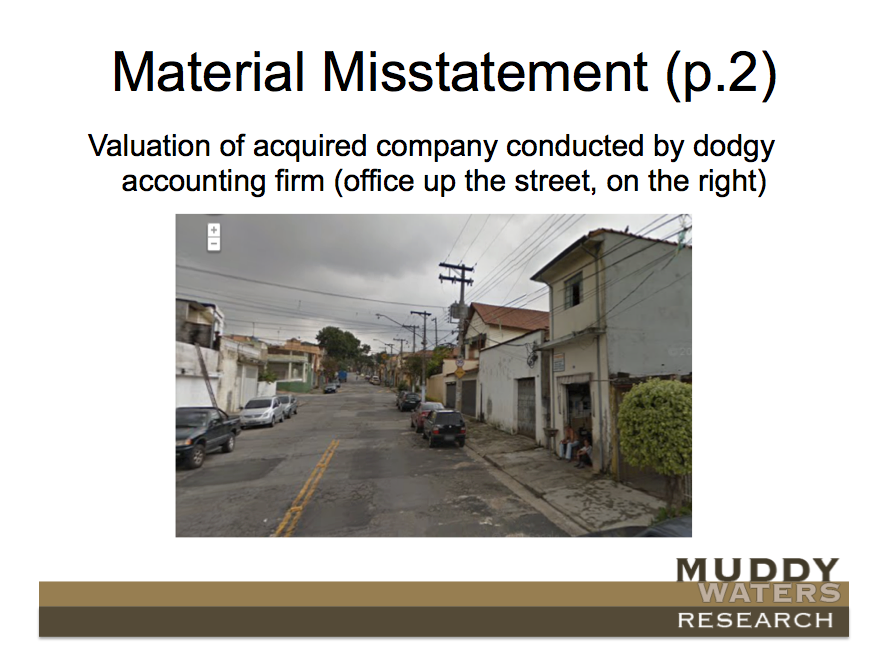
Muddy Waters founder Carson Block took communications powerhouse American Tower Corp to task on Bloomberg Market Makers yesterday. Block’s research firm is out with a new report that casts doubt over AMT’s work in emerging markets, hinting that the company has been misleading, if not outright fraudulent. “We rate AMT a Strong Sell and value it at $44.57 per share, representing downside of 40%,” Muddy Waters writes in the report. “It has engaged in a value destroying investment binge overseas, and we have identified a significant material misstatement in the Company’s accounts that could amount to fraud.” Muddy Waters flagged one transaction in particular, a $585 million purchase of towers in Brazil. “There is an approximately US$250 million discrepancy between what AMT claims to have paid for the acquisition of towers in Brazil, and the actual selling price,” according to the report. Muddy Waters provided the research to the SEC.jpg (25) jpg (26) jpg (27) jpg (28) jpg (29)

How Two First-Time Founders Went From $28,000 Salaries To Owning A $100 Million Media Brand in Refinery29

How Two First-Time Founders Went From $28,000 Salaries To Owning A $100 Million Media Brand

ALYSON SHONTELL APR. 22, 2013, 12:48 PM 37,594 8

philippe-von-borries-justin-stefano-refinery29-february-2012-bi-dng

Philippe von Borries and Justin Stefano are first-time entrepreneurs and the founders of Refinery29.

Justin Stefano and Philippe von Borries had never started a company before. Neither had worked in fashion before either. But in 2005, they left their jobs in law and politics respectively to start Refinery29Refinery29 is a New York-based fashion content and commerce company. For a long time, no one took Stefano or von Borries seriously. Now Refinery29 is one of the few new media companies that is expected to exit north of $100 million. In February, Refinery29 raised a modest $4.2 million Series B round from First Round Capital, Floodgate, Lerer Ventures, and Hearst led by president David Carey. In 2009 it generated $400,000 annually. This year it’s expected to pull in $24 million. We spoke with Stefano and von Borries about how they grew from from a largely bootstrapped business to a major fashion brand. Read more of this post

The Social Media Bubble Is Quietly Deflating

The Social Media Bubble Is Quietly Deflating

By Joshua Brustein on July 16, 2013

BW30_tech_socialgraphic_405

Two years ago, when the craze for social media startups was in full swing, a former Facebook (FB) engineer summed up the situation with a memorable lament: “The best minds of my generation are thinking about how to make people click ads,” the engineer, Jeff Hammerbacher, told Bloomberg Businessweek at the time. “That sucks,” he added. It might be over. Read more of this post

Internet IPOs: First, RetailMeNot. Next, Twitter?

Internet IPOs: First, RetailMeNot. Next, Twitter?

By Ari Levy on July 18, 2013

tech_ipo3013__01__405inline

After Facebook’s (FB) initial public offering 14 months ago—featuring a computer malfunction, misplaced trades, and lawsuits galore—a nuclear winter descended on consumer Internet equity listings. Investors interested in new technology deals ran from ill-defined metrics like consumer engagement and monthly active users. Instead, they sought solid revenue models powered by subscription and licensing fees at business software outfits such as data-visualization company Tableau Software (DATA) and human resources software maker Workday (WDAY). Read more of this post

Kremlin Intrigue Threatens Russia’s Silicon Valley; A $4.6 billion effort to jump-start Russia’s technology industry is running into trouble even before it’s finished

Kremlin Intrigue Threatens Russia’s Silicon Valley

By Henry Meyer on July 18, 2013

When agents stormed the offices of the Skolkovo technology hub in Moscow on April 18 to seize documents, a top Intel (INTC) executive unexpectedly got caught up in the raid. Dusty Robbins, head of global programs for the chipmaker, had to surrender his mobile phone. He was only allowed to leave the building escorted by officers after Skolkovo managers appealed to investigators to let him go. Robbins flew back to the U.S., skipping a planned meeting with the tech complex’s billionaire president, Viktor Vekselberg. Read more of this post