Home Depot Uses Cloud to Tap ‘Do-It-For-Me’ Market

July 5, 2013, 5:09 PM ET

Home Depot Uses Cloud to Tap ‘Do-It-For-Me’ Market

Rachael King

Home Depot Inc. plans to expand a service that connects shoppers who need help installing purchases like tile or ceiling fans to local contractors. That service relies on communications infrastructure from Twilio Inc. and Amazon.com Inc. “The market is moving from do-it-yourself to do-it-for-me,” Anthony Rodio, vice president of Home Depot, told CIO Journal. About 42% of home improvement projects are now done by outside help, he said. For the first time since 2008, sales to professional contractors is growing faster than sales to consumers, said Frank Blake, Home Depot CEO on a conference call with investors on May 21. Read more of this post

Why Israel should reconsider too much high-fiving over Waze

Why Israel should reconsider too much high-fiving over Waze

BY SARAH LACY 
ON JULY 5, 2013

Earlier this week our wonderful contributor from Israel, Mick Weinstein, wrote a story about a new fund launching and he lead with this: While the Israeli startup community basks in the glow of Waze’s recent $1.1 billion sale to Google, most of the discussion has focused on how Waze validates Israel’s effort to create hugely valuable, globally scaled consumer internet services — a relatively new field for an ecosystem that previously excelled in semiconductors and enterprise software.

I have no doubt that’s what people are saying but….um…what? The only thing “new” about the Israeli consumer Web scene is that it finally had a globally recognized hit. There’s been nearly a decade and thousands of attempts in the country beyond Waze that have mostly missed the mark or been acquired for less than $50 million by the West. One $1 billion hit in a decade of attempts doesn’t prove a country as a whole can do consumer. That’s the case even if it’s a monster hit; a stand alone company that redefines an industry. It’s certainly not the case when it’s a still-early, product-oriented company that many people feel was wildly over valued at just over $1 billion. Read more of this post

Chinese Web giant Tencent faces obstacles in its goal to expand in global IM market

Chinese Web giant Tencent faces obstacles in its goal to expand in global IM market

By Jia Lynn Yang, Saturday, July 6, 7:52 AM

BEIJING — With Web giants such as Facebook and Twitter blocked by the government here, an entire ecosystem of home-grown companies has flourished with names that are unfamiliar to many outside China. Tencent, one of the country’s biggest tech firms, is hoping to change that with a product that is already one of the fastest-growing mobile services in the world. The company’s instant messaging product, WeChat, has amassed more than 300 million users — nearly equivalent to the U.S. population — in less than three years. Tencent says there are more than 70 million users across southeast Asia, India and Mexico, with 30 million of those added in just the past three months. WeChat has also expanded into Saudi Arabia recently, and there are plans to open an office in the United States. But WeChat’s Chinese origins could cause problems for the company worldwide, just as Chinese telecommunications companies Huawei and ZTE have faced obstacles in the United States. Read more of this post

Japan’s DoCoMo holds out to iPhone mania, but at what cost?

Japan’s DoCoMo holds out to iPhone mania, but at what cost?

2:49am EDT

By Sophie Knight and Maki Shiraki

TOKYO (Reuters) – NTT DoCoMo Inc, Japan’s largest mobile provider and a pioneer of the mobile Internet, is one of just a few holdouts among the world’s big mobile carriers not offering Apple Inc’s iPhone to its 60 million customers. It is paying heavily for that obstinacy – with a net 3.2 million users jumping ship to its two domestic rivals over the last 4-1/2 years – but is determined to protect the walled garden of services it has built around its own smartphones. “We’re trying to develop a lifestyle system,” NTT DoCoMo CEO Kaoru Kato told Reuters in an interview this week. While customers and even some executives increasingly clamor for it to relent and sign an iPhone deal, DoCoMo is showing no signs of softening towards Apple. “The biggest problem is the impact on the services that we offer,” Kato said. DoCoMo’s broad offering of exclusive features, however, is no longer attracting what has become the iPhone generation. It is expected eventually to either reach a deal with Apple or risk losing its crown at the top of its industry. Read more of this post

UK tech darlings shun London for New York; “There are very few exit opportunities in Europe.”

July 5, 2013 2:28 pm

UK tech darlings shun London for New York

By Henry Mance and Arash Massoudi

When six entrepreneurs tried to raise money for an online games business in London a decade ago, many investors simply put the phone down. Now it’s the entrepreneurs’ turn to hang up. Their company, known as King and the owner of Candy Crush Saga, the most popular game on Facebook, is planning an initial public offering in New York, according to people familiar with the situation. It heads a list of successful UK tech companies which are turning their backs on a London flotation, and instead crossing the Atlantic in search of a billion-dollar valuation. Bernard Liautaud, a partner at Balderton Capital, which has invested in companies including Wonga, says: “There are very few exit opportunities in Europe.” Read more of this post

Taiwan’s information-technology industry: After the personal computer; Companies built on PCs are adapting to a changed world

Taiwan’s information-technology industry: After the personal computer; Companies built on PCs are adapting to a changed world

Jul 6th 2013 | TAIPEI |From the print edition

20130706_WBC023

THE first iPhone went on sale on June 29th 2007. Tom Sun recalls the date easily, because TPK, of which he is the chief executive, began manufacturing exactly four weeks before, making touchscreens for Apple’s gadget. This year, Mr Sun estimates, 1.2 billion mobile phones will be made with touchscreens. The iPad has since “created a segment”, the tablet, that he says is “100% touch”. TPK’s booth at Computex, a trade fair in Taipei last month, proudly showed off the latest notebook and all-in-one personal computers (PCs). But Mr Sun enthuses about many more applications, from cameras to cars. Other manufacturers, he says, will follow Tesla, an electric-vehicle maker that has put 17-inch screens in its Model S.

Taiwan, once a maker of soft toys and umbrellas, has long been a high-tech hive. It provides a rare example of successful industrial policy (though much more so in hardware than software). In 1973 the state created the Industrial Technology Research Institute (ITRI) to nurture the tech industry. ITRI started with semiconductors, securing the transfer of old technology from RCA, an American company, in 1976. In 1983 ITRI developed a clone of the IBM PC. Seven years later it formed an alliance of notebook-PC companies. Information and communications technology now makes up one-third of GDP. Read more of this post

Home Shopping Network Enjoys a Mobile-Shopping Rebirth in the Digital Era; More than half of all new customers come to HSN through their mobile phones

July 4, 2013, 7:05 p.m. ET

HSN Enjoys a Mobile-Shopping Rebirth in the Digital Era

SHELLY BANJO

MK-CE481_HSN_NS_20130704180037 MK-CE488_HSN_ju_G_20130704195017

ST. PETERSBURG, Fla.—When Mindy Grossman took over as CEO of HSN Inc. five years ago, she was up against naysayers who said the Home Shopping NetworkHSNI +1.80% would die in the digital age. True, Home Shopping Network had a reputation of C-list celebrities selling rhinestone jewelry and miracle skin creams to couch potatoes. But digital hasn’t been the death of HSN, by any means. Ms. Grossman, 55 years old, has begun to prove that she understands the audience HSN needs to attract and how they use mobile devices. HSN still has a long way to go to catch up to rival QVC, but after posting a multibillion-dollar loss in 2008, HSN Inc., which also includes home and lifestyle brand Cornerstone, started posting increasing profit, which last year topped $130 million. The stock price, less than $11 in 2008, is above $54 today, giving the company a market value of $2.9 billion. Read more of this post

Asia Chip Makers Stand to Benefit From Move to Cut-Price Gadgets

July 4, 2013

Asia Chip Makers Stand to Benefit From Move to Cut-Price Gadgets

By MIYOUNG KIM | REUTERS

SEOUL — Asian chip makers are set to cash in on a major realignment in the volatile industry that is tilting the balance of power their way at the expense of gadget makers like Apple, after years of cautious investment kept supply in check.

Manufacturers, including Toshiba and SK Hynix, are poised to reap the rewards of soaring demand for cut-price tablets and smartphones in China, the world’s biggest smartphone market, and the emergence of Chinese mobile device makers like Huawei Technologies. Read more of this post

The new hot commodities market: the cloud; Deutsche Börse to launch Cloud Exchange for spare cloud computing capacity

The new hot commodities market: the cloud

By Christopher Mims @mims July 2, 2013

Have some spare computing capacity in your data center, aka the “cloud”? Why not make some scratch by selling it on the open market? Or, if you’re so inclined, you could trade derivatives of cloud computing. In place of mortgage-backed securities, perhaps the world’s banks can pour their savings into another abstract financial instrument that depends on the reliability of Amazon’s web services. What could possibly go wrong? This is the promise of a new exchange for cloud computing capacity, called Cloud Exchange AG, which will launch early next year. It’s a joint venture of Deutsche Börse, which runs the Frankfurt stock exchange, and software development firm Zimory.

Trading computing capacity isn’t as simple as trading, say, wheat. The system implemented by the two firms will allow buyers to specify the location of servers, the precise vendor (e.g. Amazon, IBM, Rackspace), security measures and transfer speed, among other things. The scheme is similar to cloud marketplaces like Reserved Instance Marketplace by Amazon Web Services and SpotCloud by Virtustream, notes Ulrike Dauer at the Wall Street Journal. But on those platforms trade is restricted to one vendor, such as Amazon. The Deutsche Börse system allows trading across vendors. By 2015, Deutsche Börse hopes to offer derivatives and futures on cloud computing commodities trades. This could lead to a whole new level of collaboration (or competition) between Wall Street traders and their IT departments, as both try to predict the price of cloud computing resources weeks and months ahead.

As Competition Wanes, Amazon Cuts Back Discounts; After years of lowering book prices, Amazon is offering smaller discounts on some books. Authors and small publishers said this put some books beyond an audience’s reach

July 4, 2013

As Competition Wanes, Amazon Cuts Back Discounts

By DAVID STREITFELD

Jim Hollock’s first book, a true-crime tale set in Pennsylvania, got strong reviews and decent sales when it appeared in 2011. Now “Born to Lose” is losing momentum — yet Amazon, to the writer’s intense frustration, has increased the price by nearly a third. “At this point, people need an inducement,” said Mr. Hollock, a retired corrections official. “But instead of lowering the price, Amazon is raising it.” Other writers and publishers have the same complaint. They say Amazon, which became the biggest force in bookselling by discounting so heavily it often lost money, has been cutting back its deals for scholarly and small-press books. That creates the uneasy prospect of a two-tier system where some books are priced beyond an audience’s reach. Read more of this post

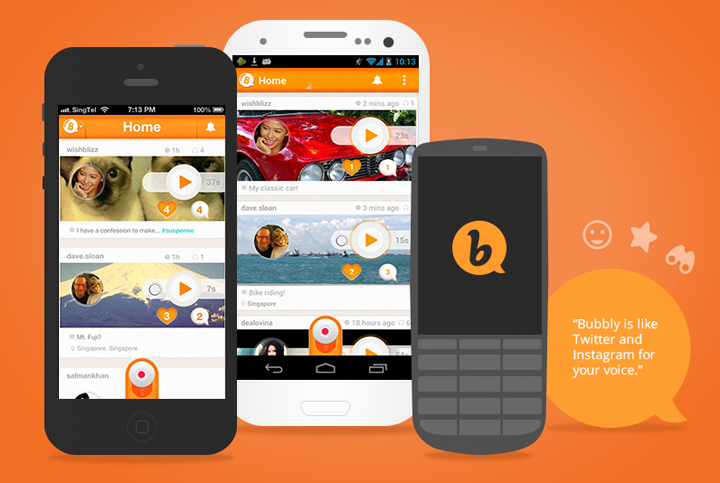
Bubbly, commonly known as the “Twitter for voice,” Hits 30 Million Users

Social Voice App Bubbly Hits 30 Million Users

July 4, 2013

by Willis Wee

bubbly-home

Singapore-headquartered Bubbly, commonly known as the “Twitter for voice,” has hit 30 million users. In addition to the 30 million users milestone, the company has rebranded itself as Bubbly (it was formerly called Bubble Motion) to give a more unified branding, look, and feel. Aptly, the latest version of Bubbly (v3.0) also launched today with a new design. Read more of this post

China hands Asian memory makers massive bargaining chip

China hands Asian memory makers massive bargaining chip

5:03pm EDT

By Miyoung Kim

SEOUL (Reuters) – Asian chipmakers are set to cash in on a major realignment in the volatile industry which is tilting the power balance their way at the expense of gadget makers such as Apple Inc, after years of cautious investment kept supply in check. Manufacturers including Toshiba Corp and SK Hynix are poised to reap the rewards of soaring demand for cut-price tablets and smartphones in China, the world’s biggest smartphone market, and the emergence of Chinese mobile device makers such as Huawei Technologies Co Ltd. Read more of this post

Rakuten launches fashion-sharing website in Taiwan

Rakuten launches fashion-sharing website in Taiwan

CNA

2013-07-04

Japanese e-commerce giant Rakuten launched a social networking site for sharing fashion information in Taiwan Wednesday to grab a bigger share of the country’s growing online shopping market. Toru Shimada, CEO and chairman of Rakuten Asia, said his company is hoping to attract at least 1 million members in the coming year to the new site called “OSHa’Re,” which means fashion in Japanese. “Taiwan is Rakuten’s global market benchmark for new innovative technologies and services,” Shimada said at a press briefing on the new service, which has visual search technology that allows users to match photos of items they want with goods offered by Rakuten’s online shopping mall. “We are confident that OSHa’Re will become the No. 1 fashion website in Taiwan,” he said. Taiwan became in 2008 the first overseas market in which Rakuten established a presence, and the Japanese online retailer has since expanded its operations to Thailand, Indonesia and Malaysia. In the past two years, Rakuten has acquired or bought stakes in companies in the United States, France, Brazil, Germany, Canada and the United Kingdom. The global e-commerce market has grown by an average of 19% per year since 2010 and is expected to reach US$1 trillion in turnover this year, according to the Taiwan External Trade Development Council, the country’s main trade promotion body. In Taiwan alone, e-commerce turnover is expected to exceed NT$1 trillion (US$33.3 billion) in 2015, the council estimated.


Why Asian Internet Companies Struggle to Become Global

JULY 3, 2013, 11:12 AM

Why Asian Internet Companies Struggle to Become Global

By ERIC PFANNER

Asia is home to nearly half of the 2 billion Internet users in the world. It makes most of the hardware — laptops, smartphones, tablets and other gadgets — that is used to gain access to the Internet. In countries like South Korea and Japan, it has some of the fastest wired and wireless networks for carrying Internet traffic. Yet in one aspect of the high-technology economy, Asia still struggles. It has yet to create an Internet company with the global scale of a Google, Facebook or Amazon. A report published Wednesday by the Economist Intelligence Unit, a research outfit affiliated with the Economist magazine, examines some of the possible reasons for this. Read more of this post

Software as a Monthly Rental; Photoshop is now the biggest-name software that you can’t actually buy, as the new version costs $30 a month, or $240 a year

July 3, 2013

Software as a Monthly Rental

By DAVID POGUE

There’s a new reason for Photoshop to be famous.

Yes, it’s still the program that just about every photographer and designer on earth uses to retouch or even reimagine photos. It’s still the only program whose name is a verb. But now, Photoshop is also the biggest-name software that you can’t actually buy. You can only rent it, for a month or a year at a time. If you ever stop paying, you keep your files but lose the ability to edit them. You have to pay $30 a month, or $240 a year, for the privilege of using the latest Photoshop version, called Photoshop CC. Or, if you want to use the full Adobe suite (Illustrator, InDesign, Premiere and so on), you’ll pay $600 a year. The price list is stunningly complex. The fees may be higher or lower depending on how many programs you rent, whether you already own an existing version and which one, whether you commit to a full year or prefer to rent one month at a time. There are also discounted first-year teaser rates, student/teacher rates and a 30-day free trial. But you get the point: the dawn of Software as a Subscription is now upon us. Read more of this post

Tencent Will Extend Payment System to Wireless Platforms

Tencent Will Extend Payment System to Wireless Platforms

Tencent Holdings Ltd. (700), China’s largest Internet company, will introduce a payment system to wireless platforms as it tries to commercialize apps including its WeChat instant messaging service to drive profit growth.

The company is seeking to tap customers who access its services on smartphones and tablet computers, Tencent President Martin Lau said at a conference in Beijing today. WeChat, with more than 300 million users, has over 70 million registered accounts outside mainland China, he said. Read more of this post

Investors buy into software-defined networks, will customers follow?

Investors buy into software-defined networks, will customers follow?

11:06am EDT

By Sayantani Ghosh

(Reuters) – As Superstorm Sandy bore down on the East coast last year, companies with data centers in its path needed another location fast. But moving computer servers is tricky, and usually planned over days or weeks. Enter a new technology: software-defined networking, or SDN. Such urgent data moves could now be done within a few hours. Investors, including some of the world’s biggest technology companies, are buying into the start-ups behind SDN, a technology that allows users to substitute some of the most complex hardware functions in server switches with software. SDN is still relatively small, generating around $300 million in annual business in a $30 billion networking industry. Customers are not yet sure how to make the most of its flexibility. Read more of this post

Shenzhen O-film Tech Co. Chairman Cai Rongjun has become a billionaire after shares in the Chinese touchscreen glass-panel maker soared nearly 178 percent this year on higher demand for tablet computers

Cai Emerges as Chinese Billionaire With Touchscreen Glass

Shenzhen O-film Tech Co. Chairman Cai Rongjun has become a billionaire after shares in the Chinese touchscreen glass-panel maker soared nearly 178 percent this year on higher demand for tablet computers.

Cai, 41, has a net worth of $1 billion after the stock advanced 10 percent yesterday, according to the Bloomberg Billionaires Index. He hasn’t appeared on any international wealth rankings. The bulk of his fortune consists of a 22 percent stake in the company, which supplies screens to Lenovo Group Ltd. (992), Samsung Electronics Co. and Sony Corp. Read more of this post

A raft of A-share companies has made ambitious moves to acquire mobile gaming companies in the burgeoning nascent market; Ourpalm shares soared 275.77% YTD

Chinese Mobile Game Companies Come Under Spotlights

By Emma Lee on July 3, 2013

A raft of A-share companies has made ambitious moves to acquire mobile gaming companies in the burgeoning nascent market. Investors saw opportunities in the industry which boasted 286 million subscribers (source in Chinese) as of the end of 2012, boosting the performance of shares related to the sector.

Ourpalm (SZ:300315) announced recently that it would acquire a 100 percent stake in Dovo Technology Inc. , a game developer, with 810 million yuan (source in Chinese). Dovo Technologygenerated 57.08 million yuan of net profit in 2012. Ourpalm is seeking for another acquisition target to expand its gaming empire. Read more of this post

How RSS feeds lost the web

How RSS feeds lost the web

By Lydia DePillis, Updated: July 2, 2013

July 1 has come and gone: Welcome to the post-Google Reader world. For some of us, it is a poorer one, since we’ve had to re-wire our brains to consume words through a different filtering device. Others, like Ezra, have decided to dispense with RSS feeds entirely, figuring that they contributed to the narrowing of his media diet to a defined set of blogs. Many more people, though, never adopted RSS feeds in the first place; even Google’s numbers were on the decline. For all the moaning in the blogosphere, it’s fair to say the average Internet user hasn’t even heard of an RSS feed, let alone set up a web application to mainline content directly into their brains. Sure, services like Digg Reader and Feedly will make a go of the medium, but their eventual peak user base seems limited. Why did RSS never become universal in the way that Facebook has, and Twitter seems on track to do? A few reasons. Read more of this post

How past failures helped make ZocDoc into a roaring success; Founder Cyrus Massoumi’s first company didn’t fare so well

Cyrus Massoumi, Founder and CEO of ZocDoc

July 1, 2013: 11:50 AM ET

How past failures helped make ZocDoc into a roaring success.

130701114910-cyrus-massoumi-620xa

FORTUNE — Fortune’s Brainstorm Tech Conference (July 22-24 in Aspen, Colo.) regularly brings together the best and brightest minds in tech innovation. Each week, Fortune turns the spotlight on a different conference attendee to offer his or her own personal insight into business, tech, and entrepreneurship. This week, we asked ZocDoc Founder and CEO Cyrus Massoumi to answer 10 questions about life outside of work, the company he admires most, and industry advice for young entrepreneurs. His responses follow. Read more of this post

China’s e-commerce giants compete for share in fresh food market

China’s e-commerce giants compete for share in fresh food market

Staff Reporter

2013-07-02

Several online retailers in China have joined the online war in the fresh food market including Amazon China’s seafood platform, which jumped into the fray in June. Meanwhile, domestic e-commerce giant 360buy Jingdong Mall also launched a fresh food platform in conjunction with China National Cereals, Oils and Foodstuffs Corporation in July, reports the Beijing-based China Business Journal. Read more of this post

For most Israeli startups, no happy ending; Google’s acquisition of Waze is inspiring, but half of all startups shut their doors within three years.

For most Israeli startups, no happy ending

Google’s acquisition of Waze is inspiring, but half of all startups shut their doors within three years.

By Inbal Orpaz | Jul.01, 2013 | 8:50 AM

The sale of the navigation apps startup Waze to Google for the princely sum of $1 billion last month is the dream of startup nation − a team of talented entrepreneurs who form a company and within a few years sell it to one of the biggest and most respected companies in the global industry.

Exits like that feed an industry of dreams, one that says that you, too, can develop an application and grow rich with relative ease. The reality, of course, is more complicated. In startup nation’s backyard is a cemetery in which thousands of aspiring young companies have been laid to rest. Hundreds are added every year. Read more of this post

Microsoft is emerging as the social search leader and Google should be worried

Microsoft is emerging as the social search leader and Google should be worried

BY MICHAEL CARNEY 
ON JULY 1, 2013

Four years into the Bing era and Microsoft’s still nascent search platform has yet to make a dent in Google’s dominance. But while many have written off Bing as a lost cause, there’s one area where Microsoft is making headway: social search.

Today, we learned that Twitter is testing an in-line Tweet translation feature in partnership with, you guessed it, Bing. Microsoft launched a similarpartnership with Facebookin October 2011 – initially with Facebook Pages content, and eventually with content from individual user profiles as well. Read more of this post

With a new web-based mobile phone, Mozilla is out-Googling Google

With a new web-based mobile phone, Mozilla is out-Googling Google

By Christopher Mims @mims July 1, 2013

Here’s a paradox: Google is so devoted to the web that it has built an entire computer operating system—Chrome OS—based on the web, and it is so devoted to mobile phones that it built a mobile OS—Android—that is now the most popular in the world. And yet, it won’t be the first company to build a web-based OS for a mobile phone. That distinction goes to the Mozilla Foundation, non-profit custodian of the Firefox browser, whose web-based Mozilla OS for smartphones has just been released on a line of phones available in Spain. Read more of this post

AltaVista, once the most advanced and comprehensive search engine on the Web, is about to close its URL forever

JULY 1, 2013, 5:35 PM

AltaVista. What’s That?

By NICK BILTON

There’s an alternate universe where someone would ask you a question you don’t know the answer to and you would respond, “I don’t know, why don’t you AltaVista it?” Instead, in the real world, you reply, “Why don’t you Google it?” AltaVista, once the most advanced and comprehensive search engine on the Web, is just days away from its last breath. Yes, like you, I thought AltaVista had been extinguished years ago, but apparently not. Last week, Jay Rossiter, executive vice president of platforms at Yahoo, which owns AltaVista, said that the search engine would be closed on July 8. Anyone who still uses AltaVista — I’m not sure who that is — should instead go to Yahoo Search, Mr. Rossiter said. Readers who are 18 years old and younger will probably ask, “What’s an AltaVista?” In short, it was one of the first and most successful search engines. It was founded in 1995 by Digital Equipment Corporation. Read more of this post

Amazon’s Perfect Timing for India; Why Jeff Bezos’ late India entry will work to the company’s advantage

Amazon’s Perfect Timing for India

by Rohin Dharmakumar | Jul 2, 2013

Why Jeff Bezos’ late India entry will work to the company’s advantage

On June 5 Amazon launched www.amazon.in . The consensus opinion among most internet watchers was that founder Jeff Bezos and Amazon would need to work very hard to play catch-up in the Indian ecommerce market that homegrown players like Flipkart had largely sewn up. Worse, Amazon was starting off as a third party marketplace (ie, it provides the platform for others to sell), instead of selling directly.  But reality may be exactly the opposite. Amazon seems to have chosen an entry date and strategy that allows it to use its strengths to maximum advantage. Read more of this post

In a Major Milestone, Korean-Made KakaoTalk Reaches 100 Million Users

In a Major Milestone, Korean-Made KakaoTalk Reaches 100 Million Users

July 2, 2013

by Steven Millward

After three years and three months in action, the Korean startup KakaoTalk has surpassed 100 million users on its social messaging app. It’s a major milestone for the app in this frenziedly competitive space, coming just over a year after reaching 50 million users in June 2012 (see graph below). The most significant new feature for KakaoTalk was its social gaming platform – launched nearly a year ago – allowing it to tie in to popular games so that your can compete with your chat buddies. It’s also a key feature for arch rival Line, which has over 160 million users. Perhaps the Korean app’s most amazing singular achievement is edging out Facebook in South Korea to become the nation’s top social network. KakaoTalk has also been expanding aggressively in Southeast Asia – as have Line and WeChat as they seek to push out Whatsapp – with recent TV ad campaigns in Indonesia and a partnership with Friendster to promote the messaging app in Malaysia.

KakaoTalk-Reaches-100-Million-Users-July-2013

How Amazon Is Trying To Create A Huge Mobile Business

How Amazon Is Trying To Create A Huge Mobile Business

JOSH LUGER JUL. 1, 2013, 4:50 PM 5,796 1

U.S. mobile commerce is exploding. Amazon, as a leading ecommerce site, is set to grab a big chunk of that. But when it comes to mobile, Amazon’s ambitions are anything but limited to ecommerce.  Recent reports from BI Intelligence detail Amazon’s mobile ambitions, analyzing everything from the potential impact of a rumored Amazon smartphone to Amazon’s ability to become a huge player in mobile advertising.

Here’s a brief overview of Amazon’s mobile ambitions:  

Tablet Sales: Amazon’s Kindle tablets and Android tablets had a big third quarter last year. Kindle shipments, including e-readers, jumped 104% in the quarter, likely helped by the early September launch of the new Kindle Fire tablet line and the fact that the 7-inch version began shipping that month. It’s tablets priced very competitively. With the release of the Nexus and theiPad mini, the competition has never been hotter.   Read more of this post

South Korea’s SK Telecom and KT Corp are expanding their rivalry into a new niche created by the smartphone craze: the global market for educational robots

July 2, 2013, 12:58 AM

SK Telecom, KT Corp Race to Market Robots

By Min-Jeong Lee

OB-YB019_atti07_D_20130702003225OB-YB018_kibot0_DV_20130702002918

SK Telecom’s Atti robot; KT Corp.’s Kibot

South Korea’s top two mobile carriers are expanding their rivalry into a new niche created by the smartphone craze: the global market for educational robots. SK Telecom Co. 017670.SE -0.49% and KT Corp. 030200.SE +0.71% have each come up with devices that either connect to a smartphone or use the phone as a “brain” to help preschool children learn basic language and mathematics skills. SK Telecom will launch a robot called Atti in September for the local market and is holding talks with potential partners overseas for a global rollout, a spokeswoman said. The company marketed a similar robot, called Albert, last year. Atti has a cradle that allows users to load an Android smartphone with a screen size of 4.6 inches to 5.5 inches. The smartphone functions as the brain of the device, reading and interpreting books out loud for children. Atti has a round body embedded with various sensors and speakers and two short feet with wheels. “The company set up a separate voice database for preschoolers considering their inaccurate pronunciation to ensure flawless and friendly interaction between preschoolers and the robots,” SK Telecom said in a statement. KT Corp.’s Kibot comes with features closer to an independent robot. It is 32 centimeters tall, with a rectangular face that has a seven-inch screen. The company recently launched an upgraded version of the robot, Kibot 2, which it started supplying to Saudi Arabia starting April. It plans to sell the robot in other regions depending on demand. Kibot can be controlled through a smartphone. One of the robot’s interesting features is a beam projector attached to back of its head, capable of projecting 60-inch images to a wall. Parents can also monitor their children through a camera embedded on the robot’s forehead. Both KT and SK Telecom are hoping thedemand for educational materials will help drive sales, but robots have been a challenging product to commercialize, with the most sophisticated and futuristic ones still far from reach of the general public. Cleaning robots have been one of the few cases where the category has shown signs of success.