What does it take to turn around a Web company? A look inside the only two we’ve ever seen

What does it take to turn around a Web company? A look inside the only two we’ve ever seen

BY KEVIN KELLEHER 

ON MARCH 1, 2013

Every time a has-been startup like MySpace or Digg or a big public company like Yahoo or AOL attempts a Web turnaround, the tech media is quick to remind them that Web turnarounds never work.

Technically, we can’t say that anymore. Two companies– Priceline and eBay– have quietly proven that truism wrong, at least from a financial point of view.

Are they anomalies or has it just taken this long to see a turnaround work?

We forget that as industries go, the Web is a young one. The first Web site appeared only 21 years ago. That’s enough time for countless Web startups to appear, for far fewer to succeed and for a subset of those successes to fall on hard times. But it’s hardly enough time to produce any successful case studies in corporate turnarounds. Read more of this post

Apps Rocket Toward $25 Billion in Sales; Players in Quickly Growing Business Scramble to Figure Out Best Ways to Attract Users and Turn a Profit

Updated March 3, 2013, 8:37 p.m. ET

Apps Rocket Toward $25 Billion in Sales

Players in Quickly Growing Business Scramble to Figure Out Best Ways to Attract Users and Turn a Profit

By JESSICA E. LESSIN and SPENCER E. ANTE

How big of a money maker are apps? What country’s GDP is the size of the global app economy? How does app use compare to TV in terms of time spent per day? WSJ’s Jason Bellini has answers.

Nearly five years after Apple Inc. AAPL -2.48% kicked off the mobile-apps craze, the industry is booming.

App stores run by Apple and Google Inc. GOOG +0.62% now offer more than 700,000 apps each. With so many apps to choose from, consumers are estimated to spend on average about two hours a day with apps. Global revenue from app stores is expected to rise 62% this year to $25 billion, according to Gartner Inc. IT +0.14%

The apps industry has matured in some respects. Some of the Wild West tactics of five years ago—like scams to accrue more downloads—have given way to more order as Apple and others tighten their rules. App developers are more methodical about marketing their apps and focusing on the few apps that work best. Read more of this post

Want To Build A $1B Consumer Tech Company? Look For Long-Haul Founders And Don’t Fear Incumbents

Want To Build A $1B Consumer Company? Look For Long-Haul Founders And Don’t Fear Incumbents

JACOB MULLINS ,posted 6 hours ago

Editor’s note: Jacob Mullins is a VC at Shasta Ventures who primarily focuses on consumer web and mobile companies. Follow him on Twitter @jacob

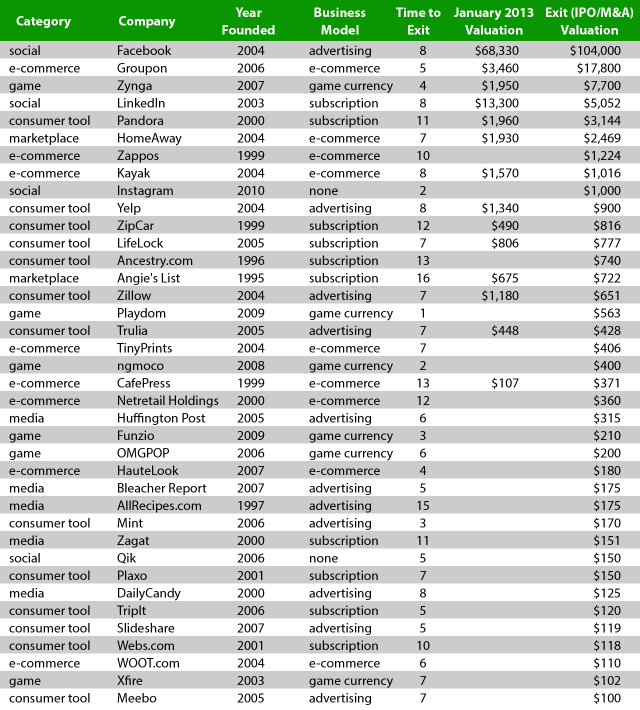
With the recent talk about the growing “billion-dollar club” in startups, I’ve been wondering, as a Series A investor, what characteristics a $1 billion consumer tech company has. I examined the pool of consumer companies that have had exits over $100 million within the current era of consumer tech, which I consider to be post-recession 2008. I wanted to see what I could learn and ideally reverse-engineer common characteristics that would help me identify the next big winners when I see them today or in the future. I created a dataset pulling from a number of venture capital data sources, including CrunchBase, and narrowed it down to my own specifics: U.S., venture-backed companies that have had realized outcomes, both IPO and M&A, over $100 million since 2008. Because private-equity funding and M&A details are less clearly reported, this may not be a comprehensive list of consumer companies. Also, I did not include software/enterprise companies, of which there are many more.

COMMON CHARACTERISTICS OF CONSUMER TECH COMPANIES

billion-chart
Here are a few highlights:

  • 38 companies over the past five years have exited over $100 million
  • Only nine companies over the past five years have exited over $1 billion; all but one of these nine (Zappos) exited in 2011/2012
  • 29 of the 38 outcomes happened in 2011 and 2012
  • 14 of these companies exited via IPO, all in 2011 and 2012
  • seven of the nine most valuable exits were all public offerings (Zappos and Instagram are the two M&A transactions worth $1 billion or more. I’m continuing to value the Instagram acquisition at the original offer of $1 billion, not taking the decreased market value of public Facebook stock into account.)

This simple survey affirmed my belief that achieving outsized results within the consumer company landscape is incredibly difficult. Now that we’re sure it’s difficult, what insight can we glean? Read more of this post

Smartphone sales in India may suffer from a higher tax on handsets costing more than $37

Chidambaram Eyes IPhone, Z10 to Plug Budget Gap: Corporate India

Smartphone sales in India may suffer from a higher tax on handsets costing more than $37 just as Apple Inc. (AAPL) steps up efforts to tap demand for data services in the world’s second-largest mobile-phone market.

Finance Minister Palaniappan Chidambaram yesterday said he would raise the excise tax on high-end phones to 6 percent from 1 percent to help finance welfare programs for the country’s poor and fund the widest budget deficit among the largest emerging economies. Samsung Electronics Co. (005930), which sells the Galaxy range of smartphones, said the move “won’t have a positive impact” on the mobile-phone industry and will force customers to pay more.

India’s government, after attempting to squeeze wireless operators including Vodafone Group Plc (VOD) and Bharti Airtel Ltd. (BHARTI) with higher license fees and airwave tariffs, is now targeting handsets for revenue from an industry that has boomed since Prime Minister Manmohan Singh opened the economy more than two decades ago. Chidambaram also increased tax on high earners, luxury cars and yachts. Read more of this post

In Sweden, TV Tax Comes to Smartphones

March 1, 2013, 3:12 p.m. ET

In Sweden, TV Tax Comes to Smartphones

By GUSTAV SANDSTROM

Sweden’s public broadcaster, feeling pressure as streaming heavyweights like NetflixNFLX +0.69% and HBO gain ground with their newly-founded Nordic services, is taking the nation’s television license fees to a new level by asking smartphone and tablet users to pay up.

License fees have been in place for years as state-backed broadcasters look to fund commercial-free programming, including the BBC. In Sweden’s case, anyone owning a television is forced to pay a SEK173 ($27) tab per month for Sveriges Television, Sveriges Radio and educational broadcasting known as Utbildningsradion. That fee hardly looks like a bargain compared with the SEK79 ($12) monthly fee that Netflix Inc. and Time Warner Inc.’s TWX +0.85% HBO each charge subscribers in Sweden. Read more of this post

Dear Apple, Amazon, Google: Here’s Why Chinese Consumers Hate Your Ecosystems; Be formless, shapeless, like water. (And be flexible towards your ecosystem users)

Dear Apple, Amazon, Google: Here’s Why Chinese Consumers Hate Your Ecosystems

Mar 1, 2013 at 14:10 PM by Steven Millward, in AsiaMobileOpinion

Chinese consumers love your gadgets – that’s great news. But the bad news for Apple, Amazon, Google, and many more companies is that Chinese netizens hate your ecosystems. They really don’t want to be trapped in your walled garden. In an age of platforms and extended web services, that’s a huge monetization problem for tech companies entering the world’s biggest market.

Android, without the Google bits

This aversion to tech ecosystems in China is seen most starkly with Google’s mobile OS, Android. An estimated 189 million smartphones were sold in China in 2012, and as many as 86 percent of those were Android devices. But that huge user-base hasn’t translated into popularity for Google’s other apps and services. Read more of this post

Jonah Berger On The Power Of Scarcity; Contagious: Why Things Catch On

Jonah Berger On The Power Of Scarcity

BY JONAH BERGER

MARCH 1, 2013

In Fast Company’s April issue, we’ll profile Jonah Berger, the 32-year-old Wharton professor who has become one of the world’s foremost experts on what goes viral and why. It’s easy to find examples of products or ideas that have spread and become popular, but as he writes, “It’s much harder to actually get something to catch on. Even with all the money poured into marketing and advertising, few products become popular.” His new book Contagious: Why Things Catch On, being published next week by Simon & Schuster, tries to answer the question, Why do some products, ideas, and behaviors succeed when others fail? In this exclusive excerpt, which will be serialized in five parts, he explores the concept of social currency, one of the six elements Berger says helps unravel the mysteries of virality.

In 2005, Ben Fischman became CEO of the discount shopping website SmartBargains.com. The business model was straightforward: companies wanting to offload clearance items or extra merchandise would sell them cheap to SmartBargains, and SmartBargains would pass the deals on to the consumer. There was a broad variety of merchandise, and prices were often up to 75% lower than retail. But by 2007 the website was floundering. Margins had always been low, but excitement about the brand had dissipated, and momentum was slowing. A year later Fischman started a new website called Rue La La. It carried high-end designer goods but focused on “flash sales” in which the deals were available for only a limited time–24 hours or a couple of days at most. And the site followed the same model as sample sales in the fashion industry. Access was by invitation only. Sales took off, and the site did extremely well. So well, in fact, that in 2009 Ben sold both websites for $350 million.

Rue La La’s success is particularly noteworthy, given one tiny detail. It sold the exact same products as SmartBargains. How come Rue La La was so much more successful? Because it made people feel like insiders.

Read more of this post

Robots are getting more powerful. That need not be bad news for workers

Robocolleague

Robots are getting more powerful. That need not be bad news for workers

Mar 2nd 2013 |From the print edition

WATSON, an IBM supercomputer, spectacularly beat its human rivals in a 2011 edition of “Jeopardy!”, an American quiz show. It has got smarter since then. Its components have shrunk from room-size to briefcase-size; its processing speed has more than tripled. The sleeker, faster Watson is now being put to commercial use: its first application is suggesting treatments in cancer clinics. Many people fear that Watson exemplifies a trend toward the displacement of human workers by machines.

In a 2011 e-book called “Race against the Machine”, Erik Brynjolfsson and Andrew McAfee of the Massachusetts Institute of Technology (MIT) worried that human workers would fail to adapt to the quickening pace of technological change. “The Lights in the Tunnel”, a 2009 book by Martin Ford, a software entrepreneur, painted a bleaker picture still. Mr Ford noted that about 40% of Americans work in old-fashioned occupations—as nurses, book-keepers and the like. He argued that innovation will soon allow firms to eliminate millions of jobs, like the 3m-plus cashiers whose positions are threatened by automated cash registers, but will create few new opportunities for displaced workers.

But plenty of research suggests that innovation need not translate into a shrinking role for human labour. Read more of this post

YouTube’s Search for the Next ‘Gangnam Style’

YouTube’s Search for the Next ‘Gangnam Style’

By Bruce Einhorn on February 28, 2013

tech_youtubechart10_405

One of the ritziest addresses in Tokyo is Roppongi Hills, a vast commercial, retail, and residential complex with two art galleries, the Grand Hyatt Tokyo, and tenants including Goldman Sachs (GS) and Barclays (BCS). There are also bald vampires clad in tighty-whities and body paint filming in Google’s (GOOG) new video studio.

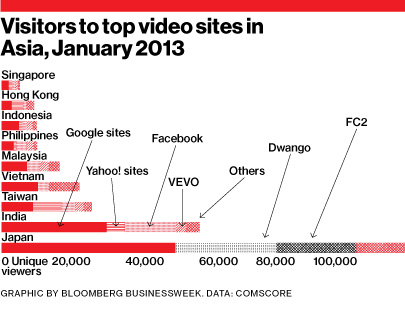
The Roppongi Hills studio is central to YouTube’s first significant effort at audience-building in Asia. The online video giant’s other two studios, in Los Angeles and London, help popular creators develop original programming for its online video channels. In Japan, YouTube’s biggest regional success story in Asia, the company is recruiting online video stars to bolster its local-language channels with more targeted original programming and higher production values. YouTube only launched dedicated local-language channels for Southeast Asia last year, and censorship still keeps Google’s video service out of China. Compared with the U.S., “Asia has come a little bit later” for YouTube, says David Macdonald, head of the video service’s Asia-Pacific content operations.

Local programming is important for advertisers who want to reach Asian audiences, says Trevor Healy, Singapore-based chief executive officer of mobile advertising agency Amobee. “You can get more creative in who you target,” he says. Videos like the Korean rapper Psy’s smash hit Gangnam Style (with more than 1.3 billion YouTube views) or smaller successes like the 600-odd “Eat Your Kimchi” clips by Simon and Martina Stawski, a Canadian couple who live in Seoul and have close to 500,000 YouTube subscribers, could be the breakthroughs YouTube needs. Psy’s overnight global fame demonstrated the potential of Asian-made content, says Healy: “When something goes viral in Asia, it really goes viral.” Read more of this post

Computer Interfaces: Tech’s Next Great Frontier

Computer Interfaces: Tech’s Next Great Frontier

By Drake Bennett on February 28, 2013

tech_interface10__01__630x420

Consider the tongue. It’s sensitive yet muscular, packed with taste buds and nerves, and without its acrobatic ability humans wouldn’t be able to eat or talk. It’s also our most versatile sense organ, and some computer engineers say it’s underused. Wicab, a Middleton (Wis.)-based company, has designed a small, square array of electrodes for the blind. When placed on the tongue like a lollipop, it turns the feed from a video camera into a pointillist pattern of tactile stimulation. The sensation is like sparkling water, or Pop Rocks candy, but after time and practice, blind users report the paradoxical sensation of seeing with their tongues.

Massachusetts Institute of Technology graduate student Gershon Dublon is trying to broaden Wicab’s idea. He’s made a cheap ($10 to $40, he estimates), bare-bones version of the device that can be connected to any set of sensors. He encourages fellow engineers to hook their tongues up to other inputs—microphones, pressure sensors, even a magnetometer, which would give a person a migratory bird’s unerring sense of direction. The device, which Dublon calls the Tongueduino, wouldn’t be just for the blind, or the deaf, but for anyone looking to augment his senses. “It would be useful,” he says, “for anyone who wants a better sense of direction.” Read more of this post

How grandparents are being replaced by Google

How grandparents are being replaced by Google

Grandparents are being replaced by the internet as rising numbers of children ignore family advice for answers online instead, a new survey has found.

The survey of 1,500 grandparents found that children are instead increasingly using the internet to answer simple questions Photo: AFP

By Telegraph Reporters

7:30AM GMT 28 Feb 2013

Researchers found that older generations are being replaced by Google, Wikipedia and YouTube, with their grandchildren not asking them basic questions that they can look up themselves. According to the survey, fewer than one in four grandparents say they have been asked for advice on basic domestic chores such as washing clothes, learning to cook a family recipe or sewing a button. Only a third of those surveyed said they had been asked “what was it like when you were young?”. Read more of this post

Coca-Cola’s Chok! Chok! Chok! ad shakes up mobile marketing

Chok! Chok! Chok! ad shakes up mobile marketing

2:45pm EST

By Kate Holton and Leila Abboud

BARCELONA (Reuters) – A strange phenomenon hit Hong Kong in late 2011.

As the clock hit 10 pm each night a Coca Cola ad aired on television, prompting thousands of viewers to grab their phones and start shaking them frantically to virtually “catch” the falling bottle caps on the screen and win instant prizes.

Dubbed Chok! Chok! Chok! – meaning rapid motion in local slang – the interactive campaign by McCann Worldgroup became a hit, and sent viewers at home, in cinemas and in front of giant outdoor screens into a frenzy. (link.reuters.com/wux36t)

Nine million people saw the ad – 380,000 downloaded the Chok! Chok! Chok! app in the first month – and its success indicates that marketers may be finally figuring out how to direct ads at consumers via mobile phones. Read more of this post

Can’t sell the TV?…sell the office: Japan Inc fires up property market

Can’t sell the TV?…sell the office: Japan Inc fires up property market

4:44pm EST

By Junko Fujita

TOKYO (Reuters) – Japanese blue-chip firms, from electronics giants to brewers, are selling prime real estate to shore up battered balance sheets, stoking a resurgent property market. Some are moving into new offices to take advantage of relatively low rents.

Big downtown office buildings are coming up for sale as Tokyo’s property market regains growth momentum for the first time in almost five years, with plenty of interest among buyers, particularly Japan’s public real estate trusts, experts said. Read more of this post

Many women were appalled at the Yahoo news, noting that Mayer, with her penthouse atop the San Francisco Four Seasons, her Oscar de la Rentas and her $117 million five-year contract, seems oblivious to the fact that for many of her less-privileged sisters with young children, telecommuting is a lifeline to a manageable life.

February 26, 2013

Get Off of Your Cloud

By MAUREEN DOWD

When Marissa Mayer became queen of the Yahoos last summer, she was hailed as a role model for women. The 37-year-old supergeek with the supermodel looks was the youngest Fortune 500 chief executive. And she was in the third trimester of her first pregnancy. Many women were thrilled at the thought that biases against hiring women who were expecting, or planning to be, might be melting.

A couple months later, it gave her female fans pause when the Yahoo C.E.O. took a mere two-week maternity pause. She built a nursery next to her office at her own expense, to make working almost straight through easier. The fear that this might set an impossible standard for other women — especially women who had consigned “having it all” to unicorn status — reverberated. Even the German family minister, Kristina Schröder, chimed in: “I regard it with major concern when prominent women give the public impression that maternity leave is something that is not important.” Almost two months after her son, Macallister, was born, Mayer irritated some women again when she bubbled at a Fortune event that “the baby’s been way easier than everyone made it out to be.” “Putting ‘baby’ and ‘easy’ in the same sentence turns you into one of those mothers we don’t like very much,” Lisa Belkin chided in The Huffington Post. Now Mayer has caused another fem-quake with a decision that has a special significance to working mothers. She has banned Yahoos, as her employees are known, from working at home (which some of us call “working” at home). It flies in the face of tech companies’ success in creating a cloud office rather than a conventional one. Mayer’s friend Sheryl Sandberg of Facebook wrote in her new feminist manifesto, “Lean In: Women, Work, and the Will to Lead,” that technology could revolutionize women’s lives by “changing the emphasis on strict office hours since so much work can be conducted online.” She added that “the traditional practice of judging employees by face time rather than results unfortunately persists” when it would be more efficient to focus on results.

Many women were appalled at the Yahoo news, noting that Mayer, with her penthouse atop the San Francisco Four Seasons, her Oscar de la Rentas and her $117 million five-year contract, seems oblivious to the fact that for many of her less-privileged sisters with young children, telecommuting is a lifeline to a manageable life.

The dictatorial decree to work “side by side” had some dubbing Mayer not “the Steinem of Silicon Valley” but “the Stalin of Silicon Valley.”

Mayer and Sandberg are in an elite cocoon and in USA Today, Joanne Bamberger fretted that they are “setting back the cause of working mothers.” She wrote that Sandberg’s exhortation for “women to pull themselves up by the Louboutin straps” is damaging, as is “Mayer’s office-only work proclamation that sends us back to the pre-Internet era of power suits with floppy bow ties.”

Men accustomed to telecommuting were miffed, too. Richard Branson tweeted: “Give people the freedom of where to work & they will excel.” Read more of this post

God a Click Away as Web Courses Fuel Falwell’s College

God a Click Away as Web Courses Fuel Falwell’s College

Three times a week almost 13,000 students at Liberty University assemble for an hour of singing and speeches, evoking the spirit of a revival meeting that also attracts Republican politicians and Christian celebrities such as New York Jets quarterback Tim Tebow. The collegians make up just 14 percent of the student body. The Lynchburg, Virginia-based school founded by Baptist minister Jerry Falwell in 1971 has an additional 82,500 online students, more than twice as many as three years ago, making Liberty the largest, private nonprofit university in the U.S. “When I look at those numbers it still boggles my mind,” said Jerry Falwell Jr., a soft-spoken lawyer who took over the institution after his father died in 2007.

Nonprofit private and state schools alike are discovering what for-profit colleges such as Apollo Group Inc. (APOL)’s University of Phoenix and Washington Post Co. (WPO)’s Kaplan University figured out more than a decade ago. Faced with a swelling number of overleveraged student borrowers, cuts in public subsidies and paltry endowment investment returns, they are embracing the Internet as a viable alternative to educating students. Read more of this post

Google’s Brin Touting Glasses Says Smartphone Emasculate

Google’s Brin Touting Glasses Says Smartphone Emasculate

Sergey Brin has an unconventional view of the handheld devices that help generate billions of dollars in ad revenue for the company he co-founded.

Hunching over a smartphone while walking about is “emasculating,” Google Inc. (GOOG)’s Brin said yesterday at the Technology, Entertainment, Design conference in Long Beach, California, according to a blog post on the event’s website.

Brin was touting the benefits of Google Glass, his company’s wearable mobile-computing devices that resemble spectacles. His point: standing upright and summoning information to one’s eyes is a better use of the body than “rubbing a featureless piece of glass.”

“Is this the way you’re meant to interact with other people?” he said at the conference. “It’s kind of emasculating.” Read more of this post

Smartphone app tests urine for medical conditions

Smartphone app tests urine for medical conditions

NEW YORK — A smartphone app that analyses urine samples for a range of medical conditions has been demonstrated at a science fair in the United States.

BY –

1 MIN 23 SEC AGO

NEW YORK — A smartphone app that analyses urine samples for a range of medical conditions has been demonstrated at a science fair in the United States.

The app can be used as an indicator of 25 different health issues including diabetes, urinary tract infections, cancers and liver problems.

Users who pay £13 (S$24.30) to download Uchek from Apple’s App Store from the end of this month will also be sent a mat and five dipsticks. Read more of this post

Nintendo Wii Games Boost Performance of Trainee Surgeons, Study Finds

Wii Games Boost Performance of Trainee Surgeons, Study Finds

Playing Nintendo Co.’s Wii console improved the performance of surgeons learning operations involving tiny cameras and instruments in a study that suggests the device could have a role to play in educating doctors.

In a trial among 42 post-graduate surgeons in Italy, those who were asked to play Wii games such as Tennis and a 3D battle game an hour a day, five days a week for four weeks did better at 13 out of 16 measures on a surgical simulator than those who didn’t play the games, researchers from Sapienza University of Rome wrote in the journal PLoS One today.

Trainee surgeons commonly hone their keyhole surgery skills on computer simulators such as those made by Cleveland-based Simbionix USA Corp. However, the expense of the machines, combined with the difficulty of a technique that involves maneuvering tiny operating tools through very small incisions, as well as increased risks of lawsuits, have raised the need for training outside the operating theater, researchers led by Gregorio Patrizi from the university’s department of surgical sciences wrote. Read more of this post

Bosses are reining in staff because they can; The lesson from Marissa Mayer’s whip-cracking at Yahoo is that this is an age of harder work

February 27, 2013 7:59 pm

Bosses are reining in staff because they can

By John Gapper

The lesson from Marissa Mayer’s whip-cracking at Yahoo is that this is an age of harder work

Marissa Mayer, Yahoo’s new chief executive, has caused consternation by insisting that employees who have worked from home must in future come to the office. Her critics have pointed out that home workers are as productive, if not more so, as those in cubicles.

They are, however, missing the point. Ms Mayer is mostly doing this as a rough and ready way to reform Yahoo’s notoriously dysfunctional and disorganised culture. She is also doing it because she can.

The lesson to draw from Ms Mayer’s whip-cracking – in Silicon Valley, of all places – is that this is an age of harder work. From intense teamwork at the top to monitoring and surveillance at the bottom, managers are squeezing more from employees than they previously would have dared. Read more of this post

LinkedIn: The Ugly Duckling of Social Media

February 27, 2013, 7:58 p.m. ET

LinkedIn: The Ugly Duckling of Social Media

By EVELYN M. RUSLI

Shares of Facebook Inc., FB -1.90% Zynga Inc. ZNGA +4.76% and Groupon Inc.GRPN +7.78% tanked after their rocky stock-market debuts. But LinkedIn Corp.’sLNKD +6.83% stock is still soaring, closing at an all-time high of $168.55 on Wednesday.

That may be because of people such as Chris Hoyt, who helps manage recruiting forPepsiCo Inc. PEP +0.53% Mr. Hoyt said the beverage maker has ramped up its spending on LinkedIn over the past three years by paying for job ads, career pages and a recruiter talent finder. The professional-networking site has become one of PepsiCo’s main sources of job candidates. Read more of this post

Why language is the key to winning India’s mobile market

Why language is the key to winning India’s mobile market

By Leo Mirani — February 26, 2013

hindireverie
“I’ve only just returned from work.”Reverie Language Technologies

“I’ll be late coming home today”Panini Keypad

MUMBAI—India has the world’s largest mobile phone market after China. Yet the amount of money mobile networks make per user is among the lowest in the world: around $2 per month. Chinese carriers such as China Mobile make five times as much. AT&T rakes in $65 per user per month in the US.

The most obvious reason is that Indian carriers operate on razor-thin margins, charging customers $0.01 per minute. Smartphone users spend more butpenetration remains low. Half of Indian smartphone owners don’t have a data plan anyway, according to Prashant Singh of Nielsen. But there are other things that make India unique.

Unlike many markets, Indian carriers derive most of their revenues the old-fashioned way: from people making calls. Non-voice revenue is just 11% of the total. That’s about half as much as in Britain and just under a third of American and Chinese operators’ non-voice revenues (pdf). Only one in two Indians send text messages, much lower than the 62% in its class of what the World Bank defines aslower-middle-income countries. Considering the zeal with which Indians have taken to mobile phones, what explains their reluctance to embrace their use for other things?

A big obstacle is language (bhasha or vasha in Hindi). Most phones sold in India come with English-language operating system software. Despite India’s reputation as an Anglophone nation, only a tenth of its 1.2 billion people count English as their first, second or third language. In any case, one out of four Indians cannot read or write. But unlike linguistically homogeneous Russia or China, India’s 22 official languages (and several hundred unofficial ones) in 11 different scripts make it a difficult market to crack. Read more of this post

Will Programmers Rule?

Raghuram Rajan, Professor of Finance at the University of Chicago Booth School of Business and the chief economic adviser in India’s finance ministry, served as the International Monetary Fund’s youngest-ever chief economist and was Chairman of India’s Committee on Financial Sector Reforms. He is the author ofFault Lines: How Hidden Fractures Still Threaten the World Economy.

Will Programmers Rule?

26 February 2013

NEW DELHI – Marc Andreessen made his first fortune writing the code that became Netscape Navigator, the Internet browser. He is now a venture capitalist who evangelizes about the growing importance of software in business today. Indeed, he proclaims that software is taking over the world – that it will be the primary source of added value – and offers the following prediction: the global economy will one day be divided between people who tell computers what to do and people who are told by computers what to do.

Andreessen’s aim is to shock his listeners – not just for effect, but to get them to do something about it. To stop the world from being divided between a few alpha programmers and many drones, he wants the potential drones to stop taking easy liberal arts courses in college. Instead, he wants them to focus on courses in science, technology, engineering, and math (STEM), where the good jobs will be. But will this solve the problem that he poses?

Perhaps not. Two attributes of software creation allow a few talented programmers to corner the market and take all the associated profits. Read more of this post

Watch Zuck, Bill Gates, Jack Dorsey, & Others In Short Film To Inspire Kids To Learn How To Code

Watch Zuck, Bill Gates, Jack Dorsey, & Others In Short Film To Inspire Kids To Learn How To Code

COLLEEN TAYLOR

posted 2 hours ago

Code.org, the new non-profit aimed at encouraging computer science education launched last month by entrepreneur and investor brothers Ali and Hadi Partovi, has assembled an all-star group of the world’s most well-known and successful folks with programming skills to talk about how learning to code has changed their lives — and isn’t quite as hard as people might think.

As you can see in the five minute clip embedded above, the short film (nine minutes in its full length version) which was directed by Lesley Chilcott, known as the producer of Waiting for Supermanand An Inconvenient Truth, is a who’s who featuring Mark ZuckerbergBill GatesJack Dorsey,Drew HoustonTony Hsieh, Miami Heat player Chris Bosh (he studied computer imaging at Georgia Tech before joining the NBA), and many more. It’s a very human look at what can certainly seem to many as a dry or intimidating subject, and it’s really a pleasure to watch. Read more of this post

S Korea grappling with smartphone addiction; smartphone penetration rate in South Korea was 64 per cent in 2012, a 60-fold-leap compared with 2009, when smartphone users accounted for less than one per cent of all mobile phone users

S Korea grappling with smartphone addiction
By Lim Yun Suk | Posted: 26 February 2013 1613 hrs

SEOUL: South Korea has more than 30 million mobile phone users. The devices have become a vital part of everyday life in the country.

But owning mobile phones also come with disadvantages. Children and adults cannot seem to get their hands off these devices.

Korean doctors are calling it an addiction.

“After church sometimes I want to play with my friends outside but all they want to do is play games on their mobiles. It’s no fun anymore,” said Han Ji Min, an elementary school student.

College student Chung Seung Yeon said: “I have many friends who use their handphones even while eating. And they do it like there’s nothing wrong with it. Because it has become so common, nobody thinks it’s serious to be using their handphones while eating.” Read more of this post

Richard Branson Says That Marissa Mayer Got It Wrong About Remote Employees; Ex-Yahoos Confess: Marissa Mayer Is Right To Ban Working From Home; Marissa Mayer, Who Just Banned Working From Home, Paid To Have A Nursery Built At Her Office; Not all Yahoo have that kind of money or clout

Richard Branson Says That Marissa Mayer Got It Wrong About Remote Employees

Aimee Groth | Feb. 25, 2013, 5:24 PM | 5,563 | 21

Last week Yahoo CEO Marissa Mayer sent out a controversial memo telling remote employees that they either had to start working from a Yahoo office or quit.

Since then, everyone has been weighing in, including Virgin Founder Richard Branson. In a post this morning titled, Give People The Freedom Of Where To Work, he wrote:

To successfully work with other people, you have to trust each other. A big part of this is trusting people to get their work done wherever they are, without supervision. It is the art of delegation, which has served Virgin and many other companies well over the years.

We like to give people the freedom to work where they want, safe in the knowledge that they have the drive and expertise to perform excellently, whether they at their desk or in their kitchen. Yours truly has never worked out of an office, and never will.

So it was perplexing to see Yahoo! CEO Marissa Mayer tell employees who work remotely to relocate to company facilities. This seems a backwards step in an age when remote working is easier and more effective than ever.

If you provide the right technology to keep in touch, maintain regular communication and get the right balance between remote and office working, people will be motivated to work responsibly, quickly and with high quality.

Working life isn’t 9-5 any more. The world is connected. Companies that do not embrace this are missing a trick.

Ex-Yahoos Confess: Marissa Mayer Is Right To Ban Working From Home

Nicholas Carlson | Feb. 25, 2013, 3:16 PM | 85,571 | 63

Last Friday, Yahoo HR boss Jackie Reses sent out a memo telling all remote employees that they needed to find a way to be working in an office by June.

This upset lots of Yahoo employees – including some working mothers, who say they wish they could afford to build a nursery at the office the way CEO Marissa Mayer has.

But we’ve just heard from a former Yahoo engineer who tells us Mayer is making the exact right call.

“For what it’s worth, I support the no working form home rule. There’s a ton of abuse of that at Yahoo. Something specific to the company.”

This source said Yahoo’s large remote workforce led to “people slacking off like crazy, not being available, spending a lot of time on non-Yahoo! projects.” Read more of this post
Brick-and-Mortar Stores Are Snapping Up Existing Web Firms to Try to Catch Up to eBay, Amazon; Home Depot is buying a startup that uses algorithms to set Web prices

February 25, 2013, 7:56 p.m. ET

Targeting Tech-Savvy Startups

Brick-and-Mortar Stores Are Snapping Up Existing Web Firms to Try to Catch Up to eBay, Amazon

By SHELLY BANJO

Three months ago, Rodrigo Carvalho and Lukas Bouvrie were working 20-hour days to raise money and attract clients for Black Locus Inc., a 20-person Austin, Texas, startup that uses algorithms to help retailers sell their wares on the Web.

Now, the recent graduates of Carnegie Mellon University’s business school work for the world’s largest home-improvement retailer, Home Depot Inc. HD -2.53%

The company, which is expected to publicly address the acquisition of Black Locus Tuesday, is the latest traditional brick-and-mortar retailer to buy a startup and launch a “technology lab” to try to catch up to online retailers like Amazon.com Inc.AMZN -2.09% and eBay Inc. EBAY -2.56%

Home Depot says the startup, renamed the Home Depot Innovation Lab, will help it compete in an online environment where prices change by the second and are determined by algorithms rather than merchants. The company declined to disclose terms of the purchase. Read more of this post

China Is No Silicon Valley

February 25, 2013, 4:49 p.m. ET

China Is No Silicon Valley

Duncan Clark is the chairman of BDA China, an investment-advisory firm specializing in China’s technology, Internet and e-commerce sectors.

IV-AA325_CLARK_G_20130225132104

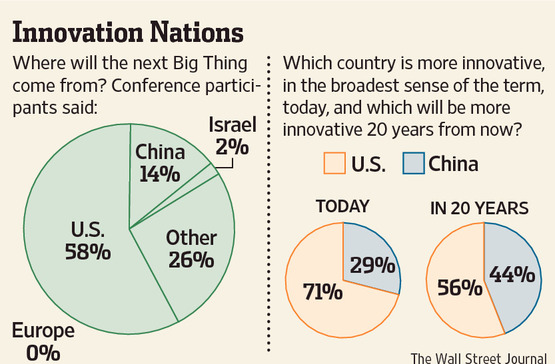
ON WHETHER CHINA CAN BECOME THE NEXT SILICON VALLEY:Innovation is born, not made. It isn’t something that you can fast-forward. When you do try to fast-forward it, you get copying.

This is China’s challenge. There’s a clear desire to move up the value chain from the “Made in China, Designed in California,” to flipping that around. Read more of this post

Mobile Revolution Buffets Taiwan PC Rivals; Two computer-making neighbors in the technologically inclined economy of Taiwan seem headed in opposite directions.

February 24, 2013

Mobile Revolution Buffets Taiwan PC Rivals

By LIN YANG

TAIPEI — Two computer-making neighbors in the technologically inclined economy of Taiwan seem headed in opposite directions.

Personal computer sales have slumped worldwide as smartphones and tablets have proliferated and gained in popularity. One Taiwan heavyweight, Acer, has shared in the suffering: It is expected to report a second straight annual loss in 2012 after losing 6.6 billion Taiwan dollars, or $223 million at the current exchange rate, in 2011.

But another Taiwan-based PC company, Asustek, which sells computers under the Asus name, grew 43 percent in the quarter that ended in September, to 6.7 billion dollars in net income. The company’s PC sales rose 6.4 percent even as industrywide PC shipments declined 4.9 percent in the last three months of 2012, according to the research firm Gartner.

The companies’ divergent fortunes expose both the mistakes and the opportunities for PC makers in an epic shift in the way consumers use technology. Read more of this post

Barnes & Noble Weighs Its E-Reader Investment; The company’s underperforming Nook Media division might signal that its substantial investment in its digital future has essentially run its course

February 24, 2013

Barnes & Noble Weighs Its E-Reader Investment

By LESLIE KAUFMAN

Even for a company with a lot of bad news lately, the bulletin from Barnes & Noble this month had an ominous feel.

Barnes & Noble, the nation’s largest book chain, warned that when it reports fiscal 2013 third-quarter results on Thursday, losses in its Nook Media division — which includes sales of e-books and devices — will be greater than the year before and that the unit’s revenue for all of fiscal 2013 would be far below projections it gave of $3 billion.

The problem was not so much the extent of the losses, but what the losses might signal: that the digital approach that Barnes & Nobles has been heavily investing in as its future for the last several years has essentially run its course.

A person familiar with Barnes & Nobles’s strategy acknowledged that this quarter, which includes holiday sales, has caused executives to realize the company must move away from its program to engineer and build its own devices and focus more on licensing its content to other device makers. Read more of this post

Business network giants face China ‘guanxi’ battle

Business network giants face China ‘guanxi’ battle
Posted: 24 February 2013 2055 hrs

BEIJING: Professional social networking websites such as LinkedIn trying to tap into China’s vast business world are finding a formidable domestic foe — the ingrained system of personal connections known as “guanxi”.

Two leading sites, California-based LinkedIn and the French company Viadeo, are targeting networkers in the world’s most populous country, but acknowledge the challenges they face.

China has the world’s biggest online population at 564 million web users, but the history of Western Internet giants looking to establish themselves in it is littered with failures and disappointed retreats. Read more of this post