How Big Data Is Changing the Whole Equation for Business; Big Data, Big Blunders

Updated March 8, 2013, 4:22 p.m. ET

How Big Data Is Changing the Whole Equation for Business

By STEVEN ROSENBUSH AND MICHAEL TOTTY
IV-AA349B_TRANS_G_20130308141808 IV-AA365_EXABYT_G_20130307153306

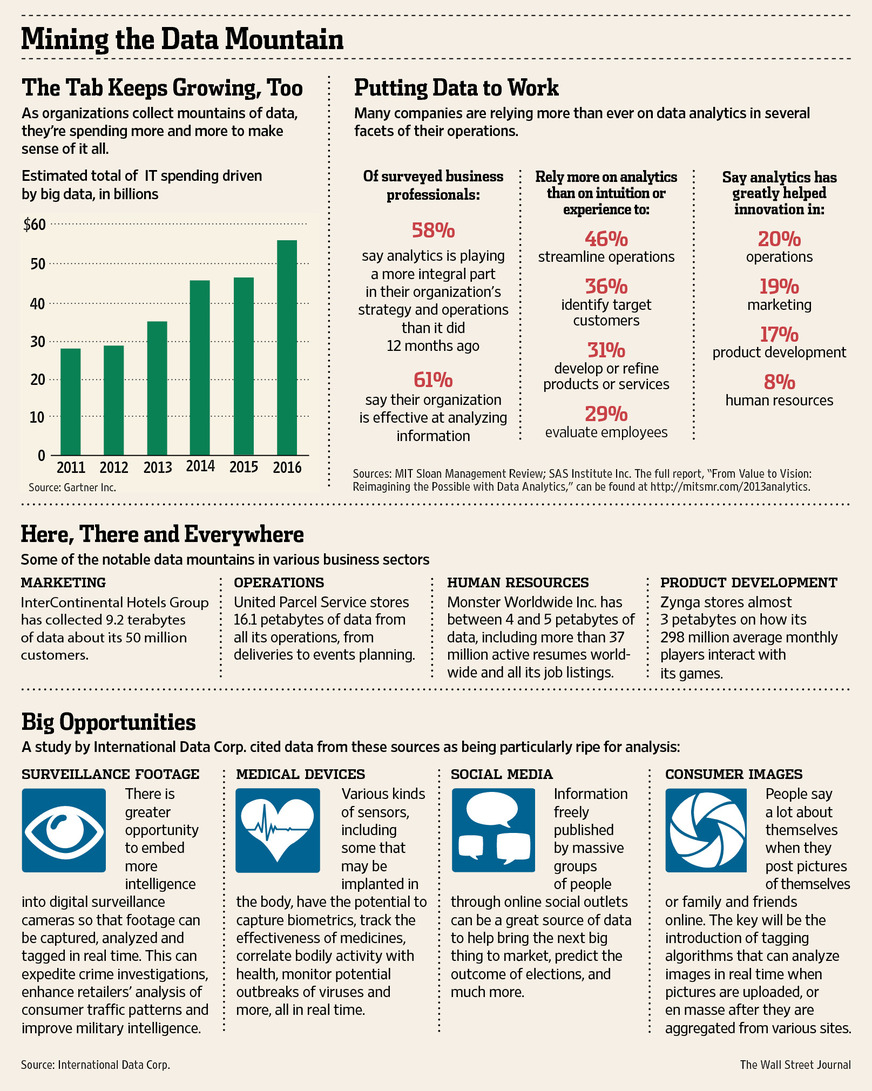
There’s a ton of information out there. And businesses are figuring out how to put it to work.

The experts call this state of affairs big data. The definition is squishy, but it usually boils down to this: Companies have access to vastly more information than they used to, it comes from many more different sources than before, and they can get it almost as soon as it’s generated.

Big data often gets linked to companies that already deal in information, like GoogleGOOG -0.13% Facebook FB -2.16%and Amazon. But businesses in a slew of industries are putting it front and center in more and more parts of their operations. They’re gathering huge amounts of information, often meshing traditional measures like sales with things like comments on social-media sites and location information from mobile devices. And they’re scrutinizing it to figure out how to improve their products, cut costs and keep customers coming back.

Shippers are using sensors on trucks to find ways to speed up deliveries. Manufacturers can trawl through thousands of forum posts to figure out if customers will like a new feature on their product. Hiring managers study how candidates answer questions to see if they’d be a good match.

Lots of obstacles remain. Some are technical, but business as usual also can stand in the way. In most companies, decisions are still based on HIPPO—the highest paid person’s opinion—and persuading an executive that data trumps intuition can be a hard sell. Read more of this post


Online Emotions, in Hundreds of New Flavors; Line’s popularity was part of what motivated Lango and MessageMe to bring their own versions of sticker-type messaging to the United States

March 9, 2013

Online Emotions, in Hundreds of New Flavors

By JENNA WORTHAM

10-BITS-articleLarge

TO say that I like to send text messages is like saying Garfield likes lasagna. It is my expressive medium. On Wednesday alone, I sent at least 100 — but I like to send more than just words. I’m a big fan of using emoji, the colorful symbol alphabet that contains nearly a thousand images of cute animals, food items and expressive smiley faces to convey what words cannot.

When a friend recently told me that she was sick, I replied with a cartoon row of steaming bowls of soup and a flexing bicep — my way of wishing her a speedy recovery. Read more of this post

Merkel Tours Berlin Start-Ups: ‘People Pay Money for That?’

03/08/2013 01:43 PM

Merkel Tours Berlin Start-Ups

‘People Pay Money for That?’

By Annett Meiritz

Merkel Visits Berlin Startup Companies

In a show of support for Berlin’s burgeoning Internet start-up scene, German Chancellor Angela Merkel ventured into a strange new world of employee-friendly tech offices on Thursday. Though she showed a lot of interest, Berlin still has a long way to go in supporting the city’s growth as a tech hub.

Two hours into her tour of Berlin’s digital wonderland, a place where business is booming and “feel-good managers” tend to the well-being of their employees, Angela Merkel was finally confronted with a bit of cautious criticism. Sitting across from the German chancellor, California native Holly mentioned that there are “barriers” for young Internet companies like Wooga, the social gaming developer where she works.

Merkel interrupted, asking: “What kind of barriers do you mean?”

Holly told the story of how she is actually a musician who initially came to Berlin on vacation, but stayed because she found the city so appealing. Then she found a job at Wooga, and the bureaucracy horror began. At municipal offices where residents are expected to register, one is “lucky if someone speaks English,” she said, adding that the authorities don’t even provide forms in the global language.

“We don’t want money from you, but we want a more welcoming atmosphere,” said Jens Begemann, one of Wooga’s founders.

The chancellor thought for a moment, then asked: “Have you spoken with the mayor about this?”

Yes, said Begemann. “But everything that you do to help Germany develop a more welcoming culture really helps the industry,” he said. Merkel nodded. Read more of this post

Korea’s Kakao Talk is paying an unexpected price for becoming the nation’s most popular mobile messenger. To the dismay of Kakao, the company that manages the service, its messages are being used as police evidence

2013-03-08

Kakao Talk pays price of popularity

Chat king suffers increased workload

By Cho Mu-hyun

Kakao Talk is paying an unexpected price for becoming the nation’s most popular mobile messenger. To the dismay of Kakao, the company that manages the service, its messages are being used as police evidence.

As mobile Internet services are increasingly being used for social communication, authorities are starting to look into servers for evidence in cases, rather than calling for witnesses, investigating hearsay or examining hard copies of documents. Read more of this post

Meet Memoto, the Lifelogging Camera; Memoto snaps photos automatically at thirty-second intervals

MARCH 8, 2013, 2:47 PM

Meet Memoto, the Lifelogging Camera

By JENNA WORTHAM

08bits-memoto-hpMedium
Memoto snaps photos automatically at thirty-second intervals.

AUSTIN, TEX., — Facebook and Instagram have conditioned people into sharing photos of their most memorable moments — vacations, parties, weddings, meals and outings with friends.

But what about everything else that happens in between?

That’s the content that Memoto, a Swedish start-up, wants to capture with a small, wearable camera that automatically takes photos of the wearer’s surroundings.

The square-shaped device can be clipped onto a collar, a jacket or worn around the neck on a string. It snaps photos at 30-second intervals, and switches off only when it is dark, face-down or placed into a pocket.

“It’s not only the stuff you thought you would want to remember,” like beautiful sunsets, elaborate dinners and rambunctious nights out with friends, said Martin Kallstrom, one of the founders of the company. “Ordinary moments can turn out to be special. But the only way to see that is to capture everything.” Read more of this post

Finnish upstart rival Supercell knocks Angry Birds off its perch

Last updated: March 8, 2013 5:31 pm

Upstart knocks Angry Birds off its perch

By Tim Bradshaw in San Francisco and Robert Cookson in London

Angry Birds has become a familiar sight at the top of Apple’s app-store leaderboard. Rovio’s blockbuster mobile game and its many spin-offs first topped the iPhone’s charts in early 2010 and is now back at number 1 in the US and other countries after a week-long promotional giveaway.

But the apps market has changed radically in the three years since Angry Birds first burst on to the iPhone. While Angry Birds and its 99 cent spin-offs, Bad Piggies andAngry Birds: Star Wars are still getting plenty of downloads, they no longer lead the app pack in generating revenues, ranking towards the bottom of the 100 “top grossing” apps of Apple’s store.

That’s not bad in a marketplace of more than 800,000 apps. But where Angry Birds once was atop the revenue charts now sits Clash of Clans, a free title from Rovio’s Finnish neighbour Supercell.

Over the past year, the “freemium” model has come to dominate mobile games. Players of Clash of Clans can purchase extra “gems” for $5 to $100 at a time, which are exchanged in the game for cannons and towers to defend from plundering barbarians and attack invading goblins. Read more of this post

Will the Austin startup ecosystem ever live up to its promise?

Will the Austin startup ecosystem ever live up to its promise?

BY HAMISH MCKENZIE 

ON MARCH 8, 2013

On paper, it seems obvious that Austin should be included in the “best startup cities in America” list. For starters, the city hogs the tech industry’s attention for a week every year during South By Southwest, now hyped and mocked in equal measure. Then there are the heavy-hitter tech residents. Some of the biggest and most important tech companies have a presence here: Google, Apple, Facebook, Evernote, Cisco, IBM, Dell, AMD, National Instruments, and Texas Instruments, just to name a few. The local economy is booming, the state is business-friendly, and the cost of living is relatively low, compared to the coasts.

But the key words in the graph above are “on paper,” “for a week” and “a presence.” The reality is despite the best intentions and endless buzz, Austin has never lived up to its much talked about potential as a startup hub. Read more of this post

How much is a piece of content worth?

How much is a piece of content worth?

BY BRYAN GOLDBERG 
ON MARCH 7, 2013

The publishing industry has changed immeasurably in the last decade, and its massive transformation can be summed up in one question… “How much is a piece of content worth?”

This complex question was brought into the national dialogue very recently when noted journalist Nate Thayer wrote a scathing condemnation of an editor for The Atlantic who dared ask him to contribute for free.

Thayer’s frustration has become a rallying cry for many freelance journalists who feel that their work is undervalued. He claims he was once offered $125,000 to write six articles a year. So, when a new editor offered him zero dollars to write, he was quite upset. [Note: an earlier version of this story cited his rate at $500/article, though he has no official market rate].

In fairness, Nate Thayer is an exceptional journalist — he has risked his life to cover Cambodia, and not a lot of people can say that they have risked their lives for anything. If we live in a world where people like Nate can’t exist to cover wars, corruption, etc, then the world will be worse.

But, at the end of the day, publishing is a business. As I’ve said many times, it needs to be treated like one, and so Nate Thayer has a right to understand how digital publishing interacts with revenue. Read more of this post

Why Sogou’s Input Method Search Could Change the Chinese Internet (and More)

Why Sogou’s Input Method Search Could Change the Chinese Internet (and More)

Mar 8, 2013 at 14:00 PM by C. Custer, in Opinion

sogou-search-input-method2

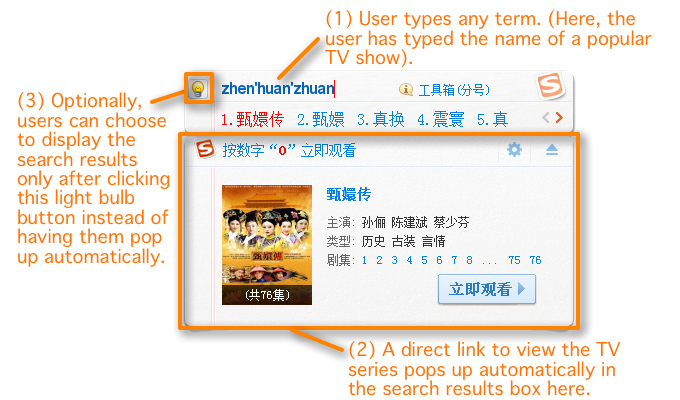
Earlier this week, I wrote about Sogou’s new method of integrating search results into its Chinese-language input method. I also gave the system a test run on my own computer, and came away pretty impressed. In fact, the more I think about it, the more I think this move has the potential to change the way Chinese users search, and maybe even the way they interact with their computers on a more fundamental level. Read more of this post

How Disney Bought Lucasfilm—and Its Plans for ‘Star Wars’

How Disney Bought Lucasfilm—and Its Plans for ‘Star Wars’

By Devin Leonard on March 07, 2013

feature_disney11__01__inline605 (1)feature_disney_605c

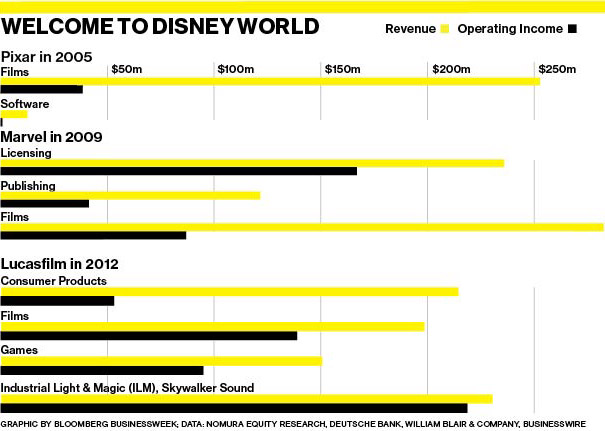
One weekend last October, Robert Iger, chief executive officer of Walt Disney (DIS), sat through all six Star Wars films. He’d seen them before, of course. This time, he took notes. Disney was in secret negotiations to acquire Lucasfilm, the company founded by Star Wars creator George Lucas, and Iger needed to do some due diligence.

The movies reacquainted Iger with Luke Skywalker, the questing Jedi Knight, and his nemesis Darth Vader, the Sith Lord who turns out to be (three-decade-old spoiler alert) his father. Beyond the movies, Iger needed to know Lucasfilm had a stockpile of similarly rich material—aka intellectual property—for more Star Wars installments. As any serious aficionado knows, there were always supposed to be nine. But how would Disney assess the value of an imaginary galaxy? What, for example, was its population? Read more of this post

Everyone wants to talk about the start-up boom in Berlin. But for every success, there are numerous failures, including the award-winning Aka-Aki

03/07/2013 06:03 PM

Aka-Aki

Left Behind by the Berlin Start-Up Boom

By Max Biederbeck

Everyone wants to talk about the start-up boom in Berlin, particularly with Chancellor Angela Merkel visiting promising new firms on Thursday. But for every success, there are numerous failures, including the award-winning Aka-Aki.

Gabriel Yoran had a brilliant idea, but failed nonetheless. Because the entrepreneur wanted to make money, his product could not survive on the market. Today, he is certain of one thing: “Only one in 10 business ideas makes it. Three plod along. The rest immediately disappear forever.”

For a long time it looked like his tech start-up, Aka-Aki, was going to be one of those to make it. It was based on a great idea, was lauded by the media, received the Lead and Webby awards, and was loved by 700,000 users.

“But you can’t trust the hype,” Yoran says today. Everyone wants to talk about projects they find exciting, he says, but that doesn’t mean the business model will bear fruit. That proved to be the bitter truth for Aka-Aki; it no longer has any users at all. In 2012, Yoran and his co-founders dissolved the business.

Young creative minds market their ideas, invent new Apps, or develop the online market in a new way. It is a process that can be fascinating to watch, and it can also be worth a mint to investors. Private equity and venture capital firms are eager to find those projects with promise, and are buying in at earlier stages than ever before. For the start-ups themselves, the cash infusions that result are vital to having a chance at success. Read more of this post

Ansys Aids Innovation With Its Simulation Software; The company that dominates simulation software expects to earn $900 million this year

Ansys Aids Innovation With Its Simulation Software

By Ashlee Vance on March 07, 2013

Jim Shaikh’s first son, Danial, arrived six weeks early, weighing all of 3 pounds and in need of milk every two hours. In the middle of the night, Shaikh would wake up, retrieve breast milk from the fridge, and begin warming the bottle in a pan of hot water on the stove. “Sometimes I would fall back asleep, and everyone upstairs would be screaming at me,” Shaikh says. “Other times I would overheat the milk. I just wasn’t very good at it.”

Shaikh, an engineer who previously helped design cars for BMW (BMW), decided to invent his way out of any paternal inadequacies. He conceived of a bottle to heat milk instantly to a specified temperature and was able to test it without building prototype after prototype. Instead, Shaikh largely brought his product to life digitally, using software from Ansys (ANSS), a Canonsburg (Pa.)-based company that has quietly cornered the market on manufacturing simulation. Ansys’s models showed Shaikh how different plastics would behave when heated up and how varying nipple designs would affect milk flow. “Everything is simulated these days,” says Shaikh.

Since its founding more than 40 years ago, Ansys has become the largest producer of simulation software, which costs thousands to tens of thousands of dollars, depending on the simulation. The company’s staff of more than 2,400, including 600 Ph.D.s, has created algorithms that mirror the laws of physics, allowing Ansys programs to model virtually anything. Ninety-six of the 100 biggest industrial companies, and 40,000 customers in all, use Ansys technology to evaluate product mater-ials and durability. Experienced engineers who once had to produce dozens of mock-ups to arrive at a final product now need a handful at most, saving time and money. Work from computer-aided design (CAD) applications can be fed into the simulation software. Read more of this post

Why Redfin, Zillow, and Trulia Haven’t Killed Off Real Estate Brokers

Why Redfin, Zillow, and Trulia Haven’t Killed Off Real Estate Brokers

By Brad Stone on March 07, 2013

feature_redfin11_buyerschart__605feat_redfin11_agentschart__605

Over the last decade, the Internet has seeped into that bedrock of the U.S. economy: the housing market. A group of growing and mostly profitable websites have sprung up to help guide consumers through what in many cases will be the largest and most nerve-wracking transaction of their lives. Four sites—Redfin and Zillow (Z), based in Seattle, and Trulia (TRLA) and Realtor.com, based in the San Francisco Bay Area—attract 61 million of the 67 million visitors to real estate websites each month in the U.S., according to ComScore (SCOR). They also generate hundreds of millions in revenue and have helped turn buying a house into entertainment—a spectator sport that can be enjoyed without darting surreptitiously into random open houses. Ninety percent of consumers now start their real estate journeys on the Web, according to the National Association of Realtors.

It all looks at first glance like the same kind of electronic marketplace that has eliminated travel agents, decimated classified ads, depressed stock brokers, and taken the swagger out of car dealers, but it hasn’t dented the fortunes of real estate brokers. A majority of buyers and sellers still wind up working with traditional brokers, one on each side of the deal.

Not only have brokers resisted the attack by the Internet’s real estate sites but their fees remain stable. Real Trends, a research firm, reports the average commission paid to the buying and selling brokers was 5.4 percent of the price of a home in 2011, up from 5 percent in 2008. (The seller’s agent collects the commission from the seller and then splits it evenly with the buyer’s agent.) That’s considerably higher than the median rate in markets abroad, where there may only be one agent involved in the transaction, such as the U.K. (a 1 percent to 2 percent fee), Germany (3 percent to 6 percent), Israel (4 percent), and the Netherlands (1.5 percent to 2 percent), according to a 2007 report by the Organisation for Economic Co-operation and Development. “Ten years ago almost no one started their home search online. And yet none of that value has come back to the consumer,” says Glenn Kelman, Redfin’s chief executive officer. Read more of this post

The Japanese art of monetization; An aging games studio called Gungho, which had a hit with Puzzles and Dragons for iOS and Android, and is creeping up on GREE in terms of revenue and market cap, and is actually above Zynga, at $2.3 billion based on only 8 million monthly active users. Gungho did not use social for distribution, the game succeeded just the on power of the app stores and TV ads.

The Japanese art of monetization

BY TOM LIMONGELLO 

ON MARCH 7, 2013

You can learn a lot about your company from usage behavior in Japan. Just like the Japanese language has a system for incorporating foreign words, when Japan latches onto particular Internet services like it did with Yahoo and Twitter, they become so important and widspread that they take on a trajectory all of their own.

In the case of Twitter, for instance, Japan found mass adoption faster than the US did. In fact, it still holds the highest Tweets per second record for New Year’s day. Within a short time of setting up shop at Joi Ito’s Digital Garage, Twitter made Japan its testing ground for new features and monetization strategies.

Japan is not nearly the largest market in Asia, but with 128 million people, 40 million of which live in Tokyo’s metro area, where strong 3G & LTE networks, tons of carrier WiFi & WiMax access and high incomes are pervasive, you can’t find a better place to test the logic of an internet business. Japan, unlike China, does not block the most successful companies from abroad. Rather, Japan’s internet border is porous. As long as the service’s simplicity prevails over the language barrier, usually the best service wins. Read more of this post

Imagining a Swap Meet for E-Books and Music; The prospect of online stores that sell used e-books and digital music has heartened consumer advocates, but publishers and artists are worried

March 7, 2013

Imagining a Swap Meet for E-Books and Music

By DAVID STREITFELD

The paperback of “Fifty Shades of Grey” is exactly like the digital version except for this: If you hate the paperback, you can give it away or resell it. If you hate the e-book, you’re stuck with it.

The retailer’s button might say “buy now,” but you are in effect only renting an e-book — or an iTunes song — and your rights are severely limited. That has been the bedrock distinction between physical and electronic works since digital goods became widely available a decade ago.

That distinction is now under attack, both in the courts and the marketplace, and it could shake up the already beleaguered book and music industries. Amazon and Apple, the two biggest forces in electronic goods, are once again at the center of the turmoil.

In late January, Amazon received a patent to set up an exchange for all sorts of digital material. The retailer would presumably earn a commission on each transaction, and consumers would surely see lower prices.

But a shudder went through publishers and media companies. Those who produce content might see their work devalued, just as they did when Amazon began selling secondhand books 13 years ago. The price on the Internet for many used books these days is a penny. Read more of this post

Once-proud Time Inc seen struggling as independent firm; “You don’t have revenue that is stable,”

Published: Friday March 8, 2013 MYT 11:35:00 AM

Once-proud Time Inc seen struggling as independent firm

NEW YORK: In giving up on its magazine business, Time Warner Inc is set to hand its shareholders an operation that has shrinking sales and profits – and will be looking for a new chief executive.

While the details of the spinoff of Time Inc are still to be announced, the media conglomerate has indicated that it will be structured as a tax-free transaction for its shareholders. It has already previously spun off other businesses to investors, including AOL and Time Warner Cable.

Time Inc faces the same challenges as print publishers everywhere, mainly that people are choosing to read on smartphones and tablets and advertisers are spending the bulk of their budgets elsewhere. As a separate public company, it won’t be able to hide behind its media conglomerate parent, and will face scrutiny from investors expecting it to generate free cash flow and stem revenue declines.

“This once proud and profitable division is being punted as its business prospects look structurally challenged,” wrote Nomura Equity Research analyst Michael Nathanson in a note about the spin-off on Thursday. Time Inc publishes more than 100 magazines worldwide, including the eponymous newsweekly Time, Sports Illustrated, and People.

Over the past decade, Time Inc’s revenue dropped almost 40 percent to $3.4 billion while its operating profit fell in half to $420 million.

Advertising revenue for the entire U.S. magazine industry fell 3 percent in 2012 to $21.07 billion while ad pages declined 8 percent compared to 2011, according to the Publishers Information Bureau.

“You don’t have revenue that is stable,” said Nathanson in an interview. Read more of this post

China Mobile says it now has 50 million users of a system called Internet of Things (IOT), in which objects can be identified and linked to the Net

03.06.2013 18:23

New Net Technology Has 50 Mln Users, China Mobile Says

Telecoms firm’s service connects objects to the Net and is being used in auto industry, health care and surveillance

By staff reporter Qin Min

(Beijing) – China Mobile says it now has 50 million users of a system called Internet of Things (IOT), in which objects can be identified and linked to the Net.

IOT refers to the identification of ordinary objects through means such as radio-frequency identification, bar codes or other methods. This allows for information about the objects to be exchanged, shared and managed on the Web. Read more of this post

The Dirty Secret of Apps: Many Go Bust; “There are so many startups that die with a whimper. That’s the worst type of death….You walk into the office one day, you look at each other, and kind of realize it has to come to an end.”

Updated March 7, 2013, 7:45 p.m. ET

The Dirty Secret of Apps: Many Go Bust

While many independent developers have made money creating mobile apps, many more have struggled or failed along the way, Ben Fox Rubin explains.

By BEN FOX RUBIN

Pocket Gems Inc. is the classic Silicon Valley success story, a startup whose mobile games have been downloaded more than 100 million times since it was founded in 2009 in a Stanford University dorm room.

More commonplace is the tale of Spork, a little-used food-rating app that lived for just a year before giving up the ghost in a small San Francisco office.

Plenty of independent developers have made fortunes off the boom in mobile apps. But many more have failed after learning the hard way that computer skills, a little money and a good idea often aren’t enough in the competitive market.

With hundreds of thousands of games, productivity tools and other apps already on the market, and thousands more launched every week, many startups are finding that their ideas aren’t so unique after all. In this environment, well-heeled companies with big marketing budgets hold sway.

“There are so many startups that die with a whimper,” said Dan Cheung, the 37-year-old software engineer who quit his job to build Spork. “That’s the worst type of death….You walk into the office one day, you look at each other, and kind of realize it has to come to an end.” Read more of this post

China’s Top E-Commerce Site to Launch Product Searches Inside WeChat App

China’s Top E-Commerce Site to Launch Product Searches Inside WeChat App

Mar 7, 2013 at 12:20 PM by Steven Millward, in E-commerceMobileSocial Media

Taobao-search-on-WeChat-app

The new ‘Taobao Search’ account inside WeChat app.

The 300-plus million users of China-made messaging app WeChat can already use it for video calls, finding dates, or following brands and celebrities – and soon it will gain another aspect. China’s biggest e-commerce site, Taobao, is testing out a sort of e-commerce search engine insideWeChat. Once up and running, it’ll allow WeChat users to directly message Taobao on their phones by typing a kind of product that they’re looking for; then the app will respond with a link to the desired items. Read more of this post

For App Makers, China Is Untapped and Untamed

Updated March 6, 2013, 7:29 p.m. ET

For App Makers, China Is Untapped and Untamed

The biggest app makers are increasingly setting their sights on China, as the internationalization of the apps business creates no only greater opportunities for developers but also heightened risks, Scott Austin reports. Photo: Getty Images.

By JESSICA E. LESSIN

China is emerging as the next battleground for global app makers—but cracking the world’s largest smartphone market is proving to be vexing.

App makers must navigate dozens of app stores with looser rules than in the U.S., fend off a proliferation of cloned apps, and steer around a thicket of regulations and intense competition from local developers.

What’s more, companies that charge for their apps are finding they need to get more creative about business models in China since users there are accustomed to getting most digital content free. Read more of this post

Less Than 14% of Chinese App Developers Make a Profit, Says China Mobile Executive

Less Than 14% of Chinese App Developers Make a Profit, Says China Mobile Executive

Mar 6, 2013 at 10:00 AM by C. Custer, in BusinessMobileStartups

Many of China’s tech luminaries are gathered in Beijing for the Two Meetings, and that means they’re all talking to the press. Xu Long, a National People’s Congress rep and the CEO ofChina Mobile’s Guangzhou subsidiary, took to the airwaves himself yesterday and made a grim pronouncement for China’s mobile market: only 13.7 percent of Chinese mobile app developers are actually making a profit.

It’s not entirely clear where that number comes from, but Xu says the source is “an investigation” of the country’s million-plus mobile app developers. Xu says the low number of profitable developers is evidence that China needs to continue exploring healthy and sustainable models for developing the mobile market. Read more of this post

Indeed Is Becoming The Google Of Job Search

Indeed Is Becoming The Google Of Job Search

Vickie ElmerQuartz | Mar. 5, 2013, 9:13 AM | 3,991 | 1

Indeed is turning into the Google of job search.

The web site announced today that it has reached 100 million unique visitors worldwide in January, a 20% gain since late September. By some measures, the company is now bigger than Monster.

In a blog post and media announcement, Indeed said it accounts for more than half of online job searches in the United States and placed more people in jobs last year than CareerBuilderLinkedIn and Monster combined.  Its fastest growth occurred in Russia, India, South Africa, Australia and Japan.

Launched in 2004, Indeed operates as an aggregator of job listings, pulling them in from across the internet. ”We provide the best experience possible for job seekers. We do that by having the most jobs,” says Chris Hyams, a vice president of Indeed. The company has a team of people “dedicated to finding jobs online where we haven’t found them before.”

It also has focused on international growth, adding offices in Dublin, London, Toronto and Tokyo, among others, in the last two years. Read more of this post

Better, smarter support needed for Australian innovation; Departing Google Australia managing director Nick Leeder thinks the reason founders are leaving Australia has more to do with the lack of a critical mass in the Australian ecosystem than a lack of initial funding

Better, smarter support needed for Australian innovation

March 6, 2013 – 9:50AM

Jana Matthews

The PM’s $1b jobs plan doesn’t feel like a boost, says leading entrepreneur and mentor Jana Matthews.

“If we want Australian companies to go global, we need to teach and prepare them…”, says Jana Matthews, program director for ANZ Innovyz START.Photo: Michele Mossop

At first, the Prime Minister’s proposed $1 billion investment to boost jobs by supporting start-ups sounds good. But is it enough and is it focused on the right kinds of programs to accelerate the growth of more companies? Read more of this post

A Revolution in China’s Search Market? Sogou Integrates Search into its Input Method

A Revolution in China’s Search Market? Sogou Integrates Search into its Input Method

Mar 6, 2013 at 08:00 AM by C. Custer, in BusinessMobileWeb

China’s Sogou has been a player in the search market here since the early days. At present, it commands around 8 percent of the search market share, which makes it one of China’s top three search engines but still puts it way, waybehind the dominant Baidu (which has more than 70 percent of the market). But Sogou does dominate the Chinese input method market, with reportedly more than 100 million usersacross its mobile and PC input methods.

Yesterday, Sogou announced an update to the “smart” version of its PC input method softwarethat seems to signal the company is placing increased importance on search. Users of the latest version of the smart input method (which you can get here) will find that when they type certain terms, relevant search results pop up directly below the character selection bar. Sogou says this will save users massive amounts of time, as where previously they needed to open a browser and search for certain kinds of content, now they can get direct links from anywhere on their computer by simply by typing their search terms. Here’s how it works:

sogou-search-input-method2

Read more of this post

Apple Vs Exxon Mobil

CHART OF THE DAY: The Incredible Destruction Of Apple

Jay Yarow | Mar. 4, 2013, 5:39 PM | 5,647 | 8

sai-cotd-030413

Apple‘s stock fell to another new low point of its current crash, closing at $420.15. It’s an incredible decline for the stock which was at $700 in September. Read more of this post

Why Blackberry Remains Powerful In Indonesia, and How It’s Still Going to Lose

Why Blackberry Remains Powerful In Indonesia, and How It’s Still Going to Lose

Mar 5, 2013 at 15:00 PM by Enricko Lukman, in MobileOpinion

A lot of my friends have had their fair share of complaints about the Blackberry Messenger (BBM) service in Indonesia, especially about the service’s lagginess. But still, a lot of them are wired into using BBM every single day, despite strong competition from apps like Line, Whatsapp, WeChat, and KakaoTalk. How deeply rooted is BBM in the Indonesian messaging ecosystem? The answer might lie in its importance in people’s professions. I asked a few of my friends from four different professions for a layman’s take on Blackberry and BBM. They’ve got some insights on how important BBM has become integral in their life and work, and yet how frustrated they are about it. Read more of this post

Apple, Amazon, Google, Microsoft Market Caps (2006- )

Apple, Amazon, Google, Microsoft Market Caps (2006- )

By Caitlyn – March 4th, 2013, 11:30AM

ALPHABETIC-ORDER

Source: Daring Fireball

Fascinating chart via John Gruber looking at the relative change in market capitalizations of four of the largest publicly trading tech companies.

The ongoing strength of Amazon is nearly amazing as the continued weakness in Microsoft.

All the while, Google keeps chugging along . . .

Opera’s Mobile Browser Is Silently Conquering Asia

Opera’s Mobile Browser Is Silently Conquering Asia

Mar 5, 2013 at 13:19 PM by Anh-Minh Do, in Asia

In the USA, smartphones already dominate 50 percent of the mobile market. In Asia,smartphones now account for 66 percent of purchases but the overwhelming majority of existing mobiles out there are still feature phones. And if you’re on a feature phone, it’s even more likely that you use Opera as your web browser of choice. Out of the top five countries for Opera Mini users in the world, three of them are in Asia.

I chatted with Håkon Wium Lie, chief technology officer at Opera, who gave me the lowdown. To date, over 237 million people all over the world have used Opera. In Asia, Opera has already hit millions of monthly unique users in a handful of countries. According to Håkon:

Indonesia and India hit one million in 2008, China in 2009, and the Philippines, Bangladesh, Pakistan, and Malaysia in 2011. Nepal and Thailand just made it on the million-user list last year. Read more of this post

Scooters Rule as E-Commerce Grows in China; Couriers at office buildings in China’s large cities can earn several times more than factory workers

Updated March 4, 2013, 11:37 p.m. ET

Scooters Rule as E-Commerce Grows in China

By PAUL MOZUR

Couriers at office buildings in China’s large cities can earn several times more than factory workers. Above, a deliveryman in Shanghai

BEIJING—David Li possesses a can-do work ethic and a willingness to zip around Beijing’s harrowing traffic on an electric scooter. That makes him highly valuable to a multibillion-dollar Chinese electronic-commerce industry struggling with how to deliver goods to demanding customers.

In 2011 Mr. Li left behind a wife, infant son and a job teaching middle-school math in the eastern city of Handan to became a courier for Chinese Internet retailer Beijing Jingdong Century Trading Co., which runs the 360buy.com shopping site.

Delivery companies say couriers who work the most profitable office buildings in large cities—where order flow is high and delivery is quick and easy—can earn more than $950 a month, well above the $200 to $650 brought in by factory workers.

Booming internet sales in China have the world’s largest manufacturing country racing to create new infrastructure systems to deliver goods to its own population. WSJ’s Paul Mozur reports via #WorldStream.

“It’s hard, but I’m ambitious,” Mr. Li says of the separation from his family. Early last year, after only five months on the job, he was promoted to manager of a distribution center that has 20 deliverymen.

E-commerce has exploded here in recent years as increasingly affluent consumers have learned to love online deals. China’s total online sales are expected to eclipse those of the U.S. in coming years, rising to $356.1 billion in 2016 from $169.4 billion last year, according to Forrester Research. U.S. online retail sales are forecast to reach $327 billion from $226 billion over the same period. That leaves Internet retailers and logistics companies attempting to build from scratch a complex distribution system to send goods purchased online to the distant corners of China. Read more of this post

Apple’s Planned ‘IWatch’ Could Be More Profitable Than TV

Apple’s Planned ‘IWatch’ Could Be More Profitable Than TV

While Tim Cook has dropped hints that Apple Inc. (AAPL) is hard at work on a television to drive the next era of growth, the company’s wristwatch-style device, still in development, may prove more profitable.

The global watch industry will generate more than $60 billion in sales in 2013, said Citigroup Inc. analyst Oliver Chen. While that’s smaller than the pool of revenue that comes from TVs, gross margins on watches are about 60 percent, he said. That’s four times bigger than for televisions, according to Anand Srinivasan, a Bloomberg Industries analyst.

Apple, with its iconic brand and lucrative retail network, is poised to tap into the growing watch industry. Headway in the business would help compensate for slowing growth in other areas, such as iPhones and iPods. Apple’s stock has slumped by more than a third since peaking in September on signs of accelerating competition led by Samsung Electronics Co. (005930) and concern over how quickly Chief Executive Officer Cook is pushing into new products.

“This can be a $6 billion opportunity for Apple, with plenty of opportunity for upside if they create something totally new like they did with the iPod — something consumers didn’t even know they needed,” said Chen, who covers luxury- goods retailers.

The TV industry will generate $119 billion in sales this year, according to market-research firm IHS Electronics & Media. Using Chen’s margin estimates, a 10 percent share for Apple in each market would mean gross profit of $3.6 billion for watches, outstripping $1.79 billion for TVs. Read more of this post