Hedge funds turn to psychology software to revolutionise trading

Last updated: September 15, 2013 8:23 pm

Hedge funds turn to psychology software to revolutionise trading

By David Oakley in London

Were you alone in a small office after a breakfast of muesli or in an open-plan space nursing a hangover when you made that brilliant trade? Some of the world’s leading hedge funds are asking these questions as they turn to psychology to delve into the minds of top fund managers to boost performance and profits. Man Group, the world’s biggest publicly traded hedge fund, is among early adopters of a software program that aims to create the perfect environment to help individual fund managers produce their best trades. Read more of this post

Apple Seen Seeding Future Wearable Products in IPhone

Apple Seen Seeding Future Wearable Products in IPhone

Apple Inc. (AAPL)’s new high-end iPhone gives a glimpse of future products that may be in store from the world’s most-valuable company. A new motion-sensor chip inside the iPhone 5s lays the groundwork for wearable-computing products, while a fingerprint sensor opens more opportunities to make the smartphone a tool for making purchases at stores, according to technology analysts who study Apple. Another new processor chip in the device may give the company the chance to switch its Mac computers away from Intel Corp. (INTC) chips. Read more of this post

When A Startup Worth Hundreds Of Millions Goes Dark: Klout’s Quiet Year Of Growth And Struggle

When A Startup Worth Hundreds Of Millions Goes Dark: Klout’s Quiet Year Of Growth And Struggle

ALYSON SHONTELL SEP. 14, 2013, 8:09 AM 19,455 22

“What do you want to be when you grow up?”

It’s a question all startups have to answer between giant fundraises and figuring out business models. Some growing companies, like Twitter and Facebook, handle adolescence well.  For others it’s awkward and takes serious soul searching to find a place in the business world. Klout is one of those companies. In early 2012, the social-importance ranking engine was on fire. Kleiner Perkins, Microsoft, and other big-name backers pumped $30 million into Joe Fernandez’s company at a valuation worth hundreds of millions of dollars. Then Klout vanished from headlines. Last week it reappeared. The news wasn’t good. Klout’s COO, Emil Michael, resigned. He left for Uber, the latest red-hot startup worth billions of dollars, to be its SVP of Business. Michael remains on Klout’s Board of Directors. Losing Michael as COO was one of a few snags the company has faced since its 2012 fundraise. The rumor mill has started to churn. Read more of this post

No Child Left Untableted; Rupert Murdoch’s new idea for how to educate America

September 12, 2013

No Child Left Untableted

By CARLO ROTELLA

Sally Hurd Smith, a veteran teacher, held up her brand-new tablet computer and shook it as she said, “I don’t want this thing to take over my classroom.” It was late June, a month before the first day of school. In a sixth-grade classroom in Greensboro, N.C., a dozen middle-school social-studies teachers were getting their second of three days of training on tablets that had been presented to them as a transformative educational tool. Every student and teacher in 18 of Guilford County’s 24 middle schools would receive one, 15,450 in all, to be used for class work, homework, educational games — just about everything, eventually. Read more of this post

Microsoft Offers $200 to Trade in IPads for Surface

Microsoft Offers $200 to Trade in IPads for Surface

In an effort to entice more consumers to buy its Surface tablet, Microsoft Corp. (MSFT) is dangling a new carrot. The Redmond, Washington-based technology company yesterday e-mailed and listed on its website a promotion that includes giving credit worth a minimum $200 to customers who turn in “gently used” Apple Inc. (AAPL) iPads to its stores. The gift card is for Microsoft stores, and the company suggests upgrading to a Surface. Read more of this post

For the time being, Netflix is trying to be an ally of pay-television

For the time being, Netflix is trying to be an ally of pay-television

Sep 14th 2013 |From the print edition

20130914_WBC374

UNTIL recently, they were rivals. But on September 10th Virgin Media, a British television company, said that it would make Netflix, an online-video service, available to 1.7m of its customers through their set-top boxes by the end of the year. For the first time Netflix subscribers will have access to the service through pay-TV. Hitherto they have had to use game consoles and other electronic paraphernalia to watch Netflix shows on their TV sets. Eliminating this hassle may win Netflix more customers and help Virgin Media retain its, too, by making a cable subscription a gateway to other services. Netflix’s share price jumped on news of what may be the first of many deals that extend its reach. Read more of this post

Electronic payments in Africa: Paul Edwards took pay-TV and mobile phones to Africa. Now it’s e-payments

Electronic payments in Africa: Paul Edwards took pay-TV and mobile phones to Africa. Now it’s e-payments

Sep 14th 2013 | JOHANNESBURG |From the print edition

“CONTENTED people don’t innovate,” says Paul Edwards, the boss of Emerging Markets Payments (EMP), a firm that provides the switches and wiring for electronic payments in Africa. Mr Edwards is certainly the restless type. In the early 1990s he was boss of Multichoice, a South African pay-TV firm, which expanded into the rest of Africa. A few years later he ran MTN, Africa’s largest mobile-phone firm. EMP is his third big venture in Africa. Its goal is to bring electronic-payment services to a largely unbanked continent. Read more of this post

Mobile music app firms struggle to survive in China

Mobile music app firms struggle to survive in China

Staff Reporter

2013-09-14

Mobile music apps companies, which are struggling due to rising copyright fees and limited available capital, are now looking to merge with internet companies as a way to stay in the market, reports tech.qq.com, a website operated by Chinese internet portal Tencent. Start-up companies in the sector are hindered by high costs stemming from labor and basic equipment procurement, and they must pay for copyright fees and servers that have a large storage capacity. The situation means that 70% of companies’ capital are consumed before their actual operations begin.

Read more of this post

Apple is no longer an innovative company, says the man who helped Steve Jobs design the Mac

Apple is no longer an innovative company, says the man who helped Steve Jobs design the Mac

By Christopher Mims @mims September 12, 2013

Hartmut Esslinger knows a thing or two about industrial design and what it’s done for Apple. He worked directly with Steve Jobs to establish a “design language” that was used on the Macintosh line of computers for over a decade. Esslinger’s iconoclastic firm had already designed over 100 products for Sony when he signed an exclusive, $1-million-a-year contract with Apple in 1982. But that Apple is mostly gone, says Esslinger in an interview with Quartz. The Apple of today resembles Sony of the 1980′s, says Esslinger, who witnessed the succession process at Sony first-hand: The visionary founder has been replaced by leaders who aren’t thinking beyond refinement and increasing profit. “Steve Jobs was a man who didn’t care for any rational argument why something should not be tried,” says Esslinger. “He said a lot of ‘no,’ but he also said a lot of ‘yes’ to things and he stubbornly insisted on trying new things.” Read more of this post

The founders of Coffitivity, a U.S. website that streams ambient cafe sounds, were surprised to discover that some of the site’s biggest fans were in a city with a thriving cafe culture: Seoul

September 13, 2013, 12:17 PM

Big in Korea: Virtual Cafe Sounds

By Jenna Davis

Coffitivity, a U.S.-based website that allows users to stream ambient coffee shop sounds for free, is creating an unexpected buzz — in Seoul. The site, which launched half a year ago, touts the slogan “enough noise to work,” based on research that shows a moderate level of noise is conducive to creativity. The result is a soundtrack of clanging dishware, muffled voices and the occasional unbridled chuckle—all at 70 decibels, the ideal level. Read more of this post

Phonebloks: the truly customisable smartphone

Phonebloks: the truly customisable smartphone

September 13, 2013 – 10:36AM

Salvador Rodriguez

art-Untitled-2-620x349

Phonebloks: Pull it apart and put it back together again. Photo: Dave Hakkens

Everyone’s chatting about the latest iPhones, but the Apple devices are not the only smartphones taking the internet by storm this week. A proposed customisable smartphone project called Phonebloks has gone viral on YouTube with more than 5 million views in just three days. Phonebloks is a new kind of phone that is made out of detachable blocks that can be easily replaced – just like Lego – allowing users to customise their device by picking and choosing the components that matter to them most. Read more of this post

Not-so secret lives of vloggers; ‘You can’t predict what will take off . . . you have to have a large library of content to provide a base for monetising’

September 12, 2013 5:53 pm

Not-so secret lives of vloggers

By Emma Jacobs

Michelle Phan: ‘You can’t predict what will take off . . . you have to have a large library of content to provide a base for monetising’

Alex Day is a celebrity; of sorts. The 24-year-old musician from Essex is recognised in the street. Fans are always nice to him but their comments can be tricky to handle. “I’m never really sure what to say to people who like my video of me sitting in my pants in my bedroom talking about my mum,” he says. Seven years after creating his own YouTube channel, called nerimon, Mr Day is a star vlogger, or video blogger. Back in 2006 he dabbled in video to relieve his teenage tedium. “I was 17, bored, in college studying media. I had a MacBook and making videos was just a thing to do. My audience was just bored college guys like me wanting a bit of distraction.” Since then he has been posting songs, music videos and funny films about his everyday life. Resisting offers from music labels, he has released three albums and two EPs. In December 2011, his single “Forever Yours” reached number four in the UK charts. He earns about £100,000 a year from a combination of YouTube revenues (via the partnership programme that gives the content creators a percentage of advertising income), music sales (through which he earns 70 per cent of his income) and merchandise. Read more of this post

Machines Made to Know You, by Touch, Voice, Even by Heart

SEPTEMBER 10, 2013, 7:20 AM

Machines Made to Know You, by Touch, Voice, Even by Heart

By SOMINI SENGUPTA

How does a machine verify the identity of a human being? Irises, heartbeats, fingertips and voices, for starters. Authentication has been a tough nut to crack since the early days of the Web. Now comes a batch of high-tech alternatives, some straight from science fiction, as worries grow about the security risks associated with traditional user name and password systems. Apple on Tuesday introduced two new iPhones, including for the first time a model with a fingerprint sensor that can be used instead of a passcode to open the phone and buy products. The new feature is part of a trove of authentication tools being developed for consumers, and not just for phones. Read more of this post

In Silicon Valley start-up world, pedigree counts

In Silicon Valley start-up world, pedigree counts

Thu, Sep 12 2013

By Sarah McBride

SAN FRANCISCO (Reuters) – When asked to name the most notable rags-to-riches entrepreneur that his firm has funded, venture capitalist Ben Horowitz doesn’t hesitate: Christian Gheorghe, a Romanian immigrant who came to the United States without speaking English, and rose from limo driver to founder of a business-analytics company, Tidemark. It’s an impressive tale that encapsulates the way Silicon Valley likes to think of itself: a pure meritocracy; a place where talent rises to the top regardless of social class, educational pedigree, race, nationality or anything else. Read more of this post

Facebook news feed changed everything; By turning a series of lonely events into something like a story … news feed gave Facebook a soul.

Facebook news feed changed everything

September 13, 2013 – 12:09PM

On the seventh birthday of Facebook’s news feed, Farhad Manjoo examines why it’s the most influential feature on the internet. In the time before news feed, the web was a strange, quiet, and probably very lonely place. I say “probably” because I can barely remember the way things worked back then. After Facebook launched news feed, nothing on the web would ever be the same again.

By turning a series of lonely events into something like a story … news feed gave Facebook a soul.  Read more of this post

Engineers searching for smartphone innovation look within

Engineers searching for smartphone innovation look within

2:13pm EDT

By Noel Randewich

SAN FRANCISCO (Reuters) – As Apple and other smartphone makers find it harder to wow consumers with new devices, engineers think future breakthroughs may depend more on finding new ways to integrate existing components than on inventing more powerful chips. Apple’s new iPhone 5S introduced on Tuesday shows how difficult it is to keep coming up with compelling innovations after years of blockbuster hits. The new device boasts a fingerprint reader and a beefed up processor, but it failed to inspire a rally on Wall Street typical of past smartphone launches by the Cupertino, California, company. Read more of this post

Hugo Barra Talks About His Future at Xiaomi and Why He Really Left Google

Exclusive: Hugo Barra Talks About His Future at Xiaomi and Why He Really Left Google

Published on September 12, 2013
by Kara Swisher

“First, let’s begin with the name,” said Hugo Barra to me, in his first extended interview since he wasnamed new head of global for Xiaomi a little over two weeks ago. “Think of ‘show me,’ and then pronounce the first word as if it was ‘shower.’” Barra’s last day at Google as head of product management at its key Android mobile unit was in September, but he’s already enthusiastically trying to get the rest of the world to know a lot more about the upstart phone maker that has been called the “Apple of China,” but that has hopes to be more compared to Google or Amazon in the future. Read more of this post

Chinese Phones Challenge ‘Cheap’ iPhone

Sep 11, 2013

Chinese Phones Challenge ‘Cheap’ iPhone

YUN-HEE KIM

AI-CD468_CHINAS_G_20130911025558

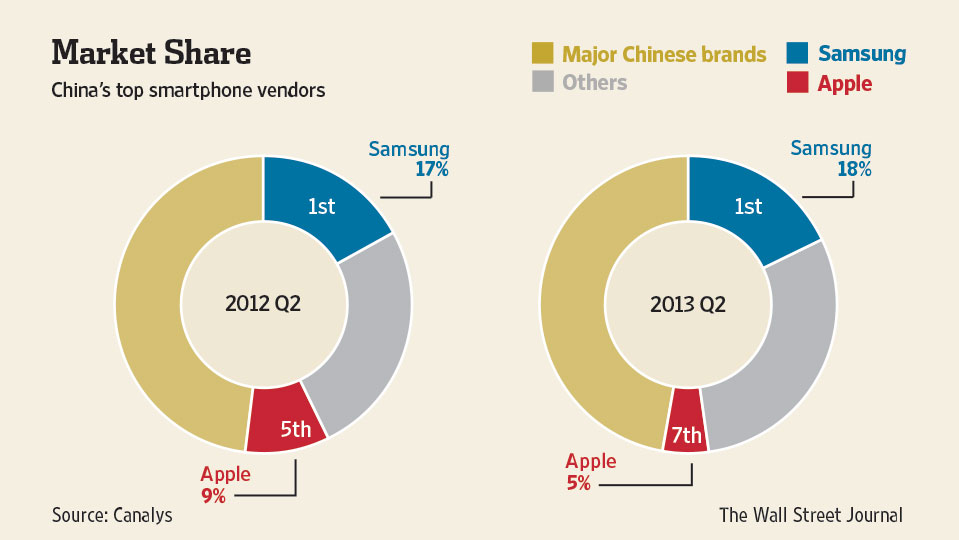
While Samsung Electronics Co.005930.SE -0.28% and Apple Inc.AAPL +1.06% own the majority of profits in the smartphone industry, their market shares are falling globally. The reason?  Cheaper alternatives in markets such as China where there are a slew of startups that are launching high-spec phones at nearly half the price. In Hong Kong’s bustling electronics market in Sham Shui Po, it’s easy to find cheaper smartphones that are giving Apple and Samsung a run for their money. Read more of this post

China’s internet giant Tencent applies for private banking license

China’s Tencent applies for private banking license: media

4:02am EDT

BEIJING (Reuters) – Tencent Holdings Ltd (0700.HK: Quote,ProfileResearchStock Buzz), one of China’s biggest Internet companies with a market cap of almost $100 billion, has applied for a private banking license, Chinese media reported on Friday. The company, known for its wildly popular social messaging app WeChat and its lucrative online games, had its submission approved by provincial authorities in Guangdong, said the Southern Metropolis newspaper. Read more of this post

Pot and Kettle: China Mobile Exec Bemoans WeChat ‘Monopoly’

September 12, 2013, 7:10 PM

Pot and Kettle: China Mobile Exec Bemoans WeChat ‘Monopoly’

If you’re going to defend yourself against being a monopoly, it’s good to be able to name a few competitors. Unfortunately for China Mobile Communications Corp. Vice President Li Zhengmao, his memory failed him just as he was contending that there is in fact a fair bit of competition to the Chinese telecom carrier space from Internet companies offering telecom-like services. “Many people claim there’s a monopoly,” Mr. Li said Thursday in response to a comment by Peking University economist Zhang Weiying at a panel during the World Economic Forum in Dalian. During a discussion aboutTencent Holdings Ltd.TCEHY +1.26%’s wildly successful WeChat mobile-messaging application, Mr. Zhang said the monopoly of China’s telecom sector needs to be broken up to spur more innovation. Read more of this post

For Michael Dell, Saving His Deal Is Just First Step; His Legacy Hinges on Recasting Company as a “Solutions” Provider

September 11, 2013, 8:13 p.m. ET

For Michael Dell, Saving His Deal Is Just First Step

His Legacy Hinges on Recasting Company as a “Solutions” Provider

SHIRA OVIDE

MK-CG210_DELL_NS_20130911183903

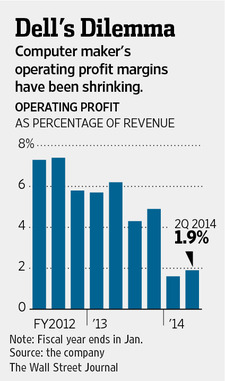
Michael Dell DELL +0.04% is set to win a bruising, yearlong battle for control of his company. His next task—getting Dell Inc. growing again—may be even tougher. Mr. Dell’s proposal to buy the computer company for nearly $25 billion is expected to win approval in a stockholder vote that ends Thursday, according to people familiar with the matter. Dell has said it expects to be a private company by the end of October. Read more of this post

Trigger Finger – Apple fires biometrics into the mainstream

Trigger Finger – Apple fires biometrics into the mainstream

6:04am EDT

By Jeremy Wagstaff and Malathi Nayak

SINGAPORE/SAN FRANCISCO (Reuters) – By adding a fingerprint scanner to its newest mobile phone, Apple Inc is offering a tantalizing glimpse of a future where your favorite gadget might become a biometric pass to the workplace, mobile commerce or real-world shopping and events. Although Apple’s executives said at Tuesday’s launch that its Touch ID technology embedded into the iPhone 5S’ home button would only provide fingerprint access to the phone and its own online stores, analysts said Apple’s embrace of such technology, called biometrics, would be key to wider adoption. Read more of this post

Internet security: Kill or cure; Internet users whinge about passwords but are none too keen on the alternatives. Good news for crooks

Internet security: Kill or cure; Internet users whinge about passwords but are none too keen on the alternatives. Good news for crooks

Sep 7th 2013 |From the print edition

20130907_IRD001_1

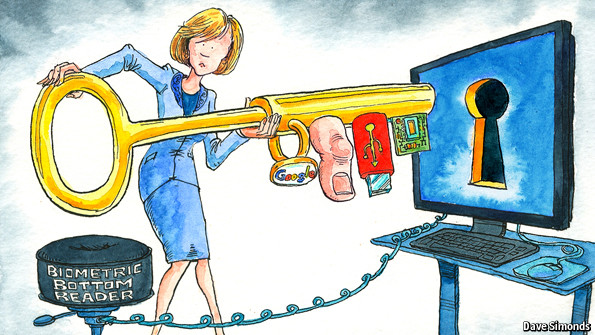
PASSWORDS are a pain. People forget them. Hackers pinch them—this year Twitter lost 250,000 and Evernote, an online notebook service had to reset 50m after a breach. Many companies have been found to store passwords without “salting” them (adding extra data to flummox hackers) or even encrypting them at all. Firms are demanding harder ones: a minimum number of characters, plus numerals and upper- and lower-case letters. Busy and careless people skimp on security: the typical internet user, research suggests, uses just seven passwords to manage 25 online accounts. Even those tend to be easily cracked variations on a theme: “Bageh0t”, “Bageh1t”, “Bageh2t”, etc. The search for alternatives is both urgent and potentially lucrative. Google, along with other behemoths like PayPal and hardware-makers such as Lenovo and LG, have forged the FIDO Alliance, to develop alternative authentication employing a panoply of gadgets. These include USB sticks, chips on fobs and other tokens. (Google is working on a ring.) Read more of this post

Vinod Khosla: 70-80% Of VCs Add Negative Value To Startups; In The Next 10 Years, Data Science Will Do More For Medicine Than All Biological Sciences Combined

Vinod Khosla: 70-80% Of VCs Add Negative Value To Startups

KIM-MAI CUTLER

posted 11 hours ago

Vinod Khosla, one of the co-founders of Sun Microsystems who later went on to create Khosla Ventures, says that the vast majority of VCs aren’t in a position to offer decent advice to startups. In fact, most of them probably hurt startups, he argued. TechCrunch founder Michael Arrington prodded Khosla to single out VCs that were horrible on boards. “Who is the VC who is the most full of shit that you’ve ever heard?” Arrington asked. “I would be offending too many people,” Khosla retorted. “Maybe some percentage that’s substantially larger than 95 percent of VCs add zero value. I would bet that 70-80 percent add negative value to a startup in their advising.” He said that most VCs “haven’t done shit” to know what to tell startups going through difficult times. “I don’t know a startup that hasn’t been through tough times,” he said. He said that founders should listen politely and just do what they want to do anyway. He said of his approach toward helping entrepreneurs: “I give them advice, but I tell them what I’m uncertain about. I’m confident that I screwed up more often than most people in this room. Hopefully, I can advise entrepreneurs to avoid mistakes. But you can never be sure if you’re trying something new and unreasonable.”  Read more of this post

“The C in 5C does not mean ‘cheap’ as I had hoped. It means clueless, as in clueless about how the vast majority of new smartphone users are paying for their phones.”

FRED WILSON: Apple Is ‘Clueless’

JAY YAROW SEP. 11, 2013, 2:49 PM 10,453 44

Influential venture capitalist Fred Wilson is not happy about Apple’s iPhone 5C. In a post he writes, “The C in 5C does not mean ‘cheap’ as I had hoped. It means clueless, as in clueless about how the vast majority of new smartphone users are paying for their phones.” For the past few months, Wilson has been saying Apple should release a low-cost iPhone to slow the ascent of Google’s Android operating system. Android is now powering 80% of smartphones on the planet, and Wilson isn’t comfortable with one company having such a dominating influence over a key technology like mobile phones. There were a lot of rumors that Apple was preparing to go for market share with a cheaper phone. Obviously, that didn’t happen. It didn’t change anything about its pricing plans. The iPhone 5C is $99 with a two-year contract, or $549 without a contract in the U.S. In China, where the smartphone market is booming (and Apple is getting whooped) the iPhone 5C will cost over $700. “The reality of much of the world is that people don’t sign two year contracts like we do here in the US,” says Wilson. “They buy pre-paid sim cards and stick them into unsubsidized phones. And on that basis, the 5C is a big disappointment.” Read more of this post

Nice startups finish last: what happens when VCs don’t want you

Nice startups finish last: what happens when VCs don’t want you

BY CARMEL DEAMICIS 
ON SEPTEMBER 11, 2013

Matt Cooper is not your typical founder. He dropped out of high school when he was sixteen and joined the circus life. He started juggling at parties and festivals to make money and developed his own act: escaping a straight jacket wearing thirty pounds of chains. One act led to another, and he eventually traveled across Europe performing his variety show. Decades later, Cooper (who goes by Coop) now runs a bootstrapped startup called Addroid which is on target for a two million run rate this year. Get this: he makes video banner ads. The dreaded, boring banner ad, but sub out the static JPEG for a commercial. It’s about as far from the life of a nomadic street performer as one could get. “If there’s anything less sexy than a banner ad let me know,” Coop says. Read more of this post

Google’s Uber investment an insight into its future

Google’s Uber investment an insight into its future

PUBLISHED: 1 HOUR 42 MINUTES AGO | UPDATE: 0 HOUR 57 MINUTES AGO

In cities such as New York, there have been ongoing regulatory battles between tech ­start-ups and taxi regulators. Now we know why. Technology threatens to upset the taxi business age old business model in more ways than one.  Photo: Bloomberg

MATTHEW YGLESIAS

Google’s eye-popping $258 million investment in the car-hailing app company Uber made headlines recently. It’s the search giant’s biggest-ever venture capital investment, and it gives a much-discussed but rather small-scale company a delirious $3.5 billion valuation. But so far, the commentary on the deal – which has been mostly focused on bubble speculation and start-up mania – has missed the real story. Read more of this post

Anatomy app gives users a better understanding of the human body

Anatomy app gives users a better understanding of the human body

BY TOMOKO OTAKE

STAFF WRITER

SEP 10, 2013

Back in highschool, I was in the middle of basketball practice, when I suddenly felt an acute pain in my knee. I had no idea what had happened to me. After visits to several different clinics, none of which could identify the problem, I finally found an orthopedist who accurately guessed the cause of my pain: The anterior cruciate ligament — one of four major ligaments of the knee, which controls anterior movements of the tibia — had been severed. Read more of this post

China’s Banks Try to Curtail Alibaba’s Online Lending Ambitions

China’s Banks Try to Curtail Alibaba’s Online Lending Ambitions

By Lulu Yilun Chen – Sep 10, 2013

Banks in China aren’t going to make it easy for Internet upstarts like Alibaba Group Holding to break into financial lending. After fruitless attempts by the e-commerce giant to court China’s biggest lenders, the traditional banks say they’re now planning to expand their own online banking operations before Alibaba can get a foothold in the market. China Construction Bank tried to set up a pure Internet bank with Alibaba about five years ago, even finalizing a name and shareholder structure, Zhang Jianguo, CCB’s president, said at an analyst conference in Hong Kong on Aug. 26. That venture failed to bear fruit, he said. Beijing-based CCB didn’t immediately respond to an e-mailed query about the status of the Internet bank and why it failed to take off. Read more of this post

At Sina Weibo’s censorship hub, China’s Little Brothers cleanse online chatter

At Sina Weibo’s censorship hub, China’s Little Brothers cleanse online chatter

8:24pm EDT

By Li Hui and Megha Rajagopalan

TIANJIN, China (Reuters) – In a modern office building on the outskirts of the Chinese city of Tianjin, rows of censors stare at computer screens. Their mission: delete any post on Sina Weibo, China’s version of Twitter, deemed offensive or politically unacceptable. But the people behind the censorship of China’s most popular microblogging site are not ageing Communist Party apparatchiks. Instead, they are new college graduates. Ambivalent about deleting posts, they grumble loudly about the workload and pay. Read more of this post