YCombinator’s Sam Altman reflects on long days and short decades and the 36 life lessons learnt: Tell your parents you love them more often, Be grateful and keep problems in perspective – Bamboo Innovator Daily: 15 Jun (Mon)

Life

  • What Happens When You Don’t Care: JamesAltucher
  • Why not giving a damn won’t stand in your way of success; Caring about our work has become a weird status symbol. But it can make us mad and unproductive: FT
  • YCombinator’s Sam Altman: 36 Life Lessons I Learned Before the Age of 30; The President of Y Combinator reflects on long days and short decades: Observer
  • Read these beautiful Kiswahili proverbs: “Haba na haba, hujaza kibaba.” (Little by little, the container gets filled. While we may overlook small changes, they are the ones which, put together over time, eventually make a difference): Quartz
  • How a 10-month-old startup’s founders convinced investors to give them millions of dollars to buy a 93-year-old German razor factory: BI
  • Shift to ‘Purpose Economy’: Forbes
  • Learning to Love Volatility: Farnam
  • Confirmation Bias: How Intelligent People Develop Totally Incorrect Beliefs: Spring
  • Do ants have a better traffic algorithm than human engineers or drivers? The number of ants could reach hundreds of thousands, but traffic on the trunk trail – unlike a car-clogged highway – keep moving: WaPo
  • How Tony Blair built a business empire in China: Telegraph
  • What I learned by reading Businessweek’s incredible 38,000-word article on code: BI
  • Tough Choices for Succession in the Family Business: NYT
  • How HR ‘Best Practices’ Kill Innovation: Forbes
  • Alan Bond, 1938-2015: Bond’s bubble; A fallen hero who personified a wild decade in Australian business: Economist

Books

  • Pebbles of Perception: How a Few Good Choices make All the Difference: Amazon

Read more of this post

Buying Furniture with Warren Buffett and Mrs. B at Asia’s Wide-Moat Furniture Innovators – Bamboo Innovator Weekly Insight (Issue 87)

 “Bamboo Innovators bend, not break, even in the most terrifying storm that would snap the mighty resisting oak tree. It survives, therefore it conquers.”
BAMBOO LETTER UPDATE | June 15, 2015
Bamboo Innovator Insight (Issue 87)

  • The weekly insight is a teaser into the opportunities – and pitfalls! – in the Asian capital jungles.
  • Get The Moat Report Asia – a monthly in-depth presentation report of around 30-40 pages covering the business model of the company, why it has a wide moat and why the moat may continue to widen, a special section on “Inside the Leader’s Mind” to understand their thinking process in building up the business, the context – why now (certain corporate or industry events or groundbreaking news), valuations (why it can compound 2-3x in the next 5 years), potential risks and how it is part of the systematic process in the Bamboo Innovator Index of 200+ companies out of 15,000+ in the Asia ex-Japan universe.
  • Our paid Members from North America, Europe, the Oceania and Asia include professional value investors with over $20 billion in asset under management in equities, some of the world’s biggest secretive global hedge fund giants, and savvy private individual investors who are lifelong learners in the art of value investing.
Dear Friends,

Buying Furniture with Warren Buffett and Mrs. B at Asia’s Wide-Moat Furniture Innovators

MUNGER: I think Warren and I can match anybody’s failures in retail.

BUFFETT: Yeah, we have a really bad record, starting in 1966. We bought what we thought was a second-rate department store in Baltimore at a third-rate price, but we found out very quickly that we bought a fourth-rate department store at a third-rate price. And we failed at it, and we failed… 

MUNGER: Quickly.

BUFFETT: Yeah, quickly. That’s true. We failed other times in retailing. Retailing is a tough, tough business, partly because your competitors are always attempting and very frequently successfully attempting to copy anything you do that’s working. And so the world keeps moving. It’s hard to establish a permanent moat that your competitor can’t cross. And you’ve seen the giants of retail…a lot of giants have been toppled.

MUNGER: Most of the giants of yesteryear are done. 

BUFFETT: Nobody is going to be able to compete with the Nebraska Furniture Mart. I mean, this store does more home furnishing business than any store in the country. And what are we in, I don’t know, the 50th market in the country? This store does $450 million annually… But there’s no store that remotely can offer the variety. There’s no store that can undersell us.

“Sell cheap and tell the truth.” – Rose Blumkin (Mrs. B) of Nebraska Furniture Mart (NFM)

“I’d rather wrestle grizzlies than compete with Mrs. B and her progeny.” – Buffett

Buffett in the 2004 AGM: “I cost us about $10 billion. I set out to buy 100 million sharers [in Wal-Mart], pre-split, at $23. We bought a little [5 million shares] and it moved up a bit and I stopped buying. Perhaps I thought it might come back a bit – who knows? That thumb-sucking, the reluctance to pay a little more, cost us a lot.”

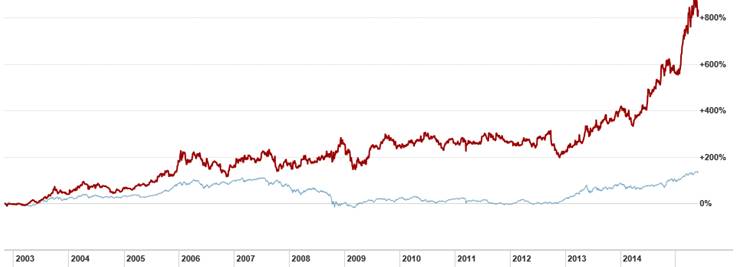
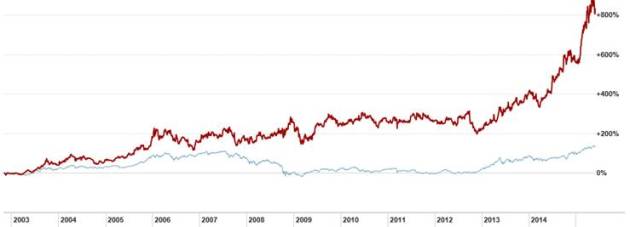
What is the investment Achilles heel of Warren Buffett and Charlie Munger? How did they overcome this weakness? Are there positive inspiring entrepreneurial stories of wide-moat innovators in Asia in this area of vulnerability and how can value investors use a framework to identify them? We will travel together to Asia to examine the success factors of an Asian wide-moat innovator who still holds the record for the longest continuous sales and profit growth – 28 straight years – of any listed company in its country and its market cap had compounded over 9-folds since 2002 to $8.5bn.
Furniture

First, back to Buffett’s Achilles heel, which appears to be in the “tough, tough” retail industry, from the above CNBC interview in 2014, given that it is “hard to establish a permanent moat that your competitors can’t cross”. Also, their biggest error of omission, as Buffett admitted during Berkshire Hathaway 2004 AGM, had been his “thumb-sucking” reluctance in investing more in Wal-Mart in the 1990s because of one-eighth of a point uptick in the stock price. Buffett’s self-awareness and candor saw him making right his earlier decision in Wal-Mart by building a large position in 2005, according to SEC filings, and now owns 60.385m of its shares, at probably an average price of $51-60 as compared to the current price of $72 per share.
Mrs B

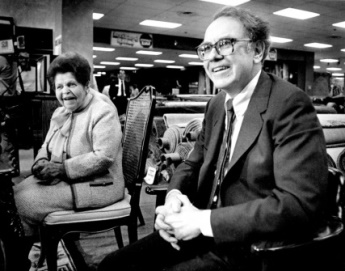
Thus, one of the best investment deals that Warren Buffett considered he has made was ironically in a retailer, a furniture store called Nebraska Furniture Mart (NFM). NFM was founded in 1937 by the late Rose Blumkin, fondly known as “Mrs. B”, a Russian immigrant to America, with $500 she had saved for 16 years selling used clothes. NFM was set up in Omaha with no locational or product advantage and goes up against rich, long-entrenched competition – and grew to become one of the top furniture retailers in the country and into the radar screen of Buffett. After several attempts to buy the business and rebuffed each time Buffett acquired 90% of NFM for $55m on his birthday on Aug 30, 1983 with a purchase proposal just over a page without the involvement of investment bankers or lawyers. Buffett didn’t audit her company, nor did he check her receivables, inventory, and real estate titles. Mrs. B agreed to make a deal with Buffett at the age of 89 because, she figured, if she sold the company before she died, then her children wouldn’t fight over it. After tucking in the cheque, Mrs. B reportedly said: “Mr. Buffett, we’re going to put our competitors through a meat grinder.” Mrs. B work ethics was phenomenal: “I come home to eat and sleep, and that’s about it. I can’t wait until it gets daylight so I can get back to the business.” She was on the floor until retiring at 103, and died the following year in 1998, with the business well taken care of by her capable children. Today, more than 30 years later, the Omaha-based store generated more than $450m in annual sales, with Buffett proclaiming confidently that the store will become “very big” and “will do over $1 billion”.

Buffett had tried to assemble a furniture empire since with the purchase of Utah-based RC Wiley in May 1995, Star Furniture in Jun 1997, Jordan’s Furniture in Oct 1999, and rental furniture provider CORT Business Services Corporation in Jan 2000. But none came close to matching NFM’s success. In Jun 2004, Berkshire also invested 9% In home furnishing retailer Pier 1 Imports (NYSE: PIR), an investment that did not work out. In Aug 2007, according to Bloomberg news, Buffett even mentioned about the Swedish-controlled flat-packed furniture retail innovator IKEA as a possible investment target, though the trust foundation setup at IKEA made the acquisition impossible.

Every year, when undergraduate students from 40 universities compete for a trip to Omaha to spend a day with Buffett, the Oracle would bring students to Mrs. B’s store to show what can result from hard work and sheer will. Buffett has previously told reporters that he would have rather done business with Blumkin over any highly pedigreed MBA in the country. Buffett explained the success factors behind NFM: “I have been asked by a number of people just what secrets the Blumkins bring to their business. These are not very esoteric. All members of the family: (1) apply themselves with an enthusiasm and energy that would make Ben Franklin and Horatio Alger look like dropouts; (2) define with extraordinary realism their area of special competence and act decisively on all matters within it; (3) ignore even the most enticing propositions falling outside of that area of competence; and (4) unfailingly behave in a high grade manner with everyone they deal with. (Mrs. B boils it down to sell cheap and tell the truth.)” In his 2013 letter to BRK shareholders, Buffett wrote: “Aspiring business managers should look hard at the plain, but rare, attributes that produced Mrs. B’s incredible success. If they absorb Mrs. B’s lessons, they need none from me.”

Make no mistake: NFM and IKEA are the rare exceptions. Furniture retailers face at least two critical economic hurdles and problems in building a wide moat and scaling up its business model. After all, can anyone still remember the once-mighty Heilig-Myers (HM)? HM used to the largest furniture retailer in the United States in the 1990s with over 1,000 stores nationwide – and it filed for Chapter 11 bankruptcy on Aug 17, 2000 and was also embroiled in an accounting fraud scandal.

It was distribution and delivery problems that helped bring down HM when it over-expanded nation-wide in 1993 as it buckled under the costs of operating large distribution centers and sprawling home delivery systems. Thus, the first critical problem to understanding the wisdom of Buffett beyond the usual quant screens, checklist and financial numbers when he commented why it is “hard to establish a permanent moat” in retail: Every furniture retailer hoping to go national must eventually overcome the same economic hurdle: the diminishing returns that kick in when a single distribution center can no longer serve all of a chain’s stores.

The second critical problem: HM, like other furniture retailers, relied on financing customers’ furniture purchases with installment loans, usually of two-year duration. Much like a financial services firm, HM provided its own debt servicing and realized revenue from the interest and fees collected from servicing the installment loans. That revenue accounted for up to one-third of profit in some years. HM lost focus in its core business improvement and dabbled in complex financing engineering transactions to boost short-term profits.

Specifically, HM transferred most of its installment sales to a trust account that issued certificates backed by the collection of the installment loans—asset-backed securities (ABS), and some were held by HM in a special-purpose entity (SPE) which were reported on its balance sheet at fair-market value despite the fact that these securities were never traded in a public market. When consumers with better credit quality began using credit cards for purchases rather than Heilig-Meyers installment loan plans, the loan plans were increasingly issued to consumers with low credit quality who defaulted and HM was awashed in toxic waste. The accounting fraud scandal was that Heilig-Meyers kept two sets of accounting books: the company was basing its loss and delinquency statistics on historical patterns rather than current data based on actual payments and collections which showed that HM was not as profitable as they wanted investors to believe. Heilig-Meyers used a “recency” accounting method rather than the standard “contractual” method, and that actual loss and delinquency rates on the contracts were in fact twice as high as stated by the company. In short, the ABS was based on the overly optimistic figures, which improperly inflated the true collateral behind them.

Thus, making and selling affordable furniture for the end customers is critical to avoid the temptations of financial engineering.

Let’s examine the success factors and business model of Nitori Holdings (TSE: 9843, MV $8.5bn) who still holds the record for the longest continuous sales and profit growth – 28 straight years – of any TSE-listed company.

Nitori is the largest furniture retailer in Japan with a 15% market share with around 300 Nitori stores, 17 Deco Home and 19 overseas stores. Rivals include Shimachu (6% market share), IKEA Japan which entered Japan in 2006 (3%), Otsuka Kagu (2%), GMS (21%) and home centers (5%), department stores (4%) and small specialist mom-and-pop stores (44%). Nitori was established in 1972 by Akio Nitori in Sapporo, Hokkaido in the northern island of Japan. Hokkaido is home to a number of innovative retailers, many of which started out in the early 1990s, when the bubble economy collapsed. Nitori first listed in the Sapporo Stock Exchange in 1989, followed by the listing on TSE in 2002.

Nitori grew by…

<ARTICLE SNIPPED>

Nitori is also renowned for its tight quality control in which less than 1% of items sold are found to be defective, winning customer’s trust. To achieve this, Nitori hired former Honda engineering specialists, many of whom are in their 60s, and gave them an engineer’s paradise. Theses engineers break chairs to see why they splinter, wash pillow covers with acid to see if their colors bleed, left lightbulbs on for hours to see how hot they get.

Like the legendary Sam Walton who has a penchant for the right analysis of data, Nitori tracks a long list of data: customer traffic; the age of every store and employee; the number of quality complaints; profit and sales area per employee. To each the company assigns a target, most of which Nitori can recite from memory.

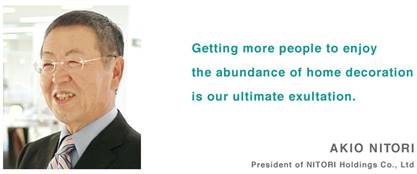
Nitori’s motto is: “Our greatest pleasure if offering and achieving ‘true life affluence’ for our Japanese customers.” Yet, like Mrs. B, many people do not know the pains and challenges that Nitori-san had to endure and overcome in order to realize this motto. Interestingly, both Mrs. B and Akio Nitori had the same life experience when they are trying to implement their low-price strategy.
Nitori

For Mrs. B, Buffett wrote that when furniture manufacturers stopped selling directly to her after bigger customers in Omaha complained about her low retail prices, she travelled to Kansas City, Chicago and New York, bought from department stores and still undersold her rivals. Her competitors used fair means and foul, and after pressurising manufacturers to stop supplying her, hauled her into court charging her with violating Fair Trade laws. But “she not only won all the cases….at the end of one case she sold the judge $1,400 worth of carpet.”

In the late 1960s, when Akio Nitori was just starting its business, local furniture wholesalers wielded enormous power, because it was relatively difficult to buy products in Hokkaido, primarily due to geographical and transport-related factors. If a company tried to accelerate its store launches by selling products at low prices, wholesalers would refuse to do business with it, as such firms were seen as troublemakers disrupting the status quo of the industry. For this reason, Nitori started buying products from wholesalers based in Niigata and Gunma prefectures. “But the transactions with them ended quickly, as information was passed on from the Hokkaido-based wholesalers,” Nitori said.

A major life-changing event was when Akio Nitori joined the Pegasus Club in 1972, the year when Nitori was officially established. The Pegasus Club was formed in 1962 to study the US and European chain-store management system and led by distribution consultant Shunichi Atsumi. Young small-business retail executives at that time, such as Daiei’s Isao Nakauchi, Aeon’s Takuya Okada, and 7-Eleven/Ito-Yokaido’s Masatoshi Ito, were among the initial participants. A core principle of the Pegasus Club is “thorough rejection of the current situation and always looking ahead to a better format in 10-30 years.” Akio Nitori’s approach of setting long-term goals and determining the right steps to achieve these goals is heavily influenced by the Pegasus Club.

The Pegasus Club organized a trip to US and Akio Nitori, 27 and the owner of two furniture stores, joined in the trip to learn more about how overseas retailers operate. Nitori spent a week in California, shopping and observing the way Americans lived. He was inspired by the insights gleaned from the US trip and was determined to achieve a “logistics revolution” to grow and scale a national chain store:

“When I visited chain stores in the United States more than 30 years ago, I was overwhelmingly impressed and marveled at the wide disparities with Japan in terms of consumer values such as low prices, merchandise selection and product quality. Creating a home that is enjoyable, relaxing, harmonious and suited to the residents’ lifestyle is a well-established activity in Europe and America, and the reason is the means exist for easily purchasing, at a reasonable price, home products that can be readily coordinated. Nitori has declared its dreams of ‘realization of a society where Japanese can enjoy true life affluence’ and by taking the excitement, stimulation and resolve of that time as its starting point, Nitori is striving to achieve a “logistics revolution” centered on the creation of a national chain store.”

Thus, to the bullying powerful local furniture wholesalers, Nitori found a solution outside the country. The company started…

<ARTICLE SNIPPED>

Besides Nitori, another wide-moat furniture innovator that we have written earlier in Mar 2014 in the article Willingness to be Misunderstood and the Swedish Corporate Model to Scale an Asian Wide-Moat Compounder: The Story of “Korea’s IKEA” Hanssem is Korea’s Hanssem (009240 KS, MV $5.6bn), whose market cap had since jumped by 270%.

********

In the 1983 annual report, Buffett explains how, at 23, Rose talked her way past a border guard to leave Russia for America. Mrs B had no formal education and knew no English. She learnt the language from her elder daughter who taught her, every evening, the words she learnt in school during the day. Mrs. B had worked in the store at age 6, talking her way into a job as a store clerk when she was 13 and becoming manager with six men working under her three years later. When her initial resources, the $500 savings that took her 16 years to accumulate to establish NFM, ran out, she sold every appliance and piece of furniture in her home to pay off a debt.

So how can value investors identify wide-moat business models and the entrepreneurial owner-operators, like the tough Mrs. B, who run them? Buffett revealed his mental model in the quote below and in a Charlie Rose:

“One question I always ask myself in appraising a business is how I would like, assuming I had ample capital and skilled personnel, to compete with it. I’d rather wrestle grizzlies than compete with Mrs. B and her progeny. They buy brilliantly, they operate at expense ratios competitors don’t even dream about, and they then pass on to their customers much of the savings. It’s the ideal business—one built upon exceptional value to the customer that in turn translates into exceptional economics for its owners.”

Charlie Rose: How was she able to kill them [the competition]?

Warren Buffett: She cared and she was smart. She knew her limitations of her knowledge and she was confident in the circle of her competence. She didn’t get outside of it and she took care of her customers. She sold cheap and it took her a long time but she built the largest home furnishing store in the country in a town like Omaha, a town of 700,000 people. She was a remarkable woman, and Charlie, she could not read or write and I think every business school should study her.

Charlie Rose: What would they learn?

Buffett: They would learn the essence of business. They would learn that taking care of customers is what it is all about. Taking care of them. I mean by that, giving them good deals, which nobody would touch. She did and working like crazy she was there day after day. She had a passion for it. The truth is, if you took the Fortune 500 CEO’s and I gave you the first draft pick on 10 of them, and I put them in competition with her; she would win.

Buffett compared her to the late Walmart founder Sam Walton:

“One thing that Sam Walton and Mrs. B had in common is they had passion for the business. It isn’t about the money, at all. It was about winning. Passion counts enormously; you have to really be doing it because you love the results, rather than the money. When we buy businesses, we are looking for people that will not lose an ounce of passion for the business even after their business is sold. After all, doing business with someone who is driven by beating the competition by creating a superior company rather than simply finding ways to build a war chest is what it’s all about.”

In essence, Buffett’s mental model beyond the numbers to identify wide-moat innovators is to sense that an entrepreneur takes care of his or her customers in a deep way and keep delivering exceptional value to them. Even if it means pains and sacrifices. Even if there are bullies. Even if it takes a long time, working crazy day-in-day-out. Even if they grow rich. All possible only because they are committed to an idea larger than themselves.

When Nitori returned from California in his life-changing trip in 1972 and inspired to carry out his “logistics revolution” to offer and achieve “true life affluence” for the Japanese customers, he did some quick calculations. It took America 120 years to develop its retail industry, and he guessed it would take him 60 years to catch up. He began crafting a six-decade plan then that he continues to refine today. With his single-minded focus on keeping prices down for customers without disappointing them on quality.

Who are your Mrs. B and Akio Nitori in Asia?

Warm regards,

KB

The Moat Report Asia

www.moatreport.com

A new monthly issue of The Moat Report Asia is now available!

Access the in-depth idea presentation:

http://www.moatreport.com/members/

In the month of June, we investigate the #1 ice cream and pasta maker in its domestic market in an Asian country. It is also the main supplier of buns to McDonald’s in its home market. Its high-speed bun production business has expanded to serve other quick-serve restaurants, including Wendy’s and KFC. The firm has nurtured a corporate culture and deep know-how in branding to establish an impressive track record in acquiring and turning small heritage brands into market leaders in different food and beverage categories. Its share price is down 37+% in the past year. This is despite resilient results announced in May. The company was incorporated in 1957 by a group of entrepreneurial families and is now led by an outstanding down-to-earth third-generation business leader.

Jessica Alba On Her Billion-Dollar Success: ‘People Just Saw Me As A Girl In A Bikini’; The Power of Full Engagement — Managing Energy, Not Time, is the Key to High Performance and Personal Renewal – Bamboo Innovator Daily: 14 Jun (Sun)

Life

  • Jessica Alba On Her Billion-Dollar Success: ‘People Just Saw Me As A Girl In A Bikini’: Forbes
  • The Power of Full Engagement — Managing Energy, Not Time, is the Key to High Performance and Personal Renewal: Farnam
  • Lessons about letting go: Star
  • Aristotle on Time: Farnam
  • What Trees Teach Us About Human Nature, Relationships, and the Secret to Lasting Love: Wisdom from a 17th-Century Gardener: BP
  • Jack Dorsey’s return to Twitter Inc: What the co-founder can learn from Steve Jobs, Howard Schultz and Michael Bregman: FP
  • Business Dynasties Try to Pass the Torch Without Dropping It: NYT
  • Hey Silicon Valley, joiners are just as important as founders: WaPo

Books

  • Crucial Conversations Tools for Talking When Stakes Are High: Amazon

Read more of this post

You Innovate with Your Heart, Not Your Head; How a decade of rejection rocketed billionaire Spanx founder Sara Blakely to mega success – Bamboo Innovator Daily: 13 Jun (Sat)

Life

  • You Innovate with Your Heart, Not Your Head: HBR
  • How a decade of rejection rocketed billionaire Spanx founder Sara Blakely to mega success: BI
  • Seven Habits Of Fearless People: Forbes
  • 25 Life Lessons From 100-Year-Old David Rockefeller, The World’s Oldest Billionaire: Forbes
  • Invent your own TAFE course, and other survival hacks from Wollongong toolbelt manufacturer Buckaroo: BRW
  • Be an ethical firm or lose your best people, EY survey finds: SCMP
  • Lunch with the FT: Richard Desmond; the media mogul calls the prime minister ‘rude’, swears vigorously and talks about what to do with a billion pounds in cash: FT
  • Genes Are Selfish; People Are Not: We are unique among animals in our consciousness, of our own selves and of our social groups.: WSJ
  • Schadenfreude Is in the Zeitgeist, but Is There an Opposite Term? Word for taking pain in another’s pleasure is ‘gluckschmerz,’ or is it?: WSJ

Read more of this post

A brilliant MIT scientist shares the sad personal story that drives his groundbreaking research – Bamboo Innovator Daily: 12 Jun (Fri)

Life

  • A brilliant MIT scientist shares the sad personal story that drives his groundbreaking research: BI
  • A Harvard cognitive scientist taught me the secret underlying all good writing: BI
  • What investors can learn from Alex Bird’s 500 winning bets at the races; Professional gambler Alex Bird made a fortune betting on photo finishes. Terry Smith says his system offers a lesson to investors: Telegraph
  • Let Rich and Poor Learn Together: NYT
  • Why doing nothing for a year was the best career decision Food Network star Ina Garten ever made: BI
  • How one woman turned less than $1,000 of savings into a business that earns over $200,000 a year: BI
  • Why we have to give our business partners the power to destroy us: BI, YouTube
  • 9 companies that make money from your laziness: BI
  • Why the CEO of the world’s biggest financial services company didn’t fire anybody during the financial crisis: BI
  • CEO succession starts with developing your leaders: McKinsey
  • Incumbents as attackers: Brand-driven innovation: Big companies are finding growth in new markets by harnessing an underused asset—their brands. McKinsey
  • Starbucks Korea chief highlights horizontal culture in management: KH
  • Nepal’s billionaire ‘noodle king’ turns focus to rebuilding homeland: Nikkei
  • Happy Birthday, Mr. Rockefeller: The World’s Oldest Billionaire Turns 100: Forbes
  • Everything you need to know about coding in one infographic: BI
  • Elon Musk doesn’t want to get into genetic engineering because he doesn’t know how to avoid ‘the Hitler problem’: BI
  • Why you come up with your best ideas when you’re mentally exhausted: BI
  • The Editorial Macro and Micro: StevenPressfield

Books

  • How to Read Literature Like a Professor: A Lively and Entertaining Guide to Reading Between the Lines: Amazon
  • Start with Why: How Great Leaders Inspire Everyone to Take Action: Amazon
  • The Seekers: The Story of Man’s Continuing Quest to Understand His World: Amazon
  • The Creators: A History of Heroes of the Imagination: Amazon
  • The Discoverers: A History of Man’s Search to Know His World and Himself: Amazon
  • 10 novels that will make you smarter about business: BI
  • The White Tiger: A Novel : Amazon
  •  Things Fall Apart: Amazon

Read more of this post

Toru Iwatani: Pac-Man and the real life of games design; 10 skills that are hard to learn but pay off forever; Phishing for Phools: The Economics of Manipulation and Deception – Bamboo Innovator Daily: 11 Jun (Thurs)

Life

  • 10 skills that are hard to learn but pay off forever: BI
  • Toru Iwatani: Pac-Man and the real life of games design; The inventor of the 35-year-old glutton chews over smartphones, managing talent and game design: FT
  • Ina Garten On How To Run A Business And Do What You Love: Forbes
  • What Good Is History? Everyone has their own version. Here’s the best way to navigate it. fool
  • The hidden economic rules behind Tinder, marriage, kidneys, and college admissions: Quartz
  • Buddhism, bombs and blouses: Japan’s versatile ‘washi’ paper: Dailymail
  • Postmortems for Startup Failures: Bloomberg
  • Heidrick & Struggles on the changing nature of leadership: McKinsey
  •  Bye, Bye, American History: Professors and historians urged opposition to the College Board’s new curriculum for teaching AP U.S. History.: WSJ
  • With only a little cash, young Mexican shakes up politics: ChinaPost
  • Too much ‘ganbaru’ could push anyone over the edge: JT
  • A Better Way to Map Brand Strategy: HBR
  • Children need to build strong reading habit: KT
  • Why do smart executives make bad decisions?: FP
  • The secret to success in the age of information overload: FP
  • Hall of fame: Six CEOs who’ve scripted great growth stories: Forbes
  • Here’s why it’s so weird that we haven’t found aliens yet: BI
  • 15-year-old makes the epic discovery of a new planet that’s 1,000 light years from Earth: BI
  • How to become a master networker, even if you’re an introvert: BI
  • The bad habit that makes leaders less effective: BI

Books

  • Phishing for Phools: The Economics of Manipulation and Deception: Amazon
  • Who Gets What — and Why: The New Economics of Matchmaking and Market Design : Amazon
  • The Four Filters Invention of Warren Buffett and Charlie Munger: Amazon

Read more of this post

The Most Important Questions Entrepreneurs Should Ask Themselves; Warren Buffett’s Quotes On Arbitrage; Bubbles; Business And More – Bamboo Innovator Daily: 9-10 Jun (Tues-Wed)

Life

  • The Most Important Questions Entrepreneurs Should Ask Themselves: Insead
  • Warren Buffett’s Quotes On Arbitrage; Bubbles; Business And More: VW
  • Much to learn from Yoda, public speakers still have; Hyperbaton is not a new form of lightsabre, it is a cunning disturbance in the order of words: FT
  • From kopi boy to Coffee Shop King of Singapore: AsiaOne
  • The use and abuse of scenarios: Although it is surprisingly hard to create good ones, they help you ask the right questions and prepare for the unexpected. That is hugely valuable. McKinsey
  • How this Chinese actress Zhao Wei parlayed fame into a billion dollar fortune: EJ
  • The Two Key Benefits Of Thought Leadership Done Well: Forbes
  • Why Manufacturing Is Vital To Engineering Education: Forbes
  • Why bigger is not always better in business: JP
  • The 4 lessons I learned from energy tycoon T. Boone Pickens over lunch: BI
  • Here’s a simple trick to perform better in stressful situations: BI
  • Free to be more productive: family business Grainger & Worrall: FT
  • Want to Create a Blue Ocean? Avoid These Six Red Ocean Traps: Insead
  •  The 1 Percent Innovation Solution: Strategy&
  • Alan Bond funded Australia’s victory in the 1983 America’s Cup, but several of his other business ventures led to convictions of misconduct and the largest corporate fraud in Australian history. NYT

Read more of this post

Eating Out with Warren Buffett at Asia’s Wide-Moat Restaurant Innovators – Bamboo Innovator Weekly Insight (Issue 86)

 “Bamboo Innovators bend, not break, even in the most terrifying storm that would snap the mighty resisting oak tree. It survives, therefore it conquers.”
BAMBOO LETTER UPDATE | June 8, 2015
Bamboo Innovator Insight (Issue 86)

  • The weekly insight is a teaser into the opportunities – and pitfalls! – in the Asian capital jungles.
  • Get The Moat Report Asia – a monthly in-depth presentation report of around 30-40 pages covering the business model of the company, why it has a wide moat and why the moat may continue to widen, a special section on “Inside the Leader’s Mind” to understand their thinking process in building up the business, the context – why now (certain corporate or industry events or groundbreaking news), valuations (why it can compound 2-3x in the next 5 years), potential risks and how it is part of the systematic process in the Bamboo Innovator Index of 200+ companies out of 15,000+ in the Asia ex-Japan universe.
  • Our paid Members from North America, Europe, the Oceania and Asia include professional value investors with over $20 billion in asset under management in equities, some of the world’s biggest secretive global hedge fund giants, and savvy private individual investors who are lifelong learners in the art of value investing.
Dear Friends,

Eating Out with Warren Buffett at Asia’s Wide-Moat Restaurant Innovators

“If you have an enemy, wish upon them a restaurant.”

– An old Chinese curse

“…the more important point even, is that 3G – they’re not buying things to sell. And the other private equity firms.. buy companies with the idea of either IPO-ing them or selling them to competitors, or selling them to another private equity firm. That is not 3G’s strategy. They bought Burger King which is now Restaurant Brands International. They bought that to keep.”

– Buffett in a CNBC interview. In a Berkshire Hathaway (BRK/A) news release dated December 12, 2014, Berkshire revealed that it currently owns 4.18% of the common shares of Restaurant Brands International (QSR), the new parent for Burger King and Tim Hortons fast-food chains. Berkshire also holds $3bn of preferred shares in Restaurant Brands that earns 9% annual interest.

Warren Buffett has defied this old Chinese curse of restaurant business only rarely in his illustrious investments career.

While restaurant chains have been a favorite target for value investors and private equity firms, because their cash-flow makes financing deals easy and brands can benefit from cost-cutting, the business dynamics of a restaurant business is characterized by challenges that makes them “a business that becomes harder as it grows bigger” and over 6 to 8 new restaurants out of 10 fail in the initial years. The deep-seated challenges surface in the form of (1) high fixed costs in operations; (2) the struggle to maintain consistent quality, uniqueness and experience in food and service at the individual outlets as it scales up in expansion – and one bad experience can eradicate three or four great customer experiences; (3) availability of suitable locations; (4) being held hostage by the key personnel that include the chef and restaurant manager and high employee turnover; and (5) low barriers-to-entry with little or no economic moat.

The deep thoughts behind Buffett’s restaurant investments hold important lessons for value investors to uncover inspiring innovators in the restaurant business in Asia. With Buffett’s wisdom, we will better understand the story of how an electrical engineer-turned-billionaire restaurant-prenuer has been able to build a wide-moat in his restaurant chain known for its “dancing staff”, tech innovations and whose market value compounded to $1.47bn in market value after growing from only one outlet prior to 1984 to over 550 restaurants throughout Asia.

However, such positive investment success stories in the restaurant business are uncommon. After all, Yum! Brands (YUM) had to write off $361m in goodwill in Feb 2015 related to the ever shrinking value of the company’s 2012 purchase of Little Sheep Mongolian Hot Pot for $860m from private equity firm 3i, following an earlier impairment charge of $258m in 3Q13. In Mar 2015, CVC Capital had to freeze the assets of the flamboyant Chinese restaurant owner Zhang Lan who sold sold a majority stake in her company South Beauty to the European private equity group last year for $300m, due to accounting tunnelling fraud. In India, there are private equity investment failures in Nirula’s, once the sole symbol of fast food in Delhi, south-Indian food chain Sagar Ratna Restaurant, Bangalore-based food chain Vasudev Adiga, etc.

But first, let’s understand Buffett’s previous restaurant investment 14 years ago before his recent deal in Restaurant Brands International (QSR), the new parent for Burger King and Tim Horton’s fast-food chains.

In 2001, Buffett bought 1.9m shares in OSI Restaurant Partners, owner of Outback Steakhouse, for $48m at around $25 per share. By 4Q06, Buffett completely sold his stake when OSI announced in Nov 2006 that it will be acquired by Bain Capital Partners for $3.18bn with the assumption of $185m in debt, or $40 per share, a 27% premium over its last traded price before the deal. In its final fiscal year (2006) as a public company, its operating profit was $152.3m. In 2008, revenue and profits declined and Bain was forced to take a goodwill impairment charge of $726m, an indication that it had seriously overpaid for Outback and the rest of OSI’s restaurant concepts. Prior to the acquisition, OSI’s debt was less than $200m, and its annual interest expense was just under $15m. After the takeover, debt was $2.6bn with $136m in interest, topping out in 2008 at $197m. OSI was relisted as Bloomin’ Brands Inc (BLMN) in Aug 2012 and it had managed to reduce its debt to $1.8bn and an annual interest bill of $83m. Its present market value at $2.7bn is still below the $3bn valuation nearly nine years when it was taken private. Interestingly, Buffalo’s Wild Wings (BWLD) is up more than 13-fold since its 2004 listing to a market cap of $2.9bn.

OSI is part of the two big waves of PE acquisitions in the restaurant industry in 2005-2006 and 2010-2011. Since 2005, over $21bn in transactions has been recorded. Despite their average EV/EBITDA at acquisition at the decently attractive level of around 7.4x, many have failed and entered into Chapter 11, including Charlie Brown’s, Uno Chicago Grill, Sbarro’s, Bugaboo Creek, etc. OSI former staff and early leaders who inspired Outback commented how with the new private equity owners, the people-first attitude has left and been replaced by a devotion to profits.

What could have attracted Buffett to OSI beyond the financial numbers? Or put in another way, why is Outback able to build a wide-moat in its business model when the general restaurant business has little or no economic moat?

OSI

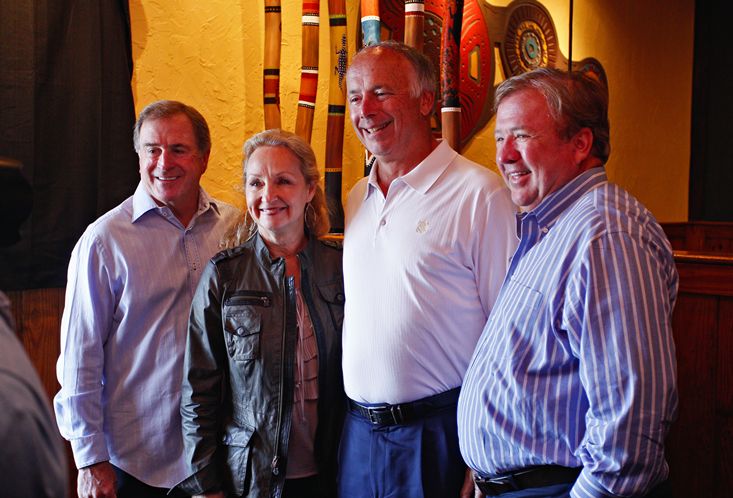
Outback Steakhouse began as one restaurant in 1988. The founders were two corporate guys and two art majors, Chris Sullivan, Trudy Cooper, Bob Basham and Tim Gannon (photo on left), who established the company because they felt they were not treated fairly by their former employee, Pillsbury, after helping the company grow the Bennigan’s chain. The founders resolve that if they were ever to own a business, they would never make anyone feel the way they were made to feel – underappreciated and under-rewarded.

This was the underlying motivation behind the unique Outback ownership structure, which requires each restaurant manager invest $25,000 in his or her restaurant in exchange for a 10% ownership stake. Outback’s original reason was to create a company that did not take advantage of its employees but that shared the benefits of success with those who make it happen. The Outback’s founders understood people. They knew that (1) People want to be part of something that they can believe in and be proud of, (2) People want to be respected, treated fairly, recognized, and have the opportunity to advance, (3) People want to have control over their destiny.

Outback’s owners believed in decentralized management. “We’ve been in their shoes. We’ve worked for companies and said, “If you guys would just leave us alone and let us do our jobs, we would be so much more efficient.” Each restaurant is a separate entity owned by Outback, a regional partner, and the restaurant’s general manager. Ownership means actual equity ownership – sharing in the annual profits and building equity under a buyout formula of 5x the last 2 years’ average annual cashflow. Other store personnel share in a bonus system on a quarterly and annual basis. People can see career paths and actual ownership at Outback, where the founders take great pride in the fact that they have created more millionaires than any other restaurant company. Every restaurant manager, JV or regional partner, and in some cases, chefs, too, are required to invest $25,000 to $50,000 cash for a 6 to 10% ownership interest in the restaurant depending on the concept. Store managers then are paid a base salary, and they receive stock options and 10% of the restaurant’s profits. They have a 5-year employment agreement and at the end of 5 years, they can resign or sell back their ownership interest based on a formula of 5 times the average cashflow for the last two years. Most managers who work at Outback for 10 years become millionaires. They also care about their restaurant, act like owners (because they are), and are able to engage their employees. Interestingly, Outback has no HR department. In addition, each restaurant has a profit-sharing program for waiters, waitresses, hosts and hostesses that is paid out quarterly.

In addition, the company took steps to maintain positive working conditions for its employees, so that they would provide cheerful service to the restaurant’s patrons. “If you worry about your employees and their environment and their ability to do the job, and you make sure they’re happy, you don’t have to worry about the guest,” Gannon said. Accordingly, wait staff were responsible for only three tables apiece, and the company devoted 40% of the space at each location to the kitchen so food preparers would not be crowded. “We understand from having been managers, waiters, cooks, what they feel like,” Gannon said, “We know what the heat of the kitchen is like — personally.” Outback’s attractive arrangements for restaurant general managers and staff resulted in management turnover of 5% compared to 30 to 40% industrywide.

So who is the wide-moat restaurant innovator in Asia that we mentioned is famous for its “dancing staff” and tech innovations?

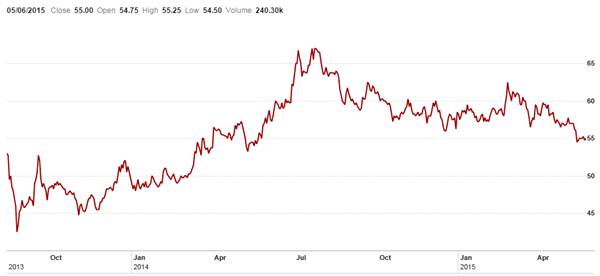
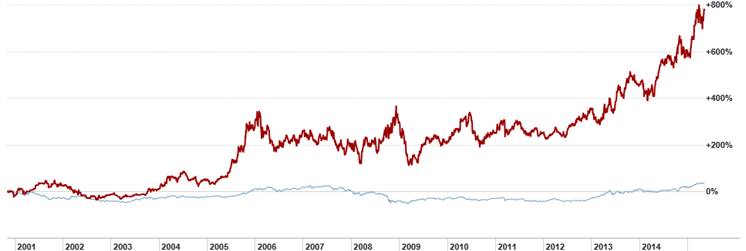
MK Restaurant Group PCL (SET: M) Stock Price Performance 2013-2015

MKMK Dance

At family business MK Restaurants Group PCL (SET: M, MV $1.47bn), best known for its popular chain of value-for-money sukiyaki restaurants in Thailand where customers cook their food in hotpots at their tables, managing director Rit Thirakomen explained that the “MK dance” began within the company, as staff were asked to dance after arriving at their restaurants early in the morning, before they began serving customers. The original objective was to create an opportunity for restaurant managers to talk to their staff each day as a means of solving or pre-empting problems. It also helped to “energise” sleepy staff members. The MK dancing also helped staff to overcome shyness and work as a united group. Some diners have found it such fun that they have even formed a club to occasionally join in dancing with the MK staff. MK branches now have dancing shows for customers at noon and in the evening.

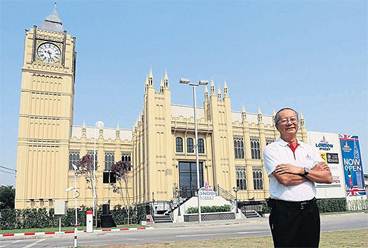
MK RitAn electrical engineer, Khun Rit, 63, cofounded the book publisher Se-Education (SET: SEED, MV $69m) in 1974 and worked there until 1986, when he joined in 1984 his wife Yupin’s family restaurant business founded by his late mother-in-law. Khun Rit spearheaded MK’s expansion into sukiyaki and eventually other Japanese food with the Yayoi chain. Despite a slowing economy, Khun Rit opened 55 new restaurants in 2014, taking its total to 557, in line with its target of having 1,000 restaurants by 2018. In March 2015, MK made a splash with London Street, Thailand’s first community food mall in Bangkok on Phatthanakan Road based on the concept of a London-chic design, which houses all 5 of MK’s restaurant brands (photo on right). MK generates $448m in sales and $62m in net profits and  $110m in EBITDA, trading at EV/EBITDA of 13x with a debt-free balance sheet and net cash of $389m.

MK Restaurants has been investing in IT every year for almost a decade. Before the advent of iPad, MK had invested in personal digital assistant (PDA)-based ordering system in 2004, with the aim to improve service time in food ordering. Many people questioned the investment. Not only was the system able to save operating costs and time spent in serving customers, thereby freeing up tables more rapidly, but also a lot of customer satisfaction was created. The investment outlay would be returned in only two years and MK was able to satisfy even more customers. The restaurant chain also invested in GPS installed in all of its trucks to improve its logistics management and save on fuel costs. Khun Rit also planned to enhance the good relationship between MK Restaurants and its customers by issuing RFID-based member cards. In this way, existing customers will immediately be recognised in any branch and details revealed such as their favourite dishes. “With the smarter member cards, we will be able to treat our regular customers with the same standard of service as soon as they come in, even at different branches.”

An engineer by education, Khun Rit said he preferred systematic methods rather than solving problems case by case.  “From a small restaurant growing into over 500 branches, our target has always been to create customer satisfaction. Every customer must feel happy when they visit our restaurants. We don’t overlook even the smallest details. At MK, we design everything – from the smallest to the biggest matters,” Khun Rit explained. In paying attention to the smallest details, MK believes that most problems represent “the tip of the iceberg” and there is a need to discover the real causes. Some examples of MK’s attention to details incorporated into “MK designs” from design of services and extended into recruitment, training, motivation, the organisation’s culture, customer feedback, quality auditing and strategy alignment:

  • MK’s customer-focus strategy includes providing comment cards on every table. To encourage clients to fill in the comment cards, the company created a colour-code scheme. If a customer rates MK’s service very highly, they mark the card in blue. Orange is used for a very poor rating, and red for areas that need improvement. The strategy has been used since 1996. In the first three years, Khun Rit saw red and orange colours being marked more often than blue. These responses helped the company identify and rectify its weaknesses.
  • Instead of expecting each of its suppliers to deliver goods to the company’s restaurants all over the country, requiring more than 20,000 trips each day, MK has the goods delivered to one of its two factories. Here, the goods are processed or materials and ingredients combined and then the company’s own fleet delivers supplies to the restaurants at least once or twice daily, requiring about 300 trips per day.

<ARTICLE SNIPPED> 

Employees work hard for companies where they believe they have a future and where they can have an impact. In the case at OSI, when they see that current top managers started out where they are now, as line employees, a powerful, self-reinforcing system is created. But the attitude and resulting behavior of top management is key. Humbleness is mission-critical. Top managers who have a sense of entitlement or superiority generally do not fit at high-growth companies, where humility is more important than status. Top management receives few perks at these companies. Except for compensation, the companies try to eliminate elitist executive perks.

Like Buffett, the authentic value investors go beyond quant screens, checklists and financial numbers to understand the underlying business model dynamics that in turn is influenced by the motivation and character of the entrepreneurs and owner-managers.

Just as OSI founders were influenced deeply by their experience of unfair treatment at their former employers and wanted to make things right by building an owner-manager environment, MK’s Khun Rit was shaped profoundly by his childhood experience which led him to found his first company called SE Education (SET: SEED). Khun Rit reminisced: “When I was a child, Thailand was still poor. The people were less educated, with no opportunities for them to receive a good education. I was hoping to see everybody allowed to receive a good education. I successfully entered the engineering faculty of the prestigious Chulalongkorn University. Because my long-cherished desire to receive a good education was achieved, I studied even harder at the university. I also helped my friends from time to time by translating their materials into English for them. Many of them were poor at English, so I helped them. This experience led me to establish a company for publishing and selling books. That is the company now called Se-Education. Our company has 300 branches across the country. I launched this company with a few classmates who graduated from the university along with me. This was an achievement of my childhood dream. As the company expanded, my life became gradually wealthy. This made me feel happy about the fact that we are providing less-educated people opportunities to cultivate themselves.”

Besides MK as the role model of a wide-moat innovator in the casual-dining space in Asia, there are two wide-moat innovators in the quick-serve segment: Café de Coral (341 HK, $2.2bn) and…

 <ARTICLE SNIPPED>

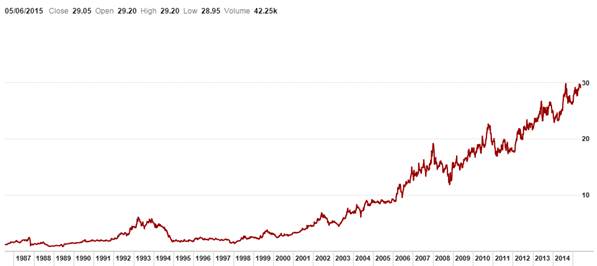
Café de Coral (341 HK) Stock Price Performance 1986-2015

Cafe de Coral

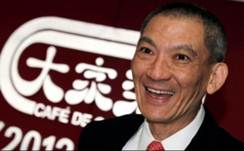
Victor LoIn an earlier article in Jul 2014, we had highlighted briefly Café de Coral, the largest fast-food chain in HK with over 580 outlets across its brands all over the world. Café de Coral was started in 1968 by Victor Lo Tang-seong and Lo Kai-muk, the second-generation leaders of the inspiring founder behind Vitasoy (345 HK, MV $1.8bn) – Dr. KS Lo. The spirit of Dr. KS Lo to want to produce a cheap, nutritious, high-protein soya milk after observing severe malnutrition in children caused by diseases in mainland China and HK had inspired the next generation of leaders in Sunny Lo Hoi-kwong (photo) who scaled Café de Coral to greater heights and had passed on the baton to his son-in-law Michael Chan. We wrote:

“Both Shin and KS were inspired by the idea larger than oneself: to bring about kindness and betterment to children and people in ruined lands through food technology and quality products and services. This larger idea has galvanized the trust and support among the community of customers, business partners and suppliers throughout the years. Whenever this core value is diluted, without the accompanying culture of trust and decentralization to empower the people in the pursuit of growth, globalization, size and diversification, chinks in the mighty armour start to appear and can deteriorate quickly into major problems that would bring down the organization.”

 <ARTICLE SNIPPED>

Finally, to the next generation of leaders, MK’s Khun Rit offered the following viewpoint:

Study hard and find what you want to do in life, something you feel passionate about. These cannot be found unless you look for them seriously. If you can find a career that you really aspired to, this should be better than anything else. We are like artists who try to create good works but returning to them again and again and improving them little by little. A beautiful work can be created with a repetition of very careful, not hasty, finishing touches. Entrepreneurs need to have passion in what they are doing and a strong belief that other people will have the same passion for the products and services they deliver.”

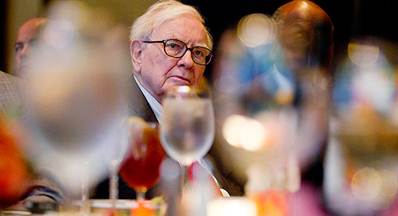
BuffettAs we eat out with Warren Buffett at these Asian wide-moat restaurant innovators amidst the multiple restaurant failures with seemingly attractive low EV/EBITDA valuations multiples from the screens and checklist, value investors come out with one important insight to think differently about the way that we “eat” and to stay resilient against the old Chinese curse.

What unites the original OSI, MK, Café de Coral and… is a sense of mission towards their customers and the people around them which inspires the extra level of intensity and dedication for them, forged by enduring dimensions as character, values, beliefs, capabilities, and personality. In a business organization, these enduring characteristics are a firm’s culture – the so-called soft factors that will actually sustain it over many years and through many situations while the hard factors like financial performance all too quickly come and go. These enduring characteristics resonate like the resolute gong of the temple bell because the sound reverberates in our hearts, stirring the everlasting values that matter: Forbearance, Honor, Duty, Hardwork, Fairness, and Humility, the timeless values that epitomize the Warren Buffett and Charlie Munger way of value investing and the core values of the Bamboo Innovator that bend but never break.

Thus, before you start to bite into that restaurant stock based on its seemingly attractive numbers, make sure you are able to go back to the basics to digest this: Do you assess the numbers and valuations to be backed by a wide-moat business model and an enduring corporate culture that promotes owner-operators? Is there an idea larger than oneself underlying the business model? If your answer is a resounding Yes!, then you are able to eat well – and sleep soundly.

Warm regards,

KB

The Moat Report Asia

www.moatreport.com

A new monthly issue of The Moat Report Asia is now available!

Access the in-depth idea presentation:

http://www.moatreport.com/members/

In the month of June, we investigate the #1 ice cream and pasta maker in its domestic market in an Asian country. It is also the main supplier of buns to McDonald’s in its home market. Its high-speed bun production business has expanded to serve other quick-serve restaurants, including Wendy’s and KFC. The firm has nurtured a corporate culture and deep know-how in branding to establish an impressive track record in acquiring and turning small heritage brands into market leaders in different food and beverage categories. Its share price is down 37+% in the past year. This is despite resilient results announced in May. The company was incorporated in 1957 by a group of entrepreneurial families and is now led by an outstanding down-to-earth third-generation business leader.

Charlie Munger’s Quotes On Academia, Accounting And More – Bamboo Innovator Daily: 8 Jun (Mon)

Life

  • Charlie Munger’s Quotes On Academia, Accounting And More: VW
  • How To Conquer Fear, Backed By Research: Barker
  • From taxi driver to billionaire city builder behind Brisbane’s Greater Springfield, the only fully master planned city to be built in Australia other than Canberra. AsiaOne
  • David Smorgon warns of Smorgon-like crisis for family business: BRW
  • The books that shaped the rise and fall of the British empire: Conversation
  • How five great corporate teams in the Fortune 500 push the envelope. Fortune

Read more of this post

The humble life of Zara owner Amancio Ortega is to be admired; Despite being one of the world’s richest men, the tycoon behind Zara still eats lunch with his employees in the company cafeteria – Bamboo Innovator Daily: 7 Jun (Sun)

Life

  • The humble life of Zara owner Amancio Ortega is to be admired; Despite being one of the world’s richest men, the tycoon behind Zara still eats lunch with his employees in the company cafeteria: Telegraph
  • How this 28-year-old turned a website he built when he was 12 into a media empire: BI
  • Red Hat CEO: How I traded top-down mandates for ‘open’ decision-making: Fortune
  • This Canadian company took a wood product once considered junk and turned it into a $2.3-billion business: FP
  • Chinese Firm Wins Warren Buffett Charity Auction With $2.3 Million Bid: WSJ
  • Emerson on Small Mercies, the True Measure of Wisdom, and How to Live with Maximum Aliveness: BP
  • The Science of Scarcity: A behavioral economist’s fresh perspectives on poverty: Harvard

Books

  • Selling the Invisible: A Field Guide to Modern Marketing: Amazon

Read more of this post

The Unthinkable: Who Survives When Disaster Strikes – and Why; Gumption: Relighting the Torch of Freedom with America’s Gutsiest Troublemakers – Bamboo Innovator Daily: 6 Jun (Sat)

Life

  • 5 Lessons from a Dog on Overcoming Life’s Hardest Challenges: TinyBuddha
  • Warren Buffett On How Business And Philanthropy Are Alike — And How They Are Completely Different: Forbes
  • Merck, the modest family: Chairman shares secrets of successful family management over more than 300 years: KH
  • Solutions for infighting among Asian business families: SCMP
  • Inside the successes and failures of a growing doggy empire; The mastermind behind the popular BarkBox subscription care package for dogs shares his hard-earned startup lessons. FastCo
  • Maree Machin lost a $2000 camera, but gained a business idea: BRW
  • Wal-Mart founder: ‘Everything I’ve done I’ve copied from someone else’: BI
  • Alan Bond: a deal-making dynamo gone wrong: TheAge
  • Shanghai master’s student controls cockroaches with ‘brain link’: WCT
  • When political pollsters get it wrong: The £2bn market research industry failed to predict the election result. Does the answer lie in asking fewer questions?: FT
  • This Japanese company taught a robot to wield a katana like a master swordsman: YouTube, BI
  • Daphne Koller on the Future of Online Education: The Coursera co-founder on the advantages of learning online—and why traditional universities aren’t going to disappear: WSJ

Books

  • Gumption: Relighting the Torch of Freedom with America’s Gutsiest Troublemakers: Amazon
  • The Unthinkable: Who Survives When Disaster Strikes – and Why : Amazon

Read more of this post

Restoring humanity to leadership: There is no value in asking yourself “Am I a leader?” Instead, ask “Who am I leading? And where am I going?” – Bamboo Innovator Daily: 5 Jun (Fri)

Life

  • Restoring humanity to leadership; There is no value in asking yourself “Am I a leader?” Instead, ask “Who am I leading? And where am I going?”: Forbes
  • Michael Lombardi on Decision Making, The Four Elements of Leadership, The Difference Between Good and Bad Coaches: Farnam
  • The Art of Science Communication: William Zinsser on How to Write Well About Science; How to master the inverse pyramid of transmuting information into wisdom.: BP
  • Do Something Syndrome: Farnam
  • It’s OK to Move Down (Yes, Down) the Value Chain: HBR
  • The Self-Tuning Enterprise; How Alibaba uses algorithmic thinking to constantly reinvent itself: HBR
  • Hungarian leaders often speak with pride of the innovations the country has given the world: the ballpoint pen, the espresso machine and the Rubik’s Cube.: FT
  • Alan Bond dead: Bond Corp’s demise left bad taste in the West; Alan Bond, America’s Cup Hero and Corporate Villain, Dies at 77: TheAge, WSJ

Books

  • The 1% Windfall: How Successful Companies Use Price to Profit and Grow : Amazon
  • On Writing Well, 30th Anniversary Edition: The Classic Guide to Writing Nonfiction: Amazon

Read more of this post

Bill Gates, College Dropout: Don’t Be Like Me; Cultivating a culture of innovation begins with children – Bamboo Innovator Daily: 4 Jun (Thurs)

Life

  • Bill Gates, College Dropout: Don’t Be Like Me: NYT
  • Cultivating a culture of innovation begins with children: TODAY
  • Eric Schmidt: Here’s why most companies fail, and why Google won’t: BI
  • Idealab’s Bill Gross reveals the single biggest reason why startups succeed: e27
  • College Dropouts Thrive in Tech: Quitting school to start a company used to be seen as risky; now it’s a badge of honor: WSJ
  • Creating an ethical culture while growing your business: BRW
  • Researchers Put Hierarchies Through the Himalayan Test; Do hierarchical countries like China succeed more than countries that put little value on ranking? : WSJ
  • Here’s how the ‘self-management’ system that Zappos is using actually works: BI
  • Google’s cofounder wrote an essay about how the world has changed since the company started: BI
  • The secret power of introverts: Fortune
  • Thomson Reuters on making information useful: McKinsey
  • How To Develop Superior Thought Leadership Content Than The Competition: Forbes

Read more of this post

7 business leaders share how they solved the biggest moral dilemmas of their careers: Bamboo Innovator Daily: 3 Jun (Wed)

Life

  • 7 business leaders share how they solved the biggest moral dilemmas of their careers: FastCo
  • The misplaced hero worship of start-up founders; Entrepreneurs who really transform the economy are found in all sizes of business: FT
  • The Backyard Effect: Finding The Secret Sauce For Growing An Entrepreneurial Ecosystem: Techcrunch
  • Ortega Overtakes Buffett to Become World’s Second-Richest Person: Bloomberg
  • The inside story of how the Clintons built a $2 billion global empire: WaPo
  • Singapore’s Yeo Hiap Seng descendants in tussle over will: AsiaOne
  •  Your Strategy Needs a Strategy: BCG
  • The New CEO’s Guide to Transformation: Turning Ambition into Sustainable Results: BCG
  • Escaping the Doghouse: Winning in Commoditized Markets: BCG
  • Be a Leader Who Can Admit Mistakes: HBR
  • Innovation Isn’t the Answer to All Your Problems: HBR

Books

  • Good Leaders Ask Great Questions: Your Foundation for Successful Leadership : Amazon

Read more of this post

The Resilience Dividend: Being Strong in a World Where Things Go Wrong; 7 simple ways to find work you’re really passionate about: Bamboo Innovator Daily: 2 Jun (Tues)

Life

  • 7 simple ways to find work you’re really passionate about: BI
  • Why A Values Fit Matters More Than A Culture Fit: Techcrunch
  • What the horse whisperer taught the CEO about leadership: BRW
  • How Korea’s crime scene sleuths do their jobs: JA
  • Don’t ‘manage’ change, dance with it: BRW
  • Lessons from King Sejong: JA

Books

  • The Resilience Dividend: Being Strong in a World Where Things Go Wrong : Amazon

Read more of this post

Grow Market Share of Ice Cream from 2% to 78% in Asia? You Need A “Passion to Serve”: Bamboo Innovator Monthly Riddle

 “Bamboo Innovators bend, not break, even in the most terrifying storm that would snap the mighty resisting oak tree. It survives, therefore it conquers.”
BAMBOO LETTER UPDATE | June 1, 2015
Bamboo Innovator Insight (Issue 85)

  • The weekly insight is a teaser into the opportunities – and pitfalls! – in the Asian capital jungles.
  • Get The Moat Report Asia – a monthly in-depth presentation report of around 30-40 pages covering the business model of the company, why it has a wide moat and why the moat may continue to widen, a special section on “Inside the Leader’s Mind” to understand their thinking process in building up the business, the context – why now (certain corporate or industry events or groundbreaking news), valuations (why it can compound 2-3x in the next 5 years), potential risks and how it is part of the systematic process in the Bamboo Innovator Index of 200+ companies out of 15,000+ in the Asia ex-Japan universe.
  • Our paid Members from North America, Europe, the Oceania and Asia include professional value investors with over $20 billion in asset under management in equities, some of the world’s biggest secretive global hedge fund giants, and savvy private individual investors who are lifelong learners in the art of value investing.
Dear Friends,

Can You Guess This Asian Wide-Moat Company?

Grow Market Share of Ice Cream from 2% to 78% in Asia? You Need A “Passion to Serve”

How do you grow a consumer brand product in Asia from 2% market share in 1990 to a dominant market leadership of 78% today? And not just once off, but multiple times in different consumer product categories?

It’s all about “a passion to serve”, the down-to-earth third generation business leader and CEO Mr. C said. We are impressed by Mr. C who has steered the family business, established in 1958, through challenging times during the 1997/98 Asian Financial Crisis from an unfocused, debt-fueled conglomerate that was involved in F&B, property, banking and semiconductor to bringing greater focus on its core consumer brand products business to command market leadership in aspirational and lifestyle consumer brand products.

This month, we highlight an Asian wide-moat innovator who is the #1 ice-cream and pasta maker in its home country with a market share of 78% and 40% respectively. [Company’s name] has also leveraged upon the ice cream brand to create an innovative RTD (ready-to-drink) milk brand products, including building the chocolate-flavoured milk to become #2 behind Nestle. [Company’s name] is also the main supplier of bun requirement to McDonald’s and its high speed bun production business has expanded to serve other quick-serve restaurants (QSR) customers that include Wendy’s and KFC.

Mr. C has cultivated a unique entrepreneurial ability and impressive track record to acquire or build small heritage brands in different food and beverage categories and transform them into market leaders.

  • The ice cream business was acquired from a family in 1990. Under the previous owners, the ice cream brand was fading out brand for middle-aged ice cream consumers with a mere 2% market share. [Company’s name] contributed financial resources, marketing savviness, and distribution network. The result was disastrous for then market leader which was caught unprepared. [Company’s name] captured market leadership with a dominant share of 78%. The per capita ice cream consumption in this Asian country in 2009 was estimated at 0.95-1 liter, which is one of the lowest in Asia. Thus, there is huge potential for the domestic ice cream market to double when [Company’s name] further penetrates both the modern and traditional trade channels.
  • The pasta brand was developed internally and has a market share of 1% when [Company’s name] entered the business in 2001. In 2008, [Company’s name] invested in a new pasta plant, which is supposedly Asia’s largest and most modern pasta plant. The pasta brand targeted mass market appeal by pioneering in 2010 value-for-money product bundling. We are impressed by how the pasta business has effectively brand themselves in the ad campaigns for mothers who need to satisfy hunger, express love, be recognized and prepare the best food for their family and loved ones, creating a unique consumer mindshare and psychological moat to become the #1 leader, relegating the pasta brand of a global MNC to #2. [Company’s name] went on to acquire the #2 pasta brand from the MNC in 2014 to further consolidate the market and augment its offerings, strengthening its potential for market dominance to achieve resilient steady growth.

How did this “passion to serve” arose?

Mr. C explained: “Let me share the story of our family and the story of [Company’s name], which is about the passion to serve. As a young boy, I grew up in our old house in ‘P City’. ‘P City’ during that time was known for its fires and floods so our house was usually a site for relief operations — something that my father loves to do since he has had this passion to serve ever since. He was also one of the leaders for good government in ‘P City’. So growing up, I was exposed to serving others or doing something good. Of course, as a young kid, I was also a fan of Batman, and most toys given to me were all his gadgets. In a way, I realize now that subtly, I was influenced by this superhero, whose passion was to fight evil and serve the people in Gotham City. I guess these influences in our lives come in many ways. It just reminds me how this passion to serve has been instilled in our family and companies’ values in later years. [Company’s name] has turned 57 years old in the industry. It was not an easy ride but hard work, innovation and the passion to serve kept us going. My message to our employees is simple: God has given us our purpose in life as a company, which is to produce quality food, always at the most reasonable prices. We have survived for over 50 years because we have fulfilled this mission, and we will continue to survive another 50 years if we continue to fulfill it.”

[Company’s name] is the unsexy, simple and understandable Buffett-type of consumer business but you know what you are getting as an investor. Despite its conservative capital structure while most of its peers are relatively highly leveraged, [Company’s name] is able to achieve a decent 9.3% ROE generated from its strong brand equity. The firm’s net profit margin of 7.6% is also one of the highest in the industry, illustrating the power of its dominant market leadership in its core products. Yet, [Company’s name] trades at the relatively cheap and attractive valuations of Price/Book 1.5x, PE15e 12.3x, EV/EBIT 15x and EV/EBITDA 11x. We think that with the business reorganization to focus on the core consumer business, the under-appreciation of the synergies in the pasta business following the 2014 acquisition of the #2 pasta brand from the global MNC, and the potential doubling in ice cream per capita consumption to catch up with its Asian peers, sales and profit momentum will accelerate and market cap could double from current level in the next 4-5 years.

Who is Mr. C and this wide-moat Bamboo Innovator?

Warm regards,

KB

The Moat Report Asia

www.moatreport.com

A new monthly issue of The Moat Report Asia is now available!

Access the in-depth idea presentation:

http://www.moatreport.com/members/


To know bamboo is to know Asia; How Should We Learn? We need to inculcate the skills to navigate the world, handle ambiguity and ignorance, and become more purpose-driven learner: Bamboo Innovator Daily: 1 Jun (Mon)

Life

  • To know bamboo is to know Asia — and a whole lot of Japanese: JT
  • How Should We Learn? We need to inculcate the skills to navigate that world, handle ambiguity and ignorance, and become more purpose-driven learners: Techcrunch
  • American geniuses Steve Wozniak, Biz Stone and Bill Nye on nurturing innovation in business: FastCo
  • Everything you need to know about The Fountainhead, a book that inspires Uber’s billionaire CEO; The Fountainhead’s hero is a principled rebel who refuses to back down from his beliefs, even if it means violating society’s rules and norms. BI
  • Medicine’s Hidden Roots in an Ancient Manuscript: NYT
  • Billionaires Behind Pom Wonderful, Fiji Water Rename Company; Lynda Resnick is the billionaire master marketer behind some of America’s favorite fruit and nut products.  Forbes
  • Richard Thaler on misbehavior, tipping, and economists as failed mathematicians: Quartz
  • How billionaire Anthony Pratt made his own name in America: BRW
  • Used car salesman on the Rich 200: the death-defying story of Tony Denny and his $320m fortune: BRW
  • To be more human is a corporate goal that does not compute; The real issue is the moral distance between companies and their customers: FT
  • Scientists Who Cheat: NYT
  • Beyond Publish or Perish, Academic Papers Look to Make a Splash: NYT
  •  Instead of Playing Golf, the World’s Elderly Are Staging Heists and Robbing Banks; Loneliness and poverty are two factors blamed for increased criminal activity among senior citizens: Bloomberg

Read more of this post

Natalie Portman reveals her ‘dark moments’ in college during powerful Harvard commencement speech; The Best Advice Commencement Speakers Gave the Class of 2015: Bamboo Innovator Daily: 31 May (Sun)

Life

  • Natalie Portman reveals her ‘dark moments’ in college during powerful Harvard commencement speech: BI
  • The Best Advice Commencement Speakers Gave the Class of 2015; Graduation speeches. They are what they are. But remarks by the late and current CEOs of Apple offer advice applicable far beyond the office. Bloomberg
  • The Founder And The Inferiority Complex: Techcrunch

Read more of this post

Apple co-founder Steve Wozniak reveals his one philosophy on work and life; Jealous mountain goddesses can’t scare this gutsy groundbreaker who found success as an engineer outside her home country: Bamboo Innovator Daily: 30 May (Sat)

Life

  • Apple co-founder Steve Wozniak reveals his one philosophy on work and life: BI
  • Apple co-founder Steve Wozniak explains the biggest difference between Steve Jobs and Bill Gates: BI
  • She Had to Leave Japan to Find Success as an Engineer; Jealous mountain goddesses can’t scare this gutsy groundbreaker: Bloomberg
  • How to Find Your Place in the World After Graduation: NYT
  • How Zippo’s Founding Family Kept The Flame Alive: Forbes
  • Why one of Silicon Valley’s top investors says ‘don’t follow your passion’: BI
  • The question that Twitter’s CEO asks at every product meeting; “What’s a bolder choice we could be making?” he said. “What if you added this constraint to what you’re doing that forced you to be more creative or bold?”: BI
  • Lunch with the FT: Federico Marchetti; Yoox founder talks about being an outsider — and the world’s shopping habits: FT
  • Apple’s Jony Ive is tired of having to design everything: FT
  • How Elon Musk is educating his children: Quartz
  • Napoleon’s life rebuilt with Legos for Waterloo anniversary: JT
  • Scientists Curbing the Ethical Use of Science: NYT
  • Securing the future of family business: Star
  • The emotional side of family businesses: BT
  • Magna Carta: Eight Centuries of Liberty; June marks the 800th anniversary of Magna Carta, the ‘Great Charter’ that established the rule of law for the English-speaking world. Its revolutionary impact still resounds today: WSJ

Read more of this post

David Brooks’s Search for Meaning; From poverty to a $3 billion fortune – the incredible rags-to-riches story of Oprah Winfrey: Bamboo Innovator Daily: 29 May (Fri)

Life

  • David Brooks’s Search for Meaning: NewYorker
  • From poverty to a $3 billion fortune – the incredible rags-to-riches story of Oprah Winfrey: BI
  • A former CIA director’s advice on how to make hard decisions: FastCo
  • A clear corporate purpose is key to outperforming rivals: BT
  • Inventors, Entrepreneurs And The Space In Between: Techcrunch
  • Why are some companies so successful?: e27
  • A palette of plans: Choosing a strategy is a lot more complex for companies than it used to be: Economist

Read more of this post

Bill Gates: A Funny, Brutally Honest Memoir in Hyperbole and a Half: Unfortunate Situations, Flawed Coping Mechanisms, Mayhem, and Other Things that Happened by Allie Brosh: Bamboo Innovator Daily: 28 May (Thurs)

Life

  • Bill Gates: A Funny, Brutally Honest Memoir in Hyperbole and a Half: Unfortunate Situations, Flawed Coping Mechanisms, Mayhem, and Other Things that Happened , by Allie Brosh, GatesNotes
  • This Billionaire Mom Runs America’s Biggest Woman-Owned Business; under Thai Lee’s management SHI International has grown from a failing software reseller into one of the biggest and best-regarded IT proviider in the world with $6bn in sales: Forbes
  • How Jessica Alba Built A $1 Billion Company, And $200 Million Fortune, Selling Parents Peace Of Mind: Forbes
  • How Successful People Handle Stress: Forbes
  • Life in the age of anxiety: NYT
  • John Nash’s Legacy Lives on in Business Strategy: K@W
  • Interview with “king of cashmere” Brunello Cucinelli: PI
  • Smarter Every Year? Mystery of the Rising IQs: WSJ
  • Remembering John Nash: Finding equations to explain the world: Economist
  • Why It’s So Important For A Stock Operator To ‘Know Thyself’: Felder
  •  ‘Change the world through education’: KT
  • Entrepreneurs Raising the Next Generation of Chief Executives: NYT
  • Why Special Ops Stopped Relying So Much on Top-Down Leadership; Leaders that can persuade others to join their network by articulating a common purpose and rallying others around it will quickly outmaneuver those that rely on top-down: HBR
  • An Organization-Wide Approach to Good Decision Making: HBR

Books

  • Hyperbole and a Half: Unfortunate Situations, Flawed Coping Mechanisms, Mayhem, and Other Things That Happened: Amazon
  • Dare to Serve: How to Drive Superior Results by Serving Others: Amazon

Read more of this post

19 Things That Actually Happened in 1999: Yahoo! was worth more than Berkshire Hathaway. Today Berkshire is worth approximately $360 billion, or about $320 billion more than Yahoo!

http://dividendreference.com/articles/2015/1000193/19-things-that-actually-happened-in-1999/

PUBLISHED ON MAY 27, 2015. POSTED IN EDITORIAL AND TAGGED AOLBRKABRKBCSCOIBMINTCMSFTYHOO

19 Things That Actually Happened in 1999

BY MICHAEL JOHNSTON

The happenings on Wall Street in 1999 prove that sometimes truth is stranger than fiction. Although the events of 1999 are ancient history by many standards, some very clear memories no doubt remain for many investors. With technology and biotech stocks once again hot, a number of comparisons to the last bubble have been made. But the current environment can’t come close to matching 1999, either in terms of valuations or in the sheer madness of the markets. Below are 19 events that actually happened in 1999, highlighting the irrational exuberance that swept over investors (well, most investors).

  1. Yahoo! was worth more than Berkshire Hathaway.

High-flying Yahoo! had a market cap of nearly $100 billion in 1999, putting it ahead of Warren Buffett’s Berkshire Hathaway. Barron’s even ran a cover story on the Oracle of Omaha titled “What’s Wrong, Warren?” that questioned whether the end was near for Buffett:

To be blunt, Buffett, who turns 70 in 2000, is viewed by an increasing number of investors as too conservative, even passe. Barron’s noted that it wasn’t the only voice questioning Buffett; critics from a new corner of the world were becoming increasingly vocal:

Indeed, Buffett has even started taking flak on Internet message boards. One contributor called Berkshire a “middlebrow insurance company studded with a bizarre melange of assets, including candy stores, hamburger stands, jewelry shops, a shoemaker and a third-rate encyclopedia company.”

Today Berkshire is worth approximately $360 billion, or about $320 billion more than Yahoo! Read more of this post

Eccentricity is the vital ingredient for a city’s success; A Biologist-Turned-Buddhist and His Philosopher Father on the Nature of the Self and the True Measure of Personal Strength: Bamboo Innovator Daily: 27 May (Wed)

Life

  • A Biologist-Turned-Buddhist and His Philosopher Father on the Nature of the Self and the True Measure of Personal Strength: BrainPickings
  • Eccentricity is the vital ingredient for a city’s success: FT
  • Acquiring proven entrepreneurs is a smart way to innovate; LinkedIn co-founder Reid Hoffman on the art of importing and keeping business builders: FT
  • What’s Hot in the Art World? Algorithms; Admirers hold on to computerized formulas; paying $2,500 for a ‘qrpff’ necktie: WSJ

Read more of this post

The Carpenter: A Story About the Greatest Success Strategies of All; How to Recognize a Budding Entrepreneur; Why Some Entrepreneurs Feel Fulfilled—but Others Don’t; How the most creative people in business generate new ideas – Bamboo Innovator Daily: 26 May (Tues)

Life

  • How to Recognize a Budding Entrepreneur; New research identifies the four qualities that founders-to-be have in common: WSJ
  • How the most creative people in business generate new ideas: FastCo
  • Why Some Entrepreneurs Feel Fulfilled—but Others Don’t; Money is only part of the equation. New research offers surprising insights into the complex path to satisfaction: WSJ
  • A serial entrepreneur’s hard-earned lesson in taking risks: FastCo
  • John Nash: A life of brilliance, madness, and reawakening: Quartz
  • Family Ties Help When Firms Go Bust: Insead
  • Reconsidering the Charismatic CEO: Strategy&
  • How Emerging Markets Can Finally Arrive; Without capable domestic firms, emerging markets will inevitably get stuck somewhere along the way. Building world-class domestic firms is the overlooked key to economic development. Strategy&

Books

  • The Carpenter: A Story About the Greatest Success Strategies of All: Amazon
  • The Seed: Finding Purpose and Happiness in Life and Work: Amazon

Read more of this post

Bamboo Innovator Daily: 25 May (Mon) – 4 Rituals To Keep You Happy All The Time

Life

  • 4 Rituals To Keep You Happy All The Time: Barker
  • “The power of a mentor is to see the full abundance that resides within our children and to build a bridge for our children to see it in themselves”; Yogi Berra’s Best ‘Yogi-ism’ Was a Profound Act of Kindness: WSJ
  • Elon Musk on How to Tell if People Are Lying: Farnam
  • The Jingle Geniuses Making Millions Writing Music For Ads, Reality TV; The Jingle Punks make millions writing music for commercials, reality TV, and “literally anything” that needs a tune: Bloomberg
  • From the archives: Nash’s Nobel prize; The Economist’s coverage on the award of the Nobel prize for economics to John Nash in 1994: Economist
  • Lucy Kellaway: I would rather shine shoes than be a banker: FT
  • The New Dictators Rule by Velvet Fist; Today’s dictators use propaganda, censorship and relatively little violence: NYT

Read more of this post

Making Right Buffet’s Biggest Investment Mistake in Asian Wide-Moat Innovators – Bamboo Innovator Weekly Insight

 “Bamboo Innovators bend, not break, even in the most terrifying storm that would snap the mighty resisting oak tree. It survives, therefore it conquers.”
BAMBOO LETTER UPDATE | May 25, 2015
Bamboo Innovator Insight (Issue 84)

  • The weekly insight is a teaser into the opportunities – and pitfalls! – in the Asian capital jungles.
  • Get The Moat Report Asia – a monthly in-depth presentation report of around 30-40 pages covering the business model of the company, why it has a wide moat and why the moat may continue to widen, a special section on “Inside the Leader’s Mind” to understand their thinking process in building up the business, the context – why now (certain corporate or industry events or groundbreaking news), valuations (why it can compound 2-3x in the next 5 years), potential risks and how it is part of the systematic process in the Bamboo Innovator Index of 200+ companies out of 15,000+ in the Asia ex-Japan universe.
  • Our paid Members from North America, Europe, the Oceania and Asia include professional value investors with over $20 billion in asset under management in equities, some of the world’s biggest secretive global hedge fund giants, and savvy private individual investors who are lifelong learners in the art of value investing.
Dear Friends,Making Right Buffet’s Biggest Investment Mistake in Asian Wide-Moat InnovatorsQuestion from a shareholder at the Berkshire Hathaway 2015 AGM: “Looking back on the last 50 years, what was the most memorable failure, and how did you deal with it?”

Warren Buffett: “Back in the mid-1990s I looked to the shoe business in Dexter, Maine, and paid $400 million for something that was destined to go to $0 in a few years. I didn’t figure that out. I paid for some transactions in BRK stock – maybe the only instance in which I felt good about the share price going down. I would say almost any time we’ve issued shares, it’s been a mistake, wouldn’t you say, Charlie?”

Charlie Munger: “Of course.”

“What I had assessed as durable competitive advantage vanished within a few years. By using Berkshire stock, I compounded this error hugely. That move made the cost to Berkshire shareholders not $400 million, but rather $3.5 billion. In essence, I gave away 1.6 percent of a wonderful business — one now valued at $220 billion — to buy a worthless business. To date, Dexter is the worst deal that I’ve made. But I’ll make more mistakes in the future – you can bet on that. A line from Bobby Bare’s country song explains what too often happens with acquisitions: ‘I’ve never gone to bed with an ugly woman, but I’ve sure woke up with a few.'”

– Buffett in 2008

Is it possible for an Asian billionaire to work alongside employees in a retail shop during weekends?

We know Sam Walton does. Even when Sam Walton was a billionaire, he still “show up regularly in the truck drivers’ break room at 4a.m. with a bunch of doughnuts and just sit there for a couple of hours talking to them.” Sam Walton would grill them: ‘What are you seeing at the stores?’ ‘How do the people act there?’ ‘Is it getting better?’ Former Wal-Mart CEO Lee Scott commented, “It makes sense. The drivers see more stores every week than anybody else in this company. And I think what Sam likes about them is that they’re not like a lot of managers. They don’t care who you are. They’ll tell you what they really think.”

Can an Asian billionaire put down his stature, face, pride and comfort to be as driven and humble as Sam Walton? Knowledge of the cognitive psychological underpinnings of the Asian entrepreneurs with Sam Walton-like psyche and the sustainability of the wide-moat businesses they built will enable the value investor to make right the investment process underlying what Buffett describes as the worst investment decision he has ever made in his entire life – his purchase of Dexter Shoes in 1993.

Shoe

Before we reveal the Sam Walton-like Asian shoe billionaire whose business has compounded by nearly 10-fold in market value since 2000 to $4.5 billion, beating the domestic index which is up 35% over the same period, generating a 12th straight record high profits from over 900 stores (180 are overseas), let us revisit Buffett’s investment decision in Dexter Shoes.

At the time, Buffett’s investment in Dexter in 1993 made a lot of sense.

First, Dexter Shoes is the type of boring, unsexy businesses like See’s Candies and Dairy Queen that Buffett had invested in numerous times before to generate compounding returns for Berkshire. Unsexy but you know what you are getting as an investor. When asked why he bought Dexter at that time, Buffett commented, “Dexter Shoe is exactly the type of business Berkshire Hathaway admires. It has a long, profitable history, enduring franchise and superb management. Dexter will continue to operate as it has in the past under its existing management.”

Second, Buffett had earlier acquired in 1991 two shoe businesses – worker boat manufacturer HH Brown and women’s and nurse’s shoes Lowell – that turned out to good investments. The management at HH Brown also endorsed Dexter’s owner-managers Harold Alfond and Harold nephew Peter Lunder, giving Buffett the confidence to proclaim, “Dexter, I can assure you, needs no fixing: It is one of the best-managed companies Charlie and I have seen in our business lifetimes”. Buffett expected in 1994 that Buffett’s shoe operations to have more than $550m in sales with pre-tax earnings topping $85m. Buffett commented then, “Five years ago we had no thought of getting into shoes.  Now we have 7,200 employees in that industry, and I sing ‘There’s No Business Like Shoe Business’ as I drive to work.”

Third, Dexter seemed to have built a moat and branding price premium advantage to withstand the onslaught of cheap Asian imports – despite the higher cost of producing over 7.5m pairs of shoes annually, including 15% of US output in golf shoes, mostly onshore in Maine. Dexter’s facilities were impressive in its production efficiencies with conveyor automation. In addition, Dexter had been a business innovator by pioneering three retail trends. Firstly, Alfond is credited with the invention of the factory outlet store in selling factory-damaged (FD) shoes in the 1960s. Harold cut out the middle man and sold FDs right from a store at the back of the factory. It was an instant success. Secondly, when factories were not making enough mistakes to supply FDs, Harold pioneered the next trend in the 70s of selling stale inventory, mostly quality shoes from previous seasons. Dexter factory outlet stores started to flourish with one store after the other in eastern United States. Other shoe retailers caught on and opened their stores next to Dexter. Harold pioneered the third trend of opening entire outlet malls along busy highways and lease retail space to dozens of competitor brands. At this time in the early 90s, Dexter employed close to 4,000 people and was generating $250m in sales with retail-manufacturing earnings and steady rental services income. Buffett came knocking on the door and Harold agreed to sell out for $443m, requesting Berkshire shares instead of cash. The value of Dexter business amounted to 1.6% of Berkshire shares which was selling for around $16,000 per share.

So what went wrong? The most cited explanation was that as much cheaper shoes manufactured overseas continue to flood the American market, Dexter lost its competitiveness. Starting from 1998, Dexter started to cut jobs, citing global competition. In 1999, Dexter began to close down its manufacturing facilities. By 2000, Buffett said, “our attempt to keep the bulk of our production to domestic factories has cost up dearly.” Due to operating losses at Dexter, Berkshire wrote off $219m of Dexter goodwill. A week after the 9/11 terrorist attack, Dexter announced it was closing its final manufacturing facility in Maine, the on located in its namesake town of Dexter. In the 1960s and 70s, the shoe industry employed roughly 30,000 people in Maine. By the time Dexter Shoe shut its doors in 2001, that employment figure had dropped to 3,300, according to the Maine Center for Workforce Research & Information. Today, that figure is below 1,300.

In a little-cited and forgotten quote that goes beyond the usual heuristic checklist measure of “long profitable history” to discuss about business dynamics, Buffett explained the most important reason to understand both the mistake and the Asian shoe billionaire who worked alongside his employees in the shop during weekends, as well as to identify potential future opportunities in retail innovators. Buffett admitted, “Shoes are a tough business.. most manufacturers in the industry do poorly. The wide range of styles and sizes that producers offer causes inventories to be heavy; substantial capital is also tied up in receivables.”

Thus, given the broad range of sizes and colors for a single product, controlling inventory risk is a major challenge in the shoe business with its small-lot, multi-type format, especially a burden for a brick-and-mortar outlet whose floor space is limited. The retail innovator who can solve this major challenge will have a real sustainable moat advantage. Despite its long profitable history and efficient manufacturing facilities, and even if it had outsourced to cheaper overseas production bases, Dexter had not yet solve this major challenge.

In Japan, this major challenge in the shoe industry faced by Dexter was compounded by the multi-tiered shoe distribution market, with distributors and wholesale firms at various stages between manufacturers and consumers. The structure remained even after a drastic shift to overseas production sites in the 90s, with the accumulated distribution costs being passed along in retail shoe prices. Japanese shoe retailers hedged inventory risk via product-return programs with manufactures and wholesale firms, while the upstream side added return-related costs in wholesale prices. Like Dexter, numerous shoe manufacturers and retailers have failed since the late 90s, including Asahi Corporation in April 1998, Americaya Shoes in April 1999, and the once-mighty Kutsu-No-Marutomi in Dec 2000.

<ARTICLE SNIPPED> 

Masahiro Miki is the low-profile secretive billionaire founder of ABC Mart who worked alongside employees in stores during weekends. Miki owns around 30% of ABC-Mart and is ranked #11 on Forbes richest Japanese list with a net worth of $3.5bn. Not many people know that Miki-san is Korean-Japanese with a Korean name of Kang Jeong-ho, as he seldom shows himself in public. Like Dexter’s Harold Alfond who was an outstanding athlete and developed his passion for sports, Miki was an amateur boxer and sports lover. Miki, who had been interested in import clothing retail, switched to selling shoes when he realized that the Japanese shoe industry was not particularly competitive. Kokusai Boeki Shoji (International Trading Corp) was established in 1985 in Tokyo’s Shinjuku ward. Miki pursued brand businesses early on by securing domestic general-distributor rights to Hawkins in 1986 (it acquired trademark rights in 1995) and Vans in 1991 (it concluded a domestic trademark usage contract in 1994). This brand-management know-how has contributed greatly to ABC-Mart’s private brand-driven growth strategy. Miki entered the retail market in 1990 with the launch of ABC-Mart and opened four stores in central Tokyo that sold sneakers and work boots, riding the casual fashion trend at that time. In the late 90s, ABC-Mart accelerated the rollout of self-branded products utilizing the trademarks it had acquired, and broadened coverage by adding business and walking shoes.

ABC-Mart compounded its market value nearly 10-fold since 2000 to $4.4bn by streamlining the procurement structure and removing the middlemen from Japan’s multi-tiered shoe retailing structure and built a high-margin format. This was made possible with two innovations.

First, ABC-Mart…

 <ARTICLE SNIPPED>

ABC-Mart also sought to solve the inventory challenge with an innovative in-store service that allows customers to directly place orders for shoes that are not in stock at its brick-and-mortar stores to the shoe retailer’s web outlet. Customers can place orders for shoes of any desired model or size from the in-store terminal when they are out of stock at the outlet they visit. They pay for the shoes there and then, and can choose to arrange home delivery or pick up the goods the next time they visit. The number of outlets that provide such services is around 600, roughly 80% of all ABC-Mart stores in Japan. The iPhone-based service, called “iChock,” minimize missed business opportunities due to items being out of stock as well as to reduce inventory at each store and improve capital efficiency.

With its extensive name-brand lineup and exclusive private-brand products, sales has been brisk despite the April 1 2015 sales price hike, posting a 12th year record high profits. While ABC-Mart has been the poster child of deflation-era retailing, with stores advertising shoes for as little as ¥2,900 ($28) and ¥3,900, along with clearance sales, it has found success in rolling out products that appeal to fashionistas who do not mind paying a little extra for style. ABC-Mart stores are also hot spots for many Chinese tourists who buy four or five pairs at once. ABC Mart found overseas success with over 180 stores, with over 150 stores in South Korea and the rest in Taiwan.

In Aug 2012, ABC-Mart also completed the $138m purchase of LaCrosse Footwear, a rival to Berkshire’s HH Brown and Justin Brands. Workwear consumers of the LaCrosse and Danner brands in America include people in law enforcement, transportation, mining, oil and gas exploration and extraction, construction, government services and other occupations that require high-performance and protection footwear as a critical tool for the job. Outdoor consumers include people active in hunting, hiking, outdoor cross-training. LaCrosse purchased storied bootmaker Whites Boots in 2014. Both these brands also sell well in Japan.

********

We have emphasized in earlier articles our observation that most Asian companies are “one-man-shop” operations with the founder making all the decisions. The willingness to build a culture of decentralization/ empowerment and invest in a system to cascade decision rights throughout the organization is an important signal that the founder desires and cares to scale up the company in a sustainable manner by not hoarding knowledge. Technology is an important tool in empowering the employees and in giving them an informational advantage in their respective roles and responsibilities at work.

Sam Walton himself solved the major problem of inventory and working capital to scale up the business by having a continual commitment in the intangible IT investments. Sam Walton’s penchant for a reliable and speedy information system is grounded in pragmatism: “Once we had those scanners in the stores, we had all this data pouring into Bentonville over phone lines. I like my numbers as quickly as I can get them. The quicker we get that information, the quicker we can act on it. What I like about it is the kind of information we can pull out of it on a moment’s notice.”

The story of Dexter Vs ABC-Mart also reminds us of Kmart Vs Wal-Mart. The once mighty Kmart was bigger than Wal-Mart in 70s and 80s; it declared bankruptcy on Jan 22, 2002. K-Mart is the typical cheap gets cheaper, cigar-butt value trap with the halo of a successful founding entrepreneur. While Wal-Mart commits itself in IT investments in order to scale up its store network in a sustainable manner, Kmart was busy acquiring various companies that include Furr’s Cafeterias of Texas, Bishop’s Buffet chain, pizza-video parlors, Payless Drug Stores, the Sports Authority, and OfficeMax as outlets for its retained earnings. By the end of 80s, Kmart was at least ten years behind Wal-Mart in its operational capabilities. As Kmart fell ever further behind, its need for outside-of-the-core growth platforms became a self-fulfilling prophecy. Wal-Mart now collects more data about consumers than anyone in the private sector. Wal-Mart mined this data into actionable business intelligence to ensure that consumers have the products they want, when they want them, and at the right price. For example, they have learned that before a hurricane, consumers stock up on food items that do not require cooking or refrigeration.

Ironically, IT investments was the tipping point factor that “killed” Kmart. It spent $2b in 2000/01 – and using IBM, the same IT supplier as Wal-Mart. The key Is discipline and integrating technology into business model to achieve “emptiness” in an indestructible intangible asset: Wal-Mart shared its info with supplier in exchange for greater discounts to integrate with its EDLP (everyday low prices) business strategy, whilst Kmart simply “invest” and “collect data” without a purpose.

********

Entrepreneurship generates substantial emotions because it is an extreme context in terms of time pressures, uncertainty and the extent of personal consequences tied up in the fate of the firm. People are heterogeneous in their motivations for engaging in the entrepreneurial process. Understanding the micro-foundations of entrepreneurial action and the notion of hot cognition, the emotions that influence cognitive processing in the entrepreneurial context, and the “why” underlying these activities is critical for the value investor to avoid costly investment mistakes. The emotions generated from making progress on a challenging entrepreneurial task – solving the inventory problem in order to scale up – increases the entrepreneur’s scope of attention, hot cognition and (access to) resources and impact subsequent activities in the entrepreneurial process.

Both Sam Walton and Masahiro Miki faced a lot of resistance and doubts when they spent heavily on IT system – the money could have been spent on tangible assets like property. In the end, the scale and constancy of the investments involved in building the indestructible intangibles discourage imitators and disrupts complacent incumbents. They “stick to their guns” and that made all the difference to understanding the wide-moat advantage that they have built up. The Heart of entrepreneurship is summed up best by Sam Walton in his inspiring autobiography Made in America:

“It is a story about entrepreneurship, and risk, and hard work, and knowing where you want to go and being willing to do what it takes to get there. It’s a story about believing in your idea even when maybe some other folks don’t, and sticking to your guns.”

Both Sam Walton and Masahiro Miki are unwavering in their core values, just like the Bamboo: Even through the strongest hurricanes, the bamboo will bend but never break; when covered with snow, it will patiently wait for it to melt down, and then rise up And in the end, the bamboo stands tall, green and beautiful. For the traditional Chinese, the bamboo represents the value of “uprightness”. At Moat Report Asia, we are of the conviction that the future is created one Bamboo Innovator at a time. If you also share in our values and investment process, and support our conscious efforts to promote entrepreneurialism in Asia, we invite you to join us in this uplifting journey to make a positive difference to society.

Warm regards,

KB

The Moat Report Asia

www.moatreport.com

http://accountancy.smu.edu.sg/faculty/profile/108141/KEE-Koon-Boon

A new monthly issue of The Moat Report Asia is now available!

Access the in-depth idea presentation:

http://www.moatreport.com/members/

This month, we highlight a wide-moat innovator who is the #1 in Asia in a patented automotive electronics part that is part of the fast-growing Advanced Driver Assistance System (ADAS) market worth >$22bn by 2018, doubled from $11bn in 2014. The ADAS market is driven by more stringent safety requirements from governments forcing the automotive industry to develop automotive electronics solutions to increase vehicle safety. [Company’s name] is the third-largest in the world behind Valeo (FR EN) and Bosch. It has >50% market share in new cars sold in China, and the installation rate of this ADAS product on China’s auto is still low (35%+ on new cars vs 80%+ in developed markets). Established in 1979 by founder and Chairman Mr. C, [Company’s name] is one of the rare Tier-1 automotive suppliers in Asia to major OEM car makers that include Ford, GM, Daimler, Hyundai, Nissan, China’s top 10 auto companies such as Great Wall Motor, thereby directly shipped to them and involved in their R&D processes and early stage processes of concept car design and prototyping, creating a pre-emptive advantage in winning new orders. Over the past 36 years, [Company’s name] has forged formidable competitive advantages in scale, product quality, technological know-how and R&D capabilities and in May 2012, [Company’s name] outgunned illustrious industrial automotive giants Valeo (founded in 1923) and Bosch (founded in 1886) to sign a breakthrough global 10-year contract with GM, with the commencement of worldwide shipment to 18 countries and 25 factories at the end of 2016.

Paid subscribers get:

  • The Monthly Moat Report Asia (20 issues)
  • Bonus Content: The Weekly Bamboo Innovator Insight Articles (>70 Issues)
  • Bonus Content: Access to the Members’ Forum
  • Bonus Content: Videos and Presentations by Thoughts Leaders, Entrepreneurs and Business Leaders in Asia

Bamboo Innovator Daily: 24 May (Sun) – Contributor, Competitor, Craftsman: A Commentary on Motivation and Vocation; Fairfax Financial Ltd chief Prem Watsa tells his ‘Horatio Alger’ story

Life

  • Contributor, Competitor, Craftsman: A Commentary on Motivation and Vocation: Convenantcap
  • What to Learn in College to Stay One Step Ahead of Computers: NYT
  • Fairfax Financial Ltd chief Prem Watsa tells his ‘Horatio Alger’ story: FP
  • How to Change Minds: Blaise Pascal on the Art of Persuasion: BP
  • Ten communication secrets of great leaders: Quartz

Read more of this post

Bamboo Innovator Daily: 23 May (Sat) – Lessons From a Buffett Believer; Why Do We Experience Awe? Because it moves us to do things for the greater good

Life

  • Every Man an Archimedes; Insights can seem to appear spontaneously, but fully formed. No wonder the ancients spoke of muses. WSJ
  • Why Do We Experience Awe? Because it moves us to do things for the greater good: NYT
  • 13 of the best graduation speeches of all time: BI
  • Lessons From a Buffett Believer: WSJ
  • Think different: Yancey Hai left a 21-year career in banking for power systems maker Taiwan’s Delta Electronics, and has not looked back.: BT
  • Watch Robert De Niro tell graduates about dealing with rejection: Quartz
  • Bouncing off Tharman’s trampoline: BT
  • Elon Musk didn’t like his kids’ school, so he made his own small, secretive school without grade levels: BI
  • 10 innovation lessons inspired by Homer Simpson: FP
  • Embracing Disruptive Change: Why Is it So Difficult? WSJ
  • What Google looks for in entrepreneurs when it’s thinking about acquiring a company: BI
  • How Discovery keeps innovating; CEO Adrian Gore describes how the South African company has been shaking up its industry through business-model innovation and explains what helps to catalyze new ideas. McKinsey
  • Inside “(Dis)Honesty – The Truth About Lies.”: Forbes
  • Signs That You’re Being Too Stubborn: HBR
  • Notes To The Charlie Rose 3 episode interview of Warren Buffett: RBCPA
  • Revealing Seven Personality Traits That Have Made Warren Buffett A Cheerful Billionaire: VW
  • Buffett in WSJ Op-Ed: Better Than Raising the Minimum Wage: Help Americans who need it with a major, carefully crafted expansion of the Earned Income Tax Credit: WSJ
  • SEC Commissioner Stein Says Overlooking Bank Criminal Activity Will Lead To Further Criminal Activity: VW
  • A new startup thinks it can stop Wall Street cheaters by monitoring how much traders laugh: BI
  • Meet the real-life ‘Wolf of Wall Street’ Instagrammer who claims he can turn your ‘pennies into millions’: BI
  • A Life-Changing Guide for Emotionally Sensitive People: TinyBuddha
  • Retelling Another Person’s Story Can Make It Your Own; Repeatedly retelling an incident can trick your brain into believing it was your own experience: WSJ
  • A great leadership reading list — without any business books on it: WaPo
  • Proof of Cheating Casts Pall Over the SAT: Barron’s
  •  Psychologist says this key skill can make people highly effective leaders: BI
  • Interview: M&A advisers Michael and Yoel Zaoui; Brothers Michael and Yoel have advised on takeovers worth $152bn in two years and changed the fate of business empires: FT
  • What’s Behind Big Science Frauds?: NYT

Books

  • The Emotionally Sensitive Person: Finding Peace When Your Emotions Overwhelm You : Amazon
  • The Good Struggle: Responsible Leadership in an Unforgiving World: Amazon
  • Defining Moments: When Managers Must Choose Between Right and Right : Amazon
  • Leading Quietly: Amazon

Read more of this post

Bamboo Innovator Daily: 22 May (Fri) – Conquering complexity with simple rules; Want To Do Big Things? Make Yourself Small; You are not special: How to get from narcissism to thoughtfulness

Life

  • Conquering complexity with simple rules: Forbes
  • Want To Do Big Things? Make Yourself Small: Forbes
  • You are not special: How to get from narcissism to thoughtfulness: Economist
  • Melinda Gates on Bill, ending poverty, and her plans to invest in women and girls: Fortune
  • Incumbents as attackers: Brand-driven innovation: McKinsey
  • Here’s How to Make Millions as an Art Forger: Bloomberg
  • The battle of Waterloo: Appallingly bloody, yet decisive, the battle of Waterloo in June 1815 deserves the attention it is getting 200 years later: Economist
  • The pressure on companies to form alliances with rivals is growing inexorably: Economist

Books

Read more of this post

Bamboo Innovator Daily: 21 May (Thurs) – All Lives Have Equal Value: Reflections On My First Year as CEO of the Gates Foundation by Sue Desmond-Hellmann; Why Reading Books Is the Best Thing You Can Do

Life

  • All Lives Have Equal Value: Reflections On My First Year as CEO of the Gates Foundation: Medium
  • Why Reading Books Is the Best Thing You Can Do: Investorfieldguide
  • What kind of leadership is needed in flat hierarchies? FastCo
  • The Fine Line Between Success And Bankruptcy: Techcrunch
  • For an Octopus, Seeing the Light Doesn’t Require Eyes: NYT
  • American Innovation Lies on Weak Foundation: NYT
  • How to Earn Respect as a Leader: HBR
  • Focus on Winning Either Hearts or Minds: HBR
  • Trader transcripts: ‘If you ain’t cheating, you ain’t trying’: FT
  • Meet the French Billionaire Who Wants to Rule U.S. Cable: Bloomberg
  • What’s Wrong With ‘Mathiness’ in Economics?: Bloomberg

Books

  • More Than a Numbers Game: A Brief History of Accounting: Amazon
  • The Story Solution: 23 Actions All Great Heroes Must Take : Amazon

Read more of this post