Opportunities Lurk in Emerging Markets; Investors Need to Do Their Homework to Find the Right Companies Rather Than Make Broad Developing-Country Bets

Opportunities Lurk in Emerging Markets

Investors Need to Do Their Homework to Find the Right Companies Rather Than Make Broad Developing-Country Bets

JENNY GROSS

Feb. 18, 2014 7:25 p.m. ET

image001-13

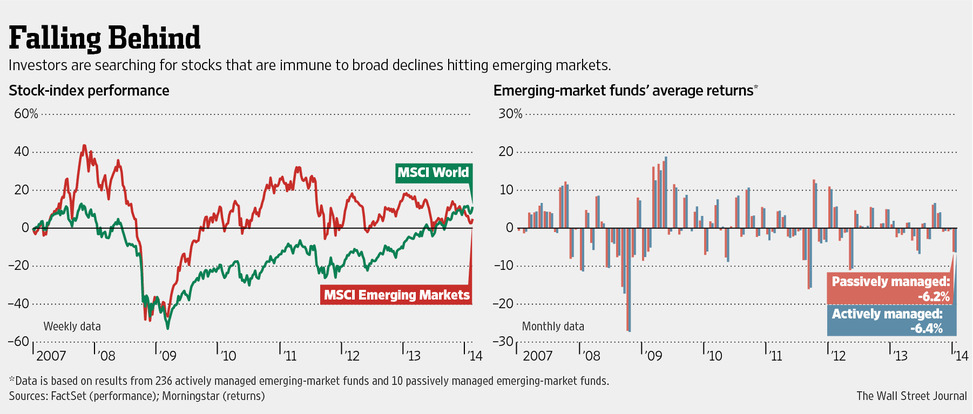
Until recently, it seemed the only way to seek refuge from the havoc in emerging markets was to avoid them completely.

Tidal shifts in U.S. Federal Reserve policy and worries about Chinese economic growth battered emerging-market stocks and bonds nearly across the board last month. The MSCI Emerging Markets Index, priced in dollars, is down 3.8% since the start of the year, and spooked investors have withdrawn billions of dollars from emerging-market funds. Read more of this post

China Fund Shifts Focus From Energy; Sovereign Fund China Investment Corp. Looks for Plays on U.S., European Recoveries

China Fund Shifts Focus From Energy

Sovereign Fund China Investment Corp. Looks for Plays on U.S., European Recoveries

LINGLING WEI

Feb. 18, 2014 12:39 p.m. ET

image001-12

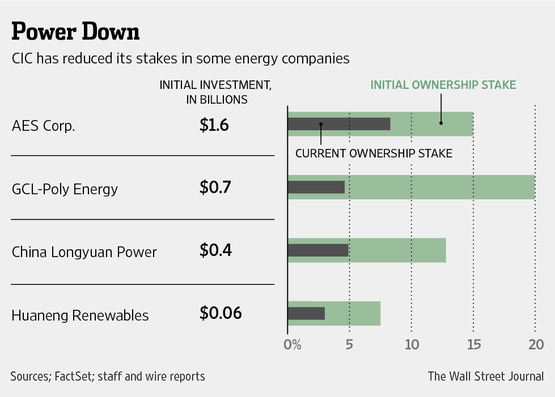
BEIJING—China Investment Corp. is selling energy and commodity holdings while seeking to capitalize on recovering U.S. and European economies, a major shift in strategy for the $600 billion sovereign-wealth fund.

Since late last year, CIC has unloaded more than $1.5 billion of shares in companies including AES Corp. AES +0.96% , a U.S. power company, and GCL-Poly Energy Holdings Ltd. 3800.HK +1.52% , a Hong Kong-listed green-energy company, according to regulatory filings by the companies. CIC, the world’s fifth-largest government-controlled fund, has also sold stakes in two other Hong Kong-traded wind-power companies, according to filings. Read more of this post

China Fuels Australian Olive-Oil Rush; Wealthy Chinese Looking Safe, Prestigious, Healthy Products

China Fuels Australian Olive-Oil Rush

Wealthy Chinese Looking Safe, Prestigious, Healthy Products

SIMON HALL And ROBB M. STEWART

Feb. 18, 2014 10:11 p.m. ET

Wealthy Chinese consumers are switching to olive oil for cooking, fueling a surge in spending on imported bottles and spurring companies to snap up olive groves in Australia to secure supplies.

The buying has been driven by shoppers looking for prestigious and healthy products that aren’t tainted by domestic food safety scandals at home. A raft of advertising campaigns showcasing the benefits of the oil not traditionally used in Chinese cuisine is also boosting demand at the expense of other cooking oils. Read more of this post

Cows are incredible: They might just keep producing more milk forever

Cows are incredible: They might just keep producing more milk forever

BY LYDIA DEPILLIS

February 17 at 2:51 pm

Along with the bright future of soybeans, this year’s long-term projections from the U.S. Department of Agriculture contained this fascinating graph of the future of growing things: Read more of this post

How Apple is following in GE’s footsteps

How Apple is following in GE’s footsteps

BY DOMINIC BASULTO

February 18 at 7:55 am

In search of growth opportunities beyond just smartphones and tablets, it now appears that Apple is willing to venture far beyond the latest wearable consumer device — such as the iWatch — and experiment with opportunities in everything from medical devices to automobiles. The latest rumor making the rounds is that Apple has considered a hookup with Elon Musk and Tesla, which would give Apple immediate access to the market for electric vehicles and pave the way for renewed growth going forward. Read more of this post

Upsetting the app cart: Asian messaging services challenge mobile order

Upsetting the app cart: Asian messaging services challenge mobile order

4:38pm EST

By Jeremy Wagstaff

(Reuters) – Asian chat services KakaoTalk, LINE and WeChat threaten to overturn the mobile order of things, usurping the role of Google Inc, Apple Inc, Amazon.com Inc, Facebook Inc and telecoms carriers as gatekeeper to the consumer.

Where these internet and telecoms giants once controlled the lucrative choke points of the industry, social messaging services are fast emerging as an alternative distribution channel for adverts, apps, and goods and services. Read more of this post

Apple looking at cars, medical devices for growth: report

Apple looking at cars, medical devices for growth: report

11:29am EST

(Reuters) – Apple Inc is looking at cars and medical devices to diversify its sources of revenue as growth from iPhones and iPads slow, according to a San Francisco Chronicle report. Read more of this post

Singapore banks to stop setting Indonesia FX reference rate

Singapore banks to stop setting Indonesia FX reference rate

Tuesday, February 18, 2014 – 21:04

Reuters

SINGAPORE – Banks in Singapore are to stop setting a reference rate for the Indonesian rupiah, the local banking and foreign exchange associations said on Tuesday, eight months after 20 banks were censured for trying to rig benchmark rates in the city-state. Read more of this post

Strategy and the Strategist: How it Matters Who Develops the Strategy

Strategy and the Strategist: How it Matters Who Develops the Strategy

Eric Van den Steen 

Harvard Business School – Competition & Strategy Unit
December 14, 2013
Harvard Business School Strategy Unit Working Paper No. 14-057

Abstract: 
This paper studies how strategy – formally defined as ‘the smallest set of (core) choices to optimally guide the other choices’ – relates to the strategist, for example, whether an optimal strategy should depend on who is CEO. The paper first studies why different people may systematically consider different decisions ‘strategic’ – with marketing people developing a marketing-centric strategy and favoring the marketing side of business – and derives two rational mechanisms for this outcome, one confidence-based and the other implementation-based. It then studies why it matters that it is the CEO and important decision makers (rather than an outsider) who formulate the strategy and shows that outsider-strategists often face a tradeoff between the quality of a strategy and its likelihood of implementation, whereas the CEO’s involvement helps implementation because it generates commitment, thus linking strategy formulation and implementation. In some sense, the paper thus explains why strategy is the quintessential responsibility of the CEO. Moreover, it shows that the optimal strategy should depend on who is CEO. It then turns that question around and studies strategy as a tool for exerting leadership, asking when the set of strategic decisions are exactly the decisions a CEO should control to give effective guidance. It finally shows how a CEO’s vision, in the sense of a strong belief, about strategic decisions makes it more likely that the CEO will propose a strategy and that that strategy will be implemented. But strong vision about the wrong decisions, such as subordinate or others’ decisions, may be detrimental to strategy and its implementation.
A coming wave of buy-outs may bring sanity to India’s utterly bonkers telecoms market

A coming wave of buy-outs may bring sanity to India’s utterly bonkers telecoms market

By Leo Mirani @lmirani 3 hours ago

An acquisition announced this morning may be the first step to fixing the unholy mess that is the world’s second-biggest telecoms market. India’s largest (and the world’s fourth-largest) mobile operator, Airtel, has acquired its smallest, Loop Mobile, for Rs 7 billion ($112 million), including Rs 4 billion in debt. Read more of this post

The Other Factor that Makes an Idea Spread

The Other Factor that Makes an Idea Spread

by Julianne Wurm  |   11:00 AM February 17, 2014

How do ideas spread? Previous research has focused on what happens to the sharers of an idea: what emotions they feel, what types of content inspire them to share (practical, funny, “sticky” and so on). And it is true that from memetics to mirror neurons to social contagion, it is likely that for any given idea, multiple factors are involved.  And yet the role of content seems to get all of the focus.  There are scores of books written about how to make your content “go viral” or “become contagious” and take on a life of its own. We seem to overlook — or at least undervalue — the role of the person delivering the idea: the carrier. Read more of this post

32 American Presidents Share Their Best Life Advice

32 American Presidents Share Their Best Life Advice

LYDIA DALLETT STRATEGY  FEB. 17, 2014, 11:25 AM

Some of them hated it. Some of them loved it. All of them learned from it.

Since George Washington’s inauguration, 44 men have occupied the White House to perform one of the most difficult jobs in the world. Some defined their terms with great accomplishments or grave misjudgments; others barely made a mark on history. Yet all strove to fulfill their mandate to the best of their abilities and live up to the incredible expectations placed upon them. Read more of this post

Samsung Builds Retail Clout in Europe, North America

Samsung Builds Retail Clout in Europe, North America

South Korean Technology Giant Tries to Expand Presence in Two of Its Largest Markets

WILL CONNORS in Toronto and SAM SCHECHNER in Paris

Feb. 18, 2014 12:22 a.m. ET

image001-7

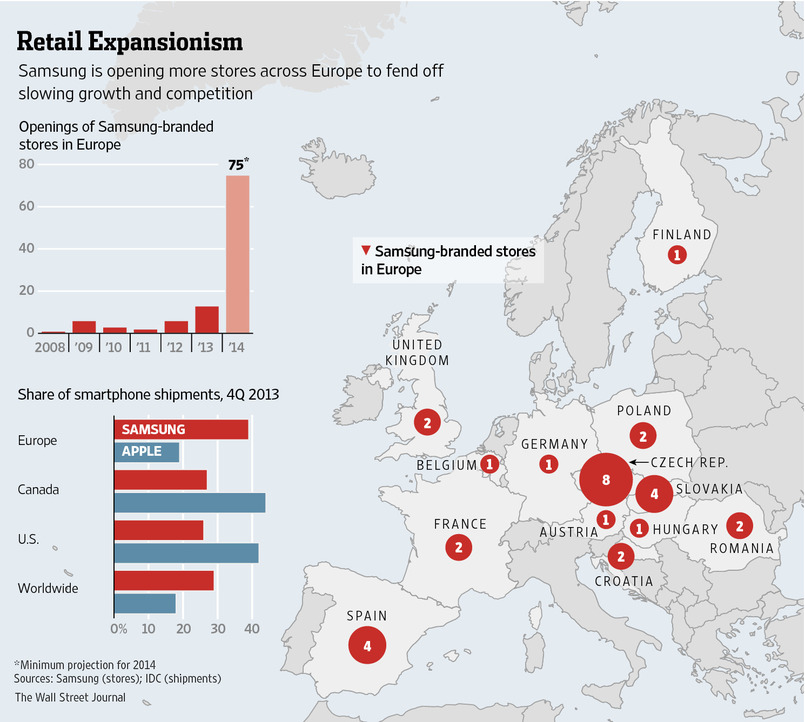
Samsung Electronics Co. 005930.SE +0.78% became the world’s biggest smartphone maker largely without the help of its own retail stores.

Now, faced with a horde of cheap, new rivals and the prospect of slowing growth, it is trying to increase its clout among consumers by expanding its retail presence in two of its largest markets—Europe and North America. Read more of this post

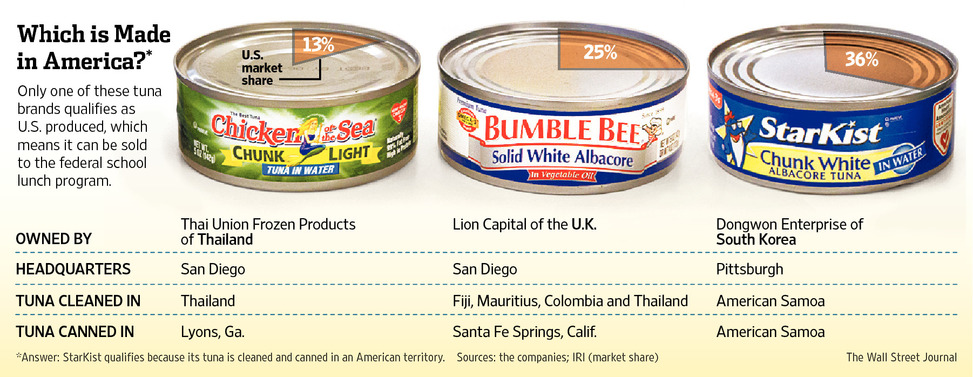
StarKist, Bumble Bee and Chicken of the Sea, the top three canned-tuna brands in the U.S., are foreign-owned, but only StarKist’s tuna qualifies for the school-lunch program. Its rivals are fighting to change that.

Tuna Firms Jostle for Uncle Sam’s Recognition

Bumble Bee, Chicken of the Sea Press for Easing of School-Lunch Program Rules

JAMES R. HAGERTY

Feb. 17, 2014 7:58 p.m. ET

The top three canned-tuna brands in the U.S. are foreign-owned, but that doesn’t stop them from bickering about which is the most American.

image001-6

At stake is their eligibility to sell tuna to the U.S. Agriculture Department for school lunches and other food programs. For now, only StarKist Co. qualifies because of a rule that any seafood the department buys must be 100% U.S.-produced. Bumble Bee Foods LLC and Chicken of the Sea International want the rules relaxed so they can sell to Uncle Sam too. Read more of this post

‘Candy Crush Saga’ Maker Publicly Files its IPO; King Digital, Which Earned $567.6 Million in 2013, Seeks Multibillion-Dollar Valuation

‘Candy Crush Saga’ Maker Publicly Files its IPO

King Digital, Which Earned $567.6 Million in 2013, Seeks Multibillion-Dollar Valuation

SVEN GRUNDBERG, TELIS DEMOS and BEN FOX RUBIN

Updated Feb. 18, 2014 10:41 a.m. ET

King Digital Entertainment PLC, the maker of the popular “Candy Crush Saga” smartphone game, said Tuesday that it filed for an initial public offering of up to $500 million on the New York Stock Exchange. Read more of this post

An investment banker at JP Morgan jumped to his death from the roof of the bank’s headquarters in HK’s Central yesterday

Investment banker jumps to death from JP Morgan’s headquarters in Central

Tuesday, 18 February, 2014, 4:49pm

George Chen, Clifford Lo and Jeanny Yu

image001-5

An investment banker at JP Morgan jumped to his death from the roof of the bank’s headquarters in Central yesterday.

Witnesses said the man went to the roof of the 30-storey Chater House in the heart of Hong Kong’s central business district and, despite attempts to talk him down, jumped to his death.

Out of respect for those involved, we cannot yet comment further. Our thoughts and sympathy are with the family that’s involved at this difficult time Read more of this post

Lee Hsien Loong on What Singapore Can – and Can’t – Teach China; Prime minister discusses the city-state’s efforts to fight graft, build institutions and set economic policy – and the ways it is and isn’t an example for China

02.17.2014 14:57

Lee Hsien Loong on What Singapore Can – and Can’t – Teach China

Prime minister discusses the city-state’s efforts to fight graft, build institutions and set economic policy – and the ways it is and isn’t an example for China

By staff reporters Hu Shuli and Zhang Hong

(Singapore) – As one of the Four Asian Tigers, Singapore is known for its strong economy and orderly society. The city-state, with its population of 5.3 million people, is listed by the World Bank as No. 4 in the world in terms of per capita income. As a regional business hub, it is lauded for its sound business reputation and the transparency of its government. Read more of this post

China Sees Big Loss of RMB Deposit amid Rise of Internet Finance

China Sees Big Loss of RMB Deposit amid Rise of Internet Finance

02-17 16:06 Caijing

Chinese lenders lost CNY94.02 billion in RMB deposit in January from a month ago.

China is losing large amount of RMB deposit as the country’s Internet giants join a race to tap into Chinese wealth explosion.

Chinese lenders lost CNY94.02 billion in RMB deposit in January from a month ago, while M1, the narrow measure of money supply, climbed 1.2 percent year-on-year, compared with a 15.3 percent surge a year ago, the central bank said Saturday. Read more of this post

Do you have the “good” kind of perfectionism? The right kind of perfectionism drives you toward success; the wrong kind shackles you with self-doubt. To spot the difference, we’ll need to investigate the blemishes in both

DO YOU HAVE THE “GOOD” KIND OF PERFECTIONISM?

THE RIGHT KIND OF PERFECTIONISM DRIVES YOU TOWARD SUCCESS; THE WRONG KIND SHACKLES YOU WITH SELF-DOUBT. HERE’S HOW TO SPOT THE DIFFERENCE.

BY DRAKE BAER

The right kind of perfectionism drives you toward success; the wrong kind shackles you with self-doubt. To spot the difference, we’ll need to investigate the blemishes in both.

Psychologists call the productivity-stifling kind of perfectionism evaluative concern perfectionism: it has self-consciousness at its center, marked by a profound concern for how others see you. As psych writer Alex Fradera reports, this leads to high levels of hassle and distress in people’s lives–and the use of avoidance as a way of dealing with problems. Because the evaluative perfectionist is so concerned with making mistakes in someone else’s eyes, they put off any tasks that might make those mistakes possible. Read more of this post

The Critical Few: Components of a Truly Effective Culture; Forget the monolithic change management programs and focus on the elements of your culture that drive performance

February 11, 2014 / Spring 2014 / Issue 74

The Critical Few: Components of a Truly Effective Culture

Forget the monolithic change management programs and focus on the elements of your culture that drive performance.

by Jon Katzenbach, Rutger von Post, and James Thomas

Sometimes corporate culture manifests itself in a make-your-own-taco party in the office kitchenette. Sometimes you can see it when an outdated phone bank is converted into an on-site ice cream shop. And sometimes it’s on display when senior leaders pick up paintbrushes to turn formerly bland office walls into electric blue work spaces. These are examples of the “Culture Blitz” at work at Southwest Airlines Company, where a 40-year culture is still going strong and is further invigorated by traveling teams who volunteer every year to visit hundreds of employees to show their appreciation. And it’s infectious. Read more of this post

‘Peak salmon’ swims into view; Slow supply growth raises ‘peak salmon’ fears

February 17, 2014 1:20 pm

Slow supply growth raises ‘peak salmon’ fears

By Emiko Terazono

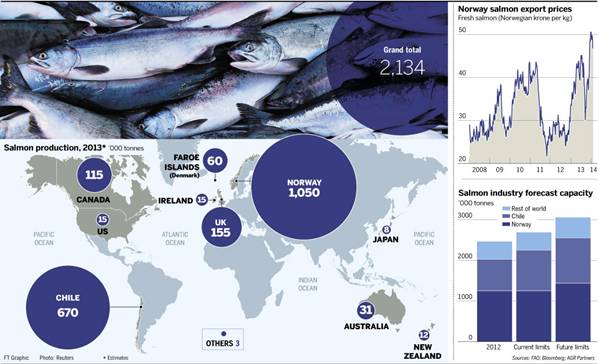
Could the world be facing “peak salmon”?

Strong demand and slowing production growth have sent prices to record highs, making life good for salmon farmers.

image001-4

Export prices from Norway, the world’s largest farmed-salmon producer, hit more than NKr50 ($8) per kg at the end of last year due to supply concerns. Read more of this post

The prodigal son parable provides an apt lesson as we strive to craft modern social policies

The Prodigal Sons

FEB. 17, 2014

David Brooks

We take as our text today the parable of the prodigal sons. As I hope you know, the story is about a father with two sons. The younger son took his share of the inheritance early and blew it on prostitutes and riotous living. When the money was gone, he returned home.

His father ran out and embraced him. The delighted father offered the boy his finest robe and threw a feast in his honor. The older son, the responsible one, was appalled. He stood outside the feast, crying in effect, “Look! All these years I’ve been working hard and obeying you faithfully, and you never gave me special treatment such as this!” Read more of this post

Three Decisions that Defined George Washington’s Leadership Legacy

Three Decisions that Defined George Washington’s Leadership Legacy

by Nick Tasler  |   9:00 AM February 17, 2014

A cynic might conclude that George Washington, the first president of the United States, owes his legacy to his towering physical stature and other superficial characteristics. The man looks like a leader, and perhaps that made him a convenient figurehead on which we  hang idealized virtues. But the cynic would be mistaken. Here are three counter-intuitive decisions Washington made that show what an exceptional leader he truly was.

1. General Washington decided not to impose a battlefield strategy on his field commanders. The general consensus among historians is that Washington was a mediocre military strategist at best.  However, a recent study in the Academy of Management Journal cast some doubt on that consensus. Read more of this post

Scaling up excellence requires idiosyncratic talent: Hayagreeva Rao, Professor

Scaling up excellence requires idiosyncratic talent: Hayagreeva Rao, Professor

Priyanka Sangani, ET Bureau Feb 14, 2014, 04.49AM IST

In 2006, Professor Hayagreeva (Huggy) Rao and Robert Sutton were teaching a short course on ‘Customer Focussed Innovation’ at Stanford University. Rao, the Atholl McBean Professor of Organizational Behaviour and Human Resources, Stanford University says that one recurring question was on how to scale up the pockets of excellence in an organization. Read more of this post

Li Ka-Shing teaches you how to buy a car & house in 5 years; Hong Kong billionaire Li Ka-Shing shares some of his money wisdom, outlining an inspirational five-year plan to improve one’s lot in life

Li Ka-Shing teaches you how to buy a car & house in 5 years

Hong Kong billionaire Li Ka-Shing shares some of his money wisdom, outlining an inspirational five-year plan to improve one’s lot in life

image001

This article is translated from the original Chinese by Edmund Ng at CeoConnectz.

Suppose your monthly income is only RMB 2,000, you can live well. I can help you put money into five sets of funds. The first $600, second $400, third $300, fourth $200, fifth $500.

The first set of funds is used for living expenses. It’s a simple way of living and you can only be assigned to less than twenty dollars a day. A daily breakfast of vermicelli, an egg and a cup of milk. For lunch just have a simple set lunch, a snack and a fruit. For dinner go to your kitchen and cook your own meals that consist of two vegetables dishes and a glass of milk before bedtime. For one month the food cost is probably $500-$600. When you are young, the body will not have too many problems for a few years with this way of living. Read more of this post

Ansell chief says the automotive manufacturers have begun to cut back on purchases

Car industry fallout ‘already here’, says condom maker Ansell

February 18, 2014

Jessica Gardiner

The demise of car making in Australia is already causing pain in the wider economy, as Ansell chief executive Magnus Nicolin says the automotive manufacturers and their suppliers have begun to cut back on purchases of the protective equipment it supplies.

Australia was one of the weaker markets that dragged back Ansell’s underlying revenue growth to just 1 per cent in the December half. Read more of this post

Ian McLeod, who has led the $1 billion profit turnaround at supermarket chain Coles, is stepping down as managing director

Coles boss Ian McLeod steps down

February 18, 2014 – 4:46PM

Eli Greenblat

image003-6

Coles managing director Ian McLeod is moving to a position in the Westfarmers group. Photo: Paul Jones

Coles boss Ian McLeod, who has led the supermarket group for more than five years and helped turn around the grocery chain, will step aside from the retailer in July to make way for new boss John Durkan. Read more of this post

IKEA napkins among substandard paper towels sold in China

IKEA napkins among substandard paper towels sold in China

Staff Reporter

2014-02-18

Napkins sold by Swedish furniture giant IKEA have been identified as one of several substandard items sold in China and Hong Kong after undergoing tests by the Beijing Consumer Association, reports Hong Kong newspaper Ming Pao.

The Fantastisk napkin made by IKEA and sold at its Beijing, Shanghai and Hong Kong outlets, were among the 14 items found to be substandard by the association out of 30 samples randomly selected from stores in more than 10 provinces and municipalities including Beijing, Shanghai, Tianjin, Hebei, Shandong, Jiangsu, Fujian and Guangdong. Read more of this post

Jim Rogers Tells Us What Everyone Keeps Getting Wrong About China

Jim Rogers Tells Us What Everyone Keeps Getting Wrong About China

MAMTA BADKAR MARKETS  FEB. 17, 2014, 11:48 PM

Concerns about a Chinese hard-landing set off by Beijing’s efforts to deflate the credit bubble are making headlines again.

GDP growth slowed to 7.7% in 2013, the lowest level in 14 years. And the slowdown has played a part in the emerging markets rout we have seen recently. But recent tradeand lending data, and Lunar New Year saleshave come in better than expected.

We reached out to Jim Rogers, chairman of Rogers Holdings , to get his thoughts on the slowdown and on what everyone is getting wrong about China. Read more of this post

Nobel Winner’s Frank Advice to China’s Leadership

Nobel Winner’s Frank Advice to China’s Leadership

By JONATHAN SCHLEFERFEB. 17, 2014

CAMBRIDGE, Mass. — A. Michael Spence won the Nobel Memorial Prize in Economic Science in 2001 for esoteric research on how people make decisions when critical information is hard to obtain. But by that time, after more than a decade and a half as an academic dean at Harvard and Stanford, many of Mr. Spence’s colleagues had begun referring to him as a “former economist.” Read more of this post