Privatisation: The $9 trillion sale; Governments should launch a new wave of privatisations, this time centred on property

Privatisation: The $9 trillion sale; Governments should launch a new wave of privatisations, this time centred on property

Jan 11th 2014 | From the print edition

IMAGINE you were heavily in debt, owned a large portfolio of equities and under-used property and were having trouble cutting your spending—much like most Western governments. Wouldn’t you think of offloading some of your assets?

Politicians push privatisation at different times for different reasons. In Britain in the 1980s, Margaret Thatcher used it to curb the power of the unions. Eastern European countries employed it later to dismantle command economies. Today, with public indebtedness at its highest peacetime level in advanced economies, the main rationale is to raise cash. Read more of this post

South Korea’s housing market: Landlords are having to ditch a century-old rental system

South Korea’s housing market: Landlords are having to ditch a century-old rental system

Feb 15th 2014 | SEOUL | From the print edition

MOST South Korean urbanites would leap at the chance to part with $150,000 to rent a smallish flat for three years in Seoul, the capital. These days, however, most Korean landlords would spurn such a measly deposit. Read more of this post

Western Union: Finance in purgatory; The wonderful, awful business of international transfers

Western Union: Finance in purgatory; The wonderful, awful business of international transfers

Feb 15th 2014 | NEW YORK | From the print edition

ON FEBRUARY 11th Western Union’s executives glossed over a decline in earnings and revenues in an upbeat call. But a day earlier five law firms had cast light on some of its troubles when they petitioned a court to represent its shareholders in lawsuits related to dealings with financial regulators. Read more of this post

The Loch Ness consensus: Countries make macroeconomic policy by themselves for themselves. Should they?

The Loch Ness consensus: Countries make macroeconomic policy by themselves for themselves. Should they?

Feb 15th 2014 | From the print edition

image001-16

“INTERNATIONAL policy co-ordination is like the Loch Ness monster,” Olivier Blanchard and Jonathan Ostry of the IMF wrote recently. It is “much discussed but rarely seen”. The oddity was sighted in New York in 1985, when the big economies conspired to weaken the dollar. It resurfaced two years later in Paris, when they decided to stop the greenback’s fall. Some also claim to have witnessed it in Washington in 2008, when the G20 group of big economies agreed to fight the financial crisis with simultaneous fiscal stimulus. Read more of this post

The growth paradox: Past economic growth does not predict future stockmarket returns

The growth paradox: Past economic growth does not predict future stockmarket returns

Feb 15th 2014 | From the print edition

EMERGING stockmarkets go in and out of fashion. They were battered during the Asian and Russian crises of the late 1990s, but then recovered to offer double-digit annual returns in the first decade of the 21st century. Since 2010, however, they have reverted to underperforming their developed-country rivals. Read more of this post

The petrostate of America: The energy boom is good for America and the world. It would be nice if Barack Obama helped a bit

The petrostate of America: The energy boom is good for America and the world. It would be nice if Barack Obama helped a bit

Feb 15th 2014 | From the print edition

image001-15

“RISE early, work hard, strike oil.” The late oil baron J. Paul Getty’s formula for success is working rather well for America, which may already have surpassed Russia as the world’s largest producer of oil and gas (see article). By 2020 it should have overtaken Saudi Arabia as the largest pumper of oil, the more valuable fuel. By then the “fracking” revolution—a clever way of extracting oil and gas from shale deposits—should have added 2-4% to American GDP and created twice as many jobs than carmaking provides today. Read more of this post

The parable of Argentina: There are lessons for many governments from one country’s 100 years of decline

The parable of Argentina: There are lessons for many governments from one country’s 100 years of decline

Feb 15th 2014 | From the print edition

A CENTURY ago, when Harrods decided to set up its first overseas emporium, it chose Buenos Aires. In 1914 Argentina stood out as the country of the future. Its economy had grown faster than America’s over the previous four decades. Its GDP per head was higher than Germany’s, France’s or Italy’s. It boasted wonderfully fertile agricultural land, a sunny climate, a new democracy (universal male suffrage was introduced in 1912), an educated population and the world’s most erotic dance. Immigrants tangoed in from everywhere. For the young and ambitious, the choice between Argentina and California was a hard one. Read more of this post

The Race Underground: Boston, New York, and the Incredible Rivalry that Built America’s First Subway

America’s first subways: Boston loves New York; What America learned about building subways

Feb 15th 2014 | From the print edition

The Race Underground: Boston, New York, and the Incredible Rivalry that Built America’s First Subway. By Doug Most. St Martin’s Press; 404 pages; $27.99. Buy from Amazon.comAmazon.co.uk

IF THEY were not such rivals, New York and Boston could be twinned. Their strengths make a good fit: New York sees itself as the cultural and financial capital of America; Boston has claims to be its academic and intellectual centre. So the two cities make an impressive team when they channel their aggression, as they did in their earnest yet friendly race to build America’s first subway around the turn of the 20th century. Read more of this post

The time is ripe for a good book about Hillary Clinton’s view of the world

The time is ripe for a good book about Hillary Clinton’s view of the world

Feb 15th 2014 | From the print edition

HRC: State Secrets and the Rebirth of Hillary Clinton. By Jonathan Allen and Amie Parnes. Crown; 440 pages, $26. Hutchinson; £20. Buy from Amazon.com,Amazon.co.uk

AS SECRETARY OF STATE until 2013, Hillary Clinton was chief foreign envoy for a president who came into office burdened with impossible expectations. Barack Obama’s to-do list included slowing global warming, ending the Iraq war, setting Afghanistan on its feet, defanging al-Qaeda, mending ties with Muslims, devoting more military and economic attention to Asia, preventing Iran from building the bomb and—in his own words—restoring America’s image as “the last, best hope on Earth”. He duly fell short. Sometimes, the fault lay elsewhere: with foreign leaders, domestic opponents and events immune even to Mr Obama’s charms. Read more of this post

The science of love at first sight

The science of love at first sight

Feb 12th 2014, 23:50 by N.L. | CHICAGO

BIOLOGISTS believe that love is fundamentally a biological rather than a cultural construct. That is because the capacity for love is found in all human cultures and similar behaviour is found in some other animals, such as prairie voles. In humans the purpose of all the cravings, craziness and desire is to focus attention on the raising of offspring. Children demand an unusual amount of nurturing, and two parents are better than one. Love is a signal that both partners are committed, and makes it more likely that this commitment will continue as long as is necessary for children to reach independence. But what does science have to say about the notion of love at first sight? Read more of this post

Unemployment in America: Closing the gap; America’s labour market has suffered permanent harm

Unemployment in America: Closing the gap; America’s labour market has suffered permanent harm

Feb 15th 2014 | From the print edition

IT TOOK barely a month for the bubble of optimism that formed over the American economy at the start of the year to deflate. Job growth slowed sharply in December, and stayed weak in January, suggesting more than bad weather was to blame. Read more of this post

Why America Has Such A High Rate Of Payment-Card Fraud

Why America Has Such A High Rate Of Payment-Card Fraud

THE ECONOMIST RETAIL  FEB. 15, 2014, 3:25 AM

AMERICA leads the world in many categories: shale-gas production, defence spending, incarceration rates and, alas, payment-card fraud. In December Target, an American retailer, said that hackers had breached its network and stolen payment-card details of about 40m of its customers. Read more of this post

Content strategy is king in social media

Content strategy is king in social media

David Dubois, INSEAD | Business | Sat, February 15 2014, 2:54 PM

Coffee lovers often have a chosen venue because it’s a great place to hang out. But without the rich aromas and great tasting coffee that they serve, would they still go there if there was nothing to drink?
For the most successful companies operating in the realms of social media, they’ve got the fresh content, they’ve brought the crowd and as long as they keep serving up this gourmet content, they’ve got a winning virtual hangout. Read more of this post

Three things your c-suite can learn from family businesses

Three things your c-suite can learn from family businesses 

Dominique Turpin, IMD | Business | Sat, February 15 2014, 2:59 PM

Happy families are all alike, Leo Tolstoy wrote at the start of his novel Anna Karenina.
His observation applies to good family-controlled businesses too. They come in all shapes and sizes—from small enterprises to global companies such as Maersk, Cargill and Samsung—but the best are very similar in some ways. Read more of this post

With more than 7,600 pharmacies and the largest U.S. chain of retail health clinics, CVS is one of the country’s largest health-care companies

SATURDAY, FEBRUARY 15, 2014

Healthy Gains Ahead for CVS

By JACK HOUGH | MORE ARTICLES BY AUTHOR

With more than 7,600 pharmacies and the largest U.S. chain of retail health clinics, CVS is one of the country’s largest health-care companies.

Smokers who quit the habit can look forward not only to pinker lungs but also fatter wallets. CVS Caremark, which announced on Feb. 5 it will stop selling tobacco by October, may also win more profit than it loses from the move. Its profit comes increasingly from health plans, which aren’t keen on carcinogens. Consider: CVS’ tobacco decision is expected to subtract six to nine cents from its yearly earnings per share. But a prescription deal with the Federal Employee Health Program, which expires at year’s end, is worth 16 cents to 21 cents a share, estimates investment bank Mizuho Securities. For CVS (ticker: CVS), a good chance at renewal just became better, and there’s plenty more business to be won. Read more of this post

Lease-to-own instalment provider Singer Thailand has been stung by a rising number of non-performing loans, with most attributed to farmers who are suffering from long-delayed payments under the government’s rice-pledging scheme

Farmers’ plight driving up Singer Thailand’s NPLs

Sucheera Pinijparakarn
The Nation February 15, 2014 1:00 am

Lease-to-own instalment provider Singer Thailand has been stung by a rising number of non-performing loans, with most attributed to farmers who are suffering from long-delayed payments under the government’s rice-pledging scheme.

The company’s managing director, Boonyong Tansakul, said farmers accounted for 25 per cent of its portfolio. Read more of this post

How to Make Yourself Work When You Just Don’t Want To; Reason #1 You are putting something off because you are afraid you will screw it up

How to Make Yourself Work When You Just Don’t Want To

by Heidi Grant Halvorson  |   12:00 PM February 14, 2014

There’s that project you’ve left on the backburner – the one with the deadline that’s growing uncomfortably near.  And there’s the client whose phone call you really should return – the one that does nothing but complain and eat up your valuable time.  Wait, weren’t you going to try to go to the gym more often this year?

Can you imagine how much less guilt, stress, and frustration you would feel if you could somehow just make yourself do the things you don’t want to do when you are actually supposed to do them?  Not to mention how much happier and more effective you would be? Read more of this post

Mindfulness in the Age of Complexity

March 2014

Mindfulness in the Age of Complexity

An Interview with Ellen Langer by Alison Beard

Over nearly four decades, Ellen Langer’s research on mindfulness has greatly influenced thinking across a range of fields, from behavioral economics to positive psychology. It reveals that by paying attention to what’s going on around us, instead of operating on auto-pilot, we can reduce stress, unlock creativity, and boost performance. Her “counterclockwise” experiments, for example, demonstrated that elderly men could improve their health by simply acting as if it were 20 years earlier. In this interview with senior editor Alison Beard, Langer applies her thinking to leadership and management in an age of increasing chaos. Read more of this post

John Maynard Keynes, Investment Innovator

Journal of Economic Perspectives—Volume 27, Number 3—Summer 2013—Pages 213–228cle Citation

Chambers, David, and Elroy Dimson. 2013. “Retrospectives: John Maynard Keynes, Investment Innovator.” Journal of Economic Perspectives, 27(3): 213-28.
John Maynard Keynes made a major contribution to the development of professional investment management. Based on detailed archival research at King’s College, Cambridge, we describe Keynes’ investment philosophy, his investment performance, and the evolution of his investment approach as the manager of a large educational endowment. His portfolios were actively managed and unconventional. He was an investment innovator both in making a substantial allocation to the then new institutional asset class of common stocks as well as in championing value investing.

Why Writers Are the Worst Procrastinators; “Work finally begins when the fear of doing nothing exceeds the fear of doing it badly.”

Why Writers Are the Worst Procrastinators

By Megan McArdle

Like most writers, I am an inveterate procrastinator. In the course of writing this one article, I have checked my e-mail approximately 3,000 times, made and discarded multiple grocery lists, conducted a lengthy Twitter battle over whether the gold standard is actually the worst economic policy ever proposed, written Facebook messages to schoolmates I haven’t seen in at least a decade, invented a delicious new recipe for chocolate berry protein smoothies, and googled my own name several times to make sure that I have at least once written something that someone would actually want to read. Read more of this post

What I Learned From Ray Dalio: Lessons from the world’s greatest macro investor.

What I Learned From Ray Dalio: Lessons from the world’s greatest macro investor.

By Samuel Lee | 02-11-14 | 06:00 AM | Email Article

A version of this article was published in the December 2013 issue of Morningstar ETFInvestor. Download a complimentary copy here.

I try to learn from the best. Ray Dalio is one of them. He founded Bridgewater Associates, one of the biggest hedge funds in the world. Many retail investors have not heard of him, probably because his funds are open only to big institutions. It’s a terrible mistake to limit yourself to listening only to the musings of mutual fund managers. Doing so means that you will ignore many of the best investors.

Dalio’s perspective is invaluable. He’s willing to entertain seemingly loony ideas. For example, in 2001 he had his firm develop a depression gauge. In 2003, Nobel Prize-winning economist Robert Lucas declared that the “central problem of depression prevention has been solved, for all practical purposes, and has in fact been solved for many decades.” Five years later, in late 2008, Dalio’s depression gauge went off. Bridgewater was one of the few firms that anticipated and successfully navigated the financial crisis and its aftermath. Unlike many other money managers, Bridgewater predicted low interest rates and low inflation even after the Federal Reserve and other central banks worldwide embarked on rounds of massive and unconventional monetary stimulus.

A great deal of Dalio’s success owes to his admirable willingness to admit error and self-correct. He expects the same of his workers. He says, “At Bridgewater people have to value getting at truth so badly that they are willing to humiliate themselves to get it.”

In many respects, Dalio is the anti-Warren Buffett. Buffett makes big bets on a handful of companies. Dalio makes many small bets on currency pairs, commodities, bonds, and, to a much lesser extent, equities. Buffett grants his subordinates plenty of autonomy and lets them figure out their own way. Dalio imposes a set of principles that his subordinates are to live by and heavily monitors them. Buffett doesn’t give much thought to economic cycles. Dalio’s investing style is based on identifying and navigating them. Buffett doesn’t like gold. Dalio thinks everyone should own a little bit of it.

Because Dalio’s found success in such an unconventional way, his methods are a rich vein to mine for lessons. After all, successful investing requires delinking your perspective from the consensus. Here are some of the most important lessons I learned from Dalio and his colleagues at Bridgewater.

The long- and short-term debt cycles are the biggest reasons the economy deviates from trend-line growth.
According to Dalio, the economy’s behavior can be largely explained by three forces: trend productivity growth, the long-term debt cycle, and the short-term debt cycle. Productivity growth occurs due to technological progress and is the most important force over century-long scales. Exhibit 1 is a chart reproduced from Dalio’s paper, “How the Economic Machine Works.” It shows trend growth of per-capita income has been steady, especially after World War II.
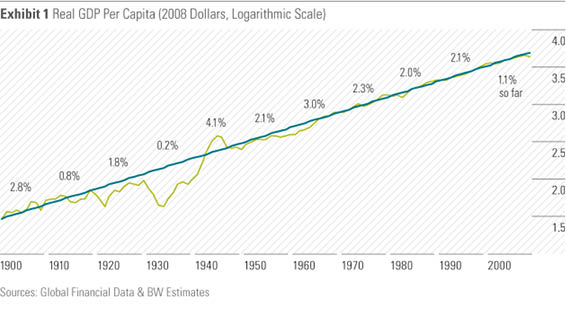
image001-11
 

Over, say, five to seven years, the short-term debt cycle dominates. It occurs when the central bank tightens and loosens credit. It’s also known as the business cycle. When credit and money grow faster than real economic production, inflation rises, spurring the central bank to raise interest rates and tighten credit, leading to a recession. When inflation is under control, the central bank lowers interest rates and loosens credit to spur economic growth. Many investors focus on where they are in the short-term cycle.

So far, Dalio’s model is conventional. His key insight is observing that there’s a long-term debt cycle, which operates over decades. During the leveraging phase of the cycle, debts rise faster than incomes in a self-perpetuating manner. Households and firms borrow money, which they spend. Because someone’s spending is another’s income, overall spending—the economy—grows. Asset prices go up. With greater incomes and more valuable assets, firms and households borrow even more and lenders are eager to lend. And the cycle continues. Part of the growth in incomes and asset prices during this phase is illusory; rising leverage has the effect of pulling forward wealth from the future.

While the process can go on for a long time, debts cannot rise faster than income forever. The process hits a wall when the central bank can no longer stimulate the economy because the short-term interest rate required to restore full employment is below zero.
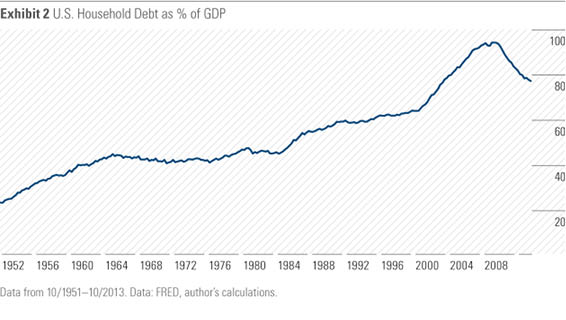
image002-3
 

According to Dalio, deleveragings are achieved through four channels: 1) debt write-downs; 2) the transfer of wealth from the haves to the have-nots; 3) austerity; and 4) money printing. The first three channels are deflationary. Money printing is inflationary.

How a deleveraging evolves depends on the relative contributions of deflationary and inflationary forces. Because deleveragings occur once a lifetime, policymakers don’t know how to manage them. Guided by conventional wisdom, they usually turn to austerity and debt restructurings to bring down debt levels. The result is an “ugly” deleveraging, during which the economic pain is worsened and the debt/income ratio actually rises because incomes fall faster than debts. Policymakers see that their medicine isn’t working and turn to fiscal stimulus and money printing to ease the burden. This is what occurred in the U.S. in the 1930s and in Europe in the aftermath of the financial crisis.

If authorities balance deflationary interventions with the right amount of money printing, the deleveraging enters a “beautiful” phase. The pain of debt write-downs is spread out. Growth is subdued, as the economy must rely on productivity improvements to grow. The United States is undergoing the most beautiful deleveraging in history, according to Bridgewater. This puts Bridgewater in an unusual camp. Of Ben Bernanke and America’s central bankers, Bridgewater co-president David McCormick has said, “History will look back on them as having responded in a way that was both necessary and heroic.”

Deleveragings take decades to work themselves out. According to this model, we’ve still a long way to go before short-term interest rates rise.

Study distant times and distant places to understand what’s going on today and how events will probably transpire in the future.
Many investors were caught flat-footed by the financial crisis and the way assets behaved in its after-math. They assumed the ghost of the Great Depression or post-bubble Japan would never visit the U.S.

Dalio, on the other hand, studied the great inflation of Weimar Germany, the Great Depression in the U.S., Latin America in the 1980s, post-1990 Japan, and other economic disasters. He seriously considered whether such events could transpire again and what caused them.

Conventional economists and investors on Wall Street focus on post-World War II data for several reasons. First, many believe old data is misleading because the economy has changed so much. Second, many data sets begin only in the 1960s or 1970s. Finally, the possibility of extreme outcomes implied by the historical record and foreign experience is frightening and easy to rationalize as irrelevant.

There’s no such thing as correlation.
Many investors diversify their portfolios based on historical correlations between asset classes. Bridgewater argues that correlation is not a real thing. It is a statistical artifact of the idiosyncratic economic shocks that affected the assets examined in the past.

It makes perfect sense. Different asset classes react in rational, fairly predictable ways to different economic conditions. Assuming a historical correlation will hold going forward is a bet that future economic conditions will, on average, look like the past. This is rarely true, which is why correlations are fairly unpredictable.

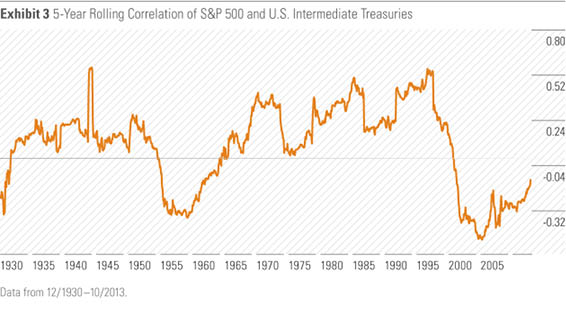
Exhibit 3 shows the rolling five-year correlation of the monthly returns of the S&P 500 and the Ibbotson Associates Intermediate Treasury Bond Index. The sign doesn’t switch randomly. There seem to be long-lived regimes.

image003-2

According to Dalio, stocks and bonds are both positively correlated when inflation expectations are more volatile than growth expectations, and negatively correlated when they’re not. This makes sense, as inflation uncertainty strongly affects the market’s discount rate. When discount rates rise, both stocks and bonds are hurt, and vice versa.

Bridgewater calls this type of analysis the “structural” approach to correlation. Based on it, Dalio invented the now-famous “risk parity” strategy, which attempts to balance a portfolio’s exposures to rising growth, falling growth, rising inflation, and falling inflation such that it’s not severely hurt when the economic environment changes


 

AussieCommerce heads up-market, eyes IPO

AussieCommerce heads up-market, eyes IPO

Published 13 February 2014 09:48, Updated 14 February 2014 09:07

James Hutchinson

+font-fontprint

image001-10

Jeremy Same and Adam Schwab of Deals.com.auPhoto: Josh Robenstone

The chief executive of fast-growing online retail outfit AussieCommerce, Adam Schwab, says the company is moving away from group-buying deals as it mulls a public listing on the Australian Securities Exchange. Read more of this post

Business is not a decathlon: why entrepreneurs should concentrate on one thing at a time

Business is not a decathlon: why entrepreneurs should concentrate on one thing at a time

Published 13 February 2014 08:54, Updated 14 February 2014 09:07

Vaughn Richtor

If there’s one thing entrepreneurs tend to excel at, it’s identifying opportunities.

Asking the question “what if . . . ?” and coming up with creative ideas are an entrepreneur’s forte, and the cornerstone on which many great businesses are built. The question is: if so many businesses start with great ideas, then why do so many businesses fail? Read more of this post

How I built Roses Only, why I sold it, and what’s next: founder James Stevens; Roses Only: The $30 million reason Jack Singleton is looking forward to Valentine’s Day

Caitlin Fitzsimmons Online editor

How I built Roses Only, why I sold it, and what’s next: founder James Stevens

Published 13 February 2014 11:56, Updated 14 February 2014 09:07+font-fontprintEmail page

image001-7

RosesOnly founder James Stevens is “bullish about Asia”. Photo: Nic Walker

For James Stevens, the sale of Roses Only in Australia and New Zealand to Jack Singleton’s FlowersCorp is only the end of the beginning.

Stevens retains the right to the Roses Only brand and owns the associated domain name in every market outside Australia and New Zealand and he has big growth plans for Asia. Read more of this post

Turkish next-gens are placing greater importance on corporate governance and professionalisation of their family businesses than preceding generation

TURKISH NEXT-GENS PUSHING FOR PROFESSIONALISATION

ARTICLE | 14 FEBRUARY, 2014 10:35 AM | BY JESSICA TASMAN-JONES

Turkish next-gens are placing greater importance on corporate governance and professionalisation of their family businesses than preceding generations, according to new research released today.

In total only 52% of family businesses in the country have a succession plan for the next generation, and only 23% have an estate plan, according to Turkish wealth builders: Family businesses cultivate economic growth, completed by Campden Wealth in conjunction with UBS. Read more of this post

Ummm, what are we doing this year?: big disconnect between managers and staff; If the boss has a plan, one-third of empoyees don’t know what it is.

Fiona Smith Columnist

Ummm, what are we doing this year?: big disconnect between managers and staff discovered

Published 12 February 2014 12:23, Updated 13 February 2014 08:57

If the boss has a plan, one-third of empoyees don’t know what it is.

A survey taken last week finds that 83 per cent of leaders and managers claim to have a business plan for 2014, but only 66 per cent of employees agree.

The survey was conducted by Leadership Management Australasia and its CEO, Andrew Henderson, says it is concerning that one-third of employees says their organisations have started the new work year without a plan. Read more of this post

Age and Scientific Genius

Age and Scientific Genius

Benjamin Jones, E.J. Reedy, Bruce A. Weinberg

NBER Working Paper No. 19866
Issued in January 2014
Great scientific output typically peaks in middle age. A classic literature has emphasized comparisons across fields in the age of peak performance. More recent work highlights large underlying variation in age and creativity patterns, where the average age of great scientific contributions has risen substantially since the early 20th Century and some scientists make pioneering contributions much earlier or later in their life-cycle than others. We review these literatures and show how the nexus between age and great scientific insight can inform the nature of creativity, the mechanisms of scientific progress, and the design of institutions that support scientists, while providing further insights about the implications of aging populations, education policies, and economic growth.


Why major creative breakthroughs happen in your late thirties; Genius, it seems, happens when a seasoned mind sees a problem with fresh eyes

Why major creative breakthroughs happen in your late thirties

By Olga Khazan, The Atlantic an hour ago

James Murphy, the former frontman of the band LCD Soundsystem, made what he called the biggest mistake of his life at 21, when he turned down a writing job on a sitcom that was about to launch.

The sitcom’s name was Seinfeld. Read more of this post

Graduate glut: 12,000 new lawyers every year in Australia

Graduate glut: 12,000 new lawyers every year

February 14, 2014

Edmund Tadros

Law students are being urged to look beyond the legal field for career options, as a massive oversupply of graduates floods into a tough job market.

The number of law students has doubled in the past decade, with more than 12,000 graduates now entering a job market that comprises about 60,000 solicitors each year. Read more of this post

Why New Zealand is the new Ireland; New Zealand’s economy has been the subject of plenty of hype lately, but some say a reality check is coming, and it’s going to hurt

Why New Zealand is the new Ireland

February 14, 2014

New Zealand’s economy has been the subject of plenty of hype lately, but some say a reality check is coming, and it’s going to hurt.

New Zealand is “like Ireland in 2007” and it’s only a matter of time before its currency takes a hit according to one analyst. Read more of this post