Greetings for Ramadan: The politics of good wishes

Greetings for Ramadan: The politics of good wishes

Jun 30th 2014, 15:39 by B.C.

AS MUSLIMS all over the world face the tough slog of mixing daily work with dawn-to-dusk fasting, at a time when days in the northern hemisphere are formidably long, they can at least be assured that their political leaders wish them well—especially in the English-speaking countries.

In the Anglosphere, but not in most other Western countries, offering warm words to Muslim citizens as they begin their fast has become an annual ritual, just like a Christmas or Easter message. David Cameron’s was particularly warm, effusive and substantial this year, whereas the greeting offered by Barack Obama was more modest in scope than in previous years. For example, the message from the White House pointedly avoided any reference to Arab struggles for democracy and confined itself to generalities about the Muslim belief in care for others and community spirit. Canada’s prime minister Stephen Harper was more concise, but he recalled that Ramadan was “a time for fasting, worship and contemplation as well as a time to share with family, friends and community.”

Read more at http://www.economist.com/blogs/erasmus/2014/06/greetings-ramadan

Who Billionaire Reid Hoffman Calls To Feel Inspired

Who Billionaire Reid Hoffman Calls To Feel Inspired

ALYSON SHONTELL TECH  JUL. 1, 2014, 5:03 AM

Who does someone who’s already incredibly successful call when they want to dream up new, successful ideas?

Billionaire LinkedIn founder ReidHoffman has three go-to people he calls when he wants to be inspired: Tesla founder Elon Musk, former PayPal CTO Max Levchin, and PayPal cofounder Peter Thiel.

Levchin, Thiel, and Hoffman are all considered part of the “PayPal mafia,” a group of successful people who were early employees or founders at the eBay-owned payment company.

“For macroeconomic, financial, bold models, I’ll call Peter [Thiel],” Hoffman explained to Bloomberg’s Emily Chang. “The intersection of kind of interesting business models or business technology, things like big data, Max Levchin. For a willingness to just think super big [where] risk is not a variable, Elon [Musk].”

When asked what they call him for, Hoffman laughed and said, “A view of the Valley.”

“Like, OK, I’m thinking about X, who are the right people to talk to about X, you know, and what can work on this?” Hoffman said.

From http://www.businessinsider.sg/who-billionaire-reid-hoffman-calls-for-inspiration-2014-6/#.U7LhMvmSxqU

Morning Bamboo Insight: 03/07/2014

Morning Bamboo Insight

Macro

1. You may want to ignore the ‘next big thing’ in mutual funds; You may want to ignore the ‘next big thing’ in mutual funds

http://www.marketwatch.com/story/the-next-big-thing-in-mutual-funds-2014-06-30/print?guid=0E00C80A-006B-11E4-B2B1-00212803FAD6

Asia Pacific

1. Bullet Train Set to Slash Travel Time From Jakarta To Bandung

http://www.thejakartaglobe.com/news/bullet-train-set-slash-travel-time-jakarta-bandung/

2. Lessons of 1997 to help Thailand against future crises

http://www.nationmultimedia.com/business/Lessons-of-1997-to-help-Thailand-against-future-cr-30237562.html

3. Beijing has banned Ramadan for many Muslims in Xinjiang

http://qz.com/229329/beijing-has-banned-ramadan-for-many-muslims-in-xinjiang/

4. Beijing Plans 10,000 Rapid-Charging Stations, but They Won’t Support Tesla

http://english.caixin.com/2014-07-02/100698704.html

5. Korea remains ‘Republic of Suicide’

http://koreajoongangdaily.joins.com/news/article/article.aspx?aid=2991496

6. Orion chairman raked in dividends; “Orion is giving all the work to IPak and in return it is compensating Dam through dividends”

http://koreajoongangdaily.joins.com/news/article/article.aspx?aid=2991487

7. Confusing Messages For Investors And Multinationals From China’s Healthcare Reforms

http://www.forbes.com/sites/benjaminshobert/2014/07/01/confusing-messages-for-investors-and-multinationals-from-chinas-healthcare-reforms/print/

8. Finding new ways to curb insider trading in Singapore

http://business.asiaone.com/print/news/finding-new-ways-curb-insider-trading

9. Korea’s cigarette prices among the world’s lowest

http://news.asiaone.com/print/news/asia/korea%E2%80%99s-cigarette-prices-among-world%E2%80%99s-lowest

10. Former Indonesian Constitutional Court chief gets life sentence

http://news.asiaone.com/print/news/asia/former-indonesian-constitutional-court-chief-gets-life-sentence

Life

1. You can make a state-of-the-art hospital out of bamboo

http://qz.com/228319/you-can-make-a-state-of-the-art-hospital-out-of-bamboo/

2. Leaders motivated by power over others will not thrive in this new world

http://blogs.hbr.org/2014/07/leadership-is-about-to-get-more-uncomfortable/

3. The Content Marketing Revolution

http://blogs.hbr.org/2014/07/the-content-marketing-revolution/

4. Four ways your business can beat the imitators: health.com.au co-founder Andy Sheats

http://www.brw.com.au/p/leadership/four_ways_your_business_founder_RMAeT3KVXc0WpCao3EwAPN

5. Startups Anonymous: 25 questions founders are too embarrassed to ask

http://pando.com/2014/07/02/startups-anonymous-25-questions-founders-are-too-embarassed-to-ask/

6. 8 Great Pieces Of Startup Advice From 4 Silicon Valley Stars Under 30

http://www.forbes.com/sites/jeffbercovici/2014/07/01/8-great-pieces-of-startup-advice-from-4-silicon-valley-stars-under-30/print/

TMT

1. Intelligent cars draw investors to tech stocks

http://www.reuters.com/article/2014/07/02/us-tech-autos-stocks-idUSKBN0F70H320140702?feedType=RSS&feedName=businessNews

2. Big data’s dirty problem

http://fortune.com/2014/06/30/big-data-dirty-problem/

Evening Bamboo Insight: 02/07/2014

Evening Bamboo Insight

Macro

1. Regulator says ‘crony capitalism’ undermines Italy’s economy

http://www.ft.com/intl/cms/s/0/b4a80580-005f-11e4-8aaf-00144feab7de.html

2. A proposal to require auditors to disclose “critical audit matters” in their reports has generated apprehension among audit firms and pushback from CFO

http://ww2.cfo.com/auditing/2014/07/nothing-critical/view-all/

3. Finance Principles Apply to CEO Succession; Counterintuitively, a poorly performing company should look inside for its next CEO, research suggests

http://ww2.cfo.com/leadership/2014/07/finance-principles-apply-ceo-succession/view-all/

4. Study On How Investment Horizon Impacts Corporate Decision-Making

http://public-prod-acquia.gsb.stanford.edu/sites/default/files/2014_Investment-Horizon-Final_0.pdf

Asia Pacific

1. “House-for-pension” a bitter option in graying China http://news.xinhuanet.com/english/indepth/2014-07/01/c_126692496.htm?utm_source=The+Sinocism+China+Newsletter&utm_campaign=f7791df4c2-Sinocism07_01_14&utm_medium=email&utm_term=0_171f237867-f7791df4c2-29575541&mc_cid=f7791df4c2&mc_eid=826a915859

2. German Auto Parts Provider Decides China Market beyond Repair; For three years Stahlgruber tried to standardize the industry, but was unable to thrive in ‘chaotic’ market

http://english.caixin.com/2014-06-30/100697596.html?utm_source=The+Sinocism+China+Newsletter&utm_campaign=f7791df4c2-Sinocism07_01_14&utm_medium=email&utm_term=0_171f237867-f7791df4c2-29575541&mc_cid=f7791df4c2&mc_eid=826a915859

3. Infosys’ New CEO Will Have to Work Harder to Establish Moral Ground: Shibulal

http://forbesindia.com/article/exit-interview/infosys-new-ceo-will-have-to-work-harder-to-establish-moral-ground-shibulal/38098/1

4. Why Hong Kong’s Entrepreneurial Reputation Is Growing

http://www.forbes.com/sites/freddiedawson/2014/06/30/why-hong-kongs-entrepreneurial-reputation-is-growing/print

5. Hundreds of thousands of protesters, some waving colonial-era flags and chanting anti-Beijing slogans, staged a pro-democracy march in rain-soaked Hong Kong that organisers say could be the largest since the city was handed back to China

http://www.channelnewsasia.com/news/asiapacific/thousands-gather-for-hong/1226088.html#

http://www.reuters.com/article/2014/07/01/us-hongkong-protests-idUSKBN0F632A20140701

6. Direct Elections Are Un-Indonesian: if elected, he would begin the process of winding back the electoral system in favor of a “consultative” approach he says is more in keeping with Indonesian cultural traditions

http://www.thejakartaglobe.com/news/direct-elections-un-indonesian-prabowo/

7. China-Taiwan relations: Big brother comes wooing

http://www.economist.com/blogs/analects/2014/07/china-taiwan-relations

8. Inquiry into Qingdao Company’s Loans Backed by Metals Collateral Continues

http://english.caixin.com/2014-07-01/100698198.html

9. The founder and chief executive of Town Health International Medical Group (3886) has set up Hong Kong’s first 24-hour clinic in 1998.

http://www.thestandard.com.hk/news_detail.asp?we_cat=16&art_id=146862&sid=42537971&con_type=3&d_str=20140630&fc=1

  1. HK Financial Secretary John Tsang Chun-wah: Housing curbs ‘must be retained’

http://www.thestandard.com.hk/news_detail.asp?pp_cat=30&art_id=146897&sid=42537618&con_type=1

11. Robots make up for China’s manual labor shortages

http://www.wantchinatimes.com/news-subclass-cnt.aspx?id=20140630000078&cid=1205

12. Song Kehuang, son of Communist Party elder Song Renqiong

http://www.wantchinatimes.com/news-subclass-cnt.aspx?id=20140630000049&cid=1601

13. Property deals through China’s ‘shadow banks’ worry Australia

http://www.wantchinatimes.com/news-subclass-cnt.aspx?cid=1203&MainCatID=12&id=20140628000129

14. Taiwan’s underground economy at 28% of GDP is proportionally larger than China’s 14%

http://www.chinapost.com.tw/print/411375.htm

15. Ex-Yuanta chiefs get time in jail for breach of trust

http://www.chinapost.com.tw/print/411357.htm

16. Dongbu Group’s liquidity woes derive from a typical weakness of Korea Inc. – a phobia of restructuring. If a company becomes weak, it must regain its health from a new diet and rehabilitation

http://koreajoongangdaily.joins.com/news/article/article.aspx?aid=2991387

17. Gov’t lifts veil on how chaebol employ temps; One out of five employees working for Korea’s conglomerates are temporary workers

http://koreajoongangdaily.joins.com/news/article/article.aspx?aid=2991444

18. The commercial property market in South Korea is chilling out as financial companies such as banks, insurers and brokerages started winding down and merging branches

http://news.mk.co.kr/english/newsRead.php?sc=30800016&cm=Finance&year=2014&no=946497&selFlag=sc&relatedcode=&wonNo=&sID=308

19. CBA tellers driven to despair by hard sell to chase sales targets which is leading to fraud; CBA was the “biggest and the baddest” of the banks. “Staff have to up-sell and on-sell products and services and debt to consumers”

http://www.smh.com.au/business/cba-tellers-driven-to-despair-by-hard-sell-20140630-3b4ca.html#ixzz36FuZ4e2I


Life

1. Clues to Teaching Young Children to Tell the Truth; A Study of Lying Involving George Washington, ‘Pinocchio’ and ‘The Boy Who Cried Wolf’

http://online.wsj.com/articles/clues-to-teaching-young-children-to-tell-the-truth-1404167647?mod=WSJ_hpp_MIDDLENexttoWhatsNewsFifth

2. The Evolution of Trust; The evolution to more frugal, deinstitutionalized living that has created the sharing economy may also lead to less involvement of government in everyday life

http://www.nytimes.com/2014/07/01/opinion/david-brooks-the-evolution-of-trust.html?emc=edit_th_20140701&nl=todaysheadlines&nlid=36114517&_r=0

3. The Untethered Soul: The Journey Beyond Yourself

www.untetheredsoul.com

4. Don’t Let All of Indonesia’s Birds Become Mythical Creatures; The Garuda is a reference to both Indonesia’s Hindu and Buddhist past, as well as to the cultural importance of birds in this country

http://www.thejakartaglobe.com/opinion/dont-let-indonesias-birds-become-mythical-creatures/

5. What Makes People Follow Reluctant Leaders

http://blogs.hbr.org/2014/06/what-makes-people-follow-reluctant-leaders

6. The rickshaw puller who saved Lee Kuan Yew

http://news.asiaone.com/news/singapore/rickshaw-puller-who-saved-lee-kuan-yew

7. Stiglitz: Inequality Is Not Inevitable

http://opinionator.blogs.nytimes.com/2014/06/27/inequality-is-not-inevitable/?_php=true&_type=blogs&ref=opinion&_r=0

8. Give the geniuses a reason to make earth a better place; It should not take fear to make us motivate talents to improve our lives, says John Llewellyn

http://www.ft.com/intl/cms/s/0/cf88b3c8-004f-11e4-a3f2-00144feab7de.html#axzz36EUm9joK

9. Founders, fathers and daughters; Women are taking power at family businesses set up by their dads

http://www.ft.com/intl/cms/s/0/b13b942c-003f-11e4-8aaf-00144feab7de.html#axzz36EUm9joK

TMT

1. For Alibaba, a challenge is to turn mobile into money

http://www.reuters.com/article/2014/06/30/uk-alibaba-group-mobile-idUSKBN0F52K620140630

2. Mobile Games Help Messaging Apps Succeed; Runaway Game Hits Like Cookie Run are Helping Messaging Apps From KakaoTalk to Line

http://online.wsj.com/articles/how-mobile-games-help-messaging-apps-succeed-1404182365

3. Research Labs Jump to the Cloud; Startups Use Software, Robots to Slash Costs for Basic Experiments

http://online.wsj.com/articles/research-labs-jump-to-the-cloud-1404168036

4. How a little open source project came to dominate big data

http://fortune.com/2014/06/30/hadoop-how-open-source-project-dominate-big-data/

5. Burberry, Estee Lauder encounter initial obstacles on Tmall; the return rate during the first 18 days of operations had touched 26.4%.

http://www.wantchinatimes.com/news-subclass-cnt.aspx?id=20140701000147&cid=1206

6. Telecoms: Scrambled signal; The fragmented mobile phone industry undermines Europe’s single-market dream

http://www.ft.com/intl/cms/s/0/8e4c0c18-002f-11e4-a3f2-00144feab7de.html#axzz36EUm9joK

7. How Jeff Bezos Created One Of The Most Admired And Feared Companies In The World

http://www.businessinsider.sg/amazons-jeff-bezos-2014-6/#.U7Lgh_mSxqU

8. Yik Yak, A 7-Month-Old School Gossip App That’s Spreading Like Crazy, Has Raised $10 Million

http://www.businessinsider.sg/yik-yak-raises-10-million-2014-6/#.U7LhwPmSxqU

9. Murdoch’s ambitions may take center stage in Sun Valley

http://www.reuters.com/article/2014/07/01/us-conference-murdoch-idUSKBN0F63TF20140701?feedType=RSS&feedName=technologyNews

Health

1. New Weapon in Fight Against ‘Superbugs’; A soil sample from a national park in eastern Canada has produced a compound that appears to reverse antibiotic resistance in dangerous bacteria

http://online.wsj.com/articles/new-weapon-in-fight-against-superbugs-1404175658?mod=WSJ_hpp_MIDDLENexttoWhatsNewsFifth

Consumer

1. La Senza goes into administration; Lingerie chain says it has no alternative to administration, putting 752 UK jobs at risk, due to difficult trading conditions

http://www.theguardian.com/business/2014/jul/01/la-senza-goes-into-administration-lingerie-chain

Investing Process

1. Buffett’s Early Investments

http://basehitinvesting.com/buffetts-early-investments/?utm_source=feedly&utm_reader=feedly&utm_medium=rss&utm_campaign=buffetts-early-investments

Customers Say Company Founders of Kexun, a P2P lending site which received a credit endorsement from Internet giant Baidu, Vanished with Money

Customers Say P2P Company Founders Vanished with Money

Kexun, a P2P lending site which received a credit endorsement from Internet giant Baidu Inc., has been hit by a string of fraud complaints. At least 958 people had filed complaints by the morning of June 25 for possible investment losses worth nearly 57 million yuan in total, China Business News reports. Several customers allege the owners of the company have disappeared with the company’s funds as the site has been closed under the name of maintenance since June 9. The highest single investment was more than 2 million yuan from a Zhejiang investor. “Kexun” was a platform rated by Baidu’s Credibility V Project, a network credit system that determines a website’s comprehensive credit by collecting data including its business entity qualification, authenticity and word of mouth evaluation.

Read more at http://www.yicai.com/news/2014/06/3977165.html

99% of the plastic we throw in the ocean has mysteriously disappeared

99% of the plastic we throw in the ocean has mysteriously disappeared

By Gwynn Guilford @sinoceros an hour ago

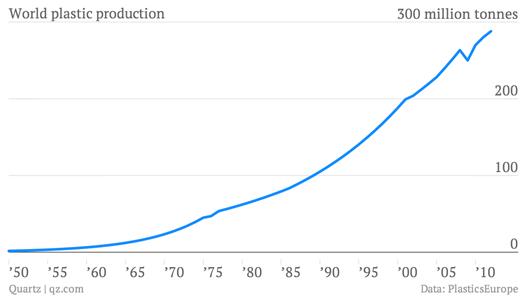
Though plastic was invented in the 1800s, it was really only around 1950 that the human-plastic love affair took off. And boy did it—the nearly 2 million tonnes (2.2 million tons) of plastic produced in 1950 had surged twentyfold in just two decades (by around the time a young Dustin Hoffman was advised to consider a future in plastics in The Graduate) (video).

image001 Read more of this post

“The irony of Sarbanes-Oxley was that it was intended to prevent more Enrons and Worldcoms but it ended up being a gigantic tax on small companies.”

‘The Sarbane-Oxley Act has ironically made the stock market less attractive instead of a safe haven for the average investor.’ 

Gone are the days where companies are going public with cheap valuations. This article from AVC.com rightly states that following the regulatory acts, companies such as Facebook and Twitter would choose to wait for themselves to be worth multi-billions, before engaging in public offerings. Unlike that of the past, where we saw Microsoft, IBM and Apple with cheap valuations, companies such as Dropbox are moving towards private financing, with amounts as large as $10 billion.

Such a trend is definitely not healthy, and would definitely affect the options value investors would have in the market should it continue. Read the original article at http://avc.com/2014/06/the-law-of-unintended-consequences/

What Makes People Generous: Charity, Empathy, And Storytelling

Tom WatsonContributor

ENTREPRENEURS 6/30/2014 @ 3:33PM 618 views

What Makes People Generous: Charity, Empathy, And Storytelling

Two weeks ago, the annual Giving USA report showed that American philanthropycontinues to climb out of the trough of the Great Recession, one of the real lagging indicators of the economy. And while U.S. philanthropy has been roughly static at two percent of GDP for a couple of generations now, overall capacity of donors remains high, even through downturns.

The challenge for causes, fundraisers, nonprofit executives, social entrepreneurs and concerned board members everywhere remains “how?” – how best to tap that steady vein of generosity in this society which, even if fairly flat, remains constant and deep.

A couple of reports that crossed my desk over the past few weeks provide some new insight, and should be of interesting to folks in the philanthropic sector.

One  is called I’m Moral, But I Won’t Help You: The Distinct Roles of Empathy and Justice in Donations, and it focuses on the results of an academic study of 600 people run through four different charitable scenarios. In one, for example, participants were asked to choose “between donating to medical patients described alternately as having a low level of responsibility for their situations and those having a high level of responsibility.” Recipients of donations in the group were described either as unable to pay for medical treatment because of “low-wage jobs with poor benefits due to economic conditions” or unable to pay for treatment because of inability “to hold a steady job due to their drug and alcohol abuse or gambling addiction” – in shorter terms, not their fault and their fault.

Read more at

http://www.forbes.com/sites/tomwatson/2014/06/30/what-makes-people-generous-charity-empathy-and-story-telling/print/


The Right to Write: Who owns a story, the person who lives it or the person who writes it?

By ROXANA ROBINSON

JUNE 28, 2014 2:39 PM 47 Comments

I sat on a panel once with another novelist and a distinguished African-American critic, to discuss Harriet Beecher Stowe’s novel “Uncle Tom’s Cabin.” The critic said, “Of course, as a white woman, Stowe had no right to write the black experience.” The other novelist said lightly, “No, of course not. And I had no right to write about 14th-century Scandinavians. Which I did.”

The exchange made me wonder: who has the right to our stories?

For centuries, African-Americans couldn’t fully participate in the literary conversation, since for many of them literacy was forbidden. Why wouldn’t they resent the fact that their stories were told by whites? But does this mean that, as novelists, we can write stories only of our own race, our own gender, our own subcultural niche?

Stowe used other people’s stories as sources, but what drove her to write was her own outraged response to slavery. She has the right to that response. Isn’t it better that Stowe wrote her book, instead of staying respectfully mute because the stories were not hers to tell? It was the narrative strands about the black experience that gave the book such emotional potency, and made it such a powerful abolitionist force.

Who owns the story, the person who lives it or the person who writes it?

Read more at http://opinionator.blogs.nytimes.com/2014/06/28/the-right-to-write/?ref=opinion

How We Transformed Marketing at Electrolux

How We Transformed Marketing at Electrolux

by MaryKay Kopf and Fred Geyer  |   11:00 AM June 30, 2014

Marketers are racing to create seamless customer experiences that make it easy for consumers to engage at every touchpoint as they navigate the “decision journey” and beyond. Despite this revolution, leading appliance makers have been slow to adapt to the ways people learn about and purchase appliances. Electrolux was no exception – until recently.

Many consumers think of us as a vacuum cleaner company – and indeed our first product, in 1919, was a vacuum. But today we’re a $15 billion global consumer and professional appliance firm that includes Frigidaire, AEG, Molteni, Electrolux, Zanussi, and Eureka among its brands. As we were a product-centric organization, the shopping experience had played a supporting role, with individual elements of the experience managed by different organizational silos. When online emerged it became a new silo, followed by mobile and social. The organization was locked in a structure that made it difficult to connect and integrate all the different ways that a person gathers information, makes a decision and receives support — online and offline. In 2012, Electrolux leadership decided this had to change.

Read more at http://blogs.hbr.org/2014/06/how-we-transformed-marketing-at-electrolux/

Morning Bamboo Insight: 02/07/2014

Daily Bamboo Insight

Macro

1. ECB Must Embrace Role as Zombie Killer; Low Interest Rates Encourage Banks to Paper Over Unrecognized Losses, Says the Bank for International Settlements

http://online.wsj.com/articles/ecb-must-embrace-role-as-zombie-killer-1404204219?mod=Markets_newsreel_2

2. In a recent paper titled “Banks As Secret Keepers,” four economists argue that banks are necessarily opaque institutions, concealing their portfolios and concentrating on hard-to-value assets

http://online.wsj.com/articles/heard-on-the-street-bank-secrets-can-do-investors-a-service-1404142241

3. With Markets at Peaks, Some Say Air Feels Thin; Global Junk-Bond Sales Hit a High in the First Half, but Some Investors Are Wary: ‘This Is a Time for Caution’

http://online.wsj.com/articles/with-debt-yields-low-firms-dash-for-cash-1404158180

http://online.wsj.com/articles/with-markets-at-peaks-some-say-air-feels-thin-1404167926

4. Where in the World is the Kuwait Investment Authority? On the trail of the world’s oldest-and most elusive-sovereign wealth fund.

http://ai-cio.com/print.aspx?id=2147489062

Asia Pacific

1. Steer Clear of China’s Aluminum Crush

http://online.wsj.com/articles/heard-on-the-street-steer-clear-of-chinas-aluminum-crush-1404205417?tesla=y&mg=reno64-wsj&url=http://online.wsj.com/article/SB10001424052702304344504580002491074538712.html

2. India’s Auditor Suggests Canceling Reliance Jio’s Licenses; Government Report Cites Irregularities in How the Company Acquired the Licenses

http://online.wsj.com/articles/india-auditor-suggests-revoking-some-reliance-jio-licenses-1404143573

3. Thailand’s Divided Military; Gen. Prem Tinsulanonda’s arch-royalist faction may control the top posts, but most soldiers support former Prime Minister Thaksin

http://online.wsj.com/articles/thailands-divided-military-1404148174

4. Kathmandu founder Jan Cameron’s retail empire collapses again; Cameron’s private company DSG, which operates more than 140 Crazy Clarks and Sams Warehouse discount variety stores, has gone into receivership

http://www.brw.com.au/p/entrepreneurs/kathmandu_founder_jan_cameron_retail_1kxvqwwnSFwwta84vYXvMO

5. Modi pitches India’s frugal space prowess at rocket launch

http://www.reuters.com/article/2014/06/30/us-india-space-idUSKBN0F51ES20140630?feedType=nl&feedName=usmorningdigest

6. Macau gambling revenue sees first decline in over 4 years

http://www.thestar.com.my/Business/Business-News/2014/07/01/Macau-gambling-revenue-sees-first-decline-in-over-4-years/

7. Australia’s dependence on China commodity appetite increases

http://www.thestar.com.my/Business/Business-News/2014/06/30/Australia-dependence-on-China-commodity-appetite-increases/

8. China general’s ousting tightens Xi’s grip on military; “One of the things that Deng commanded was, ‘We either get the PLA out of business, or you get out of the PLA’,” he said of the order to businessman officers

http://www.channelnewsasia.com/news/asiapacific/china-general-s-ousting/1226340.html#

9. 600,000 Chinese Die Each Year From Working Too Hard

http://www.zerohedge.com/news/2014-06-30/600000-chinese-die-each-year-working-too-hard

10. What Psy’s ‘Hangover’ Doesn’t Say About Korea’s Drinking Culture

http://blogs.wsj.com/korearealtime/2014/07/01/what-psys-hangover-doesnt-say-about-koreas-drinking-culture/

Life

1. World Cup: Jurgen Klinsmann’s Yoda; Menotti’s central belief is that the key to victory isn’t defensive organization or keeping hold of the ball, but trying to score as many goals inside 90 minutes as humanly possible

http://online.wsj.com/articles/world-cup-jurgen-klinsmanns-yoda-1404165139

2. The Evolution of Trust; The evolution to more frugal, deinstitutionalized living that has created the sharing economy may also lead to less involvement of government in everyday life

http://www.nytimes.com/2014/07/01/opinion/david-brooks-the-evolution-of-trust.html?emc=edit_th_20140701&nl=todaysheadlines&nlid=36114517&_r=0

TMT

1. Tencent’s Online Shopping Doesn’t Come Cheap; Company Spends $736 Million for 20% of 58.com

http://online.wsj.com/articles/heard-on-the-street-tencents-online-shopping-doesnt-come-cheap-1404128933

2. When Big Data Isn’t an Option; Companies that only have access to “little data” can still use that information to improve their business

http://www.strategy-business.com/article/00250?gko=6a94d&cid=20140701enews&utm_campaign=20140701enews

3. The Incredible Shrinking Tech Spending Projections

http://bits.blogs.nytimes.com/2014/07/01/the-incredible-shrinking-tech-spending-projections/?ref=technology

4. With Software Eating Hardware, Silicon Valley Enters “Hard” Times

http://techcrunch.com/2014/06/30/with-software-eating-hardware-silicon-valley-enters-hard-times/

Health

1. New Weapon in Fight Against ‘Superbugs’; A soil sample from a national park in eastern Canada has produced a compound that appears to reverse antibiotic resistance in dangerous bacteria

http://online.wsj.com/articles/new-weapon-in-fight-against-superbugs-1404175658?mod=WSJ_hpp_MIDDLENexttoWhatsNewsFifth

Consumer

1. Grocery manufacturers are struggling to adapt to the online world and need to invest in smarter packaging, presentation and supply chains to reap the long term benefits

http://www.reuters.com/article/2014/07/01/us-food-digital-idUSKBN0F636N20140701?feedType=nl&feedName=usmorningdigest

2. “When Esprit went public in 1998 they said ‘we want to buy your business and fold it into Esprit’; “When multinational companies buy small privately-owned entrepreneurial businesses they often lose their soul”

http://www.theage.com.au/small-business/startup/red-earth-ring-any-bells-its-back-20140624-3aq84.html?eid=email:nnn-13omn620-ret_newsl-membereng:nnn-04/11/2013-small_business-dom-business-nnn-age-u&campaign_code=13IBU007&promote_channel=edmail&mbnr=NDEzOTI1Mg

3. Nestlé U.S. Chief Looks for Brands to Fix or Toss; Number of Product Variations Is Slashed, Lean Cuisine Gets a Makeover

http://online.wsj.com/articles/nestle-u-s-chief-looks-for-brands-to-fix-or-toss-1404172061

Investing Process

1. Banks as Secret Keepers

Tri Vi Danag 

Columbia Business School – Finance and Economics

Gary B. Gorton 

Yale School of Management; National Bureau of Economic Research (NBER)

Bengt R. Holmström 

Massachusetts Institute of Technology (MIT) – Department of Economics; National Bureau of Economic Research (NBER); European Corporate Governance Institute (ECGI)

Guillermo L. Ordoñez 

University of Pennsylvania – Department of Economics; National Bureau of Economic Research (NBER)
June 2014
NBER Working Paper No. w20255

Abstract:      
Banks are optimally opaque institutions. They produce debt for use as a transaction medium (bank money), which requires that information about the backing assets – loans – not be revealed, so that bank money does not fluctuate in value, reducing the efficiency of trade. This need for opacity conflicts with the production of information about investment projects, needed for allocative efficiency. Intermediaries exist to hide such information, so banks select portfolios of information-insensitive assets. For the economy as a whole, firms endogenously separate into bank finance and capital market/stock market finance depending on the cost of producing information about their projects.


Tide turning against buybacks ahead of the market top

FT reports that there has been a change in corporate buyback behaviors, as companies prefer not to deploy their cash to buy back their stocks. While traditionally, companies that engage in buyback behaviors are often rewarded during post-crisis rally, it has been reported that TrimTabs, the US research group, shows that money spent on buying back stock in each of the last two months has been the lowest since January 2013.

And one possible reason is that companies fear that their own company’s stocks may be overvalued. This comes at a time when there are more new offerings in the market, with notable ones being GoPro’s IPO in recent weeks. This begs the question, how long more would the equity rally continue?

Read more at http://www.ft.com/intl/cms/s/0/da7af7d6-fe16-11e3-acf8-00144feab7de.html#axzz36CcgBUKt

Daily Bamboo Insight: 01/07/2014

Daily Bamboo Insight

Macro 

1. Secrecy of Dark Pools Can Blur Both Ways; what seems to have escaped notice is that a lack of transparency is almost sure to invite abuses

http://dealbook.nytimes.com/2014/06/30/secrecy-of-dark-pools-can-blur-both-ways/?_php=true&_type=blogs&emc=edit_dlbkpm_20140630&nl=business&nlid=36114517&_r=0

2. Hedge funds’ correlation with the equity market has risen back to pre-financial crisis highs, raising fears that the $2.7tn industry could again suffer sharp losses in the event of a market slide

http://www.ft.com/intl/cms/s/0/b5ad4370-fde7-11e3-acf8-00144feab7de.html#axzz36A4WnU9X

3. FASB Turning Back Clock on Global Accounting, IASB Leader Says

http://ww2.cfo.com/gaap-ifrs/2014/06/fasb-turning-back-clock-global-accounting-iasb-leader-says/?utm_campaign=CFOWeekly&utm_source=CFO-email&utm_medium=email&utm_content=CFOWeekly_Friday_2014-6-27&utm_term=the-economy

4. Soros Dabbles in Shareholder Activism

http://dealbook.nytimes.com/2014/06/27/soros-dabbles-in-shareholder-activism/?emc=edit_dlbkam_20140630&nl=business&nlid=36114517


Life

1. Warning, high voltage: scientists solve mysteries of electric fish http://www.reuters.com/article/2014/06/26/us-science-fish-idUSKBN0F12UW20140626

2. Passion for Reality: The Extraordinary Life of the Investing Pioneer Paul Cabot

http://www.amazon.com/gp/product/0231167466?ie=UTF8&camp=1789&creativeASIN=0231167466&linkCode=xm2&tag=moi0e-20

3. Sleep as a Competitive Advantage

http://dealbook.nytimes.com/2014/06/27/sleep-as-a-competitive-advantage/?emc=edit_dlbkam_20140630&nl=business&nlid=36114517


Energy

1. Following long ban, U.S. could dominate global light oil supply

http://www.reuters.com/article/2014/06/30/us-oil-exports-u-s-idUSKBN0F50B320140630?feedType=RSS&feedName=businessNews

Abe’s Stewardship Arrow to Shoot Down Criss-Crossed Accounting Woes

image001

“Bamboo Innovators bend, not break, even in the most terrifying storm that would snap the mighty resisting oak tree. It survives, therefore it conquers.”

BAMBOO LETTER UPDATE | June 30, 2014
Bamboo Innovator Insight (Issue 40)

  • The weekly insight is a teaser into the opportunities – and pitfalls! – in the Asian capital jungles.
  • Get The Moat Report Asia – a monthly in-depth presentation report of around 30-40 pages covering the business model of the company, why it has a wide moat and why the moat may continue to widen, a special section on “Conversation with Management” to understand their thinking process in building up the business, the context – why now (certain corporate or industry events or groundbreaking news), valuations (why it can compound 2-3x in the next 5 years), potential risks and how it is part of the systematic process in the Bamboo Innovator Index of 200+ companies out of 15,000+ in the Asia ex-Japan universe.
  • Our paid Members from North America, Europe, the Oceania and Asia include professional value investors with over $20 billion in asset under management in equities, some of the world’s biggest secretive global hedge fund giants, and savvy private individual investors who are lifelong learners in the art of value investing.
 

Abe’s Stewardship Arrow to Shoot Down Criss-Crossed Accounting Woes


猫に鰹節(ねこにかつおぶし neko ni katsuobushi)

– Local Japanese proverb translated as “fish to a cat”. It means a situation where one cannot let their guard down (because the cat can’t resist stealing your fish).


猫を追うより皿を引け(ねこをおうよりさらをひけ neko o ou yori sara o hike)

– Local Japanese proverb translated as “rather than chase the cat, take away the plate”. It means attack problems at their root.


The swooshing sound of the arrow pierces through the hazy air last Tuesday with Abe’s televised address of Japan’s first corporate governance code. More than 120 institutional investors have signed up for the new seven-point Stewardship Code for them to engage with and monitor management team on strategy and governance and speak up for better returns.


The Code is voluntary yet forceful since it requires companies to comply or explain why they cannot follow the rules and would give backbone to the stewardship rules. To understand the implications of Abe’s third arrow aimed at shooting down the cozy cross-shareholding structure that shielded managers from failed investments and bringing shareholders perennially low profitability and returns, we need to travel back to a fishing village in 1921 and also have knowledge of the shortcomings of Japanese consolidated financial statements.


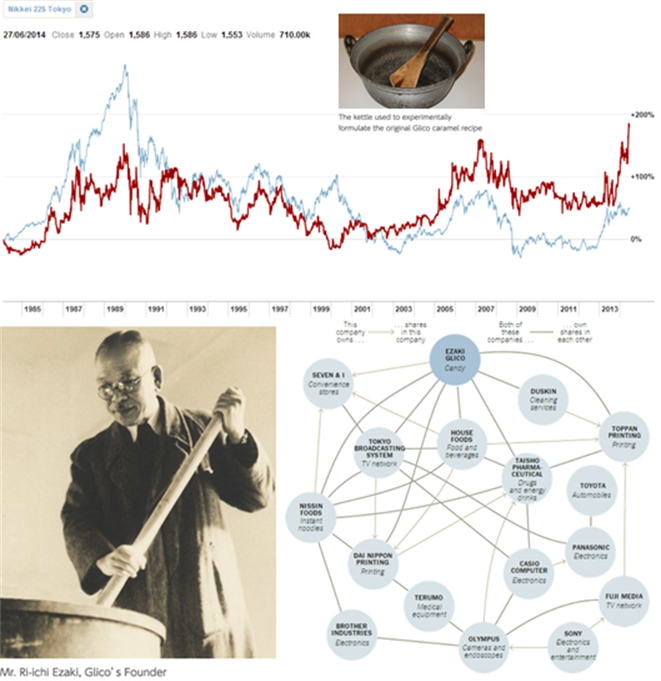
Ezaki Glico (2206 JP) – Stock Price Performance, 1984-2014
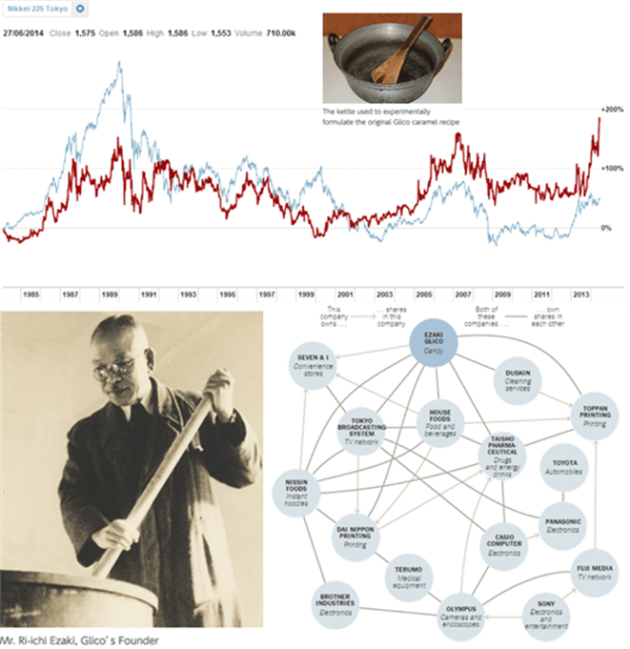
image002

Greatly saddened after the death of his sons, Ri-ichi Ezaki sought solace in trip to a fishing village. Ezaki noticed a group of children playing by the seashore and was struck by how healthy they were. He determined that their diet of oysters containing glycogen contributed to their good health. Ezaki began experimenting with means of extracting glycogen for use in other foods, particularly in confectionery, in order to improve the health of other Japanese children. By 1921, Ezaki had launched initial production of his first sweet, a caramel containing glycogen named “Glico.”


Thus, the oyster-to-candy Ezaki Glico (2206 JP, MV $2.1bn) was born in 1922 and is now a confectionery giant with over $3.1bn in sales. Its intangible knowledge in food science technology has also created the hugely popular flagship product for the firm in 1965: Pocky Chocolate, a chocolate-coated, stick-shaped cookie product, which is also known as Mikado for western markets. The name for the product came from the Japanese rendering of the sound (“pokki”) made when the sticks were broken. Pocky is arguably the Asian success story equivalent to that of Oreo biscuit, owned by Kraft’s Mondelez (MDLZ US, MV $63bn), which registered over $2bn in sales. While Oreo has a patent for the secret method to give cocoa powder its characteristic black color, Pocky has no patents. Yet, besides Pepero by Korea’s Lotte Confectionery (004990 KS, MV $2.7bnbn), no other companies has the intangible knowledge to manufacture this seemingly simple coated stick snack. Even wide-moat companies including Mayora Indah (MYOR IJ, MV $2.2bn), Southeast Asia’s largest confectionery maker, Chinese rice-cracker giant Want Want(151 HK, MV $18.6bn) Apollo Food (APOF MK, MV $124m), Hup Seng (HSI MK, MV $286m) were sheepish in admitting they do not possess the manufacturing know-how much as they would like to add this super-seller to their portfolio.


With a brand franchise backed by a relatively strong balance sheet with $558m in gross cash ($275m in “short-term investments”) and over a billion in net asset, Glico has always been the target of many activist investors to push the managers to adopt more shareholder-friendly proposals such as paying out higher dividends and conduct share buybacks. American hedge fund Steel Partners, led by billionaire Warren Lichtenstein, had been the largest single shareholder in Glico since 2004 and tried to force the management to reduce its complicated cross-shareholdings in Japanese companies (see above chart) which resulted in financial losses and eroded the company’s profitability. “Management is responsible for running a good company, not an investment portfolio”, wrote Steel’s boss in 2008. Glico’s keiretsu-like cross-shareholdings include mutual stakes in companies as diverse as Duskin (a cleaning services company which also operates Mister Donut chain), Toppan Printing, TV network Tokyo Broadcasting System, instant noodles Nissin Foods. Steel Partners wanted to overhaul management and bring themselves in as an outside board member. Glico’s network of allies gathered and approved a poison-pill measure that fended off the “abusive acquirer”. By the end of 2008, Steel Partners dumped its 11.8-14.4% stake in Glico.


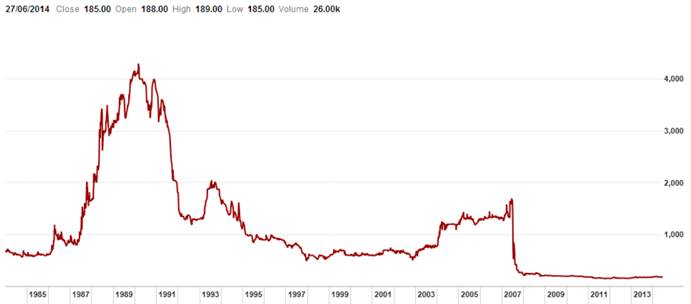
Steel suffered losses in its activist role in other Japanese companies such as Bull-Dog Sauce (2804 JP, MV $127m) and wig-maker Aderans (8170 JP, MV $618m). Japanese courts ruled in Aug 2007 that Steel was an “abusive acquirer” and cleared the way for Bull-Dog to issue a massive number of shares with 88% of the shareholders voted to adopt a poison pill to defeat Steel’s tender offer bid which was at a 26.7% premium to the previous month’s average price. Similarly, Steel has been in dispute with Aderans since 2007 when the company adopted a poison pill takeover defence. Steel had a 28.9% voting rights in Aderans and value investor Dodge & Cox had 9.3%. Steel had the rare success of replacing the board but still suffered losses from its average price of ¥2,700, according to an analysis of its regulatory filings by RiskMetrics (current price ¥1,560). The travails of Steel and Dodge & Cox had followed from the failed 1989 hostile takeover by T. Boone Pickens of Koito Manufacturing (7276 JP, MV $4bn), a first-tier supplier in the Toyota vertical keiretsu. Even after he became the largest single shareholder with 20% of Koito, Pickens could not put himself on Koito’s board. This was because other members of the Toyota keiretsucollectively controlled more Koito’s shares than Pickens and acted in concert to block him. Thus, cross-shareholdings made it hard for investors to have a voice and the Stewardship Code aims to dismantle this.


Bull-Dog Sauce (2804 JP) – Stock Price Performance, 1985-2014
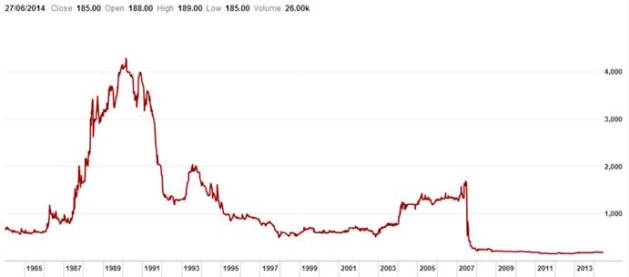
image003 

Japan is both “developed” and “developing” at the same time: developed in the sense of its economic significance as the world’s second largest economy with depth and liquidity in its capital markets, but developing-status when it comes to corporate governance and shareholders’ rights protection due to the legacy of…


<Article Snipped>


Still, it is critical for value investors to understand the accounting dynamics of Japanese companies. Currently, major differences between Japanese accounting standards and international standards deal with accounting for business combinations and consolidations as philosophical differences persist between Japanese GAAP and IFRS. The key difference lie in that cross-shareholdings and interlocking ownership structures often make it difficult to differentiate between a parent company and subsidiaries, particularly if holding companies are involved. Below are a summary of the accounting risks, governance pitfalls and institutional dynamics distilled from our past decade plus of investing in Asia and Japan:


1) Parent and Consolidated Financial Statements – The case of Kanebo


One important feature of consolidation reporting in Japan is that both the parent company financial statements are disclosed as well as the consolidated financial statements. Sales between parents and subsidiaries may be recognized as revenue if consolidated financial statements are disclosed (this is prohibited in the United States). The Japanese began to use consolidated financial statements in 1978, at least half a century later than many of the other industrialized countries of the world. Beginning in March 2000…


<Article Snipped>


Anyone who has spent time around cats knows that cats, unlike dogs, bury their deposits with sand or dirt in various concealment actions. Thus, beyond the keiretsu-like hidden accounting woes and governance risks that cannot be identified by western-based quant screens and checklists, value investors should attempt to add the all-important third analytical dimension in identifying Asian wide-moat compounders such as… whether there is a corporate culture that fosters innovation and a resilient business model that have persistent influence on firm performance and value. Otherwise, the opaqueness and complexities of Japanese and Asian companies beyond their accounting numbers can engulf the value investor who is the fish to the keiretsu cat.


To read the exclusive article in full to find out more about the unique governance pitfalls and accounting risk of Japanese companies, including consolidation report and the Tobashi accounting method to disguise losses, as well as the implications of the Stewardship Code for institutional investors that was announced in both Japan and Malaysia, please visit:


  • Abe’s Stewardship Arrow to Shoot Down Criss-Crossed Accounting Woes, Jun 30, 2014 (Moat Report Asia, BeyondProxy)


Some updates:


1)      KB will be going for his two-weeks mandatory military training with night exercises from 1 Jul to 12 Jul, following which KB will be on a business trip to Italy on 13 to 21 Jul as a keynote speaker in Ciccio Azzollini’s sold-out Value Investing Seminar and to attend Value Unplugged 2014. We will resume the Weekly on 28 Jul. Many thanks for understanding.


2)      Value Unplugged 2014 and Value Investing Seminar in July in Italy

Value Unplugged 2014 (www.valueunplugged.com) in Naples, Italy is now full. We’ll gather in a small, relaxed setting to learn and make friends. We’ll also attend Ciccio Azzollini’s sold-out Value Investing Seminar in July in Trani, Italy — the definitive summer conference for value investors – as one of the keynote speakers.

http://www.valueinvestingseminar.it/content_/relatori.asp?lan=eng&anno=2014


3)     We have lined up potential video interviews with hidden business leaders in Singapore to value-add to our Members. One of them is an ASEAN-listed subsidiary of a Swiss-listed MNC and one of our savvy subscribers Mr K had quadrupled his investments after listening to our interview on BeyondProxy in March 2013. Another is a business model akin to the early stages of wide-moat compounders Hero Motocorp and Bajaj Auto which one of subscriber, a hugely successful value investor, commented that one of his biggest mistakes (error of omission) is not investing during the early days of Hero and Bajaj because he thought these were heavy capex animals like the automakers but their business model is frugal innovations in assembly know-how and they are agile creatures with the bamboo characteristics in the “core-periphery network” that is the underlying source of their wide-moat. Because of our lifelong dedication towards investigating the pitfalls of value investing and the underlying sources of wide-moat in both the West and Asia at an early stage, we will contextualize the information in ways no one else had thought about to value-add to you.


4)     Our latest Moat Report for the month of July is out. It investigates an Asian-listed company who’s theglobal #1 and #2 maker of two types of patient monitoring devices for both clinical- and home-use. The company is trading at EV/EBIT 9.7x and EV/EBITDA 8.8x and has an attractive dividend yield at 5.6% and a strong balance sheet with net cash as percentage of market value and book equity at 23% and 47% respectively.


The Moat Report Asia
 

“In business, I look for economic castles protected by unbreachable ‘moats’.”

– Warren Buffett


The Moat Report Asia is a research service focused exclusively on competitively advantaged, attractively priced public companies in Asia. Together with our European partners BeyondProxy and The Manual of Ideas, the idea-oriented acclaimed monthly research publication for institutional and private investors, we scour Asia to produceThe Moat Report Asia, a monthly in-depth presentation report highlighting an undervalued wide-moat business in Asia with an innovative and resilient business model to compound value in uncertain times. Our Members from North America, the Nordic, Europe, the Oceania and Asia include professional value investors with over $20 billion in asset under management in equities, secretive global hedge fund giants, and savvy private individual investors who are lifelong learners in the art of value investing.


Learn more about membership benefits here: http://www.moatreport.com/subscription/


  • Individual subscription at $1,994 per year:

https://www.moatreport.com/individual-subscription/?s2-ssl=yes


Our latest monthly issue for the month of July investigates an Asian-listed company who’s the global #1 and #2 maker of two types of patient monitoring devices for both clinical- and home-use. Founded in 1981 and listed in 2001, the company’s reliable manufacturing technology platform for over 30 years has enabled it to build a global durable franchise in the niche patient monitoring device market that has stable resilient growth and yet is experiencing potential disruptions led by its new innovation. A secret to its success is its in-house capabilities to combine Swiss design, high-precision electronics and sensors components with clinical healthcare to produce world-class products with cost competitiveness. The firm has competitive technology and patents especially its core competence of having an algorithm to allow fast reading/filtering of signals and outputting the accurate results in a short period of time. The company has the potential to consolidate the market further. The company is also a sticky ODM partner to reputable companies including Wal-Mart, Costco, CVS and it has a diversified customer base with none of the customers accounting for more than 10% of its sales. The company demonstrated that it has bargaining power over its powerful customers with the ability to build its own brand since 1998 (62% of overall sales). 91% of its sales are to developed markets in US and Europe. The company is trading at EV/EBIT 9.7x and EV/EBITDA 8.8x and has an attractive dividend yield at 5.6% and a strong balance sheet with net cash as percentage of market value and book equity at 23% and 47% respectively. The firm has also undertaken the unusual capital management program to reduce 10% of its shares outstanding in Sep 2012 to boost capital efficiency by utilizing the comfortable net cash position. The proactive shareholder-friendly stance backed by its strong net cash position should limit any downside in share price. The company’s terminal value and downside risk will be protected by giants such as J&J, Bayer, Abbott etc who wish to swallow it up to possess its valuable manufacturing technology platform and worldwide patents in algorithm-technology. The company’s worldwide patents in algorithm-technology has been commercialized into an innovative product series that is at the heart of its total solution service business model. This valuable intangible asset is not factored into long-term valuation. The innovative product with the algorithm measurement technology are not merely additional features; it “forces” the clinical community to adopt them as the standard, which in turn helps drive home-use penetration as patients seek a consistent and integrated healthcare experience. It transforms the product into a unique strategy that incorporates software development to create value-added services for health monitoring and collaborating with hospitals and governments on tele-healthcare projects. As a result of its wide-moat, the company has a far superior ROE at 20.9% that is nearly double that of its key giant conglomerate rival. When we compare EV/EBIT relative to ROE and ROA, the company is cheaper by as much as 120-150% when compared to its key giant conglomerate rival. The stock price of the company is down nearly 20% from its recent high in end March 2014 on profit-taking by short-term investors. Share price is back to May 2013 level, representing an attractive opportunity to take position in this long-term durable franchise. The stable long-term shareholdings and patient capital by the founder and the management team who together own around 48% of the equity has enabled the firm to adopt a very long-term approach to building its business and cultivating new growth areas. While he may sometimes be slightly over-optimistic and thinking too far ahead with his long-term opinions, this  idealistic engineer-visionary-philosopher has done a fantastic job in continuously defying the odds of many skeptics by growing the company from a small startup into one of the world’s leading patient monitoring equipment company. He is the rare Asian entrepreneur who was persistent in building his own brand despite the threat of offending his ODM customers. He was also early in cultivating and coordinating a global network with high-tech component, R&D and manufacturing in his home country, manufacturing, assembly and packaging in Shenzhen, China and medical R&D and clinical testing center in Europe, including making the difficult decision to establish a direct marketing sales force in Europe and North America given the high cost. Unlike most Asian business owners whose interest and focus in the core business starts to wane due to complacency from growing personal wealth and the inability to scale the core business, the founder is genuinely passionate in the company’s ability to add value to the patients and society. The firm can effectively run without the founder with the long-term corporate culture and management system in place, yet he can inject great value as the steward in new innovations; we believe that this combination is rare for an Asian company and deserves a valuation premium.


Our past monthly issues examine:


  • The world’s #1 ODM (Original Design Manufacturer) and global #5 manufacturer of a consumer healthcare device product that is used frequently, even daily, thus providing the foundation for stable recurring cashflow. This company is also a hidden champion in a niche product segment (50-55% of group’s sales) that has become a high-growth fashion product currently accounting for less than 10% of the overall industry. The company is able to mass-manufacture this niche product, but not the giants, because of its unique process IP in flexible manufacturing system and know-how to handle large-scale complex orders. The manufacture of this product itself is difficult to replicate and requires FDA/CE licenses because of its medical device nature and the entry barrier is not capital but the know-how and R&D expertise. In particular, the manufacturing integrates different fields of science including polymer chemistry, physics, optics, engineering, materials control, process control, microbiology, and, injection molding. The firm has also developed a proprietary system of tracking the manufacturing process of different sets of product so that if a quality issue arose, when and where the problem set of products was being produced could be swiftly identified, thus diminishing the scale and cost of product recall. This system has helped the firm win the long-term trust of its ODM customers to place stable large orders. The Big Four giants do not have such a system and have to incur substantial losses from product recalls. The company also possess its own brand which has many loyal followers and support in its home market where it enjoys a 30% market share and contributes to 25% of group’s sales while sticky ODM customers account for 75% of group’s sales, mainly from the Japan market. As a result of its wide-moat advantages, the firm enjoys a consistently high ROE of 41%, double or triple that of the giants. From FY07 onwards,even during the depths of the Global Financial Crisis in 2007/09, the firm has not raised equity. Since listing in Mar 2004, the company has only done one rights issue in May 2005. Also, it is able to sustain a strong stable cash dividend payout (>70% with 3% yield) with its healthy net-cash balance sheet (net cash $30m; net cash-to-equity ratio 23%) and proven management execution in prudent capex expansion to support sustainable quality earnings growth. M&A deals in the healthcare and medical device sector has been growing due to their strong defensive nature and giants seeking growth to overcome their own patent cliff. The firm will always be an attractive takeover target by giants who wish to swallow it up to possess its valuable flexible manufacturing system and know-how to fill their own missing competency gap and hence will enjoy long-term downside protection in its terminal value. In the battle between “ODM vs Brand”, we find the story of the company to be quite similar to that of TSMC (2330 TT, MV $103bn), now the largest ODM foundry in the world. “Skate to where the puck is going to be, not where it has been,” as hockey legend Wayne Gretzky advised. In our view, the profit and valuation premium in the value chain will start to skate to the “Inno-facturers” who are the hidden ODM innovators (the brand behind brands) consolidating the industry, such as TSMC and this company. While its valuation is not cheap with EV/EBIT (FY13) at 20.6x, when we compare EV/EBIT relative to ROE, the company is relatively cheap, by as much as 130-220% when compared to giants and other comparables. When we compare EV/EBITDA relative to ROE, the valuation gap is 90-160%. This long-term valuation gap implies that the company, with its far superior and sustainable ROE, could potentially double to $2.4bn, as it continues to consolidate its niche product segment and enter into a new product cycle of an innovative product whose patents are expiring in 2014/15 (US/worldwide) to make ASP/margin improvements in sustaining quality profits and cashflow. Its share price has dropped 18% from its recent high and underperformed the index by 26% in the last six months. This will present a buying opportunity for long-term value investors who can penetrate beyond conventional valuation metrics because of a deep understanding of its business model and underlying source of its wide-moat advantages. In Asia, many firms break apart or become value traps due to shareholder conflict, envy and differences in opinion on the business direction of the company. The stable long-term corporate culture infused by the late founder, who established the company in 1986 with the current executive chairman and 2 other key shareholders, to combine the energy and ideas of everyone to work hard to keep the business running forever is underappreciated.


  • The Home Depot of Asia which has the largest market share in its home country and now seeks to expand regionally. It is one of the few home improvement retailers in the world which is able to achieve a structural negative cash conversion cycle (CCC) at -39 days for resilient, recurring and sustainable operating cashflow to enable the expansion of its store network while keeping a healthy balance sheet. It is hard to achieve negative cash conversion cycle (CCC) as a home retailer as compared to a supermarket retailer as the product nature is more durable. Even Home Depot, Lowe’s and Bed Bath & Beyond (BBBY) are not able to achieve a negative CCC. Led by the capable owner-operators since 1995, the company is a pioneer in proactively creating awareness and demand in the minds of consumers that upgrading your home can be fun and in incremental affordable steps. Its creative branding has resulted in the firm to become the “first on customers’ mind”, or what Charlie Munger elucidated as the “psychological wide-moat” advantage. 80% of sales are generated customers looking for home improvement and renovation ideas and solutions.  Growth is supported by the management’s proven ability to identify and cater to dynamic changes in customer preferences. The firm’s comprehensive pre and aftersales service creates brand loyalty and sustains long-term sales. The merchandizing management is tailored to the peculiarities of customer preferences in each area to drive same store sales growth with creative customization by store, location, season and events. Its key strategy to expand its profit margin is to increase its higher-margin house brands and product-mix management. Its EBITDA/sqm of $400/sqm was higher than Home Depot until Home Depot experienced a rebound last year to $500/sqm. The firm’s resilient sales are supported by its unrivalled network of diverse locations throughout the country. Its bold vision and successful “Blue Ocean” execution in the highly fragmented second-tier markets has created a powerful wide-moat advantage that will last for many years to come. In short, the management have proven their ability to execute in difficult market and industry conditions especially in the past 5 to 7 years during the 2007/09 global financial crisis with the firm emerging much stronger. The Illinois Institute of Technology engineering graduate and quiet billionaire owner behind the home retailer is one of the few Asian business tycoons who has the thirst to scale up the business in a sustainable way, as opposed to opportunistic ventures, having been largely influenced by his early years experience observing the success of American wide-moat firms. If we can adjust the EV/EBITDA valuation metric to reflect the CCC, the company’s EV/EBITDA of 18.5x will be lower at 10-11x, while Home Depot’s EV/EBITDA 11x will be higher at 13x. Noteworthy is that Home Depot has a negative free cashflow throughout FY1989-2001 (13 consecutive years!) and yet market cap has climbed from $1.5bn to $103bn. Home Depot compounded despite the ugly valuations during the capex ramp-up. This once again highlights that the power of wide-moat is often underappreciated, misunderstood and overlooked. When Home Depot generated $180m in operating cashflow in FY1992, quite similar to this Asian firm now, Home Depot is valued at $5bn (vs $3bn). Store network is expected to double in the next 4-5 years, representing a potential doubling in market value.


  • The Northeast Asian-listed company who is the world’s largest maker of an essential component with applications in apparel, shoes, diapers, car seats etc. All top 20 global athletic shoe brands, including Nike, Adidas, Reebok, Sketchers, UnderArmor are customers and this Asian innovator with R&D capabilities has forged long-term “spec-in” partnerships with them. Its broad product offering is protected by over 110 patents. By locating its Pan-Asian production plant network in China, Taiwan, Vietnam and Indonesia close to its major clients, including sales/customer service centers and warehouses in US and Europe, the firm is better positioned to understand their requirements, deliver fast and meet their needs. While top 10 athletic shoe brands account 40% of its revenue, the firm has a diversified clientele base of over 10,000 customers, giving it resilience and growth with both the established and emerging brands as clients. The company is trading at PE14e 12x, EV/EBITDA 7.1x and EV/EBIT 10.6x with a dividend yield of 3.9%. Interestingly, its EBITDA margin is double that of Adidas and its 8.7% net margin is higher than Adidas’ 5.4%, though below Nike’s 9.8%. Given the tipping point of its Pan-Asian production network and contributions from its new products and as capex tapers off in the next few years, free cashflow could be around $50-60m and applying a P/FCF of 15x would yield a market value of $750-900m,, representing a potential upside of 100-150%. Thus, the firm offers a similar quality growth trajectory to Nike/Adidas with its unique knowledge-based business model and yet trades at a more attractive valuation and higher dividend yield as downside protection.


  • The Middleby of Asia commanding a dominant market share of over 80% in hypermarkets, 50% in chain outlets, 30% in 4- to 5-star hotels in China and an overall 30% in its home market. Yet, no single customer accounts for more than 5% of its revenue. Just to recall for value investors, NYSE-listed Middleby, with its sleepy and boring business, has compounded 100-fold from around $50m to $5.7bn since its tipping point in 1999. The founders of this Asian family business demonstrated clear dedication in building up the company with its wide-moat business model backed by a strong and unique distribution/marketing network in finding, winning and binding new customers to build massive brand equity and long-lasting relationships with clients over time. Their devotion to its core product for nearly 20 years results in maximum problem-solving skills, innovative strength and product leadership and hence, to ever greater customer benefit that will protect the company to consolidate the fragmented market and provide ample opportunities to continue its profitable growth. The company is currently trading at PE13e 15.8x and an undemanding EV/EBIT 10.1x and EV/EBITDA 9.5x and its growth potential based on its unique business model is not priced in. There is a structural re-rerating of niche business models with (1) diversified client base, (2) steady revenue streams, (3) lean capex requirements that creates ample free cashflow and defensive growth. Based on PE, P/CFO and EV/EBIT, the company is trading at a 40-50% discount to the foreign listed comparables despite more efficient use of assets in generating profits and cashflow. It has an attractive 7% earnings yield growing at 20% over the next 3-5 years and a 3.8% dividend yield that is supported by its strong cashflow generation ability, steady revenue stream and lean capex requirements to limit downside risks in valuation. Based on the growth plans to penetrate new product and customer segments; build its third plant in India in addition to the ones in its home market and in China; and potential bolt-on acquisition opportunities with its healthy balance sheet in net-cash position, it has the potential to double its operating cashflow in the next 3-5 years and market value could double, representing an upside potential of 100-140%.


  • An emerging Asian Walgreens which is a top 3 community pharmacy operator in its home market. Walgreens is a classic neglected American compounder up over 272-fold to $54 billion from under $200m as it quietly consolidates the market. Over the decade, we observed that it is difficult to scale services-based businesses without an entrepreneurial mindset, committment and execution and the bold and unique management system of the company since 2000 allowed the pharmacists to be part-owner of the business which will lead to increased level of commitment and an owner’s mindset in growing the business for the long-term in the community. The firm has strong cash generation ability due to its negative cash conversion cycle (CCC) in the business model to help the business stay resilient during difficult times and to fund capex needs internally without straining the business model scalability as the network expands. The centralized logistics system provide regular deliveries to all of its community pharmacies enables the outlets to maximize retail space without the need to have space to keep stocks. This also enables the community pharmacies to optimize retail space to carry a wide range of products which is important as consumers increasingly have top-of-mind recall for the company as the destination to go to for their healthcare needs. Like Walgreens, the company believed in the power of embedding technology into the business model to better compete and its financial and warehousing/inventory management systems are integrated with its in-house POS (point-of-sale) system which is linked among all its community pharmacies and head office via virtual private network. The company is founded by five college friends who were somewhat frustrated that their pharmacy degrees were underappreciated and under-rewarded as compared to their medical degree counterparts even though they had studied hard for 4-5 years and had in-depth medical knowledge. They were eager to prove themselves that they are as capable, if not more so. This restless spirit to prove their capabilities resulted in them coming together to be entrepreneurs and they wish to provide the platform for similar restless pharmacists to apply their hard-earned knowledge acquired in the university. We find that this common purpose and camaraderie spirit is rare in Asian companies and makes the company unique to scale up sustainably. The company is currently trading at a EV/EBIT of 13.9x and EB/EBITDA 12.6%. In the next two to three years as the company expands its network of outlets, operating cashflow (CFO) could increase 50-60% and a re-rerating could result in a doubling in market value.


  • An Asian-listed pharmaceutical company which has a dominant franchise in a neglected but growing disease and is a leader with a domestic market share of 49% in this niche segment and is the only fully-integrated player amongst the few pre-qualified WHO firms, giving it >30% EBITDA margin, better pricing power compared to the competition, and significant advantage over other players in ramping up the global business from the current 30% market share in the most-common treatment drug (vs Novartis 50%). Furthermore, the pharma company has the second-highest GP/TA (gross profit/ total asset) ratio in the industry at 56.3% and the most conservative accounting practice in the industry which “depresses” earnings relative to its peers i.e. it is the only domestic firm which expenses, and does not capitalize, all R&D. With the new plant for formulations export to US, the deepening of the niche drug franchise, growing wins in chronic pain and other niche areas and the commercialization of the potential blockbuster product of blood thinner by FY16/17, EBITDA could potentially double to $200m in the next 4-5 years, triggering a valuation re-rating to a market value of $3.4bn, a 130% upside.


  • An Australian-listed company with market value $405m, EV/EBITDA 7.5x, EV/EBIT 10x, div 3%, 70% domestic market share whose management made the controversial bold decision to stop overseas exports in order to focus on cultivating the higher-margin domestic market with innovative marketing strategy and new products and is potentially doubling its supply in the next 3-5 years. It is in its 10th year of listing after piling the foundation in consolidation, investment, rationalization for its next stage. It has an all-time low debt-equity position 18.6% with healthy balance sheet. “Buffett of Nordic” recently increased position between Apr-Sep this year in the peer comparable of the company and the billionaire investor announced in Nov an acquisition of a rival in a wave of global consolidation and with the view on a sustained recovery in product prices.


  • Northeast Asia-listed company with global #1 market share leadership in 4 different products, including making the components for an innovative consumer product whose sales have climbed from $90 million to $526 million in the recent three years. The company is a hidden global consolidator with underappreciated growth. The stock is trading at PE 11.5x, EV/EBITDA 9x and generates a sustainable dividend yield 5.75%.


  • Taiwan and Southeast-Asian-listed entrepreneurial company, both with a dominant 80% domestic market share and have innovative business models to generate substantial cashflow to support both expansion and a 4-5% dividend yield.


  • There is also a behind-the-scene conversation with the CEOs of the companies to understand their thinking process in building up the business.


The Moat Report Asia Members’ Forum has been getting penetrating quality dialogues from our subscribers.Questions range from:


  • The nuances of internal dealings in Asia, including the case discussion of the recent deal in which HK billionaire’s Lee Shau-kee Henderson Land acquiring Towngas or Hong Kong & China Gas (3 HK) from his family holdings, seemingly déjà vu from the early Oct 2007 transaction when the market peak.
  • The case of F&N Singapore spinning out its property unit FCL Trust and getting “free” special dividend-in-specie and the potential risk in asset swap restructuring to deleverage the hidden debt in the entire Group balance sheet.
  • The dilemma of whether to invest in a Southeast Asian-listed company and hidden champion with a domestic market share of 60% due to family squabbles and a legal suit over the company’s ownership.
  • Discussion of the wise and thoughtful 107-year-old Irving Kahn’s investment into a US-listed but Hong Kong-based electronics company with development property project in Shenzhen’s Qianhai zone and the possible corporate governance risks that could be underestimated or overlooked, as well as their history of listing some assets in HK in 2004.. This is also a case study of “buy one get one free” in John’s highly-acclaimed book The Manual of Ideas in which the “free” property is lumped together with the (eroding) core business to make the combined entity look cheap and undervalued. What are the potential areas that value investors need to watch out for when adapting the SOTP (sum-of-the-parts) valuation method in Asia?
  • And many more intriguing questions.


Do find out more in how you can benefit from authentic and candid on-the-ground insights that sell-side analysts and brokers, with their inherent conflict-of-interests, inevitable focus on conventional stock coverage and different clientele priorities, are unwilling or unable to share. Think of this as pressing the Bloomberg “Help Help” button to navigate the Asian capital jungle. Institutional subscribers also get access to the Bamboo Innovator Index of 200+ companies and Watchlist of 500+ companies in Asia and the Database has eliminated companies with a higher probability of accounting frauds and  misgovernance as well as the alluring value traps.


Professional Development Workshops for Executives and Lifelong Learners
 

Our 8th run of the series of workshop From the Fund Management Jungles: Value Investing Exposed and Explored– (Part 1) Moat Analysis, (Part 2) Tipping Point Analysis and (Part 3) Detecting Accounting Fraud – on 14 June 2014 has been well-received with serious value investors, professionals, and serious lifelong learners attending, with some who flew in from Jakarta and KL!..


Our 9th workshop will be on Detecting Accounting Fraud Ahead of the Curve sometime later in the year.


Thank you for your support all this while!


Thank you so much for reading as always.


Warm regards,

KB Kee

image004

Managing Editor

The Moat Report Asia

Singapore

Mobile: +65 9695 1860


A Service of BeyondProxy LLC

1608 S. Ashland Avenue #27878

Chicago, Illinois 60608-2013

Other offices: London, Singapore, Zurich


P.S.1 Here is a little more about my background:

KB Kee has been rooted in the principles of value investing for over a decade as an analyst in Asian capital markets. He was head of research and fund manager at a Singapore-based value investment firm. As a member of theinvestment committee, he helped the firm’s Asia-focused equity funds significantly outperform the benchmark index. He was previously the portfolio manager for Asia-Pacific equities at Korea’s largest mutual fund company.


He holds a Masters in Finance and degrees in Accountancy and Business Management, summa cum laude, from Singapore Management University (SMU) and had also published articles on governance and investing in the media, as well as published an empirical research paper Why ‘Democracy’ and ‘Drifter’ Firms Can Have Abnormal Returns: The Joint Importance of Corporate Governance and Abnormal Accruals in Separating Winners from Losers in the Special Issue of Istanbul Stock Exchange 25th Year Anniversary Best Paper Competition,Boğaziçi JournalReview of Social, Economic and Administrative Studies, Vol. 25(1): 3-55. KB has also presented his thought leadership as a keynote speaker in global investing conferences. KB has trained CEOs, entrepreneurs, CFOs, management executives in business strategy, value investing, macroeconomic, industry trends, and detecting accounting frauds in Singapore, HK and China, and had taught accounting at the SMU where he is currently an adjunct lecturer.


P.S.2  Why do I care so much about doing The Moat Report Asia for you?

My personal motivation in embarking on this lifelong journey has been driven by disappointment from observing up close and personal the hard-earned assets of many investors, including friends and their families, burnt badly by the popular mantra: “Ride the Asian Growth Story!” I witnessed firsthand the emotional upheavals that they go through when they invest their hard-earned money – and their family’s – in these “Ride The Asian Growth Story” stocks either by themselves or through money managers, and these stocks turned out to be the subject of some exciting “theme” but which are inherently sick and prey to economic vicissitudes. They may seem to grow faster initially but the sustainable harvest of their returns is far too uncertain to be the focus of a wise program in investment. Worse still, the companies turned out to be involved in accounting frauds. Their financial numbers were “propped up” artificially to lure in funds from investors and the studiously-assessed asset value has already been “tunnelled out” or expropriated. And western-based fraud detection tools and techniques have not been adapted to the Asian context to avoid these traps.


After a decade-plus journey in the Asian capital jungles, it has been somewhat disheartening as I observe many fraud perpetrators go away scot-free and live a life of super luxury on minority investors’ hard-earned money. And these perpetrators make tempting offers to various parties in the financial community to go along with their schemes. When investors have knowledge in their hands, we have a choice to stay away from these people and away from temptations and do the things that we think are right. With knowledge, we have a choice to invest in the hardworking Asian entrepreneurs and capital allocators who are serious in building a wide-moat business.


image005image006image007image008image009CONNECT WITH US
MOAT REPORT ASIA    OUR TEAM    SUBSCRIBE    MEMBERS    CONTACT US

The Moat Report Asia
A Service of BeyondProxy LLC
1608 S. Ashland Avenue #27878
Chicago, Illinois 60608-2013

Other offices: London, Singapore, Zurich

Europe Is Closely Studying Lessons From Japan

Europe Is Closely Studying Lessons From Japan

They Fear Euro Zone Is Falling Into Similar Lethargy

MARCUS WALKER

Updated June 29, 2014 7:45 p.m. ET

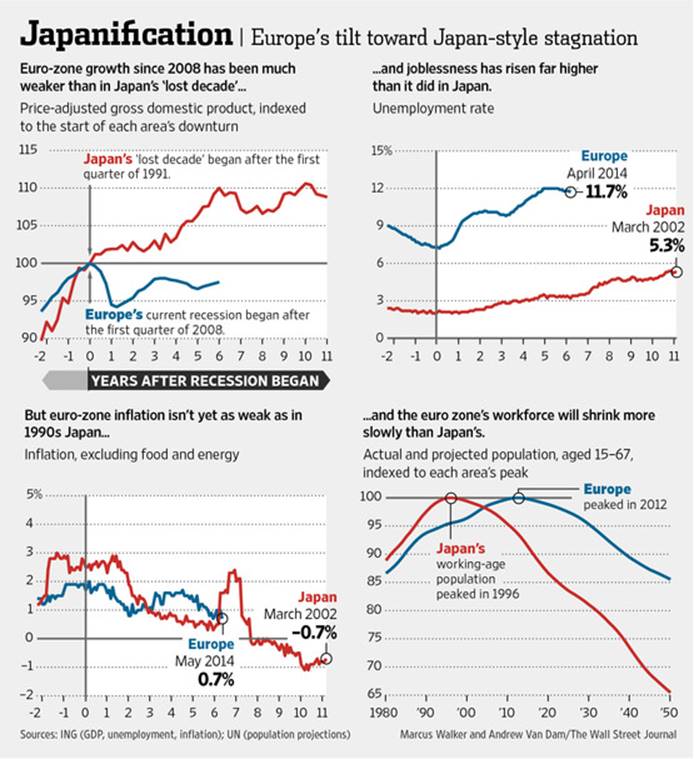
BERLIN—If Europe is tilting toward becoming the next Japan, does that mean it needs its own version of Abenomics?

Japanese Prime Minister Shinzo Abe’s announcement last week of fresh measures to improve sluggish growth coincides with an intensified debate in Europe about whether the euro zone is sliding into similar long-term lethargy.

The euro zone’s stuttering recovery and rising dependence on spending elsewhere are a worry for global growth. The 18-country currency bloc, with its $13 trillion economy, is too big to be a passenger without weighing others down, too.

image001

But how meaningful is the comparison with Japan, which has managed barely 1% annual growth for the past two decades, and how similar are the problems and potential cures? Japan famously fell into a self-perpetuating deflation in the 1990s, with falling prices leading consumers and business to delay spending, thus keeping growth weak.

Read more at http://online.wsj.com/articles/calls-mount-for-europe-to-adopt-abenomics-1404062899

How Bill Gates gamed IBM…and 4 other tips to negotiating the best contracts for your business

How Bill Gates gamed IBM…and 4 other tips to negotiating the best contracts for your business

Published 23 June 2014 13:03, Updated 24 June 2014 13:38

Program on Negotiation at Harvard Law School

Sophisticated negotiators understand that a successful deal often hinges on hammering down the right contract language. In fact, choosing the wording is a negotiation in itself, one with its own unique pitfalls.

Five guidelines can help you master this difficult task.

1. DEFINE THE DEAL BEFORE YOU SET THE PRICE.

Consider the college dropouts whom a corporation hired for low wages to provide operating-system software for a new line of home computers. The company used its clout to drive a hard bargain on price, but the young programmers shrewdly added a clause that would enable them to sell their software to other customers. Read more of this post

Whatever it takes: Billionaire retail trader Solomon Lew has his Country Road revenge

Whatever it takes: Solomon Lew has his Country Road revenge

June 24, 2014 – 1:48PM

Elizabeth Knight

Business columnist

Solomon Lew has a long history with Woolworths and has fought a pitched battle with the South African retailer for nearly 20 years.

High stakes David Jones play could deliver Solomon Lew a $207m Country Road payday

Billionaire rag trader Solomon Lew has cemented his reputation as a master tactician – and one capable of using whatever it takes to achieve a commercial outcome.

He has just rung up $207 million on his personal cash register courtesy of his long time commercial nemesis, the South African retailing giant Woolworths and its chief executive Ian Moir.  Read more of this post

Google Makes Its Nest At The Center Of The Smart Home

Google Makes Its Nest At The Center Of The Smart Home

Posted 1 hour ago by Matt Burns (@mjburnsy)

“Okay Google, turn down the heat.”

Using Google Now, a homeowner will soon be able to talk to a Nest Learning Thermostat and complain about the heat. And that’s just the beginning.

Google is turning the Nest Learning Thermostat into the hub of smart homes. With the “Works with Nest” certification program, announced today, gadgets, cars and universal remotes will all work with the Thermostat, providing automated actions agnostic of the brand. Suddenly the smart home world is much smaller. Read more of this post

What American Apparel CEO Dov Charney’s ouster says about the new world of corporate leadership; The long leash is tightening on CEOs – especially charismatic founders whose drive and influence have made them seemingly untouchable

What American Apparel CEO Dov Charney’s ouster says about the new world of corporate leadership

image001

Theresa Tedesco | June 23, 2014 | Last Updated: Jun 23 7:20 PM ET

Keith Bedford/BloombergDov Charney, the embattled CEO of American Apparel Inc., on June 18 was unceremoniously ousted from the clothing retailer he founded in 1997. Read more of this post

S. Korea to export nuclear technology to Europe for first time in 50 years

S. Korea to export nuclear technology to Europe for first time in 50 years

2014.06.24 14:21:42

South Korea has de facto landed a deal to overhaul the Dutch research nuclear reactor.
This is the first time for Korea to export nuclear technology to Europe.
The Ministry of Science, ICT and Future Planning said Tuesday KAERI, a consortium comprising Korea Atomic Energy Research Institute, Hyundai Engineering & Construction and Hyundai Engineering, was picked as a preferred bidder for the ‘project to raise the research nuclear reactor’s output and construct cold neutron facilities at Delft University of Technology.’
The project seeks to boost the research reactor’s thermal output from 2 megawatt (MW) to 3 MW, upgrade various facilities and build cold neutron research facilities by the end of 2017. The deal is valued at 19 million euro (about 26 billion won).  Read more of this post

Korean credit agencies hit by allegations of favoritism

Updated : 2014-06-23 17:51

Korean credit agencies hit by allegations of favoritism

By Park Si-soo
Korean credit rating agencies are under fire for giving “overly favorable” assessments to domestic companies.
There are many companies, including Hyundai Motor, Kia Motors, KT, SK Telecom, S-Oil and POSCO, whose credit ratings assessed by Korean agencies are six notches or more higher than those given out by internationally recognized agencies such as Moody’s, Standard & Poor’s (S&P) and Fitch.
GS Caltex shows the biggest gap of eight places, raising questions about how seriously investors should take Korean agencies’ evaluations into consideration when making decisions, according to CEO Score, a business consulting firm that compared 33 Korean firms’ credit ratings suggested by major agencies at home and abroad. Read more of this post

Having started life selling calcium supplements from above a shop in provincial England, Shire has emerged three decades later as one of the most prized assets in the European healthcare sector

June 23, 2014 9:39 pm

Shire a jewel in crown among drugmakers

By Andrew Ward, Pharmaceuticals Correspondent

Having started life selling calcium supplements from above a shop in provincial England, Shire has emerged three decades later as one of the most prized assets in the European healthcare sector.

On Friday, months of speculation over which big pharmaceuticals group would make the first move for Shire came to an end when AbbVie confirmed it had made a £27bn takeover proposal.

Flemming Ornskov, Shire chief executive, made clear on Monday that AbbVie – or any other suitor – would have to bid much higher than the latest £46.11 per share cash and stock offer made by the Chicago-based company. Read more of this post

European companies take on pre-crisis levels of debt

June 22, 2014 5:48 pm

European companies take on pre-crisis levels of debt

By Andrew Bolger

European companies that raise finance are taking on levels of debt not seen since the financial crisis as they adjust to the prospect of low interest rates for the foreseeable future.

The ratio of debt to company earnings, or “leverage multiples”, for all European transactions were 5.1 times earnings in the first quarter of 2014, above the 10-year average (4.8 times) for the first time since 2008. Read more of this post

Defining high-frequency trading’s US level of evil

June 20, 2014 7:28 pm

Defining high-frequency trading’s US level of evil

By John Dizard

John Dizard considers whether there is enough liquidity in equity markets

The Wall Street/Washington policy world tends to agree with its European counterparts that there is a worrying lack of liquidity in the credit markets. Most people do not worry much about that as long as the dryness goes along with rising prices; it is during the falling-price times that talking heads worry about liquidity. Read more of this post

India expects Narendra Modi-inspired equity spree

June 23, 2014 12:50 pm

India expects Narendra Modi-inspired equity spree

By James Crabtree in Mumbai

image001-1

With stocks still close to record levels one month after the election of prime minister Narendra Modi, might India’s long-dormant equity markets be about to open up in earnest? So far, the signs are good. Read more of this post

Asia turns on the taps for tech funding

June 24, 2014 2:52 am

Asia turns on the taps for tech funding

By Josh Noble in Hong Kong

When the bosses of US video messaging app Tango were on the lookout for a strategic partner, they turned in the direction of Hangzhou, China – home of ecommerce company Alibaba.

Within weeks, Tango’s founders met with Alibaba’s executive vice chairman Joe Tsai, before selling a quarter of the company for $215m.

Deals like this, where Asian capital goes into a young tech company from another part of the globe, are becoming increasingly common. The region is emerging as a key source of funding for the sector, putting Hong Kong and Singapore firmly on the map for tech startups seeking cash. Read more of this post

Business needs to make the case for capitalism; ‘Profit’ is popularly understood as being taken from consumers

June 23, 2014 6:48 pm

Business needs to make the case for capitalism

By John McTernan

‘Profit’ is popularly understood as being taken from consumers, writes John McTernan

British businesses urgently need to become actively involved in politics. There are serious short and long-term political threats to them and their profitability. This should worry them but it should worry the country even more.

The short-term threats are easily described and understood.

If Scotland were to leave the UK it would badly damage a range of companies, particularly in the banking and financial services sector. But the social, economic and trade links between Scotland and the rest of the UK would mean the crisis caused by independence would spread quickly and widely. The silence of almost all businesses on the September referendum is a scandal. The few interventions made to date were driven by stringent financial reporting requirements rather than a desire to play a public role. But corporations are actors and they should not be afraid to speak. Read more of this post

If Finland is the best Europe can do we should be worried; The country’s plummeting productivity is down to bad luck and bad policies

June 23, 2014 7:11 pm

If Finland is the best Europe can do we should be worried

By Risto Penttila

The country’s plummeting productivity is down to bad luck and bad policies, writes Risto Penttila

Either the World Economic Forum is wrong or Europe is in deep trouble. The latest competitiveness rankings from the Swiss think-tank list Finland as the most competitive country in the EU. At first, the country’s business leaders thought someone was pulling their leg. But the news was real. If Finland is the best the EU can offer, we should all be very concerned. Read more of this post

Robots will not eat the jobs but will unleash our creativity; Tech revolution has put the means of production within everyone’s grasp, says Marc Andreessen

June 23, 2014 5:25 pm

Robots will not eat the jobs but will unleash our creativity

By Marc Andreessen

Tech revolution has put the means of production within everyone’s grasp, says Marc Andreessen

Agrowing number of people seem to fear that robots will eat all the jobs. Their worry boils down to this: computers can increasingly replace human labour thus displacing jobs and creating unemployment. Your job, and every job, will go to a machine.

It is textbook Luddism, relying on a “lump of labour” fallacy – the idea that there is a fixed amount of work to be done in the world by humans. The counterargument comes from economists such as Milton Friedman, who believe that human wants and needs are infinite, which means there is always more to do. Read more of this post

Beijing accuses banks and developers over property market

June 23, 2014 8:30 am

Beijing accuses banks and developers over property market

By FT Reporters

China has signalled it will resist calls for aggressive measures to prop up its flagging property market, even as house prices continue to drop.

People’s Daily, the Communist party’s main mouthpiece, said in a commentary on Monday that the property market was in a “normal adjustment period” and accused domestic developers, speculators and foreign banks of exaggerating the slowdown in order to put pressure on authorities to adopt heavy-handed stimulus policies. Read more of this post