Virtual-Currency Craze Spawns Bitcoin Wannabes; Entrants Include Litecoin, Worldcoin and Even Bbqcoin; a Ticket to Fortune?

Virtual-Currency Craze Spawns Bitcoin Wannabes

Entrants Include Litecoin, Worldcoin and Even Bbqcoin; a Ticket to Fortune?

JOE LIGHT

Updated Nov. 20, 2013 9:00 p.m. ET
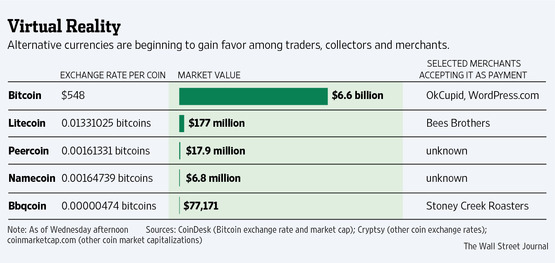
MI-BZ819_ALTCOI_G_20131120202703

Owner Taylor Minor waits on customers at Stoney Creek Roasters in Cedarville, Ohio, which accepts a form of payment called bbqcoin. Ty Wright for The Wall Street Journal 

Gary Thomas plans to get rich off virtual currencies—but not bitcoin. The electrical engineer is betting big on newcomers like alphacoin and fastcoin. Mr. Thomas started trading the digital currencies from his home outside Boston earlier this year. He said he is convinced this is his ticket to fortune, even after an earlier attempt—investing in Internet stocks during the dot-com bubble—ended in disaster. Read more of this post

Turning workers into capitalists: Employee share ownership has merit. But that does not justify further government incentives

Turning workers into capitalists: Employee share ownership has merit. But that does not justify further government incentives

Nov 23rd 2013 |From the print edition

20131123_FND000

IN AN effort to rebuild New England’s cod industry after the war of independence, George Washington signed a law in 1792 giving shipowners “allowances” (ie, subsidies) to offset the tariffs they had to pay on their inputs. Two conditions were attached to the support: shipowners had to sign a profit-sharing agreement with their crew, with whom they also had to split the allowance. Thus one of America’s first tax breaks was designed to encourage owners to share profits with their workers. Read more of this post

The chief of Europe’s sixth-biggest PE group EQT urged his peers to “focus more on building companies than avoiding taxes” if they want to keep their licence to operate amid greater regulatory and political scrutiny of the sector

November 21, 2013 5:29 pm

Private equity groups told to alter focus

By Anne-Sylvaine Chassany in Paris

The chief of Europe’s sixth-biggest private equity group has urged his peers to “focus more on building companies than avoiding taxes” if they want to keep their licence to operate amid greater regulatory and political scrutiny of the sector. The plea made by Conni Jonsson, EQT’s managing partner, on Thursday at a conference in Paris was received with a warm round of applause, as private equity companies both in Europe and in the US face criticism from politicians and unions that they exploit tax loopholes to boost their returns. Read more of this post

Slowing buybacks could spell trouble for U.S. stocks

Slowing buybacks could spell trouble for U.S. stocks

12:20pm EST

By Chuck Mikolajczak

NEW YORK (Reuters) – With just over a month remaining in a year that has seen the S&P 500 rocket to new records, one of the rally’s drivers could have peaked: stock buybacks. In the last few years, major U.S. companies, including IBM, Apple and Exxon Mobil have dramatically boosted share repurchases. Overall, Federal Reserve data shows corporations are the primary buyer of equities – while pension funds, mutual funds and households have increasingly been sellers in recent years. Read more of this post

Pubs turns focus from property to staff; For a long time in the pub industry, the property market came before pubs. Whoever was running the pub – and how well they were doing it – did not matter

November 21, 2013 7:05 pm

Pubs turns focus from property to staff

By Duncan Robinson

For a long time in the pub industry, the property market came before pubs. Whoever was running the pub – and how well they were doing it – did not matter. “In the past, you used to churn the tenants,” says Stephen Billingham, executive chairman of Punch Taverns, which has 4,000 pubs across the UK. “If they failed, you brought in somebody new.” Read more of this post

Nobelist’s Valuation Measure Draws Questions

Nobelist’s Valuation Measure Draws Questions

ALEXANDRA SCAGGS

Nov. 21, 2013 12:06 p.m. ET

MI-BZ835_SHILLE_G_20131121151504

Bubble-hunting economist Robert Shiller‘s stock-market valuation measure is waving a yellow flag, but there is a debate brewing over whether even that is too alarming a picture. Of 15 stock-market valuation measures tracked by Bank of America BAC +2.97% Merrill Lynch’s stock strategy team, Mr. Shiller’s cyclically adjusted price/earnings ratio is the only one above its long-term average. Read more of this post

Goodwill Testing May Soon Get Simpler for Private Companies

November 22, 2013, 3:14 AM ET

Goodwill Testing May Soon Get Simpler for Private Companies

EMILY CHASAN

Senior Editor

Annual tests companies use to check whether assets they have acquired have lost value and need to be written down could become simpler soon. The Financial Accounting Standards Board is set to decide on Monday whether to endorse changes proposed by its new Private Company Council that would let private firms choose to amortize so-called goodwill from past acquisitions on their balance sheets. The proposal would also allow simplify and limit the testing that triggers write-downs. Read more of this post

Get big or die trying: Finding a better way to deliver pensions

Get big or die trying: Finding a better way to deliver pensions

Nov 23rd 2013 |From the print edition

PENSION funds have had a pretty good 2013: rising share prices and higher bond yields have reduced their funding deficits. Nevertheless, the combined strains of volatile markets and improved longevity are causing the industry to have a rethink, as a World Bank conference in Cape Town revealed this week. Some funds in the Dutch system, long regarded as among the best in the world, have been forced to cut benefits to pensioners because of funding shortfalls. In Canada, the Ontario Teachers’ Pension Plan, often praised for its sophistication, has had to reduce inflation protection for workers who retired after 2009—a cut in pensioners’ real incomes. Read more of this post

Fed Casts About for Endgame on Easy-Money Policy

Fed Casts About for Endgame on Easy-Money Policy

JON HILSENRATH and VICTORIA MCGRANE

Updated Nov. 20, 2013 3:35 p.m. ET

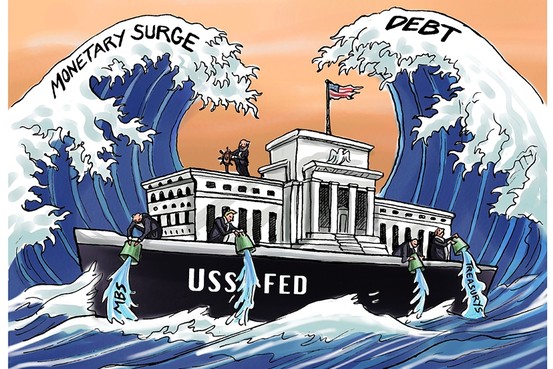
Federal Reserve officials, mindful of a still-fragile economy, are laboring to devise a strategy to avoid another round of market turmoil when they pull back on one of their signature easy-money programs in the months ahead. Central-bank officials have been debating for months when to start paring the $85 billion-a-month bond-purchase program. They were surprised during the summer when their discussions and public pronouncements on the potential timing rocked markets, pushing interest rates higher and stock prices down. Read more of this post

Every month that the Fed’s quantitative easing goes on, the exit strategy becomes more difficult and dangerous

Phil Gramm and Thomas R. Saving: Janet Yellen’s Greatest Challenge

Every month that the Fed’s quantitative easing goes on, the exit strategy becomes more difficult and dangerous.

PHIL GRAMM and THOMAS R. SAVING

Nov. 21, 2013 6:50 p.m. ET

ED-AR525_GRAMM_G_20131121155747

With the Senate Banking Committee on Thursday approving Janet Yellen‘s nomination to lead the Federal Reserve, her confirmation is virtually assured. Less certain is what Ms. Yellen ultimately intends to do with Fed policy on quantitative easing, now entering its 34th month. She is committed to maintaining QE for now, but does she have an exit strategy? The Fed needs one, because the economic stakes could not be higher. Read more of this post

Eurozone banks’ asset shedding hits SMEs

Last updated: November 19, 2013 7:23 pm

Eurozone banks’ asset shedding hits SMEs

By Christopher Thompson

Never mind the banks, the bigger impact of next year’s eurozone stress tests could be on small businesses. As banks shed assets ahead of the tests, pruning their assets, lending to companies across the single currency zone has suffered. And the scale of bank deleveraging yet to come is daunting. To comply with new capital requirements Royal Bank of Scotland estimates the eurozone’s biggest banks need to cut an additional €2.6tn from their balance sheets – at €31.3tn collectively in September, they remain among the biggest of any region in the world. That is on top of €3.5tn in asset cuts already made since May 2012. Read more of this post

Europe’s Most Entrepreneurial Country? It’s Ireland

Europe’s Most Entrepreneurial Country? It’s Ireland

BEN ROONEY

Nov. 20, 2013 12:15 p.m. ET

EM-AX962_TECHEU_G_20131120120005

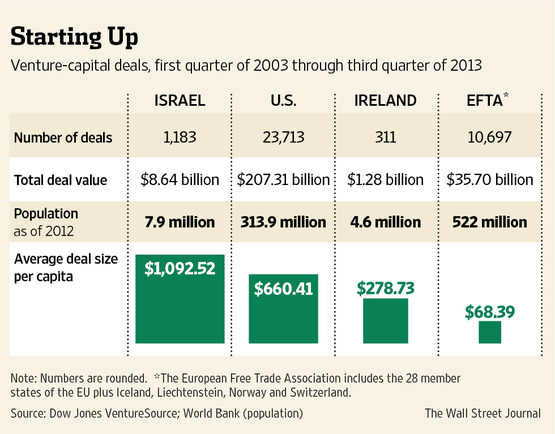
Ranking tech entrepreneurialism is a tricky task and whatever measure you come up with is going to annoy somebody, but by at least one measure, Europe’s most entrepreneurial country is Ireland. What does “most entrepreneurial country” mean? In this analysis, we looked at Dow Jones VentureSource data on the total amount of venture capital raised by tech companies in each European country since 2003, divided by population to get the per capita figure, then averaged it out over the 39 quarters. Read more of this post

Does cheapness predict subsequent outperformance?

November 21, 2013 4:10 pm

Does cheapness predict subsequent outperformance?

By Dominic Picarda

Europe looks cheap, but the US is pricey

Nothing sets off alarm bells quite like investors claiming that old valuation rules no longer apply. The classic case of this was during the technology bubble of the late 1990s. Faced with internet firms that made little or no profit, analysts spurned traditional valuation tools and cooked up new techniques based – among other things – upon website clicks. When investors woke to the incoherence of this “new paradigm”, technology stocks collapsed. Read more of this post

BMW, Cadillac Aim to Pull Plug on Tesla With Pricey New Cars

BMW, Cadillac Aim to Pull Plug on Tesla With Pricey New Cars

JOSEPH B. WHITE

Nov. 20, 2013 6:25 p.m. ET

LOS ANGELES— Tesla Motors Inc. TSLA -3.95% is about to get deep pocketed rivals in the luxury electric luxury car market after largely having the business to itself since the 2012 launch of the Model S sedan. BMW AG BMW.XE +0.31% , General Motors Co. GM -0.84% ‘s Cadillac and VolkswagenAG VOW3.XE +0.08% ‘s Porsche and Audi NSU.XE +0.30% brands are among the luxury brands using this week’s Los Angeles Auto Show to promote new plug-in models aimed at affluent, eco-conscious Californians who make up the heart of Tesla’s buyers. Read more of this post

Blame Rich, Overeducated Elites as Our Society Frays

Blame Rich, Overeducated Elites as Our Society Frays

Complex human societies, including our own, are fragile. They are held together by an invisible web of mutual trust and social cooperation. This web can fray easily, resulting in a wave of political instability, internal conflict and, sometimes, outright social collapse. Analysis of past societies shows that these destabilizing historical trends develop slowly, last many decades, and are slow to subside. The Roman Empire, Imperial China and medieval and early-modern England and France suffered such cycles, to cite a few examples. In the U.S., the last long period of instability began in the 1850s and lasted through the Gilded Age and the “violent 1910s.” Read more of this post

Big trucks still rule Detroit in energy-conscious era

Big trucks still rule Detroit in energy-conscious era

8:38am EST

By Paul Lienert

DETROIT (Reuters) – Five years into a remarkable rebound from near-disaster, the Detroit 3 automakers still count on sales of pickup trucks and SUVs in the North American market for the bulk of their global profits, despite efforts to shift buyers into smaller, greener vehicles as part of a broader move to remake the Motor City. Promotion of green technologies, notably hybrid and electric vehicles, has been a signature policy of the Obama administration, which oversaw the $80 billion taxpayer-funded bailout in 2009 of General Motors and Chrysler. Read more of this post

Asset price ‘security alerts’ mask real risks

Last updated: November 22, 2013 9:44 am

Asset price ‘security alerts’ mask real risks

By Tracy Alloway in New York

Defining value is hamstrung by assumptions and expectations

Any reader who has flown commercially in the US during the past dozen years will no doubt have a passing awareness of the Homeland Security Advisory System. The now defunct terrorism threat scale was rolled out to indicate the threat level faced by the nation, from green – for a “low” risk of an attack – to red for “severe”. I was this week reminded of the now-moribund warning system thanks to a flight to Florida and a new research report by Fitch Ratings that draws an unusual parallel between the nation’s old colour-coded scale and US accounting rules. Read more of this post

Anxiety Over Asset Bubbles From Homes to Internet Rising in Poll

Anxiety Over Asset Bubbles From Homes to Internet Rising in Poll

Asset bubbles are forming in Internet and social media stocks as well as in the housing markets of London and China, according to the latest Bloomberg Global Poll. Eighty-two percent of the responding investors, analysts and traders who are Bloomberg subscribers said Internet and social media shares are either at or near unsustainable levels. Seventy-three percent said the same of Chinese house prices and 69 percent identified London homes as already or almost frothy. They were less concerned about U.S. housing, with 31 percent seeing prices approaching or at excessive levels. Read more of this post

An ECB Negative Deposit Rate? Don’t Hold Your Breath, Says Citi

An ECB Negative Deposit Rate? Don’t Hold Your Breath, Says Citi

Tyler Durden on 11/20/2013 13:18 -0500

While the FOMC Minutes due out in less than an hour is what everyone is looking forward to, the big surprise announcement of the day was the repeat of a rumor released initially 6 months ago, namely that the ECB is considering negative deposit rates – a concept we first speculated aboutback in June of 2012. Alas, just like last time, the latest incarnation of the NIRP rumor appears to be merely more hot air (and certainly will be exposed as such once the non-compliant mostly German ECB members hit the tape). One person who says not to hold your breath for an ECB negative rate, is Citi’s Valentin Marino, who says not only is a negative deposit rate unlikely before the results of the AQR and stress tests as it would accelerate bank deleveraging, but that it “could worsen the pervasive credit crunch and add to the growth headwinds and deflation risks in in the currency block. It would erode investors’ confidence in Eurozone’s financial institutions and accentuate their relative underperformance.”  Read more of this post

Shortcomings of The NPV Approach To Valuing Stocks

Shortcomings of The NPV Approach To Valuing Stocks

by csinvestingNovember 20, 2013

Part I: What are the three major shortcomings of using the Net Present Value Approach (“NPV”) to valuing companies?

The NPV approach has three fundamental shortcomings. First, it does not segregate reliable information from unreliable information when assessing the value of a project. A typical NPV model estimates net cash flows for several years into the future from the date at which the project is undertaken, incorporating the initial investment expenditures as negative cash flows. Five to ten years of cash flows are usually estimated explicitly. Cash flows beyond the last date are usually lumped together into something called a “terminal value.” A common method for calculating the terminal value is to derive the accounting earnings from the cash flows in the last explicitly estimated year and then to multiply those earning by a factor that represents an appropriate ratio of value to earnings (i.e., a P/E ratio). If the accounting earnings are estimated to be $12 million and the appropriate factor is a P/E ratio of 15 to 1, then the terminal value is $180 million. Read more of this post

The Top-Heaviness Problem in Indexation and the Wealth Index

Horizon Kinetics: The Top-Heaviness Problem in Indexation and the Wealth Index

by ValueWalk StaffNovember 20, 2013

These two normally separate sections have been combined for this issue, since the two categories converge in my discussion of a new approach to the top-heaviness problem in indexation. Let’s review the problem. We understand the need for indexation, and we also understand the need for liquidity. The first problem in constructing an index is to provide the customer base enough liquidity for investing sufficient funds in the index. The only recognized approach is that of market capitalization, because that measurement is more or less a guide to the liquidity of the constituent elements of an index. This approach creates a top-heaviness problem, one aspect of which is that if a company is very highly valued in a conventional metric sense, as in having a very high P/E, it has a proportionately larger market capitalization. Therefore, anyone who buys the index would be buying companies that are overvalued. Read more of this post

Cross-Border Reverse Mergers: Causes and Consequences

Cross-Border Reverse Mergers: Causes and Consequences

Jordan I. Siegel Harvard Business School

Yanbo Wang Boston University School of Management

September 24, 2013
Harvard Business School Strategy Unit Working Paper No. 12-089

Abstract: 
We study non-U.S. companies that have used reverse mergers as a means to adopt U.S. corporate law (and sometimes U.S. securities law as well). Early adopters of cross-border reverse mergers and those firms that hired a Big Four auditor exhibited superior corporate governance outcomes. Later adopters of cross-border reverse mergers were likely to strategically mimic the early entrants only to gain access to U.S. capital markets — that is, they took some governance actions but not others — and are shown to be likely to have worse corporate governance outcomes over time. Firm-level origins in China initially appears to be a significant negative determinant of at least some corporate governance outcomes, but the variable loses its statistical power when examining the most comprehensive data set on cross-border reverse mergers yet assembled and when including a battery of relevant control variables. Adoption of Nevada’s corporate law is associated with some of the most serious restatements involving real corporate governance and data manipulation problems. In summary, the evidence supports the existence of strategic mimicry, which the capital market did not fully discern for many years. It also supports the explanatory power of reputational bonding to explain the fact that adoption of U.S. institutions can be used either to build reputation or to exploit relatively weak U.S. cross-border law enforcement.

Independent Directors’ Dissent on Boards: Evidence from Listed Companies in China

Independent Directors’ Dissent on Boards: Evidence from Listed Companies in China

Juan Ma Harvard Business School

Tarun Khanna Harvard University – Strategy Unit

October 24, 2013
Harvard Business School Strategy Unit Working Paper No. 13-089

Abstract: 
In this paper, we examine the circumstances under which so-called “independent” directors voice their independent views on public boards in a sample of Chinese firms. First, we ask why independent directors dissent, i.e. how they justify such dissent to public investors. We find that when independent directors dissent, they tend to offer mild, subjective justifications. Overt criticism of the management is rare. Next, we ask when an independent director is more likely to dissent and who is more likely to dissent. Controlling for firm and board characteristics, we find that dissent is significantly correlated with breakdown of social ties between the independent director and the board chair who locates at the center of the board bureaucracy in China. Dissent is more likely to occur when the board chair who appointed the independent director has left the board. Dissent also tends to occur at the end of board “games”, defined as a 60-day window prior to departure of the board chair or departure of the independent director herself. The endgame effect is particularly strong, seeing 27% of the dissent issued at board “endgames” which represents only 4% of independent directors’ average tenure. While directors with foreign experience are more likely to dissent, we do not find that academics, accountants and lawyers are significantly more active in voicing dissent. Lastly, we show that dissent is consequential to both the director and the firm. For directors, dissent significantly increases one’s likelihood of exiting the director labor market, which translates to a more-than-10% estimated loss of annual income. For firms, we document an economically and statistically significant cumulative abnormal return of -0.97% around announcement of dissent. Although the literature has suggested that dissent might be reflective of diverse viewpoints, and perhaps beneficial in and of itself through reduction of firm variability, we do not find this offsetting beneficial effect to be strong.

Nikola Tesla: “I do not think there is any thrill that can go through the human heart like that felt by the inventor as he sees some creation of the brain unfolding to success. Such emotions make a man forget food, sleep, friends, love, everything”

11 Bizarre Sleeping Habits Of Highly Successful People

VIVIAN GIANG NOV. 19, 2013, 11:24 AM 219,099 6

One of a professional’s most important daily rituals is how and when they sleep, since this affects how well they perform on the job. For people at the top, who often face intense pressure and packed schedules, sometimes these sleeping habits can be quite strange. Olympic gold medalist Michael Phelps, for instance, sleeps in a high altitude chamber which forces his body to work even while resting. Meanwhile, famed writer Charles Dickens always slept facing north, and inventor Nikola Tesla never slept for more than two hours a night. Here’s a look at the most bizarre sleeping habits of highly successful people.

nikola-tesla-wireless-electricity nikola-tesla-1

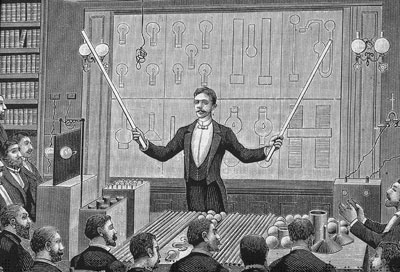
Inventor Nikola Tesla never slept for more than two hours a day.Tesla got more out of the day with his limited sleep schedule. Like Da Vinci, Telsa also followed the Uberman sleep cycle and claimed to never sleep for more than two hours a day and reportedly once worked for 84 hours in a lab without any rest or sleep. “I do not think there is any thrill that can go through the human heart like that felt by the inventor as he sees some creation of the brain unfolding to success … Such emotions make a man forget food, sleep, friends, love, everything,” he said. Read more of this post

Malcolm Walker, Iceland’s frozen food evangelist; “A lot of my friends who’ve had businesses have sold them and suddenly got old very quickly.” “Some of my friends have done well in business . . . their 17-year-old gets a BMW, they all turn out brats. My three children are amazing. They know the value of money.”

November 10, 2013 1:40 pm

Malcolm Walker, Iceland’s frozen food evangelist

By Emma Jacobs

download (32) Malcolm-Walker-006

There is a great deal of snobbery surrounding Iceland, the frozen food emporium started by Malcolm Walker more than four decades ago. People like to mock its doner kebab pizzas and its party packets of “bubble bobble” prawns. He has heard it all before. There has always been, he observes, a distinct class difference between the City of London and its metropolitan media, and northern entrepreneurs, like him. Read more of this post

Big Trouble In Massive China: “The Nation Might Face Credit Losses Of As Much As $3 Trillion”

Big Trouble In Massive China: “The Nation Might Face Credit Losses Of As Much As $3 Trillion”

Tyler Durden on 11/19/2013 12:09 -0500

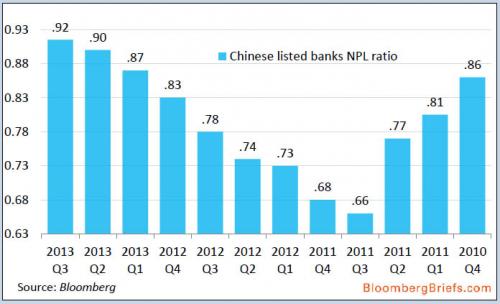
The following chart from Bloomberg showing official Chinese NPL data has its pros and cons.

China NPLs_0

The pros: it shows that the trend in improving NPLs has dramatically inverted in the past ten quarters and has risen to the highest in at least three years.

The cons: the chart, which again is based on official data, is woefully misrepresenting and underestimating just how profound the bad debt situation is in a country in which each month pseudo-nationalized banks issue loans amounting to the same or more in new liquidity as the Fed and BOJ do combined!  Read more of this post

Interest Rate Swaps Hit Record High As China Warns “Big Chance Of Bank Failures”

Interest Rate Swaps Hit Record High As China Warns “Big Chance Of Bank Failures”

Tyler Durden on 11/19/2013 22:35 -0500

20131119_china_0

Overnight repo rates are spiking once again in early trading as the typically smaller banks that are more desperate bid aggressively for whetever liquidity they can find. 5Y Chinese swap rates have also reached a record high as the Yuan reaches its highest since Feb 2005. Chinese authorities are clearly stepping up the rhetoric:

*CHINA SHADOW-FINANCE RISKS WILL SPREAD TO BANKS, FANG SAYS

*VERY BIG CHANCE ONE OR TWO SMALL CHINA BANKS WILL FAIL: FANG

*SOME CHINA TRUST INVESTMENT FIRMS MAY FAIL, SELL ASSETS: FANG

*CHINA MUST PLAN FOR BANK-FAIL SCENARIOS TO MANAGE RISKS: FANG

*CHINA NEEDS TO PAY MORE ATTENTION TO CORPORATE LEVERAGE: HU

The gambit between the PBOC’s liqudity provision and the growing dependence on their “spice” is clear – the question is, of course, will banks send a message (via the markets) to the PBOC or will they self-select (on first-mover’s advantage) eradicating the weakest. 5Y Chinese Interest Rate Swaps have reached a record high (implying expectations priced into the market of rising interest rates)… and short-term liquidity is problematic again as overnight repo jumps to 5.00% in early trading.. What everyone is wondering is – with the failure of 1 or 2 banks seemingly guaranteed – how will the contagion be contained? How will the interbank market respond when no one knows who is it? We know what happened in the US in 2008…

Disruption and loss can foster growth; Adversity often provides the stimulus that drives a determination to success in business

November 19, 2013 4:10 pm

Disruption and loss can foster new growth

By Luke Johnson

Adversity often provides the stimulus that drives a determination to success in business

E xperiencing adversity is almost a necessary precondition for those destined for the top. As Henry David Thoreau said: “You cannot dream yourself into a character; you must hammer and forge yourself one.” If it all comes too easy, if your life is too comfortable, then you are unlikely to stretch yourself, or know how to handle hard knocks. Nothing creates adversity like war. It is almost always a tragic waste of lives and resources. But from all the terrible dislocation of armed conflict a number of businesses have emerged. Read more of this post

Signs of ‘sudden’ cardiac death may come weeks before: study

Signs of ‘sudden’ cardiac death may come weeks before: study

Tue, Nov 19 2013

By Ransdell Pierson and Bill Berkrot

(Reuters) – Signs of approaching “sudden” cardiac arrest, an electrical malfunction that stops the heart, usually appear at least a month ahead of time, according to a study of middle-age men in Portland, Oregon. “We’re looking at how to identify the Tim Russerts and Jim Gandolfinis – middle aged men in their 50s who drop dead and we don’t have enough information why,” said Sumeet Chugh, senior author of the study and associate director for genomic cardiology at the Cedars-Sinai Heart Institute in Los Angeles. Read more of this post

Hemingway’s Secret to Maintaining Productive Momentum: Always Leave a Little Water in the Well

HEMINGWAY’S SECRET TO MAINTAINING PRODUCTIVE MOMENTUM

THE IMPORTANCE OF BEING LIKE ERNEST? TREAT YOUR PRODUCTIVITY AS IF IT’S A RENEWABLE RESOURCE: ALWAYS LEAVE A LITTLE WATER IN THE WELL.

BY DRAKE BAER

To Ernest Hemingway, writers are like wells: “The important thing is to have good water in the well,” he told the Paris Review, “and it is better to take a regular amount out than to pump the well dry and wait for it to refill.” In this way, Hemingway coined the phrase leaving water in the well: instead of spending all your creative juices all at once, you leave a little bit of inspiration so that you can return to the same momentum that you left it with. Hemingway, whose habits of badass productivity we’ve talked about before, said to never stop writing without knowing how you are going to start again, to, in other words, never end a day’s work without knowing how you are going to start the next day. Read more of this post