IRobot Co-Founder Has Startup for Flying Robots

IRobot Co-Founder Has Startup for Flying Robots

Nov. 11, 2013 10:21 p.m. ET

CYPHY WORKS

IRobot Corp. IRBT +1.33% co-founder Helen Greiner, who helped introduce the world to the Roomba robot for home vacuum cleaning and the PackBot for battlefield bomb disposal, has another company—this time for flying robots. CyPhy Works Inc. makes drones that launch, hover and land automatically, to help people with tasks performed from the air. The drones are powered through a thin wire that lets them stay up in the air for hours or weeks. The wire also enables the robots to send real-time high-definition video and other data back to the base with less risk of it being intercepted or jammed, the company says. The drones also are equipped with batteries that enable them to fly for shorter periods without being tethered. One is small enough to fly through a door or window. Read more of this post

IPhone App Wipes Out Population to Show Contagion Risks

IPhone App Wipes Out Population to Show Contagion Risks

The plague started in Indonesia. A viral infection, it spread quietly at first, making its way from person to person with coughing and sneezing its only symptoms. Then someone infected with the virus got on a plane. As the disease spread around the globe, fever gave way to sweating, nausea, vomiting. Hundreds infected turned to thousands. The virus developed drug resistance. Thousands became millions. It was all part of Ian Lipkin’s plan. Read more of this post

For about two years, Google refused to let Nielsen place measurement tags on ads running on YouTube, a stance that media buyers say stopped some advertisers buying time on the online video site. Google’s reversal could fuel the shift of TV ad dollars to online video

Google Relents on YouTube Ad Measurement

Nielsen to Begin Tracking Viewership of Videos

SUZANNE VRANICA

Nov. 11, 2013 4:26 p.m. ET

For about two years, Google Inc. GOOG -0.54% refused to let Nielsen HoldingsNLSN -0.28% place measurement tags on ads running on YouTube, a stance that media buyers say stopped some advertisers buying time on the online video site. Last week, Google reversed its position in a decision that analysts say could fuel the shift of TV ad dollars to online video. Read more of this post

Etsy’s Industrial Revolution

November 11, 2013

Etsy’s Industrial Revolution

By ELIZABETH WAYLAND BARBER

PASADENA, Calif. — HAND-KNIT sweaters? Hand-thrown pots? How about quilts stitched on a sewing machine? In an age when artisanal items can be sold at a premium, what products should qualify as “handmade”? This is the problem confronting executives at Etsy, the online marketplace for all things vintage and handmade, which has not allowed factory-made products to be sold on its site since it was founded in 2005. Read more of this post

EBay Evolves Into a Global Commerce Hub

EBay Evolves Into a Global Commerce Hub

By R.J. Hottovy, CFA | 11-11-13 | 06:00 AM | Email Article

Our positive long-term outlook for  eBay (EBAY) is intact following strong third-quarter results, highlighted by double-digit growth in PayPal and Marketplaces active users, impressive mobile commerce adoption rates, and modest margin expansion despite user engagement and other investments across all business segments. We believe the company remains on track to achieve its 2015 targets of $300 billion in enabled commerce volume, revenue of $21.5 billion-$23.5 billion, operating margins around 27%, and adjusted earnings per share near $4.00. Read more of this post

“If Google Analytics gives a map of who visited where, ClickTale tells you what they did”; ClickTale, whose software enables website owners to see how people behave on their sites

Website analytics firm ClickTale sees 50 percent annual sales growth

5:53am EST

By Tova Cohen

TEL AVIV (Reuters) – ClickTale, whose software enables website owners to see how people behave on their sites, expects to maintain an annual sales growth rate of over 50 percent in the next few years as companies seek to improve their customers’ experience. “Sales have grown by thousands of percent over the last six years to tens of millions of dollars a year,” co-founder and Chief Executive Tal Schwartz told Reuters. “The growth rate is over 50 percent year over year.” Read more of this post

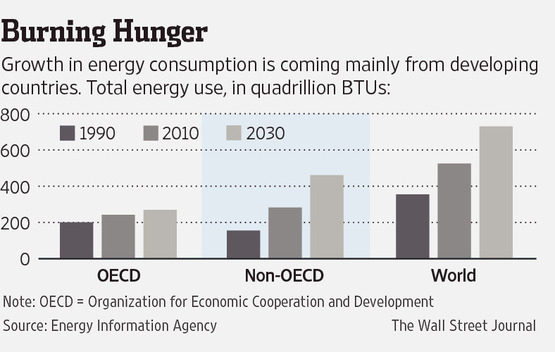
The Future of Energy: Predicting what the energy landscape will look like in 20 years

The Future of Energy

Predicting what the energy landscape will look like in 20 years

Updated Nov. 11, 2013 4:19 p.m. ET

EY-AA555_CHANGE_G_20131108151520EY-AA588_EYCOVE_G_20131108145403

Consider how the energy landscape has changed in the past 20 years. In 1993, the price of oil was a bit over $18 a barrel; it’s around $100 a barrel now. In 1993, the life of a cellphone battery was hardly a concern because there were only 34 million cellphone subscribers world-wide, compared with more than 6.8 billion today. The battery for electric cars mattered even less: It would be another three years before the General Motors EV1 went into production and a year after that before the first Prius went on sale in Japan. Wind farms were a novelty, and solar energy barely registered in the statistics. Read more of this post

How to Cure South Korea’s English Fever?

November 12, 2013, 9:52 AM

How to Cure South Korea’s English Fever?

By Jasper Kim 

How much should a country pay to master the English language? Based on the economics and outcomes of English tuition in South Korea today, the country is throwing excessive amounts at the task with meager results. According to Swiss-based language learning company EF Education First, the average South Korean gets nearly 20,000 hours of English education from kindergarten through university. Much of that tuition comes at private institutes known as hagwon that Korean kids flock to stay ahead in the nation’s hyper-competitive educational race. There are currently over 17,000 hagwon that teach English in South Korea. That’s roughly one hagwon for every 647 students. Read more of this post

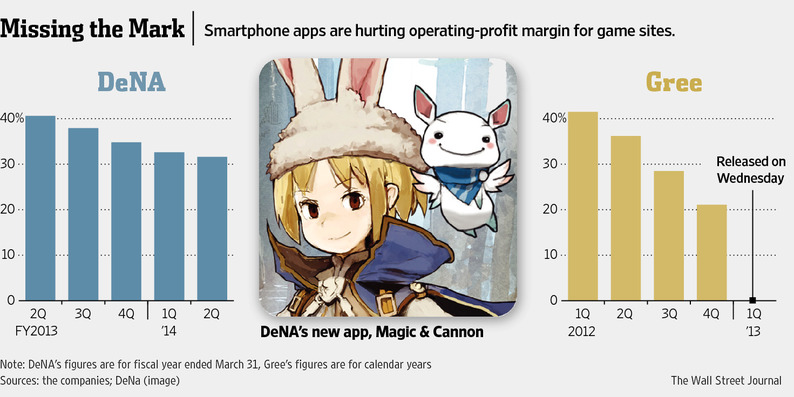
Gree, DeNA Earnings: Profits Fall at Japanese Mobile-Game Sites

Gree, DeNA Earnings: Profits Fall at Japanese Mobile-Game Sites

Companies Face Increased Competition from Apps

MAYUMI NEGISHI

Nov. 11, 2013 11:56 a.m. ET

AM-BB023_GAMECH_G_20131111124504

TOKYO—Just a few years ago, mobile-game sites DeNA Co. 2432.TO +1.46% Ltd. andGree Inc. 3632.TO +0.24% were the kings of Japan’s lucrative cellphone-game industry. But now their profits are falling as users turn to stand-alone applications on phones and tablets. Hurt by a dearth of hit games just as app downloads have exploded in Japan, Gree last month encouraged employees to take voluntary retirement and on Wednesday is expected to announce a steep drop in quarterly profit. Read more of this post

Behind the Scenes of Tokyo’s Political Soap Opera

Behind the Scenes of Tokyo’s Political Soap Opera

Shinzo Abe faces plenty of roadblocks in his quest to revive Japan’s sluggish economy. His mentor wasn’t supposed to be one of them. Former Prime Minister Junichiro Koizumi is easily the most popular Japanese politician of the last 20 years. Not since Yasuhiro Nakasone in the mid-1980s had a Japanese leader made such a splash domestically and globally. Not coincidentally, both were keen reformers — as Abe, too, claims to be. Read more of this post

Jakarta Mulls Gridlock in 2014

Jakarta Mulls Gridlock in 2014

By Hotman Siregar & Deti Mega Purnamasari on 9:08 am November 12, 2013.

With hordes of cheap, new cars and motorcycles continuing to hit the city’s streets, and the two rail-based public transit networks not expected to be ready until at least 2016, experts have warned that Jakarta faces imminent gridlock next year. Azas Tigor Nainggolan, chairman of the city-funded Jakarta Transportation Council, said on Monday that he was concerned about the lack of effort to curb the number of private vehicles from clogging the city’s streets, particularly in the chronically congested downtown area, and the slow pace of improvement in public transportation. Read more of this post

Hyundai Motor Chief Technology Officer Quits Over Quality Issues

Hyundai Motor Chief Technology Officer Quits Over Quality Issues

Hyundai Motor Co. (005380)’s chief technology officer resigned after a series of recalls dented the South Korean automaker’s reputation for quality. Kwon Moon Sik, who was president of the research and development division, quit yesterday along with two other executives over a chain of quality issues, the Seoul-based company said in an e-mailed statement today. It didn’t say who will replace Kwon. Read more of this post

A fight has erupted between a group of institutional investors and the owners of Singapore semiconductor company UTAC over a debt swap that will test governance standards in emerging bond markets

November 12, 2013 3:22 am

Singapore debt feud tests emerging bond markets

By Stephen Foley in New York

A fight has erupted between a group of institutional investors and the owners of Singapore semiconductor company UTAC over a debt swap that will test governance standards in emerging bond markets. The investors are clashing with TPG and Affinity Equity Partners, the private equity groups that took UTAC private in a $1.4bn buy-out in 2007, on the eve of the credit crisis. Read more of this post

The Singapore brokerage unit of AMMB Holdings Bhd (AmBank Group), AmFraser, is believed to have exposure of close to S$150mil of financing for trades related to the recent fallout from a penny stock crash

Updated: Tuesday November 12, 2013 MYT 8:17:53 AM

Some snowball effect expected

BY GURMEET KAUR AND YVONNE TAN

PETALING JAYA: The Singapore brokerage unit of AMMB Holdings Bhd (AmBank Group), AmFraser Securities Pte Ltd, is believed to have exposure of close to S$150mil (RM384.61mil) of financing for trades related to the recent fallout from a penny stock crash involving Singapore Exchange Ltd (SGX)-listed Blumont Group Ltd, LionGold Corp Ltd and Asiasons Capital Ltd, sources said. Read more of this post

A simmering battle between Singapore conglomerate Fraser & Neave and its bondholders related to the company’s plans to spin off its property division has drawn the attention of the city state’s central bank

MAS Casts Eyes on F&N’s Spat With Bondholders

By Kit Yin Boey on 4:53 pm November 11, 2013.
Singapore. A simmering battle between Singapore conglomerate Fraser & Neave and its bondholders related to the company’s plans to spin off its property division has drawn the attention of the city state’s central bank. The Monetary Authority of Singapore has approached bankers and investors to gather information on a consent solicitation that F&N launched last week. Read more of this post

Capital-hungry Myanmar firms cautiously drawn to Singapore listings

Capital-hungry Myanmar firms cautiously drawn to Singapore listings

4:11pm EST

By Eveline Danubrata and Jared Ferrie

SINGAPORE/YANGON (Reuters) – At Yangon International airport, large blue and white signs in the arrival and departure halls promote Singapore’s stock exchange as the go-to destination for Myanmar businesses seeking capital. The advertisements underscore Singapore’s nascent role as a magnet for Myanmar companies eager to grow as their country emerges from decades of isolation but frustrated by its crippled banking system and barely existing financial markets. Read more of this post

Regulators must hold UK asset managers to higher standards

November 11, 2013 6:20 pm

Regulators must hold UK asset managers to higher standards

By Patrick Jenkins

Pay and churn should be the focus of UK regulatory reform

By the end of this month, the UK’s Financial Conduct Authority will come up with its latest proposals to reform the asset management industry. A consultation paper will focus on customer charging structures, raising further questions over the sector’s murky interactions with the research and sales staff of investment banks. Read more of this post

One Answer to the Index Fund: Build a Better Index

NOVEMBER 11, 2013, 11:10 AM

One Answer to the Index Fund: Build a Better Index

By JEFF SOMMER

PAUL A. SAMUELSON made a startling and significant case for index funds in 1974. In a deliberately provocative essay, Mr. Samuelson, who had already won the Nobel in economic science and written the most influential economics textbook in history, said most professional investment managers should “drop dead.” At the very least, he said, they should “go out of business.” Read more of this post

Investors need to starve the hedge fund beast; The industry model mainly benefits intermediaries

November 11, 2013 7:38 pm

Investors need to starve the hedge fund beast

By Jonathan Ford

The industry model mainly benefits intermediaries, writes Jonathan Ford

Asked in the late 1970s how he saw the outlook for the specialist investment vehicles that he is credited with inventing, Alfred Winslow Jones was no optimist. “Thehedge fund doesn’t have a terrific future,” he said gloomily. Hedge funds’ investment styles were too easily copied, and the inefficiencies on which they thrived too swiftly eroded. They would never, Jones thought, become a big part of the investment scene. Read more of this post

Hedge Funds Are Muscling Into the Stodgy World of Municipal Debt

Hedge Funds Are Muscling Into Munis

Sharp-Elbowed Investors See Potential in the Stodgy World of Municipal Debt

MICHAEL CORKERY and MATT WIRZ 

Updated Nov. 11, 2013 8:01 p.m. ET

MI-BZ626_HFMUNI_NS_20131111182103

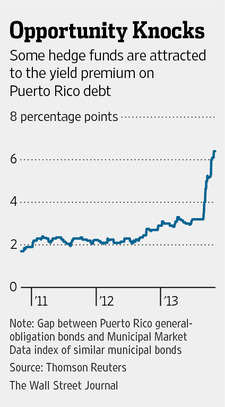
Hedge funds are making a large bet on municipal debt, bringing aggressive tactics to a $3.7 trillion market long known as humdrum. The strategies include demanding high interest rates in return for financing local governments, buying the debt of struggling municipalities on the cheap, and trying to profit on rising volatility as many mom-and-pop investors who have dominated the municipal-bond market for decades flee amid deepening fiscal problems in many U.S. cities and states. Read more of this post

Financial Innovation Is Depressing

Financial Innovation Is Depressing

DealBook has a special section today on ideas and innovation on Wall Street and let’s just say it will not inspire too many idealistic Stanford undergrads to stop work on their iPhone apps and take that financial-engineering job at Wells Fargo. It’s all pretty sad stuff. My favorite article in the section is of course the one on innovation in fraud, which it turns out is genuinely fertile ground for creativity, though tell that to the Stanford kids. To be fair, though, there is also innovation in catching fraud, specifically a Commodity Futures Trading Commission Rule, adopted in 2011, that outlaws market manipulation. So! Nice work there CFTC. Read more of this post

Eastern Europe: Which way to turn? Former Soviet states that choose to join the EU trade bloc run the risk of Russian retaliation

November 11, 2013 6:40 pm

Eastern Europe: Which way to turn?

By Neil Buckley and Roman Olearchyk

Former Soviet states that choose to join the EU trade bloc run the risk of Russian retaliation

Vladimir Pirogov, 73, who for 50 years was a trainer at the city stadium in Yalta in the well-funded heyday of Soviet sport, perches these days on a stool just off the Crimean resort’s elegant promenade, selling his paintings to tourists. In what is now Ukraine, his generation still looks east to Russia, he says. “We’re not needed in Europe, not our factories, not our economic potential. We’re mostly Russian speakers here,” says Mr Pirogov. “We want to live with Russia.” Read more of this post

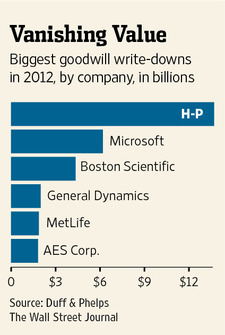
Soured deals: Just a handful of companies have taken goodwill write-downs this year on past acquisitions that have soured. Low premiums, high stock prices and new accounting rules may be letting more firms avoid or delay the charges

Companies Get More Wiggle Room on Soured Deals

EMILY CHASAN and MAXWELL MURPHY

Nov. 11, 2013 8:15 p.m. ET

MK-CH774_GOODWI_NS_20131111183004

Last year U.S. companies slashed the value of their past acquisitions by $51 billion because the deals didn’t pan out as expected, according to a study set for release Tuesday. That was the highest yearly total for such write-downs since the financial crisis. This year, however, there have been only a handful of big corporate mea culpas. Suitors are paying the lowest premiums for target companies in nearly 20 years, stocks are trading near records, giving companies cover to avoid write-downs on the value of their assets, and new accounting rules may be allowing more of them to delay the charges. Read more of this post

In Malaysia’s culture of ingratiation, ‘Datuks’ are dime a dozen

In Malaysia’s culture of ingratiation, ‘Datuks’ are dime a dozen
(1 hr 20 mins ago)

For centuries, the Malay royal title “Datuk” – Malaysia’s equivalent of “Sir’’— was an honor that unlocked doors to the elite. But Datuks like K. Basil don’t feel so special these days. “Just throw a stone in the street and you’ll hit a Datuk,” complains Basil, a policeman-turned-politician and one of many who feel the awarding of the coveted titles has got out of hand in a status-obsessed Malaysian society, writes Shannon Teoh of AFP. (pictured, a ‘Datuk’ anointed by a self-styled royal Raja Noor Jan Shah Raja Tuah Shah, stand for a photo before attending a private event at a palace in Gombak, on the outskirts of Kuala Lumpur). Read more of this post

Dairy Compounders Ignore Macro Noises: Bega Cheese +130%, PT Ultrajaya Milk +230% YTD (Bamboo Innovator Insight)

The following article is extracted from the Bamboo Innovator Insight weekly column blog related to the context and thought leadership behind the stock idea generation process of Asian wide-moat businesses that are featured in the monthly entitled The Moat Report Asia. Fellow value investors get to go behind the scene to learn thought-provoking timely insights on key macro and industry trends in Asia, as well as benefit from the occasional discussion of potential red flags, misgovernance or fraud-detection trails ahead of time to enhance the critical-thinking skill about the myriad pitfalls of investing in Asia at the microstructure- and firm-level.

The weekly Bamboo Innovator Insight series brings to you:

Cheese

Dear Friends and All,

Dairy Compounders Ignore Macro QE Noises: Bega Cheese +130%, PT Ultrajaya Milk +230% YTD

At the Singapore Cricket Club last Thursday, the Bamboo Innovator had lunch with one of our subscribers, Mr Hemant Amin, a highly accomplished and astute Indian value investor who runs a global industrial raw material procurement house and his own multi-million family office with concentrated bets in stocks such as Infosys which delivered over 60 times in handsome returns. Hemant also heads a value investor group called BRKets (www.brkets.com) with 11 other members. The name BRKets (pronounced as ‘brickets’) is a fusion of Berkshire Hathaway’s ticker code BRK and the Cricket Club where they meet. 6 of the BRKets members joined us for an interesting lunch discussion on value investing in Asia where we share our investment outlook, wide-moat business model analysis and stock ideas.

When Hemant ordered cheese platter for his desert, it triggered me to think about the inspiring stories of another outstanding Indian entrepreneur Devendra Shah and Barry Irvin of Bega Cheese. Shah turned the smallish Pune-based Parag Milk Foods into a high value dairy powerhouse with his bold decision in early 2008 to invest in the untapped opportunity in processed cheese in India, doubling by end 2008 the entire country’s cheese-making capacity from 40 tonnes to 80 tonnes. Interestingly, while the world is fixated on the QE tapering macro challenges, Warrnambool Cheese & Butter Factory (ASX: WCB AU, MV A$467m) is up 90% in less than three months since Sept. This was despite WCB posting its lowest profit since 2009 with FY13 (year end Jun) net profit down over 50% as it was the subject of a three-way bidding war by Canadian giant Saputo (TSX: SAP, MV C$9.6bn), Japan’s Kirin, and Bega Cheese (ASX: BGA AU, MV A$704m). Bega is a wide-moat company in our Bamboo Innovator Index since its listing in Aug 2011 with a market value of A$240m. NZ dairy giant Fonterra (FCG NZ, MV NZ$10.9bn), after its own contamination scare in Aug, joined in the industry consolidation battle by acquiring a 6% stake in Bega on Nov 2, adding on to Bega’s spectacular share price returns of 130% year-to-date. Ongoing competition in the raw milk market with supply affected by droughts in NZ and Australia and unseasonably cold weather conditions in Europe has kept upward pressure in prices paid to milk suppliers; the surge in the GDT (global dairy trade) price index from 800 to over 1,400 in the last year-and-a-half has hurt the profitability of processor such as WCB. Yet, despite both WCB and Bega being cheese processor companies, Bega has been able to achieve FY13 EBITDA and net profit growth of 13% and 25% respectively as compared to the FY13 decline of 28% and 51% for WCB. Meanwhile, the share price performance of dairy giants Saputo and Fonterra are flat YTD.

So why are Parag and Bega outperforming Bamboo Innovators in a cyclical commodity industry, especially when they are supposedly price-taking minnows in the midst of oligopolistic giants Fonterra, Murray Goulburn, Saputo, Amul (India), Royal Friesland Campina, Arla etc? What are the lessons for value investors when investing in companies related to the volatile commodities cycle? I admit that I was also surprised by the sharp jump in share price of well-managed boring consumer food companies such as Bega. But it once again proves the wisdom of one of our subscribers, Mr K, an intelligent value investor who has nearly doubled his returns from his investment since Mar this year in DKSH Malaysia (DKSH MK) after it was highlighted as a Bamboo Innovator; his thoughtful comments:

“I’d love money making ideas, but I also very excited about education, and understanding/ navigating Asian markets. If I can avoid stupid (frauds) mistakes, I think the upside will work out.”

By avoiding the “set-up” fraudulent companies which are promoted with that alluring sexy growth theme by a whole gamut of syndicates, insiders and brokers/dealmakers, and by staying long-term in undervalued wide-moat businesses – even if they are boring like cheese! – the short-term returns may be unexciting or even frustrating but the longer-term upside will eventually work out for the value investor.

How did Barry Irvin grow Bega Cheese from a single-site regional dairy processor in southern New South Wales (NSW) town of Bega, with 80 employees and selling only into the domestic market, to its position today as the southern hemisphere’s largest cheese-packing and processing business, with sales nudging to over A$1 billion a year, exporting to more than 40 countries and employing over 1,600 people? What caught the Bamboo Innovator’s attention in Bega before its Aug 2011 listing was an article in May 2011 in Sydney Morning Herald about how Irvin was the parent and caregiver of his autistic child Matthew, now 22. For two decades, the 51-year-old Irvin has juggled the responsibilities of caring for a disabled child, running the family farm and steering the ambitious former dairy co-operative through deregulation, acquisition, a public float..

helpLead-420x0Barry Irvin pictured with his son Matthew.

The role of a caregiver is special: they need to have that intangible quality of inner courage at its “core” to give strength to its “periphery”, much like the empty hollow center of a bamboo in which the nutrients and moisture that would have been exhausted making and maintaining this empty center can be utilized for growth of the periphery bamboo culm/stem. The architecture of the bamboo culm presents a powerful configuration: fibers of greatest strength occur in increasing concentration toward the periphery of the plant. With Irvin helming Bega, it is likely that the company will invest in the intangibles, in people and building long-term relationships..

Also, what are the lessons for value investors from the story of Indonesia’s PT Ultrajaya Milk (+230% YTD), controlled by the family of the late Ahmad Prawirawidjaja who established the business in 1958 from his house in Bandung? What are the 4 key Bamboo Innovator takeaways?

Google Has Designed A Throat Tattoo That Is Also A Lie Detector

Google Has Designed A Throat Tattoo That Is Also A Lie Detector

JIM EDWARDS 58 MINUTES AGO 994 1

Google has filed a patent for an electronic skin tattoo that connects to a mobile device, and can be used as a lie detector. The tattoo isn’t permanent — it’s applied to a sticky substance on the skin. The intent of the device is to allow someone to wear a communications device on their throat, keeping a mobile phone or similar device in their pocket. The tattoo communicates with the device, transmitting conversation. Such a device might make things easier for someone who wants to transmit a conversation but cannot use their hands. Google’s application suggests it might be used by security personnel, perhaps working undercover in noisy environments like sports stadiums or at political demonstrations: Mobile communication devices are often operated in noisy environments. For example, large stadiums, busy streets, restaurants, and emergency situations can be extremely loud and include varying frequencies of acoustic noise. Communication can reasonably be improved and even enhanced with a method and system for reducing the acoustic noise in such environments and contexts. The tattoo has a darker side too, according to the application. It can be hooked up to a lie detector: Optionally, the electronic skin tattoo 200 can further include a galvanic skin response detector to detect skin resistance of a user. It is contemplated that a user that may be nervous or engaging in speaking falsehoods may exhibit different galvanic skin response than a more confident, truth telling individual. It’s not clear from the application why someone might want to operate a lie detector at a remote distance from the person they were testing. But again, undercover operations — in which authorities send in stooges to deal with bad guys — spring to mind. Or perhaps Google envisions a situation in which the person wearing the tattoo doesn’t know they have one? We first saw this on The Register. Here’s a closeup of the Google neck tattoo:

screen_shot_2013-11-11_at_8.33.02_am 2

Why Focusing Too Narrowly in College Could Backfire; Students are told learn the subjects that will best land them a job when they graduate. But that could be the worst thing they could do

Why Focusing Too Narrowly in College Could Backfire

Students are told learn the subjects that will best land them a job when they graduate. But that could be the worst thing they could do.

PETER CAPPELLI

Updated Nov. 10, 2013 4:19 p.m. ET

WE-AA547_WECOVE_G_20131106122850WE-AA554B_VOCAT_G_20131106125407 WE-AA557_VOCATI_G_20131106125413

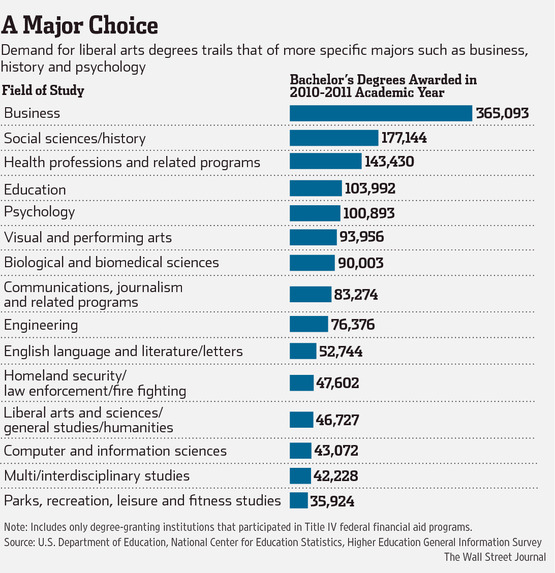
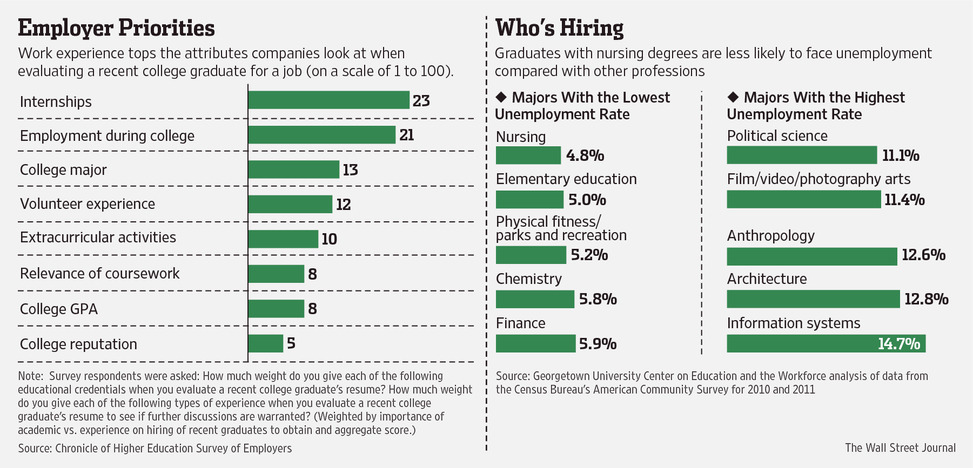
A job after graduation. It’s what all parents want for their kids. So, what’s the smartest way to invest tuition dollars to make that happen? The question is more complicated, and more pressing, than ever. The economy is still shaky, and many graduating students are unable to find jobs that pay well, if they can find jobs at all. The result is that parents guiding their children through the college-application process—and college itself—have to be something like venture capitalists. They have to think through the potential returns from different paths, and pick the one that has the best chance of paying off. For many parents and students, the most-lucrative path seems obvious: be practical. The public and private sectors are urging kids to abandon the liberal arts, and study fields where the job market is hot right now. Schools, in turn, are responding with new, specialized courses that promise to teach skills that students will need on the job. A degree in hospital financing? Casino management? Pharmaceutical marketing? Little wonder that business majors outnumber liberal-arts majors in the U.S. by two-to-one, and the trend is for even more focused programs targeted to niches in the labor market.

Read more of this post

35 Years After Inventing The CD, Philips Is Doing Everything Right

35 Years After Inventing The CD, Philips Is Doing Everything Right

JAN HENNOP, AGENCE FRANCE PRESSE NOV. 10, 2013, 6:02 AM 9,504 7

Back in 1978 in a boardroom near Lake Geneva, a bunch of nervous Philips inventors demonstrated a device that was to revolutionise the entertainment industry for the next three decades. Called the “Pinkeltje” after a small Dutch gnome in a children’s story, the device performed flawlessly — and so the world’s first Compact Disc (CD) player was born. Thirty-five years later the Netherlands’ Philips, once one of Europe’s best-known brands for radios and televisions, is ditching the consumer electronics business that used to be its bread and butter, and is thriving. The Philips story is a business case of how a leading global industrial group, with leading technology, went through several rocky years of restructuring, and found a successful strategy to re-invent itself in time. Read more of this post

Should a non-technical founder hedge against failure?

Should a non-technical founder hedge against failure?

BY HAYDEN WILLIAMS 
ON NOVEMBER 10, 2013

Recently I grabbed coffee with a founder whose startup is in a similar stage to mine. I reached out to him after he signed up for our networking platform. Because he had also started his career in finance I was interested to speak with him. We shared the challenges we were dealing with, our product roadmap and plans to monetize our products. Towards the end of our conversation, we veered into the personal dilemmas early-stage founders face. He asked me, “What’s your plan if, worst case scenario, Treatings fails? Would you go back to finance, start another company or join an existing startup?” Read more of this post

Why it is very clever to pretend to be stupid; Disarm others, make them forget you are scarily powerful and lull them into liking you

November 10, 2013 1:48 pm

Why it is very clever to pretend to be stupid

By Lucy Kellaway

Disarm others, make them forget you are scarily powerful and lull them into liking you

Last week I had a drink with a woman who has just landed one of the biggest jobs in her industry. Over a couple of grapefruit negronis she told me she had no idea why she had been promoted and that she was not even sure if she wanted the job. In return I told her that I was bumbling along more or less OK, though keeping the show on the road was getting increasingly tricky. Read more of this post