China’s Party Platter of Reforms: Will China’s Leaders Save the Economy From Itself?

China’s Party Platter of Reforms: Will China’s Leaders Save the Economy From Itself?

ALEX FRANGOS

Updated Nov. 7, 2013 11:24 p.m. ET

BN-AI175_1108ch_G_20131108045023

China’s Communist Party leaders are great talkers, and they’ll do plenty of gabbing behind closed doors this weekend at their “third plenum” in Beijing. The question is whether the talking at this potentially pivotal meeting turns into political momentum needed to save China’s economy from itself. The urgency is high. The economy continues to be driven by a dangerous combination of high debt, overinvestment and distortions in the way the country’s deep pool of savings is allocated toward state-owned companies and away from households. Read more of this post

China still awaits genuine reform; Change can only come if Communist party loosens its grip

November 7, 2013 6:05 pm

China still awaits genuine reform

Change can only come if Communist party loosens its grip

It has been nearly a year since Xi Jinping led the seven-strong standing committee on to the stage of the Great Hall of the People as the new head of China’s Communist party. At the time there was much speculation, partly encouraged by Mr Xi’s more down-to-earth manner, about whether his appointment might herald a fresh attempt toimplement economic and political reform. Those hopes have not yet been answered. Mr Xi has shown himself rather more adept at consolidating his grip over the Communist party than at opening up either China’s economic or political system. He has brought cadres to heel with an anti-corruption campaign, established what looks like a firm grip on the People’s Liberation Army and launched a campaign against bloggers in order to stifle criticism of the party. He has even revived sloganeeringreminiscent of the Mao era. Some speculate that Mr Xi has tacked to China’s political left in order to provide cover for market-oriented reforms. But if he is a closet reformer he has a funny way of showing it. There have been intimations of changes to policy – a liberalisation of banking licences here, the announcement of a free-trade zone there. But nothing that amounts to much. Read more of this post

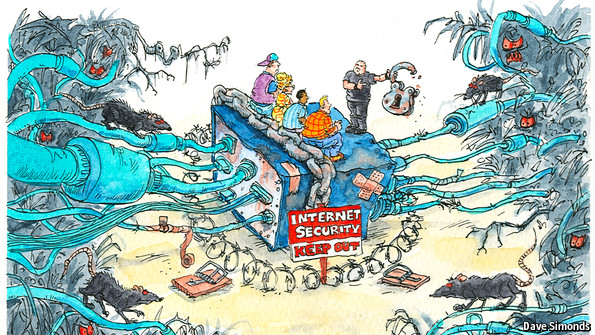
Internet security: Besieged; Stung by revelations of ubiquitous surveillance and compromised software, the internet’s engineers and programmers ponder how to fight back

Internet security: Besieged; Stung by revelations of ubiquitous surveillance and compromised software, the internet’s engineers and programmers ponder how to fight back

Nov 9th 2013 |From the print edition

20131109_STD001

SECURITY guards (at least the good ones) are paid to be paranoid. Computer-security researchers are the same. Many had long suspected that governments use the internet not only to keep tabs on particular targets, but also to snoop on entire populations. But suspicions are not facts. So when newspapers began publishing documents leaked by Edward Snowden, once employed as a contractor by America’s National Security Agency (NSA), the world’s most munificently funded electronic spy agency, those researchers sat up. Read more of this post

Brazil’s biggest software firm sees a sluggish economy as an opportunity

Brazil’s biggest software firm sees a sluggish economy as an opportunity

Nov 9th 2013 | SÃO PAULO |From the print edition

IN THE late 1970s Bill Gates predicted “a computer on every desk and in every home”. Laércio Cosentino, an engineer at SIGA, a Brazilian maker of software for mainframes, concluded that therefore every small firm in his country, even the ubiquitous street-corner padari a(bakery), would eventually have one too. In 1983 Mr Cosentino, then just 22, convinced his boss to set up a separate business to concentrate on serving small and medium-sized enterprises (SMEs). Thirty years on, the company, nowadays called Totvs (pronounced “totus”), dominates Brazil’s $1.9-billion-a-year market for enterprise software. Investors have piled in. On October 22nd Totvs disclosed that the world’s biggest fund manager, BlackRock, had increased its stake to 5%. Read more of this post

BlackBerry: Only thorns; For a fallen star of the smartphone industry, things go from bad to worse

BlackBerry: Only thorns; For a fallen star of the smartphone industry, things go from bad to worse

Nov 9th 2013 | OTTAWA |From the print edition

20131109_WBC716

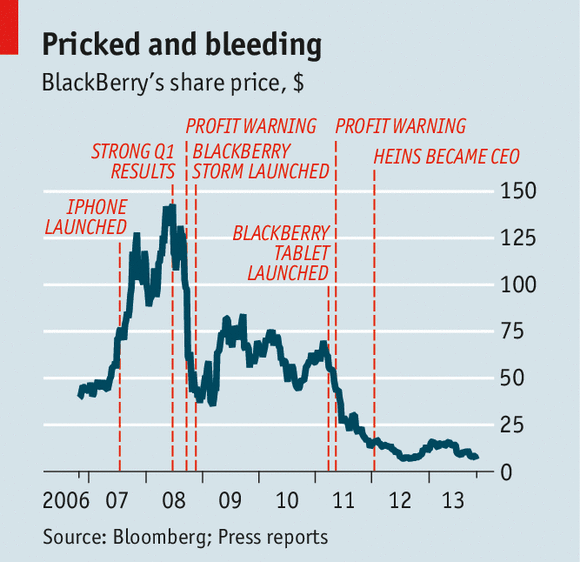
THE signs do not look good. On November 4th, six weeks after BlackBerry said that its biggest shareholder, Fairfax Financial, wanted to take the ailing Canadian smartphone-maker private for $4.7 billion in cash, the sale was called off. BlackBerry instead declared that it would raise $1 billion in debt, convertible into 16% of its shares. Fairfax, a Toronto holding company that focuses on insurance but owns 10% of BlackBerry, is taking a quarter of the issue. Barbara Stymiest, who chairs BlackBerry’s board, called this “a significant vote of confidence in BlackBerry and its future”. The stockmarket called it a flop: the share price, already a fraction of what it once was (see chart), fell by 16%. Read more of this post

Wei Chuan Foods (味全食品) Chairman Wei Ying-chung (魏應充) has been released on a bail of NT$10 million but is restricted from leaving the country over suspected involvement in fraudulent actions

Wei Chuan Foods’ chairman out on NT$10 mil. bail

By Joy Lee, The China Post
November 8, 2013, 12:22 am TWN

TAIPEI, Taiwan — Wei Chuan Foods Corporation (味全食品) Chairman Wei Ying-chung (魏應充) has been released on a bail of NT$10 million but is restricted from leaving the country over suspected involvement in fraudulent actions after being questioned by prosecutors, the Taipei District Prosecutors’ Office (TDPO) announced yesterday. Read more of this post

Foreign investors lack faith in Stan Shih to save Acer

Foreign investors lack faith in Stan Shih to save Acer

Staff Reporter

2013-11-08

Foreign investors do not believe that Acer founder Stan Shih rejoining the management after the departure of former CEO Wang Jeng-tang will make a difference to the Taiwan-based PC maker, our sister paper China Times reported on Nov. 7. Acer’s share price closed at NT$16.9 (US$0.57) on Nov. 6, while anonymous foreign investors claimed that NT$12 (US$0.41) a share will be the bottom. Read more of this post

Trickle down economics doesn’t work; Finance Minister Yair Lapid: Israel’s economy grew by 26.8% in the past ten years, but Israelis’ salaries rose by just 2.1%

Lapid: Trickle down economics doesn’t work

Finance Minister Yair Lapid: Israel’s economy grew by 26.8% in the past ten years, but Israelis’ salaries rose by just 2.1%.

7 November 13 09:49, Yossi Nissan

“When I entered the Ministry of Finance, I was surprised that Israel had no economic strategy,” said Minister of Finance Yair Lapid at the Caesarea Forum this morning. “After months of work, I want to state the Ministry of Finance’s economic strategy for the coming years in two sentences: we want Israelis to earn more and have a better quality of life. How will we do this? We’ll create an innovation-based economy. Read more of this post

The surprise decision by the European Central Bank to cut interest rates means there’s now about an even chance that the euro, this year’s best performing major currency, erases all of its gains in a matter of months

Euro Bulls Crack as Odds of Return to 2013 Lows Jump: Currencies

The surprise decision by the European Central Bank to cut interest rates means there’s now about an even chance that the euro, this year’s best performing major currency, erases all of its gains in a matter of months. There is an almost 50 percent probability the euro, which has risen more than 5 percent against the greenback since reaching a 2013 low in April, will give back its increase by mid-2014, according to data compiled by Bloomberg. The odds are the highest in seven weeks and up from 37 percent prior to the ECB lowering its key rate yesterday to a record. Read more of this post

Stuck in third: Daimler is set to keep chugging down the Autobahn behind BMW and Audi

Stuck in third: Daimler is set to keep chugging down the Autobahn behind BMW and Audi

Nov 9th 2013 |From the print edition

20131109_WBC722

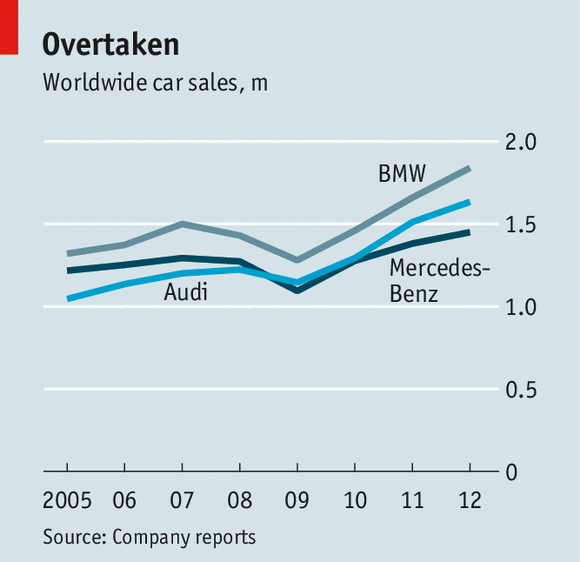
AS A corporate motto, “The best or nothing” has a timeless quality. Gottlieb Daimler pasted it on the wall as he went about inventing the modern car in the late 19th century. In 2010 the firm that bears his name adopted it as a slogan. It was as badly timed as a misfiring engine. Mercedes-Benz, Daimler’s car division, already trailing BMW in terms of sales and profitability, saw another Geman premium carmaker, Audi, also start to pull away in the same year (see chart). Yet this year Daimler’s shares have surged by 40%, persuading optimists that the firm is catching up. This week it said its worldwide sales in October had risen 15% year-on-year to a new record. Read more of this post

Paul Krugman: The Mutilated Economy; The long-term costs of short-run failure are piling up and up and up and up

November 7, 2013

The Mutilated Economy

By PAUL KRUGMAN

Five years and eleven months have now passed since the U.S. economy entered recession. Officially, that recession ended in the middle of 2009, but nobody would argue that we’ve had anything like a full recovery. Official unemployment remains high, and it would be much higher if so many people hadn’t dropped out of the labor force. Long-term unemployment — the number of people who have been out of work for six months or more — is four times what it was before the recession. Read more of this post

Danger: US mortgage market whiplash risk; IMF points to M-Reits as source of potential instability

November 7, 2013 12:49 pm

Danger: US mortgage market whiplash risk

By Gillian Tett

IMF points to M-Reits as source of potential instability

This week, the US government was handed one small reason to smile. A survey by the National Association of Realtors suggests house prices rose in nine out of 10 US cities in the year to October, growing on average by 14 per cent. This represents the most broad-based increase seen since 2007. And since it comes hard on the heels of other upbeat housing data, there is growing optimism in some policy quarters that the scars from the 2007 housing crash may be healing, boosting overall economic growth. Read more of this post

Big consulting and accounting firms are making a risky move into strategy work; “operations consultants sit at the front of the classroom. Strategy consultants stay in the back, not paying attention, throwing paper airplanes. But they still get the girls and get rich.”

Big consulting and accounting firms are making a risky move into strategy work

Nov 9th 2013 | NEW YORK |From the print edition

20131109_WBC736

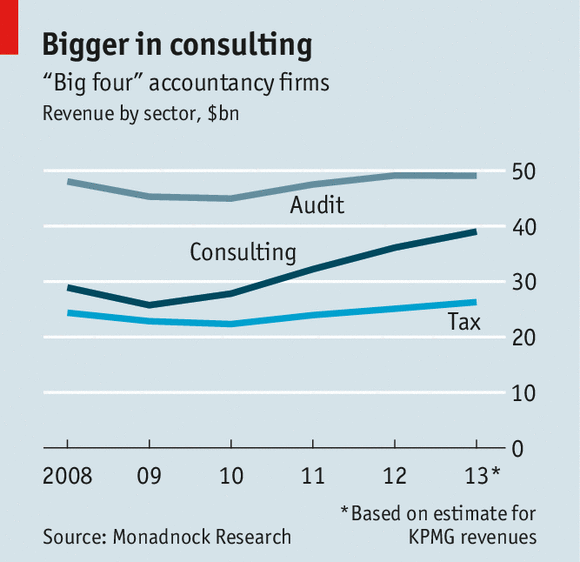
“OPERATIONS consultants sit at the front of the classroom,” says a partner at a strategy consultancy. “Strategy consultants stay in the back, not paying attention, throwing paper airplanes. But they still get the girls and get rich.” Like so many caricatures, this one is cruel but contains a grain of truth. Operations consultants—the fine-detail guys who tinker with businesses’ internal processes to make them run better—generally do not enjoy the same glamour or financial rewards as strategy specialists, whose job is to advise firms on make-or-break deals, adopting new business models and other big stuff. Read more of this post

Bumi says has no proof Bakrie family has cash for split

Bumi says has no proof Bakrie family has cash for split

10:11am EST

LONDON (Reuters) – London-listed coalminer Bumi Plc (BUMIP.L: Quote, Profile, Research, Stock Buzz) will press ahead with a December vote on a planned split with the Bakrie family, its Indonesian co-founders, despite having no guarantees the family can finance the deal, the company said on Friday. Bumi was created in 2010 to bring Indonesian mining assets to London investors but has faced bitter shareholder battles against the background of tumbling thermal coal prices. Read more of this post

Gas boom to reshape US role in Asia: study

Updated: Friday November 8, 2013 MYT 1:24:40 PM

Gas boom to reshape US role in Asia: study

WASHINGTON: A boom in gas production will reshape the US role in Asia and could fuel new tensions with a growing, energy-hungry China, a new report says.
US foreign policy has historically been based largely on demand for outside energy, with Washington closely allying itself with oil-rich Arab monarchies.
But a major increase in gas production – in part through the controversial practice of “fracking” deep underground – has given the United States the prospect not just of energy independence but of playing a Middle Eastern-style strategic role as an exporter, according to industry forecasts. Read more of this post

What LME bazooka means for aluminium trade

November 8, 2013 8:54 am

What LME bazooka means for aluminium trade

By Jack Farchy in Abu Dhabi

Some traders believe the premiums may even rise

Boom! Charles Li just fired his bazooka. After a two-week dramatic pause that kept the market on tenterhooks, the London Metal Exchange on Thursday announced its solution to the thorny issue of warehousing: the LME will cap queues at 50 days and to arm itself with a range of punishments for badly-behaving warehouses. One question hangs over the market. What does Mr Li’s bazooka (which the chief executive of LME’s owners,Hong Kong Exchanges & Clearing, has recently rebranded “Chinese medicine”) mean for aluminium premiums? Read more of this post

Legacy of Peter Munk, one of Canada’s most important entrepreneurs, hangs on solving Barrick Gold’s problems

Last updated: November 7, 2013 4:51 pm

Peter Munk’s legacy hangs on solving Barrick Gold’s problems

By James Wilson

Peter Munk’s long business career has brought him into plenty of difficulties as well as triumphs – but the Canadian entrepreneur marks his 86th birthday on Friday amid one of his toughest challenges yet. Barrick Gold, the mining group that Mr Munk has steered over three decades and turned into the world’s largest gold miner, is in the throes of one of Canada’s largest capital calls, raising at least $3bn of equity. It comes in the teeth of deep gloom about gold prices after a sharp sell-off this year, and after Barrick decided to suspend work on Pascua-Lama, its flagship new mine, admitting that the ballooning costs of the South American venture made it unviable for the foreseeable future. Barrick made a $5bn writedown on the mine this year. Read more of this post

Sylvester Stallone on Art, Movies and Playing Rocky Again; “There is nothing as gratifying as being one on one with a concept, with your thought and vision.”

Nov 7, 2013

Sylvester Stallone on Art, Movies and Playing Rocky Again

ALEXANDRA CHENEY

BN-AH961_sly13_DV_20131107160725

“Rambo Mind” 2012 by Sylvester Stallone

Sylvester Stallone has appeared in more than 60 films, but he’d give up his acting career if it interfered with his painting. “There is nothing as gratifying as being one on one with a concept, with your thought and vision. Movies are the work of a collective conscious. It takes 500-800 people on a movie to complete a vision. Painting is as close as a person can get to actually capturing the heat of the moment,” the actor told the Journal. For the first time, Stallone’s paintings are being exhibited in Russia in a kind of retrospective exhibition that spans 38 years. He calls Mark Rothko and Jean-Michel Basquiat influences, and has shifted in style from his early works, mostly created with a large palette knife and a spectrum of color, to his more recent canvases, which use more red, white and black, and are decidedly more abstract. The action hero phoned Speakeasy to talk about shifting from painting to sculpture, how his early film roles influenced his paintings, and confirmed to the Journal that he’s once again taking on the character of Rocky Balboa in Ryan Coogler’s “Creed.” Read more of this post

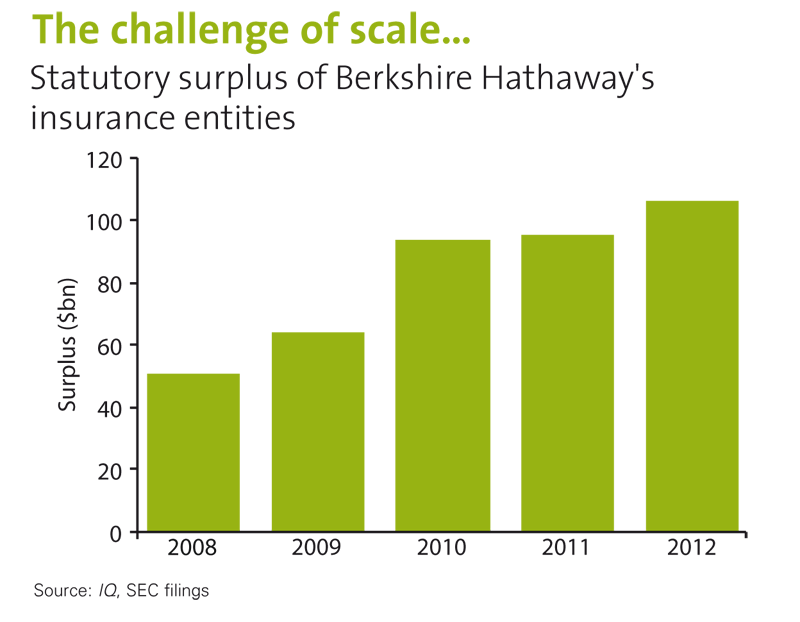
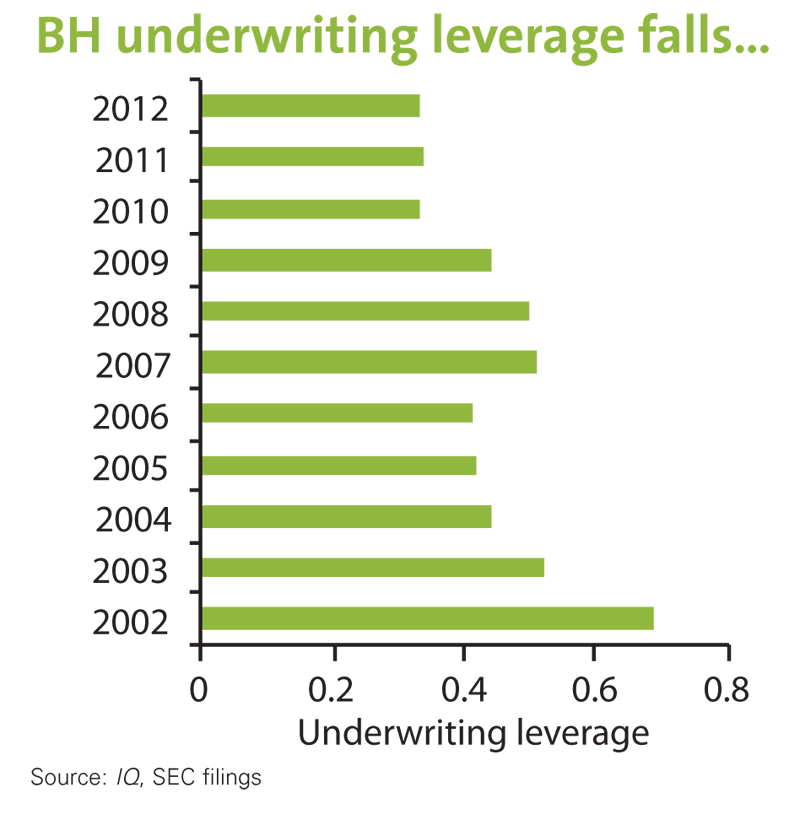
Ajit Jain feeds Buffett’s hunger

Jain feeds Buffett’s hunger

Adam McNestrie

ii__1377681573_20-BH-transactions ii__1377681583_20-challenge-of-scale ii__1377681617_21-BH-underwriting-leverage

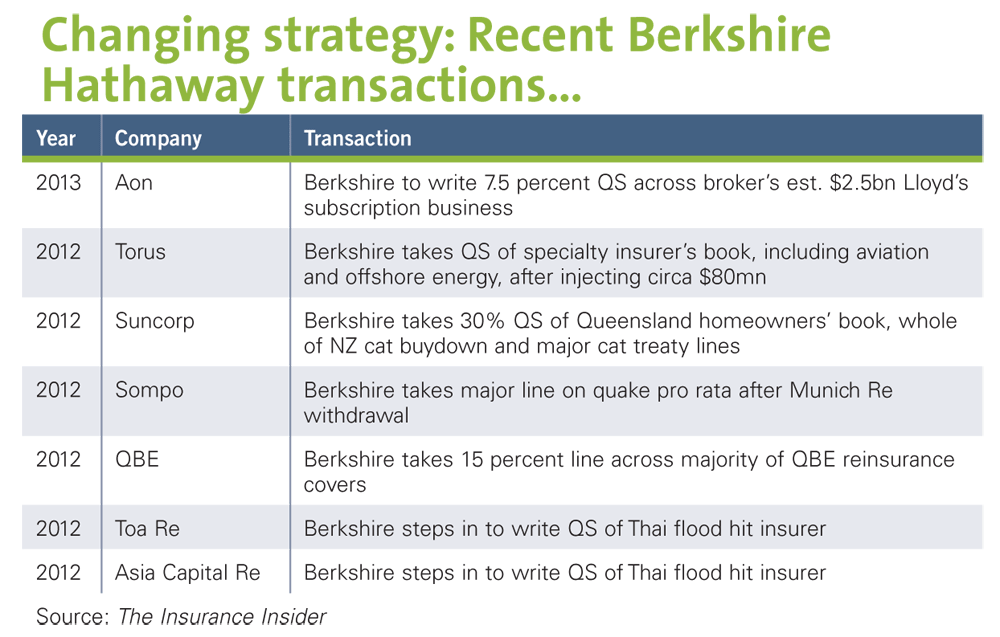
People are starting to worry about him. The changes in diet. The idiosyncratic decisions. The silence. He isn’t quite the man he used to be, isn’t quite himself. Everyone is talking about it: speculating about his motives, glossing his actions, promulgating theories, kvetching about its implications. Which is to say that Ajit Jain, the softly spoken, smiling carnivore par excellence of the reinsurance world has of late taken up omnivorous habits. Where Jain was previously notorious for holding aloof until he scented blood, then attacking ferociously and making off with hefty chunks of red meat in his mouth, the last two years have seen him extend his diet in surprisingly catholic ways. These days, Jain has started eating things that he used to turn his nose up at. He isn’t quite willing to shovel anything down that comes his way, but if it is presented by his chef of choice (Aon) then he’s almost sure to open wide. Read more of this post

‘He had to change’: How Diageo CEO Tim Salt became human and why his business is super-engaged

Fiona Smith Columnist

‘He had to change’: How Diageo CEO Tim Salt became human and why his business is super-engaged

Published 08 November 2013 07:39, Updated 08 November 2013 07:40

92884c34-47ec-11e3-bca4-8651e21e9e85_535208172--236x197_4_0_1762852563--646x363

Diageo chief executive Tim Salt had an ‘ugly way’ of operating during his years at Pepsico but says he has left it behind him. Photo: Michel O’Sullivan

When the managing director of drinks company Diageo says he used to be too competitive, he’s not kidding. In fact, it is the first thing his former boss at Lion Nathan, Gordon Cairns, recalls about Tim Salt. “He was very internally competitive,” says Cairns, a director of Westpac Banking Corporation and Origin Energy, and former CEO of Lion Nathan, where Salt worked in the 1990s. “He also didn’t take feedback very well,” Cairns says, raising his eyebrows for effect. “He had to change or he would never have been successful at Lion Nathan.” When Salt joined the beverage and food company (now known as Lion), he was a young gun who had absorbed the dog-eat-dog culture of Pepsico over six years in the US and Australia. Pepsico is a “very intensely competitive organisation”, says Salt, who had been marketing director of international cola. Read more of this post

Performance Reviews: Why Bother? “The best kind of performance review is no performance review”

Performance Reviews: Why Bother?

By Claire Suddath November 07, 2013

When Peter Gross, an editor in the financial services industry in Virginia, walked into his 2008 yearend performance review, he was feeling pretty good. “I knew I’d get dinged on some nebulous things like ‘initiative’ and ‘enthusiasm,’ ” he says. “But on the measurable stuff, I’d exceeded all my goals.” So he was taken aback when, on a scale from one to five, his manager gave him mostly twos and threes. “I remember there was one thing I was supposed to do 30 times over the course of year, and I’d done it 49 times, but I still only got ‘meets expectations,’ ” he recalls. Every year after that, Gross worried for weeks leading up to his annual review. “I was a mess,” he says. “I’d be up stress-eating until 2:30 in the morning, and of course the actual day was nerve-racking.” Read more of this post

Harvard Zebrafish Research Yields Possible Treatments for Muscle Diseases

Harvard Zebrafish Research Yields Possible Treatments for Muscle Diseases

Zebrafish experiments by Harvard University researchers yielded new chemicals that prod stem cells to make muscle tissue, an advance that may lead to treatments for muscular dystrophy and related disorders. The chemicals, found to coax fish embryo cells to form muscle, also had the same effect on human stem cells that were transplanted into mice with a muscle-wasting disease. The researchers’ findings were published today in the journal Cell. Read more of this post

FDA Wants To Ban Trans Fat From All Processed Food

FDA Wants To Ban Trans Fat From All Processed Food

by Paul SheaNovember 7, 2013

Big changes may be afoot in the food industry. The Food and Drug Administration (FDA) has revealed that it wants to ban the use of trans fats in all processed foods. The move is not set in stone just yet, but there are indications that it could become a concrete regulation in the coming months. According to the FDA the consumption of trans fats has declined drastically in recent years as awareness about the dangers they pose pervaded consumer and producer mentalities. The cultural change has not been big enough to prevent the deaths of millions, and the agency is now looking to ban the substances by law. Read more of this post

Startups: Misadventures in Spending

Startups: Misadventures in Spending

A Look at Some of the Pitfalls of Allocating Capital

Nov. 6, 2013 3:42 p.m. ET

Raising capital is a challenge for most startups. But those who do so successfully then face the dilemma of figuring out how to best allocate the funds. With the temptations of plush office spaces, perks and high salaries, a startup’s so-called “seed” funds can quickly disappear. Founders have to decide which part of their business would benefit the most from added money. This week on The Accelerators, a Wall Street Journal blog on the challenges of starting and growing a business, a group of experienced entrepreneurs and venture capitalists shared their views on the pitfalls of poorly allocating startup capital. Edited excerpts: Read more of this post

A former television personality who founded a successful cosmetics brand, Yue-sai Kan deploys her sizable homes in Shanghai, Beijing and New York for large-scale entertaining

Yue-sai Kan’s Real-Estate Empire

The former television personality has homes in Shanghai, Beijing and New York

BN-AG952_1105yu_D_20131105174849

‘In Beijing, traffic is a disaster, so central location is a must,’ Ms. Kan says of selecting her three bedroom, 3,983-square-foot, Beijing apartment. She says she’s spent less than 10 nights here since its purchase and renovation.Mick Ryan for The Wall Street Journal

MINA CHOI

Nov. 7, 2013 7:43 p.m. ET

Owning multiple homes across several continents might be a challenge for many. Yue-sai Kan sees it as a necessity. Known in China as a bridge between the East and the West, Ms. Kan is a former television personality and a businesswoman who founded Yue-sai Cosmetics in China, now part of L’Oréal. As the owner of the Miss Universe China franchise, a popular contest, Ms. Kan is often in the spotlight, and she entertains her guests and friends frequently at home—whether it’s the one in Shanghai, Beijing or New York. She also has an apartment on Copacabana beach in Rio; one in Brisbane, Australia; one in Changsha, the capital of Hunan Province, and one she co-owns with her sister in Rome, near the Spanish Steps. Read more of this post

Chinese joke of the day: A young man went to seek for advice from a Zen master, complaining that he was rich but unhappy

Updated: Friday November 8, 2013 MYT 6:50:53 AM

Let’s phrase it, we all want riches

BY THO XIN YI

A new phrase which pokes fun at the Beverly Hillbillies of China has gone viral, but many actually yearn to befriend the wealthy.

THE Chinese Netizens are a creative lot. This is proven through a variety of Internet catchphrases and expressions that dominate the social media every now and then. When a new phrase is introduced, it goes viral overnight, and people would start using it to relate to their everyday experiences. The memes could have been inspired by a conversation in the television drama series, a quote in a news story, a line from a song or could be simply made up. Entertainment aside, the catchphrases are often used to poke fun at the current affairs in China. The latest phrase is tuhao. Tu denotes earth or uncouth and hao means grandeur. The term tuhao can be interpreted as the “nouveau riche” or Beverly Hillbillies of China. Generally, it is used within a sarcastic context to describe the new rich people who are wealthy but lack sophisticated style. According to Baidu, the Chinese equivalent of Wikipedia, tuhao is not a new word. It has appeared in texts which date back to the Song and Qing Dynasties and used to describe the rich and the powerful or landlords who exploit the poor.

Tuhao recently became famous through a joke on the Internet: A young man went to seek for advice from a Zen master, complaining that he was rich but unhappy. The Zen master asked, “How do you define rich?” The man replied, “I have an eight-figure bank savings and three apartments in Wudaokou (a place in Beijing). Am I wealthy?” The master then extended his hand without uttering a word, and this gesture was interpreted by the young man as advice to be grateful and give back for what he has gained. But the master explained, “No, tuhao, let’s be friends.”

His response implies that even a Zen master, who is supposed to live a simple, non-materialistic life, is eager to be associated with the rich. The joke explains a social phenomenon in China, where people yearn to befriend the rich in the hope of benefiting from the relationship, even though they might secretly despise them out of jealousy. Read more of this post

Portfolios With Purpose: Stock Picking for a Cause

Nov 5, 2013

Portfolios With Purpose: Stock Picking for a Cause

STEVEN RUSSOLILLO

Stacey Asher has taken the art of stock-picking to a philanthropic level, with several of Wall Street’s heavy hitters backing her cause. Ms. Asher is founder and CEO of Portfolios With Purpose, a non-profit organization that runs an annual stock-picking competition where investors aim to raise money for their charities of choice. The contest has attracted hedge-fund titans such as David Einhorn, Leon Cooperman and Dan Loeb in past years as well as hundreds of so-called mom-and-pop investors. It raised $198,700 this year. Now, Ms. Asher has her sights set on doubling that amount for the 2014 competition. Participants must register and provide their picks by Dec. 31 to be eligible for next year’s competition. Read more of this post

Singapore Prime Minister’s Office Website Hacked After Lee Warns

Singapore Prime Minister’s Office Website Hacked After Lee Warns

Singapore authorities are investigating a breach of Prime Minister Lee Hsien Loong’s website last night, one day after he said he would track down a group that announced plans to hack government online portals. The page for searches on the website of the Prime Minister’s Office was “compromised” at 11:17 p.m. yesterday, the country’s phone and Internet regulator said in an e-mailed statement today. Read more of this post

Hot Investment Concepts You Should Approach With Caution

Hot Investment Concepts You Should Approach With Caution

Nov. 6, 2013 2:09 p.m. ET

New investment products might seem like the best thing since the ETF, but following trends isn’t always the surest—or safest—way to make money. With this issue in mind, we posed the following question to The Experts: Are there any current hot investment concepts that you think investors should be wary of? This discussion relates to a recent Investing in Funds & ETFs Report and formed the basis of a discussion on The Experts blog on Nov. 4.

Beware of Alternative Investments

CHARLES ROTBLUT : The push for holding alternative investments concerns me. These are funds designed to produce a different return than stocks. Getting more diversification isn’t a bad idea in and of itself, but these funds tend to come with higher fees and many were created after the last bear market. They also are often complex with characteristics that aren’t easily understood. The age of these funds is also a concern. Since many of the funds now available to non-accredited individual investors (which are most of us) were created after the last bear market, we don’t know how they will hold up during a period of financial stress. If a bear market makes it difficult for these funds to execute their strategies or sell certain positions, the losses for shareholders could be significant. Read more of this post

Conglomerate Firms, Internal Capital Markets and the Theory of the Firm

Conglomerate Firms, Internal Capital Markets and the Theory of the Firm

Vojislav Maksimovic University of Maryland – Robert H. Smith School of Business

Gordon M. Phillips University of Southern California; National Bureau of Economic Research (NBER)

August 3, 2013
Robert H. Smith School Research Paper

Abstract: 
This article reviews the conglomerate literature with a focus on recent papers which have cast strong doubt on the hypothesis that conglomerate firms destroy value on average when compared to similar stand-alone firms. Recent work has shown that investment decisions by conglomerate firms are consistent with value maximization, that conglomerate firms trade at an average premium relative to single-segment firms when value weighting, and that the valuation premia and discounts, both for conglomerates and single-segment firms, are driven by differences in the production of unique differentiated products. A profit-maximizing theory of the firm that considers how firms select their organizational structure can explain these recent findings and much of the large variation in findings in the conglomerate literature. We also review the literature showing how market imperfections create additional benefits and costs of internal capital markets and a potential for managerial distortions.