ETFs Churning Record Cash as $47 Billion Flows to Market; “There’s no doubt that ETFs have greater influence than before, and the swings in the ETFs are indicative of general market feelings. They become the market.”

ETFs Churning Record Cash as $47 Billion Flows to Market

Money has been flowing in and out of financial markets more rapidly than ever before this year, a bullish signal as the threat of a U.S. government default fades. About $47 billion has gone to exchange-traded funds that track everything from stocks to bonds to commodities since Sept. 1, according to data compiled by Bloomberg. That followed about $18 billion pulled in August, $40 billion added in July and $11 billion pulled in June, making it the most volatile period on record for flows. Almost $7 billion went to ETFs on Oct. 17 alone, as Congress passed legislation to avoid a default. Read more of this post

Latest China smog emergency shuts city of 11 million people in Heilongjiang’s Harbin

Latest China smog emergency shuts city of 11 million people

20131020_smog3 20131020_smog5 20131020_smog6_0

1:38pm IST

BEIJING (Reuters) – Choking smog all but shut down one of northeastern China’s largest cities on Monday, forcing schools to suspend classes, snarling traffic and closing the airport in the country’s first major air pollution crisis of the winter. An index measuring PM2.5, or particulate matter with a diameter of 2.5 micrometers (PM2.5), reached a reading of 1,000 in some parts of Harbin, the gritty capital of northeastern Heilongjiang province and home to some 11 million people. A level above 300 is considered hazardous, while the World Health Organisation recommends a daily level of no more than 20. Read more of this post

Infecting an Audience: Why Great Stories Spread

INFECTING AN AUDIENCE: WHY GREAT STORIES SPREAD

BY: JONATHAN GOTTSCHALL

In the second of a two-part series, Jonathan Gottschall discusses the unique power stories have to change minds, and the key to their effectiveness.

In his 1897 book What is Art? the great Russian novelist Leo Tolstoy defined art as “an infection.” Good art, Tolstoy wrote, infects the audience with the storyteller’s emotion and ideas. The better the art, the stronger the infection–the more stealthily it works around whatever immunities we possess and plants the virus. Tolstoy reached this conclusion through artistic intuition, not science, but more than a century after Tolstoy’s death this is exactly what psychologists are finding in the lab. When we enter into a story, we enter into an altered mental state–a state of high suggestibility. Read more of this post

Q&A: Nate Silver on China and the New FiveThirtyEight; how he uses data to eliminate bias, and how data from China can come from unexpected sources; I flew through Beijing [on the way to Hong Kong] – there was less physical brightness coming from Beijing than you would have seen from a comparable American city or European city

October 21, 2013, 3:40 PM

Q&A: Nate Silver on China and the New FiveThirtyEight

Nate Silver, founder of the FiveThirtyEight blog, is tired of politics.

Mr. Silver is renowned for his work on big data that led him to accurately predict the winner of the U.S. presidential election – twice. In the last U.S. election, he correctly declared the outcome in all 50 states, well before voters had headed to the polls. The writer and statistician has taken on a varied list of projects—he started in 2003 with a baseball analysis system and also achieved moderate success applying statistics modeling to World Series poker.  In April, Mr. Silver announced the end of his blog’s relationship with the New York Times, and a move over to ESPN—an opportunity to widen his appeal. In an interview, the FiveThirtyEight Editor-in-Chief talked about how he uses data to eliminate bias, and how data from China can come from unexpected sources. Edited excerpts:

How much of your predictions are your intuition, versus pure data analysis?

Once the model is designed there are no subjective tweaks made to it. In any type of complex system, there is judgment involved in the way you design a model. I don’t say, “I don’t like this result, so let me change the model” – it’s a matter of being completely disciplined in how you apply it. There is science, judgment, and experience – however you want to put it – in the principles of model design.

Can you apply good data analysis to poor data, for example, in China?

People in the United States and the United Kingdom overestimate the quality of economic data. Even if people are above board, it is simply hard to estimate something like the American economy. With China, you would have even more difficulty. I think the general lesson is that by looking at a broader consensus of indicators, you do well than just looking at one indicator or one sector. It is problematic to think about “how do you measure Chinese growth”. One way [is to look at] more public facing measures – by looking, for example, at the amount of light output emanating from China. I flew through Beijing [on the way to Hong Kong] – there was less physical brightness coming from Beijing than you would have seen from a comparable American city or European city. Read more of this post

Sharp Japan export slowdown dents ‘Abenomics’, flags Asia weakness

Sharp Japan export slowdown dents ‘Abenomics’, flags Asia weakness

7:26am EDT

By Leika Kihara and Tetsushi Kajimoto

TOKYO (Reuters) – Japan’s export growth fell well short of expectations in September as the country posted a record run of trade deficits, a sign that slowing demand in Asia is taking the shine off Prime Minister Shinzo Abe’s stimulus policies. In volume terms Japan’s exports fell on the month, adding to the weak picture for Asia’s trade-reliant economies, after China last week reported a surprise slide in exports for September. Taiwan’s export orders – a leading indicator of activity over the next two or three months – highlighted similar signs of slowing demand in the region. “There is really no change in the main thing that’s going on across Asia – which is no growth in exports the past two years. I think it’s weak global spending, it’s as simple as that,” said Tim Condon, regional economist for ING in Singapore. Read more of this post

BIITS Replacing BRICs as Emerging Markets No Longer Blanket Buy

BIITS Replacing BRICs as Emerging Markets No Longer Blanket Buy

Emerging markets risk shattering into BIITS.

Investors in these markets are becoming more discerning about where they put their money, shying away from countries such as Brazil, India (SENSEX), Indonesia, Turkey and South Africa. Behind the discrimination is a new-found focus on current-account deficits and structural weaknesses exposed by the likelihood of less stimulus from the Federal Reserve and cooling demand in China, according to economists from HSBC Holdings Plc, JPMorgan Chase & Co. and International Strategy & Investment Group LLC. Read more of this post

Banks Face Risk-Model Clampdown in Basel Trading-Book Review

Banks Face Risk-Model Clampdown in Basel Trading-Book Review

Banks face an overhaul of how they calculate possible losses on securities they hold in their trading books as global regulators target discrepancies in how lenders measure the riskiness of their investments. In a bid to address weaknesses uncovered by the financial crisis, the Basel Committee on Banking Supervision may publish draft proposals as soon as this month on capital rules for assets that banks intend to trade, according to members of the group. Read more of this post

The Technology in Domino’s Pizza: How Asian Firms Can Have Enduring Pizzazz (Bamboo Innovator Insight)

The following article is extracted from the Bamboo Innovator Insight weekly column blog related to the context and thought leadership behind the stock idea generation process of Asian wide-moat businesses that are featured in the monthly entitled The Moat Report Asia. Fellow value investors get to go behind the scene to learn thought-provoking timely insights on key macro and industry trends in Asia, as well as benefit from the occasional discussion of potential red flags, misgovernance or fraud-detection trails ahead of time to enhance the critical-thinking skill about the myriad pitfalls of investing in Asia at the microstructure- and firm-level.

  • The Technology in Domino’s Pizza: How Asian Firms Can Have Enduring Pizzazz, Oct 21, 2013 (Moat Report Asia, BeyondProxy)
Pizzazz

Dear Friends and All,

The Technology in Domino’s Pizza: How Asian Firms Can Have Enduring Pizzazz

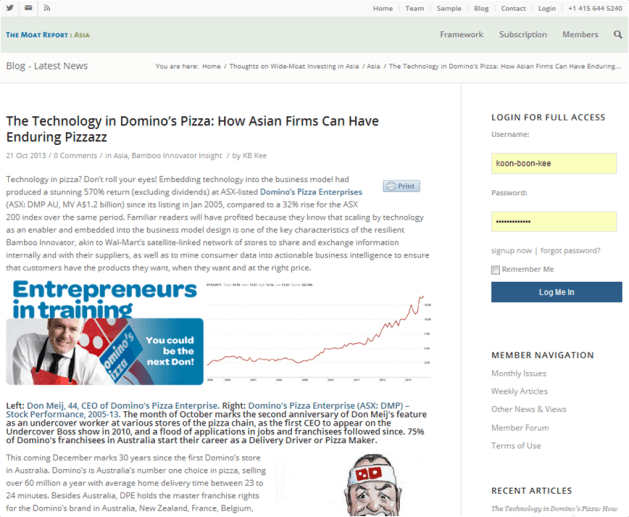
Technology in pizza? Don’t roll your eyes! Embedding technology into the business model had produced a stunning 570% return (excluding dividends) at ASX-listed Domino’s Pizza Enterprises (ASX: DMP AU, MV A$1.2 billion) since its listing in Jan 2005, compared to a 32% rise for the ASX 200 index over the same period. Familiar readers will have profited because they know that scaling by technology as an enabler and embedded into the business model design is one of the key characteristics of the resilient Bamboo Innovator, akin to Wal-Mart’s satellite-linked network of stores to share and exchange information internally and with their suppliers, as well as to mine consumer data into actionable business intelligence to ensure that customers have the products they want, when they want and at the right price.

This coming December marks 30 years since the first Domino’s store in Australia. Domino’s is Australia’s number one choice in pizza, selling over 60 million a year with average home delivery time between 23 to 24 minutes. Besides Australia, DPE holds the master franchise rights for the Domino’s brand in Australia, New Zealand, France, Belgium, Monaco and The Netherlands, and is the largest franchisee for the brand in the world. DPE also recently acquired 75% of Domino’s Japan from Bain Capital in Aug/Sep 2013 for A$128 million, plus agreeing to supply new debt funding of another A$96.4 million for a total of about A$225 million, adding 259 Japanese stores (216 corporate and 43 franchise) to increase DPE’s total store network to over 1,200 stores. Thus, for value investors seeking exposure to Japan but are wary of the governance risks of the domestic stocks, DPE provides an interesting alternative with significantly lower governance risk. Stocks listed outside of Japan with exposure to Japan could be an interesting topic of discussion in the highly insightful Japan Investing Summit on Nov 5-6. Long-time value investors in Japan are cognizant that stocks with high net cash or net current asset as a percentage of their market cap are potential value traps since the cash and liquid assets are “borrowed” by their powerful bank shareholders as part of the keiretsu network, a phenomenon documented empirically as the “keiretsu” valuation discount and investor activism pushing for change usually becomes an act of kicking the hornet’s nest. Empirical fans would find the research of Takeo Hoshi (Stanford University), Anil Kashyap and Douglas Skinner (Chicago Booth School of Business), and Suraj Srinivasan (Harvard Business School) to be particularly useful in understanding governance risks in Japan.

Back to pizza. What did Domino’s Pizza do to embed technology into its business model? What are the 5 Key Bamboo Innovator Takeaways?

The Moat Report Asia Members’ Forum has been getting penetrating quality dialogues from our existing institutional subscribers from North America, the Nordic, Europe, the Oceania and Asia, including professional value investors with over $20 billion in asset under management in equities. Questions range from:

  • The nuances of internal dealings in Asia, including the case discussion of the recent deal in which HK billionaire’s Lee Shau-kee Henderson Land acquiring Towngas or Hong Kong & China Gas (3 HK) from his family holdings, seemingly déjà vu from the early Oct 2007 transaction when the market peak.
  • The case of F&N Singapore spinning out its property unit FCL Trust and getting “free” special dividend-in-specie and the potential risk in asset swap restructuring to deleverage the hidden debt in the entire Group balance sheet.
  • The dilemma of whether to invest in a Southeast Asian-listed company and hidden champion with a domestic market share of 60% due to family squabbles.
  • Discussion of the wise and thoughtful 107-year-old Irving Kahn’s investment into a US-listed but Hong Kong-based electronics company with development property project in Shenzhen’s Qianhai zone and the possible corporate governance risks that could be underestimated or overlooked, as well as their history of listing some assets in HK in 2004.. This is also a case study of “buy one get one free” in John’s highly-acclaimed book The Manual of Ideas in which the “free” property is lumped together with the (eroding) core business to make the combined entity look cheap and undervalued. What are the potential areas that value investors need to watch out for when adapting the SOTP (sum-of-the-parts) method in Asia?
  • And many more intriguing questions.

Do find out more in how you can benefit from authentic and candid on-the-ground insights that sell-side analysts and brokers, with their inherent conflict-of-interests, inevitable focus on conventional stock coverage and different clientele priorities, are unwilling or unable to share. Think of this as pressing the Bloomberg “Help Help” button to navigate the Asian capital jungle. Institutional subscribers also get access to the Bamboo Innovator Index of 200+ companies and Watchlist of 500+ companies in Asia and the Database has eliminated companies with a higher probability of accounting frauds and  misgovernance as well as the alluring value traps.

Sydney Opera House celebrates 40 years

Sydney Opera House celebrates 40 years

AFP-JIJI

OCT 20, 2013

an20131021e1a-870x533

A giant birthday cupcake is displayed on the steps of the Sydney Opera House as the World Heritage-listed building celebrates its 40th birthday on Sunday. The distinctive performance hall, inspired by Danish architect Jorn Utzon’s childhood in the Aalborg shipyards, is one of Australia’s best-known landmarks and is a centerpiece of Sydney’s cultural scene. | AFP-JIJI

SYDNEY – The Sydney Opera House, World Heritage-listed as “one of the indisputable masterpieces of human creativity,” celebrated its 40th birthday Sunday with a flotilla of lifesavers, Aboriginal dancers and a gigantic cupcake. Huge crowds packed the steps for a distinctively Australian performance on the glittering harbor front, where three generations of Danish architect Jorn Utzon’s family were the guests of honor. It was a postcard-perfect day beneath the same cloudless blue skies that inspired Utzon’s winning design to build Sydney an opera house back in 1956 — the white sails drawn from his childhood in the Aalborg shipyards. “A building like this happens once in a lifetime,” Utzon’s son Jan told revelers on Sunday. “It is a unique Australian expression of will and enthusiasm and ‘let’s-go-do-it’ kind of spirit.”  Read more of this post

David Mong still uses the title of “vice chairman” of the Shun Hing Group, although in reality he is chairman. “The title doesn’t matter, as long as I am doing my job,” said the eldest son of the late William Mong, the famed rice-cooker tycoon

Son still shines
Imogene Wong
Monday, October 21, 2013

6_2013102101235898666Leader

David mong Tak-yeung still uses the title of “vice chairman” of the Shun Hing Group, although in reality he is chairman. “The title doesn’t matter, as long as I am doing my job,” said the eldest son of the late William Mong Man-wai, the famed rice-cooker tycoon. Perhaps, the younger Mong is quietly paying obeisance to his father, who was chairman of the group and passed away three years back. Read more of this post

A Lost Generation; the passing of years in our generation is marked not by increasing wisdom and charitable behavior, but by the diminishing, or even negative, contribution one makes to society

Desi Anwar: A Lost Generation

By Desi Anwar on 2:01 pm October 19, 2013.
A friend of mine tweets his disgust at how the country is increasingly full of corruption. It is as if with the passing of time, the number of corrupt individuals around is actually going up, instead of going down. Surely it was not like this in the past? This actually makes perfect sense. Given the increase in the country’s population and thus in the number of people entering the age when they’re mature enough in their life and career to hold a position of power, then the number of those chancing to enter the corruption market can only increase. Read more of this post

What’s That Smell? Exotic Scents Made From Re-engineered Yeast

October 20, 2013

What’s That Smell? Exotic Scents Made From Re-engineered Yeast

By ANDREW POLLACK

EMERYVILLE, Calif. — Vanilla, saffron, patchouli. For centuries, spices and flavorings like these have come from exotic plants growing in remote places like the jungles of Mexico or the terraced hillsides of Madagascar. Some were highly prized along ancient trading routes like the Silk Road. Now a powerful form of genetic engineering could revolutionize the production of some of the most sought-after flavors and fragrances. Rather than being extracted from plants, they are being made by genetically modified yeast or other micro-organisms cultured in huge industrial vats. Read more of this post

‘An Industry of Mediocrity’; When will America learn how to teach its teachers?

October 20, 2013

‘An Industry of Mediocrity’

By BILL KELLER

“Those who can, do. Those who can’t, teach. And those who can’t teach, teach teaching.”

WHOEVER coined that caustic aphorism should have been in a Harlem classroom last week where Bill Jackson was demonstrating an exception to the rule. Jackson, a 31-year classroom veteran, was teaching the mathematics of ratios to a group of inner-city seventh graders while 15 young teachers watched attentively. Starting with a recipe for steak sauce — three parts ketchup to two parts Worcestershire sauce — Jackson patiently coaxed his kids toward little math epiphanies, never dictating answers, leaving long silences for the children to fill. “Denzel, do you agree with Katelyn’s solution?” the teacher asked. And: “Can you explain to your friend why you think Kevin is right?” He rarely called on the first hand up, because that would let the other students off the hook. Sometimes the student summoned to the whiteboard was the kid who had gotten the wrong answer: the class pitched in to help her correct it, then gave her a round of applause. Read more of this post

The CEO Of Cisco Bills The Company When He Flies In His Own Private Jet; In 2013, John Chambers billed Cisco $2.8 million in jet expenses; since 2009, Chambers has billed Cisco $11.1 million in private jet expenses

The CEO Of Cisco Bills The Company When He Flies In His Own Private Jet

JULIE BORT OCT. 18, 2013, 5:12 PM 4,803 10

Many big tech companies, like HP and IBM, keep fleets of private jets to fly their executives around in convenience, safety and style. But at Cisco, CEO John Chambers works it in reverse. He owns his own jet and then he sends Cisco a bill when he uses it for work, which he presumably does a lot. In 2013, he billed Cisco $2.8 million in jet expenses, according to forms filed with the SEC. Unlike car mileage, there doesn’t seem to be an IRS standard when reimbursing for your private jet. Chambers just has to make sure that his expense rate isn’t higher than what it would cost to hire a private chartered jet. That’s not hard to do. It will cost you $21,000 to charter a 4-passenger plane for an hour to fly from San Jose to L.A. on a JetSuite private charter (non-member rate). Blogger Brad Reese calculates that since 2009, Chambers has billed Cisco $11.1 million in private jet expenses. $2.8 million certainly isn’t a lot of money by Cisco’s standards. But just for kicks, we looked at what it would cost to fly first-class on a commercial airline (United), from San Jose, California (where Cisco is based) to Bangalore, India (where Cisco has an R&D facility). About $16,000. For $2.8 million, one person could fly 175 times, first-class to Bangalore at that rate. Or four people (a small entourage) could fly 43 times. It’s hard to tell if Cisco is getting a sweet deal by paying for Chamber’s business travel on his private jet. Most companies only disclose the reverse situation. They tell shareholders how much the company spent when executives use the corporate jets for personal travel. This is included their total compensation numbers, so presumably they pay taxes on the benefit (though many companies also pay for their executives to get help preparing their taxes.) For instance, IBM says that its CEO, Ginni Rometty, must use IBM’s jets at all times, even for personal travel, for safety reasons, according to forms filed with the SEC. In 2012, she spent $304,376 for personal travel on the corporate jets.

‘People are basically good,’ says billionaire philanthropist and eBay founder Pierre Omidyar

‘People are basically good,’ says philanthropist

THE OBSERVER

OCT 20, 2013

LONDON – Born: Pierre Omidyar was born in 1967 in Paris to Iranian immigrants. He moved to Washington at the age of 6 and graduated from Tufts University with a bachelor’s degree in computer science in 1988. Omidyar worked for Claris, an Apple subsidiary, before setting up an e-commerce company that would become eBay. Best of times: In September 1998, eBay went public, making Omidyar a billionaire overnight. He is now worth close to $9 billion and spends most of his time in Hawaii with his wife and fellow philanthropist, Pamela. Read more of this post

The Key To Entrepreneurial Success In South Asia

The Key To Entrepreneurial Success In South Asia

Posted yesterday by Shruti Challa (@shrutichalla)

Entrepreneurs from South Asia are obsessed with Silicon Valley, as is much of the world these days. Social media and mass media have combined to create the perception that geeks from the Bay Area are a breed apart. The combination of skinny jeans, hipster glasses and confident personalities like Dave McClure or Steve Blank, it seems, is irresistible. But this style has nothing to do with building a great company. Solving important problems does, and for anyone not in Silicon Valley, that means focusing on their own markets and not what seems to be cool. Read more of this post

The father of modern China begged Henry Ford for help, and Ford turned him down

The father of modern China begged Henry Ford for help, and Ford turned him down

By Heather Timmons 3 hours ago

Have you created a new industrial system, lately?

The father of modern China once invited Henry Ford to China to create a “new industrial system,” to help the then-struggling country. Sun Yat-sen, who founded the Nationalist Party and helped to overthrow the ruling Qing dynasty, wrote a letter in 1924 asking Ford to visit South China, where “much of the intelligence, energy and wealth of this country can be found.” Read more of this post

Under suspicion: How trust drives business performance

Fiona Smith Columnist

Under suspicion: How trust drives business performance

Published 21 October 2013 10:22, Updated 21 October 2013 11:08

Plain-speaking former minister in the Howard government, Amanda Vanstone, gives a graphic description of what it feels like to discover you are under suspicion of dishonesty. She recalls, in a column for the Sydney Morning Herald , being phoned by an anxious staff member about a mistake in one of Vanstone’s claims – at a time when Senator Mal Colston had (in her words) been caught taking “rorting to new levels”. Read more of this post

You may find mei mystifying: the topic of 迷信 (meishin, superstition)

You may find mei mystifying

BY MARK SCHREIBER

SPECIAL TO THE JAPAN TIMES

OCT 20, 2013

It’s almost Halloween again, so before I set out my カボチャ提灯 (kabocha chōchin, jack-o’-lantern), I thought the time is right to take up the topic of 迷信 (meishin, superstition). The first character is 迷, meaning lost or puzzled, made by combining the phonetic 米 (alternatively read mai, mei, bei, kome andyone, and meaning “rice”) with 辶 (shinnyō, the classifier for motion). Its verb form is 迷う (mayō). Read more of this post

Farmer’s Dream Fades as Tongyang Defaults: Korea Markets

Farmer’s Dream Fades as Tongyang Defaults: Korea Markets

When a 78-year-old farmer in South Korea was seeking a safe investment for his 300 million won ($282,600) of retirement savings in 2011, his advisers at Tongyang Securities Inc. recommended Tongyang Group bonds. Less than three months after making his latest purchase of debt issued by the nation’s 47th-largest conglomerate, his dreams of a comfortable retirement were shattered as five Tongyang affiliates filed for bankruptcy protection on Sept. 30 and Oct. 1, his son told Bloomberg News by phone from Seoul. Read more of this post

Wearable Gadgets Transform How Companies Do Business; Companies are decking employees out with devices that help them do their jobs better

Wearable Gadgets Transform How Companies Do Business

Companies are decking employees out with devices that help them do their jobs better

H. JAMES WILSON

Updated Oct. 20, 2013 7:52 p.m. ET

LE-AA311_WEAR8j_D_20131016161038 LE-AA304_WEAR7j_D_20131016160928 LE-AA297A_WEAR1_D_20131016160125 LE-AA300_WEAR4_D_20131016160636

The Hitachi Business Microscope tracks employees’ interactions with colleagues, to encourage effective oollaboration. Data collected by Hitachi Business Microscopes shows interactions among two groups of employees. Smart glasses from Vuzix provide voice and visual information to help warehouse employees work more efficiently and safely. Disney is testing a wristband for visitors to its parks to use as a ticket, hotel-room key, charge card and more.

LE-AA298_WEAR2_D_20131016160345 LE-AA302_WEAR5j_D_20131016160735 LE-AA316_WEAR6j_D_20131016161139

Data from Catapult Sports motion sensors embedded in players’ undershirts help the Buffalo Bills avoid fatigue that can lead to injury. Data from the motion sensors can be displayed to allow comparisons among players on a team. 

Big companies are putting wearables to work. We’ve all seen gadgets that can measure our heart rates, how many calories we’re burning or how many steps we take. Then there are devices that go even further, like Google Glass, which displays text messages and news feeds right up near our eyeballs. Read more of this post

Tech Wealth and Ideas Are Heading Into News; The technology industry and its various power brokers are suddenly investing significant sums of money in preserving news capacity and quality

October 20, 2013

Tech Wealth and Ideas Are Heading Into News

By DAVID CARR

Producing serious news is an expensive enterprise with a beleaguered business model, one that remains tied to the tracks as a locomotive of splintered audiences and declining advertising hurtles toward it. But just when it looked as if all were lost, an unlikely cavalry has come roaring over the hill with serious money, fresh ideas and no small amount of enthusiasm. Silicon Valley and its various power brokers — some who had roles in putting the news business in harm’s way to begin with — are suddenly investing significant sums of money in preserving news capacity and quality. Read more of this post

Twitter is “strongly considering” shuttering #Music App, after its download and usage numbers have dropped precipitously following a respectable launch

Twitter’s #Music App Could Be On The Way Out, Says New Report

Posted 19 hours ago by Darrell Etherington

Twitter’s #Music app, which offered social music discovery culled from activity on the 140-character sharing service, is reportedly nearing the end of its brief life, according to a newreport from AllThingsD. Twitter is “strongly considering” shuttering the mobile app, after its download and usage numbers have dropped precipitously following a respectable launch. Read more of this post

Tools to Help Employees Work Together; Web-based apps focus on teams instead of organizations

Tools to Help Employees Work Together

Web-based apps focus on teams instead of organizations

TERRI GRIFFITH

Oct. 20, 2013 4:59 p.m. ET

For years, organizations have installed powerful software designed to get employees to collaborate. But at most companies, the software has just sat there, unused. The problem: Too often, the software proved a poor fit with how people actually work. Now, several Web-based applications are taking a different, more focused approach. They aim to make it easy for an individual team member to recruit co-workers and other potential partners to solve specific work problems, whether or not the rest of the organization comes along for the ride. Here are three tools that can help overcome the inertia that has blocked use of other applications. Each highlights the power a single person can have in getting co-workers to work together. Read more of this post

The Risks of Big Data for Companies; Yes, all that information is great. But are companies prepared for it?

The Risks of Big Data for Companies

Yes, all that information is great. But are companies prepared for it?

JOHN JORDAN

Updated Oct. 20, 2013 6:47 p.m. ET

Big data. It’s the latest IT buzzword, and it isn’t hard to see why. The ability to parse more information, faster and deeper, is allowing companies, governments, researchers and others to understand the world in a way they could only dream about before. All that is true. And yet…It’s also true that in our rush to embrace the possibilities of big data, we may be overlooking the challenges that big data poses—including the way companies interpret the information, manage the politics of data and find the necessary talent to make sense of the flood of new information. Read more of this post

Vietnam airlines prepare for boom as roads fail

Vietnam airlines prepare for boom as roads fail

HANOI — Vietnam’s fledgling airline industry is poised for a boom as local competition heats up with fleet expansions, new routes and planned share offers that are set to make it one of the world’s three fastest growing markets.

50 MIN 8 SEC AGO

HANOI — Vietnam’s fledgling airline industry is poised for a boom as local competition heats up with fleet expansions, new routes and planned share offers that are set to make it one of the world’s three fastest growing markets. Even as the local economy chugs along at about 5 per cent growth, its slowest pace in 13 years, demand for domestic air travel is growing by double digits. That is translating into a surprisingly robust new source of business for Boeing, Airbus and regional aircraft makers such as Mitsubishi, Bombardier and Embraer. Read more of this post

Silicon Valley Makes Its Next Stop the Kitchen; A number of food start-ups see a big, slow-moving market begging to be invaded by someone with new ideas and a new way of building a business

OCTOBER 20, 2013, 11:00 AM

Disruptions: Silicon Valley’s Next Stop: The Kitchen

By NICK BILTON

SAN FRANCISCO — Megan Miller knows that cockroaches are packed with protein and she says they can be made into a surprisingly tasty treat. But if that is a bit too avant-garde to believe, do you think you might like crickets if they were “ground up into a powder so you can’t see wings or legs?” Ms. Miller believes you would. She is the co-founder of Chirp Farms, a start-up firm here that is dedicated to making food like the company’s flagship Chirp bars, which are $2.50 morsels made of crickets. They are expected to arrive in stores next year. While making food from insects might sound fascinating — or icky — the approach she is taking, treating Chirp Farms like a technology start-up rather than a food outfit, is what really makes the company interesting. Read more of this post

IT Reuse Helps Companies Thrive

IT Reuse Helps Companies Thrive

Organizations should encourage technology sharing among business units and departments

PETER WEILL, STEPHANIE L. WOERNER AND MARK MCDONALDPeter Weill

Oct. 20, 2013 4:59 p.m. ET

LE-AA307_REUSEc_D_20131016163603

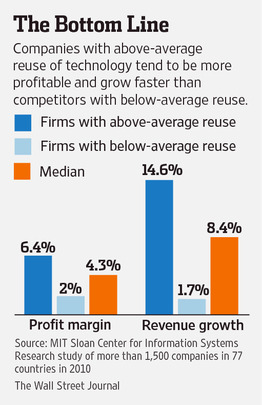
Everyone knows that reinventing the wheel is a bad idea, but apparently many large organizations haven’t gotten the memo. When faced with a new business issue or challenge, these companies typically rush to build something new, instead of exploring whether technology, data or business processes deployed elsewhere in the firm could be part of the solution. “We are different,” they say, to justify starting from scratch. Read more of this post

IBM Is Not A Cloud King with its confused cloud services strategy; SEC is investigating how IBM is counting its revenues for how it recognizes cloud computing

IBM Is Not A Cloud King

Posted 20 minutes ago by Alex Williams

IBM reported its third quarter financials this past week that showed a company struggling with its legacy hardware business and the problems that come with a confused cloud services strategy. Revenues were down $1 billion with hardware sales declining 17 percent. Overall revenues for the nine-month period totaled $72.1 billion, a decrease of 4 percent, compared with $75.2 billion for the nine months of 2012. The software division is not having tremendous success, either. This last quarter software sales were up just one percent. Read more of this post

Foldable boats – what will they think of next?

Foldable boats – what will they think of next?

October 4, 2013

Adam Courtenay

James_Graham_GM_having_a_fish_at_Rottnest_Island-article-620x349

This entrepreneur liked the idea so much he bought the company.

When Perth entrepreneur Deryck Graham first saw the original prototype for his Quickboat, he liked it so much he bought the company. It was not the first foldable boat ever made – but Graham saw the potential to make it work without the use of clips or latches, nuts and bolts. He planned to make it into the ultimate DIY-friendly boat, capable of being stored under a bed or in a garage, transported on roof racks and constructed in less than a minute.

Read more of this post