New York Times: The Opulence of Singapore

December 16, 1984

THE OPULENCE OF SINGAPORE

Barbara Crossette is chief of The New York Times’s bureau in Bangkok. By Barbara Crossette YOU KNOW,” SAYS FRAN cis Siah Ooi Choe, smiling, ”we still get Americans over here thinking we live under mosquito nets and ill-treat the workers.” At his new plant in Singapore’s Kallang Bahru industrial complex, Mr. Siah controls what has become a multimillion-dollar empire built on plastic bags. On the rooftop of the plant are a swimming pool, squash courts, sauna, massage rooms, game rooms, bar and cafeteria – all at the disposal of Mr. Siah’s factory workers. Read more of this post

The Fallacy of Success

The Fallacy of Success  OCT 10 2013

KOTTKE.ORG

In a book called All Things Considered published in 1915, G.K. Chesterton deftly skewers the glut of books by gurus, articles linked to from Hacker News, and conference talks by entrepreneurs about how to be successful.

That a thing is successful merely means that it is; a millionaire is successful in being a millionaire and a donkey in being a donkey. Any live man has succeeded in living; any dead man may have succeeded in committing suicide. But, passing over the bad logic and bad philosophy in the phrase, we may take it, as these writers do, in the ordinary sense of success in obtaining money or worldly position. These writers profess to tell the ordinary man how he may succeed in his trade or speculation-how, if he is a builder, he may succeed as a builder; how, if he is a stockbroker, he may succeed as a stockbroker. They profess to show him how, if he is a grocer, he may become a sporting yachtsman; how, if he is a tenth-rate journalist, he may become a peer; and how, if he is a German Jew, he may become an Anglo-Saxon. This is a definite and business-like proposal, and I really think that the people who buy these books (if any people do buy them) have a moral, if not a legal, right to ask for their money back. Nobody would dare to publish a book about electricity which literally told one nothing about electricity; no one would dare publish an article on botany which showed that the writer did not know which end of a plant grew in the earth. Yet our modern world is full of books about Success and successful people which literally contain no kind of idea, and scarcely any kind of verbal sense. Read more of this post


What Supercell’s $1.5B deal means for mobile, global gaming, and Finland

What Supercell’s $1.5B deal means for mobile, global gaming, and Finland

BY HAMISH MCKENZIE 
ON OCTOBER 15, 2013

Finnish mobile gaming company Supercell, maker of “Clash of Clans” and “Hay Day,” has just announced that it has sold 51 percent of itself to Japan’s SoftBank and GungHo, a fellow game maestro, for $1.5 billion. The deal values Supercell, a 130-person company (last time we checked) that is headquartered on a single floor of a Helsinki skyscraper formerly occupied by Nokia, at more than $3 billion. Here are the basics, before we get into some analysis:

Softbank and GungHo, maker of “Puzzles & Dragons,” have set up a company in Finland that will own the 51 percent stake.

Co-founder Ilkka Paananen will remain CEO, and the company will continue to operate independently.

Every Supercell employee is getting a share of the cash. Read more of this post

Technopreneurship and the Early Stage Ecosystem in China in 2013

An overview of China’s tech and startup ecosystem in 20 slides

October 16, 2013

by Paul Bischoff

We came across this slideshow put together by Beijing-based Innovation Works partner Chris Evdemon yesterday. It’s one of the best summaries of China’s early stage tech landscape I’ve ever seen.  Evdemon covers where China is in 2013, where it’s going, and what it needs in 20 slides. If you want to educate yourself or someone else in less than half an hour, then take a look. It has pictures! Here’s a few major points:

Mobile is huge in China with Android as its central play. Chris believes that the next few billion dollar companies will probably be Android-focused.
Web and mobile penetration is growing ridiculously fast along with the upper-middle class. Chinese internet culture must be understood to capitalize on it.

Freemium is very China and the world has a lot to learn from her. Chris drafted up an interesting  ”hierarchy of needs” for Chinese gamers, claiming that Chinese game industry could pull in four times more ARPU than the US.

Despite having lots of venture capital money in China ($7 billion as Chris wrote), there are very few angels in China. China needs more early-stage investment and startup-friendly services.

Why we invested in LinkedIn nine years ago; An early LinkedIn investor looks back at his firm’s original decision

Why we invested in LinkedIn nine years ago

October 15, 2013: 12:50 PM ET

An early LinkedIn investor looks back at his firm’s original decision.

By David Sze

FORTUNE — The best early-stage venture capital investments appear obvious in retrospect, however very few of them are actually obvious when you make them. In fact, we reviewed our process at Greylock and discovered that the best investments are non-obvious enough that they result in a mixed vote by our partnership. Such was the case with LinkedIn (LNKD) nine years ago. Read more of this post

How Google Figured Out How To Make Money

How Google Figured Out How To Make Money

WILL OREMUS SLATE
OCT. 15, 2013, 2:56 PM 3,511 3

The idea that made Google the world’s greatest search engine was all Larry Page and Sergey Brin.  But the idea that set it on the path to becoming the world’s greatest company wasn’t theirs originally. It was borrowed, with some key modifications, from their biggest early rival. In September 1998, Page and Brin founded Google based on an algorithm called PageRank that they had developed as Stanford Ph.D. students.  Other search engines ranked pages based on the relevance of the text they contained, which allowed spammers to game the system by filling their pages with commonly searched keywords.  Read more of this post

Why Matt Barrie’s Freelancer.com will have to work hard to convince conservative Australian investors

James Thomson Editor

Why Matt Barrie’s Freelancer.com will have to work hard to convince conservative Australian investors

Published 15 October 2013 09:05, Updated 16 October 2013 07:47

d2a98702-3517-11e3-89bf-107997ca3bd1_612841345--90x60_6_0_3683992895--646x363

Matt Barrie has a global business, but he’ll need to convince local investors of its valuation.Photo: Tim Bauer

463. That’s the number that sums up the prospectus of Matt Barrie’s Freelancer, which is likely to face an uphill battle to convince conservative Australian investors to take a punt on its unique model. It’s great to see that Barrie has decided to list his company on the ASX – he understands he will be something of a pioneer in terms of listed technology companies and he is willing to embrace that role. But it won’t be an easy path. Read more of this post

Freelancers Spur Gig Economy by Tapping Online Exchanges

Freelancers Spur Gig Economy by Tapping Online Exchanges

By Ben Schenkel – Oct 15, 2013

Two years into his new career writing code for phone apps, Leo Landau works for companies as far away as Australia while never leaving his apartment in Eugene, Oregon. By year’s end he expects to earn $10,000 more than inspecting buildings for asbestos, a job he lost in 2008. “I’m working from home, setting my own schedule and making decent money,” Landau said. He doesn’t plan on moving to California’s Silicon Valley even if he could land higher-paying work there. For now, the self-taught programmer, 31, says he enjoys cobbling together an income via Elance, a website where companies and short-term contractors pair up. Read more of this post

Amazon plans entry into smartphone market with HTC

October 15, 2013 5:15 pm

Amazon plans entry into smartphone market with HTC

By Tim Bradshaw in San Francisco, Sarah Mishkin in Taipei and Barney Jopson in New York

Amazon is working with HTC to develop a range of smartphones as the e-commerce company steps up efforts to compete with Apple and Google, according to people familiar with the project. One of the three devices discussed by the two companies is at an advanced stage of development, according to one person, but another warned that the timeline for launch has been changed before and Amazon may yet decide not to release the device. Read more of this post

S.Korean lawmakers scold gov’t for underestimated sovereign debts

S.Korean lawmakers scold gov’t for underestimated sovereign debts

English.news.cn   2013-10-16 14:12:04

SEOUL, Oct. 16 (Xinhua) — South Korean lawmakers on Wednesday scolded the government for surging sovereign debts, which have been underestimated after excluding debts that are highly likely to be realized in the future or belonging to the government in the end. Combined debts, which the South Korean government should be accountable for, would reach 1,053 trillion won (1 trillion U.S. dollars) as of the end of 2013, main opposition Democratic Party lawmaker Lee Yong-sup said in a report for the parliamentary audit session on Wednesday. Read more of this post

Lee Hae-jin, the head of No. 1 Internet portal operator NAVER Corp., saw his stake value hover above 1 trillion won ($939.4 million) on the back of its messenger service LINE

2013-10-16 11:25

NAVER CEO’s stake value surpasses W1 tril.

Lee Hae-jin, the head of No. 1 Internet portal operator NAVER Corp., saw his stake value hover above 1 trillion won ($939.4 million) on the back of its messenger service LINE, data showed Wednesday. The combined value of Lee’s shares came to 1.04 trillion won Tuesday after shares of NAVER, formerly known as NHN, surged 8.97 percent from the previous trading session, according to the data by market researcher Chaebul.com. Market watchers said the increase is attributable to the growing profits from its messenger service LINE, which held some 260 million worldwide users as of Oct. 1, with the figure expected to reach 300 million at end-October. Read more of this post

Korea has the fourth-highest number of patents in the world, yet just 20 of patented technologies are commercialized. 7,400 fried chicken restaurants open and 5,000 go bankrupt each year. Half of all chicken restaurants go under within 3 years and 80% close within 10 years

Entrepreneurs thriving in former East Germany state

Oct 16,2013

SPECIAL REPORTING TEAM [kjy@joongang.co.kr]

When 50-year-old Park Myung-ja opened a fried chicken restaurant in June 2012 with her husband, it cost 60 million won ($56,297) just in rent and key money.

However, Park closed the store in less than a year.
“There are so many fried chicken stores around that we worked until dawn to survive, but there was nothing more we could do,” she said, shaking her head.
Then Park started working in the kitchen of a restaurant again, where she got paid 50,000 won a day. Her husband is currently looking for a food delivery job.
About 18,000 start-ups go out of business each year. Fried chicken stores, in particular, seem to fail easily.
According to KB Financial Group, 7,400 fried chicken restaurants open and 5,000 go bankrupt each year. Half of all chicken restaurants go under within three years and 80 percent close within 10 years.  Read more of this post

Li Ka-shing packing bags for ‘Journey to the West’

Li Ka-shing packing bags for ‘Journey to the West’

Staff Reporter

2013-10-16

With declining profit levels a ripening reality for his businesses in mainland China and Hong Kong, business magnate Li Ka-shing is dumping his assets and heading West, the Economic Observer reported. According to the financial reports of Li’s Hutchison Whampoa, the company recorded an operational income of HK$325.9 billion (US$40.03 billion) in 2010, with pre-tax revenue pegged at HK$39.3 billion (US$5.1 billion). Of this figure, the company’s mainland China business accounted for 12% of the total, with pre-tax revenue taking up 28% of the total. The contribution of its mainland China business dropped to 11% in 2012, with pre-tax revenue plunging 19%. Read more of this post

Yet Another Way to Mock China’s New Rich: tuhao jin (土豪金), which in modern-day parlance might be translated as “the gold of the uncouth and wealthy.”

OCTOBER 15, 2013, 7:05 PM

Yet Another Way to Mock China’s New Rich

By AMY QIN

When Apple introduced the iPhone 5s in China last month, demand was predictably overwhelming. Less predictable, however, was the online reaction when the gold-colored version of the phone sold out almost instantly. Chinese on the Internet gleefully described the gold phone, by far the most popular of the three colors available, as tuhao jin (土豪金), which in modern-day parlance might be translated as “the gold of the uncouth and wealthy.” Used to connote derision for the garish and excessive tastes of China’s new rich, the term tuhao has since gone viral, yielding more than 24.2 million search results on Sina Weibo, China’s popular microblog platform, as of Tuesday afternoon. Read more of this post

Homely lessons from a Tiger Mum; A growing number of Chinese parents are shunning the gruelling school system

October 15, 2013 3:11 pm

Homely lessons from a Tiger Mum

By Patti Waldmeir in Shanghai

A growing number of Chinese parents are shunning the gruelling school system, says Patti Waldmeir

Cao Qing is home-schooling her 13-year-old son because, among other things, “he doesn’t like homework”. In the land of the midnight homework project, the average teenager’s distaste for homework would not normally give Tiger Mum pause. Most Chinese children learn early to sacrifice playtime and sleeptime on the altar of schoolwork: kids who do not excel in primary school fail to get into the middle school that gets them into the high school that guarantees the right university entrance scores. School is a serious business in China, right from the beginning. Read more of this post

Express delivery staff in China profit from selling client data

Express delivery staff in China profit from selling client data

Staff Reporter

2013-10-16

Express delivery employees in China are profiting from the sale of records containing personal information online, with asking prices ranging between 0.40 yuan to 1 yuan (US$0.06- US$0.16), reports the Chinese-language Economic Information Daily. The business of selling express sheets has become a vast “gray area” for express delivery employees to earn money from an individual’s personal information. It is also becoming a platform for con artists to make false claims, burglarize homes or even commit murder, the paper said. Read more of this post

Export Fair in China Loses Steam

October 15, 2013

Export Fair in China Loses Steam

By KEITH BRADSHER

GUANGZHOU, China — With nearly as much floor space as five McCormick Places in Chicago, the sprawling Canton Fair, which opened in Guangzhou Tuesday morning, is a monument to China’s industrial versatility and export prowess. But although the 12 million square feet of exhibits still offer products as varied as wheelbarrows and Segway knockoffs, the autumn session of the fair hints at the broader malaise now afflicting exporters across China and other East Asian nations. Read more of this post

Australian tio, including Vanda Gould, chairman of listed investment company CVC, charged in $30 million fraud investigation

Trio charged in $30 million fraud investigation

October 16, 2013 – 12:50PM

Ben Butler

Police have arrested Australian businessmen Vanda Gould and John Leaver and Belgian national Peter Borgas as part of an Operation Wickenby investigation into $30 million of tax evasion and money laundering. Mr Gould, who is chairman of listed investment company CVC, and Mr Leaver, who is a director of the company, were arrested in raids on their Sydney homes on Tuesday night.

Read more of this post

Asia’s Challenge to Europe

October 14, 2013

Asia’s Challenge to Europe

By KEITH BRADSHER

The BaShiTong food court, a collection of small eateries on the third floor of an office building in central Chongqing, China, closed this summer just three months after it opened. Workers sued for back wages. The owner of one spot lost all his savings and barged into the office of the food court’s promoter with a propane tank, taking him hostage and threatening to blow the place up by igniting the tank. Read more of this post

India’s struggling sugar mills seek solace in ethanol

India’s struggling sugar mills seek solace in ethanol

Tue, Oct 15 2013

* Govt wants oil companies to achieve 5 pct blending of ethanol in gasoline

* Hopes to reduce record current account deficit by cutting crude imports

* Demand for ethanol will give sugar mills a shot in the arm

* Oil firms float tender for 1.33 bln litres of ethanol

* With Brazil as inspiration, ethanol blending could keep growing

By Rajendra Jadhav

MUMBAI, Oct 15 (Reuters) – Struggling sugar mills in India are seeking solace in producing ethanol from crushing sugarcane, as the government ramps up pressure on oil retailers to cut fossil fuel imports by blending gasoline with the biofuel. New Delhi, scrambling for ways to cut nearly $20 billion off its oil costs as it battles a record current account deficit, could save around $1 billion on annual imports of crude as it pushes oil firms to hit a goal of 5 percent blending of ethanol in gasoline. Read more of this post

People are drinking more Coca-Cola despite costs and a slow economy

Updated: Wednesday October 16, 2013 MYT 7:30:30 AM

People are drinking more Coca-Cola despite costs and a slow economy

NEW YORK: Coca-Cola Co on Tuesday reported quarterly earnings that met Wall Street’s expectations as it sold more of its namesake soft drinks, as well as teas and waters, despite a challenging economy. Morningstar analyst Tom Mullarkey said he was encouraged by Coke’s global volume growth, which reached 2 percent overall, as well as the popularity of the Coca-Cola brand in North America. Read more of this post

The Slow Death of a Former Breakfast Table Star; Americans bought just 563.2 million gallons of orange juice, the lowest since at least the 1998-99 season

Oct 14, 2013

The Slow Death of a Former Breakfast Table Star

By Alexandra Wexler

Picture an American family at the breakfast table. Now remove the pitcher of orange juice. Once a morning staple, orange juice is on the outs. Total U.S. retail sales of the juice fell to the lowest level in at least 15 years during the 2012-13 season, according to Nielsen data published by the Florida Department of Citrus on Monday. Americans bought just 563.2 million gallons of the beverage during the season that ended on Sept. 28, the lowest since at least the 1998-99 season, the oldest data available from the FDOC. Read more of this post

Regulators warn on rise of boom-era debt

October 15, 2013 5:27 pm

Regulators warn on rise of boom-era debt

By Sam Fleming and Philip Stafford

Global securities regulators have warned that the types of debt security that played a central role in the global financial crisis are again growing in popularity among investors. The International Organisation of Securities Commissions (Iosco) said on Tuesday that investors chasing higher yields were placing more money into leveraged investment products that could be vulnerable to a sharp change in financial market conditions. Read more of this post

Credit default swaps run out of road

October 15, 2013 9:35 am

Credit default swaps run out of road

By Tracy Alloway and Michael Mackenzie in New York

In 1994 bankers at JPMorgan Chase came up with the canny idea of selling off some of the risk of their loans by striking insurance-like deals with other banks and financial institutions. In return for paying some fees, JPMorgan was able in effect to unload much of its credit risk and save on capital costs. From that humble beginning the “single-name” credit default swap (CDS) was born. By 2008, Wall Street had manufactured trillions of dollars’ worth of the swaps, using the derivatives to increase or reduce their exposure to loans – with sometimes disastrous results. Read more of this post

A Push to End Securities Fraud Lawsuits Gains Momentum

OCTOBER 15, 2013, 4:35 PM

A Push to End Securities Fraud Lawsuits Gains Momentum

By STEVEN M. DAVIDOFF

A group of pro-corporate forces has begun a behind-the-scenes fight at the Supreme Court. You may not have heard about it, but it could just end shareholders’ ability to sue companies for securities fraud. Securities fraud litigation — suits against companies for disclosure violations of the federal securities laws — has been a big business over the years. From 1997 to 2012, more than 3,050 securities litigation cases were brought, according to Cornerstone Research, a financial and economic consulting firm. Companies and their insurers paid $73.1 billion in judgments and settlements, and plaintiffs’ lawyers alone collected almost $17 billion in fees, Cornerstone’s research shows. Read more of this post

Power-Starved Iraqis Know Amps From Watts

Power-Starved Iraqis Know Amps From Watts

By Francis Curta on 3:13 pm October 14, 2013.
Baghdad. In electricity-starved Iraq, just about everyone knows his amperes from his watts, and juggling electrical appliances to run them off a generator is by now second-nature. Power cuts and shortages have gone on for so long that most Iraqis turned to generators to make up for the lack of national grid electricity. “In Iraq, there isn’t a single home without a generator… from the most simple abode to the most remote tent,” says Abu Karar al-Quraishi, who sells small generators in central Baghdad. Read more of this post

Hans Riegel, Billionaire Maker of Gummy Bears, Dies at 90; The Man Who Turned Warren Buffet Away; “Money was never my motivation. I don’t even know when I made my first million.”

Hans Riegel, Billionaire Maker of Gummy Bears, Dies at 90

Haribo

Hans Riegel, the German billionaire owner of Haribo GmbH, the maker of Gummy Bear candy, has died. He was 90. Riegel died today of heart failure in Bonn, the company said in an e-mailed statement. He had undergone successful surgery this year to remove a benign brain tumor and was “on the way to recovery,” Haribo said. Riegel had a net worth of $4.2 billion, according to the Bloomberg Billionaires Index. “With his pioneering spirit, he created an internationally incomparable company and brand,” Bonn-based Haribo said. Read more of this post

More Firms Abandon ‘Happy Meal’ Convertible Bond Financing Plan; companies that used the structure overwhelmingly experienced a significant stock-price decline within a short time afterward

More Firms Abandon ‘Happy Meal’ Financing Plan

Seaspan Is Latest to Back Away From Unusual Borrowing Method

MICHAEL ROTHFELD

Oct. 15, 2013 6:23 p.m. ET

More companies are shunning an unusual borrowing plan known as a “Happy Meal,” which has left some investors queasy. In the latest move, shipping company Seaspan Corp. SSW -0.84% last week abandoned a $125 million bond plan three days after its stock price plunged following the Oct. 7 announcement of the deal. In a statement, the Hong Kong-based company said the financing, which included a common stock offering and a convertible bond commonly known as a Happy Meal, “would not be in the best interests of our shareholders.” Read more of this post

Supercell: Zero to $3 Billion in Three Years; Enter the New Videogame Boss: SoftBank’s Son

Supercell: Zero to $3 Billion in Three Years

Deal Brings Second Free-to-Play Firm Into SoftBank’s Stable

JUHANA ROSSI, SVEN GRUNDBERG and JOHN D. STOLL

Updated Oct. 15, 2013 7:47 p.m. ET

HELSINKI— Petteri Koponen visited a dingy office on the outskirts of Finland’s capital in 2010 to meet with a group of developers launching a mobile-games company called Supercell. “Basically it was just one room with very small windows,” recalls Mr. Koponen, an early investor in startups. “At that point, they didn’t have chairs for everyone.” The company’s co-founder, Ilkka Paananen, was hunched over a cardboard box he used as a desk as he discussed the company’s plans. Read more of this post

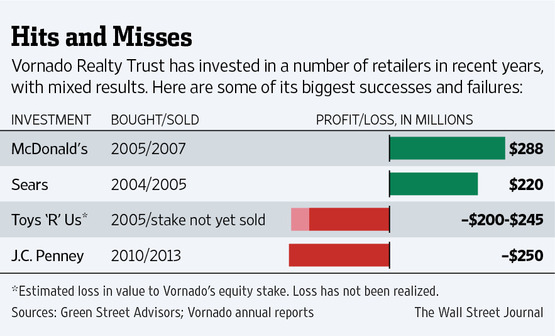
Real-Estate Pioneer Loses Its Touch: Vornado Loses $250 Million on Investment in J.C. Penney; Vornado grew from a small, New Jersey strip-center owner to a giant in real estate partly through its strategy of buying big stakes in retailers to get a piece of their valuable holdings of malls, stores and parking lots

Real-Estate Pioneer Loses Its Touch

Vornado Loses $250 Million on Investment in J.C. Penney

ROBBIE WHELAN

Updated Oct. 15, 2013 7:38 p.m. ET

MI-BZ085_VORNAD_G_20131015182704

Vornado Realty Trust VNO -0.72% grew from a small, New Jersey strip-center owner to a giant in real estate partly through its strategy of buying big stakes in retailers to get a piece of their valuable holdings of malls, stores and parking lots. But you would never know it from how the company fared in its latest retail deal, a failed investment in J.C. Penney Co. JCP -8.89% Late last month, Vornado sold its remaining 6% stake in Penney for $13 a share, slightly more than half what it paid for the shares three years ago. The company’s total loss on the deal was $250 million, or 40% of its initial investment, according to Green Street Advisors Inc. Read more of this post