Cancer Survivor Shows Obamacare Unleashing Startups

Cancer Survivor Shows Obamacare Unleashing Startups: Economy

Maksim Tsvetovat and Tatyana Kanzaveli say they doubt they could have started their data-collection company, Open Cancer Network, without Obamacare. Tsvetovat, 37 and the father of a four-year-old boy, said he was hesitant to quit his job as chief technology officer at a consulting firm and lose his health coverage. Even more crucially, Kanzaveli, 50, was diagnosed with colon cancer in January, less than two months after her contract job with an investment company ended. Her condition left her unable to purchase new medical insurance. Read more of this post

An ‘epic fail’ for network resilience in Singapore

An ‘epic fail’ for network resilience

I think we just failed an end-of-year exam on network resilience, Singapore.

BY LIM MAY-ANN –

3 HOURS 22 MIN AGO

I think we just failed an end-of-year exam on network resilience, Singapore. My friend was returning home in a taxi last week when she texted me saying the driver had started the ride telling her that she could not pay by NETS (Network for Electronic Transfers) because there was “something wrong with the network”. He proceeded to recount how he had spent the day at his company’s overcrowded service centre because he thought his taxi information update system was not working, only to be told after hours of waiting that there was “something wrong with the network”. Read more of this post

Homer the Sloth Gnaws at Bankrupt Detroit as Zoo Becomes Burden; “Unlike a museum, our assets are liabilities. They require feeding every day, and they die.”

Homer the Sloth Gnaws at Bankrupt Detroit as Zoo Becomes Burden

Bubbles the chimp and Boo the grizzly are marquee attractions at the Detroit Zoo, furry cultural assets and financial liabilities in a municipal bankruptcy where still life is worth more than animal life. As appraisers value city-owned Picassos and Van Goghs in the Detroit Institute of Arts, the zoo is under pressure to make expensive additions to draw more visitors, even as support from the insolvent city may disappear. And the 3,300 animals in Michigan’s biggest paid tourist attraction are not as valuable in an $18 billion bankruptcy as their fame suggests. Read more of this post

How Alibaba Could Underprice Amazon, and Other Things You Should Know; Alibaba Earnings More Than Double on Surging E-Commerce; Alibaba Becomes Most Profitable Internet Company in China, Surpassing Tencent

How Alibaba Could Underprice Amazon, and Other Things You Should Know

By Danielle Kucera – Oct 14, 2013

Here’s an SAT analogy test for you: Alibaba is to China as [blank] is to the U.S. 

Possible answers: Amazon, EBay or Rackspace.

The correct one? Amazon, EBay and Rackspace. And PayPal. And Yahoo. If you’re not yet familiar with Alibaba, get ready. China’s largest e-commerce company will likely go public in 2014. Investment banks have given the company a valuation of as much as $120 billion, a market cap that would make it the third-biggest Internet company behind Google and Amazon. That position may eventually put it in a spot hordes of companies pine for: a significant competitor to Amazon in the U.S. In addition, Alibaba recently led a $206 million investment in retail website ShopRunner, widening its presence in the country, and is moving toward a U.S. stock sale after talks with Hong Kong’s exchange broke down, a person familiar with the matter said last month. Even so, few U.S. consumers are well-acquainted with Alibaba. Here are a few things you should know about the company. Read more of this post

Yandex, the company that runs Russia’s most-popular search engine, has bought the country’s most-visited movie- and television-information website in a deal that expands its reach in Europe’s most populous Internet market

Yandex Buys Russia’s Answer to IMDb

Deal Expands Company’s Reach in Europe’s Most Populous Internet Market

OLGA RAZUMOVSKAYA

Updated Oct. 15, 2013 5:37 p.m. ET

MOSCOW— Yandex YNDX +0.60% NV, the company that runs Russia’s most-popular search engine, has bought the country’s most-visited movie- and television-information website in a deal that expands its reach in Europe’s most populous Internet market. Announcing the deal Tuesday, Yandex gave no financial details of the deal to buy KinoPoisk, or MovieSearch. Analysts and industry insiders said it could be valued at as much as $95 million. Read more of this post

Apple Taps Fashion CEO as Retail Magic Fades; Burberry’s Angela Ahrendts Brings Flair for Minimalist Style, Love of Tech

Apple Taps Fashion CEO as Retail Magic Fades

Burberry’s Angela Ahrendts Brings Flair for Minimalist Style, Love of Tech

KATHY GORDON, IAN SHERR and JOANN S. LUBLIN

Updated Oct. 15, 2013 8:15 p.m. ET

P1-BN566_APPLE_NS_20131015174504

Apple Inc. AAPL +0.53% reached into the world of fashion to fill its long-vacant position of retail chief—a job made all the more important as the tech giant’s sales soften. The company said Tuesday it was hiring Angela Ahrendts, the chief executive behind a seven-year growth spurt at British luxury-goods company Burberry GroupBRBY.LN -7.63% PLC. The 53-year-old Ms. Ahrendts, who was chosen after a yearlong search, is known for having refreshed Burberry’s image with more-subtle designs and understated offerings, after the brand’s famous beige, black and red plaid had become a bit frayed due to overexposure. Read more of this post

The Money Is in the Email: Square Cash Lets Users Email Funds to Friends

The Money Is in the Email: Square Cash Lets Users Email Funds to Friends

WALTER S. MOSSBERG

Oct. 15, 2013 9:00 p.m. ET

PJ-BR086A_PTECH_DV_20131015175153

Square now has a service that makes transferring money to a friend as easy as sending them an e-mail, because it works by sending an e-mail. But, as Walt Mossberg tells us, you have to put a lot of trust into Square with your money. (Photo: Square Inc.)

While you can buy a $500 iPad at Amazon.com AMZN -1.38% with a single click, sending even small amounts of cash to a friend or relative is still often a tedious and slow task. In most cases, you wind up doing exactly what you would have in 1957—writing a check and mailing it. The recipient then has to cash it or deposit it in her bank account. But starting Tuesday, you can just email cash, free of charge, directly from your debit card to anyone else’s, regardless of what bank each party uses. There’s no login or password to remember and no special software or hardware required—you just use email. It works on both ends using any email service or program on any email-capable device, whether a computer, a smartphone or a tablet. Read more of this post

China’s Retail Grocers Consolidate Further; Wumart to Buy Stores and Equity Stake From Local Competitor CP Lotus for $372m

China’s Retail Grocers Consolidate Further

Wumart to Buy Stores and Equity Stake From Local Competitor

LAURIE BURKITT in Beijing and CYNTHIA KOONS in Hong Kong

Updated Oct. 15, 2013 12:06 p.m. ET

Chinese supermarket chain Wumart Stores Inc. will acquire stores and an equity stake from a local rival for about US$372 million in cash and stock, in the latest move to consolidate China’s fragmented retail grocery market. Wumart said Tuesday that it struck a deal to buy the majority of C.P. Lotus Corp.’s retail outlets in China for 2.34 billion Hong Kong dollars (US$301.8 million). The acquisition will add 36 stores to Hong Kong-listed Wumart’s 145 markets and 396 minimarkets across China, according to a statement from the company. Wumart will take control of C.P. Lotus stores in the cities of Beijing and Shanghai and provinces other than the southern regions of Guangdong and Hunan, the statement said. Read more of this post

Maersk Monster Ships Create Capacity Glut to Clip Kuehne

Maersk Monster Ships Create Capacity Glut to Clip Kuehne

A.P. Moeller-Maersk A/S (MAERSKB)’s fleet of 1,300-foot container ships has worsened a capacity glut that’s depressing freight rates and eroding earnings, Kuehne & Nagel International AG (KNIN), the No. 1 sea-freight forwarder, said today. The three Triple-E class ships, the largest in the world, are exacerbating the effects of slowing demand on routes linking Asian exporters with consumers in Europe, Kuehne & Nagel Chief Financial Officer Gerard van Kesteren said in an interview after the company’s third-quarter profit missed analyst estimates. Read more of this post

For U.S. bond traders, the Grinch may steal bonuses

For U.S. bond traders, the Grinch may steal bonuses

8:20pm EDT

By Lauren Tara LaCapra and David Henry

NEW YORK (Reuters) – With anemic bond trading revenue over the past few months hurting Wall Street profits, pay cuts and even layoffs are back on the table just when the future had started looking up for traders. Overall, bonuses on fixed-income, currency, and commodity trading desks will likely be down 10 percent to 15 percent, said Alan Johnson, head of the Wall Street compensation consulting firm Johnson Associates. It could be the third or fourth year in a row in which some Wall Street bond traders get $0 bonus checks, he added. Read more of this post

Time to fix flaws in Singapore’s contra trading system

Time to fix flaws in local contra trading system

Wednesday, Oct 16, 2013

Goh Eng Yeow

The Straits Times

Last week, the local stock market suffered its worst calamity since the global financial crisis when the Singapore Exchange (SGX) “designated” the trading of three counters – LionGold Corp, Blumont Group and Asiasons Capital. The SGX edict means investors must pay for these three stocks in cash, while contra trading and short selling are banned. It came after the trio’s share prices went into free fall the previous Friday. As the losses mount, there is the usual finger-pointing to find scapegoats, and soul-searching to determine if things could have been done better to prevent a similar incident in future. One important observation to make is the many flaws in the “contra trading system” that have been uncovered by the fiasco. Read more of this post

Singapore supermarkets still plagued by missing trolleys

Supermarkets still plagued by missing trolleys

Wednesday, October 16, 2013 – 07:30

Kash Cheong

The Straits Times

Despite having implemented various measures, supermarkets are still losing quite a number of trolleys, no thanks to inconsiderate shoppers who cart them away for convenience. Sheng Siong lost an average of 38 trolleys each month from January to July this year, almost double last year’s figures. FairPrice saw a 14 per cent drop in lost trolleys but the cooperative with 120 supermarkets and hypermarkets still lost about 100 trolleys a month in the first half of this year. Dairy Farm, which runs Giant and Cold Storage, declined to give figures, adding that the number of trolleys lost was “not significant”. Read more of this post

China to ban new projects in sectors facing overcapacity, including steel, aluminium, shipbuilding and cement

China to ban new projects in sectors facing overcapacity

3:50am EDT

BEIJING, Oct 15 (Reuters) – China said it would block new projects in a number of sectors suffering from overcapacity, including steel, aluminium, shipbuilding and cement, according to a statement issued by the government on Tuesday. The long-awaited plan to tackle long-standing supply gluts in five industrial sectors was published by China’s cabinet, the State Council, according to the statement on China’s official government website, www.gov.cn. Margins in sectors like steel and aluminium have been affected for years by a massive supply glut, leaving many firms suffering heavy losses and reliant on government subsidy. According to the new plan, China will also seek to absorb overcapacity by stimulating domestic demand, relocating plants overseas, restructuring and merging existing firms and eliminating plants by strengthening environmental, safety and energy standards.

Singapore Shows Asia How To Crack Down on Housing Bubble?

Singapore Shows Asia How To Crack Down on Housing Bubble

Singapore, the city-state that banned chewing gum to curb litter, is showing the rest of Asia how to cool a housing bubble. The government this year ramped up efforts to bring down property prices that surged to a record, adopting some of its strictest measures, including a cap on debt at 60 percent of a borrower’s income, higher stamp duties on home purchases and an increase in real-estate taxes. Read more of this post

How Ho Chi Minh City’s Filthy Canal Became a Park

How Ho Chi Minh City’s Filthy Canal Became a Park

Sewers and storm drains don’t stir most people’s deepest passions. But try creating a modern, economically vibrant city without them. Ho Chi Minh City, Vietnam’s economic capital, has spent the past decade building a modern sanitation and flood control system for the 1.2 million people living along its Nhieu Loc-Thi Nghe canal. Cleaning up this once-filthy waterway and creating new sanitation infrastructure has changed the face of the city, transforming it into a model for improving urban infrastructure in difficult settings around the world. Read more of this post

Fed Gets Bigger in Markets as QE Prompts New Tools

Fed Gets Bigger in Markets as QE Prompts New Tools

The Federal Reserve is getting more involved in debt markets as it tries to compensate for the impact of its almost $4 trillion balance sheet on short-term interest rates. Policy makers are testing a new tool intended to improve their control of near-term borrowing costs. The facility would allow banks, broker-dealers, money-market funds and some government-sponsored enterprises to lend the Fed unlimited amounts of cash overnight at a fixed rate in exchange for borrowing Treasuries in so-called reverse repo transactions. Read more of this post

Two Out of Five Americans Cut Spending Amid Government Shutdown

Two Out of Five Americans Cut Spending Amid Government Shutdown

The U.S. government shutdown prompted two out of five Americans to curb spending, according to a survey commissioned by Goldman Sachs Group Inc. (GS) The survey of 1,025 people, conducted from Oct. 10 to Oct. 13, found that the shutdown had a greater impact on lower income consumers, with 47 percent of respondents who earned $35,000 or less saying they would curb spending. Among those with income of more than $100,000, 32 percent said they would tighten spending. Read more of this post

Bodies Double as Cash Machines With U.S. Income Lagging: Economy

Bodies Double as Cash Machines With U.S. Income Lagging: Economy

Hair, breast milk and eggs are doubling as automated teller machines for some cash-strapped Americans such as April Hare. Out of work for more than two years and facing eviction from her home, Hare recalled Louisa May Alcott’s 19th-century novel and took to her computer. “I was just trying to find ways to make money, and I remembered Jo from ‘Little Women,’ and she sold her hair,” the 35-year-old from Atlanta said. “I’ve always had lots of hair, but this is the first time I’ve actually had the idea to sell it because I’m in a really tight jam right now.”

Read more of this post

Machines Trading $400 Billion of Bonds as Humans Retreat

Machines Trading $400 Billion of Bonds as Humans Retreat

A record share of U.S. corporate-bond trading has moved to computers as buyers who traditionally transacted over the phone seek faster ways to buy and sell in a market where Wall Street’s human traders are retreating. Investment-grade volumes on MarketAxess Holdings Inc.’s electronic system are on pace to exceed $400 billion in 2013 after surging 45 percent to $44 billion in September from a year earlier, according to data from the company, which estimates it captures about 90 percent of electronic trades among the dollar-denominated notes. That’s equal to 14.3 percent of all market activity, including business done over the phone, up from 12.2 percent a year earlier. Read more of this post

Mining M&A Decline Imperils Explorers’ Aspirations

Mining M&A Decline Imperils Explorers’ Aspirations

Mining acquisitions valued at less than $1 billion have slumped to an eight-year low as the industry’s largest players rein in spending after a drop in commodities prices. The slump threatens hundreds of exploration and development companies that don’t have revenue, more than half of which are based in Canada. Being bought by a larger miner is proving increasingly elusive as companies such as Toronto-based Barrick Gold Corp. (ABX), the biggest gold producer, avoid acquisitions and new projects in favor of improving existing operations. Read more of this post

Coal’s Slump Leaves Czech Town Facing Mass Unemployment

Coal’s Slump Leaves Czech Town Facing Mass Unemployment

Most mornings, Lubomir Nevrly drives past a forest of grimy chimneys and steel-mill towers spewing smoke over the eastern Czech city of Ostrava. He doesn’t want them to stop operating. “If they close another coal mine it will be a catastrophe for the region,” said the 60-year-old Ostrava native who spent two decades working as a miner. “Crime will go up, people will start drinking. Soon we’ll be afraid to go out on the streets.” Read more of this post

India Rupee Revived by Rajan as Carry Trade Favorite

India Rupee Revived by Rajan as Carry Trade Favorite

Reserve Bank of India Governor Raghuram Rajan has turned the rupee from a pariah to the world’s favorite currency after just a month in office as he intensifies efforts to quell inflation and lure capital. Investors selling dollars to buy rupees earned 10 percent since Rajan took over on Sept. 4, the most among 44 currencies tracked by Bloomberg and a turnaround from a 2.8 percent third-quarter loss. Options betting on one-month implied volatility show investors becoming more confident in the rupee than for any currency in Asia or the BRIC nations, which also include Brazil, Russia and China. Read more of this post

Indian sage dreams of gold to save economy, government starts digging

Indian sage dreams of gold to save economy, government starts digging

7:22am EDT

By Shyamantha Asokan

NEW DELHI (Reuters) – The Indian government is digging for treasure after a civic-minded Hindu village sage dreamt that 1,000 tons of gold was buried under a ruined palace, and wrote to tell the central bank about it. The state Archaeological Survey of India has sent a team of archaeologists to the village of Daundia Khera in the northern state of Uttar Pradesh. They are due to start digging on Friday, Praveen Kumar Mishra, the head archaeologist in the state, told Reuters. Read more of this post

Mandatory vs. Voluntary Management Earnings Forecasts in China

Mandatory vs. Voluntary Management Earnings Forecasts in China

Xiaobei Huang University of International Business and Economics – Business School

Xi Li Temple University – Fox School of Business and Management

Senyo Y. Tse Texas A&M University – Lowry Mays College & Graduate School of Business

Jenny Wu Tucker University of Florida – Warrington College of Business Administration

May 2, 2013
Mays Business School Research Paper No. 2012-82

Abstract: 
Capital-market regulators face the question of whether mandating management earnings forecasts would improve the information environment or be counterproductive. We examine the efficacy of a forecast regulation in the emerging market of China, which mandates management earnings forecasts in certain performance regions such as anticipated losses, turning profit, and large changes in earnings from the previous year and allows voluntary forecasts in other circumstances. We examine the quantity, quality, and usefulness of mandatory forecasts by comparing firms’ forecast behavior under the mandatory vs. voluntary regime in China. Our results suggest that the Chinese mandate substantially increases the quantity of information available to investors, particularly by state-owned enterprises (SOEs) — firms that play a major role in the economy but are reluctant to provide forecasts voluntarily. Firms that issue mandatory forecasts are more likely to issue voluntary forecasts in the subsequent year. Yet mandatory forecasts are less timely and less precise than voluntary forecasts, suggesting that mandatory forecasts are of lower quality than voluntary forecasts. On balance, investors react to mandatory forecasts as if they are useful. One unintended consequence of the mandate is that firms appear to manage their reported earnings to avoid the bright-line threshold for mandatory forecasts of large earnings decreases. Overall, our evidence provides guidance to regulators in emerging markets and feedback to regulators in developed economies.

The Vicarious Wisdom of Crowds: Toward a Behavioral Perspective on Investor Reactions to Acquisition Announcements

The Vicarious Wisdom of Crowds: Toward a Behavioral Perspective on Investor Reactions to Acquisition Announcements

Mario Schijven Texas A&M University – Department of Management

Michael A. Hitt Texas A&M University – Department of Management

2012
Strat. Mgmt. J. (2012)
Mays Business School Research Paper No. 2012-17

Abstract: 
Although event-study methodology is invaluable to strategic management research, we argue that the traditional financial economic rationale on which it is based has led scholars to assume away the behavioral mechanisms underlying investor reactions. Building on behavioral theory from management, psychology, and economics, we set out to develop a behavioral perspective on investor reactions to acquisition announcements — one that relaxes the assumption of investors making objective, rational-deductive calculations. Given the information asymmetry they face, we theorize that investors (1) infer management’s perception of an acquisition’s synergistic potential from the premium it pays, and (2) draw on additional public information to assess the reliability of that perception. Using a multi-industry sample of acquisitions by North American firms, we find considerable support for our behavioral framework.

Can Asia Produce a Precision Castparts (PCP), a 1,000X Compounder? (Bamboo Innovator Insight)

The following article is extracted from the Bamboo Innovator Insight weekly column blog related to the context and thought leadership behind the stock idea generation process of Asian wide-moat businesses that are featured in the monthly entitled The Moat Report Asia. Fellow value investors get to go behind the scene to learn thought-provoking timely insights on key macro and industry trends in Asia, as well as benefit from the occasional discussion of potential red flags, misgovernance or fraud-detection trails ahead of time to enhance the critical-thinking skill about the myriad pitfalls of investing in Asia at the microstructure- and firm-level.

Asia PCPDear Friends and All,

Can Asia produce a Precision Castparts Corp (PCP)? PCP grew from a small metal casting workshop to become one of the best compounders in American capital history, up over 1,700x in three decades plus to a global giant with a market cap of $34.7 billion. In other words, an initial investment of $100,000 compounds to over $170 million.

This is one of the questions that I asked rhetorically in our recent Members’ Forum dialogue with one of our thoughtful Institutional Subscribers, who come from various continents spanning from North America, the Nordic, Europe and Asia, including professional value investors with over $20 billion in asset under management. This is not a trivial question since the median market cap of Asian companies is below $100 million, which is PCP’s market value before 1980. Even Buffett’s Berkshire Hathaway was attracted to the wide moat of PCP and initiated the purchase of 1.248 million shares in 3Q2012, a stake subsequently increased to 1.977 million shares that’s now worth over $450 million in its latest 13F filing; the astute capital allocators also overcome this major psychological barrier faced by many value investors: buying a stock that has already gone up multiple-folds. It is common for value investors to run screens for “cyclically cheap” stocks trading at 52-weeks low or 3-5 years low and “overlook” stocks like PCP or Fastenal who are long-term industry consolidators with their business models overcoming short-term cyclicality.

In the Forum, our institutional subscriber was initially asking about how the net cash position of a steel and aluminum stockist-cum-fabricator family business listed in Southeast Asia can be nearly two-third of its market cap which is below $100 million. The stock appears cheap, trading at a price-to-book of 0.68x. So a natural counter question: Could the high net cash be misleading and the stock is a value trap? How about tunneling opportunities of the cash via related party transactions? Is the listed company a front to act as a loan guarantor for its unlisted companies in the business group so that the high net cash mask the massive hidden off-balance-sheet debt at the group level? All these are prevalent situations in Asia that value investors using quant screens neglect to investigate, especially when share prices and volume of the illiquid stocks are manipulated.

And what similarities do PCP and the below chart of a Northeast Asian-listed stock, a family business which has 25% domestic market share in a relatively stable-demand product and run by the Seul family for 58 years, appear to have in common? What are the important differences that resulted in PCP becoming a resilient Bamboo Innovator but not the Asian company below?

Taihan Electric Wire Co. Ltd. (001440.KS) – Stock Price Performance, 1983-2013
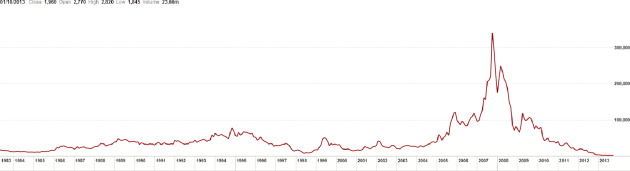
BII_Oct2013_841

The Moat Report Asia Members’ Forum has been getting penetrating quality dialogues from our existing institutional subscribers from North America, the Nordic, Europe and Asia. Questions range from:

  • The nuances of internal dealings in Asia, including the case discussion of the recent deal in which HK billionaire’s Lee Shau-kee Henderson Land acquiring Towngas or Hong Kong & China Gas (3 HK) from his family holdings, seemingly déjà vu from the early Oct 2007 transaction when the market peak.
  • The case of F&N Singapore spinning out its property unit FCL Trust and getting “free” special dividend-in-specie and the potential risk in asset swap restructuring to deleverage the hidden debt in the entire Group balance sheet.
  • Discussion of the wise and thoughtful 107-year-old Irving Kahn’s investment into a US-listed but Hong Kong-based electronics company with development property project in Shenzhen’s Qianhai zone and the possible corporate governance risks that could be underestimated or overlooked, as well as their history of listing some assets in HK in 2004.. This is also a case study of “buy one get one free” in John’s highly-acclaimed book The Manual of Ideas in which the “free” property is lumped together with the (eroding) core business to make the combined entity look cheap and undervalued. What are the potential areas that value investors need to watch out for when adapting the SOTP (sum-of-the-parts) method in Asia?
  • And many more intriguing questions.

Do find out more in how you can benefit from authentic and candid on-the-ground insights that sell-side analysts and brokers, with their inherent conflict-of-interests, inevitable focus on conventional stock coverage and different clientele priorities, are unwilling or unable to share. Think of this as pressing the Bloomberg “Help Help” button to navigate the Asian capital jungle. Institutional subscribers also get access to the Bamboo Innovator Index of 200+ companies and Watchlist of 500+ companies in Asia and the Database has eliminated companies with a higher probability of accounting frauds and  misgovernance as well as the alluring value traps.
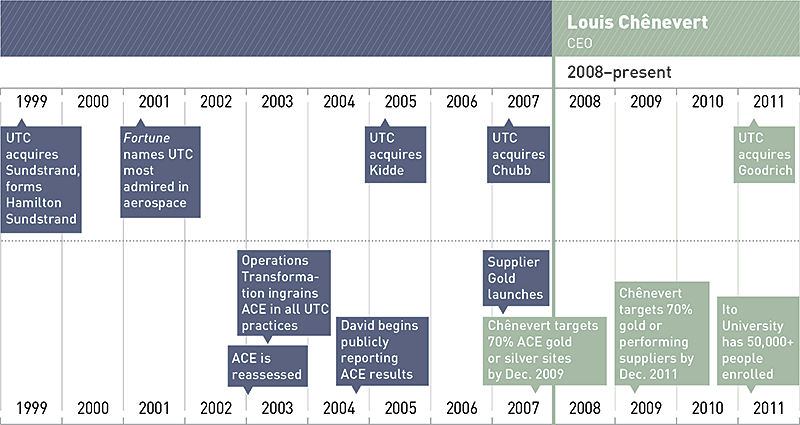
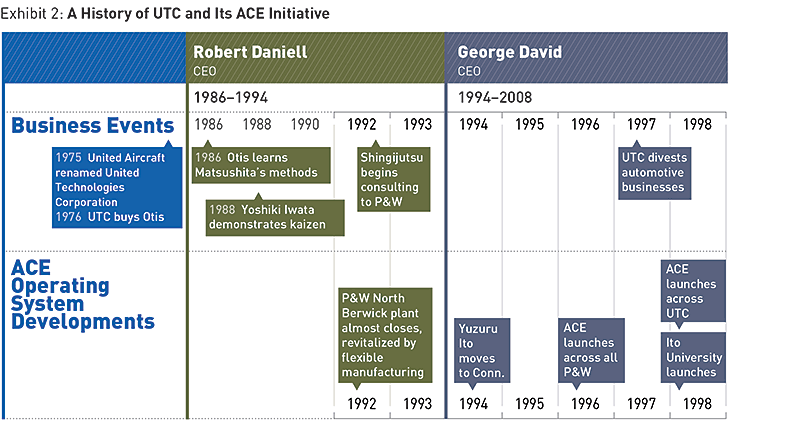
An Uncommonly Cohesive Conglomerate: How United Technologies Corporation—owner of Pratt & Whitney, Otis Elevator, and a wide range of other businesses—became one of the major corporate success stories of the past two decades.

Published: August 27, 2013

An Uncommonly Cohesive Conglomerate

How United Technologies Corporation—owner of Pratt & Whitney, Otis Elevator, and a wide range of other businesses—became one of the major corporate success stories of the past two decades.See also The Story of UTCʼs Success—In Pictures.

by George L. Roth

00209_ex01 00209_ex02bb 00209_ex02ab

Right from the start, the service call was unusual. In a business-to-business manufacturing company like Otis Elevator—or its corporate parent, the United Technologies Corporation (UTC)—field engineers are supposed to be heroes. They swoop in when there’s a technical problem too complex for anyone else to solve. But when two of Otis’s best field engineers were dispatched from their U.S. headquarters near Hartford, Conn., to Osaka, Japan, to fix a pair of malfunctioning elevators at Matsushita Electric, they weren’t brought to the problem site. Instead, they were ushered into a conference room where their customers, Matsushita’s corporate leadership, sat stone-faced around a table. Read more of this post

Oct. 17 Is Start Rather Than Finish of Debt-Limit Crisis Endgame

Oct. 17 Is Start Rather Than Finish of Debt-Limit Crisis Endgame

The day after tomorrow represents the beginning of Washington’s debt-crisis end game, not the end of it. The Treasury Department expects to exhaust its borrowing authority no later than Oct. 17, leaving the federal government with no more than $30 billion on hand. Depending upon daily tax receipts and incoming bills, the U.S. government could be forced to default on its obligations at any date thereafter — to bond holders and millions of Social Security recipients. Read more of this post

SoftBank Buys 51% in Finnish developer Supercell Oy for $1.53 billion to add games including “Clash of Clans” and “Hay Day.”

SoftBank Buys ‘Clash of Clans’ Developer Majority Stake

SoftBank Corp. (9984), Japan’s third-largest wireless carrier, bought a 51 percent stake in the Finnish developer Supercell Oy for $1.53 billion to add games including “Clash of Clans” and “Hay Day.” The deal values all of the game developer at $3 billion and will help accelerate global growth, Supercell Chief Executive Officer Ilkka Paananen said by phone today. SoftBank, led by billionaire President Masayoshi Son, is making deals in Europe and North America to tap growth amid a declining population at home. The company paid $21.6 billion for control of Sprint Corp. and invested $150 million in 2010 to acquire a minority stake in Zynga Game Network Inc. Read more of this post

Freelancers Spur Gig Economy by Tapping Online Exchanges

Freelancers Spur Gig Economy by Tapping Online Exchanges

Two years into his new career writing code for phone apps, Leo Landau works for companies as far away as Australia while never leaving his apartment in Eugene, Oregon. By year’s end he expects to earn $10,000 more than inspecting buildings for asbestos, a job he lost in 2008. “I’m working from home, setting my own schedule and making decent money,” Landau said. He doesn’t plan on moving to California’s Silicon Valley even if he could land higher-paying work there. For now, the self-taught programmer, 31, says he enjoys cobbling together an income via Elance, a website where companies and short-term contractors pair up. Read more of this post