Ball and Brown (1968): A Retrospective

Ball and Brown (1968): A Retrospective

Ray Ball University of Chicago

Philip R. Brown University of Western Australia – Department of Accounting and Finance; University of New South Wales – Australian School of Business; Lancaster University – Department of Accounting and Finance; Financial Research Network (FIRN)

July 31, 2013
FIRN Research Paper

Abstract: 
This essay provides a retrospective view on our co-authored paper, Ball and Brown (1968). The retrospective was commissioned by Gregory Waymire, then President of the American Accounting Association. It describes how we both came to be PhD students at the University of Chicago and set about researching the relation between earnings and share prices. It outlines the background against which we conducted the research, including the largely a priori accounting research literature at the time and the electric atmosphere and radical new ideas then in full bloom at Chicago. We describe some of the principal research choices we made, and their strengths and weaknesses. We also describe the reception our research received and how the related literature subsequently unfolded.

How Do CEOs See Their Role? Management Philosophy and Styles in Family and Non-Family Firms

How Do CEOs See Their Role? Management Philosophy and Styles in Family and Non-Family Firms

William Mullins Massachusetts Institute of Technology (MIT) – Sloan School of Management

Antoinette Schoar Massachusetts Institute of Technology (MIT) – Sloan School of Management; National Bureau of Economic Research (NBER)

September 2013
NBER Working Paper No. w19395

Abstract: 
Using a survey of 800 CEOs in 22 emerging economies we show that CEOs’ management styles and philosophy vary with the control rights and involvement of the owning family and founder: CEOs of firms with greater family involvement have more hierarchical management, and feel more accountable to stakeholders such as employees and banks than they do to shareholders. They also see their role as maintaining the status quo rather than bringing about change. In contrast, professional CEOs of non-family firms display a more textbook approach of shareholder-value-maximization. Finally, we find a continuum of leadership arrangements in how intensively family members are involved in management.

Six Principles for Developing Humility as a Leader: Know what you don’t know. Embrace and promote a spirit of service. Listen, even (no, especially) to the weird ideas. Be passionately curious. Never underestimate the competition.

Six Principles for Developing Humility as a Leader

by John Dame and Jeffrey Gedmin  |  11:00 AM September 9, 2013

Whether we’re looking at business or politics, sports or entertainment, it’s clear we live in an era of self-celebration. Fame is equated with success, and being self-referential has become the norm. As a result we are encouraged to pump ourselves full of alarming self-confidence. Bluster and the alpha instinct, contends Tomas Chamorro-Premuzic, professor of business psychology, often get mistaken for ability and effectiveness (at least for a while). It may well be why so many (incompetent) men rise ahead of women to leadership positions, as Chamorro-Premuzic argued in arecent HBR post. Yes, we have scores of books, articles, and studies that warn us of the perils of hubris. The word comes from the Greek and means extreme pride and arrogance, generally indicating a loss of connection to reality brought about when those in power vastly overestimate their capabilities. And yes, many of us have also seen evidence that its opposite, humility, inspires loyalty, helps to build and sustain cohesive, productive team work, and decreases staff turnover. Jim Collins had a lot to say about CEOs he saw demonstrating modesty and leading quietly, not charismatically, in his 2001 bestseller Good to Great. Yet the attribute of humility seems to be neglected in leadership development programs. And to the extent it is considered by managers rising through the ranks, it is often misunderstood. How can we change this?  Read more of this post

Hello darkness, my old friend. I’ve come to talk with you again. Because a vision softly creeping. Left its seeds while I was sleeping. And the vision that was planted in my brain. Still remains. Within the sound of silence

《Sound Of Silence》 (Originally by Simon & Garfunkel)

Hello darkness, my old friend
I’ve come to talk with you again
Because a vision softly creeping
Left its seeds while I was sleeping
And the vision that was planted in my brain
Still remains
Within the sound of silence

In restless dreams I walked alone
Narrow streets of cobblestone
‘Neath the halo of a street lamp
I turned my collar to the cold and damp
When my eyes were stabbed by the flash of a neon light
That split the night
And touched the sound of silence  Read more of this post

Eighteen years after her death, Taiwanese pop diva Teresa Teng, one of Asia’s most-loved performers, made a surprise return to the stage in Taipei over the weekend with the help of California-based multimedia company Digital Domain 3.0 Inc

September 9, 2013, 10:44 AM

Deceased Taiwan Pop Star Makes Virtual Stage Comeback

By Jenny Hsu

OB-YV066_Teresa_G_20130908024444

Taiwan pop star Jay Chou, right, performs on stage with a digital rendering of late pop diva Teresa Teng in Taipei on Friday.

Eighteen years after her death, Taiwanese pop diva Teresa Teng, one of Asia’s most-loved performers, made a surprise return to the stage in Taipei over the weekend with the help of California-based multimedia company Digital Domain 3.0 Inc. The life-size digital image of Ms. Teng, dressed in a signature slim-fitting cheongsam, thrilled the audience of 15,000 on Friday night, when she ascended from beneath the stage to sing three duets with Mandopop star Jay Chou at his concert in Taipei. Mr. Chou and the virtual Ms. Teng performed one of her biggest hits, “What You Have to Say,” in addition to two of Mr. Chou’s songs, “Red Tavern” and “Thousand Miles Away.”

Read more of this post

Sam Adams Creator Becomes Billionaire as Craft Beer Rises; Through a combination of in-person proselytizing and folksy TV ads, Koch created widespread awareness

Sam Adams Creator Becomes Billionaire as Craft Beer Rises

Jim-Koch.First-Cases__1271271325_1883

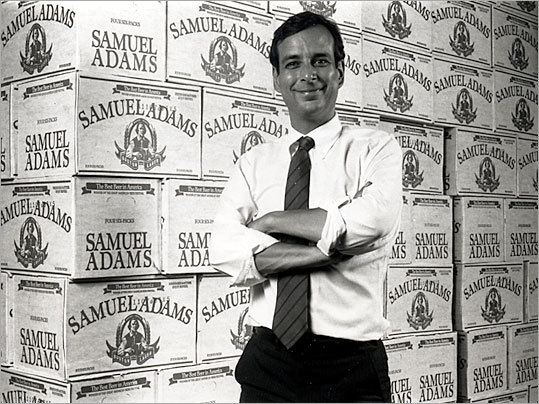
Armed with a family recipe and a flair for marketing, C. James “Jim” Koch popularized craft beer in the U.S. and turned Boston Beer Co. into the second-largest American-owned brewery. It also made him a billionaire, as frothy sales of his flagship Samuel Adams brand helped Boston Beer shares double in the past year and reach a record high Friday. Craft beer such as Sam Adams has been a bright spot in an otherwise stale U.S. beer market. Total American beer sales fell 2 percent in the first half of 2013, according to data compiled by Bloomberg, while the craft brew segment grew 15 percent. Boston Beer’s sales increased more than 17 percent during the period. Read more of this post

BlackRock to JPMorgan See Deeper Emerging-Market Bond Losses; “We’re not yet convinced that we’ve seen the worst in terms of flows out of emerging markets”

BlackRock to JPMorgan See Deeper Emerging-Market Losses

Wall Street’s biggest firms are predicting intensifying bond losses in emerging markets, where borrowing costs have already soared to the highest in more than four years versus U.S. corporate debt, as the Federal Reserve considers curtailing record stimulus. “We’re not yet convinced that we’ve seen the worst in terms of flows out of emerging markets,” Jeffrey Rosenberg, the chief investment strategist in fixed-income at New York-based BlackRock Inc. (BLK), the world’s largest asset manager, said in a telephone interview, expressing his own views. “We see a lot of valuation change but we see the potential for even more valuation change.” Read more of this post

Battle-weary policy makers do not want to believe that an emerging market crisis is possible. But there are striking resemblances now to the economic troubles these countries suffered in the 1990s

Sept. 9, 2013, 6:31 a.m. EDT

No country is safe from emerging market meltdown

Commentary: Repeat of 1990s debt crisis would threaten global growth

By Satyajit Das

SYDNEY (MarketWatch) — Battle-weary policy makers do not want to believe that an emerging market crisis is possible. But there are striking resemblances now to the economic troubles these countries suffered in the 1990s. Then, loose monetary policies pursued by the Federal Reserve and the Bank of Japan brought large capital inflows into emerging markets, especially Asia. In 1994, Federal Reserve Chairman Alan Greenspan withdrew liquidity, resulting in a doubling of U.S. interest rates over 12 months. In the 1994 ‘Great Bond Massacre’, holders of Treasury bonds suffered losses of around $600 billion. Trading losses led to the bankruptcy of Orange County in California, the effective closure of Kidder Peabody and failures of many investment funds. Read more of this post

Scientists studying solar radiation management as a way to cool planet

Scientists studying solar radiation management as a way to cool planet

By Lenny Bernstein, Monday, September 9, 6:54 AM

The 1991 eruption of Mount Pinatubo, a volcano in the Philippines, blasted enough fine particles and sulfur dioxide gas into the atmosphere to envelop the Earth in a high-altitude cloud for the better part of two months. When scientists checked in 1992, they determined that the cloud had deflected enough sunlight to cool the planet by about 1 degree. Now, with the planet warming inexorably and the threat of long-term climate change looming, some experts are wondering whether the time may one day come when humans want to deliberately attempt such “solar radiation management.” The idea is being investigated by, among others, the National Academy of Sciences, which is conducting research funded by the CIA, NASA and the National Oceanic and Atmospheric Administration. The academy has invited experts to discuss the idea Tuesday. Read more of this post

Nintendo Slumps After Stock Excluded From Nikkei

Nintendo Slumps After Stock Excluded From Nikkei: Tokyo Mover

Nintendo Co. (7974), the world’s largest maker of video games, fell the most in more than two years as CLSA Asia-Pacific Markets cut the stock to sell after the company wasn’t added to the Nikkei 225 Stock Average. The shares fell 9 percent to 10,780 yen as of 2:19 p.m. in Tokyo, the biggest drop since July 2011. Before today, the Kyoto-based company had gained 31 percent this year amid expectation the transfer of its listing to Tokyo from Osaka may see the stock added to the Nikkei. Read more of this post

Nissan-Beijing Traffic System to Help Ease World’s Worst Commute

Nissan-Beijing Traffic System to Help Ease World’s Worst Commute

Beijing, once voted the city with the world’s most onerous commute, is getting help from an automaker to ease its traffic jams.

Nissan Motor Co. (7201) jointly developed a real-time traffic information system with the Chinese capital that provides motorists the fastest route to their destinations, based on road conditions provided by the city’s traffic information center. The suggested shortcuts are delivered through a dashboard-mounted device similar to a global positioning system. Read more of this post

Thailand to Scrap Luxury-Goods Tax to Lure Travelers From China

Thailand to Scrap Luxury-Goods Tax to Lure Travelers From China

Thailand’s government said it will scrap import duties on luxury watches, clothes and cosmetics to help the country compete with Hong Kong and Singapore for wealthy travelers from markets including China. The duty on some luxury goods will be cut to zero from 30 percent by the end of the year, Permanent Secretary for Finance Areepong Bhoocha-Oom told reporters in Chonburi province. Read more of this post

GE to IBM Ending Retiree Health Plans in Historic Shift

GE to IBM Ending Retiree Health Plans in Historic Shift

America’s biggest employers, from GE to IBM (IBM), are increasingly moving retirees to insurance exchanges where they select their own health plans, an historic shift that could push more costs onto U.S. taxpayers. Time Warner Cable Inc. (TWC) yesterday said it would steer retired workers toward a privately run exchange, days after a similar announcement by International Business Machines Corp. General Electric Co. (GE) last year said it, too, would curb benefits in a move that may send some former employees to the public insurance exchanges created under the 2010 Affordable Care Act. Read more of this post

Secret Swiss Accounts Said No Longer Safe for Tax Dodging

Secret Swiss Accounts Said No Longer Safe for Tax Dodging

Taxpayers who still believe they can hide secret Swiss bank accounts from the Internal Revenue Service are “beyond foolish,” the top U.S. tax prosecutor said as a five-year crackdown expands to new offshore havens. The enforcement drive has forced a “remarkable” change in the ability of the U.S. to find secret accounts in Switzerland, the world’s largest offshore financial center with about $2.2 trillion of assets, said Kathryn Keneally, assistant attorney general in the Justice Department’s tax division. Read more of this post

Sequoia Capital Pulls Back From South America

SEPTEMBER 6, 2013, 10:15 AM

Sequoia Capital Pulls Back From South America

By VINOD SREEHARSHA

SÂO PAULO, Brazil — Sequoia Capital has decided to manage its activities in South America from its headquarters in California after its lone partner here, David Velez, left to start his own venture, people with direct knowledge of the firm’s plans said. The move, which these people said had been in the works for several months, shows the difficulty the Silicon Valley venture capital firm has faced in finding attractive investments in the region, even as start-ups have proliferated in recent years. Read more of this post

Loving What You Do Is A Privilege. Grind on, my friend.

Loving What You Do Is A Privilege

DAN WALDSCHMIDT, EDGY CONVERSATIONS SEP. 8, 2013, 8:50 PM 1,089 5

Sometimes you just have to gut it out. Stick it out. Fight it out. Stay out of the way of disaster.

It’s sexy to talk about “loving your job” and “pursuing your passion”. But in-between your idea to get started and the finish line is pain and sweat and tears.

Not love. Not joy. Not fun. Just hard damn work. (And a lot of it)

You have to grit it out.

Grind it out. Work on days when you’re sick-and-tired and tired and sick.

You have to put in effort even though no one else believes in you. Even though you’re not sure you believe in what you’re doing.

Your boss might be an idiot. Your coworkers might be short sighted, passive aggressive punks. Your clients might abuse you. Your prospects might lie to you. The world could be crumbling down around you.

And yet, if you are going to be awesome, you just need to grind on.

You don’t love the pain. You don’t enjoy the sweat that gets in your eyes. You aren’t passionate about getting emotionally kicked-in-the-gut each day.

But, you do what needs to be done. And that’s what makes you awesome.

Loving what you do is a privilege. It is an honor. It is a reward for grinding out progress in the darkest of days.

Unless your passion in life is to “fool around”, you’ll never love everything about what you have to do in order to be successful.

But that’s okay, because if you grind it out for long enough you’ll love the place you’ve arrived at.

Grind on, my friend.

Cutting Through the Noise: More than two dozen of the country’s top value investors weigh in on key elements of the research and decision-making process

SATURDAY, SEPTEMBER 7, 2013

Cutting Through the Noise

By JOHN HEINS AND WHITNEY TILSON | MORE ARTICLES BY AUTHOR

More than two dozen of the country’s top value investors weigh in on key elements of the research and decision-making process.

Professional investors are an exceedingly competitive lot—unsurprising, given that their chosen field is one where the score delineating winners and losers can be tallied at every market close. But as results-driven as investors tend to be, the best money managers put equal emphasis on the process they follow for conducting research and making portfolio decisions. They have a clear understanding of the most important questions they want answered and how best to answer them. Of course, their methods of discovery can vary widely. Some investors put great emphasis on having macro views that inform their decisions, while others firmly reject that approach. Some consider time spent with management critical to their research process, while others consider it a waste of time. Some see industry specialization among analysts as a benefit; others see it as a detriment. But nearly all successful fundamental investors see their research and decision-making process as a primary source of competitive advantage, and should be able to explain in detail why that’s so. Read more of this post

China’s Credit Levels Echo U.S. Crisis; Quick Jump in Country’s Debt is Reminiscent of Previous Meltdowns

September 8, 2013, 6:53 p.m. ET

China’s Credit Levels Echo U.S. Crisis

Quick Jump in Country’s Debt is Reminiscent of Previous Meltdowns

ALEX FRANGOS

MI-BY325_REPEAT_G_20130908170607

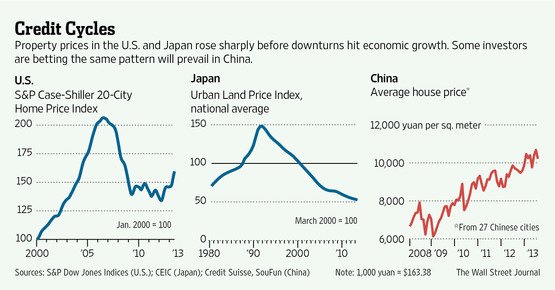
Investors have made billions betting against economies in which debt is rising and home prices are soaring. They have had particular success targeting the banks that fund these booms. Right now, their target is China. Some compare China to the U.S. in 2007. Others cite Japan before the 1989 real-estate bust. China bulls acknowledge the risks but say the government has the money and expertise to defuse the problems. Until recently, the bears were winning the tug-of-war, pushing down the prices of Chinese banks until they were the cheapest of any major economy based on price-to-book value, a measure for how investors rate the quality of a bank’s assets. But recently, the Chinese economy and markets have perked up. Chinese banks, reflected in the Hang Seng H Financial Index, have rallied 17% since July 3, even as they warned of rising bad debts and said they would likely have to raise capital. Read more of this post

Chinese Zombies Emerging After Years of Solar Subsidies

Chinese Zombies Emerging After Years of Solar Subsidies

Only five solar-power vendors remain in a space built for 170 at a sprawling complex of offices stacked three stories high outside Xinyu city in China’s southeast. Locked doors and empty offices are what’s left of the government’s audacious plan to dominate the global solar industry. What happened in Xinyu is being replicated across China, which used subsidies and $47.5 billion of credit to wrest supremacy from Germany, Japan and the U.S., saddling an industry with losses for at least two years. Read more of this post

Goldman believes China’s credit losses could reach up $3 trillion; “If you went to a meeting with Bank of China today and mentioned NPLs, they would stare at you blankly and refer you to someone senior.”

Updated: Monday September 9, 2013 MYT 7:29:22 AM

China Locks Foreign Investors Out Of Another Bad-Debt Cleanup

HONG KONG: Chinese banks have a colossal mess of bad debts to clean up for the second time in as many decades, but they are unlikely to call in the financial world’s most efficient mop and broom. Read more of this post

Higher education is in an expensive muddle with too many useless degrees; The Great Stagnation of American Education

Higher education is in an expensive muddle with too many useless degrees

A long summer break has allowed me to reflect on some issues which, although extremely important, I somehow seem to miss in the hubbub of events and financial news.

I think there is too much higher education. Roughly 50pc of youngsters now go to university to get a degree. In my day, the proportion was more like 5pc. (The policemen are getting younger too.) Now doubtless 5pc was too low but I am pretty sure that 50pc is too high. Photo: Alamy

By Roger Bootle

7:37PM BST 08 Sep 2013

I have found myself reflecting on higher education. This isn’t just idle speculation. Education is an important part of modern economies and has a major bearing on how they perform. This is an area in which Britain both excels and does appallingly badly – in different parts, of course. I realise that what I have to say may tread on a few toes, because I am no professional expert in the field. Still, I do have some basis for comment. Many moons ago, I taught economics at various levels. I now consume large amounts of the output of the educational establishment, in the shape of applicants for jobs at my company. Above all, I am the parent of teenage children and, like so many other parents, am anxious about their prospects. Read more of this post

How the Bamfords dig deeper to propel JCB clear of rivals; Family, business and politics are controversially entwined at the UK’s most successful construction equipment maker

How the Bamfords dig deeper to propel JCB clear of rivals

Family, business and politics are controversially entwined at the UK’s most successful construction equipment maker.

jcb-bamford_2664976f

Digger history: JCB chief Sir Anthony Bamford with his son, Jo. Photo: David Marsden

By Louise Armitstead, Chief business correspondent

9:00PM BST 08 Sep 2013

While Sir Anthony Bamford is accused of using his JCB fortune to bulldoze his way into British politics, his father had precisely the opposite complaint. Politics, in the form of trade unions, burrowed into his digger company in the 1970s and ultimately drove Joseph Cyril Bamford to quit. The soon-to-be Lord Bamford, who was made a life peer last month, remembers the day his father stood on a trailer to address workers as a wave of union militancy swept the country. Read more of this post

Hamlet and the secrets of decision-making; Simple guidelines exist for better decision-making but don’t expect a formula

September 6, 2013 7:13 pm

Hamlet and the secrets of decision-making

By Julian Baggini

Simple guidelines exist for better decision-making but don’t expect a formula

Eyes Wide Open: How to Make Smart Decisions in a Confusing World, by Noreena Hertz, William Collins, RRP£14.99/$26.99, 352 pages

Touching a Nerve: The Self as Brain, by Patricia S Churchland, WW Norton, RRP£17.99/$27.95, 304 pages

The Hamlet Doctrine: Knowing Too Much, Doing Nothing, by Simon Critchley and Jamieson Webster, Verso, RRP£14.99, 288 pages

I Don’t Know: In Praise of Admitting Ignorance (Except When You Shouldn’t), by Leah Hager Cohen, Riverhead Books, RRP$17.95, 128 pages

Decisions, decisions. It has become a truism that we increasingly face far too many of them. There are plenty of books offering to help you through this morass but, such is the choice, they only seem to make the headache worse. Read more of this post

The west needs a replacement for the warrior spirit; Warfare and welfare have long been connected

September 6, 2013 7:24 pm

The west needs a replacement for the warrior spirit

By Mark Mazower

Warfare and welfare have long been connected, writes Mark Mazower

The memory of Iraq, and the anger that war still provokes, loom large over the defeat of the British government over Syria in the House of Commons, and the wrangling in the US Congress and the French parliament. The doubts surfacing in these legislatures suggest that public opinion on both sides of the Atlantic is a lot more sceptical than it once was about the efficacy of military action and more worried at the tendency of so-called surgical strikes to turn into unwinnable wars. Read more of this post

U.S. firms’ enthusiasm for China cools as political, economic uncertainty deepens

U.S. firms’ enthusiasm for China cools as political, economic uncertainty deepens

By Simon Denyer, Published: September 6

BEIJING — American companies’ enthusiasm for investing in China has been dampened by a combination of policy uncertainty, an economic slowdown and narrowing profit margins, the head of the U.S.-China Business Council said Friday. Attacks on Western values and on foreign companies’ business practices this year have also unsettled some U.S. businesses operating in China, while barriers to foreign investment in many sectors of the economy remain substantial, escalating concerns about the extent to which the firms will be allowed to benefit from growth in the world’s second-largest economy. Read more of this post

Tycoon Wu Bing, who has an intertwined relationship with the country’s oil industry and Sichuan officialdom, has reportedly been detained by authorities.

Wu Bing, tycoon with HK ties, believed to be in detention

Monday, 09 September, 2013, 12:00am

Keith Zhai and Joanna Chiu

Wu Bing, one of the richest men in Sichuan, has not been seen in public since May 22

Tycoon Wu Bing, who has an intertwined relationship with the country’s oil industry and Sichuan officialdom, has reportedly been detained by authorities. Wu Bing in an undated photoWu, who also goes by the name Li Ruochen and Wu Yongfu, is chairman of Hong Kong-registered Zhongxu Limited and the behind-the-scenes owner of various businesses, including Zhongxu Investment Corporation, a company based in Sichuan’s capital, Chengdu, registration documents show. Read more of this post

Those Big Fat Chinese Weddings

Those Big Fat Chinese Weddings

By Christina Larson September 06, 2013

“The shape of the bra cup is built into the dress,” says Chen Yaping, marketing director at Galatea Bridal Boutique in Beijing, pointing to a rack of well-endowed white wedding gowns. “It doesn’t matter how big you are.” Galatea, which takes its name from an ancient Greek myth, is one of numerous bridal shops launched recently in China’s capital, catering to a fast-growing bridal industry—estimated at $57 billion by the China Wedding Industry Development Report—that now mixes Western precedents and local characteristics. A display case within the store exhibits jeweled tiaras next to towering 9-inch, rhinestone-encrusted silver platform heels. Read more of this post

Oriental DreamWorks Rewrites Its China Production Strategy

Oriental DreamWorks Rewrites Its China Production Strategy

SEPTEMBER 6, 2013 | 08:43AM PT

Patrick Frater

Describing Oriental DreamWorks as a “Chinese content company,” the outfit’s head of production Joe Aguilar this week laid out a substantially expanded production mandate for the one-year old joint venture. Aguilar announced that Oriental DreamWorks now intends to be involved in animated TV production, live action films, live action TV – including reality formats, as well as mobile and Internet content. Read more of this post

China is developing helicopters with the ability to fly at speeds twice the current average, according the country’s major aircraft maker

China develops new generation of high-speed aircraft

Monday, September 9, 2013 – 11:36

Zhao Lei

China Daily/Asia News Network

CHINA – China is developing helicopters with the ability to fly at speeds twice the current average, according the country’s major aircraft maker. Lin Zuoming, chairman of Aviation Industry Corp of China, said the company is developing new-generation helicopters that can travel up to 500 kilometers an hour. “We have been keeping pace with other countries in the research and development of ultrafast helicopters,” he added. Read more of this post

China embraces ‘British Model’, ditching Mao for Edmund Burke

China embraces ‘British Model’, ditching Mao for Edmund Burke

David Cameron might be reassured to know that China’s Communist leadership is studying the long arc of British history with intense interest, even if Russia’s Vladimir Putin deems our small island to be of no account.

Professor Li said the 18th Century Irish philosopher Edmund Burke is now all the rage in Chinese universities, studied for his critique of violent revolution, and esteemed as the prophet of stability through timely but controlled change. Photo: Quirky China News / Rex Features

By Ambrose Evans-Pritchard

4:30PM BST 08 Sep 2013

“We want to learn from the British model,” said Daokui Li, a memberChina’s upper chamber or `House of Lords’ (CPPCC) and a professor at Beijing’s Tsinghua University. “Today’s leaders in China are looking carefully at the British style of political change over the last 400 years, analysing the difference with France,” he told me at the annual Ambrosetti gathering of world policy-makers at Villa d’Este on Lake Como. “England went through incredible changes: a war against the US; wars against France; wars against Germany twice, the rise and decline of empire; and universal suffrage. Yet society remained stable through all this turmoil, with the same institutions and political structure. We think the reason is respect for tradition, yet willingness to make changes when needed.” Read more of this post