Indonesia’s Investment Stature Under Siege, Further Pain Seen
ByRieka Rahadianaon 9:05 am August 28, 2013. From a tumbling currency to a crippling current-account shortfall, slowing economic growth, high inflation and retreating investors, Indonesia’s stature as emerging-market superstar is under siege. The immediate prospects look forbidding. Measures imposed by the government and central bank on Friday are no panacea for a near-record current-account deficit that has torpedoed the rupiah currency and spooked foreign investors who own nearly a third of its government debt. Read more of this post
50 Tempe Producers Halt Production in Bogor as Soybean Price Hikes Take Toll
ByVento Saudaleon 6:26 pm August 27, 2013. A man slices bars of tempe in a kiosk selling fried tempe in Bandung in this May 20, 2013 file photo. Soaring soybean prices in Indonesia have forced at least 50 tempe and tofu factories in Bogor to cease production. (JG Photo/Rezza Estily)
Bogor, West Java. Soaring domestic prices have taken a toll on the local soybean industry, with at least 50 tempe and tofu factories in the West Java town of Bogor alone recently forced to put their businesses on hold. Kasmono, 45, a tempe producer from Kedungbadak village in Bogor, said soybean prices had increased from around Rp 7,000 (64 cents) per kilograms two weeks ago to Rp 9,100 per kilogram on Tuesday. “Demand for tempe in the market hasn’t changed, both in terms of quality and prices. But soybean prices have been continually up,” Kasmono said. “I’m confused [as to what to do].” Read more of this post
Updated: Wednesday August 28, 2013 MYT 12:41:05 PM
Rupee collapse confounds India Inc
MUMBAI: Indian companies such as Whirlpool of India Ltd say they can’t plan more than a couple of months out as a fast-falling rupee currency drives up the cost of imports, forcing them to raise prices even as consumer spending crumbles. The timing is particularly tough for consumer companies that were counting on India’s September-to-December holiday season to spur sales. Read more of this post
Record Gold in India Seen Hurting Jewelry Demand as Rupee Slumps
Gold advanced to a record in India after the nation’s currency extended a plunge to an all-time low, threatening jewelry demand during the main festival season in the world’s largest consumer. The contract for delivery in October surged as much as 3.3 percent to 32,933 rupees per 10 grams ($1,555.96 an ounce) on the Multi Commodity Exchange of India Ltd. (MCX) in Mumbai today. Futures have rallied 33 percent since reaching a two-year low in June as the rupee tumbled about 10 percent, more than the 14 percent gain in bullion priced in dollars. Read more of this post
Some of Japan’s most dominant companies owe their success not only to technology and process expertise but also to an often-overlooked factor: During the past decade, they’ve been quietly turning their supplier relationships into a tool for innovating faster while radically cutting costs. Welcome to the new keiretsu—a modern version of the country’s traditional supply system. During its heyday, in the 1980s, the traditional keiretsu system—an arrangement in which buyers formed close associations with suppliers—was the darling of business schools and the envy of manufacturers everywhere. Although there was some tentative movement in the West toward keiretsu-like supplier partnerships at the time, the rise of manufacturing in low-wage countries soon made cost the preeminent concern. Most Western companies today wouldn’t dream of investing in supplier relationships that would require significant care and feeding. Indeed, many people probably assume that keiretsu died when Japanese manufacturers initiated Western-style cost-cutting tactics.
These days, “overworked” is the new normal, and learning to manage your time wisely is the key to getting ahead in today’s 24/7 work environment. The truth is, you won’t ever have more hours in a day, or fewer tasks to fulfill, but if you master your time and use it efficiently, you’ll feel less pressure and less overwhelmed. Suzana Simic, manager of career services at Computer Systems Institute — a proprietary post-secondary education institution — provides these four key time-management tips to help you tackle the daily grind.
1. Make a realistic to-do list.
Create your list the night before so you’ll have a head start the next day. “The day the tasks are due, check them off one by one until you’ve accomplished all your daily tasks,” Simic says. “Setting goals and achieving them will boost your morale and get you fired up for the next task.”
2. Turn off distractions.
There are so many possible diversions in today’s technological world. But you need to ignore as many of them as possible so you can stay focused on completing your tasks. “Put on your blinders,” Simic says. “Eliminate or reduce all the things that you don’t need to complete a complicated task. This means exiting out of emails, closing your office door and switching your phone to silent.” Read more of this post
More hours in the day. It’s one thing everyone wants, and yet it’s impossible to attain. But what if you could free up significant time—maybe as much as 20% of your workday—to focus on the responsibilities that really matter? We’ve spent the past three years studying how knowledge workers can become more productive and found that the answer is simple: Eliminate or delegate unimportant tasks and replace them with value-added ones. Our research indicates that knowledge workers spend a great deal of their time—an average of 41%—on discretionary activities that offer little personal satisfaction and could be handled competently by others. So why do they keep doing them? Because ridding oneself of work is easier said than done. We instinctively cling to tasks that make us feel busy and thus important, while our bosses, constantly striving to do more with less, pile on as many responsibilities as we’re willing to accept. Read more of this post
Enterprise’s Leader on How Integrating an Acquisition Transformed His Business
by Andrew C. Taylor
The Idea: When the car rental company acquired Alamo and National, rather than execute a “takeover,” it moved slowly and sought to learn from its new brands.
In 2007 Enterprise Rent-A-Car was marking its 50th anniversary. We had much to celebrate. With more than $9 billion in global revenue, we were the largest car rental company in the world and one of the largest family-owned and -operated companies in the United States. As the industry leader, we had been approached from time to time about acquisition opportunities—especially after several of our competitors merged or changed owners in the mid-1990s. However, while our major rivals had always focused on renting cars at airport locations, Enterprise had concentrated on “home city” rentals, with much of our business coming from people who needed a car while their own was being repaired. So we had never really been tempted. We were growing steadily and organically, in local neighborhoods and at airports. We believed in our strong, do-it-yourself culture. And we had little interest in altering what was working so well. Read more of this post
Companies have long emphasized touchpoints—the many critical moments when customers interact with the organization and its offerings on their way to purchase and after. But the narrow focus on maximizing satisfaction at those moments can create a distorted picture, suggesting that customers are happier with the company than they actually are. It also diverts attention from the bigger—and more important—picture: the customer’s end-to-end journey. Read more of this post
ENDICOTT, N.Y. — This town in the hills of Upstate New York is best known as the birthplace of IBM, one of the country’s most iconic companies. But there remain only hints of that storied past. The main street, once swarming with International Business Machines employees in their signature white shirts and dark suits, is dotted with empty storefronts. During the 1980s, there were 10,000 IBM workers in Endicott. Now, after years of layoffs and jobs shipped overseas, about 700 employees are left. Read more of this post
Here’s The Incredible Amount Of Data That Goes Into IBM’s Tennis Analysis
AUG. 27, 2013, 8:00 AM
The U.S. Open starts this week, and rabid tennis fans are keeping track of each ace, break point, missed volley, and Rafael Nadal fist pump. IBM may have even the most stat-geeky fans beat, though. IBM SlamTracker’s Keys to the Match system calculates 41 million data points from eight years of Grand Slam matches to apply predictive analysis to every facet of every player’s game. Check out the infographic below to find out what went into IBM’s exhaustive data efforts, which could be applied to both sports and business. U.S. Open fans should visit IBM Sports for in-depth analysis of all the action, and follow IBM Sports on Instagram for animated data points and live pictures from the Open.
Amazon’s cloud computing service, AWS, has more than five times the combined capacity of its next 14 rivals, according to a research report by Gartner, as cited in The Seattle Times’ recent look at Amazon’s efforts to win the contract for the CIA’s cloud services. Most people regard Amazon as that online book and retail company. But the Gartner report argues that Amazon has reached a staggering level of dominance in enterprise-level computing services for big companies. The Seattle Times: AWS generates roughly $3 billion in annual revenue, according to analyst estimates, by offering services to businesses at a fraction of what it would cost if those businesses owned and ran their own computers. Read more of this post
Amazon wants its retail store to always be just a click away.
The Seattle retail giant announced Tuesday that developers can allow physical goods from Amazon.com to be purchased through just about any Android app. That means users could buy an actual calendar to hang on their wall while using a calendar app, or spices from a recipe app. It is easy to imagine how the new in-app purchasing could appeal for marketers: Stick a virtual pair of the latest Air Jordan shoes on a game character and offer them at a discount. Read more of this post
On November 22, 2010, at 7:55 PM, Apple’s Senior Vice President of marketing, Phil Schiller, blasted an email to top Apple executives. He had just seen an ad from Amazon, and he was not happy. He emailed Steve Jobs, Eddy Cue, who runs Apple’s Internet services, and Greg Joswiak, VP of marketing:
I just watched a new Amazon Kindle app ad on TV. It starts with a woman using an iPhone and buying and reading books with the Kindle app. The woman then switches to an Android phone and still can read all her books. While the primary message is that there are Kindle apps on lots of mobile devices, the secondary message that can’t be missed is that it is easy to switch from iPhone to Android. Not fun to watch.
Steve Jobs replied a few hours later:
What do you recommend we do? The first step might be to say they must use our payment system for everything, including books (triggered by the newspapers and magazines). If they want to compare us to Android, let’s force them to use our far superior payment system. Thoughts?
GigaOm first dug up this email exchange. It is evidence in the Department of Justice’s eBook case against Apple. A few months after Jobs sent this email, Apple decided to cripple Amazon’s Kindle app for iPhones and iPads. Apple said that if Amazon wants to sell a book through iOS, Apple’s mobile operating system, then Apple would collect 30% of the sale. Amazon abandoned selling books straight through its app. Instead, users have to buy a book through the web, then it’s sent wirelessly to the app. A bit of a pain, but it doesn’t seem to have slowed Kindle sales. Quartz writer Zachary Seward notes that the larger point from this exchange is that Apple executives realized the oft-discussed eco-system lock-in advantage for Apple is not that strong. Since this email exchange, Apple’s lock-in has only gotten weaker. Just about every great app for iOS is also available on Android. People are increasingly using services like Netflix and Spotify, which work on both platforms. Those apps make iTunes less powerful, and therefore Apple’s lock-in less powerful. Apple would counter any concerns by saying it has the highest customer satisfaction rate of any smartphone on the planet. And that’s the best indication that customers are going to stick with the iPhone. This seems to be the ad from Amazon that prompted the email:
Why hasn’t the future arrived for one of consumers’ most used gadgets?
By John Patrick Pullen
FORTUNE — After a month of phone tech support, a month of wireless router reconfigurations, a month in which I restored my computer to a backup from six weeks before, and a month of spotty, poor Internet service, I finally yanked my high-speed modem out of the wall last Monday and hauled it into my local Comcast office for a replacement. And it was there, flanked by more than a dozen people with phone, television, and Internet problems similar to mine — all watching Night at the Museum in the waiting room, like we were stranded in a bus station at the side of the information superhighway — that I thought, “Hey, that’s a pretty cable box they’ve got there. I wonder how I can get that for myself?” Read more of this post
The Economist explains: Is Netflix killing cable television?
Aug 26th 2013, 23:50 by A.E.S.
NEXT MONTH the Emmys, the American television awards, could label a show that never appeared on a television channel as the year’s best drama. “House of Cards”, a series about political maneuvering starring the actor Kevin Spacey (pictured), is available only on Netflix, an online-video service. The show’s success highlights the maturation of video-streaming firms, and the threat they pose to traditional television. People can now watch television-quality shows, including “House of Cards”, only through Netflix, seemingly diminishing the need to pay for a cable subscription. Is Netflix killing cable television? Read more of this post
“BLACKFISH”, a gripping new documentary about killer whales in captivity, feels like an action thriller. Opening with the death of Dawn Brancheau, a trainer killed by a whale at Seaworld in Florida in 2010, it builds suspense with a haunting score, shock revelations and emotional footage of the killer in question—a sorry-looking orca called Tilikum. This film (now available on DVD) is an example of a new breed of theatrically-minded, more commercially viable documentaries that are contributing to the genre’s increasing success. Recent British Film Institute data show that the number of documentaries released in British cinemas has grown steadily every year over the last decade, from a measly four in 2001 to 86 last year. Documentaries now also account for about 16% of the Cannes film market according to its director, Jerome Paillard, compared with 8% five years ago. Netflix, an online streaming service that also makes television series, recently announced that it will soon be producing documentaries for the next wave of its original content drive. Read more of this post
Aereo Wins Send Networks on Hunt to Stop Streaming TV
Broadcasters stymied by court losses in New York are turning to judges in California and Massachusetts in their campaign to shut down the Aereo Inc. online streaming TV service backed by Barry Diller. Aereo, which relays broadcast TV to subscribers over the Internet, continues to expand its service to more U.S. cities even as CBS Corp. (CBS), Comcast Corp. (CMCSA)’s NBC, Walt Disney Co. (DIS)’s ABC and Twentieth Century Fox Film Corp.’s Fox pursue copyright litigation that may wind up before the U.S. Supreme Court. Read more of this post
Career first, children later: Taiwan women put their eggs on ice
7:22am EDT
HSINCHU, Taiwan (Reuters) – Caught between traditional expectations and career pressures, working women in Taiwan are increasingly opting to freeze their eggs at fertility clinics as they postpone marriage and motherhood. Women play a big part in Taiwan’s workforce, trailing only New Zealand and Australia for female employment among 14 countries in Asia, a recent report by MasterCard showed. Read more of this post
HONG KONG (Reuters) – At a workshop in an old Hong Kong neighborhood, paper craftsman Ha Chung-kin uses delicate sheets of paper and sticks of bamboo to fashion a huge, expensive boat that will soon be consigned to the flames. The Hungry Ghosts festival that has prompted Ha’s exquisite labors centers on a superstition that the spirits of the dead return to Earth during the seventh month of the Chinese Lunar calendar, which runs from August 7 to September 4 this year. Read more of this post
HONG KONG (Reuters) – Chinese white goods makers like Haier Electronics Group Co Ltd (1169.HK: Quote,Profile, Research, Stock Buzz) are muscling in on their distributors and expanding into logistics and e-commerce in a bid to win the fierce battle for margins in the world’s biggest home appliance market. This strategy shift is expected to hurt retailers such as market leader Suning Commerce Group Co Ltd (002024.SZ: Quote, Profile, Research, Stock Buzz) and GOME Electrical Appliances Holding Ltd (0493.HK:Quote, Profile, Research, Stock Buzz) as slowing economic growth and increasingly thrifty, web-savvy consumers intensify the already cut-throat competition in the $89 billion sector. Read more of this post
Thai Stocks Slump 21% From High in Longest Decline Since 1998
Thai stocks retreated for a ninth day, sending the benchmark index down more than 20 percent from this year’s high, amid concern foreign outflows will accelerate as the economy weakens. The baht and government bonds dropped. The benchmark SET Index lost 2.7 percent to close at 1,293.97 in Bangkok, its longest losing streak since 1998. Siam Cement Pcl (SCC) and Total Access Communication Pcl (DTAC) dropped more than 3.6 percent and were among the biggest drags on the index. The baht weakened 0.8 percent to 32.18 per dollar, while the yield on 10-year government debt rose 14 basis points to 4.29 percent, the highest level since December 2009. Read more of this post
Malaysia weighing hike in property gains tax to stabilise housing prices: Report
Tuesday, Aug 27, 2013
Reuters
KUALA LUMPUR – Malaysia’s government is exploring the possibility of hiking the real property gains tax (RGPT) to rein in rising housing prices and curb speculation in the market, state news agency Bernama reported on Tuesday. Bernama quoted Housing Minister Abdul Rahman Dahlan as saying current property tax levels had failed to stabilise house prices with the house price index continuing to rise. Read more of this post
Tepco’s ‘Whack-a-Mole’ Means Government Takes Over in Fukushima
Japan’s government will lead “emergency measures” to tackle radioactive water spills at the wrecked Fukushima nuclear plant, wresting control of the disaster recovery from the plant’s heavily criticized operator, Tokyo Electric Power Co. (9501) “We’ve allowed Tokyo Electric to deal with the contaminated water situation on its own and they’ve essentially turned it into a game of ‘Whack-a-Mole,’” Trade Minister Toshimitsu Motegi told reporters last night in Fukushima. “From now on, the government will move to the forefront.” Read more of this post
Ebay-Style Loans Lure Summers to Mack in Wall Street Asset Craze
On a June morning in midtown Manhattan, more than 300 investors cram into a conference room at the Convene Innovation Center, nibbling on pastries and waiting for Renaud Laplanche to take the stage. As founder and chief executive officer of LendingClub Corp., Laplanche has rock star status at this inaugural LendIt conference, where Wall Street investment managers clamor for insight into the world of peer-to-peer lending. Read more of this post
Wow or bust! Market yourself or perish! Sign up for the action faction! Don’t get sidetracked by analysis paralysis!
Those phrases urging business people to stop thinking and take action! Now! – always with an exclamation mark! – are associated with my work on what makes a successful management team. I’m not about to to recant. But I will acknowledge that two books have set me back on my heels:Quiet by Susan Cain , and Wait by Frank Partnoy. I despise terms such as “transformational”, but the ideas in these two books may actually merit them. As I put it, when speaking (loudly) about Quiet to one avowedly aggressive senior management team recently: “I’ll bet a pretty penny that you have been ignoring the half of the population who might have saved you from, or at least ameliorated, the horrendous mess of the past six or seven years.” The subtitle of Quietis “the power of introverts in a world that can’t stop talking” and one of her arguments is that the more measured and thoughtful introverts might have helped to avoid the early 2000s feeding frenzy. But we failed to ask them aboard. Why? She unearthed voluminous research that says we find talkative people “smarter, better looking, more interesting, and more desirable as peers”. And we like fast talkers too. There is a lot to say for action- takers and risk-seekers: I have been celebrating them for 30 years. But Cain’s book gave me pause concerning the imbalance I’ve been party to, and cheerleader for. Read more of this post
The debt dragon: Credit habit proves hard for China to kick
By Simon Rabinovitch in Guiyang
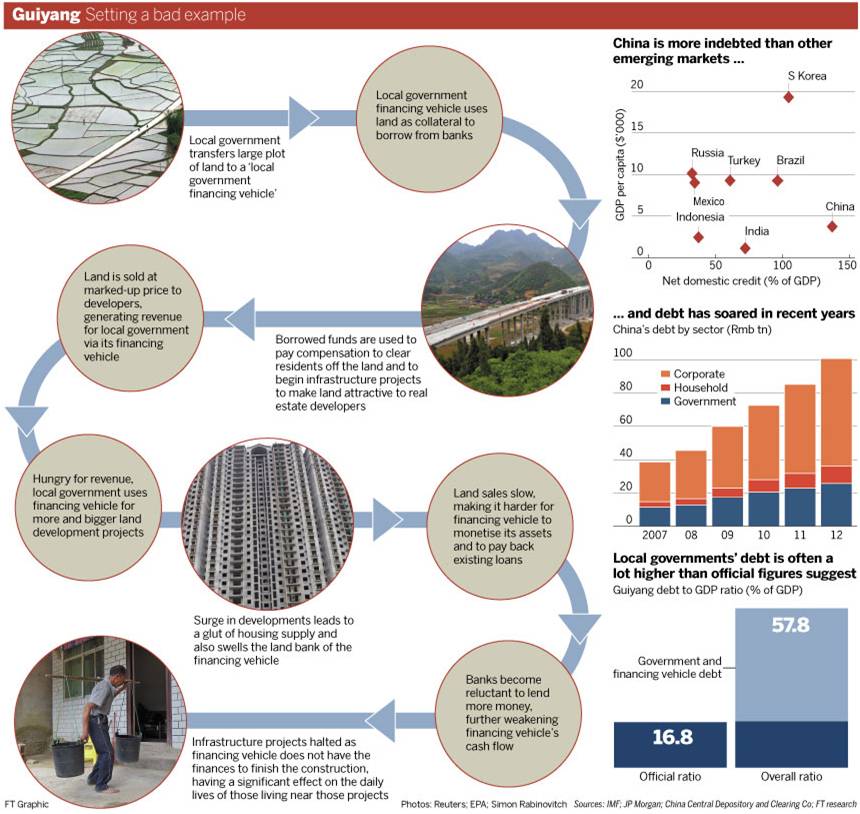
The Chinese government says its debt problem is under control, but the people of Pianpo village have cause to disagree. Over the past year they have seen their water cut off, rubbish pile up in the streets and their wages go unpaid as debt has mounted. An elevated motorway soars over the villagers’ concrete homes, meant to connect them to central Guiyang, one of China’s fastest-growing cities. Instead, the slip road to Pianpo ends in a patch of gravel. The state-owned company building the road took on too much debt and could not pay its construction workers. Water pipes were dismantled when the roadworks began but were never repaired when cash ran short. A couple of times a day, Chen Xiuxiang, 75, trudges up a hill to fetch his weight in water – 120 pounds – from a working tap, carrying two buckets on a wooden pole across his shoulders. Most of his neighbours do the same. “They keep promising they’ll fix things but they never do,” says Mr Chen. Read more of this post
Interest Costs Leave Companies With Less Cash to Invest; the Case of Shougang Group
TOM ORLIK
As worries over China’s debt problem mount, the burden of paying off those loans could be the trigger that tips runaway credit into slower economic growth and financial stress. Few areas illustrate the problems better than the old industrial sector, where state-owned steel plants and cement kilns continue to borrow and expand even as overcapacity grows. With debts high and profits low, some companies, such as state-owned steel giant Shougang Group, are using new loans to repay old ones, according to Dagong Global Credit Rating Co. Shougang Group declined to comment. Read more of this post
EVERY once in a while, my family will toss around ideas for potential inventions. Like my son’s ultimate alarm clock, which wakes you up, tells you the weather and makes tea and toast. None of us have ever gotten past the talking phase. But a lot of other people have. Last year, the United States Patent and Trademark Office reported that 1.5 million patent applications were pending, compared with around 269,000 in 1992. And the office issued around 270,000 patents in 2012, about 160,000 more than two decades before. It’s very easy to believe that a multimillion-dollar invention is just a twist of a screwdriver away. Listen to the seductive radio and television ads that promise to help your invention fly off the shelves. Watch reality television shows like “Shark Tank,” where contestants vie to get businesses to invest in their idea. Read more of this post
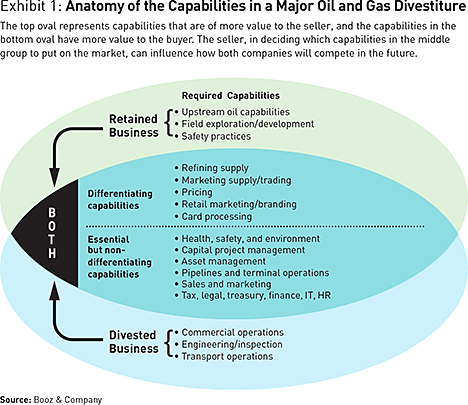
A major North American oil and gas company had formulated the straightforward part of a deal—deciding to sell one of its refineries and a group of its gas stations—a few months earlier. Now, as part of its business strategy in preparing these assets for sale, the company was diving into the details of divestiture, and the capabilities that would be affected by the deal. This exercise was going to be almost as complex as a typical merger or acquisition; certainly it would be more complex than the company’s leaders had expected. Read more of this post
H.E.R.O. stands for “Honorable. Exponential. Resilient. Organization.” and is operationalized into a unique, systematic 4-step investment process to identify the winners. The investment objective seeks to capture long-term investment returns created by disruptive forces and innovation by focusing on high-quality and liquid listed equities in the Asia-Pacific region that ride on and benefit from them. Through our cross-sector and in-depth fundamental research process, the Fund aim to provide access to companies whom we believe are run by high-integrity, honorable and far-sighted owner-operators with a higher sense of purpose in solving High-Value Problems for their target customers and society, and have unique, scalable and wide-moat business models with sustainable competitive advantages and innovative products, services, and processes to create, expand and service their total addressable market, including the resiliency and balance sheet strength to maintain or grow profitability, pricing power and market positions through up/downturns in the economy.