Travelocity Teams Up With Expedia to Power Searches; Rivals in Online Travel Industry Strike Long-Term Agreement

August 22, 2013, 8:19 p.m. ET

Travelocity Teams Up With Expedia to Power Searches

Rivals in Online Travel Industry Strike Long-Term Agreement

JACK NICAS And DREW FITZGERALD

Travelocity is teaming up with longtime rival Expedia Inc. EXPE +1.68% to power the core of its business: finding hotels and airfares. The two companies said Thursday that they are entering a long-term agreement under which Expedia will handle most of Travelocity’s operations, from running searches to answering customers’ questions to processing bookings. In turn, Travelocity will largely become a brand aimed at attracting customers to its website rather than a true travel agency. Read more of this post


The wristband that records everything you hear

The wristband that records everything you hear

If you have been whipped up into an angry frenzy by Google Glass, it’s probably best to look away now.

kapture_2650927b

The device is always on but can only store the last 60 seconds of sound

By Andrew Trotman

5:14PM BST 22 Aug 2013

Supporters of the search giant’s glasses that can make phone calls, give you directions as you walk and record video believe it will revolutionise the wearable technology sector. Those on the other side of the divide ask how non-users will be affected, with Senator Joe Barton even sending a letter to Google to voice his concern at possible invasions of privacy. Now there is a new product for Mr Barton to worry about. Kapture is planning to release a wristband later this year that can record every sound around you, which you can then share with the world. The device is always on but can only store the last 60 seconds of sound. The makers see it as a way of preserving those moments in life that are difficult to capture. Read more of this post

The Pentagon as Silicon Valley’s Incubator

August 22, 2013

The Pentagon as Silicon Valley’s Incubator

By SOMINI SENGUPTA

SAN FRANCISCO — In the ranks of technology incubator programs, there is AngelPad here in San Francisco and Y Combinator about 40 miles south in Mountain View. And then there is the Pentagon. In the last year, former Department of Defense and intelligence agency operatives have headed to Silicon Valley to create technology start-ups specializing in tools aimed at thwarting online threats. Frequent reports of cyberattacks have expanded the demand for security tools, in both the public and private sectors, and venture capital money has followed. In 2012, more than $1 billion in venture financing poured into security start-ups, more than double the amount in 2010, according to the National Venture Capital Association. Read more of this post

Tesla Aiming for China After Hundreds of Hong Kong Orders; “If you drive a Ferrari, people will give you a really nasty look. But if you drive an electric car, everybody’s going to be happy.”

Tesla Aiming for China After Hundreds of Hong Kong Orders

When Bem Ho discovered the minivan he drives doesn’t earn him much respect, he ordered a set of wheels that will turn more heads: a Model S electric sedan from Tesla Motors Inc. (TSLA) “I’m getting sick of driving my van because when people see the car they always think I’m a chauffeur,” said Ho, who runs an apparel manufacturer in Hong Kong. “It’ll be like a talking point when you go out: ‘Oh that’s an electric car.’”

Read more of this post

Technology companies fight for funds as venture capitalists look elsewhere; Investors reluctant to take further stakes in perceivedly volatile sector until earlier ventures such as Spotify start to pay off

Technology companies fight for funds as venture capitalists look elsewhere

Investors reluctant to take further stakes in perceivedly volatile sector until earlier ventures such as Spotify start to pay off

Jemima Kiss

The Guardian, Thursday 22 August 2013 21.35 BST

European technology companies are trapped in a funding bottleneck asventure capital firms refuse to reinvest in the sector until they see a return from earlier investments, such as music service Spotify, via successful stock market flotations. As US companies such as Twitter gear up for multibillion-dollar flotations, European venture capitalists say that they need to see share issues that will recoup their initial forays into the technology sector before seeking out the next Google. Read more of this post

Nokia’s dilemma is different now. Back then in early 1990s, the world was on the verge of a decade-long explosion in mobile phone use. This time, however, the company is coming at the tail-end of the smartphone boom

August 22, 2013 7:26 pm

Nokia: A bet with a safety net

By Richard Milne and Daniel Thomas

The ailing company is betting on a new smartphone but some believe salvation lies elsewhere

As Nokia was developing its latest smartphone, Stephen Elop came up with an unusual challenge for the engineers. Mr Elop, the Finnish company’s Canadian chief executive, would stand in the darkened corner of a room while the engineers stood on the other side, taking his picture. The goal? To see if they could produce a photograph sharp enough so that you could tell the time on his watch. Eventually they did. Read more of this post

Internet radio service Pandora: Sing a song of slumping shares

Pandora: Sing a song of slumping shares

8:43pm EDT

By Gerry Shih

SAN FRANCISCO (Reuters) – Internet radio service Pandora Media Inc (P.N: Quote, Profile, Research, Stock Buzz) said on Thursday that rising expenditures to acquire music and expand its sales force would push fiscal 2014 earnings below analyst expectations, and its shares slumped 5 percent. The company also backtracked on a 40-hour monthly limit on free music streaming that was announced just six months ago, a measure originally implemented to control rising costs. Pandora said it will lift the monthly cap September 1 after watching its margins improve. Read more of this post

How BlackBerry Handled Past Wealth: As the company’s fortunes spiral down, a look back shows little reward for loyal shareholders even in its heyday. But executives did well

August 22, 2013

How BlackBerry Handled Past Wealth

By FLOYD NORRIS

23norris-webgraphic-articleInline

It started in an unlikely place, far from the headquarters of more established technology companies, and grew to become a dominant player. Along the way, investors piled in, undeterred by the company’s policy of never paying a dividend. But then the technology changed, and the company struggled to keep up. Eventually it realized it could not continue as it was. It was broken up and acquired, with investors receiving a fraction of what their shares had been worth at the peak. Read more of this post

How binge viewing of Netflix’s original series might end up accelerating expenditures

How Binge-Viewing Could Rock Netflix Stock

AUGUST 22, 2013 | 09:00AM PT

Binge viewing of original series might end up accelerating expenditures

Andrew Wallenstein

Binge-viewing may lead to binge-spending at Netflix, which could eventually see the impact in its stock price. What went unmentioned among the myriad issues its top execs addressed when the streaming service announced its second quarter earnings last month was a potentially significant shift in accounting practices hinted at in the company’s 10-Q. “We are in the early stages of original content, and continue to monitor whether the viewing pattern is higher than initially expected in the first few months to suggest that we amortize at a faster initial rate,” the disclosure read. Read more of this post

Apple Engineers Want Out, Say Recruiters; “Apple culture has started to change with the new leadership on top.”

Apple Engineers Want Out, Say Recruiters

NICHOLAS CARLSON AUG. 22, 2013, 10:26 AM 8,438 9

Silicon Valley recruiters and former Apple employees say Apple hardware engineers are sending out more resumes than ever before, according to Reuters reporters Porrnima Gupta and Peter Henderson. The reason: under CEO Tim Cook, Apple is not the company it used to be under Steve Jobs. One “recruiter with ties to Apple” told Gupta and Henderson, “I am being inundated by LinkedIn messages and emails both by people who I never imagined would leave Apple and by people who have been at Apple for a year, and who joined expecting something different than what they encountered.” Read more of this post

3-D printer company MakerBot Reaches for the Masses with $1,400 Digitizer; designing new objects can require specialized skills in 3-D modeling or engineering, which can be a barrier for novices

AUGUST 22, 2013, 3:12 PM

A 3-D Scanner Reaches for the Masses

By AMY O’LEARY

The 3-D printer company MakerBot on Thursday entered the new market for scanning, introducing a desktop device called the Digitizer that could help push more of the public into 3-D printing. The $1,400 Digitizer looks a little like a classic record player, but with lasers. It rotates small objects on a turntable near two lasers and a camera to create a three-dimensional model that can then be reproduced by a 3-D printer. Read more of this post

Translating Cookpad, Japan’s top cooking and recipe-sharing site with 20 million users, including 80-90% of all Jap women in their 20s and 30s, and more than 1.5 million registered recipes

Translating Japan’s top cooking site

BY MAKIKO ITOH

AUG 22, 2013

fg20130823mia-870x641

The Internet isn’t all kitten videos and saucy stuff, you know. In Japan, food and cooking makes up a large part of the Net — and recipe-sharing site Cookpad is its biggest juggernaut. With 20 million users — including an astonishing 80 to 90 percent of all Japanese women in their 20s and 30s — and more than 1.5 million registered recipes, it’s the go-to source for Japanese home cooks. Earlier this month it launched an English-language website (en.cookpad.com), a pared-down version with around 1,600 recipes initially translated from the mother site; this number is promised to grow to at least 30,000. I’ve been involved in working on several of the translations myself. Read more of this post

Lee Kai-Fu, China’s Innovation Idol

Lee Kai-Fu, China’s Innovation Idol

By Lauren Hilgers on August 22, 2013

feat_china35__01__304

Lee Kai-Fu, China’s foremost evangelist for innovation, works on the 12th floor of a Beijing office building with a sprawling electronics mall in the basement. On a hot, gray summer day, the view outside his window is anything but inspiring. That doesn’t seem to bother Lee, who’s thinking about Steve Jobs. “One would believe, because China has four times as many people as the U.S., for every American Steve Jobs, China should have four,” he says as he fixes his wire-rimmed glasses. “But we don’t. We don’t have a single Steve Jobs.”

Read more of this post

Apple’s Falling China Share Vexes IPhone Case Makers; “Apple has no fresh ideas, no new designs. The market changes very quickly. If you don’t change, you will die.”

Apple’s Falling China Share Vexes IPhone Case Makers

Apple Inc. (AAPL)’s falling market share in China is prompting thousands of local accessory makers to give more attention to products that fit mobile phones and tablet computers made by Samsung Electronics Co. (005930) and domestic rivals.

A shift to devices from Samsung, Lenovo Group Ltd. (992) and a widening array of Chinese makers offering cheaper handsets is pushing up costs for those that previously relied on the iPad and iPhone, said Vincent Kwok, chief executive officer of Guangzhou-based Magic Kingdom, a maker of protective cases. Read more of this post

Alibaba vs. Tencent: China’s Growing Internet Turf War

Alibaba vs. Tencent: China’s Growing Internet Turf War

By Lulu Yilun Chen on August 22, 2013

Two of China’s richest men are intensifying their rivalry in the world’s biggest Internet market. The country’s largest e-commerce company, Alibaba Group Holding, led by Executive Chairman Jack Ma, is under assault from top Internet player Tencent Holdings (700:HK), chaired by Pony Ma. (The two aren’t related.) Tencent, a megaportal and China’s version of AOL (AOL), got a jump on Alibaba in mobile apps. Its chat software WeChat, released two years ago, has more than 300 million users—eclipsing the mobile app of Sina Weibo, a Twitter-like microblogging site in which Alibaba bought a stake in April. Now Tencent is trying to expand into the kind of fee-generating online payment services Alibaba dominates. Read more of this post

‘Jurassic Park 3D’ Opens No. 1 in China

August 21, 2013, 7:49 PM

‘Jurassic Park 3D’ Opens No. 1 in China

By Alexandra Cheney

OB-YP902_jp_E_20130821192055

“Jurassic Park” (1993)

“Jurassic Park 3D,” the re-release of the 1993 science-fiction film from Steven Spielberg, debuted Tuesday in China at No. 1. The film, which brought in $6.3 million from 2,500 screens, marks the fourth-highest opening day of the year in China. “Iron Man 3” ($19.1 million), “Pacific Rim,” ($8.6 million) and “Fast and Furious 6,” ($8.3 million) are ahead of the dinosaur re-release, while “Man of Steel” ($6.2 million) and “The Hobbit” ($5.6 million) trail the 20-year old Universal Studios film. The film has grossed more than $45.4 million domestically since it was re-released in 3D in April, and more than $20.7 million internationally. “Jurassic Park 3D” will open this weekend in Panama, Mexico, Spain, Ireland and the United Kingdom. When the film originally premiered in 1993, it grossed $970 million worldwide, overtaking “E.T. The Extra-Terrestrial” as the highest-grossing film at that time. This is the first time the film is being shown in China, a country with proven success in 3D conversions. In 2012, “Titanic 3D” grossed $11.2 million opening weekend and took in a total of $150.2 million there.

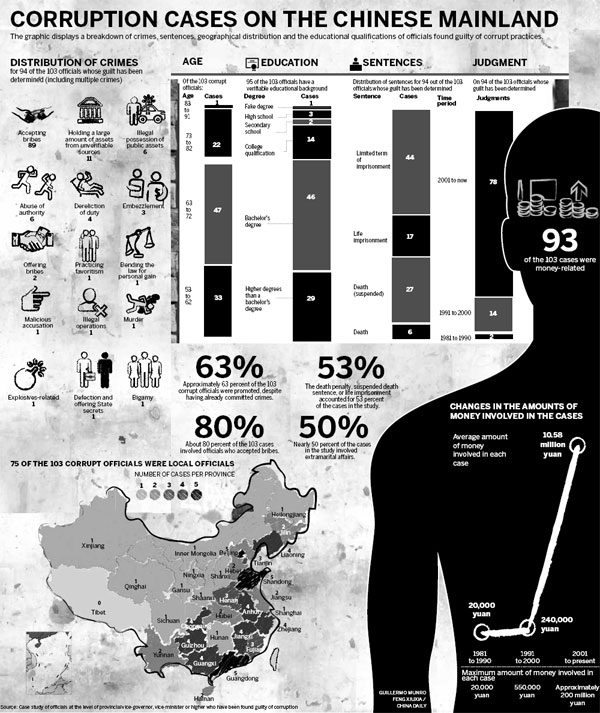
New study reveals corruption pattern in China

New study reveals corruption pattern

Updated: 2013-08-22 07:41

By Tang Yue, Zhang Yuchen and Wu Wencong ( China Daily)

Many fallen officials had occupied high-level posts, report Tang Yue, Zhang Yuchen and Wu Wencong.

02587d4d8601137f9e2a2b Read more of this post

or Banks, the Chinese ‘Princeling’ Stock Has Fallen; Drought in IPO Market Curbs Need for Elite Connections

August 22, 2013, 11:46 a.m. ET

For Banks, the Chinese ‘Princeling’ Stock Has Fallen

Drought in IPO Market Curbs Need for Elite Connections

WEI GU

AM-AZ946_WEICOL_G_20130822113605

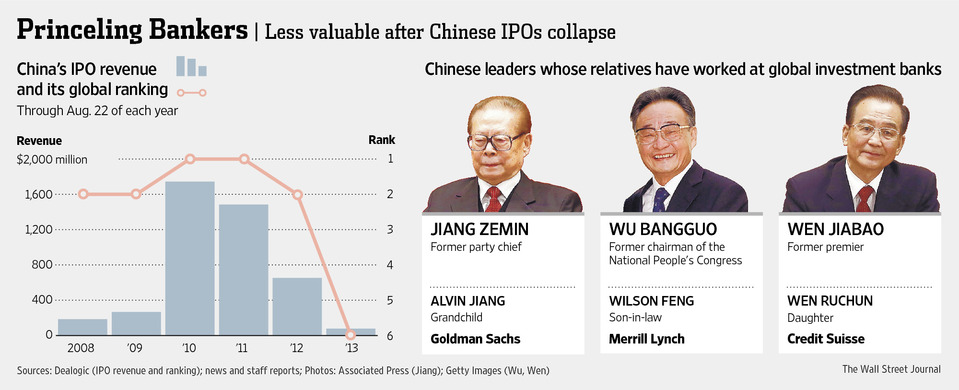
The great irony of the U.S. government’s investigation into the hiring of Chinese princelings by J.P. Morgan Chase JPM +1.12% & Co. is that right now, the children of China’s elite aren’t that valuable to the big investment banks. China’s state-owned companies, where the princelings could help the most, are far less important to the banks than they were when there was a steady parade of multibillion-dollar initial public offerings. Recently, China has suffered an IPO drought. Read more of this post

Correlations: East Asia Grows Older, Faster

Correlations: East Asia Grows Older, Faster

By Evan Applegate on August 22, 2013

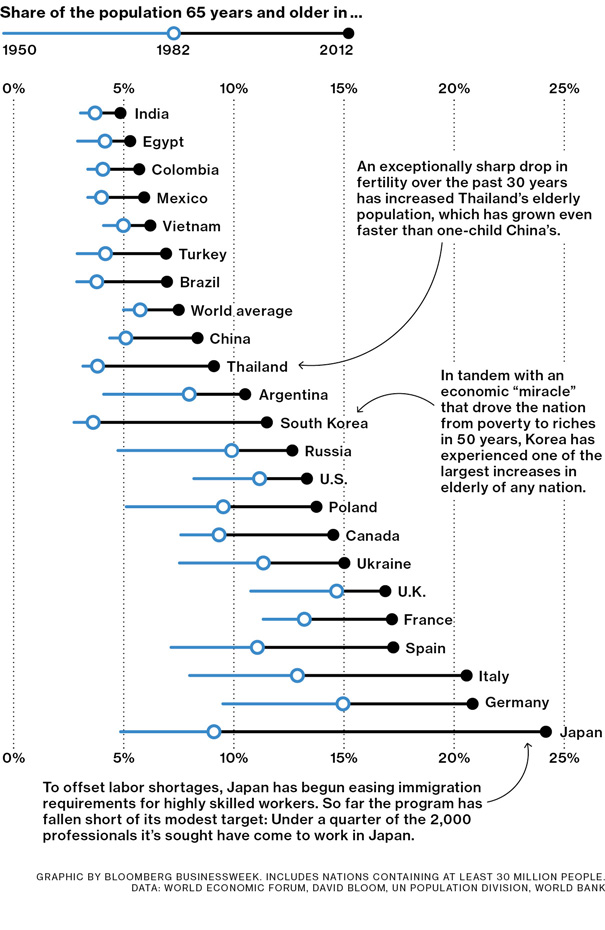
East Asia’s “tiger” economies, once home to a big supply of young labor, are seeing the fastest rise worldwide in the percentage of their elderly population. Is a grayer nation destined for decline? Harvard economist David Bloom says such fears may be overblown, if the developed world is a template. Labor force participation among older citizens has actually risen in Organisation for Economic Co-operation and Development nations, increasing the supply of productive workers.

econ_correlations35_605

India’s Problem Is Exports, Not the Rupee

India’s Problem Is Exports, Not the Rupee

King Canute had it easy. Indian Finance Minister Palaniappan Chidambaram has battled currency markets for two months, trying to stem the collapse of the Indian rupee from 55 to a dollar in May to 65 this week. He has found commanding currency markets even harder than commanding the ocean waves.

He should stop trying. A weaker rupee is not inherently a terrible thing. Rather than frantically shoring up the currency, Chidambaram should target the structural impediments in the economy that have caused both Indian and foreign investors to lose faith in the once-glowing India story. Read more of this post

Crashing markets spell trouble for India’s privatization plans

Crashing markets spell trouble for India’s privatization plans

5:50pm EDT

By Manoj Kumar and Rajesh Kumar Singh

NEW DELHI (Reuters) – The collapse of the rupee is derailing India’s hopes of raising more than $6 billion from the sale of stakes in state-run firms, jeopardizing a key plank of Finance Minister P.Chidambaram’s blueprint to reverse the country’s economic malaise. Investor confidence has evaporated amid fears over the rising cost of funding India’s gaping current account deficit, prompting New Delhi to delay plans to raise much-needed funds through partial privatizations, finance ministry sources said. Read more of this post

Doctors Face New Scrutiny Over Gifts; New Health Law Calls for Increased Disclosures

August 22, 2013, 7:57 p.m. ET

Doctors Face New Scrutiny Over Gifts

New Health Law Calls for Increased Disclosures

PETER LOFTUS

U.S. doctors are bracing for increased public scrutiny of the payments and gifts they receive from pharmaceutical and medical-device companies as a result of the new health law.

Starting this month, companies must record nearly every transaction with doctors—from sales reps bearing pizza to compensation for expert advice on research—to comply with the so-called Sunshine Act provision of the U.S. health-care overhaul. The companies must report data on individual doctors and how much they received to a federal health agency, which will post it on a searchable, public website beginning September 2014. Read more of this post

Why the U.S. Power Grid’s Days Are Numbered; 3,200 utilities that make up the U.S. electrical grid sell $400 billion worth of electricity a year

Why the U.S. Power Grid’s Days Are Numbered

By Chris Martin, Mark Chediak, and Ken Wells on August 22, 2013

http://www.businessweek.com/articles/2013-08-22/homegrown-green-energy-is-making-power-utilities-irrelevant

There are 3,200 utilities that make up the U.S. electrical grid, the largest machine in the world. These power companies sell $400 billion worth of electricity a year, mostly derived from burning fossil fuels in centralized stations and distributed over 2.7 million miles of power lines. Regulators set rates; utilities get guaranteed returns; investors get sure-thing dividends. It’s a model that hasn’t changed much since Thomas Edison invented the light bulb. And it’s doomed to obsolescence. Read more of this post

London’s Savile Row Tailors Strive to Stay a Cut Above

London’s Savile Row Tailors Strive to Stay a Cut Above

By Sarah Shannon on August 22, 2013

comp_savilemap35_405

Visitors to 10 Savile Row in London are greeted by photographs of the current Sultan of Oman in full military regalia. Deeper inside the shop of tailor Dege & Skinner, above a rack of silk handkerchiefs, hangs a smaller picture of Prince William. There’s a reason for the sultan’s exalted status: Half of Dege & Skinner’s revenue comes from outside the U.K., and that share is growing. Read more of this post

A Century of International Potash Intrigue

A Century of International Potash Intrigue

In case you didn’t notice, the world’s potash markets went haywire last week, after the announcement that Russia’s OAO Uralkali, the world’s largest producer of this crucial ingredient in fertilizer, suspended its participation in an alleged cartel with its long-time Belarus partner Belaruskali. Their joint marketing venture, the Belarusian Potash Co., produced at its peak 40 percent of the world’s potash, with much of the balance coming from Canpotex Ltd., another syndicate based in North America. Together these two set production quotas and divided global markets, ensuring stable prices and steady profits. Read more of this post

Indonesia: A rise in economic nationalism compounds broader worries about South-East Asia’s giant

A rise in economic nationalism compounds broader worries about South-East Asia’s giant

Aug 24th 2013 | JAKARTA |From the print edition

HOW quickly the mood can turn. Barely a year ago Indonesia was the toast of emerging-market investors. The country revelled in the world’s demand for its vast reserves of coal, oil and other resources, and celebrated with a consumer boom: economic growth clipped along at over 6%. Politics was stable, macroeconomic policy sound. Foreign investors were scrabbling to get into a market of 240m people and apparently boundless potential. Read more of this post

Indonesia to See Big Growth in Digital Media: PwC

Indonesia to See Big Growth in Digital Media: PwC

By Jakarta Globe on 9:24 am August 23, 2013.
With increasing access to the Internet and an explosive growth in mobile devices and entertainment, most notably in the BRIC countries, businesses must engage in constant innovation in order to keep pace with evolving markets, PricewaterhouseCooper projected on Thursday. In its annual Global Entertainment and Media Outlook 2013-2017, PwC said that growth in the industry will come from spending on digitally delivered media in the next five years, although most spending will continue to be on on-digital media. Read more of this post

In Indonesia, buzzers are not heard, but tweet for money

In Indonesia, buzzers are not heard, but tweet for money

5:43pm EDT

By Andjarsari Paramaditha

JAKARTA (Reuters) – In Indonesia’s capital Jakarta, a buzzer is not an alarm or a bell, but someone with a Twitter account and more than 2,000 followers who is paid to tweet. Jakarta is the world’s tweet capital and advertisers eager to reach the under-30 crowd are paying popular Twitter users to spread their word through social media, starting at about $21 per tweet. While celebrity endorsements via Twitter are common worldwide, Indonesia is unusual because advertisers are paying the Average Joes too. Read more of this post

Taiwan Data Reflects Decoupling from U.S.; “Demand from the U.S. is actually stabilizing, but that’s not seen in Taiwan’s exports. It has to do with the competitiveness of products from Taiwan.”

August 23, 2013, 2:03 AM

Taiwan Data Reflects Decoupling from U.S.

By Aries Poon

Gone are the days when Taiwan’s trade and production data acted as a barometer of the health of developed economies, particularly the U.S. Last year, as the U.S. economy expanded 2.8%, Taiwan’s exports to the U.S. dropped 9.3%. In the first seven months of this year the island’s exports to the U.S. were off 1.1% from a year earlier, despite the quickening U.S. recovery.

Read more of this post

Israel Struggles With Upgrade From Emerging to Developed Market

Israel Struggles With Upgrade From Emerging to Developed Market

By Shoshanna Solomon on August 22, 2013

mf_telaviv35_405_inline

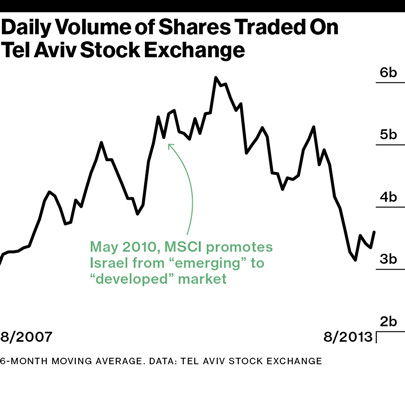
In the minds of many investors, Israel left the ranks of emerging markets in 2010. In May of that year, MSCI (MSCI), the New York-based firm that builds popular investing indexes, added the country to its benchmark of developed nations. The promotion was a sign of Israel’s success: Its economy had recovered from the financial crisis faster than most advanced nations, and foreign money was pouring into its stock market. In 2009, Israel’s benchmark TA-25 stock index gained 75 percent. “We’re playing with the big boys now,” said Ester Levanon, then the chief executive officer of the Tel Aviv Stock Exchange (TASE), after winning MSCI’s approval. Read more of this post