Currency Volatility in Emerging Market Is Unnerving Investors

AUGUST 20, 2013, 9:02 PM

Currency Volatility Is Unnerving Investors

By NATHANIEL POPPER

Lawmakers and central bankers in India, Indonesia, Turkey and several emerging-market economies are scrambling to contain the damage from falling currencies and to keep foreign investors from heading for the exits. Money has poured out of those economies over the last few weeks, pushing down the prices of a wide array of assets, including stocks, bonds and currencies. On Tuesday, the Indian rupee fell to a record low against the dollar, while the Indonesian rupiah dropped to its lowest level against the dollar since 2009. Read more of this post

If iTunes Radio won’t be profitable, what’s the point? Apple’s move into Internet radio isn’t really about Internet radio at all. Instead, it’s about keeping its users from other Internet radio products

If iTunes Radio won’t be profitable, what’s the point?

Diane Bullock, Minyanville11:10 a.m. EDT August 21, 2013

Apple’s move into Internet radio isn’t really about Internet radio at all.

When Apple got into the music business in April 2003, the company didn’t actually expect to make money at it. The iTunes store launched with only “break-even” ambition as far as Cupertino was concerned, merely acting as a hook for the real profit center: The iPod. So much for self-fulfilling prophecies. Five years in, iTunes had unseated Wal-Mart as the country’s leading music vendor and assumed the top spot in the global market by 2010. Last year’s sales hit $13.5 billion, with Apple generating up to 15% operating margin on gross revenue while commanding 64% of the world’s online music sales. Read more of this post

Disney to Shutter 10-Year-Old Toontown Multiplayer Game to shifts resources toward the larger Club Penguin and to mobile games; The change leaves Club Penguin as the only so-called virtual world operated by Disney

Disney to Shutter 10-Year-Old Toontown Multiplayer Game

Walt Disney Co. (DIS) will close its Toontown Online video game for kids after 10 years, as the company’s interactive unit shifts resources toward the larger Club Penguin and to mobile games.

Toontown, in which monthly members form teams to fight evil robots, will stop operating on Sept. 19, according to its website. The game made its debut in June 2003 and Disney has said it was the first massively multiplayer online game designed for kids and families. Read more of this post

DeNA, Gree Slump as Gamemakers Team Up on Marketing; the alliance will allow the companies to bypass platforms such as DeNA’s Mobage and Gree

DeNA, Gree Slump as Gamemakers Team Up on Marketing: Tokyo Mover

DeNA Co. (2432) and Gree Inc. (3632), Japan’s biggest social-game operators, slumped in Tokyo trading after gamemakers led by Sega Sammy Holdings Inc. (6460) said they would team up to promote each other’s titles for smartphones. DeNA, operator of the Mobage network, plunged as much as 9.3 percent to 1,924 yen, headed for the biggest decline in more than three months. Gree dropped as much as 7.5 percent. Sega, creator of Sonic the Hedgehog, developed a system to allow makers including Capcom Co. (9697) and Taito Corp. to display advertising of mobile app games by other members, Koji Ueda, a Sega spokesman, said by phone today. The Nikkei newspaper earlier today reported the alliance will allow the companies to bypass platforms such as DeNA’s Mobage and Gree. Gamemakers pay a commission to companies such as Gree and DeNA for games accessed through their platforms. “Overall, we view this as negative” for Gree and DeNA, David Gibson, a Tokyo-based analyst at Macquarie Group Ltd., said in a note today. “Developers continue to shift their resources away and not use recently launched app marketing initiatives announced by Gree/DeNA.” DeNA traded at 1,949 yen, down by 8.1 percent, as of 1:14 p.m. in Tokyo, extending its drop this year to 31 percent. Gree traded at 838 yen and has lost 37 percent this year, compared with a 30 percent advance for the broader Topix index.

To contact the reporter on this story: Naoko Fujimura in Tokyo at nfujimura@bloomberg.net
Japan’s nuclear crisis deepens, China expresses ‘shock’

Japan’s nuclear crisis deepens, China expresses ‘shock’

6:25am EDT

By Kiyoshi Takenaka and James Topham

TOKYO (Reuters) – Japan’s nuclear crisis escalated to its worst level since a massive earthquake and tsunami crippled the Fukushima plant more than two years ago, with the country’s nuclear watchdog saying it feared more storage tanks were leaking contaminated water.

The U.N.’s International Atomic Energy Agency (IAEA) said on Wednesday it viewed the situation at Fukushima “seriously” and was ready to help if called upon, while nearby China said it was “shocked” to hear contaminated water was still leaking from the plant, and urged Japan to provide information “in a timely, thorough and accurate way”. Read more of this post

A U.S. manufacturing comeback won’t rebuild the middle class

A U.S. manufacturing comeback won’t rebuild the middle class

By Nin-Hai Tseng, Writer August 21, 2013: 5:00 AM ET

Cheaper labor may bring about more jobs, but workers have less spending power.

FORTUNE — There’s been some good news lately about U.S. manufacturing — that sector of American industry once considered vital to the growth of the nation’s middle class. It’s well known manufacturing has been declining for decades, but experts, and some across corporate America, have been saying that many factors signal that factory jobs that have gone to China and other parts of the world are returning. Read more of this post

Should India be “investment grade?”

Should India be “investment grade?”

By Heather Timmons 2 hours ago

For more than a year, India has been teetering on the edge of a credit rating agency cliff: The country’s sovereign credit rating, a measure of its overall political and economic stability, is rated just one notch above “junk” by Fitch, Standard & Poor’s and Moody’s.

Surprisingly, the country has not yet fallen over that edge. Rating agencies are notoriously unreliable when it comes to judging the actual worthiness of a company, country or financial asset, and their performance in the run up to the subprime mortgage crisis (and subsequent testimony in the lawsuits afterward) has seriously undercut their reputations as objective advisors. Read more of this post

India Borrowing Costs at 2001 High Threaten Singh Goal

India Borrowing Costs at 2001 High Threaten Singh Goal

A surge in Indian sovereign debt costs to a 12-year high this week is threatening Prime Minister Manmohan Singh’s plan to cut the budget deficit and fueling the fastest surge in credit risk since 2008.

Ten-year (GIND10YR) yields rose 72 basis points this month through yesterday to 8.92 percent, the most among 14 regional markets tracked by Bloomberg, touched the highest level since 2001 of 9.48 percent. They plunged 57 basis points today after the Reserve Bank of India said late yesterday it will buy long-dated notes via open-market auctions. Government debt in Indonesia added 68 basis points to 8.39 percent. Read more of this post

Plunging Rupiah Spurs Yudhoyono Into Action With Policy Plans

Plunging Rupiah Spurs Yudhoyono Into Action With Policy Plans

Indonesian President Susilo Bambang Yudhoyono will announce measures on Friday to deal with a slowing economy and a currency that’s fallen to a four-year low. The government will draft a package of policies, and the rupiah’s plunge is the main problem to be tackled, Yudhoyono told reporters in Jakarta today. It will be difficult to reach a target of 6.3 percent expansion by relying on investment as exports decline, he said.

The move comes after Yudhoyono, due to hand over power in elections next year, gave a favorable assessment of his economic record in two speeches on Aug. 16. Since then, central bank data showed the current-account deficit widened to a record in the second quarter, the rupiah fell 3.6 percent and the Jakarta Composite index of shares slid 7.7 percent this week. Growth has slowed for the last four quarters, dipping below 6 percent in the three months through June for the first time since 2010. Read more of this post

Thailand Holds Rate as Rising Debt Curbs Room to Aid Economy

Thailand Holds Rate as Rising Debt Curbs Room to Aid Economy

Thailand kept its benchmark interest rate unchanged for a second straight meeting as rising household debt and capital outflows reduce scope for monetary easing to revive an economy in recession.

The Bank of Thailand held its one-day bond repurchase rate at 2.5 percent, with policy committee members voting six to one for the decision, it said in Bangkok today. Nineteen of 20 economists in a Bloomberg News survey predicted the outcome, while one saw a reduction to 2.25 percent as an economic contraction last quarter added to signs of a regional weakening. Read more of this post

Malaysia’s Central Bank Trims 2013 Forecast; Data From Malaysia Underscores Fragile Growth Prospects in Southeast Asia

Updated August 21, 2013, 10:29 a.m. ET

Malaysia’s Central Bank Trims 2013 Forecast

Data From Malaysia Underscores Fragile Growth Prospects in Southeast Asia

ABHRAJIT GANGOPADHYAY

KUALA LUMPUR—Slowing growth and a dwindling current-account surplus are adding to market concerns about Malaysia when capital is flowing quickly out of the region. The central bank on Wednesday cut Malaysia’s full-year growth outlook, citing weak external demand as gross domestic product grew 4.3% in the second quarter from a year earlier, short of market expectations for a 4.7% rise. Bank Negara Malaysia projected the economy would grow 4.5%-5.0% in 2013, down from 5.0%-6.0% previously. GDP grew 4.1% in the first quarter on a seasonally adjusted basis. The cut to the central bank’s forecast “is perhaps a pre-emptive step to tamp down market expectation,” said Rahul Bajoria, an economist at Barclay’s Capital. Read more of this post

Cheaper rivals eat into Apple’s China tablet share; A principal factor in the rise of Android tablets has been the falling price of components

August 21, 2013 11:09 am

Cheaper rivals eat into Apple’s China tablet share

By Kathrin Hille in Beijing and Sarah Mishkin in Hong Kong

Apple has lost more than 40 per cent of its share of the Chinese tablet market over the past year to cheaper rivals led by Samsung Electronics, as devices based on Google’s Android and other operating systems rapidly overtake the US company’s gadgets. In the second quarter, Apple shipped 1.48m iPads in China, 28 per cent of the tablets shipped in that market, according to research firm IDC. This was down from a 49 per cent market share a year ago. Samsung shipped 571,000, or 11 per cent of the total, in the second quarter of this year. The data echo statistics showing Apple is losing ground in the tablet market worldwide. Apple’s global tablet market share dropped to 32.4 per cent in the second quarter from 60.3 per cent a year earlier, IDC said earlier in August. Read more of this post

Entrepreneurial Exits and Innovation

Entrepreneurial Exits and Innovation

Vikas A. Aggarwal INSEAD – Entrepreneurship and Family Enterprise

David H. Hsu University of Pennsylvania – Management Department

August 5, 2013
INSEAD Working Paper No. 2013/89/EFE/ACGRE

Abstract: 
We examine how IPOs and acquisitions affect entrepreneurial innovation as measured by patent counts and forward patent citations. We construct a firm-year panel dataset of all venture capital-backed biotechnology firms founded between 198’22’008 tracked yearly through 2006. We address the possibility of unobserved self-selection into exit mode by using coarsened exact matching (CEM), and in two additional ways: (1) comparing firms that filed for an IPO (or announced a merger) with those not completing the transaction for reasons unrelated to innovation, and (2) using an instrumental variables approach. We find that innovation quality is highest under private ownership and lowest under public ownership, with acquisition intermediate between the two. Together with a set of within-exit mode analyses, these results are consistent with the proposition that information confidentiality mechanisms shape innovation outcomes. The results are not explained by inventor-level turnover following exit events or by firms’ pre-exit window dressing behavior.

Buying to Sell: Private Equity Buyouts and Industrial Restructuring

Buying to Sell: Private Equity Buyouts and Industrial Restructuring

Pehr-Johan Norback Research Institute of Industrial Economics (IFN)

Lars Persson Research Institute of Industrial Economics (IFN); Centre for Economic Policy Research (CEPR)

Joacim Tag Research Institute of Industrial Economics (IFN)

July 29, 2013
CESifo Working Paper Series No. 4338

Abstract: 
We show how temporary ownership by private equity firms affects industry structure, competition and welfare. Temporary ownership leads to strong investment incentives because equilibrium resale prices are determined by buyers incentives to block rivals from obtaining assets. These incentives benefit consumers, but harm rivals in the industry. Evaluating optimal antitrust policy, we underscore that an active private equity market can aid antitrust authorities by triggering welfare-enhancing mergers and by preventing concentration in the industry. By spreading the cost of specializing in restructuring over multiple markets, private equity firms have stronger incentives than incumbents to invest in acquiring specialized restructuring skills.

Berkshire Hathaway Embracing Media? An Asian Perspective. Bamboo Innovator is featured in BeyondProxy.com, where value investing lives

Bamboo Innovator is featured in BeyondProxy.com, where value investing lives:

  • Berkshire Hathaway Embracing Media? An Asian Perspective, Aug 21, 2013 (BeyondProxy)

Berkshire Media


Why ‘Overlearning’ Is The Key To Ridiculous Success

Why ‘Overlearning’ Is The Key To Ridiculous Success

ANNIE MURPHY PAUL, THE BRILLIANT BLOG AUG. 19, 2013, 5:10 PM 4,336 2

“Why do I have to keep practicing? I know it already!”

That’s the familiar wail of a child seated at the piano or in front of the multiplication table (or, for that matter, of an adult taking a tennis lesson). Cognitive science has a persuasive retort: We don’t just need to learn a task in order to perform it well; we need to overlearn it. Decades of research have shown that superior performance requires practicing beyond the point of mastery. The perfect execution of a piano sonata or a tennis serve doesn’t mark the end of practice; it signals that the crucial part of the session is just getting underway. Read more of this post

Su Yongle, one of the creators and an angel investor in one of China’s most popular animated series, Pleasant Goat and Big Big Wolf, has lost interest in the Pleasant Goat brand and is now looking to invest in the field of online education

Pleasant Goat creator to move on to pastures new

Staff Reporter

2013-08-21

13bl1pn201751937

Su Yongle, one of the creators and an angel investor in one of China’s most popular animated series, Pleasant Goat and Big Big Wolf, has lost interest in the Pleasant Goat brand and is now looking to invest in the field of online education, selling part of his holdings for an estimated HK$17 million (US$2.2 million), reports the Chinese-language Chinese Entrepreneur magazine. An angel investor is an individual who provides capital for a business startup, usually in exchange for convertible debt or ownership equity. Su initially invested 3 million yuan (US$490,000) in making animated films before he created CPE Culture Communication Co. When Wong Wai Ming, former chief director of the series, began to establish the cartoon, Su decided to mass produce the series with the aim of seeing Pleasant Goat on TV screens throughout the country. In July 2005, Pleasant Goat made its debut in Hangzhou and was broadcast on the Zhejiang TV station before finally being broadcast nationwide. Guided by Su and Wong, more than 500 episodes of Pleasant Goat were produced by 2008. Read more of this post

Sometimes the best that a company can hope for is death; Failed businesses are seen as victims of errors rather than as having simply run their course

August 20, 2013 5:52 pm

Sometimes the best that a company can hope for is death

By John Kay

Failed businesses are seen as victims of errors rather than as having simply run their course

The Financial Times has carried an unusual number of obituaries and stories of terminal illness this summer. There was the bankruptcy of Detroit and the slide into administration of once-ubiquitous companies, such as Jessops, the high-street camera retailer. Then there was last week’s announcement of the continuing troubles of BlackBerry, which made the defining business product of the first decade of the 21st century. Humans have always found it hard to cope with the idea that every individual has a lifespan even as life itself goes on. The idea of a natural life cycle for a business, or industrial centre, is even more difficult to accept. So we ask: what can be done to revive Detroit? Can BlackBerry find a new role? Read more of this post

Bugaboo: the pull of a cool pushchair

August 20, 2013 5:09 pm

Bugaboo: the pull of a cool pushchair

By Emma Jacobs

max-barenbrug-nico-moolen-001

Bugaboo founder Max Barenbrug, left, and chief executive Nico Moolenaar. Photographer: Paul O’Driscoll. Man with a pram plan: Max Barenbrug wants substance not hype to be the reason a Bugaboo is bought by parents

O n Fridays, Max Barenbrug, co-founder of Bugaboo, the maker of expensive statement strollers and prams used by Elton John, Madonna and reportedly the Duchess of Cambridge, is found at home. This time is earmarked for his two children but as they are aged 10 and 11, for the most part they are at school and he is on his own. “At home I am totally Max, which is sitting silently and thinking. I like to be alone. When I am with the children I ask the girls, ‘do your thing, don’t bother me’.” The childcare strategy allows him freedom to ponder. “I don’t like to work extremely hard. I have never worked extremely hard.” Which is a rare statement from an entrepreneur. His philosophy is that products are “1 per cent inspiration and 99 per cent transpiration. Transpiration can be outsourced, inspiration is where you make a difference and I focus on that. An idea should be in the head as long as possible.” Read more of this post

How French Brand Vilebrequin Cornered The Market For $200 Swim Trunks

How French Brand Vilebrequin Cornered The Market For $200 Swim Trunks

ROBIN MELLERY-PLATT, THE BUSINESS OF FASHION AUG. 20, 2013, 7:04 PM 1,394

vilebrequin

SAINT-TROPEZ, France — Winding down the Corniche, one of Europe’s most breath-taking roads, and descending into Saint-Tropez from the direction of Monte Carlo, the super-yachts cruising the bay below look like nothing more than polished toys, discarded in a child’s paddling pool. Henri Matisse, the most renowned Tropezian artiste en résidence, would have enjoyed the view at Le Byblos’ palette-shaped pool. Under the hotel’s terracotta and sand façades, swimsuits printed with colourful turtles, palm trees and maritime themes are everywhere. Almost every male guest is part of the riot. Read more of this post

Thiel Fellow Launches A Topical Energy Spray For Absorbing Caffeine Through Your Skin

Founders Who Can’t Handle A Full Cup Of Coffee Want Everyone To Start Spraying On Caffeine Instead

ALYSON SHONTELL AUG. 20, 2013, 6:12 PM 1,479 2

In case you don’t like drinking, eating or inhaling caffeine, two founders going through investor Peter Thiel’s fellow program are creating another way to energize you. Ben Yu and Devon Soni have launched a campaign on crowdfunding platform Indiegogo for a product called Sprayable Energy. It’s an unscented, colorless formula that can be sprayed on skin, kind of like sunless tanner. It contains water, a derivative of the amino acid tyrosine, and caffeine. Four sprays equal one cup of coffee, the founders say, and each little bottle has up to 160 squirts.  The founders say they’ve “struggled with caffeine sensitivity” and the product they’re perfecting will give energy without the jitters. They also say Sprayable Energy users won’t experience a caffeine crash later in the day. Yu and Soni are seeking a modest amount, $15,000, to bring their idea to life. They’ve already raised more than $11,000 to tackle what they say is a $45 billion market. It’s worth noting that the a number of innovative ways to shoot caffeine into your system have been blocked. Perky Jerky was forced to stop putting caffeine in beef jerky, and the FDA went after inhalable solutions too.

Read more of this post

The importance of writing in Amazon’s success is a clue about why so many employers find that new college graduates aren’t well prepared to be contributors in their workplaces

Jeff Bezos’ PowerPoint prohibition

Jacqueline Pfeffer Merrill Posted on 9 Aug 2013, 1:47 AM 5,629 views PD Forum

You’ve been there too-—the really, truly awful PowerPoint presentation that makes you want to run screaming from the room. More than a decade ago, it was estimated that 30 million PowerPoint presentations were given each day—the number must be much higher today. Just think of how many millions of hours are spent every day sitting through truly terrible PowerPoint presentations. So it’s noteworthy that Amazon founder—and new Washington Post owner­­—Jeff Bezos’ proscribes PowerPoint presentations at Amazon. Bezos instead requires that employees compose 6-page narrative memos, and he starts meetings with quiet reading periods—“study halls”—in which everyone reads the memo from beginning to end. Read more of this post

Here’s Some Wonderful Writing From Elon Musk That Everyone In Business Should Emulate

Here’s Some Wonderful Writing From Elon Musk That Everyone In Business Should Emulate

JOE WEISENTHAL AUG. 20, 2013, 9:10 AM 13,368 18

There’s no shortage of reasons to call Elon Musk a badass. He’s super-successful. He has a company that does private rocket launches that look like something approaching magic. He’s made the best car of all time, according to Consumer Reports. And the latest news is that he’s made the safest car of all time, as well. Here’s another thing about him that goes overlooked: He’s a tremendous communicator, on par or possibly better than Steve Jobs. Because while Steve Jobs was talking about the magic of gadgets, Musk is actually communicating about engineering concepts, which fly above most people’s heads. Read this from Tesla’s announcement today about its safety rating. It’s a wonderful paragraph:

The Model S has the advantage in the front of not having a large gasoline engine block, thus creating a much longer crumple zone to absorb a high speed impact. This is fundamentally a force over distance problem – the longer the crumple zone, the more time there is to slow down occupants at g loads that do not cause injuries. Just like jumping into a pool of water from a tall height, it is better to have the pool be deep and not contain rocks. The Model S motor is only about a foot in diameter and is mounted close to the rear axle, and the front section that would normally contain a gasoline engine is used for a second trunk.

After you read that, you instantly grasp how Tesla’s small engine block makes it safer. Read more of this post

New CEO Of Bloomberg Media Sent Employees A Memo Explaining His Philosophy On Journalism

New CEO Of Bloomberg Media Sent Employees A Memo Explaining His Philosophy On Journalism — Here It Is

LINETTE LOPEZ AUG. 19, 2013, 3:01 PM 3,106 3

There hasn’t been a peep from the new CEO of Bloomberg Media Group, Justin Smith, since his hire was announced. Friday, however, he sent Bloomberg’s media team a quick memo about his philosophy on journalism — we’ve copied it below. The most important thing to note here is that Smith makes it clear that he is a business man. “Helping create quality content and figuring out how to commercialize it has been my life’s passion,” he wrote. “Though I came out of print media, I’ve specialized in transitioning media brands onto digital and live event platforms.” Reading that, you can’t help but think of Jeff Bezos, a business man, purchasing the Washington Post from the family of journalists that held it for decades. It serves as a reminder that good journalism is alive — the problem is that it’s time to rethink how it’s sold to the people that want to consume it. Smith is promising that he knows how to do that, writing that he wants Bloomberg to choose to “live on the new, exciting frontier of media.” Note the word “choice.” Smith divides the industry into two camps — publications that are letting the industry’s changes steam roll the out of existence, and publications that accept the changes and embrace them. Check out Smith’s full memo below (emphasis ours): Read more of this post

A Stunning Chart That Shows How Nepotism Really Works

A Stunning Chart That Shows How Nepotism Really Works

JOE WEISENTHAL AUG. 19, 2013, 2:33 PM 11,010 10

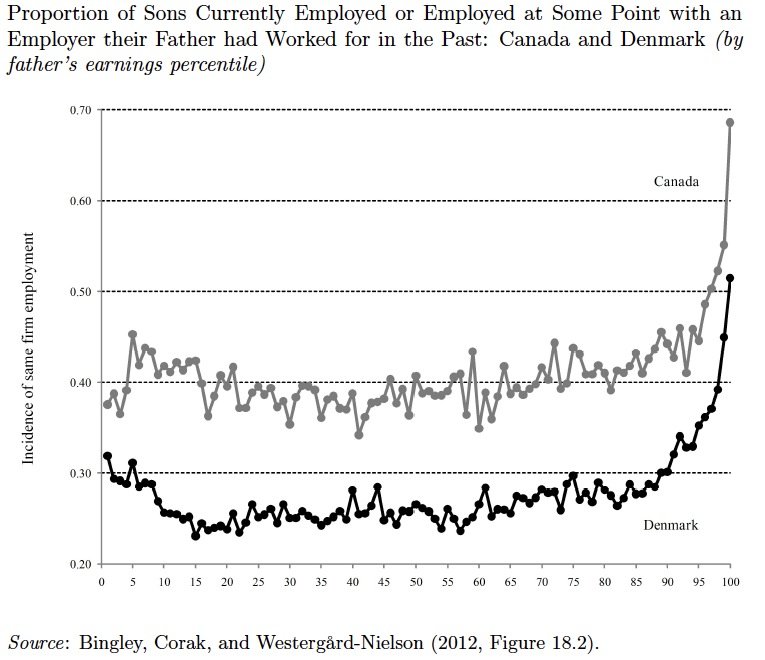
Here’s one way the rich hold onto their wealth: By hiring their spawn. This way, the wealth and the accumulated power stay in the family, rather than dissipate outwords. Toby Nangle tweeted out this great chart from economist Miles Corak, who has done a lot of work on wealth mobility. It shows the likelihood that a son at some point in their life works for the same firm that their father once worked for across various income levels. The conclusion couldn’t be more clear: The richer the father is, the more likely it is that their son will work at a firm they worked for at some point in their life. As you get to the very elite, the % of sons sharing an employer with their father just soars. The numbers in the survey are from Canada or Denmark, but the similarity across countries indicates that this is a pattern not confirmed to just those two.

screen shot 2013-08-19 at 2.30.24 pm


Taking the Xerox business model out of its box

Taking the Xerox business model out of its box

Dan Ovsey | 13/08/19 | Last Updated: 13/08/16 7:45 PM ET

DC_Ursula_Burns05.jpg

Darren Calabrese/National PostXerox CEO Ursula Burns says the inventor of the photocopier is divesting itself of traditional DocuTech processes and investing much more heavily in high-end printing and other services that cater to businesses in an era of customized, on-demand and just-in-time needs. When Ursula Burns began her career at Xerox in 1981 as part of the product development team, the company was known almost exclusively for its flagship photocopiers. Since then, she has seen the advent of the Internet, digital communication, on-demand service models and just-in-time business processes. Now the company’s CEO — and the first African-American woman to lead a Fortune 500 company — Ms. Burns has the unenviable task of transforming and re-branding Xerox into a services-based tech company that must partially distance itself from what has made its brand famous, in order to remain relevant in the future. During a recent trip to Toronto, she spoke with FP’s Dan Ovsey about the rationale and genesis behind Xerox’s service push, where it’s making strategic investments and how it will identify the people and processes to make the shift work. Following is an edited transcript of their conversation. Read more of this post

Is Economics More Like History Than Physics?

Is Economics More Like History Than Physics?

By Jag Bhalla | August 16, 2013 |  12

Is economics like physics, or more like history? Steven Pinker says, “No sane thinker would try to explain World War I in the language of physics.” Yet some economists aim close to such craziness.

Pinker says the ”mindset of science” eliminates errors by “open debate, peer review, and double-blind methods,” and especially, experimentation. But experiments require repetition and control over all relevant variables. We can experiment on individual behavior, but not with history or macroeconomics. Read more of this post

We’re not a start-up nation, Or even a nation at all, as the envy and spite aroused by the IBM-Trusteer deal reveal

We’re not a start-up nation

The Trusteer deal exposes Israel of 2013 as a collection of cultures, countries, world views, and tribes.

20 August 13 12:57, Yanki Margalit

Congratulations to Shlomo Kramer and Mickey Boodaei, the investors, and the hundreds of employees of Trusteer Ltd. An impressive business success. You established and built a real, global information security company with a reputation. Congratulations to IBM (NYSE: IBM) on its 14th acquisition in Israel and on the establishment of an information security center in the country. Read more of this post

The Beauty of Limits

August 19, 2013

The Beauty of Limits

By CARL RICHARDS

Haow often do we hear ourselves saying we want more? More freedom, more money, more time. More seems as if it would always be great, until we get it. Then we’re faced with a new set of problems that comes with having more. My work is location-independent. My wife and I could live anywhere that our budget will allow, and that ends up being a lot of places. Normally having more options is what we want, but this has actually led to a consistent problem that we spend a lot of time discussing. Read more of this post

Talking About Your Goals Makes You Less Likely To Achieve Them; the personal satisfaction of achievement is infinitely sweeter than public acclaim

Say What? Talking About Your Goals Makes You Less Likely To Achieve Them

JEFF HADEN, LINKEDIN AUG. 20, 2013, 10:53 AM 1,422 1

We all have a huge personal goal we want to accomplish: A big, challenging, amazing goal. We think about it, dream about it, obsess about it… but we never accomplish it. That could be because we also talked about it, because according to some studies, people who talk about their intentions are less likely to follow through on those intentions. Say you want to thru-hike the Appalachian Trail, a grueling five- to seven-month trek from Georgia to Maine. (Having completed about 2% of it, I’m not so well on my section-hiking way, much less thru-hiking.) You’re having dinner with friends and you tell them all about it. “Oh, wow!” one exclaims. “That sounds amazing. But won’t it be super hard?” Read more of this post