Fish are getting more expensive, but they do not all move at the same speed

Fish are getting more expensive, but they do not all move at the same speed

Aug 10th 2013 |From the print edition
20130810_FNC193

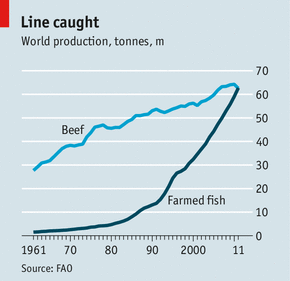
IT IS a good time to be a fisherman. The global fish-price index of the UN’s Food and Agricultural Organisation (FAO) hit a record high in May. Changing consumer diets, particularly in China, explain much of the sustained upward movement. High oil prices, which increase the cost of fishing and transportation, also add to the price of putting fish on the table. Not all fish are created equal, however. There are two types of fish production: “capture” (or wild) and “aquaculture” (or farmed). And they seem to be on different trajectories. Fish such as tuna, the majority of which is caught wild, saw much bigger price increases than salmon, which are easier to farm. Overall, the FAO’s price index for wild fish nearly doubled between 1990 and 2012, whereas the one for farmed fish rose by only a fifth. What explains this big difference? Read more of this post
What Angela isn’t saying: Euro-zone rescues have left sovereign debt too high to be sustainable

What Angela isn’t saying: Euro-zone rescues have left sovereign debt too high to be sustainable

Aug 10th 2013 |From the print edition

20130810_FNC192_0

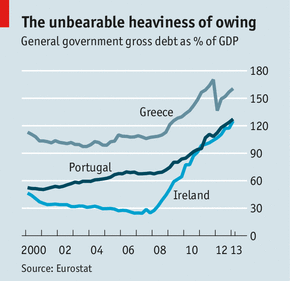
AN ORCHESTRATED hush has descended over the euro area as Angela Merkel, the German chancellor who conducts its troubled band of 17 states, campaigns for a third term in the election on September 22nd. The calm also stems from signs that the euro-zone economy may gradually be emerging from recession. But discord will reappear after the poll as it becomes clear that Europe’s bail-out programmes won’t be unwound harmoniously and that more big bills are on their way.

Of the first three rescued euro-zone countries—Greece in the spring of 2010, Ireland at the end of that year and Portugal in mid-2011—only one should be able to leave its bail-out programme as planned. Helped by its resilient economy, Ireland, whose rescue amounted to €67.5 billion ($90 billion), looks set to bow out at the end of this year. In practice, however, it will be only a partial departure. Read more of this post

Squeezing the hourglass: Growth is back. But for many Britons, it does not feel like it

Squeezing the hourglass: Growth is back. But for many Britons, it does not feel like it

Aug 10th 2013 | SOLIHULL |From the print edition

20130810_BRD001_0

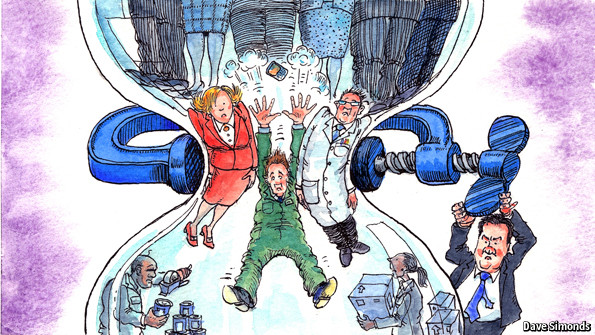
MARK CARNEY is a man on a macroeconomic tightrope. On August 7th the new governor of the Bank of England promised that interest rates will stay low until the unemployment rate, now 7.8%, has fallen to 7.0% or lower. He gave himself two get out clauses: his pledge is off if inflation gets out of hand or if Britain’s banks start to wobble. Mr Carney’s announcement reflected the balancing act demanded of him: he must spur economic confidence without allowing inflation to erode wages and savings. The severity of the slump in British living standards shows just how tricky that task will be. Read more of this post

Christie’s CEO Steven Murphy: ‘Why shouldn’t I take Amazon going into the art business seriously?’

Christie’s CEO Steven Murphy: ‘Why shouldn’t I take Amazon going into the art business seriously?’

August 9, 2013: 11:23 AM ET

The storied auction house reacts to Amazon entering the fine art biz.

By Ryan Bradley, senior editor

FORTUNE — On Tuesday Amazon announced the launch of Amazon Art, a partnership with 150 U.S. dealers and galleries that currently features some 40,000 works from 4,500 artists. There’s a Monet selling for $1.45 million (user reviews are appropriately snarky: “BUYER BEWARE: THIS ITEM IS IN FRENCH. There is no English version. I purchased this product and couldn’t understand a word of it.”) and a Norman Rockwell for $4.85 million, the most expensive piece on the site, so far. On Wednesday Fortune sat down with Christie’s CEO Steven Murphy, who is especially well-suited to consider the magnitude of Amazon (AMZN) entering the fine art space. Before arriving at Christie’s in 2010, Murphy worked in music and book publishing — first at the publishing house Simon & Schuster, then as a president at EMI Records, and finally as the CEO of Rodale. So he’s seen, firsthand, his industries hugely affected by the online retail Goliath. Edited excerpts follow: Read more of this post

Microsatellites: What Big Eyes They Have; By expanding Earth imaging, low-cost satellites could help many businesses keep track of their operations. But frequent updating of those images may also raise privacy questions

August 10, 2013

Microsatellites: What Big Eyes They Have

By ANNE EISENBERG

11-NOVEL1-articleLarge

Kelley Alwood, project manager, worked on the SkySat-1 satellite in Skybox Imaging’s clean room.

PEOPLE already worried about the candid cameras on Google Glass and low-flying drones can add a new potential snooper to the list: cameras on inexpensive, low-orbiting microsatellites that will soon be sending back frequent, low-cost snapshots of most of Earth’s populated regions from space. They won’t be the first cameras out there, of course. Earth-imaging satellites the size of vans have long circled the globe, but those cost millions of dollars each to build and launch, in part because of their weight and specialized hardware. The new satellites, with some of the same off-the-shelf miniaturized technology that has made smartphones and laptops so powerful, will be far less expensive. The view from high up is rich in untapped data, said Paul Saffo, a forecaster and essayist. He expects the new satellite services to find many customers. Insurance companies, for example, could use the satellites’ “before” and “after” views to monitor insured property and validate claims after a disaster. Businesses that update online maps for geologists, city planners or disaster relief officials could be customers, too. The images could also be used to monitor problems like deforestation, melting icecaps and overfishing. Read more of this post

Chrome rules the web: What Google’s browser has in common with Queen Victoria

Chrome rules the web: What Google’s browser has in common with Queen Victoria

Aug 10th 2013 |From the print edition

20130810_WBM200

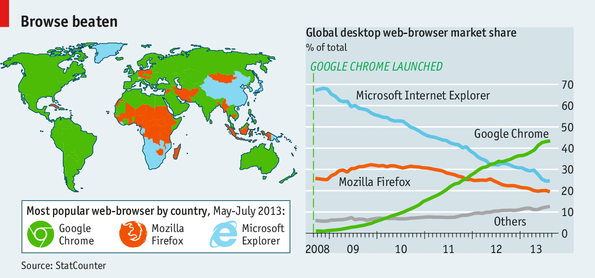
EMPIRES rise and fall swiftly on the internet. Google’s Chrome browser, which celebrates its fifth birthday next month, has captured much of the territory of older browsers and is now responsible for about 43% of all the web traffic generated by the world’s desktop computers. When Chrome was launched the dominant browser was Microsoft’s Internet Explorer (IE), with a 68% share—it is now down to just 25%. It is only 20 years since Mosaic, the first browser capable of combining words and images in a single page, was made available. Some of its developers went on to launch Netscape, an improved version, in 1994, just as the internet was taking off. But Netscape’s dominance quickly crumbled after Microsoft started bundling IE with its Windows operating system. IE and Microsoft’s other software became so prevalent that in 2000 an American court briefly contemplated breaking the company into two. By 2010, when the European Commission forced Microsoft to start offering Windows users a choice of browsers, many were switching anyway, especially to Mozilla’s Firefox. Now Chrome is increasingly pushing Firefox to the margins. Measuring browser use is difficult and subjective: one source shows that IE is still in front in terms of numbers of visitors to websites. But for e-commerce, share of traffic matters more. By this measure Chrome now dominates much of the planet. Like the boast made of the British empire in Queen Victoria’s time, the sun never sets on its dominions.

Can Japan finally make special economic zones work?

Can Japan finally make special economic zones work?

Aug 10th 2013 | TOKYO |From the print edition

20130810_FNM936

THE world’s best-known and most successful special economic zone is China’s Shenzhen. After 1979, when Deng Xiaoping chose the small farming and fishing town north of Hong Kong to test free-market economics, it grew rapidly into an industrial metropolis. Japan, though long converted to capitalism, has also used special zones to test ideas too radical for the rest of the country. Shinzo Abe, the prime minister, has now put them at the heart of his plan for economic revival. After decades of not achieving much, can they finally help Japan manage a Shenzhen-like transformation? If the zones’ expected size is any guide, they could indeed have an impact. The final locations will soon be announced, with the vast cities of Tokyo, Osaka and Nagoya said to be likely candidates. A new cabinet minister may even be chosen to oversee the tokku, as such areas are known in Japanese. Read more of this post

Boundary problems: America has changed the way it measures GDP

Boundary problems: America has changed the way it measures GDP

Aug 3rd 2013 |From the print edition

ECONOMICS is a messy discipline: too fluid to be a science, too rigorous to be an art. Perhaps it is fitting that economists’ most-used metric, gross domestic product (GDP), is a tangle too. GDP measures the total value of output in an economic territory. Its apparent simplicity explains why it is scrutinised down to tenths of a percentage point every month. But as a foundation for analysis it is highly subjective: it rests on difficult decisions about what counts as a territory, what counts as output and how to value it. Indeed, economists are still tweaking it. This week America’s GDP rose by $560 billion, or 3.6%, mainly because the “boundary” that defines what counts as an economic asset was moved. Read more of this post

Myanmar Faces Difficult Balance in Financial Overhaul

August 10, 2013, 4:35 a.m. ET

Myanmar Faces Difficult Balance in Financial Overhaul

NATASHA BRERETON-FUKUI And SHIBANI MAHTANI

Myanmar has come a long way in revamping its financial system since the military gave up formal power two and a half years ago. The country’s new civilian leaders made its central bank independent last month and ushered in several other changes meant to smooth the way for more foreign investment. And over the past two weeks, the government has allowed foreign-exchange trading between local banks, according to state media, and appointed a new management team for the central bank. Read more of this post

140-Year-Old Business Advice That Still Holds Up Today; Some work has inherent value. If you are involved with a business that produces something for the benefit of the community or society at large, you are adding something positive to the world. In return, your compensation may not be spectacular, but if you can make a living and save for the future, you’ll likely feel better about your life than if you’re involved in an occupation that takes something away from the world.

140-Year-Old Business Advice That Still Holds Up Today

LUKE LANDES, CONSUMERISM COMMENTARY AUG. 9, 2013, 4:55 PM 2,098 2

There may be only about six stories in personal finance, but those stories seem to endure the passing of time. Good storytellers can breathe new life into the same old financial advice, and great communicators can introduce world-weary concepts to those who might need to hear them for the first time. While looking for information about a town in upstate New York, I came across a gazetteer written in 1871 for Saratoga County. It’s a booklet, digitized for aiding online research, containing a business directory of several towns within that county. Like a telephone directory, the book contains names and addresses of residents, although unlike a telephone directory, there are no phone numbers. The book is more than just a directory, though. The gazetteer offers historical accounts of the towns covered as well as general information a household in 1871 might need, such as a guide to the decimal system of measures, “recipes” for home remedies for common ailments, and of course, advertisements. (See one such advertisement, for pills “to prevent female irregularities,” reproduced here.) And particularly interesting was a section titled, “How to Succeed in Business.” Several pages in the book are dedicated to help readers make good decisions with their labors, their interpersonal relationships, and the management of their money. There’s nothing particularly special about this. Financial self-help guides and business advice have been published for longer than this country has been in existence, but I enjoyed this discovery and thought it would be worth sharing. Here are some excerpts, first on being an upright citizen in business. Read more of this post

The Gorilla Lurking Where We Can’t See It; A study of radiologists shows that when we pay careful attention to one thing we become literally blind to others—even startling ones like gorillas

August 9, 2013, 8:34 p.m. ET

The Gorilla Lurking Where We Can’t See It

ALISON GOPNIK

Imagine that you are a radiologist searching through slides of lung tissue for abnormalities. On one slide, right next to a suspicious nodule, there is the image of a large, threatening gorilla. What would you do? Write to the American Medical Association? Check yourself into the schizophrenia clinic next door? Track down the practical joker among the lab technicians? In fact, you probably wouldn’t do anything. That is because, although you were staring right at the gorilla, you probably wouldn’t have seen it. That startling fact shows just how little we understand about consciousness. Read more of this post

Ex-Top Official Says China’s Xi Not Serious in Tackling Graft; “I can only see one thing: he has continued suppression. Besides that, I can’t see what else he wants to do. So I think he probably just wants to do one thing: to maintain his stability, maintain his position.”

Ex-Top Official Says China’s Xi Not Serious in Tackling Graft

By Sui-Lee Wee on 2:47 pm August 10, 2013.

File photo of Bao, a former member of the Central Committee of the Communist Party of China, smoking at home during an interview in Beijing

Bao Tong, former member of the Central Committee of the Communist Party of China, smokes at home during an interview in Beijing, in this February 20, 2013 file photo. (Reuters Photo/Petar Kujundzic/Files)

Beijing. Chinese President Xi Jinping is not serious about fighting corruption and is more intent on maintaining his position than curing the country’s “sickness,” the most senior official jailed over the 1989 Tiananmen Square protests said on Friday. Bao Tong, the most trusted aide to purged reformist Communist Party chief Zhao Ziyang, characterized the new president as no different from Mao Zedong — the leader who led China into the chaos of the Cultural Revolution. It was Bao’s harshest criticism to date of Xi, who many liberals and intellectuals are hoping will emerge as a reformer, like his father, Xi Zhongxun, a liberal-minded former vice premier. “I can only see one thing: he has continued suppression,” Bao, 80, told Reuters in his apartment in Beijing. “Besides that, I can’t see what else he wants to do. So I think he probably just wants to do one thing: to maintain his stability, maintain his position.” Read more of this post

Are Startups Too Busy to be Creative?

Are Startups Too Busy to be Creative?

Aug 7, 2013 · 700 views

Alex Mayyasi. 

xlarge

When a fan asked Ernest Hemingway how to start writing a novel, he recommended cleaning the fridge.  It was not an insult. It alluded to the weird way that our best ideas seem to pop into our head unbidden when we engage in a mindless task.  In an opinion piece for the New York Times, essayist and cartoonist Tim Kreider once described what he calls “The Busy Trap.” Differentiating between people busy with multiple minimum wage jobs and those who self-impose busyness by taking on ever more responsibilities and activities, he questions what it means when people exclaim “I’m so busy!” Read more of this post

All the Presidents’ Vacation Reading; Can a modern president hope to read as much as Adams, Lincoln and Truman did?

August 9, 2013, 8:48 p.m. ET

All the Presidents’ Vacation Reading

Can a modern president hope to read as much as Adams, Lincoln and Truman did?

TEVI TROY

This month, for a fourth summer, President Barack Obama will vacation on Martha’s Vineyard. What will he read during his down time? That, too, has become something of a summer ritual. On his two most recent trips, Mr. Obama has made a pilgrimage to the Bunch of Grapes bookstore to pick up some books, the names of which, inevitably, find their way into the media, where they are dissected and debated by his allies and critics alike. Mr. Obama’s summer choices have included Daniel Woodrell’s “The Bayou Trilogy” and Ward Just’s “Rodin’s Debutante” in 2011 and Jonathan Franzen’s “Freedom” in 2010. For authors, the presidential imprimatur provides priceless publicity. “Freedom,” in particular, caught a wave. At the time of Mr. Obama’s visit to Martha’s Vineyard in 2010, the novel had yet to be officially released, but Mr. Obama obtained an early copy from the store, adding to the book’s cachet and, as Politico’s Karin Tanabe wrote, setting the “Web atwitter.” The book shot up the best-seller lists. Only Oprah, it seems, provides a bigger sales bump. Read more of this post

The wit and wisdom of Isaiah Berlin; How the cold war shaped the great philosopher’s thinking – and tested his integrity

August 9, 2013 7:06 pm

The wit and wisdom of Isaiah Berlin

By Duncan Kelly

How the cold war shaped Isaiah Berlin’s thought – and tested his integrity

Building: Letters 1960-1975, by Isaiah Berlin, edited by Henry Hardy and Mark Pottle, Chatto RRP£40/Random House UK RRP$59.95, 704 pages

Isaac and Isaiah: The Covert Punishment of a Cold War Heretic, by David Caute, Yale £25/$35, 336 pages

A Mind and its Time: The Development of Isaiah Berlin’s Political Thought, by Joshua Cherniss, OUP £60/$110, 288 pages

By the 1960s Isaiah Berlin was assured in his fame, a shining star in an unusually cosmopolitan academic and cultural firmament. His professorship at All Souls in Oxford, where he held the chair in social and political theory, was only one, rather small component of his life. Berlin was globally connected, particularly in Washington, where he had worked in the British embassy during the war, and he would reap rewards from his numerous networks in the decades that followed. Friends in the Ford Foundation secured him the funding, matched by the British businessman Leonard Wolfson, for the construction of a new graduate college in Oxford in 1965, which he served as the first president. Wolfson College is a tremendous legacy and a fitting monument to a life whose achievements were recognised across continents. In Building, a new and weighty volume of letters written between 1960 and 1975, all of Berlin’s characteristic gifts are on display – as well as some of his darker moments. Already, he was looking back, drawing the threads of his intellectual preoccupations together. Writing in 1969 (after turning 60) to the painter Dorothea Head, he laments the aimless “dashing about” of the day’s secure and prosperous youth, and reflects on the pressures faced by his own generation. “We feared something: war, economic collapse, totalitarianism. But ennui is worse.” Read more of this post

Starbucks chief Howard Schultz steps into JC Penney fight, saying hedge fund manager Bill Ackman is a “destroyer of companies”; “Bill Ackman has blood on his hands for being the one who brought Ron Johnson in”

Last updated: August 9, 2013 8:19 pm

Starbucks chief steps into JC Penney fight

By Barney Jopson and Dan McCrum in New York

Howard Schultz, chief executive of Starbucks, has accused the hedge fund manager Bill Ackman of being a “destroyer of companies” as he stepped into a fight between the investor and the struggling retailer JC Penney. Mr Schultz, one of America’s best-known businessmen, spoke out after Mr Ackman, a JC Penney board member, wrote a letter urging fellow directors to find a new chief executive quickly and released it to the media. “I thought it was disgusting,” Mr Schultz told the Financial Times, accusing Mr Ackman of bypassing established governance procedures. “When I saw what happened [on Thursday] . . . I’m distraught.” Read more of this post

Simplify Your Tech Life,Thoreau-Style; Even an avowed naturalist would have a hard time totally unplugging today. Here’s how to take refuge from banal Facebook posts and incessant phone alerts without retreating to a tiny cabin in the woods

August 9, 2013, 5:49 p.m. ET

Simplify Your Tech Life,Thoreau-Style

Even an avowed naturalist would have a hard time totally unplugging today. Here’s how to take refuge from banal Facebook posts and incessant phone alerts without retreating to a tiny cabin in the woods

MICHAEL HSU

YOU MAY NEVER HAVE READ“Walden,” but you’re probably familiar with the premise: a guy with an ax builds a cabin in the woods and lives there for two years to tune out the inessential and discover himself. When Henry David Thoreau began his grand experiment, in 1845, he was about to turn 28—the age of a typical Instagram user today. Thoreau lived with his parents right before his move. During his sojourn, he returned home to do laundry.

“In proportion as he simplifies his life, the laws of the universe will appear less complex, and solitude will not be solitude, nor poverty poverty, nor weakness weakness.”

—Henry David Thoreau, 1854 Read more of this post

NYC parents hire toddler training experts at $450 an hour in battle for elite school places where four-year-olds must attend a playgroup where they are tested by teachers for academic ability and their social and emotional IQ

August 8, 2013 5:07 pm

The serious side of child’s play

By Emma Jacobs

Bribing toddlers can be counter-productive, according to Vanessa. Instead, the 28-year-old coaches her young charges how to play together – for $450 an hour. After all, play dates are no trivial matter. They can decide a child’s future. Vanessa, who declines to give her last name, is one of a new breed of play date experts that help children prepare for admission to New York’s elite kindergartens. As part of the admission process to these schools that charge up to $40,000 a year, four-year-olds must attend a playgroup where they are tested by teachers for academic ability and their social and emotional IQ. Read more of this post

Paul Graham: How to Convince Investors

How to Convince Investors
Paul Graham
August 2013
(This is one of a pair of essays on fundraising. The next one, on fundraising tactics, is coming soon.)
When people hurt themselves lifting heavy things, it’s usually because they try to lift with their back. The right way to lift heavy things is to let your legs do the work. Inexperienced founders make the same mistake when trying to convince investors. They try to convince with their pitch. Most would be better off if they let their startup do the work—if they started by understanding why their startup is worth investing in, then simply explained this well to investors. Investors are looking for startups that will be very successful. But that test is not as simple as it sounds. In startups, as in a lot of other domains, the distribution of outcomes follows a power law, but in startups the curve is startlingly steep. The big successes are so big they dwarf the rest. And since there are only a handful each year (the conventional wisdom is 15), investors treat “big success” as if it were binary. Most are interested in you if you seem like you have a chance, however small, of being one of the 15 big successes, and otherwise not. [1]
(There are a handful of angels who’d be interested in a company with a high probability of being moderately successful. But angel investors like big successes too.)
How do you seem like you’ll be one of the big successes? You need three things: formidable founders, a promising market, and (usually) some evidence of success so far. Read more of this post

Smart Leaders Have Protégés

Smart Leaders Have Protégés

by Sylvia Ann Hewlett  |   9:00 AM August 9, 2013

Just how important protégés are to a powerful person was made clear to me by this question, told to me by a Fortune 100 CEO. When choosing his direct reports, he asks: “How many blazing talents have you developed over the years and put in top positions across the company, so that if I asked you to pull off a deal that involved liaising across seven geographies and five functions, you’d have the bench strength — the people who ‘owe you one’ — to get it done?” Read more of this post

Lee Kuan Yew: 1Malaysia campaign may be unrealistic

Lee Kuan Yew: 1Malaysia campaign may be unrealistic

Saturday, August 10, 2013 – 15:31

Isabelle Lai

The Star/Asia News Network

20130810_LKY

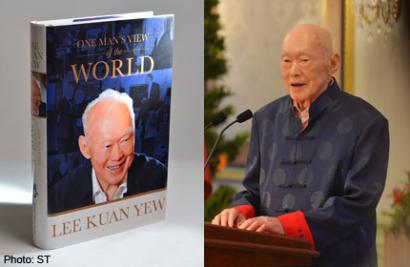
PETALING JAYA – Malaysians hoping that Barisan Nasional’s 1Malaysia concept can usher in a new era for race relations may be unrealistic, but those counting on the Opposition to do the same are not very much less so, said Lee Kuan Yew. The former Singapore Prime Minister said that Datuk Seri Najib Tun Razak’s 1Malaysia campaign, launched in 2008 to win back support from Chinese and Indian voters, had not lived up to the excitement it created. Read more of this post

Richard Branson Explains The Most Important Thing Every Good Boss Should Do

Richard Branson Explains The Most Important Thing Every Good Boss Should Do

JULIE BORT AUG. 9, 2013, 8:57 PM 3,749

Earlier this week, Richard Branson and Elon Musk, two of the world’s most daring and successful entrepreneurs, offered advice via a Google Hangout. That was cool, but Richard Branson, founder and chairman of Virgin Group, has been offering fantastic advice to business people for years. We just found this YouTube of him from 2011 where he explains the most important thing every manager should do: praise people. He then tells an amazing story of how he almost went instantly bankrupt when his bank manager came to his house and called all his loans. Moral of the story is don’t be afraid to change banks (and it’s good to have wealthy friends). But it also underscores that in order to succeed, you have to live with the risk of failure because no matter how  successful you are, failure is always a possibility.

Jeff Bezos Will Walk Out Of A Meeting If You Don’t Get To The Point

Jeff Bezos Will Walk Out Of A Meeting If You Don’t Get To The Point

VIVIAN GIANG AUG. 9, 2013, 10:47 AM 14,307 16

Reuters

Jeff Bezos won’t waste any time in a meeting with you if he doesn’t fully understand where the conversation is going or how it will make Amazon better. Craig Timberg and Jia Lynn Yang write about Bezos’ demanding management style in The Washington Post: “In the relentlessly efficient world of Jeffrey P. Bezos, Amazon employees quickly learn when they have overtaxed the attention of their chief executive. He quietly pulls out his smartphone and starts replying to e-mails. In extreme cases, Bezos will walk out.” Nadia Shouraboura, formerly a part of Bezos’ senior executive team tells Timberg and Yang that you “better be ready” if you have a meeting with Bezos. “He will figure out something you haven’t thought of … If you haven’t thought through exactly how to delight our customer, that’s a bad thing.”

Jeff Bezos, The Post’s incoming owner, known for a demanding management style at Amazon

By Craig Timberg and Jia Lynn Yang, Published: August 8

In the relentlessly efficient world of Jeffrey P. Bezos, Amazon employees quickly learn when they have overtaxed the attention of their chief executive. He quietly pulls out his smartphone and starts replying to e-mails. In extreme cases, Bezos will walk out. Read more of this post

Cactus Needles Inspired A Super-Efficient New Way To Clean Up Oil Spills

Cactus Needles Inspired A Super-Efficient New Way To Clean Up Oil Spills

ROBERT FERRIS AUG. 9, 2013, 2:25 PM 1,187 1

screen shot 2013-08-07 at 5.00.21 pm

Scientists may have just invented an amazing new way to clean up oil spills by mimicking the ingenious physics of cactus needles. Cactus needles are not just for warding off animals trying get a taste of the plant’s moist flesh. They also use a trick from physics to help them draw water from the air to keep the plant hydrated in its harsh desert environment. Cactus needles are shaped like cones with — as many unfortunate victims have found — a sharp tip facing outward. The spines widen as they get closer to the body of the plant. Read more of this post

It’s So Hot In Shanghai That People Are Camping Out In Air Conditioned Subway Stations

It’s So Hot In Shanghai That People Are Camping Out In Air Conditioned Subway Stations

ADAM TAYLOR AUG. 9, 2013, 3:15 PM 2,083 1

Almost 400 people have been camping out a Shanghai Metro station, making use of the air conditioning that many don’t have at home, Shanghaiist reports, hoping to beat a horrible heatwave that has hit the city. Looking at pictures, the people at Xingzhong Road station appear to have planned ahead, bringing cardboard and sheets to lie on. Amazingly, the station seems to be pretty cool about it — though a Shanghai Metro spokesperson did ask that those enjoying the A/C refrain from drinking, smoking or playing cards. It may seem like extreme behavior, but the weather may well merit it. The Washington Post’s Capital Weather Gang reports that Shanghai saw its hottest July in 140 years, with temperatures soared to 100ºF or higher for 10 straight days between July 23 and August 1. All across China’s east record temperatures are being set. These photos, shared to Weibo, capture the scene:

6c2e55bbjw1e7gbhp0wq4j20ic1ouqhm (1)

Property confiscated from some of Sicily’s notorious criminals is being used to build a growing ethical tourism business

August 9, 2013 3:24 pm

In the mafia’s footsteps

By Kabir Chibber

Property confiscated from some of Sicily’s notorious criminals is being used to build a growing ethical tourism business

Ayoung Alexis de Tocqueville, just 22 and travelling around Sicily in the 1820s, wrote: “One is surprised, after crossing in almost complete isolation for eight or ten hours, to enter suddenly in a town of twenty thousand souls, without a highway, with no noise to proclaim your arrival.” These days, little has changed. About an hour from Palermo, the tiny town of San Giuseppe Jato suddenly appears from nowhere after a succession of rolling hills that reach out into the distance. The town is the base of Francesco Galante and the team at Libera Terra, a loose web of Italian co-operatives and non-profit organisations dedicated to fighting the mafia. At any given time, this ragtag bunch of agronomists, labourers and student volunteers can be found drinking espresso in industrial quantities in their office above a petrol station, while building a small ethical tourism empire from lands seized by the state from the Cosa Nostra. They now run vineyards, farms and guest houses throughout Sicily. Read more of this post

End of QE will drive a bond sell-off to remember; Debt losses will accelerate as equity markets gradually accept Fed taper

August 9, 2013 11:52 am

End of QE will drive a bond sell-off to remember

By Michael Mackenzie in New York

Debt losses will accelerate as equity markets gradually accept Fed taper

Bond investors hurt by this summer’s interest rate turmoil may be surprised to find the damage was small by previous standards. The rapid rise in bond yields from May fails to crack the top 10 list of fixed income routs for the past 50 years, according to Liberty Street Economics, a website that publishes research from economists at the Federal Reserve Bank of New York.* Of the 15 largest bond market debacles since 1961, this year’s interest rate shock ranks at number 13, based on the economists’ criteria for defining such events. Before fixed income investors take umbrage at such a lowly ranking for the hefty losses they have just experienced, Liberty Street has not yet called time on this year’s stampede out of bonds. Just like a sleeper song or film, the bond market’s current affliction could climb further up the hit parade, with September delivering another employment report and a Fed policy meeting that could well launch a reduction, or taper in the central bank’s $85bn of monthly bond buying. Read more of this post

Investors shun advice as costs are laid bare; Financial advisers are being forced to spell out their charges and many customers think they are too high

Investors shun advice as costs are laid bare

Financial advisers are being forced to spell out their charges and many customers think they are too high.

Richard Mills: ‘I was paying commission to the adviser and not really getting anything for it.’ 

By Richard Dyson

7:45AM BST 10 Aug 2013

Now that consumers can see more clearly how much they pay for financial advice, many no longer want it. One in three investors who have taken financial advice in the past five years says they will never consider paying for the service again. These findings – part of an authoritative survey into thousands of investors’ intentions – emerge just six months after new rules were introduced requiring financial advisers to declare their charges explicitly to clients, rather than receiving payment in the form of commissions. Read more of this post

City of London Investment Trust, one of the oldest and largest generalist investment trusts, said this week it would remove its performance fee and charge only a management fee, prompting analysts to predict that more would follow

August 2, 2013 6:31 pm

Trust performance fees axed

By Jonathan Eley

City of London Investment Trust, one of the oldest and largest generalist investment trusts, said this week it would remove its performance fee and charge only a management fee, prompting analysts to predict that more would follow. Henderson, which manages the trust, said it hoped the move would make it “more attractive to a wider audience of retail investors.” The annual management fee will henceforth by 0.365 per cent and the ongoing charges in respect for this year should be around 0.45 per cent – less than some tracker funds. Read more of this post

Buffett-Like Buyers Seen Lured to Hanesbrands

Buffett-Like Buyers Seen Lured to Hanesbrands: Real M&A

Boxers and bras may be next on the shopping list for private-equity buyers with Hanesbrands Inc. (HBI) offering one of the cheapest valuations in the retail industry.

The underwear maker’s $6.2 billion market value is 12 times its free cash flow from the past year, lower than all but two similar-sized U.S. apparel companies, according to data compiled by Bloomberg. While Warren Buffett’s Berkshire Hathaway Inc. has 43 percent of the U.S. industry through brands including Fruit of the Loom, suitors would get a second-place share of 19 percent by buying Hanes, data compiled by IBISWorld Inc. show. Read more of this post