Sina Weibo’s Failure: Why Chinese Companies Should Take the Rest of the World Seriously

Sina Weibo’s Failure: Why Chinese Companies Should Take the Rest of the World Seriously

July 29, 2013

by C. Custer

Last week, we reported that Sina Weibo has added Facebook login to its service to make it easier for overseas users to sign up. My response? Way too little, way too late. A couple of years ago, Weibo was buzzing. Even outside China, lots of people were talking about it. But despite the interest from overseas pundits, brands, and social media watchers, Sina made pretty much no attempt to make the service accessible to anyone other than Chinese people. It didn’t even bother to localize the service in other languages (which would have been easy), let alone push more strongly into any new markets. And at the time, everyone seemed to think that made a lot of sense. China’s market, after all, was gigantic and still growing. Why should Sina even bother with foreigners when there was so much work still to be done in the Chinese market? Read more of this post

Silicon Valley or Demand Mountain?

Silicon Valley or Demand Mountain?

Edward Jung, former Chief Architect at Microsoft, is Chief Technology Officer at Intellectual Ventures.

24 July 2013

BELLEVUE, WASHINGTON – Everyone wants to know how to build the next Silicon Valley: an innovation hub that draws talent and capital, and that creates jobs, companies, and whole new industries. Developed-country governments scramble to subsidize technology that could be the Next Big Thing. Emerging-market policymakers hope that incentives like tax breaks and free land will induce innovators to settle and prosper there. But most of these well-meaning schemes are missing an essential ingredient: demand. Read more of this post

Korean accounting firms poised for seismic changes next year

Accounting firms poised for seismic changes next year

By Park Seung-cheol/ Lee Ga-yoon

2013.07.31

South Korea’s accounting industry is fussing over the largest-ever seismic changes slated for next year. Critical changes will all come next year: international audit standards will become effective; the period for audit firm rotation will approach on the annulment of the rule, under which businesses must replace an audit firm with another in six years; and an independent auditing committee will be given rights to pick audit firms.  Large accounting firms including Samil PwC, Deloitte Anjin, Samjong KPMG Advisory and Ernst & Young Korea are already in the cutthroat competition, believing the next year’s accounting firm selection will be the event that will reshape the market landscape. An official at Ernst & Young Korea noted, “accounting firms had enjoyed extra demand for consulting services with the introduction of the international financial reporting standards, but now failed to seek new breakthroughs to be in the doldrums over the last few years,” adding “the next year will be the cornerstone for accounting firms to get out of the hardships.”  The international audit standards call for a parent company’s auditor to hold responsibility for the audit results of its consolidated subsidiaries. Accounting firms project that the introduction of international audit standards will eventually make parent company and its subsidiaries have the same audit firm. In addition, it has been three years since Korea scrapped the rule, by which businesses are obliged to rotate their auditors every six years, in 2009. This is acting as another catalyst for fueling competition among accounting firms.

The benefits and perils of riding China’s coat-tails; Many Latin American nations have bet the mine on an economy that is now slowing

July 31, 2013 4:18 pm

The benefits and perils of riding China’s coat-tails

By David Pilling

Many Latin American nations have bet the mine on an economy that is now slowing

Few parts of the world have benefited as much from China’s rise as Latin America. In 1990, China was a lowly 17th on the list of destinations for Latin American exports. By 2011, it had become the number one export market for Brazil, Chile and Peru and number two for Argentina, Cuba, Uruguay, Colombia and Venezuela. Over that time, annual trade rose from an unremarkable $8bn to an irreplaceable $230bn. Chinese leaders predict it will reach $400bn by 2017. Read more of this post

Ex-courier lifts lid on theft and fraud in China’s logistics industry

Ex-courier lifts lid on theft and fraud in China’s logistics industry

Staff Reporter

2013-08-01

A retired courier said that it has become the norm for employees in China’s delivery services industry to steal or tamper with items trusted to them to sort and deliver, while couriers work with contacts to scam the recipients out of money, reports the Guangzhou Daily. The former courier, who recently retired from his position at the Guangzhou branch of Shanghai YTO Express (Logistics) — a leading player in the delivery services industry — said that many couriers steal parts of a parcel if its packaging is broken. He added that many would open and steal from parcels if they knew that the contents were items such as moon cakes, teas or fruit. He said that many in the industry would also take high-end electronic products such as iPhones if they had the chance, which they then would replace with a counterfeit item, repackaging the parcel before delivering it to the recipient. Read more of this post

Money Merry-Go-Round in North Korea

Money Merry-Go-Round in North Korea

Good luck finding a North Korean won in Pyongyang

By Giles Hewitt on 1:10 pm July 31, 2013.
Pyongyang. Chinese yuan, US dollars, euros and tea bags. Money can come in many forms in North Korea, but as a foreign visitor you’ll probably never even see a local banknote, let alone use one. Pretty much any hard currency is welcome in a country with anemic foreign reserves. Tourists, although few in number, represent a valuable cash source. For those who do choose to visit, every transaction — no matter how small — must be made in foreign exchange, further narrowing options in what is already among the most restrictive countries in the world. There are not many places to spend money in the capital Pyongyang. As a foreigner, the choice is reduced further by the need to find somewhere that takes foreign currency and — importantly — is capable of giving change. Read more of this post

China Owes Hollywood Millions After Halting Payment for Films; lack of profit has not deterred US studios from sending their films to China,

China Owes Hollywood Millions After Halting Payment for Films

By Agence France-Presse on 1:48 pm July 31, 2013.
Los Angeles. China has stopped paying Hollywood studios for its films in a dispute over a Chinese tax on movie profits, Hollywood trade papers reported Tuesday. Tens of millions of dollars in box office revenues are owed in arrears to the likes of Disney, Warner, Universal, Paramount, Fox and Sony, according to The Hollywood Reporter. The magazine said China’s state-owned movie distributor, China Film Group, owes more than $31 million to Warner for “Man of Steel,” $23 million to Sony for “Skyfall” and $23 million to Fox for “Life of Pi.” China stopped payment at the beginning of the year, when American studios took issue with a two percent value-added tax that the world’s most populous nation was levying on US films. Chinese authorities want the studios to pax them the tax, but the studios argue it violates a World Trade Organization agreement governing the film trade between the two countries. In the accord last year, heralded as historic by the United States, the two countries agreed that China could import 34 US blockbusters a year (up from 20) and studios’ revenue share from China was fixed at 25 percent (up from 13 to 17 percent). The Motion Picture Association of America (MPAA), which acts on behalf of studios’ interests, is negotiating with Chinese authorities, to resolve the tax dispute. In the meantime, lack of profit has not deterred US studios from sending their films to China, which currently has the world’s most dynamic movie market, in the aim of cementing a long-term foothold.

Overcapacity sends China’s steel sector into loss

Overcapacity sends China’s steel sector into loss

English.news.cn   2013-07-31

BEIJING, July 31 (Xinhua) — China’s iron and steel industry reported a loss of 699 million yuan (about 113 million U.S. dollars) in June, the first monthly deficit that the overcapacity-troubled industry has seen this year. For the first half, the profits of members of the China Iron and Steel Association (CISA) hit 2.27 billion yuan, with an average profit margin of 0.13 percent, the lowest among all industries, said the CISA on Wednesday. Steel prices have been dropping since February. At the end of June, the price of steel products fell 6.45 percent compared with the beginning of this year, and down 14.7 percent year on year, according to the CISA. Read more of this post

Chinese Venture Fundraising Hurt by Fears Over Economy

July 31, 2013, 5:42 a.m. ET

Chinese Venture Fundraising Hurt by Fears Over Economy

Economic Concerns Outweigh Renewed IPO Activity

SONJA CHEUNG

Venture capital fundraising in China slumped to a two-year low in the second quarter as concerns about the country’s slowing economy outweighed renewed activity in initial public offerings, according to data from Dow Jones VentureSource. IPOs of Beijing-based e-commerce company LightInTheBoxHolding Co. in the U.S., and of car dealership China Harmony AutoHolding Ltd. in Hong Kong in early June, failed to reignite interest in those investing in mainland VC funds, despite proof that fund managers are finding it slightly easier to off-load investments. Read more of this post

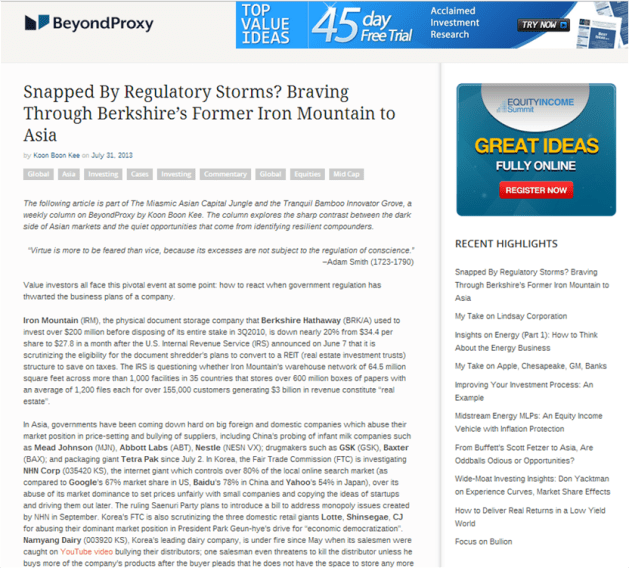
Snapped By Regulatory Storms? Braving Through Berkshire’s Former Iron Mountain to Asia. Bamboo Innovator is featured in BeyondProxy.com, where value investing lives

Bamboo Innovator is featured in BeyondProxy.com, where value investing lives:

  • Snapped By Regulatory Storms? Braving Through Berkshire’s Former Iron Mountain to Asia, July 31, 2013 (BeyondProxy)

RegulatoryStorm


IBM Says SEC Investigating Its Cloud-Computing Revenue Figures

IBM Says SEC Investigating Its Cloud-Computing Revenue Figures

International Business Machines Corp. (IBM) said the Securities and Exchange Commission is investigating how it reports revenue from offsite cloud-computing services. IBM is cooperating with the SEC in the probe, which it learned about in May, it said today in a filing, without providing further details. Revenue from cloud services, such as storing clients’ data and software applications remotely, rose 70 percent in the first half of 2013 from a year earlier, it said in the filing, repeating a figure it has disclosed before. IBM Chief Executive Officer Ginni Rometty has identified cloud computing as one of the company’s chief sources of growth amid a slowdown in demand for services such as consulting. The Armonk, New York-based company is banking on such faster-growing markets, along with buybacks and acquisitions, to help reach profit of $20 a share by 2015, up from $15.25 last year. IBM fell as much as 1.3 percent in early trading today. It had closed yesterday little changed at $196.01.

To contact the reporter on this story: Crayton Harrison in New York at tharrison5@bloomberg.net

Mother of Song Dynasty patriot General Yue Fei (岳飞): “Loyalty is not to one single emperor but to an ideology.” 为什么不能把这个忠字扩大一点?忠于的不在再是一个皇帝,而是仁义之念,仁义之事,仁义之功,仁义之战。为仁义而忠,为仁义而弘道,甚至为仁义而杀身。

岳飞母亲:“你有没有想过,娘为什么会提这“尽——忠——报——国”四个字?

你不在的时候,娘琢磨着,‘忠’、‘国’这两个字,真是越想越觉得有意思,有学问。

一般来说,这个忠字是忠于君父,那娘在想,为什么不能把这个字扩大一点?

忠于的不在再是一个皇帝,而是仁义之念,仁义之事,仁义之功,仁义之战。为仁义而忠,为仁义而弘道,甚至为仁义而杀身。

这报国的国字,那不单单是指大宋而言,指的是四海之内皆兄弟之国,指的是人与人之间能和平相处之国。

朝廷以仁义为政,三军以仁义为师的泱泱大国。

你的忠,你的国,也许在眼前,也许在未来,

娘只盼着时机到了,你能把握你的忠,报效你的国。

把这股劲儿,这股气传给你的儿女,传给你的兄弟。”

1371602296_401702253215147B

Your Company Is Only as Good as Your Writing

Your Company Is Only as Good as Your Writing

by Kyle Wiens  |   8:00 AM July 30, 2013

Good writing: Businesses claim to practice it, support it, and value it. But more often than not, their money isn’t where their mouth is. Poor grammar and jargon-riddled writing are rampant. We’re great at inventing terms — the instruction manual for my toaster refers to the lever that pops up the toast as the ‘Extra-Lift Carriage Control Lever’ — but poor at communicating what we actually mean. We could learn a thing or two about communication from our forefathers. One of the most effective speeches of all time, Lincoln’s Second Inaugural Address, was only 701 words. Of those, 505 were words of one syllable and 122 had two syllables. Great leaders consider communication a core competence, so why don’t more businesses? Manufacturers spend millions on safety training to get people to wear hard hats, but spend very little to make sure their safety critical work instructions are written clearly. That’s not good enough. Effective writing must be a company-wide endeavor. Read more of this post

James Dyson: Big invention does not happen overnight — or in 5 years

Big invention does not happen overnight — or in 5 years

BY JAMES DYSON

6 HOURS 20 MIN AGO

In 2010, Singapore committed S$16.1 billion to fund research, innovation and enterprise over five years. A smart move providing the foundation and fuel for Singapore’s long-term growth.

In 2010, Singapore committed S$16.1 billion to fund research, innovation and enterprise over five years. A smart move providing the foundation and fuel for Singapore’s long-term growth. But for research, is five years really long term? It took me five years and more than 5,000 prototypes to perfect my design for a bagless vacuum cleaner. It was a gamble; I flirted with bankruptcy on a number of occasions, had to re-mortgage my house and borrow hundreds of thousands of pounds. I (and thankfully, my wife too!) believed in my idea, but even once I had got it working, success did not happen overnight. And that was a vacuum cleaner — one single product. Big invention needs big — and long-term — investment. Read more of this post

Some entrepreneurs want to do good. Many more are driven by a chip on the shoulder, a desire for revenge, a distaste for authority.

July 30, 2013, 4:21 p.m. ET

Who Moved My Fortune?

Some entrepreneurs want to do good. Many more are driven by a chip on the shoulder, a desire for revenge, a distaste for authority.

PHILIP DELVES BROUGHTON

Successful entrepreneurs, in my experience, are tenacious, hardheaded and creative. They persist with their ideas long after others might have given up, and they are good at persuading clients, partners and investors to take a chance. Like successful people in any field, they are driven by a powerful inner need, sometimes positive, like the hunger to do something entirely original, but often less appealing: a large chip on the shoulder, a desire for revenge, a distaste for authority and in many cases flat-out greed. “The Social Network,” David Fincher and Aaron Sorkin’s 2010 movie about the founding of Facebook, gave a good sense of how all these forces churned inside Mark Zuckerberg: the sense of social insecurity at Harvard; the delight in confronting authority; and the ruthless unwillingness to share equity. Read more of this post

On Henry Ford’s 150th Birthday, His Greatest Insight Has Been Tragically Forgotten

On Henry Ford’s 150th Birthday, His Greatest Insight Has Been Tragically Forgotten

GUS LUBIN JUL. 30, 2013, 10:15 AM 15,137 73

fredgraph-69

Henry Ford, who was born 150 years ago today, is remembered as the guy who unleashed the full potential of the assembly line, beginning in 1913 when the Ford Motor Company cranked out Model T’s much faster and cheaper than anyone could imagine. But his business philosophy, known as Fordism, went beyond the implementation of mass production. Ford argued that high wages were essential for economic and moral reasons. As he wrote in his autobiography: What good is industry if it be so unskillfully managed as not to return a living to everyone concerned? No question is more important than that of wages — most of the people of the country live on wages. The scale of their living — the rate of their wages — determines the prosperity of the country. Ford set a powerful precedent in 1914 when he doubled wages for workers on his assembly line in Detroit, Mich. The move was in part a reaction to high turnover among his workers, who found the work too hard and unrewarding. At the same time, he argued that it was good for his business.  Read more of this post

FBI Agents Arrest Sell-Side Tech Analyst Sandeep Aggarwal For Leaking Non-Public Info To A Former SAC Portfolio Manager

FBI Agents Arrest Tech Analyst Sandeep Aggarwal For Leaking Non-Public Info To A Former SAC Portfolio Manager

JULIA LA ROCHE JUL. 30, 2013, 12:08 PM 7,825 1

sandeep-aggawral

San Francisco-based technology sell-side analyst Sandeep Aggarwal was arrested yesterday by FBI agents in San Jose, California on insider trading charges, the FBI New York bureau Tweeted. Today, the U.S. Attorney’s Office for the Southern District of New York announced criminal charges against Aggarwal.  Aggarwal, 40, is charged with one count of conspiracy to commit securities fraud, and one count of conspiracy to commit wire fraud. He has also been civilly charged by the Securities and Exchange Commission. Aggarwal, who lives in India and recently returned to the U.S.,  is accused of tipping off former SAC portfolio manager Richard Lee about a pending deal between Microsoft and Yahoo!.

Read more of this post

Sir Luke Johnson: It’s time for educators to learn new tricks; we need more students qualified in science, technology, engineering and maths

Last updated: July 30, 2013 4:06 pm

It’s time for educators to learn new tricks

By Luke Johnson

The west needs more students qualified in science, technology, engineering and maths

Ihave seen firsthand how the online revolution has inflicted convulsions across various industries, including retailing, the media business and financial services. Soon it will start to affect public services such as education profoundly. This shake-up will no doubt prove traumatic for participants, but in the longer run it could prove hugely beneficial for society and students. Many developed nations need more productive schools and better educated citizens. We spend too much to accomplish mediocre results. The way to achieve improvements is through technology – and altered attitudes among educational leaders. Read more of this post

As China’s heatwave hits 104 °F in a slew of cities, people get creative about cooling off

As China’s heatwave hits 104 °F in a slew of cities, people get creative about cooling off

By Gwynn Guilford @sinoceros July 30, 2013

hangzhousubway heatwave_treadmill Read more of this post

4 Simple Ways To Spot A Fake Rolex Watch

4 Simple Ways To Spot A Fake Rolex Watch

MEGAN WILLETT JUL. 30, 2013, 7:55 PM 3,687 5

rolex-cyclops-lens-watch

Even if you’re not a watch aficionado, chances are you’ve heard of the Swiss brand Rolex. Rolex is a widely known status symbol, with over 700,000 of its timepieces pumped out annually. It’s also one of the most counterfeited watch brands out there. Bloomberg interviewed watch dealer David Duggan, who has been selling watches since 1975, to find out the best way to determine if a Rolex is fake or not. Here are some of his top tips:

1. The cheapest fakes are easy to spot because of their quartz dial movements. The second hand stutters along inside the counterfeit watch, whereas a real Rolex has a smooth second hand movement. If you’re still unsure about the difference between a “stuttering” second hand and a “smooth” one, listen closely — there should not be a ticking noise coming from a true Rolex. Read more of this post

Plastic film used by China’s supermarkets to wrap meat and vegetables may contain banned toxic plasticizers

Danger in supermarket plastic wrap

English.news.cn   2013-07-30

By Hu Min

BEIJING, July 30 (Xinhuanet) — Plastic film used by supermarkets to wrap meat and vegetables may contain banned toxic plasticizers that could impair male sexual function and lead to premature sexual development in females, according to China Central Television. Fifteen samples of polyvinyl chloride plastic wrap out of 16 samples sent for tests were found to contain bis(2-ethylhexyl) adipate (DEHA), some at an alarming level, CCTV said. The plastic film was from produce bought in Shanghai, Beijing and Guangzhou, but CCTV did not name the brands or the supermarkets involved. Read more of this post

The world must learn to deal with failure; Regulators lack the wherewithal to try and eliminate the risk of collapse

July 30, 2013 4:11 pm

The world must learn to deal with the reality of failure

By John Kay

Regulators lack the wherewithal to try and eliminate the risk of collapse

Last week, the Financial Stability Boardidentified nine international insurance companies as GSifis. For those uninitiated in the acronyms beloved of the regulatory community, a GSifi is a global systemically important financial institution. Finding GSifis in the insurance sector is a solution in search of a problem. Having invented the concept of GSifi to describe too-big-to-fail banks, the world’s financial regulators are on the hunt for other businesses which can be treated in a similar way. Read more of this post

7-Eleven wizard, 80, to take on U.S.; With 50,000 global outlets, time said ripe to expand convenience store chain where it was born

7-Eleven wizard, 80, to take on U.S.

With 50,000 global outlets, time said ripe to expand convenience store chain where it was born

BY YUKI YAMAGUCHI

BLOOMBERG

JUL 30, 2013

Seven & I Chairman Toshifumi Suzuki Interview & Their Store Images

Over the past 39 years, Toshifumi Suzuki has expanded 7-Eleven to 50,000 outlets, more than any other retail chain. Now, at the age of 80, he says he has no interest in retiring. He’s got too much work to do. “I’m not thinking about it at all yet,” said Suzuki, chief executive of Japan’s Seven & I Holdings Co., global owner of the home of the Slurpee. High on Suzuki’s to-do list is a renewed focus on the U.S., where the chain was founded 86 years ago when a Dallas ice maker began selling eggs, bread and milk. Suzuki opened Japan’s first 7-Eleven in Tokyo’s bayside Toyosu district in 1974 and built the brand into Japan’s biggest convenience store chain. Then in 1991, after 7-Eleven brand owner Southland Corp. filed for bankruptcy, he turned around and bought the mother company. Read more of this post

Luxottica Has Its Eyes on Brazil and Asia; Andrea Guerra, head of Luxottica Group, on leadership, listening, and competing for customers

July 30, 2013, 9:58 p.m. ET

Luxottica Has Its Eyes on Brazil and Asia

MANUELA MESCO

MK-CF154_LUXOTT_G_20130730171128OB-YJ466_LUX073_G_20130730220903

Andrea Guerra, head of Luxottica Group, on leadership, listening, and competing for customers.

The overall global luxury market may be cooling, but for sunglasses and eyewear in emerging markets, the future looks hot. That’s good news for Luxottica S.p.A.,LUX.MI +0.73% the world’s largest eyewear group. The Italian company, which owns iconic brands like Ray-Ban and holds licenses to produce eyewear for designer labels such as Burberry, Chanel and Armani, logged €7 billion ($9.29 billion) in sales last year and recently reported a 7% year-on-year increase for second-quarter revenue. Andrea Guerra, the company’s chief executive since 2004, has spearheaded an acquisition drive intended to establish Luxottica in new markets around the globe. Last year alone, it made four acquisitions, including Grupo Tecnol Ltda, a leading eyewear maker in Brazil, as well as retail chains in Spain, Portugal and Italy. Read more of this post

As Work Habits Change, Software Makers Rush to Innovate

July 30, 2013

As Work Habits Change, Software Makers Rush to Innovate

By QUENTIN HARDY

Every day, millions of office workers prepare memos and reports using scissors and paste, and store data on floppy disks, though they have plenty of digital memory in their computers and the cloud. Smartphone-toting executives have their mail dumped into in-boxes, one corporate message atop another.

They are not using these objects, of course, but clicking on the pictures of them in popular word-processing programs like Microsoft Word or Google Docs. The icons linger like vestigial organs of an old-style office, 31 years after I.B.M.’s personal computer brought work into the software age. They symbolize an old style of office software, built for the time when the desktop computer was new and unfamiliar. Read more of this post

Biotech growth fuels need for sophisticated software

Biotech growth fuels need for sophisticated software

BY STEVEN OVERLY

THE WASHINGTON POST

JUL 30, 2013

WASHINGTON – When Qiagen scooped up Ingenuity Systems this year, the acquisition of the Redwood City, California-based firm marked the first time the biotechnology giant had purchased a firm that exclusively makes software. The purchase allows Qiagen to analyze information it derives from the genetic maps of organisms, which can be used to detect variations and mutations that point to the cause of certain diseases or new ways to treat them. The deal is indicative of the increasing interdependency of the life-science and information-technology industries. Read more of this post

Korean President Park Geun-hye is backpedaling on her pledge to uproot unfair business practices by conglomerates and improve their corporate governance structure by limiting the power of owners

2013-07-29 17:54

President backpedals on chaebol reform

By Na Jeong-ju
President Park Geun-hye is backpedaling on her pledge to uproot unfair business practices by  conglomerates and improve their corporate governance structure by limiting the power of owners, critics say.
The administration has become soft-handed on inter-affiliate deals that have been abused by chaebol owners to expand their business empires. Tax officials have hinted at reducing the scope of audits into conglomerates.
The finance ministry is moving to ease business regulations in order to draw more investment from chaebol firms and create more jobs. These changes are in stark contrast to Park’s presidential campaign pledge — she vowed to achieve “economic democratization” by toughening punishment for violations committed by big businesses and ensuring fair competition between large and small firms. Read more of this post

What It Means When Charlatans Have Access to Our Leaders

07.30.2013 18:01

Closer Look: What It Means When Charlatans Have Access to Our Leaders

Government and business elites can preach materialism all they want, but when they take advice from frauds they’re showing how little faith they have

By staff reporter Wang Xiaoxiao

1375178434064333

ang Lin with photos of some of the people he has advised

The name of a qigong master, Wang Lin, has become an Internet buzzword because he has high-powered followers and the public wonders why.

Wang, a 61-year-old native of the eastern province of Jiangxi, made his name in the late 1990s when qigong – an ancient admixture of breathing exercises and meditation – was a national fad, although he was able to keep a low profile. He claimed some unusual abilities: he said he treated various heads of state for their diseases and showed visitors how he could make a snake appear in an empty pot. Wang has garnered a circle of followers, and is continually referenced and visited by various celebrities and officials. Read more of this post

Private Investigators Tracking Fraud Face Risks in China

July 30, 2013, 7:30 p.m. ET

Private Investigators Face Risks in China

Detention of British Gumshoe Highlights Danger

JAMES T. AREDDY

SHANGHAI—The police detention this month of a British private investigator here amid a pharmaceutical bribery probe highlights the growing risks for private gumshoes tracking fraud in the world’s No. 2 economy. Shanghai police detained a prominent commercial sleuth, Briton Peter Humphrey of ChinaWhys Co., according to the British government. Authorities won’t say why he is being held, and he isn’t reachable. In China, a detained person isn’t necessarily a criminal suspect. Mr. Humphrey’s detention comes as Chinese officials investigate bribery allegations against U.K. drug maker GlaxoSmithKline PLC. GSK.LN -0.03% Glaxo is a longtime client of Mr. Humphrey, according to people familiar with the situation. It isn’t clear whether Glaxo is a current client. Glaxo has said Mr. Humphrey isn’t an employee and declined further comment. Read more of this post

Why is China auditing local government debt again?

Why is China auditing local government debt again?

by China Seminar on July 29, 2013

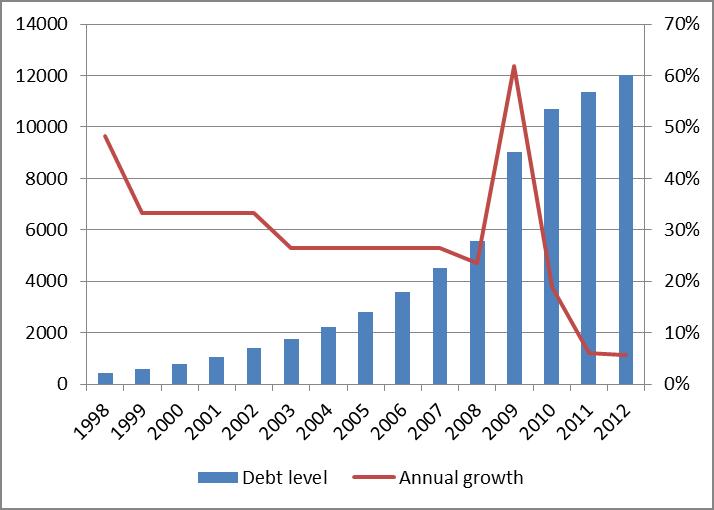
Here is what the FT says:

lg debt lg debt growth lg2

China will conduct an urgent audit of all government debt, underlining concerns over rising financial risks in the world’s second-biggest economy.

The National Audit Office said in a one-line statement on Sunday that it had been instructed by the state council, China’s cabinet, to come up with a tally of how much money is owed by all levels of government from villages up to central authorities.

So why do we ask the question in the title? Because this would be the third audit report on local government debt, only one month after the last report was published, and it comes much earlier than everyone expected, including the National Audit Office (NAO) itself. Two audits have been done on this subject so far. The first audit covering more than 3000 local governments was conducted from March to May in 2011 and the report was published in June 2011. Thesecond audit was done on a much smaller scale as it only included 36 local governments. It was done during November 2012 to February 2013 and a report was published on June 10th, just a month ago. According to the information provided by the People’s Daily, the official newspaper of the Party (in Chinese, for English see the FT report), the third round of the audit was required by the State Council and it will start immediately on August 1st. The NAO has called off other projects to focus on this one and many auditors were asked to cancel their holidays.  Read more of this post