Mandela’s lessons in how to negotiate; You don’t need to be friends with the other side but you do need to keep talking

July 31, 2013 3:22 pm

Mandela’s lessons in how to negotiate

By Michael Skapinker

You don’t need to be friends with the other side but you do need to keep talking

Assessments of Nelson Mandela’s achievements rightly focus on his talent for the conciliatory gesture and South Africa’s relative post-apartheid peace and institutional stability. (If you contest the last two, compare the country with Syria,Egypt or even Russia.) Less often discussed are the long negotiations that produced a political settlement. They are worth recalling as Israelis and Palestinians return to tentative talks. And, although similarities between politics and business should not be overdone, anyone involved in negotiations, whether between unions and management, or over a corporate merger, or even an office desk reshuffle, should consider the lessons ofSouth Africa’s transition. What are they?  Read more of this post
Tocqueville’s Francois Sicart: Chinese entrepreneurs asked why, when we hold large cash balances and effect few transactions, they should still pay us. I answered that periods like this are when we work the hardest to uncover the next winning idea.

What is the Contrary of Tepid? Investing in a Market that Lacks Conviction

François Sicart

The problem with the contrarian approach to investing is that it works best when investor sentiment reaches extreme levels, such as panic or euphoria.  It is not as useful when the majority of investors are somewhat worried or complacent, as they are today. This is why, to fine-tune our discipline, we try to use both a contrarian and a value approach, a combination that we have creatively labeled “contrarian value.”  Most of the time the two approaches should go pretty well hand-in hand:  The nature of a market is that when investors become excessively pessimistic, the price of assets like stocks should become excessively cheap.  When investors become excessively optimistic, asset prices should become excessively expensive.  The problem lies in defining “excessively.” Read more of this post

Why Tinkering Too Much with Your Portfolio Won’t Pay Off

Why Tinkering Too Much with Your Portfolio Won’t Pay Off

Published: July 31, 2013 in Knowledge@Wharton

Investors run the gamut, from fire-and-forget types who buy mutual funds and leave them alone for decades, to fussbudgets who watch their portfolios minute by minute, ready to buy or sell with every up and down. But is there a golden mean that would allow the investor to act when it will really pay off, while avoiding counterproductive tinkering? Common sense says that this “Goldilocks” zone must exist, but theorists have had a hard time nailing it down, says Wharton finance professor Andrew B. Abel. “It was a mathematical nightmare,” he notes. Read more of this post

Got a New Strategy? Don’t Forget the Execution Part

Got a New Strategy? Don’t Forget the Execution Part

Published: July 31, 2013 in Knowledge@Wharton

When it comes to executing strategy, the old saying “the devil is in the details” holds true for many companies, according to Wharton emeritus management professor Lawrence G. Hrebiniak. While executives may readily participate in the development of new strategies, execution tends to get short shrift, because it is often viewed as a lower-level task or concern, he notes. In the following interview, Hrebiniak — who just published the second edition of his book, Making Strategy Work: Leading Effective Execution and Change — explains why it’s critical for firms to create a “culture of execution” in order to succeed. Read more of this post

Seven dirty, gritty, real startup lessons that cost me $2 million

Seven dirty, gritty, real startup lessons that cost me $2 million

BY PABLO FUENTES 
ON JULY 31, 2013

As CEO and founder of a company that makes an app that helps people apply to jobs from their mobile phones, I am happy to report that we’ve sucked a lot since launching in 2009. We’ve pivoted four times, a fact the press won’t let me forget. I’ll spare you the details, but it involved multiple layoffs, a founder split, brief homelessness, extended brokenness, multiple bridge rounds, a broken engagement, and other personal and professional obstacles. Along the way, we iterated our way to product-market fit, have solid growth in both users and engagement, and recently raised more funding. But getting here has been brutal. Read more of this post

How powerful were caught by own cover-up

How powerful were caught by own cover-up

PUBLISHED: 16 HOURS 30 MINUTES AGO | UPDATE: 2 HOURS 14 MINUTES AGO

Businessman and BRW Rich List member Travers Duncan of White Energy is one of five men who ICAC has found lied and misled to cover up former NSW Labor minister Eddie’s Obeid’s actions. All have been referred to the NSW prosecutor. Photo: Nic Walker

NEIL CHENOWETH

Independent Commission Against Corruption commissioner David Ipp QC has handed down the most important corruption report in nearly three decades. Some of the richest men in the country face possible criminal charges for a cover-up. Ipp found they lied and misled in order to hide the corrupt involvement of Labor powerbroker Eddie Obeid in a coal deal, to protect their own payout of more than $500 million. Read more of this post

A team of Chinese scientists have discovered that urine can be used to grow new teeth

Extracting the urine: Chinese scientists find new way to grow teeth

Staff Reporter

2013-07-31

A team of Chinese scientists have discovered that urine can be used to grow new teeth. The results published in the Cell Regeneration Journal revealed that urine may be used as a source of stem cells that could in turn be grown into tiny tooth-like tissue. The scientists at the Guangzhou Institutes of Biomedicine and Health hope that the technique could be developed into a way of replacing lost teeth. The research team said they used urine as a starting point and harvested cells that are normally passed from the body before coaxing the collected cells into stem cells. A mix of these stem cells and other cells from a mouse was then implanted into test animals and after three weeks the bundle of cells began resembling a tooth. Read more of this post

People like Facebook because it’s like gambling; “It’s Not About Winning, It’s About Getting Into the Zone. A sense of monetary value, time, space, even a sense of self is annihilated in the extreme form of this zone that you enter.”

People like Facebook because it’s like gambling

By Alexis Madrigal, The Atlantic 10 hours ago

“People love Facebook. They really love it,” Biz Stone wrote earlier this month. “My mother-in-law looks hypnotized when she decides to put in some Facebook time.” She is not the only one. ComScore estimates Facebook eats up 11 percent of all the time spent online in the United States. Its users have been known to spend an average of 400 minutes a month on the site. I know the hypnosis, as I’m sure you do, too. You start clicking through photos of your friends of friends and next thing you know an hour has gone by. It’s oddly soothing, but unsatisfying. Once the spell is broken, I feel like I’ve just wasted a bunch of time. But while it’s happening, I’m caught inside the machine, a human animated GIF: I. Just. Cannot. Stop. Or maybe it’ll come on when I’m scrolling through tweets at night before bed. I’m not even clicking the links or responding to people. I’m just scrolling down, or worse, pulling down with my thumb, reloading, reloading. Read more of this post

A Dog’s Facial Expression Shows Its Mood

A Dog’s Facial Expression Shows Its Mood

Dogs use specific facial expressions to show how happy they are to see their owners, scientists have found.

By Richard Gray, Science Correspondent

3:39PM BST 30 Jul 2013

While most dog owners will recognise their pet’s wagging tail as a sign of joy, they may also want to pay more attention to their animal’s face the next time they walk in through the front door. Animal behaviour experts have found the animals’ emotions are betrayed by specific facial movements that can reveal whether your dog really is pleased to see you. Using high-speed cameras, the researchers tracked the changes in the faces of dogs in the moments they were reunited with their owners or when meeting a stranger for the first time. They found that the dogs tended to move their left eyebrow upwards around half a second after seeing their owner. Read more of this post

This One Tweet Reveals What’s Wrong With American Business Culture And The Economy

This One Tweet Reveals What’s Wrong With American Business Culture And The Economy

HENRY BLODGET JUL. 31, 2013, 12:18 PM 23,960 175

If you watch TV, you’ll be led to believe that the problem with the U.S. economy is that one political team or the other is ruining the country. A sharp drop in government spending this year is, in fact, temporarily hurting economic growth, but that’s not the real problem. The real problem is that American corporations, which are richer and more profitable than they have ever been in history, have become so obsessed with “maximizing short-term profits” that they are no longer investing in their future, their people, and the country.

This short-term corporate greed can be seen in many aspects of corporate behavior, from scrimping on investment to obsessing about quarterly earnings to fretting about daily fluctuations in stock prices. But it is most visible in the general cultural attitude toward average employees. Employees are human beings. They are people who devote their days to creating value for two other groups of people: customers and shareholders.  And, in return, at least in theory, they are people who share in the rewards of the value created by their team. In theory. In practice, American business culture has become so obsessed with maximizing short-term profits that employees aren’t regarded as people who are members of a team.  Rather, they are regarded as “costs.” Read more of this post

Snapchat Lawsuit Details How One Founder Discovered He Had No Equity In The Company — Which Is Now Worth $800 Million

Snapchat Lawsuit Details How One Founder Discovered He Had No Equity In The Company — Which Is Now Worth $800 Million

JIM EDWARDS JUL. 31, 2013, 7:06 PM 3,872 6

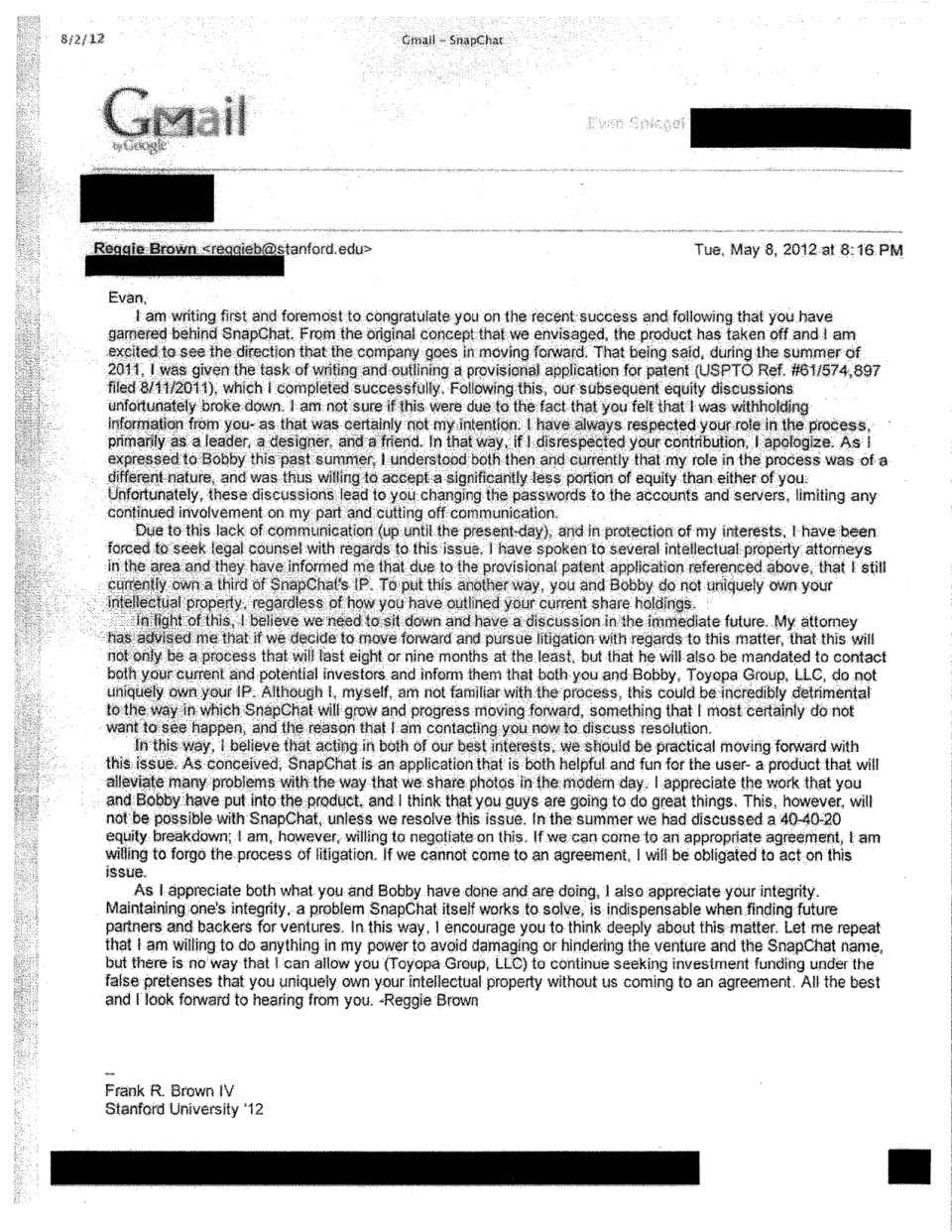
brown-may-8-2012-email-copy

Frank “Reggie” Brown, the ousted third alleged founder of Snapchat, never had equity in the company even though he allegedly came up with the idea for the disappearing messages app, filed for its patent, and had some role in designing the company’s logo, according to Techcrunch. Brown is suing CEO Evan Spiegel and CTO Bobby Murphy for one third of the super-hot company, which is valued at $800 million. The story is complicated, as lawsuits tend to be. Basically, Brown was intimately involved with the founders of Snapchat right at the beginning. How much work he actually did for the company is in dispute. Read more of this post

Steve Sinofsky, Microsoft’s former Windows chief, was one of the people who warned Bill Gates in the 1990s about the potential impact of the internet on Microsoft’s software-based business

Microsoft Is Paying Steven Sinofsky $10 Million Not To Work For Apple, Amazon, Facebook, Or Google

CHARLES ARTHUR, THE GUARDIAN JUL. 31, 2013, 7:57 AM 3,642 5

Steve Sinofsky, Microsoft’s former Windows chief who was dramatically ousted last November, is banned from joining former rivals including Apple, Amazon, Facebook, Google, database giant Oracle, storage company EMC or virtualisation company VMWare before 2014, new documents reveal. Sinofsky is in line for a payoff that will earn him more than $10m (£6.6m) according to calculations by the Guardian, covering 418,000 share options that were due to vest through to mid-2016. The agreement also bans him from trying to persuade a list of companies including IBM, Dell, Intel and Nokia from ceasing to be Microsoft customers. Read more of this post

Walgreen gets a modern makeover; CEO Greg Wasson is expanding the retailer’s mission and taking it global.

Walgreen gets a modern makeover

By Geoff Colvin, senior editor-at-large  @FortuneMagazine July 31, 2013: 12:24 PM ET

greg-wasson-ceo-of-walgreens-poses-in-a-newly-opened-duane-reade-store-in-new-york-february-17-2010

Greg Wasson wants Walgreen to offer more — and better — services.

As the digital revolution remakes retailing and the Affordable Care Act transforms health care, drugstores need fresh thinking.Walgreen (WAG, Fortune 500) CEO Greg Wasson, 54, is bringing it to America’s largest retail pharmacy chain, with some 8,300 locations (as Walgreens, Duane Reade, and a few other names regionally). Last summer he bought 45% of the U.K.’s Alliance Boots, becoming the first U.S. drug chain to expand abroad, and in March he signed a distribution deal with AmerisourceBergen, a drug wholesaler. He’s also reimagining his stores. Sushi bars? Beauty consultants? He’s trying them out. Wasson spoke recently with Geoff Colvin about turning drugstores into primary-care providers, serving more economically strapped customers, selling groceries, and much else. Edited excerpts: Read more of this post

For surgery, big and famous hospitals aren’t always the best

For surgery, big and famous hospitals aren’t always the best

8:25am EDT

By Sharon Begley

NEW YORK (Reuters) – Patients going to a hospital for surgery care about many things, from how kind the nurses are to how good the food is, but Consumers Union (CU) figures what they care about most is whether they stay in the hospital longer than they should and whether they come out alive. In the first effort of its kind, the nonprofit publisher of Consumer Reports magazine released ratings of 2,463 U.S. hospitals in all 50 states on Wednesday, based on the quality of surgical care. The group used two measures: the percentage of Medicare patients who died in the hospital during or after their surgery, and the percentage who stayed in the hospital longer than expected based on standards of care for their condition. Both are indicators of complications and overall quality of care, said Dr John Santa, medical director of Consumer Reports Health. Read more of this post

India’s Poor Drain ‘Impure’ Blood to Cure Ills

India’s Poor Drain ‘Impure’ Blood to Cure Ills

By Rupam Nair on 1:30 pm July 31, 2013.
New Delhi. Mother-of-three Lilavati Devi stands perfectly still in the hot sun in Old Delhi as a practitioner and his assistants check the veins in her hands. Then, armed with razor blades, the practitioner slices neatly into her skin and lets the “impure blood” drain out. Devi suffers from chronic arthritis and firmly believes that her elderly “doctor” or practitioner, Mohammed Gyas, has the skills to cure her and others through the ancient treatment of bloodletting. “Science and modern medicine have failed,” Devi tells AFP, as an assistant pours cold water on her bleeding hands and sprinkles them with a grey-colored herbal powder. The 82-year-old Muslim man’s treatment “has been the only way to end the severe joint pain,” she says. Read more of this post

Amazon Is Raking In A Huge Amount Of Profit On Its Cloud, Competitor Says

Amazon Is Raking In A Huge Amount Of Profit On Its Cloud, Competitor Says

JULIE BORT JUL. 31, 2013, 7:31 PM 1,886 3

Amazon is notoriously tight-lipped when talking about its cloud business. It’s cloud prices are cheap and the company has vaguely said it keeps prices low by charging a low margin of profit. But the folks at cloud computing competitor ProfitBricks say that Amazon’s low margins are a myth. They say that the company is really making 60-80% profit. To prove that, ProfitBricks cut its prices in half on Wednesday, to a measly 3.25 cents an hour for compute time including 1G RAM (yes, less than 4 cents). And it says at that rate, it’s still making plenty of profit. This compares to somewhere between 6 cents and 60 cents an hour for Amazon.  Read more of this post

The trouble with Zuckism

The trouble with Zuckism

KEVIN KELLEHER 
ON JULY 31, 2013

zuckism1

If no one ever complained about lies, damn lies, and anecdotal evidence, it’s because no one ever had to. Our reliance on numbers, math, and the order they impose on the messier parts of the business world make stats necessary, if sometimes also the subject of skepticism. Whenever we feel especially skeptical, we lean on anecdotal evidence as a kind of correction. A pretty much imperfect correction. Read more of this post

Fab.com Raises $10M From Singaporean Telecom Giant SingTel at $1 billion valuation; Fab.com’s layoffs in Europe also come at a time when some reports have been critical of Fab.com’s missteps, as well as its company highhanded culture

Eyeing Potential Growth In Asia, Fab Raises $10M From Singaporean Telecom Giant SingTel

LEENA RAO

posted 2 hours ago

Amidst layoffs, and shortly following a new $150 million round in new funding, Fab is announcing an additional contribution to its Series D round of financing. Singaporean telecommunications giant SingTel Group has put $10 million into Fab, and according to the design-focused ecommerce company, the Asian company will will be a key partner wIn helping Fab explore expansion opportunities in Asia. CEO and co-founder Jason Goldberg explains that SingTel will be instrumental in helping Fab expand to Asian markets. He writes: He also addressed some of the changes taking place at the company, namely the layoffs and ditching the flash sales model: Most importantly, we announced the centralization of our operations at our New York headquarters, underscoring our shift from a flash sales model to more of a comprehensive global online lifestyle shop. We have momentum, we have growth, we have a solid team in place, and we have millions of customers worldwide that we want to continue to fall in love with Fab.SingTel has a lot in common with Fab – they serve a growing, young, and sophisticated population of consumers who are looking for lifestyle products to reflect their optimistic, dynamic and vibrant approach to life. That matches well with the predominantly 25-45-year-olds who come to Fab to browse and buy unique and compelling items they’ll live with in their homes, wear, and gift. Read more of this post

For nuns and analysts alike, bank commodity earnings are a mystery; Goldman relents in metals warehousing row

For nuns and analysts alike, bank commodity earnings are a mystery

1:43am EDT

By Cezary Podkul

NEW YORK (Reuters) – When the Reverend Seamus Finn got an email from Goldman Sachs last week, the giant Wall Street bank was addressing an issue that was already on his mind. “We were getting ready to go back to them and talk to them about commodities anyway,” said Finn, who heads up faith-consistent investing for the Missionary Oblates, a Washington DC-based Catholic group that owns Goldman shares. Read more of this post

New Tools for Keeping the Lights On; New instruments have been installed to try to prevent another huge power failure like the one that cut off electricity for 50 million people in 2003

July 31, 2013

New Tools for Keeping the Lights On

By MATTHEW L. WALD

RENSSELAER, N.Y. — After the lights went out for 50 million people from the Northeast to the Midwest on Aug. 14, 2003, investigators found readings from two obscure instruments that would have given them an hour’s warning — plenty of time to solve the problem if the devices had been wired to provide a stream of critical data. Now, a decade after the largest blackout in American history, engineers are installing and linking 1,000 of those instruments, called phasor measurement units, to try to prevent another catastrophic power failure. When the work is done, the engineers say, they will have a diagnostic tool that makes the old system seem like taking a patient’s pulse compared with running a continuous electrocardiogram. Read more of this post

Chromecast, Simply and Cheaply, Flings Web Video to TVs

July 31, 2013

Chromecast, Simply and Cheaply, Flings Web Video to TVs

By DAVID POGUE

POGUE-JP1-articleLarge

A demonstration of Google’s Chromecast, which can display Netflix and YouTube on your television.

Ever hear the old saying, “Information wants to be free?” Well, here’s a corollary for you: “TV wants to be à la carte.” Take the story of the iTunes store. The instant somebody offered the chance to buy songs individually, the world changed forever. Hello, music à la carte. Goodbye, Tower Records. Now it’s cable TV’s turn. We are engaged in a great civil movement, testing whether that business, or any business so conceived and so dedicated, can long endure. The number of people who cut the cord, or cancel the satellite, in favor of getting all their TV from the Internet is still small — maybe 1 percent of us a year. But the online alternatives to cable TV are growing. And once it becomes simple and easy to get Internet video from our laptops and phones to the actual television, well, the term “TV drama” will have a whole new meaning. Read more of this post

Hong Kong watchdog cracks down on China Metal Recycling, a $1.43 billion company that describes itself as China’s largest recycler of scrap metal

Hong Kong watchdog cracks down on China Metal Recycling; bankers wary

5:00pm EDT

By Rachel Armstrong

SINGAPORE, Aug 1 (Reuters) – Hong Kong’s securities regulator has taken one of its most draconian actions ever and asked the courts to liquidate a listed company, a move that could be the first of several as the watchdog hardens its stance against alleged market misconduct. The Securities and Futures Commission (SFC) says it has evidence that China Metal Recycling, a $1.43 billion company that describes itself as China’s largest recycler of scrap metal, exaggerated its financial position when it listed in Hong Kong in 2009. The case, which comes up for its next hearing in Hong Kong on Friday, underscores the SFC’s resolve to restore investor confidence to what was the world’s busiest IPO market at a time when offerings have dried up due to volatile trading conditions, China’s waning economic growth and regulatory concerns. Read more of this post

China banks could see bad loans rise in 2013 due in part to delinquency risks from industries plagued by overcapacity

Updated: Wednesday July 31, 2013 MYT 5:01:18 PM

China banks could see bad loans rise in 2013-industry body

BEIJING (Reuters): Bad loans at Chinese banks could rise by between 70 billion yuan and 100 billion yuan ($11 billion and $16 billion) in 2013 due in part to delinquency risks from industries plagued by overcapacity, the China Banking Association said in an annual report on the industry. The report comes several days after Beijing began a new campaign to reduce overcapacity in several industries, a step seen as key to eventually rebalancing China’s economic structure. It warned that steel, photovoltaic and shipping sectors may be at the forefront of a new crop of bad loans. “Such industries facing excessive capacity could lift non-performing loans and require highest attention from banks in their short-term risk control,” the industry body said in the report, published on its website late on Tuesday. Read more of this post

China’s Cadres Balk at Showing the Money; For All the Corruption-Campaign Fanfare, Efforts to Get More Insight Into Officials’ Assets Appear to Suffer a Backlash

July 31, 2013, 7:41 p.m. ET

China’s Cadres Balk at Showing the Money

For All the Corruption-Campaign Fanfare, Efforts to Get More Insight Into Officials’ Assets Appear to Suffer a Backlash

JAMES T. AREDDY

WO-AO797A_CASSE_NS_20130731183317

SHANGHAI—Chinese President Xi Jinping stripped away some traditional privileges of government service when he took office. But even as his administration frowns on banqueting and fancy cars, it is defending a fundamental entitlement of Chinese public service: concealed wealth. Almost no Chinese official tallies his investments and net worth in ways that make the information accessible to the public. Now, there are indications that Mr. Xi’s government is stepping up efforts to keep it that way. In addition to the apparent resealing of once-available data, Chinese authorities also appear to be cracking down on transparency advocates as political dissidents. Read more of this post

Bond Slump Saddles Big Banks; Large Banks Can’t Avoid Trouble When Interest Rates Rise

July 31, 2013, 3:22 p.m. ET

Bond Slump Saddles Big Banks

Large Banks Can’t Avoid Trouble When Interest Rates Rise

DAN FITZPATRICK and SHAYNDI RAICE

The recent market turmoil exposed a new weakness in the balance sheets of large banks: they hold so many bonds that they can’t avoid trouble when interest rates rise. When long-term rates jumped by a full percentage point in May and June amid worries the Federal Reserve would taper its bond-buying stimulus program, bank investments in mortgage-backed securities and Treasuries got slammed. J.P. Morgan ChaseJPM +0.72% & Co., Bank of America Corp., BAC +0.55% Citigroup Inc. C +0.70%and Wells Fargo WFC +0.55% & Co. saw a measure of the paper value of these holdings fall by more than $13 billion during the second quarter. Read more of this post

Angry and powerless in China

Angry and powerless in China

Thursday, August 1, 2013 – 10:21

New Straits Times

According to the Chinese Constitution, “the People’s Republic of China is a socialist state … led by the working class and based on the alliance of workers and peasants”. Taken literally, that should mean that people such as farmers and migrant workers are the masters of the country. But, as events show, such is not the case; in fact, quite the contrary.

On July 20, Ji Zhongxing, originally a farmer from Shandong province but now paralysed from the waist down and unemployable, detonated a home-made bomb at the Capital International Airport in Beijing, losing his left hand in the process. However, after six frustrating years, he has finally succeeded in getting the attention of officialdom. Read more of this post

US failures could teach China’s automakers how to succeed

US failures could teach China’s automakers how to succeed

Wednesday, July 31, 2013

In early 20th-century China, personal transportation didn’t get much better than a rickshaw. On the other side of the world, automakers like Winton Motor Carriage Company in Cleveland, Ohio were bringing automobiles to the masses. By 1924, however, Winton was out of business. An inability to produce enough cars to meet national demand helped bankrupt the company as the major US automakers grew stronger. Nearly 100 years later, as China’s car market experiences an auto boom similar to that of the US, small mainland automakers may find themselves in a similar position as they struggle to serve the growing needs and requirements of today’s Chinese car buyers. China now has more than 170 automakers. That’s roughly comparable to the more than 250 car manufacturers in the US just after the turn of the century. Like Winton, many of the Chinese firms are small, local ventures with production capacities that pale in comparison to the major automakers. Read more of this post

Chinese mobile games: fit to burst?

Chinese mobile games: fit to burst?

Jul 31, 2013 4:23pm by Lydia Guo

Shanghai is having a particularly hot summer this year but that didn’t stop game lovers by the tens of thousands from queuing up to get into ChinaJoy 2013 – The 11th China Digital Entertainment Expo & Conference. “Everyone was talking about mobile games this year,” says Xue Yongfeng of consulting firm Analysys. He says China’s mobile games industry is booming – creating a bubble that’s likely to burst next year. The mobile games industry developed quickly in 2012. Sun Shoushan of China’s Administration of Press, Broadcasting Stations and Radio said in a speech at the event that revenues had surged more than 90 per cent to Rmb3.24bn ($530m); in the first half of this year, revenue from mobile games more than doubled. Read more of this post

Old newspaper era is over, Obama says via Kindle

Old newspaper era is over, Obama says via Kindle
He says the old way of doing business is gone forever.

AFP | 01-08-13

WASHINGTON – President Barack Obama acknowledged the problems facing the US newspaper industry on Wednesday, ironically in an interview that was distributed via online retail giant Amazon’s Kindle e-reader. With the Internet dominant and print sales in decline, Obama said traditional media was grappling with a new reality and, much like the manufacturing and retail sectors, the old way of doing business was gone forever. “People trying to get into the middle class are having a tougher and tougher time,” Obama said. “You see that in every profession. You see that in journalism. It used to be there were local newspapers everywhere. “If you wanted to be a journalist, you could really make a good living working for your hometown paper. “Now you have a few newspapers that make a profit because they’re national brands, and journalists having to scramble to piece together a living, in some cases as freelancers and without the same benefits that they had in a regular job for a paper.” The US newspaper industry has suffered the same problems which have hit papers worldwide, notably falling sales and a collapse in advertising revenues due to the growth of online classified ads. Several major metropolitan newspapers have closed their doors in recent years or ceased publishing print editions. Others have slashed editorial staff. “What’s true in journalism is true in manufacturing and is true in retail,” Obama said. “What we have to recognise is that those old times aren’t coming back.”

Alarm bells for crowdfunding as bubble pops for soap start-up

July 31, 2013 6:16 pm

Alarm bells for crowdfunding as bubble pops for soap start-up

By Lucy Warwick-Ching, Tanya Powley and Elaine Moore

One of the first companies to raise money via crowdfunding in the UK has ceased trading, sounding alarm bells for investors in what has become one of the fastest growing investment areas in the country. Bubble & Balm, a fair trade soap manufacturer, was the first start-up to raise money via equity crowdfunding platform Crowdcube, in 2011. It raised £75,000 in return for 15 per cent of the company’s equity from 82 investors, who contributed between £10 and £7,500 each. As part of the deal investors were also in line to receive free soap and discounted products. Read more of this post