Michael O’Leary, the outspoken CEO of Ireland’s Ryanair, is fanatical about making air travel affordable for the masses

SATURDAY, JULY 27, 2013

No Frills, and No Excuses

By JONATHAN BUCK | MORE ARTICLES BY AUTHOR

Michael O’Leary, the outspoken CEO of Ireland’s Ryanair, is fanatical about making air travel affordable for the masses. He’s pretty keen on rewarding shareholders, too. The pitch for owning Aer Lingus.

Brash, cocky, outrageous? Michael O’Leary, chief executive of Ireland’s Ryanair, has been called all that and more. And no wonder. He dressed as the Pope when his airline opened a new route to Rome. He wants to charge passengers who stand in line to use the bathroom on his fleet of Boeing 737-800s. And—get this—he has offered to donate the levy to charity “for incontinence, or something like that.” Read more of this post

Launch of Lee Kuan Yew’s new book: One Man’s View of the World

Launch of Lee Kuan Yew’s new book

20130729_leekuanyew_book_sph_myp

Monday, July 29, 2013 – 10:45

AsiaOne

SINGAPORE – Straits Times Press, the book publishing unit of Singapore Press Holdings (SPH), announced today the launch of Mr Lee Kuan Yew’s new book. Titled One Man’s View of the World by Lee Kuan Yew, the 400-page volume conveys Mr Lee’s views on the future of the major powers and regions of the world. The book is made up of 11 chapters. The first seven cover countries or regions: China, the United States, Europe, other Asian powers (Japan, India and Korea), South-east Asia, Singapore and the Middle East. Mr Lee also gives his views on the global economy and energy and climate change. Read more of this post

End game in property wait; Hong Kong Monetary Authority announced 27 cases of negative equity involving residential mortgage loans, the first time that negative equity has reared its ugly head since June last year

End game in property wait
Mary Ma
Monday, July 29, 2013
The Hong Kong Monetary Authority announced that as at the end of June, there were 27 cases of negative equity involving residential mortgage loans. This is the first time that negative equity has reared its ugly head since June last year. It would be imprudent to say the resurgence of negative equity cases is alarming, as they mainly related to mortgages with unusually higher loan- to-value ratios. But it’s still a development that shouldn’t be ignored. Following the property market crash during the 2003 SARS outbreak, many homeowners were trapped in negative equity. Nobody wants to see that again. Now, everyone is asking the same question – have home prices peaked? Read more of this post

Joseph Wong Chong-chun leads his family business as chairman and chief executive of Stelux to become one of the three largest watch makers in Hong Kong

Man on a mission
Natalie Ngan
Monday, July 29, 2013

6_2013072819323160578Stelux02

The boss of one of the leading watch makers and retailers in town did not exactly start out as a timepiece fan. “I didn’t know how to appreciate watches when I was young,” says Joseph Wong Chong-chun, who leads his family business as chairman and chief executive of Stelux Holdings International (0084). “But my dad gave me one before I went to Britain for university. That’s when I developed a liking for watches.” Wong got a bachelor’s degree in industrial engineering from the University of Bradford, and a master’s in operational research from the University of Southampton. His father Wong Chue-meng was the founder of Stelux, which started making watch components in 1963 and grew to become one of the three largest watch makers in Hong Kong. Read more of this post

Giorgio Riello’s account of the history of cotton reveals much about globalisation

July 28, 2013 3:43 pm

A rich picking for the re-emerging powers

Review by James Crabtree

Giorgio Riello’s account of the history of cotton reveals much about globalisation

images (23)

Cotton: The Fabric that Made the Modern World, by Giorgio Riello,Cambridge University Press, RRP£25/$35

The skyline of south Mumbai is dominated by imposing neo-gothic buildings, with ornate turrets and grinning gargoyles that might look more at home in Manchester or London than the financial capital of modern India. These incongruous edifices at first seem to be the likely result of simple colonial ambition (some might say of excess). But the impetus behind their construction actually came from a more unlikely commercial source: the global cotton trade. Read more of this post

Peter Drake gave himself a $26 million loan before his $3 billion mortgage fund empire, LM Investments, collapsed in March.

LM fund gave loan to Drake

July 29, 2013

Michael West

peter-drake

Peter Drake gave himself a $26 million loan before his mortgage fund empire, LM Investments, collapsed in March.

Adding this to other loans, including a $16 million loan to a Hong Kong company controlled by the Kiwi-born businessman, and it appears that Drake owes LM at least $46 million and is headed for bankruptcy. Drake brought a defamation action against Fairfax Media and the author of this story before the collapse of his $3 billion fund empire. Read more of this post

Investors Are Lab Rabbits in Central Bank Experiments

Investors Are Lab Rabbits in Central Bank Experiments

The European Central Bank and Bank of England are emulating Ben S. Bernanke’s experiment in offering monetary-policy guidance to financial markets. Investors could well end up being the guinea pigs. Bond prices have fluctuated during the last three months, with the yield on the 10-year Treasury note swinging from 1.63 percent to 2.74 percent, the fastest jump since 2010, as the Federal Reserve chairman struggled to provide a clearer picture of when and why the central bank will reduce and then end its asset purchases.

“If this is science, then we’re the little white lab rabbits,” said Vincent Reinhart, chief U.S. economist for Morgan Stanley in New York, who served as the Fed’s chief monetary-policy strategist from 2001 to 2007. Read more of this post

Heart Surgery in India for $1,583 Costs $106,385 in U.S.

Heart Surgery in India for $1,583 Costs $106,385 in U.S.

Devi Shetty is obsessed with making heart surgery affordable for millions of Indians. On his office desk are photographs of two of his heroes: Mother Teresa and Mahatma Gandhi.

Shetty is not a public health official motivated by charity. He’s a heart surgeon turned businessman who has started a chain of 21 medical centers around India. By trimming costs with such measures as buying cheaper scrubs and spurning air-conditioning, he has cut the price of artery-clearing coronary bypass surgery to 95,000 rupees ($1,583), half of what it was 20 years ago, and wants to get the price down to $800 within a decade. The same procedure costs $106,385 at Ohio’s Cleveland Clinic, according to data from the U.S. Centers for Medicare & Medicaid Services. Read more of this post

The Benefit of Hindsight: New rules allow ETFs to market back-tested data, but the practice is mired in murky practices that don’t benefit most investors

SATURDAY, JULY 27, 2013

The Benefit of Hindsight

By SARAH MAX | MORE ARTICLES BY AUTHOR

New rules allow ETFs to market back-tested data, but the practice is mired in murky practices that don’t benefit most investors.

Hindsight is 20/20. So it’s easy to see why investors might be kicking themselves for not investing in the PowerShares S&P 500 Low Volatility Portfolio (ticker: SPLV) in 2008. Over the past five years, the index this exchange-traded fund tracks has returned 11.7% a year — considerably better than the S&P 500’s 8.5%. There’s just one hitch: That index didn’t exist five years ago, and those returns are mostly hypothetical. Read more of this post

Hedge funds gripped by crisis of performance

July 28, 2013 12:33 pm

Hedge funds gripped by crisis of performance

By Dan McCrum in New York

Hedge funds have a performance problem. Since the turn of the decade, Wall Street’s master stock pickers have spectacularly failed to beat the market. The crisis of performance comes as the industry is under intense scrutiny over the source of past returns, with SAC Capital facing criminal insider trading charges that threaten to undermine the record of one of the world’s most successful hedge funds. The firm says it has done nothing wrong. While many hedge funds fared better than the stock market during the financial crisis, and rode the 2009 recovery back to health, they have been confounded by sometimes violent market moves over subsequent years. Read more of this post

Hollywood’s Reliance on Sequels Makes for a Pallid Picture

July 26, 2013, 7:06 p.m. ET

Hollywood’s Reliance on Sequels Makes for a Pallid Picture

ERICH SCHWARTZEL

Hollywood is having a problem with numbers. To get lucrative sequels, studios have to score with original hits, but this summer the biggest movies have titles that end in a 2 or 3. Even more than in recent years, audiences haven’t bought into original concepts despite record-setting efforts to offer big-budget features that generate healthy international ticket sales—and, down the road, ready-made sequels. Several weekends of expensive misses have some in the industry talking about “tentpole” fatigue. Moreover, the glut of megabudget flicks meant to hoist Hollywood’s fortunes is shortening the time studios can capture audiences, especially for a poorly reviewed movie. Hollywood’s dependence on sequels and franchises, particularly in the summer, is hardly new, but this season’s numbers put the issue into sharp relief. Read more of this post

The historic merger between Publicis andOmnicom that will create the world’s largest advertising and marketing services group by revenues is a bold bet that size matters in a new media world that is increasingly controlled by technology

Last updated: July 28, 2013 8:14 pm

Leviathan scrambles to connect with audience

By Emily Steel, Andrew Edgecliffe-Johnson, Adam Thompson

The historic merger between Publicis andOmnicom that will create the world’s largest advertising and marketing services group by revenues is a bold bet that size matters in a new media world that is increasingly controlled by technology. Gone are the advertising’s Mad Men days when creative shops such as Publicis’ Leo Burnett developed campaigns for the Marlboro Man. Today’s marketers are scrambling to connect with consumers amid the proliferation of media and mobile devices. Read more of this post

Procter & Gamble: Time to freshen up; Investors are hoping that AG Lafley will unveil plans to reinvigorate the company

July 28, 2013 3:27 pm

Procter & Gamble: Time to freshen up

By Barney Jopson

Investors are hoping that AG Lafley will unveil plans to reinvigorate the company

Nick Mangold, a burly American footballer, eases his 6ft 4in frame into a barber’s chair and lets the Gillette whisker trimmer get to work on his bushy beard. The New York Jets star is in Greenwich Village as a celebrity spokesman for Procter & Gamble, which counts Gillette as one its many brands. But a clean cut is not on the cards. “I’m not a complete shave guy, as your eyes will attest,” he says. The Fusion ProGlide Styler, a $19.99 razor-cum-trimmer, helps ensure “the wife won’t kill me”, Mr Mangold explains, but his strawberry blonde beard still bears hints of the unruly haystack to which it was once likened. For P&G, beards are big business. But this pillar of corporate America is in need of more than a trim. With a market value of $223bn, it has long been the gold standard in inventing, packaging and advertising high-end products to clean hair, bodies, clothes and dishes. But the personal and household products group has reached a defining juncture in its 175-year history. In both developed and emerging economies, it faces consumer markets that are more cost-conscious, commoditised and volatile. Analysts, long in awe of its consistently high performance, are now asking: has the P&G playbook run its course? Read more of this post

Betting on start-ups can revive a tired presidency; Making things easier for risk-takers is a way to reach elusive economic goals

July 28, 2013 5:17 pm

Betting on start-ups can revive a tired presidency

By Edward Luce

Making things easier for risk-takers is a way to reach elusive economic goals

George W Bush was supposed to have said: “The problem with the French is they don’t have a word for entrepreneur.” Unfortunately he never said it (though he really should have). Today’s Washington is also ambivalent about the French word. In a bitterly gridlocked town, every politician still pays lip service to small businesses. Yet by turning a blind eye to the needs of struggling entrepreneurs, the town is conniving in their declining fortunes. President Barack Obama would help his embattled presidency and the US economy if he embraced the cause of America’s entrepreneurs. Read more of this post

Industrial giant GE is trying to do business in just-opened Myanmar, where they badly need the stuff it makes and sells. So why is this storied multinational struggling?

Why GE’s Myanmar Venture Has not been Easy

by Simon Montlake | Jul 29, 2013

img_71023_ge_last_frontier US_Cross Border_GE’s Last Frontie.indd

The industrial giant is trying to do business in just-opened Myanmar, where they badly need the stuff it makes and sells. So why is this storied multinational struggling?

In the midday haze outside the Thingaha Hotel in Naypyidaw, the new capital of Myanmar, the national flag droops alongside the Stars and Stripes and General Electric’s corporate logo. Inside the Grand Ballroom the staff scurries with last preparations for a meticulously planned gala dinner. Heading up this coming-out party is Stuart Dean, a blue-eyed, rawboned American and GE’s chief for Southeast Asia. Read more of this post

H&M Aiming to Catch Zara With Delayed American Web Push

H&M Aiming to Catch Zara With Delayed American Web Push

Hennes & Mauritz AB (HMB) began selling cheap-chic clothes online in Sweden about the same time Google Inc. (GOOG) started crunching its first search results. Fifteen years later, H&M’s American fans are still waiting for Web shopping.

If the hype is to be believed this time around — the Stockholm-based retailer has postponed twice before — in August H&M will enter the world’s biggest online apparel market, allowing American shoppers to click to buy $12.95 zebra-striped ballet flats and $59.95 trenchcoats. Read more of this post

Recall in Japan Blemishes Skin-Whitening Industry; Booming Business in Asia Is Shaken After Women Using Kao’s Kanebo Products Develop Splotches

July 28, 2013, 2:25 p.m. ET

Recall in Japan Blemishes Skin-Whitening Industry

Booming Business in Asia Is Shaken After Women Using Kanebo Products Develop Splotches

MAYUMI NEGISHI

TOKYO—Under the glare of the sun, 27-year-old Ria Ko holds a parasol, wears long gloves and applies a new layer of SPF 50 sunscreen every couple of hours. Her pale complexion is hard won—acquired through a decade of effort to stay clear of the sun—and each freckle that appears causes her a moment of distress. From Tokyo to Mumbai to Shanghai, the skin-whitening industry is booming and projected to grow into a $20 billion business globally by 2018, according to Global Industry Analysts. In Asia, a fair complexion is synonymous with beauty, higher social position and wealth. Companies are scrambling to develop the next hot product in a culture that for centuries has identified light skin as a status symbol—because it proved that a woman was exempt from field work. But the industry has been shaken after Japan’s second-biggest cosmetics company, Kanebo Cosmetics Inc. said last week that it has confirmed the appearance of white stains—some bigger than 2 inches in diameter—on the faces, necks, and hands of thousands of women who had used its skin-lightening products. Read more of this post

Samsung Seeks Growth From Component Business

July 28, 2013, 6:28 a.m. ET

Samsung Seeks Growth From Component Business

South Korean Company Says Pace of Smartphone Growth May Slow in Third Quarter

MIN-JEONG LEE

SEOUL—Samsung Electronics Co.’s 005930.SE -1.15% estimated spending of nearly $12 billion to upgrade and invest in its chip facilities this year underscores the South Korean company’s reliance on its component business to drive earnings at a time when smartphone profits appear to be hitting a plateau. According to IDC, Samsung sold about 72.4 million smartphones in the second quarter. The WSJ’s Min-Jeong Lee tells Yun-Hee Kim how Samsung is positioning itself to compete in the smartphone market. While the South Korean companyreported a 50% increase in second quarter net profit Friday to a record 7.77 trillion won ($7 billion), margins from its smartphone business—its biggest profit generator for the past year—were squeezed due to hefty marketing expenses tied to its flagship Galaxy S4 smartphone. Read more of this post

Chinese Search for Infant Formula Goes Global; The Baby Formula Barometer

July 25, 2013

Chinese Search for Infant Formula Goes Global

By EDWARD WONG

At the Sheung Shui station in Hong Kong, near the Chinese border, the trade in baby milk powder is heavy

HONG KONG — The group of 40 mainland Chinese tourists made all the requisite shopping purchases on a recent trip to Europe: silk scarves, Swiss watches, Louis Vuitton handbags. And baby milk powder, of course. Loads of it. Rushing shelves at a supermarket in Germany, Chinese shoppers stuffed a half-dozen large cans into bags, one of the tourists said. “One woman told me, ‘If it was easier to carry, we would buy more; it’s good and cheap here,’ ” recalled the tourist, Zhang Yuhua, 60, who bought two cans. Chinese are buying up infant milk powder everywhere they can get it, outside of China. And that has led to shortages in at least a half-dozen countries, from the Netherlands to New Zealand. The lack of supply is a reminder of how the consumption patterns of Chinese — and their rising food and environmental safety concerns — can have far-reaching impacts on critical daily goods around the world. Read more of this post

80% Of US Adults Are Near Poverty, Rely On Welfare, Or Are Unemployed

80% Of US Adults Are Near Poverty, Rely On Welfare, Or Are Unemployed

Tyler Durden on 07/28/2013 16:47 -0400

20130710_santelli_0

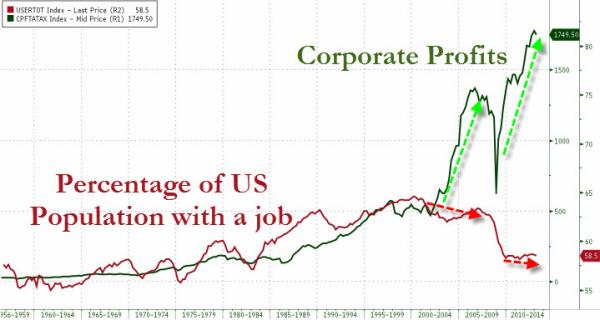
Despite consumer confidence at a six-year high, the latest AP survey of the real America shows a stunning four out of five U.S. adults struggle with joblessness, are near poverty, or rely on welfare for at least parts of their lives amid signs of deteriorating economic security and an elusive American dream. Hardship is particularly on the rise among whites, based on several measures. Pessimism among whites about their families’ economic futures has climbed to the highest point since at least 1987. “Poverty is no longer an issue of ‘them’, it’s an issue of ‘us’,” as ‘the invisible poor’ – lower income whites – are generally dispersed in suburbs (Appalachia, the industrial Midwest, and across America’s heartland, from Missouri, Arkansas and Oklahoma up through the Great Plains) where more than 60% of the poor are white. More than 19 million whites fall below the poverty line of $23,021 for a family of four – accounting for more than 41% of the nation’s destitute – nearly double the number of poor blacks and as one survey respondent noted “I think it’s going to get worse.” Read more of this post

Blackstone is finding fewer opportunities in India, where it says “serious governance issues” threaten to erode investor returns amid the slowest pace of economic growth in a decade. “The most prudent assumptions made of India are turning out to be highly optimistic”

Blackstone Sees Fewer Breaks as Singh Founders: Corporate India

Blackstone Group LP (BX) is finding fewer opportunities in India, where it says “serious governance issues” threaten to erode investor returns amid the slowest pace of economic growth in a decade. The world’s largest manager of alternative assets including private equity and real estate has been “very cautious” in Asia’s third-biggest economy because it is becoming more difficult for the government to make the right decisions, Akhil Gupta, chairman of Blackstone’s Indian unit, said in an interview in his office in Mumbai. “The most prudent assumptions made of India are turning out to be highly optimistic,” he said. “One doesn’t see a way out. I haven’t ever seen such pessimism when we talk to Indian company or government officials.” Read more of this post

Chicago Next? Windy City Cash Balance Plummets To Only $33 Million As Debt Triples

Chicago Next? Windy City Cash Balance Plummets To Only $33 Million As Debt Triples

Tyler Durden on 07/28/2013 11:06 -0400

While everyone’s attention is focused on the Detroit bankruptcy, and just what assets the city will sell in lieu of raising a DIP loan, perhaps it is time to refocus attention to the city 300 miles west: Chicago. According to the Chicago Sun Times citing year-end audits, Obama’s former right hand man, Rahm Emanuel, closed the books on 2012 with $33.4 million in unallocated cash on hand — down from $167 million the year before — while adding to the mountain of debt piled on Chicago taxpayers. In addition to a liquidity problem, Chicago may also be quite insolvent as the city’s total long-term debt soared to nearly $29 billion. That’s $10,780 for every one of the city’s nearly 2.69 million residents. More than a decade ago, the debt load was $9.6 billion or $3,338 per resident. Of course, in a world in which debt is “wealth”, this is great news… at least until debt becomes “bankruptcy.” Read more of this post

U.S. chief executives can’t break cost-cutting habit

U.S. chief executives can’t break cost-cutting habit

Fri, Jul 26 2013

By Lewis Krauskopf, Patricia Kranz and Lucia Mutikani

(Reuters) – A disconcerting trend lurks beneath the recent round of solid profit forecasts announced by companies ranging from United Technologies Corp (UTX.N: Quote, Profile, Research, Stock Buzz) to Wendy’s Co (WEN.O: Quote, Profile, Research, Stock Buzz): More than three years into the recovery, CEOs are still relying on cost cuts to prop up earnings.

While the cuts are not as severe as those that followed the 2008 financial crisis, companies remain cautious, mindful that revenue growth is still tepid. As a result, many appear to be more comfortable wringing efficiencies out of their businesses than gearing up for accelerated production. Read more of this post

Young, Rich Real-Estate Dummies

Young, Rich Real-Estate Dummies

The Wall Street Journal reports that well-to-do young Americans prefer to put their savings into “safe” luxury real estate rather than “risky” equities. Some are wealthy heirs and heiresses who have nothing better to do with their money. Others are members of the nouveau riche, cashing out their Facebook shares for houses in San Francisco. Yet most people described in the article are simply young, rich and dumb.

Matt Winter, a 28-year-old interior designer in L.A. says that he “always felt that having your money in property is the safest and best thing to do if you want to grow your personal wealth.” That was why he spent $1.7 million on his new home, after having spent about $1 million on his first home two years ago. Winter goes on to say that he owns no stocks because equities “spook him.” Read more of this post

Wall Street’s Biggest Job Cuts Yet to Come, Whitney Says

Wall Street’s Biggest Job Cuts Yet to Come, Whitney Says

Wall Street firms must cut more jobs to boost their return on equity and satisfy shareholders, said Meredith Whitney, a banking analyst and founder of Meredith Whitney Advisory Group LLC.

“The biggest layoffs are ahead of us,” Whitney said in a Bloomberg Television interview today with Tom Keene, Sara Eisen and Scarlet Fu. “It’s no fun, it’s painful but you have to downsize dramatically, get more efficient on every single line of business.” Read more of this post

The poison pill in India’s search for cheap food

The poison pill in India’s search for cheap food

1:35am EDT

By Rajendra Jadhav and Jo Winterbottom

MUMBAI/NEW DELHI (Reuters) – Nearly a decade ago, the Indian government ruled out a ban on the production and use of monocrotophos, the highly toxic pesticide that killed 23 children this month in a village school providing free lunches under a government-sponsored program. Despite being labeled highly hazardous by the World Health Organization (WHO), a panel of government experts was persuaded by manufacturers that monocrotophos was cheaper than alternatives and more effective in controlling pests that decimate crop output. Read more of this post

James Gordon Dies at 85; Work Paved Way for Laser that help revolutionize modern life with a wide range of practical applications, from long-distance telephone calls to eye surgery, from missile guidance systems to the checkout counter at the supermarket

July 27, 2013

James Gordon Dies at 85; Work Paved Way for Laser

By DOUGLAS MARTIN

dog-gordon-onit-popup

Charles H. Townes, left, with James P. Gordon and the maser they developed.

Distinguished Columbia University physicists, some of them Nobel Prize winners, called it a “harebrained scheme.” But James P. Gordon, principal builder of a refrigerator-size device that would help revolutionize modern life, believed in it enough to bet a bottle of bourbon that it would work. He was a 25-year-old graduate student in December 1953 when he burst into the seminar room where Charles H. Townes, his mentor and the inventor of the device, was teaching. The device, he announced, had succeeded in emitting a narrow beam of intense microwave energy. Dr. Townes’s team named it the maser, for microwave amplification by stimulated emission of radiation, and it would lead to the building of the first laser, which amplified light waves instead of microwaves and became essential to the birth of a new technological age. Lasers have found a wide range of practical applications, from long-distance telephone calls to eye surgery, from missile guidance systems to the checkout counter at the supermarket. Read more of this post

Zealot: The Life and Times of Jesus of Nazareth

The life of Jesus

Perhaps Jesus was no pacifist

Jul 27th 2013 |From the print edition

Rebel with a cause

Zealot: The Life and Times of Jesus of Nazareth. By Reza Aslan. Random House; 296 pages; $27. Buy from Amazon.com

20130727_BKP003_0

IN HIS earlier book about Islam, Reza Aslan, an Iranian-born American writer, presented a subtle view of the different layers of truth that can be found in sacred writings. For example, he explained that stories about Muhammad’s childhood are not meant to relate to historical events, but rather “to elucidate the mystery of the prophetic experience”. In any case, he added teasingly, myth is always true somehow; if it did not express a powerful truth, it would not last. The sensibility that Mr Aslan brings to his latest book, about the founder of another monotheism, is by comparison rather one-dimensional, although his considerable gifts as a storyteller and populariser of complex religious ideas remain intact. The purpose of “Zealot” is not to contemplate Jesus of Nazareth as a source of ultimate meaning, but to investigate and describe the story of his life. The book’s underlying assumption is that if Jesus has any significance at all, it is to be found in the facts of his earthly existence. And these facts, Mr Aslan maintains, are often diametrically opposed to the story set out in the New Testament—which is one the author himself once embraced as a 15-year-old convert to evangelical Christianity. Read more of this post

The CEO Of Overstock.com Took Out A Full Page Ad In The Wall Street Journal Mocking Steven Cohen

The CEO Of Overstock.com Took Out A Full Page Ad In The Wall Street Journal Mocking Steven Cohen

LINETTE LOPEZ JUL. 27, 2013, 11:56 AM 8,734 14

screen shot 2013-07-27 at 11.36.20 am

Overstock.com CEO Patrick Byrne took out a full-page ad in this morning’s Wall Street Journal shredding billionaire Steven Cohen for his hedge fund’s indictment by a Federal Grand Jury earlier this week. The firm, SAC Capital, has been charged with insider trading. Byrne’s animosity didn’t come out of nowhere — on a 20o5 conference call the CEO of Overstock.com said that “Sith Lords” were naked short-selling his stock and destroying the company. He later identified them to be SAC’s Steve Cohen and Michael Milken. And indeed, last year a bunch of lawyers for major banks accidentally leaked emails describing how they allegedly short-sold the stock and leaked techniques to hedge fund clients. Now that you know where all the hate comes from, check out the ad below (via Instagram: ognjenglisic) “Congratulations on the indictment, Stevie, and remember: roll early, roll often. You friend Patrick M. Byrne, CEO of Overstock.com,” it reads. Major schadenfreude.

ETF Wolves in Sheep’s Clothing: Financial advisors are increasingly using passive, index-tracking ETFs to implement strategies that are just as active as what you’d find in the most aggressive mutual funds

SATURDAY, JULY 27, 2013

Wolf in Sheep’s Clothing

By CORRIE DRIEBUSCH | MORE ARTICLES BY AUTHOR

Financial advisors are increasingly using passive, index-tracking ETFs to implement strategies that are just as active as what you’d find in the most aggressive mutual funds.

BA-BC478_ETF_MY_G_20130727011118

Some pairings just make sense — Scarlett and Rhett, peanut butter and jelly, exchange-traded funds and index investing. But when the pairing is put into a different context — a campy musical version of Gone with the Wind, or a PB&J-filled breakfast cereal — it becomes a distinctly different thing. And that “different thing” is happening in the world of ETFs. Financial advisors are increasingly using passive, index-tracking ETFs to implement strategies that are just as active as what you’d find in the most aggressive mutual funds. For some investors, it’s a natural fit. But for others, particularly those drawn in by the allure of passive ETFs, it’s going to be stomach-churning. Read more of this post