Music streaming expected to decimate iTunes Australia

Music streaming expected to decimate iTunes Australia

PUBLISHED: 29 JUL 2013 00:05:00 | UPDATED: 29 JUL 2013 07:53:30

PAUL MCINTYRE

First it was compact discs. Then downloads. Now music labels are facing another challenge to their business models, with revenue growth from iTunes in Australia expected to halve this year as more consumers take up new streaming services such as Spotify and Pandora. Record company and commercial radio executives say music faces more structural change from a maturing market for download-to-own music services such as iTunes, competition from non-Apple device manufacturers and platforms that allow users to stream music for free through an ad-funded service or by paying a ­­sub­scription fee. Read more of this post

Financial advisers who put their clients into Australian LM’s frozen funds stand to collect millions in commission before their clients see any return

LM frozen funds: commissions before client earnings

July 30, 2013 – 12:24PM

Michael West

The financial advisers who put their clients into LM Investment Management’s frozen funds stand to collect millions in commission before their clients see any return. The latest administrators report for LM Investment Management shows commissions of $10 million are subject to claims by financial advisers. However, the actual investors themselves have not been deemed by the LM group administrators to be creditors. Rather, their savings rank behind the fees of the very people who put them into these dud investments in the first place. Business Day revealed yesterday LM founder Peter Drake had taken at least $46 million in loans before his mortgage fund empire collapsed earlier this year. These have not been repaid and Drake appears headed for bankruptcy. In light of the loans to Drake and the feeding frenzy by the administrators and their lawyers, the prospective returns for investors in the LM suite of funds is diminishing with every week that passes. Since the collapse in March this year, the administrators FTI Consulting have charged $2.4 million in fees, or $130,000 a week. Disbursements came to another $2 million. Read more of this post

China: Citizens united; Civil activists pose a growing threat to the Communist party as they link up

July 29, 2013 5:36 pm

China: Citizens united

By Kathrin Hille

Civil activists pose a growing threat to the Communist party as they link up, writes Kathrin Hille

When the Chinese police arrested rights lawyer Xu Zhiyong on July 16, they charged him with “gathering a crowd to disturb order in a public place”.

As Mr Xu had been under house arrest since April, the charge triggered an outcry. But in the eyes of China’s ruling Communist party, the softly spoken but stubborn lawyer is still a threat, even while confined to his Beijing home. Over the past year, Mr Xu has worked to link activists who were each running individual campaigns, marshalling them into a broader movement called “citizenry” to foster a sense of rights and responsibilities across a range of public issues. It is the virtual equivalent of a crowd in the street. Read more of this post

How India has Punctured its Gas Balloon; Even as gas takes off in the US as a cleaner and cheaper fuel, India is heading in the opposite direction with policy flip-flops and failed promises strewn along the way

How India has Punctured its Gas Balloon

by Cuckoo Paul | Jul 30, 2013

Gas_Final.indd

Even as gas takes off in the US as a cleaner and cheaper fuel, India is heading in the opposite direction with policy flip-flops and failed promises strewn along the way

From his office in central London, Christof Ruhl, chief economist and vice president at British Petroleum (BP), analyses energy demand-supply data from around the world to produce one of the most widely consumed reports of the oil industry: BP’s statistical review of world energy. This year, Ruhl says, he was amazed by the unprecedented shifts in energy preference in countries the world over. Read more of this post

The language of success; Online translator Lingo24 is turning to private equity to fund its £100m expansion.

The language of success

Online translator Lingo24 is turning to private equity to fund its £100m expansion.

lingo24_2628459b

We did something awful but we got customers.” That’s how Christian Arno, the founder of online translation company Lingo24, knew he was on to something when he launched a rudimentary translation website while still at university.

By Philip Smith

7:00AM BST 28 Jul 2013

We did something awful but we got customers.” That’s how Christian Arno, the founder of online translation company Lingo24, knew he was on to something when he launched a rudimentary translation website while still at university. His idea was to use the web to entice corporate customers looking for low-cost translation – because he had access to “cheap” language students to do the work. “It was the dotcom boom and I looked at what was happening in the translation space, and the answer was not very much.” His first website, by his own admission, was “shocking”. “It was in Motherwell FC colours, claret and amber. I’ve nothing against Motherwell but they are not my team,” he says. However, the gaudy site didn’t deter customers, and he quickly won clients, including the Liverpool Tourist Board. “I was amazed,” he says. Read more of this post

India’s attempt to ignite a startup boom

India’s attempt to ignite a startup boom

July 29, 2013: 1:46 PM ET

It has come in fits and starts, but India is slowly building its own startup world.

By Anika Gupta

FORTUNE – Most entrepreneurs remember vividly when they decided to strike out on their own. For Siddhartha Ahluwalia, the moment came over breakfast, in 2009. Then 22 years old and an engineering student at the Indian Institute of Information Technology & Management in Gwalior, he was interning at India’s premier graduate business school — the Ahmedabad campus of the Indian Institute of Management (IIM-A). An IIM-A student sat down at Ahluwalia’s table and started to talk about his own business — a tech platform that served TV ads at train stations. “IIM-A is full of energy regarding entrepreneurship,” Ahluwalia remembers. “You meet a lot of new entrepreneurs.” The fired-up Ahluwalia enlisted three friends as co-founders, and they started work on an advertising platform for doctors’ offices. Read more of this post

Apps That Know What You Want, Before You Do

July 29, 2013

Apps That Know What You Want, Before You Do

By CLAIRE CAIN MILLER

SEARCH-2-popup

Google Now, a search app that tries to anticipate what users want, as seen on a Galaxy Nexus.

SAN FRANCISCO — In Hollywood, there are umbrella holders. Outside corner offices, there are people who know exactly how much cream to pour in the boss’s coffee. In British castles, royals have their valets. And then there is Silicon Valley, where mind-reading personal assistants come in the form of a cellphone app. A range of start-ups and big companies like Google are working on what is known as predictive search — new tools that act as robotic personal assistants, anticipating what you need before you ask for it. Glance at your phone in the morning, for instance, and see an alert that you need to leave early for your next meeting because of traffic, even though you never told your phone you had a meeting, or where it was. Read more of this post

The E-Commerce Entrepreneurs Who Are Literally Working Themselves To Death

The E-Commerce Entrepreneurs Who Are Literally Working Themselves To Death

ALYSON SHONTELL JUL. 29, 2013, 3:39 PM 8,902 17

Running an online business can be difficult. It can also be life-threatening. In China, there’s been a spike in the number of overworked employees who have dropped dead, particularly in the e-commerce space. One company that’s becoming infamous for its worker death toll is Taobao, a Chinese e-commerce platform that resembles eBay. Merchants can post items on their own Taobao storefronts. They’re in charge of everything from keeping inventory and shipping items to updating the website and communicating with customers. But when their businesses take off, the work load can become too much. In July 2012, 24-year-old “Aijun aj” who was running a store on Taobao died of cardiac failure. She wasn’t the first or the last. Aijun’s death was preceded by a mother who ran a store on Taobao and a 25-year-old who ran another highly-rated online shop. Being overworked doesn’t directly kill you. It leads to a series of poor health decisions, such as irregular diets, chronic stress, lack of exercise, and exhaustion, which can cause heart issues like Aijun’s, blood clots and more. Read more of this post

Inside The Booming Mobile Video Ecosystem (Infographic)

INFOGRAPHIC: Inside The Booming Mobile Video Ecosystem

BUSINESS INSIDER JUL. 29, 2013, 2:30 PM 765

slide1-70

Mobile video has begun to accumulate scale, and has also turned out to be one of the few types of mobile content — along with games — that monetizes reliably and drives premium ad rates. That’s reflected in the much higher prices that mobile publishers can command for mobile video ads, compared to standard mobile formats like banners. eMarketer estimates mobile video will account for $520 million in ad spending in the U.S. this year, or 13% of the digital video ad market. In a recent report, BI Intelligence breaks down the mobile video ecosystem, analyzing the behavior and devices behind the growth in consumption, and examining the demographics and behavior of mobile video consumers. We specifically detail how mobile video monetization is booming, and look at the new video ecosystem that is taking shape, with mobile devices — rather than television — at the center. Read more of this post

Tencent launches online Karaoke service, Just Wanna Karaoke, a combination of YY Music and Changba

Tencent Taps into Online Music Show Business

By Tracey Xiang on July 29, 2013

KTVqq

Tencent officially launched an online Karaoke service, Just Wanna Karaoke, which began public testing in May. It is developed by 91KGE, a music game development company, and Tencent calls it a social game. It’s, however, no more than a combination of YY Music and Changba. YY Music is an online live music show platform that sells virtual gifts to audiences to buy for performers. Changba is a mobile Karaoke app that recently started selling virtual gifts as well. Two months ago YY Music launched a major update of its mobile app that added live video broadcasting. YY is trying to expand from music to other forms of performance, such as oral storytelling, as well. Changba, starting with audio only, began supporting videos recently. Read more of this post

World’s post offices look to reinvent selves

World’s post offices look to reinvent selves

AFP-JIJI

JUL 29, 2013

PARIS – There was a time when your local post office would mainly sell stamps and deliver letters. No longer. To counteract the turmoil brought on by email and text messages, postal services worldwide have reinvented themselves, taking on the technological revolution that once looked to cripple them. Traditional mail service has dropped sharply in recent years, though emerging countries are a notable exception. According to the Universal Postal Union, global letter and light parcel delivery dropped 3.7 percent in 2011 from a year earlier, and by 5.1 percent when just counting Europe and the former Soviet Union. Read more of this post

Essilor, the world’s biggest producer of eyeglass lenses by sales is buying a 51 per cent stake in Transitions Optical from partner PPG Industries for $1.73bn

July 29, 2013 4:39 pm

Essilor buys majority stake in Transitions Optical for $1.73bn

By Adam Thomson in Paris

Essilor International, the world’s biggest producer of eyeglass lenses by sales is buying a 51 per cent stake in Transitions Optical from partner PPG Industries for $1.73bn.

The acquisition will hand Essilor full ownership of Transitions Optical, the inventor of plastic lenses that darken in ultraviolet light, and increase the French company’s exposure to a segment that is growing twice as fast as the overall optics industry. Read more of this post

BMW Launches Its First Mass-Production Electric Car

Updated July 29, 2013, 10:18 p.m. ET

BMW Launches Its First Mass-Production Electric Car

Auto Maker Needs to Boost Sales of Electric Cars to Meet Regulatory Requirements

JOSEPH B. WHITE

MK-CF123_BMW_G_20130729174124

BMW unveiled Monday its first mass-production electric car, the i3. The German car maker says the car can accelerate from 0-60 miles an hour in just over seven seconds and says the basic model has a range of 100 miles. The new i3 is expected to be priced at $41,350 before incentives.

BMW AG BMW.XE -0.26% Chief Executive Norbert Reithofer unveiled on Monday the auto maker’s first mass-production electric car, saying his company would need to boost sales of plug-in and battery electric vehicles dramatically by 2025 to meet regulatory requirements. The BMW i3 is expected to go on sale in the U.S. in the second quarter of 2014 where it is expected to be priced at $41,350 before federal tax and other incentives. An optional “range extender”—a small gasoline motor—will likely boost the price tag to $45,000. Mr. Reithofer said he is taking a long view on the potential of electric vehicles. “If you build such a car…you have to look into the future, 10, 15, 20 years,” Mr. Reithofer said. “If you look around the world, [at] the emissions regulations, in the United States, in the European Union, even in China…cars like the BMW i3 are a must.” Read more of this post

China, whose airline market is dominated by state-owned carriers noted for inefficiency and poor service, will study policies to encourage the budget-carrier model that is sweeping Asia

Updated July 29, 2013, 8:30 a.m. ET

China’s Air Regulator Will Consider Ways to Boost Budget-Carrier Market

Having Lifted Ban on New Independent Airlines, Government Pushes Low-Cost Model

JOANNE CHIU

AI-CC550_CAIR_NS_20130729082406

SHANGHAI—China is taking steps to jump-start the budget-airline business, say people familiar with the situation, a sign of further liberalization in one of the nation’s most tightly regulated sectors. Li Jiaxiang, head of the Civil Aviation Administration of China, told a semiannual CAAC working meeting this month that the regulator plans to study new policies to promote low-cost carriers in the second half of the year, according to people there, who included airline executives. Mr. Li also urged the nation’s smaller airlines to look into the budget model, and established airlines to learn from successful low-cost airlines to improve management standards and operating efficiency, the people said. Read more of this post

China’s top stock-market regulator Xiao Gang Turns Gray as China IPO Freeze Precedes New Rules

Xiao Turns Gray as China IPO Freeze Precedes New Rules

Four months after taking over as China’s top stock-market regulator, Xiao Gang showed up at a government meeting in July with gray hair at his temples.

The salt-and-pepper look provoked debate, even poetry, on China’s Weibo microblog service. Commentators argued whether the challenges of overseeing Asia’s worst-performing major stock market had aged him or if he had stopped dyeing his hair.

Xiao, 54, is stuck between more than 700 companies waiting to raise funds and Chinese leaders led by Xi Jinping who have pledged to clean up corruption. The China Securities Regulatory Commission, under pressure from investors to avoid exacerbating a 25 percent slump in the Shanghai Composite Index (SHCOMP) since July 2010, is drafting rules to curb misconduct that would establish stiff penalties for investment banks before ending an almost 10-month freeze on initial public offerings. Read more of this post

Myanmar’s Yangon More Expensive Than NYC Sparking Boom

Yangon More Expensive Than NYC Sparking Boom: Real Estate

Sean Danley has spent the past six months scouting office space in Yangon after being sent to establish the Myanmar branch of his U.S.-based employer.

He looked in the city’s three sole 1990s-era towers, where annual rents have climbed to more than $100 a square foot, compared with less than $75 in downtown Manhattan, according to broker CBRE Group Inc. Too expensive, he said.

The villas he considered either didn’t have safety exits, weren’t clean, required sharing space with other companies or were in odd locations — all unsuitable to the image of his $29 billion in revenue engineering and construction company, which he said he wasn’t authorized to identify. After seeing 10 places and losing one possibility to someone faster with his “bag of money,” Danley is still looking. Read more of this post

U.S. says JP Morgan manipulated market; settlement seen

U.S. says JP Morgan manipulated market; settlement seen

7:47pm EDT

WASHINGTON (Reuters) – The U.S. power regulator outlined its case of market manipulation against JPMorgan Chase & Co on Monday as industry sources said a final settlement on the issue should come on Tuesday. Traders used improper bidding tactics in California and the Midwest to boost profits, officials said in a statement that brought to light some details of an extensive investigation. Reports of that probe have circulated for months and a deal with the regulator could put an end to a distraction for JPMorgan Chief Executive Jamie Dimon. The U.S. Federal Energy Regulatory Commission (FERC) staff has found “eight manipulative bidding strategies” used by a JPM affiliate in 2010 and 2011, the regulator said. Read more of this post

Why Are Google Employees So Disloyal?

Why Are Google Employees So Disloyal?

The perks Google lays on for its employees are the stuff of legend. Free gourmet food all day, the best health insurance plan anywhere, five months’ paid maternity leave, kindergartens and gyms at the workplace, the freedom to work on one’s own projects 20 percent of the time, even death benefits. No wonder the tech behemoth has topped Fortune Magazine’s list of best companies to work for every year since 2007.

Why, then, aren’t Googlers more loyal to their employer? In one recent ranking of companies with the highest employee turnover rates, the Mountain View, California, company is among the leaders. The median employee tenure at Google is just more than one year, according to the payroll consultancy PayScale. Read more of this post

Taiwan says may tighten tax rule on property trading

Taiwan says may tighten tax rule on property trading

Monday, Jul 29, 2013

Reuters

TAIPEI – Taiwan does not rule out the possibility of tightening a tax rule on trading properties and luxury goods, as it aims to narrow the gap between the rich and the poor. Speculation has helped drive up property prices on the island, especially in the capital Taipei and some other northern cities, and worsened affordability at a time when growth is slowing. Taiwan’s Finance Minister Chang Sheng-ford told reporters over the weekend that studies show the tax has received positive feedback as it has helped curb property turnover and narrowed the gap between rich and poor. The government introduced the so-called luxury tax almost two years ago. Properties that are sold in less than two years after being bought are taxed. A 15 per cent tax applies to properties sold within a year of purchase and 10 ppercent to those sold within two years. A 10 per cent tax applies on sales of luxury goods worth at least T$3 million (S$126,405). One possibility is to collect the tax from buyers, which is what Hong Kong and Singapore have done, Chang said. Another option is to extend the tax-free period to three or four years from the current two years, the minister added.


Strategic Informed Trading by Corporate Executives and Firm Value

Strategic Informed Trading by Corporate Executives and Firm Value

Katherine Gunny University of Colorado at Boulder – Department of Accounting

Tracey Chunqi Zhang Singapore Management University – School of Accountancy

September 26, 2012
Singapore Management University School of Accountancy Research Paper No. 1

Abstract: 
Proponents of insider trading argue that informed trading benefits shareholders and could have a positive effect on firm value, however opponents counter that insider trading could be detrimental to firm value. We measure the extent of strategic informed trading by the fraction of insider trades that are V-shaped purchases (defined as insider purchases that are preceded by negative abnormal returns and followed by positive abnormal returns) and Λ-shaped sales (defined as insider sales that are preceded by positive abnormal returns and followed by negative abnormal returns). Our strategic informed trading proxy is negatively associated with future earnings performance and Tobin’s Q, even after controlling for the direction of insider trading intensity. We adopt the view that there could be frictions that prevent the board from setting the level of informed trading at the optimal level at any given time. We find that our measure of strategic informed insider trading is positively related to restatements, another possible manifestation of agency problems resulting from the same frictions. Moreover, strategic informed trading declines significantly after announcements of earnings restatements, which are usually accompanied with significant corporate governance improvement. Overall our evidence indicates that the type of informed trading we identify represents suboptimal informed trading that is detrimental to firm value – consistent with the opponent view of informed trading.

‘Shallow Risk’ and ‘Deep Risk’ Are No Walk in the Woods

Jul 26, 2013

THE INTELLIGENT INVESTOR

‘Shallow Risk’ and ‘Deep Risk’ Are No Walk in the Woods

By Jason Zweig

BF-AF445_INVEST_G_20130726172020

Earlier this week, the Dow Jones Industrial Average hit 15567.74, a new high. That was the 28th time this year the Dow closed at a record. At these all-time-high prices, just how much riskier stocks are than alternatives like bonds, cash or gold depends largely on how you define “risk.” William Bernstein, an investment manager at Efficient Frontier Advisors in Eastford, Conn., and the author of several books on investing and financial history, says risk takes two basic forms—and understanding the difference can help investors figure out what they should be afraid of. What Mr. Bernstein calls “shallow risk” is a temporary drop in an asset’s market price; decades ago, the great investment analyst Benjamin Graham referred to such an interim decline as “quotational loss.” Shallow risk is as inevitable as weather. You can’t invest in anything other than cash without being hit by sharp falls in price. “Shallow” doesn’t mean that the losses can’t cut deep or last long—only that they aren’t permanent. “Deep risk,” on the other hand, is an irretrievable real loss of capital, meaning that after inflation you won’t recover for decades—if ever. Read more of this post

China has at least 36 local governments with as much debt, on average, as Detroit

China has at least 36 local governments with as much debt, on average, as Detroit

By Jake Maxwell Watts @jmwatts_ 4 hours ago

China’s National Audit Office announced on Sunday that it is conducting a comprehensive review of all local government debt, which has long been considered a potential time bomb that threatens for China’s economy. But how bad is the debt really? An audit that took a sample of 36 local governments at the end of 2012 (15 provinces, their capital cities, the municipalities of Tianjin, Shanghai and Guangzhou, and one district from each municipal city) found that those authorities had taken on a total of 3.85 trillion yuan ($628 billion) in debt, up 12.9% from 2010. That works out to $17.4 billion each—just under the $18 billion in debt held by the US city of Detroit, which filed for bankruptcy earlier this month. Read more of this post

Small Stocks Are in Eye of the Index; Inclusion in Russell 2000 May Distort Some Stock Values

July 28, 2013, 6:46 p.m. ET

Small Stocks Are in Eye of the Index

Inclusion in Russell 2000 May Distort Some Stock Values

JUSTIN LAHART

MI-BX482_RUSSHE_NS_20130728173005

The Russell 2000 is the benchmark for small-capitalization stocks. But some stocks in it aren’t that small. This may pose a problem for investors, even as the index has been hitting all-time highs. The argument for small stocks is clear. Research has consistently shown that over long stretches small-cap stocks beat their bigger brethren. A driver has been the fraction of fast-expanding small companies on their way to becoming large ones. Yet some of them may no longer be in the Russell 2000. Which stocks Russell designates as small cap counts. The iShares Russell 2000 ETF, IWM -0.40% the ninth largest of all exchange-traded funds, has about $25 billion under management. More than 400 mutual-fund portfolios, with over $370 billion under management, use the Russell 2000, or its subindexes, as benchmarks, said Morningstar. Read more of this post

Startups Take Off in South Korea; Successful Entrepreneurs Reinvesting in Fledgling Companies

Updated July 29, 2013, 12:07 a.m. ET

Startups Take Off in South Korea

Successful Entrepreneurs Reinvesting in Fledgling Companies

JAEYEON WOO

OB-YH880_subscr_G_20130725023742

A package for expectant moms in their early pregnancy

SEOUL—When Paek Jin-joo was pregnant with her first baby, it was challenging for her to figure out what she needed to know and buy as an expectant mother. Spending hours looking up the Internet was too time consuming. “I thought to myself how convenient it would be if someone could offer tips and help shop for products necessary for pregnant women,” says the 35-year-old Ms. Paek, who was an office worker at an online education company in Seoul before setting up her own company, 10Box, in October last year. As the U.S. startup scene experiences a slowdown this year, South Korea is one place that is booming. The country is one of the most wired nations in the world with broadband penetration at over 100%. The number of Korean startups has nearly doubled to 28,193 in 2012 from just 15,401 in 2008, according to data from the Korean Venture Capital Association. Steady growth in the number of startups in South Korea in recent years is getting a fresh push from successful entrepreneurs reinvesting in fledgling companies, as well as commitment from the government to provide backing. But competition and scaling the business have been major challenges for some of the country’s startups. Read more of this post

Is there an Incentive for Active Retail Mutual Funds to Closet Index in Down Markets? Fund Performance and Subsequent Annual Fund Flows; Study finds there’s no big benefit to active management in down markets

Is there an Incentive for Active Retail Mutual Funds to Closet Index in Down Markets? Fund Performance and Subsequent Annual Fund Flows between 1997 and 2011

Aron A. Gottesman Pace University – Lubin School of Business – Department of Finance and Economics

Matthew R. Morey Pace University – Lubin School of Business – Department of Finance and Economics

Menahem Rosenberg Pace University

April 26, 2013

Abstract: 
Closet indexing is the practice of staying close to the benchmark index while still maintaining to be an active mutual fund manager and probably also charging fees similar to those of truly active managers. Recent work shows active mutual fund managers were much more likely to closet index during down markets. Indeed, closet indexing became so popular that it accounted for about a third of all mutual fund assets during time surrounding 2008. In this paper we set out to answer the question of whether there actually is an incentive for mutual fund managers to closet index during down markets. To do this we examine the relationship between annual fund performance and subsequent annual fund flows in both up and down markets. Using this approach we find that the relationship between fund performance and subsequent net fund flows is significantly different in up markets years as compared to down market years. Specifically, we find that fund performance does not drive subsequent flows nearly as much in down markets as it does in up markets. Indeed, in up markets, we find a strong positive relationship between fund performance and subsequent flows. Conversely, in down years, the amount of outperformance or underperformance does not significantly influence the next year’s fund flows. Hence, based on these results, there is an incentive for active managers to closet index in down markets as investors do not reward outperformance with higher flows.

Fund managers should go into the closet when markets drop

Study finds there’s no big benefit to active management in down markets

By Michael Shagrin
July 25. 2013 3:54PM

Fund managers have every incentive to mimic their benchmark when markets are down, according to researchers at Pace University and Touro College. During up years, a strong relationship exists between fund performance and net flows. However, during down years, outperforming or underperforming a benchmark does not have a significant impact on the subsequent year’s flows. This means that “there is an incentive for active managers to closet-index in down markets, as investors do not reward outperformance with higher flows,” according to the researchers, who recently conducted a study, “Is There an Incentive for Active Retail Mutual Funds to Closet Index in Down Markets? Fund Performance and Subsequent Annual Fund Flows between 1997 and 2011.”  Read more of this post

9-Year-Old Massachusetts Girl Carissa Yip Becomes Youngest-Ever Chess Expert

9-Year-Old Massachusetts Girl Becomes Youngest-Ever Chess Expert

GRANT WELKER, ASSOCIATED PRESS JUL. 28, 2013, 5:51 PM 1,382 4

CHELMSFORD, Mass. (AP) — Only three years or so since first picking up the game of chess, 9-year-old Carissa Yip can already look down at 93 percent of the more than 51,000 players registered with the U.S. Chess Federation. She has risen so far up the rankings that she has reached the expert level at a younger age than anyone since the chess federation began electronic record-keeping in 1991, a new level she reached in recent weeks. Her father, Percy, who taught her until she began beating him within a year, said she could reach master level in as soon as a year. “Some never reach master level,” he said. “From expert to master, it’s a huge jump.” Read more of this post
Former kindergarten teacher Keith Green started his own YouTube channel, Cakes by Choppa after Spider-Man cake video viewed 15.8 million times around the globe – earning him huge advertising revenue.

Get rich on YouTube

July 19, 2013

Larissa Ham

Choppa-making-a-Mickey-Mouse-cake-620x349

Choppa making a Mickey Mouse cake.

Fancy earning $17,000 in just one hour, without leaving home? That’s what former kindergarten teacher Keith Green – known to all as “Choppa” – did after he filmed himself creating a Spider-Man cake and posted it on YouTube a year ago. It took him less than an hour to decorate the cake and edit the video but it’s since been viewed 15.8 million times around the globe – earning him huge advertising revenue. Choppa says he believes his video went viral thanks to timing – close to the release of movie The Amazing Spider-Man, and rock musical Spider-Man: Turn off the dark – but also “the fact it’s so simple”. The 33-year-old, who once dreamt of being an animator, got his first taste of cake decorating as a child while helping his mother create tasty gems from Women’s Weekly cookbooks. Two years ago, as a hobby, he started his own YouTube channel, Cakes by Choppa. It took off so quickly that six months ago the kindergarten teacher of 14 years quit his job to focus on his weekly online videos.

Read more of this post

China 3% Growth Risk Seen by Barclays Signals Likonomics Anxiety

China 3% Growth Risk Seen by Barclays Signals Likonomics Anxiety

A copper price collapse of more than 60 percent, zinc cut by up to a half and oil down to $70 a barrel. That’s the fate facing world commodity markets should China’s growth dip to 3 percent in the next three years — a scenario economists at Barclays Plc (BARC) are now examining.

They’re not the only ones building models based on a steep decline in growth in the world’s second-biggest economy. Nomura Holdings Inc. (8604) estimates a one-in-three chance of a sharp drop by the end of 2014, and Societe Generale SA sees a “non-negligible risk” of less than 6 percent growth this year and an outside chance of 3 percent average expansion for this half and next. Read more of this post

How Much Slowdown Can Beijing Tolerate? The notion of a bottom line for growth and stability is a myth. The truth is more complex

How Much Slowdown Can Beijing Tolerate?

July 22, 2013

By Minxin PeiABOUT THE AUTHOR

The notion of a bottom line for growth and stability is a myth. The truth is more complex.

The once-mighty Chinese economy is now headed in one direction only – downward. GDP growth was 7.5 percent in the second quarter of this year, down slightly from 7.7 percent in the first quarter. In the last quarter of 2012, the Chinese economy grew 7.9 percent. The deceleration from 7.9 to 7.5 percent may seem relatively minor – only 0.4 percentage point in six months. However, when annualized, this figure means that the Chinese economy has lost about one-tenth of its growth momentum since last year. Read more of this post

China Plans Urgent Audit of Public Debt

July 28, 2013, 6:43 a.m. ET

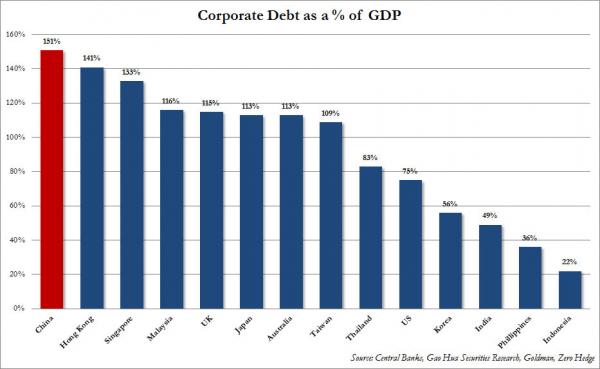
China Plans Urgent Audit of Public Debt

Burgeoning Borrowing Adds to Stress on China’s Financial System

PAUL MOZUR and TOM ORLIK

China MS 2_0 China Corporate Debt to GDP_0 China MS 1_0 China MS 3_0 China MS 4_0 China MS 5_0 China MS 6_0

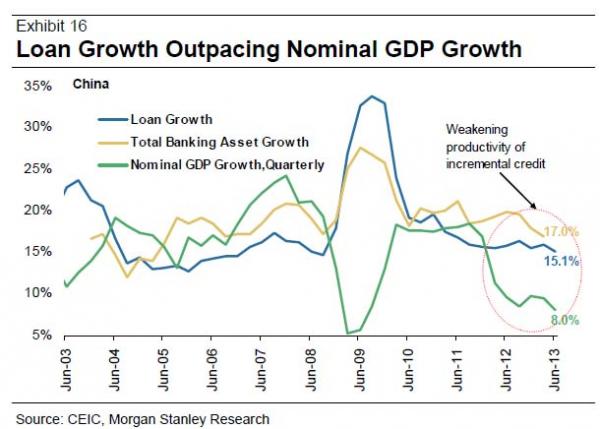
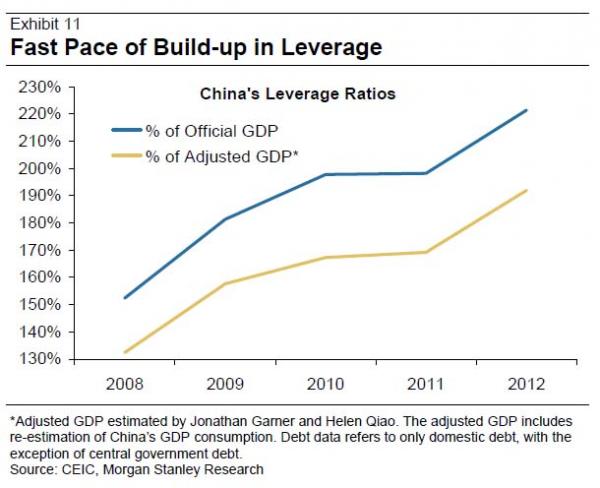
BEIJING—China will conduct an urgent review of overall public debt, highlighting concerns about burgeoning official borrowing that are adding to stress in China’s financial system and limiting Beijing’s capacity to support flagging growth. In a one-line statement on Sunday, China’s National Audit Office said it would carry out an examination of total government debt, acting on the orders of the State Council, China’s cabinet. A separate article in the Communist Party mouthpiece People’s Daily said the order came Friday and that work would begin on the audit on Monday. The article, citing unnamed sources, said the Audit Office would temporarily suspend other projects to begin work on the audit, suggesting the urgency of the task. Read more of this post