Is Management Due for a Renaissance?

Is Management Due for a Renaissance?

by David K. Hurst  |   2:00 PM May 30, 2014

Every now and then, a thinker calls for a renaissance in some field of work – a rebirth, or return to classic roots after a period of straying from them. Is management – not yet a very old discipline – due for one? When Richard Straub, President of the Peter Drucker Society of Europe, recentlydeclared so, it got me thinking by analogy about how one might come to pass. Read more of this post

Investors want to ban ‘junk’ companies from London; Call for changes after poor treatment of minority shareholders at Bumi and ENRC

Investors want to ban ‘junk’ companies from London

Call for changes after poor treatment of minority shareholders at Bumi and ENRC

By Louise Armitstead

8:15PM BST 31 May 2014

A group of powerful institutional investors has demanded that City regulators tighten the UK’s listing rules to ban sub-standard foreign companies floating in London.

In the wake of concerns over the treatment of minority shareholders at a number of companies, including Bumi, the investors demanded changes in the way overseas companies are allowed to list on the London Stock Exchange. Read more of this post

27 Tips For Mastering Anything

27 Tips For Mastering Anything

JENNA GOUDREAU STRATEGY  JUN. 1, 2014, 1:30 AM

Tony Hisgett/Flickr

What does it take to become a master at your craft? Is genius innate, or can it be learned?

In his book, “Mastery,” Robert Greene draws from the latest research, interviews modern masters, and examines the lives of former greats like Albert Einstein, Leonardo da Vinci, and Mozart to discover what it takes to achieve excellence.

He argues that success is within anyone’s reach, if they have discipline, patience, and follow a number of important steps. Read more of this post

Ginni Rometty: Reinventing Big Blue; Naysayers are ganging up on IBM CEO Ginni Rometty. But her plan to turn around the 103-year-old company just might work

Ginni Rometty: Reinventing Big Blue

Naysayers are ganging up on IBM CEO Ginni Rometty. But her plan to turn around the 103-year-old company just might work.

LESLIE P. NORTON

May 31, 2014 1:40 a.m. ET

Ginni Rometty likes to say that there’s no such thing as a bad day if you learn from it. And since taking over as chief executive of International Business Machines in January 2012, she has learned a lot. Big Blue’s revenue has fallen for eight straight quarters, reaching the lowest level in five years in the first quarter of this year.

image001-2

IBM (ticker: IBM) is still hugely profitable, of course, earning $18 billion last year on revenue of $100 billion. But in many ways, it faces its biggest challenge since the early 1990s, when it was on the verge of bankruptcy. Read more of this post

Super Mario Gets A Mercedes In This Awesome Ad

http://www.youtube.com/watch?v=Sc59X7xS2ts

Super Mario Gets A Mercedes In This Awesome Ad

RICHARD FELONI ADVERTISING  MAY. 31, 2014, 12:34 AM

If you’ve ever played a Super Mario game, you’re going to love the new Japanese commercial for the Mercedes-Benz GLA SUV.

In it, an 8-bit Mario smashes blocks, collects coins, and runs over Goombas in a pixelated Benz. When he wraps up the level, the NES game turns live-action, and a tough looking Mario in Batman-esque armor emerges from the SUV. Read more of this post

A Study Being Passed Around Silicon Valley Shows That Raising Tons Of Money Can Hurt Startups

A Study Being Passed Around Silicon Valley Shows That Raising Tons Of Money Can Hurt Startups

ALYSON SHONTELL TECH  MAY. 31, 2014, 9:49 PM

When startups raise large rounds of financing from investors, it’s often praised in the press. And in Silicon Valley, founders are often encouraged to raise as much money as possible. But a new study shows that most startups shouldn’t strive to raise gobs of cash, and they can actually exit for more money if they take less funding.

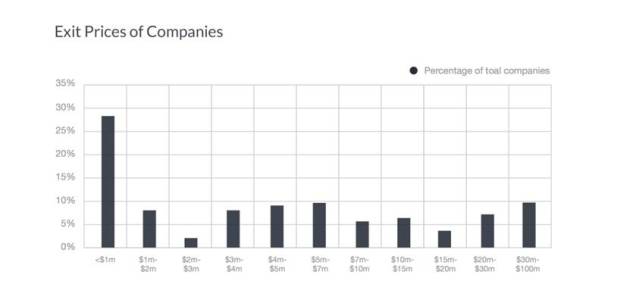
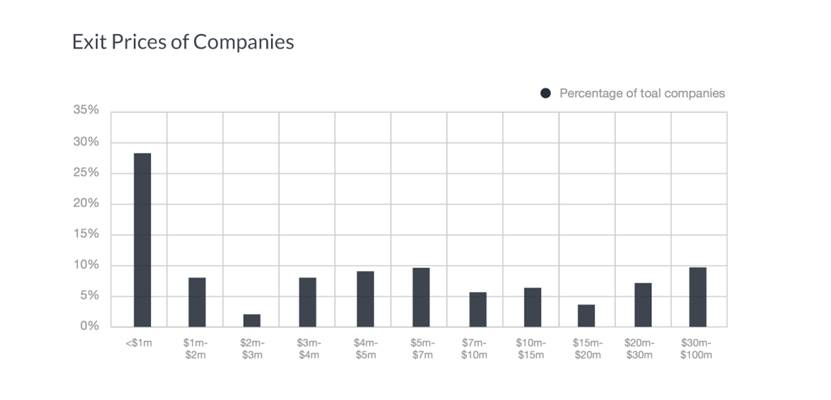
Exitround, a startup that matches early stage companies with potential acquirers,analyzed the sales of 200 startups. It worked with startup accelerator programs Y Combinator, Techstars and SoftTech VC to compile the data and only looked at companies with sale prices under $100 million. Exitround says 88% of all startups are sold for less than that price. The study has been

The study found that startups with the most lucrative exits raised either $2-3 million or $5-10 million. They also tend to be about four years old.

From the study:

image001-1

In Exitround’s analysis, companies that raised $5 million to $10 million actually generated larger average exits than those that raised $10 million to $50 million. And those companies that raised $3 million to $5 million had a lower average exit price than those that raised $2 million to $3 million.

Here’s a chart that supports the data.

The Exit Curve: Exitround’s Report On Tech M&A

Exitround NewsMarket Analysis

By Tomio Geron on May 30, 2014

image002-1

inShare54

image003-1

Raising as much capital as possible is often seen as a badge of honor in Silicon Valley. And there are many great reasons for startups to raise as much capital as possible. But raising more capital may not always be the best option. Exitround’s analysis of proprietary exit data has found that there are good reasons to remain cautious.

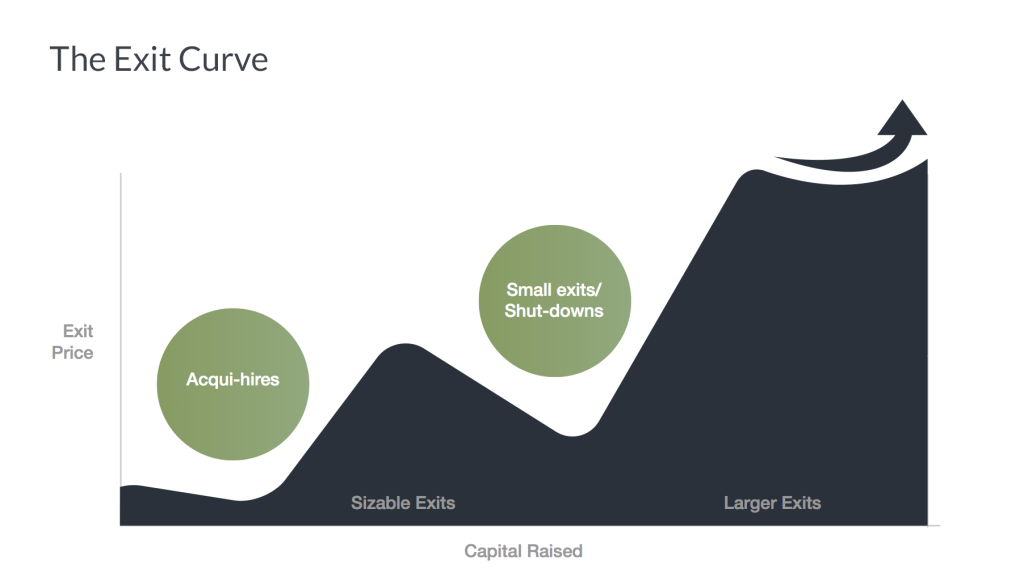
There’s a sweet spot for how much capital to raise for startups that want to get the most money out of their sale. Exitround determined these particular exit ranges based on data we analyzed covering more than 200 companies acquired since 2006 for less than $100 million. The best exits from a return-on-capital perspective form a pattern, which we call the Exit Curve. The best average exits tend to cluster around companies with total capital raises of between $2 million to $3 million and between $5 million to $10 million. But exit prices drop after companies raise more than $3 million and $10 million, respectively.

The information in the report will be of particular interest to entrepreneurs and investors seeking to understand the trajectories of startups and what possible outcomes are for their companies–particularly since 88% of tech M&A deals happen below $100 million. Determining potential outcomes is a useful baseline to have in mind as entrepreneurs and investors think about how much to invest or raise, and at what valuations. Knowing the market is also important when entrepreneurs and investors go through an acquisition process.

Here are some other key findings from the Exitround report:

– Raising more capital does not necessarily result in a larger exit price. Exitround’s analysis of proprietary exit data has found that exit prices do not always get larger as companies raise more capital. They sometimes go down.

– Companies that generate substantial exits are usually at least four years old. Companies below four years old on average did not show a substantial variation in price, but those more than four years old increased substantially in price. In other words, companies are not built overnight.

– Exit prices varied among companies in different sectors. Some sectors, such as cloud and mobile showed the best return on invested capital.

David Cohen founder & CEO of TechStars, a contributor to the study, said, “I was excited to participate and contribute data to Exitround’s report because for the first time we’ll have a broad-scale industry look into the long tail of tech M&A activity, which will help me make more informed decisions as an investor, and generally contribute to increased transparency within our industry.”

Seed Investing

The emergence of the seed investing has become a key part of the startup and venture investing landscape. The data in Exitround’s report shows that companies that have raised relatively small amounts of capital can generate substantial returns for those investing at the seed stage.

Michael Kim, founder and managing partner of fund of funds Cendana Capital, which invests in seed funds and is a contributor to the Exit Report, said, “The findings help support our thesis—with real data—that seed VC funds have potentially higher alpha with lower beta (risk) because meaningful returns can be generated by capital efficient start ups early in their life.”

Other topics covered in the report:

The Data Behind The New Seed/Venture Investing Landscape

What Size Exits Have The Best Returns?

Which Size Exits Have The Best Multiples?

How Long Does It Take to Build a Successful Startup?

Which Generates Better Return Multiples: Consumer or Enterprise?

How Does Team Size Affect Price? (or vice versa)

Who Pays More: Public Or Private Buyers

How Are Investors Paid?

How Much Of A Deal Is Held Back For Earn-out/Retention?

Which Sectors Have The Best Outcomes?

Methodology

Information on tech M&A is difficult to find, particularly for exits below $100 million. For founders this can make anacquisition process difficult, particularly for those who have not gone through it before or who do not have strong advisors to help them.

Typically, most M&A reports analyze already-available public data. The Exitround Exit Report is different because it is based on Exitround’s data, which is previously undisclosed data, and which we are presenting in an aggregate anonymized form. Read more of this post

Thoreau on the Greatest Gift of Growing Old

Thoreau on the Greatest Gift of Growing Old

“Living has yet to be generally recognized as one of the arts,” Karl De Schweinitz wrote in his 1924 guide to the art of living, and as with any art, genius-level mastery at it is only accomplished through hours upon hours of deliberate practice. It’s a truth that Henry David Thoreau, one of the great masters of the art of living, illustrates in a particularly beautiful passage from The Journal of Henry David Thoreau, 1837–1861 (public library) – the same treasure trove of wisdom that gave us Thoreau on what success really meansfriendship and sympathy, and why not to quote Thoreau.

Writing in the afternoon of October 20 of 1857, shortly after his fortieth birthday, Thoreau does what he does best, drawing from an everyday encounter a profound existential parable: Read more of this post

Tweedy Browne: Graham’s Teachings A firewall Between Investor And Bad Biases

Tweedy Browne: Graham’s Teachings A firewall Between Investor And Bad Biases

by VW StaffMay 30, 2014, 2:21 pm

We are aware that many investors have an expectation that their financial advisor in his or her client letter will provide not only fresh insights into a complicated investment landscape, but a well conceived plan to successfully navigate any difficulty the world might throw in their path. Ideally, this missive would also provide a unique perspective on current events. However, these communications are frequently packaged within a time frame (quarterly/semiannually) that we believe is not terribly helpful when it comes to defining investment goals, i.e., what am I investing for and how do I achieve those goals? If the expectation is that we can, on a regular basis, lay out a new roadmap on how to get to a “better financial place” over the next three to six months, you likely will be disappointed. Frankly, we are often stumped when it comes to offering a new plan to address the “current” environment. We have written frequently over the years about the how and why of what we at Tweedy Browne do and the strengths that we believe are inherent in an investment process focused on the longer term. One client went so far as to say he admired our “belligerent consistency” when it comes to our investment approach. We guess, but are not completely sure, that he was paying us a compliment. Read more of this post

Charles Brandes Explains Why He Invested In IEX

Charles Brandes Explains Why He Invested In IEX

by VW StaffMay 29, 2014, 4:32 pm

Trading Value – Pursuit of Best Execution and Innovation

This edition of the Brandes Quarterly Commentary offers an inside look at our trading team, and how its commitment to efficient, positive change in the marketplace helps serve our clients’ long-term interests. An important part of the firm’s commitment to best execution is our investment in The IEX Group (IEX), which we describe in detail below i .

More investors are now aware of the industry challenges created by high frequency trading, mostly due to the intense interest in the new book by best-selling author Michael Lewis, Flash Boys: A Wall Street Revolt . Read more of this post

P/E Versus The EV/EBITDA

P/E Versus The EV/EBITDA

by Rupert HMay 30, 2014, 4:46 pm

I have noticed, that with merger mania in full swing, Wall Street is turning to increasingly disjointed and exotic valuation metrics in order to justify the high valuations, (by value investing standards) that are now being placed on many stocks. None of these is more prevalent and suspect than the EV/EBITDA ratio. Read more of this post

Maya Angelou on Identity and the Meaning of Life; The kindnesses . I never forget them. And so they keep one from becoming bitter. They encourage you to be as strong, as volatile as necessary to make a well world

Maya Angelou on Identity and the Meaning of Life The light of the world has grown a little dimmer with the loss of the phenomenal Maya Angelou, but her legacy endures as a luminous beacon of strength, courage, and spiritual beauty. Angelou’s timeless wisdom shines with unparalleled light in a 1977 interview by journalist Judith Rich, found in Conversations with Maya Angelou (public library) – the same magnificent tome that gave us the beloved author’s conversation with Bill Moyers on freedom – in which Angelou explores issues of identity and the meaning of life. Read more of this post

Thailand’s Junta Turns Its Attention to State Enterprises; Company Heads Told to Submit Reviews, Business Plans and Get Option to Resign

Thailand’s Junta Turns Its Attention to State Enterprises

Company Heads Told to Submit Reviews, Business Plans and Get Option to Resign

JAKE MAXWELL WATTS And NOPPARAT CHAICHALEARMMONGKOL

May 31, 2014 11:06 a.m. ET

Thailand’s ruling military on Saturday gave the heads of the country’s largest state enterprises, many of them affiliated with the ousted civilian government, a two-day deadline to submit a review of their operations and invited them to resign if they wished.

Just over a week since the army ousted Thailand’s caretaker government and suspended the constitution, military chief Gen. Prayuth Chan-ocha has been under pressure to lay out plans for reviving a spluttering economy in which state enterprises play a significant role in sectors ranging from banking to transport and energy. Read more of this post

Apple’s emphasis on the human angle of Beats provides an intriguing peek into how Apple sees itself – and how executives wants customers to think of Apple

What the Beats Deal Says About Apple: It Loves Tastemakers

By FARHAD MANJOO

MAY 30, 2014 1:47 PM 7 Comments

There’s one thing executives at Apple would like you to know about their decision to buy Beats Music: Apple really loves humans. It loves us in the general sense — the company believes we’re better than computers are at deciding what kinds of music we like — and it loves the specific humans who run Beats, especially the firm’s founders, the music impresarios Dr. Dre and Jimmy Iovine. Read more of this post

For Web startups with big ambitions, regulation increasingly on the radar

For Web startups with big ambitions, regulation increasingly on the radar

Fri, May 30 2014

By Alexei Oreskovic

RANCHO PALOS VERDES Calif. (Reuters) – Internet startups are starting to see what could come between them and their ambitions: regulators.

Recent lawsuits and government investigations into high-flying “sharing economy” services have put the issue front and center. Now, Web companies developing services in everything from healthcare to transportation are crafting strategies for working with government agencies. Read more of this post

Online banking thefts hit Japan firms prompting compensation rethink

Online banking thefts hit Japan firms prompting compensation rethink

Fri, May 30 2014

By Taiga Uranaka and Taro Fuse

TOKYO (Reuters) – Hackers stole nearly $2 million from the online bank accounts of Japanese businesses in April, a surge in theft that has prompted some banks to curtail online services and rethink compensation policies, executives and regulators say.

In April there were 50 cases of theft from online accounts held by Japanese businesses with nearly 200 million yen stolen, according to a person with knowledge of the industry-wide tally, which has not been made public. That was more than the entire previous year. Read more of this post

The Tiananmen Square massacre, 25 years on

May 30, 2014 6:32 pm

The Tiananmen Square massacre, 25 years on

By Jonathan Fenby

The People’s Republic of Amnesia: Tiananmen Revisited, by Louisa Lim, OUP USA, RRP£16.99/$24.95, 240 pages

Tiananmen Exiles: Voices of the Struggle for Democracy in China, by Rowena Xiaoqing He, Palgrave Macmillan, RRP£18/$29, 240 pages

Age of Ambition: Chasing Fortune, Truth and Faith in the New China, by Evan Osnos, Bodley Head, £20/Farrar, Straus and Giroux, RRP$27, 416 pages Read more of this post

The economics of book festivals; Book festivals, from Hay to Edinburgh, are booming but just who’s making the money?

May 30, 2014 6:24 pm

The economics of book festivals

By Carl Wilkinson

There is a particular sound that for many, along with the cry of the cuckoo, the thwack of willow on leather and the hum of a distant lawnmower, now signifies the approach of summer. It is, of course, the amplified tones of an author trying to be heard as rain drums on the roof of a marquee.

With its mushrooming tents, ranks of deckchairs and orderly queues of readers waiting to have their books signed, the literary festival is now an established feature of British cultural life. Yet just over 30 years ago, in 1983, when the Edinburgh International Book Festival was launched, it was one of only three. Today, according to literaryfestivals.co.uk, a website that tries to keep up with them all, there are more than 350 in Britain alone and a further 100 in Australia and New Zealand. Not to mention others in Gibraltar, Colombia, India, Spain, Kenya . . . Read more of this post

Thailand’s junta stokes stifled anger of ‘red shirts’

May 30, 2014 2:49 pm

Thailand’s junta stokes stifled anger of ‘red shirts’

By Michael Peel in Ubon Ratchathani

Phangsri still wears her blood-red top with pride to signal her disgust at Thailand’s coup and her opposition to a junta that has forbidden criticism during an ever-tightening crackdown.

The shop owner and her allies in the popular “red shirt” political movement are lying low for now, but say they are ready to rise – peacefully – if the generals fail to deliver on a promise to return the country to parliamentary rule. Read more of this post

An astonishing record – of complete failure: ‘In 2008, the consensus from forecasters was that not a single economy would fall into recession in 2009’

May 30, 2014 1:04 pm

An astonishing record – of complete failure

By Tim Harford

‘In 2008, the consensus from forecasters was that not a single economy would fall into recession in 2009’

In the 2001 issue of the International Journal of Forecasting, an economist from the International Monetary Fund, Prakash Loungani, published a survey of the accuracy of economic forecasts throughout the 1990s. He reached two conclusions. The first was that forecasts are all much the same. There was little to choose between those produced by the IMF and the World Bank, and those from private sector forecasters. The second conclusion was that the predictive record of economists was terrible. Loungani wrote: “The record of failure to predict recessions is virtually unblemished.” Read more of this post

Narendra Modi prepares to raise India’s FDI limits

May 30, 2014 10:39 am

Narendra Modi prepares to raise India’s FDI limits

By Victor Mallet in New Delhi

India’s new government is preparing to ease restrictions on foreign direct investment in the country, including in arms manufacturing, as part of its plan to boost economic growth and create jobs, government officials in New Delhi said on Friday.

Although Bharatiya Janata party leaders had signalled before their election victory that they intended to liberalise India’s complex foreign investment regime, shares in affected Indian companies rose sharply in response to news of reform plans drafted by the ministries of finance and commerce and industry. Read more of this post

The rise of the global capital; ‘Many ambitious Dutch people no longer want to join the Dutch elite. They want to join the global elite’

May 30, 2014 1:00 pm

The rise of the global capital

By Simon Kuper

‘Many ambitious Dutch people no longer want to join the Dutch elite. They want to join the global elite’

It was one of those paceless mornings that make Amsterdam so agreeable. A friend and I were sitting in a dinky café on a canal, armed with good coffee, aimlessly leafing through the newspapers. My friend is an art dealer, and inevitably another art dealer wandered in, and inevitably they knew each other: Amsterdam is an upscale bohemian village. Read more of this post

Corporate citizens of the world owe fealty to us all; Multinationals need to lay down roots wherever they grow

May 30, 2014 7:50 pm

Corporate citizens of the world owe fealty to us all

By Andrew Hill

Multinationals need to lay down roots wherever they grow

The head of a British multinational declared this week that he opposed the idea of companies that exist “somewhere in the ether”. It may be “odd to be British, but it’s even odder to say you’re nobody”, this chief executive said. “Who in the world would applaud you for saying that you are rootless?” The answer was, until recently: most business leaders and investors – the very people who were listening to him address a private session at the Inclusive Capitalism conference in London.

Global companies in the past 30 years have done all they can to shrug off the uncomfortable trappings of nationality, tax domicile and regulatory jurisdiction in pursuit of profit and efficiency. Read more of this post

Belts: The Next Frontier of Men’s Accessories? An upstart direct-to-consumer label aims to capitalize on the nascent trend for colorful belts

Belts: The Next Frontier of Men’s Accessories?

image001

An upstart direct-to-consumer label aims to capitalize on the nascent trend for colorful belts

CHRISTOPHER TENNANT

May 30, 2014 12:27 p.m. ET

Startups have seized tremendous market share in record time by focusing on a single product. Dorothy Hong for The Wall Street Journal

LATE LAST SUMMER, Andrew Heffernan and his girlfriend, Anna Lundberg, were looking for a fresh angle on the burgeoning menswear market. Read more of this post

The futurist Ray Kurzweil on his work improving Google’s search engine, the merging of man and machine and his quest to live forever

May 30, 2014, 7:17 p.m. ET

Weekend Confidential: Ray Kurzweil

By Alexandra Wolfe

Ray Kurzweil is teaching computers how to read better–one more step in the march of technological progress. The 66-year-old inventor and futurist thinks that by 2030, computers won’t only be able to understand ordinary spoken language but will show emotions too. Next to arrive will be the “singularity”–a term he popularized nearly a decade ago for the point at which humans and computers will merge as one. That will happen in 2045, he predicts, when human intelligence will be enhanced a billion-fold thanks to high-tech brain extensions. Read more of this post

Teaching Your Children About Wealth; Families are using limited liability companies to transfer assets between generations

Teaching Your Children About Wealth

Families are using limited liability companies to transfer assets between generations.

LIZ MOYER

May 30, 2014 5:45 p.m. ET

Wealthy families are increasingly turning to family limited liability companies to minimize taxes and transfer assets between generations.

The strategy helps provide hands-on investment education for the younger generation without forcing older family members to cede control and offers other benefits. Read more of this post

Health-care fraud: The $272 billion swindle; Why thieves love America’s health-care system

Health-care fraud: The $272 billion swindle; Why thieves love America’s health-care system

image001-2

May 31st 2014 | MIAMI AND NEW YORK | From the print edition

INVESTIGATORS in New York were looking for health-care fraud hot-spots. Agents suggested Oceana, a cluster of luxury condos in Brighton Beach. The 865-unit complex had a garage full of Porsches and Aston Martins—and 500 residents claiming Medicaid, which is meant for the poor and disabled. Though many claims had been filed legitimately, some looked iffy. Last August six residents were charged. Within weeks another 150 had stopped claiming assistance, says Robert Byrnes, one of the investigators. Read more of this post

History and Harleys: Buffalo Thunder teaches black kids that, with hard work, they can live high on a Hog

History and Harleys: Buffalo Thunder teaches black kids that, with hard work, they can live high on a Hog

image001-1

May 31st 2014 | From the print edition

AS WELL he might, the young skateboarder looked startled as he rounded the African-American civil war memorial in Washington, DC and met a crowd of black motorcycle riders being addressed by a brigadier general. Sentry-straight in his blue and gold uniform, the general was leading a remembrance ceremony on May 25th, the Sunday of the Memorial Day weekend. He spoke of the more than 200,000 black soldiers and sailors who fought for the Union in the civil war, and of the debt that he owed them as an officer and African-American. To one side sat a group of grandmotherly ladies in 19th-century dress, lace parasols aloft. In front stood nearly 1,000 members of the Buffalo Soldiers Motorcycle Club, from a dozen states. Several sported striped riding-breeches, spurred boots and Stetson hats, in honour of black cavalry regiments raised after the civil war to help settle the West, overcoming hostile white settlers, harsh conditions and short rations as they escorted wagon trains, carved roads from desert plains and fought American Indians. The Cheyenne first nicknamed the black troops “Buffalo” warriors, it is said, in double homage to their toughness and their curly hair. Read more of this post

Bigger graft crackdown for China’s energy sector still to come

Bigger graft crackdown for China’s energy sector still to come

Staff Reporter

2014-05-30

The Chinese government has extended the reach of its anti-corruption campaign to the energy sector by ousting a number of major figures in the field, which, said insiders, may be just the start of an even bigger crackdown.

There have been 21 energy-related ranking officials on the blacklist including three from the National Energy Administration, former chief Liu Tienan, former deputy chief Xu Yongsheng, and the former director of the administration’s new energy and renewable energy department Wang Jun. Read more of this post

Auditors Eye Hydropower Project Linked to Disgraced Mining Boss, Zhou Bin; Examiners want to know why state-owned CPIC paid premium for firm that planned to build hydroelectric plants that were never finished

05.29.2014 19:30

Auditors Eye Hydropower Project Linked to Disgraced Mining Boss, Zhou Bin

Examiners want to know why state-owned CPIC paid premium for firm that planned to build hydroelectric plants that were never finished

By staff reporter Yu Ning

(Beijing) – Government auditors in Harbin, in the northeastern province of Heilongjiang, are looking into large deals by state-owned China Power Investment Corp. (CPIC). The auditing started on April 17 and is to finish in July. Read more of this post

Chinese Regulator Ready to Roll out New Rules for P2P Lending, Sources Say

05.30.2014 16:04

Regulator Ready to Roll out New Rules for P2P Lending, Sources Say

Discussions over new regulations focused on giving P2P lending services enough room to work without breaking existing laws, one company’s boss says

By staff reporters Wang Shenlu and Liu Ran

(Beijing) – The banking regulator is working on the country’s first regulations for the peer-to-peer (P2P) loan industry by treating it as a type of private lending, sources with knowledge of the matter say. Read more of this post