Chipotle under attack by noodles and clones

Chipotle under attack by noodles and clones

7:43pm EDT

By Lisa Baertlein

LOS ANGELES (Reuters) – Chipotle Mexican Grill (CMG.N:Quote, Profile, Research, Stock Buzz) is one of the restaurant industry’s hottest stocks, but fickle diners and an ever-expanding selection of entrepreneurial eateries threaten to make it harder for the upscale burrito seller to keep delivering the explosive growth investors savor.

After two decades without significant direct challenges in the “fast-casual” category, Chipotle is bumping up against a bevy of new rivals that also sell $10 meals made right before diners’ eyes in the open assembly-line kitchens it popularized. Read more of this post

Oreo, Meet Dorito: Does Merging PepsiCo and Mondelez Make Sense? Nelson Peltz Thinks So

Updated July 18, 2013, 8:43 p.m. ET

Oreo, Meet Dorito

Does Merging PepsiCo and Mondelez Make Sense? Nelson Peltz Thinks So

MIKE ESTERL and JULIE JARGON

MK-CE866B_PEPSI_G_20130718182708

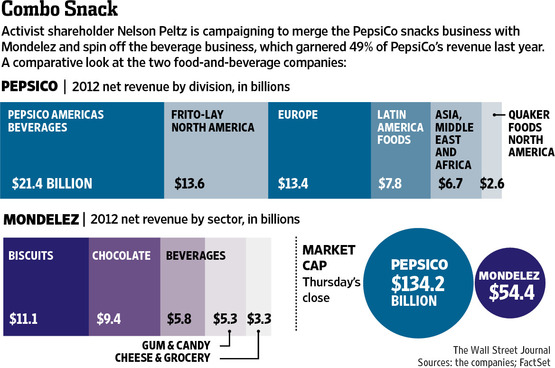
Activist investor Nelson Peltz thinks PepsiCo Inc.’s PEP +1.83% salty snacks go better with the sweet snacks at Mondelez International Inc. than soda and Gatorade. Wall Street isn’t as enthusiastic about Mr. Peltz’s suggestion, made Wednesday, that PepsiCo buy Mondelez in an $80 billion deal and then spin off PepsiCo’s beverage business. Shares of Mondelez inched up 0.3% to $30.58 on Thursday, still far below the $35 to $38 a share that Mr. Peltz said PepsiCo should pay for Mondelez, indicating investors see such a deal as far from certain. PepsiCo shares rose 1.8% to $86.80, a sign that investors are chewing over Mr. Peltz’s idea but not too sure of where it might go. The megadeal—envisioned in a white paper from Mr. Peltz’s Trian Fund Management LP—could generate synergy and scale by putting PepsiCo chip brands such as Lay’s, Doritos and Tostitos on the same trucks as Mondelez’s Cadbury chocolate bars, Oreo cookies and Trident gum around the world. Read more of this post

Why is it so damn hard to understand China’s mobile market? Introducing the China App Index.

Why is it so damn hard to understand China’s mobile market? Introducing the China App Index.

by KAI LUKOFF on 07/18/2013 · LEAVE A COMMENT

Two things stand out when I talk to foreign app developers about China:

They’re very excited about the opportunity;

They know almost nothing about the market.

If they’re so eager, then why is still so hard for them to understand the China market? First, to investigate a new market, a developer starts by reviewing the top app rankings on Google Play or the iTunes App Store. This works for nearly every market in the world, except for China. While Google Play is dominant in the rest of the world, it’s a small player in China, where Android is the vast majority of the market. The major mobile analytics firms (AppAnnie, Distimo, etc.) rely upon Google Play data, so they don’t really cover China either. Second, just as in PC internet, China is very different. If you look at the top apps in China, there’s nary a foreign app to be found. In other countries, there are many more global apps (Facebook, Instagram, WhatsApp, etc.) in those rankings. But foreign developers still have great opportunities in China. Among top games, foreign developers makeup roughly half. And the distribution channels (app stores), are far more open to foreign developers than the PC internet was. In the PC era, foreign game developers had to be represented by local Chinese publishers, which handicapped their access to the market (see the debacle between Blizzard & The9). Today, a foreign developer still needs to invest time to understand the market, but the regulatory barriers are not as great. So to help foreign developers understand the market, I launched at initiative at our China app store, Wandoujia. The China App Index is a monthly report with data for our top new and fastest-growing apps. But since lists alone can be a little dry, we’ve decided to pull out three catchy trends each month. For example, My WeChat ‘Moments’ (朋友圈) feed was recently flooded with pictures from the Baidu PhotoWonder celeb photo-comparison feature, so it made sense to highlight that as a trend among our fastest-growing apps.

Google’s Revenue Reignites Mobile Worries

July 18, 2013, 5:56 PM

Google’s Revenue Reignites Mobile Worries

By Amir Efrati

Google GOOG -0.86% reported lower-than-expected second-quarter revenue, reigniting concerns about the impact of mobile devices on online advertising prices and the Web giant’s push into lower-margin businesses. The Mountain View, Calif., company reported a 20% rise in revenue from its core business in the three months that ended June 30, slightly lower than the 22% revenue rise seen in the prior two quarters. The company also reported a 16% rise in profit for the second quarter in a row. Read more of this post

Microsoft Takes $900 Million Writeoff on Tablet

July 18, 2013, 5:15 PM

Microsoft Takes $900 Million Writeoff on Tablet

By Don Clark

Microsoft took a $900 million charge related to slashing the price of its struggling Surface RT tablet, contributing to fourth-quarter results that missed revenue and profit expectations by a wide mark. The software giant, which also cited effects of the soft personal computer market, reported earnings per share excluding the Surface writedown of 66 cents a share, well below Wall Street expectations on that basis of 75 cents. It reported revenue of $19.9 billion, compared with analyst expectations of $20.7 billion. Microsoft’s shares tumbled 5% in after-hours trading on the news to $33.55, off $1.89. Read more of this post

Yahoo’s Rally: Made in China by Alibaba

July 17, 2013, 1:00 p.m. ET

Yahoo’s Rally: Made in China

In CEO Marissa Mayer’s Efforts to Turn Around the Company, Alibaba Is Buying Her Time

ROLFE WINKLER

MI-BX268_ALIHOO_G_20130717180605

The typical honeymoon doesn’t last too long before the hard work of marriage begins. And so it normally is with new corporate chief executives and their shareholders. Lucky for Marissa Mayer, as well as Yahoo YHOO 0.00% shareholders, growth at Alibaba Group is extending the vacation. Yahoo’s second-quarter results, released late Tuesday, were unimpressive at best. Sales shrank 1% year over year, and the company forecasts no improvement in the third quarter. Ms. Mayer has little to show for her efforts a year after becoming CEO. Still, Yahoo shareholders didn’t seem to mind: The stock jumped 7% on Wednesday and now trades at a five-year high. Read more of this post

IBM’s Unexceptional Exceptionals; Big Blue’s reported earnings are “earnings before bad stuff.”

July 17, 2013, 7:02 p.m. ET

IBM’s Unexceptional Exceptionals

A Lot of Work Goes Into Big Blue’s Earnings—but Not Necessarily the Most Inspiring Kind

ROLFE WINKLER

If International Business Machines IBM +1.77% engineered products as well as it engineers its earnings, maybe its revenue growth wouldn’t be so anemic. Never mind that second-quarter results, reported late Wednesday, showed sales declining 3% from the prior year. IBM’s stock still increased 2.6% in after-hours trading, suggesting that investors are more focused on earnings, which are still rising. IBM said earnings per share for the full year will now amount to at least $16.90, up from guidance given last quarter of at least $16.70. That figure, though, isn’t calculated according to U.S. accounting standards—in colloquial terms, it is effectively “earnings before bad stuff.” It ignores, for instance, a $1 billion charge in the second quarter for “workforce rebalancing.” Include that charge, as well as other costs like amortization of intangible assets arising from IBM’s acquisitions, and the company’s forecast for 2013 earnings per share based on U.S. accounting standards actually falls to at least $15.08 from at least $15.53. IBM is both a serial acquirer and a serial cost cutter. In other words, these charges are a regular feature of how IBM does business. This raises the question: Why are they treated as one-time items? Just because tech rivals like Oracle ORCL -0.47%also publish an earnings-before-bad-stuff figure doesn’t mean it makes sense. IBM also boosted its earnings per share in the second quarter with the help of a lower tax rate and by buying back shares. Holding those two constant with where they were the prior year would have reduced quarterly earnings by 23 cents a share, or 8%. Investors won’t complain about IBM paying lower taxes while buying back stock. But it would inspire more confidence if the company could boost earnings by boosting its business.

Buffett’s Washington Post is buying Forney Corp., a supplier of products for industrial boilers, an usual acquisition for a media and education company

Updated July 18, 2013, 7:35 p.m. ET

Washington Post Diversifies… Into Boilers

Publishing Company Buys Industrial Unit from United Technologies

WILLIAM LAUNDER

MK-CE861_WASHPO_D_20130718181829

It’s not uncommon for an industrial company to seek some glitz by buying into media and entertainment. Washington Post Co. WPO -0.11% may be the only media company going in the other direction—adding soot and grease. The company on Thursday said it is buying a maker of parts for industrial furnaces from United TechnologiesCorp. UTX +0.48%. The decidedly un-glitzy deal is in keeping with a strategy of investing in companies that have strong earnings potential, said Post Chairman Donald Graham. Read more of this post

Once a Bridge to Renewable Energy, Shale Gas Is Now Cheap and Widely Available

July 18, 2013, 8:46 p.m. ET

So What’s the Matter With Shale Gas, Anyway?

Once a Bridge to Renewable Energy, Shale Gas Is Now Cheap and Widely Available

JOHN BUSSEY

MK-CE853_THEBIZ_G_20130718180604

Sometimes it seems as if the environmental movement has been left behind by the sheer speed of America’s shale energy revolution. That may be because a resource—natural gas—that environmental groups once saw as part of the solution has become part of the problem, at least as they see it. Shale gas and oil are widely viewed as one of the biggest forces to hit the U.S. economy in modern history. Total U.S. gas production has rocketed 33% since 2008 and oil 46%, driving down energy costs. The expanding shale industry supported 1.7 million jobs in 2012 and produced $62 billion in state and federal tax revenue, according to IHS/CERA, the energy consultancy. Read more of this post

Detroit Failed Because It Didn’t Do What Cities Do; Detroit forgot the economic case for cities: When you put different industries and different people with different ideas in close contact with another, magical things happen

Detroit Failed Because It Didn’t Do What Cities Do

Detroit’s city government filed today for Chapter 9 bankruptcy after years of financial trouble and industrial contraction. It’s easy to think that the city’s fault was going all in on auto manufacturing. Detroit made a bet, and the bet went bad. No surprise, then, that Detroit went bad, too. Including, in this case, its municipal debts.

Detroit’s dependence on cars, though, wasn’t exactly the problem. It was dependence itself. Cities should never go all in on any industry, cars or otherwise. It didn’t realize that until it was too late.

Detroit forgot the economic case for cities: When you put different industries and different people with different ideas in close contact with another, magical things happen.

“Magical things” is, of course, the technical term economists use for a number of spillover benefits created by urban areas. Their work suggests that the magic happens mainly from the mix of ideas. Read more of this post

Frustrated by Indian Policy, Foreign Investors Pull Back; Frustrated With Indian Policies, Wal-Mart, Berkshire Hathaway, Others Pull Back on Investment

July 18, 2013, 3:22 p.m. ET

Frustrated by Indian Policy, Foreign Investors Pull Back

Frustrated With Indian Policies, Wal-Mart, Berkshire Hathaway, Others Pull Back on Investment.

SEAN MCLAIN, SHEFALI ANAND and BIMAN MUKHERJI

NEW DELHI—A series of high-profile withdrawals of foreign investment across several industries this week have highlighted growing frustration with the Indian government over weak public policy as the economy slows.

Global retail giant Wal-Mart Stores Inc., WMT +0.18% insurer Berkshire HathawayInc. BRKB +0.79% and steel companies Posco 005490.SE -0.80% and ArcelorMittalMT +2.18% all pulled back on Indian investment plans this week. Read more of this post

Buyouts Grow Harder for U.S.-Listed Chinese Firms; Tighter Credit, Rising Valuations Are Barriers to Deals

July 18, 2013, 2:02 p.m. ET

Buyouts Grow Harder for U.S.-Listed Chinese Firms

Tighter Credit, Rising Valuations Are Barriers to Deals

CHAO DENG

The number of Chinese companies going private after being publicly traded on U.S. exchanges has been rising in recent years, but buyers are facing headwinds from higher valuations and tighter credit. Doubts about U.S.-listed Chinese companies’ bookkeeping and disclosures a few years ago caused their shares to tumble, paving the way for company executives and private-equity firms to take these companies private in the hope of profiting by relisting them elsewhere. Read more of this post

The Myth of China’s Economic Reform

The Myth of China’s Economic Reform

Can we please have a moratorium on the word “Likonomics”? Premier Li Keqiang’s plans to overhaul the Chinese economy have hardly earned such a grand moniker yet.

Say what you will about “Thatchernomics” or “Reaganomics,” but Margaret Thatcher and Ronald Reagan fundamentally altered the British and American economies. No one is rolling their eyes at “Aquinomics,” President Benigno Aquino’s thus-far successful prescription for the Philippines, the onetime “sick man of Asia.” By contrast, Likonomics is a ridiculously premature nod to ideas that are, at best, still on the drawing board and might never come off it. Read more of this post

The Inspiring Story Of The Astronaut Who Was Rejected By NASA 15 Times Before Finally Reaching The Skies

The Inspiring Story Of The Astronaut Who Was Rejected By NASA 15 Times Before Finally Reaching The Skies

VIVIAN GIANG JUL. 17, 2013, 8:58 PM 1,269 5

clay-anderson-2

In 1998, Clayton Anderson was a 29-year-old aerospace engineer who wanted to fulfill his childhood dream of going to space. One agency was stopping him from getting there: NASA. The government agency had rejected Anderson’s application for its astronaut training program 15 times. But Anderson is one of those people whose dogged perseverance is inspiring.  Anderson didn’t feel depressesd after getting yet another rejection letter from NASA. He said he actually felt “hope” whenever he received one: “Most applicants receive postcards; a letter sent on stationary meant something.” But so many rejections after so many years can wear on a man, and Anderson decided that his 16th attempt would be his last one. Fortunately, that last attempt was all he needed. In August of 1998, Anderson reported for training, which included “numerous scientific and technical briefings, intensive instruction in Shuttle and International Space Station (ISS) systems, physiological training, ground school to prepare for T-38 flight training, as well as learning water and wilderness survival techniques.” In 2007, Anderson boarded the Space Shuttle Atlantis for a trip to the International Space Station as a flight engineer on his father’s birthday and returned to earth five months later on his wedding anniversary. Three years later, he went to space a second time as a mission specialist on STS-131. Anderson is the first and only astronaut from Nebraska and has logged 167 days in space, including more than 38 hours in spacewalks. You can read his expedition journals here. In January of 2013, the 54-year-old retired from NASA and is now turning his attention to education. David Hendee writes at the World-Herald that Anderson has opportunities at the University of Nebraska at Omaha and Iowa State University’s aerospace engineering program. If this story doesn’t embody the “never give up” motto, we’re not sure what does. Below is one of Anderson’s rejection letters featured in the book “Other People’s Rejection Letters“:

clayrjection

Surprises Are the New Normal; Resilience Is the New Skill

Surprises Are the New Normal; Resilience Is the New Skill

by Rosabeth Moss Kanter  |  10:00 AM July 17, 2013

The difference between winners and losers is how they handle losing. That’s a key finding from my ongoing research on great companies and effective leaders: no one can completely avoid troubles and potential pitfalls are everywhere, so the real skill is the resilience to climb out of the hole and bounce back. Volatile times bring disruptions, interruptions, and setbacks, even for the most successful among us. Companies at the top of the heap still have times when they are blindsided by a competing product and must play catch-up. Sports teams that win regularly are often behind during the game. Writers can face dozens of rejections before finding a publisher that puts them on the map. Some successful politicians get caught with their pants down (so to speak) and still go on to lead, although such self-inflicted wounds are harder to heal. Resilience is the ability to recover from fumbles or outright mistakes and bounce back. But flexibility alone is not enough. You have to learn from your errors. Those with resilience build on the cornerstones of confidence — accountability (taking responsibility and showing remorse), collaboration (supporting others in reaching a common goal), and initiative (focusing on positive steps and improvements). As outlined in my book Confidence, these factors underpin the resilience of people, teams, and organizations that can stumble but resume winning. Read more of this post

SuperCorp: How Vanguard Companies Create Innovation, Profits, Growth, and Social Good

SuperCorp: How Vanguard Companies Create Innovation, Profits, Growth, and Social Good [Hardcover]

supercorp-how-vanguard-companies-create-innovation-profits-growth-and-social-good-184668207x

Release date: August 25, 2009

Rosabeth Moss Kanter on the answer to the global crisis of business and American-style capitalism. Out of the ashes of conventional business models arises a set of companies using their power not only for profits and sustainable growth but also social good. If you think business corporations are doomed to be lumbering, bloated, and corrupt, think again. Based on an extraordinary three-year investigation, interviewing more than 350 key people at major companies around the world, Rosabeth Moss Kanter provides encouraging and astounding evidence that this assumption is completely outdated. The businesses that are agile, keeping ahead of the curve in terms of market changes and customer needs, are the businesses that are also progressive, socially responsible human communities. Take IBM. When the tsunami and earthquake struck Asia, IBM didn’ t just cut a check for relief funds and call it a day. The company used its technological expertise and skilled people to create what government and relief agencies could not: information systems to effectively track relief supplies and reunite families. While IBM did this with no commercial motive, its employees’ desire to serve people suffering during these crises stimulated innovations that later benefited the company. Or Proctor & Gamble. Despite a decade-long commitment to research and development of a water purification product, commercial prospects were unpromising. But because it was so consistent with P&G’s statement of purpose, people within the company persevered. And when the tsunami struck, it was then able to deliver roughly a billion glasses of drinking water for the victims, earning plaudits from aid partners, the media, governments, and crucially, P&G employees. SuperCorp captures the zeitgeist of the emerging twenty-first-century business. For example:

• The strong potential synergy between financial performance and attention to community and social needs
• The unique competitive advantage from embracing the values and expectations of a new generation of professionals
• The growth opportunities that result from stressing values and supressing executive egos when seeking partners and integrating acquisitions

SuperCorp is a remarkable look at the business of the future and the management skills required to get there. IBM, Banco Real, P&G, Cemex, Omron, and other companies reported on now move with the rapidity and creativity of much smaller enterprises. These companies are not perfect, but when people are empowered and values drive decisions, everything can come together in magical “Rubik’s Cube moments” of deep satisfaction. Kanter’s compelling and inspiring stories show that people are more inclined to be creative when their company values innovation that helps the world. Read more of this post
Beca Asia Emeritus Chairman Chuan Seng Lee presided over a business which grew to 40 times its original size in 25 years. In that time, the Msian-born Kiwi learnt many things about developing a NZ company in the ASEAN region

PERSEVERANCE BUILDS PROSPERITY IN ASEAN

15 July 2013

By NZTE

CSLee

Beca Asia Emeritus Chairman Chuan Seng Lee presided over a business which grew to 40 times its original size in 25 years. In that time, the Malaysian-born Kiwi learnt many things about developing a New Zealand company in the ASEAN region. He says New Zealanders relate well with Asia, but need to have passion and perseverance to survive. It can be hard to convince a potential client of the value of your product or service, so you need the desire for success and a gutsy determination to keep going if you encounter slow initial progress. Lee says many ASEAN companies have been burnt by foreign companies who talked them into deals, then made ungraciously swift exits when the going got tough. “There are foreign firms that bail and leave everybody in the lurch. (That’s why) they will be cautious.” Read more of this post

Nike’s Crazy New $160 Running Shoe Is Basically A Sock

Nike’s Crazy New Running Shoe Is Basically A Sock

TONY MANFRED JUL. 17, 2013, 12:03 PM 5,665 11

nike-free-flyknit-sock

Nike released a bunch of information this week about its next running shoe — the Nike Free Flyknit. To put it crudely, it’s basically a sock with the sole of a running shoe attached to the bottom of it. It retails for $160, and goes on sale August 1st. Nike has been trying to make running shoes that mimic what it’s like to run barefoot (“naturally”) for a while. The current Nike Free has a flexible sole that curves to the motion of your foot as it hits the ground, and the support on the upper parts of the shoe is less bulky than traditional running shoes. The sole of this new Nike Free Flyknit is the same as the Nike Free, but the upper is a knitted material that’s really sock-like.  It seems pretty wild, but we’re guessing it might be a little too extreme for non-hardcore runners who don’t want to drop $160 on a shoe they’ve never experienced before. Read more of this post

How To Break The Sound Barrier With A Ping Pong Ball

How To Break The Sound Barrier With A Ping Pong Ball

KARIN HEINEMAN, INSIDE SCIENCE JUL. 17, 2013, 1:46 PM 2,535 5

Getting students excited about science isn’t always easy, but having a live demonstration that uses ping pong balls traveling at supersonic speeds will get almost any kid’s attention. Mechanical engineering and technology students at Purdue University built a supersonic, air-powered cannon that shoots ping pong balls at speeds so fast they break the sound barrier. “We figured out it was coming out at about 919 miles an hour, and it was just mind-blowing,” said Craig Zehrung, a Ph.D. student at Purdue. That is faster than an F-16 fighter jet at low speeds. Drawing upon his experience in the air force, mechanical engineer Mark French designed the cannon and turned a mundane class in to a fun learning experience. Read more of this post

Chengguan local officials allegelly beats street vendor to death in China’s Hunan Province; reporters mauled by police for vendor’s death coverage

Chengguan allegelly beats street vendor to death in Hunan Province

2013-07-18 00:38:09 GMT2013-07-18 08:38:09(Beijing Time)  SINA English

U166P5029DT20130718100236U166P5029DT20130718100248

Several urban management officials, more popularly known as Chengguan in China, were accused of beating a street vendor to death in Chenzhou city, South China’s Hunan Province, according to a Weibo blast on Wednesday. The blast said the husband of a couple, who sold watermelon near a bridge, died after he had a dispute with the Chengguan. Witness said the husband was beaten in the head by an iron weight during the brawl. The families of the victim fought against the government officials who planned to loot the vendor’s corpse, which attracted crowd of onlookers. “The government dispatched over 200 armed police and finally snatched the corpse,” a reporter with CCTV revealed on his Sina Weibo.

Reporters mauled by police for vendor’s death coverage

2013-07-18 07:36:04 GMT2013-07-18 15:36:04(Beijing Time)  SINA English

By Jia Xiaoguang, Sina English

Two reporters of a local TV station in southern Hunan Province were violently assaulted by a handful of policemen when they were doing an on-scene report of the death of the watermelon dealer in Hunan’s Linwu county last night. Li Haitao and Lei Kai, two reporters of Huanan Economic TV Station, arrived at the site where a street vendor selling watermelon was beaten to death during a brawl with several chengguan, or urban law enforcement officials yesterday morning, at around 23 o’clock last night. On seeing them, about five or six policemen who were carrying out mission there soon walked towards them, yelling “No filming here! You’re dead men if you dare to film.” According to Li’s description, he then stayed in their news van while Lei got off and prepared for the report. Lei was beaten up fiercely by the charging policemen, who quickly closed in on them, thrusting wooden clubs into the van window and hitting Li in the head. Injuries of varying degrees were found on their heads, shoulders and backs after the atrocity, while Lei’s mobile phone was also taken away during their fight. They are currently writing news report in a local hotel.

In search of the buccaneer in corporate India

July 17, 2013 4:15 pm

In search of the buccaneer in corporate India

Review by Avantika Chilkoti

Conquering the Chaos: Win in India, win everywhere, by Ravi Venkatesan,Harvard Business Review Press, $30/£20

Any company looking to expand into India needs a “Clive figure”, Ravi Ven­katesan recently told the Financial Times. It was a contentious reference to Robert Clive, the British army officer who led the East India Company to assume power in India. Controversy aside, Venkatesan’s point is an astute one: multinationals mov­ing into India need a buccaneer to head the bus­iness, an energetic lead­er who believes zealously in Asia’s third-largest economy. Venkatesan was just this sort of country manager at Microsoft India and Cummins India, the engine maker, so his views are pertinent. Read more of this post

CHART OF THE DAY: The Chinese Premier’s 2 Favorite Economic Indicators Look Super Depressing

CHART OF THE DAY: The Chinese Premier’s 2 Favorite Economic Indicators Look Super Depressing

SAM RO JUL. 17, 2013, 5:18 PM 797

Earlier this week, we learned that China’s economy decelerated to 7.5% growth in Q2, which is right in line with the Chinese government’s target. However, some economists and skeptics have long argued that the economic data produced by the Chinese government is unreliable, especially since it seems to suit the needs of policymakers. As such, savvy economists often point to other indicators that act as proxies to Chinese economic activity.  These stats include purchasing managers’ indices, gasoline usage, and the export data of China’s trading partners. China’s Premier even offered his own proxy economic indicators.  Unfortunately, they don’t look too hot. From Standard Chartered’s Stephen Green: …Such proxies are, no doubt, useful pointers. But one has to be careful. Figure 11 shows two popular proxies – growth of rail freight movement and electricity production. The two (in addition to bank credit) were reported to have been favourites of Li Keqiang when he was running Liaoning province. We show what has been happening. Pretty depressing: the chart suggests that the economy has entered a recession. “However, choose different proxies and the story changes,” added Green.

screen shot 2013-07-17 at 5.14.31 pm

Embrace Innovations Founder Jane Chen on Keeping Indian Infants Warm

Embrace Innovations Founder on Keeping Indian Infants Warm

by Jane Marie Chen | Jul 18, 2013

topimg_22061_jane_chen_600x400

We met this woman who had lost her first baby and used our product for her second baby who was born prematurely

Jane Chen’s Embrace Innovations sells low-cost infant warmers. She says the challenges in India force one to be entrepreneurial

Jane Marie Chen
Age:
 32
Designation: CEO and co-founder, Embrace Innovations. It sells low-cost infant warmers for low-birth-weight and premature babies in developing nations. It has partnered with multinationals like GE Healthcare to address infant mortality. Read more of this post

Distinguishing Alpha from Noise: Resurrecting the Role of Investment Philosophy in Evaluating Investment Managers; “In the long run X always wins”, where X could be dividend yield, earnings growth, quality of management, yet managers are unable cite a reason why X should be systematically under-priced by the market.

17 Jul

Distinguishing Alpha from Noise

David J. Merkel

I read a paper today that I thought was pretty interesting — A Consultant’s Perspective on Distinguishing Alpha from Noise. [8 pages PDF]  I have been on both sides of the table in my life.  I have hired managers, and I have tried to sell my equity management services. In general, managers that thought would offer value would venture off the beaten path.  They might own some well-known names, but they would own far more that would make me say, “Who is that?”  The companies would be less known because they are smaller, foreign, have a control investor, etc. Those portfolios would look a lot different than an index fund.  They would be more concentrated by sector, industry and company.  They would have a process that analyzes what the market is misvaluing, whether by sector, industry, or company.  They would stick to their discipline through thick and thin, realizing that all anomalies in the market go in and out of favor. Read more of this post

The Wealth Management Whine: The wealth management industry is on the eve of a major consolidation. Are the woes self-inflicted?

July 15, 2013, 5:36 P.M. ET

The Wealth Management Whine

By Robert Milburn

Steven Crosby, senior managing director at PricewaterhouseCoopers, predicts a five-fold, global increase in mergers and acquisitions in the wealth industry – during just the next two years. In Europe, meanwhile, he’s expecting a ten-fold increase in mergers among wealth management firms.

Crosby’s startling call is largely determined by the raw data found buried in PwC’s 2013 Global Private Banking and Wealth Management Survey. The PwC survey, now in its 20th edition, is drawn from interviews with senior banking executives. A third of the survey’s 200-plus participating wealth management companies expect “significant consolidation” in the next two years, versus just 7% in 2011. Read more of this post

Conquering the Chaos: Win in India, Win Everywhere

Conquering the Chaos: Win in India, Win Everywhere [Hardcover]

Ravi Venkatesan (Author)

conquering-the-chaos-win-in-india-win-everywhere-400x400-imadjcd7ggzqyhkv

Publication Date: June 18, 2013

India: A Defining Choice for Your Business

India is on the minds of business leaders everywhere. Within a few decades, India will be the world’s most populous nation and one of its largest economies. But it is also a complex and challenging market, with a reputation for corruption, uncertainty, and stultifying bureaucracy. The initial infatuation with India is over and reality has set in. But India is not a market that can be ignored. So why take a chance in this extraordinary and complex region? What does it take to win in India? How do you deal with the chaos—and even prosper from it? Ravi Venkatesan, the former Chairman of Microsoft India, offers inside advice on how your firm can overcome the unique challenges of the Indian market. He argues that chaotic India is in fact an archetype for most emerging markets, many of which present similar challenges but not the same potential. Succeeding in India therefore becomes a litmus test for your ability to succeed in other emerging markets. If you can win in India, you can win everywhere. Hard as these markets are, Venkatesan says, for most multinational firms the bigger challenge to success in emerging markets may well be the internal culture and mind-set at headquarters. The unwillingness to make a long-term commitment to the new market or to adequately trust local leadership, combined with the propensity to rigidly replicate the products, business models, and operating systems that have worked at home drives many companies to a “midway trap” that results in India remaining an irrelevantly small contributor to global growth and profits. Combining his personal experience with in-depth research and interviews with CEOs and senior leaders at dozens of companies—including Nokia, GE, JCB, Dell, Honeywell, Volvo, Bosch, Deere, Unilever, and Nestlé—Venkatesan shows you how to tackle slowing growth, policy uncertainty, and corruption and enable your firm to thrive in India. He proves that you can break through successfully, but it takes a very different type of leadership, both locally and at headquarters. If you want to succeed in the twenty-first century, you must succeed in emerging markets. This practical book, written by one of India’s most respected CEOs, will give you the keys to win in India, other emerging markets, and beyond. Read more of this post

Superstars still reign over publishing; The decline of retail chains has made book publishers warier of taking risks on new authors

July 17, 2013 7:16 pm

The superstar still reigns supreme over publishing

By John Gapper

The decline of retail chains has made book publishers warier of taking risks on new authors

Alfred Marshall, the economist, wrote in 1947 that changes in technology and trade meant that “the operations in which a man exceptionally favoured by genius and good luck can take part are so extensive as to enable him to amass a large fortune with a rapidity hitherto unknown”. Robert Galbraith is a man exceptionally favoured by genius but it was only when Galbraith was revealed this week to be the nom de plume of a woman called JK Rowling that his supposed debut novel, The Cuckoo’s Calling , ascended the bestseller list with rapidity. As Marshall noted of the phenomenon of the superstar, a big name makes a big difference.

Read more of this post

Pete Flint, co-founder and CEO of Trulia, talks about what it takes to build a business and what’s next for the online real-estate marketplace

July 17, 2013, 7:25 p.m. ET

How Trulia’s CEO Built the Business

After Struggling to Find Off-Campus Housing, Co-Founder Creates Online Real-Estate Service

SARAH E. NEEDLEMAN

Pete Flint, of Chigwell, England, struggled to find off-campus housing while pursuing an M.B.A. at Stanford University.

MK-CE815_HIBI_DV_20130717171725

Pete Flint says aspiring entrepreneurs need to be ‘customer-obsessed.’

Frustrated by the situation, he spent his entire second school year in 2003 researching a solution, which later developed into a business plan for an online home-search service. He and his classmate, Sami Inkinen, created TruliaInc. TRLA +2.86% in 2004 after raising $2 million in funding from prominent Silicon Valley investors such as Ron Conway, Greg Waldorf and Kevin Hartz. They launched Trulia.com the following year. Read more of this post

Tesla CEO Musk Morphs From Tony Stark to Henry Ford

Tesla CEO Musk Morphs From Tony Stark to Henry Ford

Elon Musk inspired Robert Downey Jr.’s portrayal of comic-book billionaire industrialist Tony Stark in the “Iron Man” films. The role model for Musk, a billionaire industrialist for real, appears to be Henry Ford.

The Ford Motor Co. (F) (F) founder’s mastery of mass-production made the Model T the first affordable car, revolutionizing transportation. Musk, who named Tesla Motors Inc. (TSLA) (TSLA)’s sedan the Model S as a tip-of-the-cap to Henry’s car, sees himself similarly as an engineer, a tinkerer, a nitty-gritty entrepreneur. Read more of this post

Why U.S. Students Don’t Major in Science

Why U.S. Students Don’t Major in Science

In recent years, a lot of people have been concerned about the relatively low numbers of science majors among American college students. The percentage of science and engineering graduates in the U.S. has been far below that in China and Japan. On various math and science tests, the performance of U.S. students has fallen below that of students in South Korea, Singapore, Japan, England, Finland, Israel, Australia and Russia.

This is a real problem, because science majors can contribute to economic growth and because many of them end up with especially good jobs after graduation. In the employment market, students with degrees in STEM (science, technology, engineering and math) can be at a comparative advantage. The relatively low number of American graduates in these fields has created what some people call “the STEM crisis.” Read more of this post