Lasting Legacy: Nelson Mandela’s Evolution as a Strategic Leader

Lasting Legacy: Nelson Mandela’s Evolution as a Strategic Leader

Published: July 09, 2013 in Knowledge@Wharton

Paul J. H. Schoemaker is research director of Wharton’s Mack Institute for Innovation Management, executive chairman of Decision Strategies International and the author of numerous books and articles. He recently visited South Africa, where he met with government and business leaders to discuss Nelson Mandela’s legacy. In the following opinion piece, Schoemaker describes three decisions that illustrate Mandela’s leadership, and he analyzes early political events that influenced Mandela’s career.

The life story of Nelson Mandela is well known, and has elevated him to the level of such widely recognized heroes as Mahatma Gandhi and Mother Teresa. There is indeed much courage, sacrifice, wisdom and nobility in his life — attributes that demand our deep respect and have much to teach us. What is less well-known is how Mandela evolved into the kind of strategic leader who, from prisons on Robben Island and elsewhere, helped to bring genuine democracy to South Africa. For example, while isolated from his fellow prisoners by force, he steered secret government meetings toward the abolishment of apartheid and free elections. Subsequent to that, he became the country’s first democratically elected black president.

Read more of this post

Economic uncertainty is ‘tremendously positive’: Jim Collins; “We are returning to normal. Normal is chaos, disruption, uncertainty and change. That’s actually the human condition.”

Economic uncertainty is ‘tremendously positive’: Jim Collins

PUBLISHED: 3 HOURS 59 MINUTES AGO | UPDATE: 3 HOURS 2 MINUTES AGO

The turbulence is likely to gather pace, with technology and globalisation acting as accelerators to speed up the boom and bust cycles. Photo: Reuters

JAMES THOMSON

Jim Collins starts with a history lesson that will send chills down the spines of entrepreneurs and executives struggling with the chaos and turmoil of the past five years. “In the developed world, we grew up in a period of very unusual stability and prosperity. Obviously there were disruptions – fuel shocks etcetera – but from the 1950s up until around 2000, it was a period of stability and prosperity,” he tells me from his New York office. Collins, the highly regarded management thinker, consultant and researcher famous for books including Built to Last and Good to Great, says the lesson from his most recent work, Great by Choice, is that the longer sweep of human history is not marked by lengthy periods of prosperity. “We are returning to normal. Normal is chaos, disruption, uncertainty and change. That’s actually the human condition.” Read more of this post

Prozac World: These Are The Most Stressed Out Countries

Prozac World: These Are The Most Stressed Out Countries

Tyler Durden on 07/17/2013 21:23 -0400

20130717_stress_0

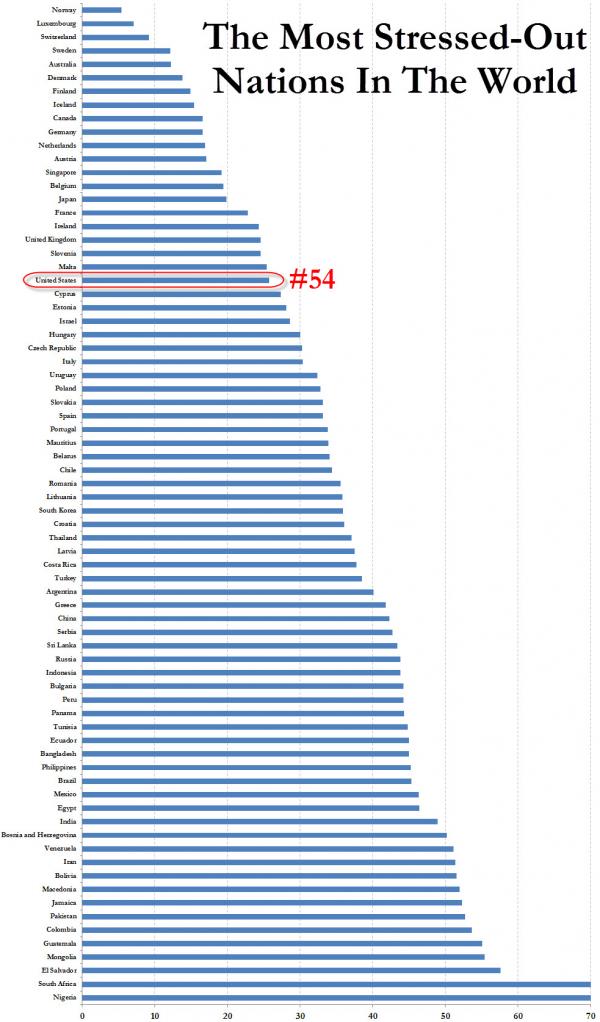
While anti-depressant use is surging in Sweden (up 1000% since 1980), bursting in Britain (up 495% since 1991), and up an astounding 400% since 1994 in the USA (with 1 in 10 on some kind of ‘prozac’), it is the poor-old Nigerians that should really be complaining. Based on seven variables,Bloomberg has scored 74 nations around the world for their “stressed-out” factor and finds the USA to be 54th (so stop whining and suck it up), Norway the least stressed-out of all and El Salvador and South Africa at the top with Nigeria (with the roiling Egyptians ranking 15th). Bloomberg ranked countries based on the stressfulness of their living environments. Read more of this post

Members of Italy’s Ligresti family, who once controlled insurer Fondiaria-SAI SpA (FSA), were arrested today on charges of false accounting and market manipulation

Ligresti Family Members Arrested in Fondiaria-SAI Probe

Members of Italy’s Ligresti family, who once controlled insurer Fondiaria-SAI SpA (FSA), were arrested today on charges of false accounting and market manipulation, police said. The family’s patriarch, Salvatore Ligresti, and his two daughters, were among seven people taken into custody by Italy’s financial police, according to an e-mailed statement from its Turin office. They are accused of misleading at least 12,000 investors by concealing 600 million euros ($789 million) of losses at Fondiaria-SAI in its 2010 accounts. Ligresti is under house arrest, while his daughters Giulia Maria and Jonella are being detained at an undisclosed jail, police said. Three former Fondiaria executives, Emanuele Erbetta, Antonio Talarico and Fausto Marchionni also have been charged. An arrest warrant was issued for Gioacchino Paolo Ligresti, one of Salvatore Ligresti’s sons, is in Switzerland, police said. Gian Luigi Tizzoni, a defense attorney for the Ligrestis, wasn’t immediately available to comment on the case. According to the police statement, the Ligrestis underestimated the company’s reserves for outstanding insurance claims, allowing it to distribute 253 million euros of earnings to the family holding company Premafin Finanziaria SpA (PF), instead of losses.

To contact the reporter on this story: Daniele Lepido in Milan at dlepido1@bloomberg.net

‘Intelligent’ surgical knife can sniff out cancer tissue

‘Intelligent’ surgical knife can sniff out cancer tissue

2:24pm EDT

By Ben Hirschler

LONDON (Reuters) – Scientists have created an “intelligent” surgical knife that can detect in seconds whether tissue being cut is cancerous, promising more effective and accurate surgery in future. The device, built by researchers at London’s Imperial College, could allow doctors to cut back on additional operations to remove further pieces of cancerous tumors. The technology, effectively merging an electrosurgical knife that cuts through tissue using heat with a mass spectrometer for chemical analysis, has also been shown to be able to distinguish beef from horsemeat. Read more of this post

Down Syndrome’s Extra Chromosome Silenced in Lab Cells

Down Syndrome’s Extra Chromosome Silenced in Lab Cells

Scientists silenced the extra copy of a chromosome that causes Down syndrome in laboratory stem cells, offering the first evidence that it may be possible to correct the genes responsible for the disorder.

The findings, published today in the journal Nature, offer new cell models for developing potential treatments, researchers said. The models, aided by gene-manipulating technology from Sangamo Biosciences Inc. (SGMO), may help researchers discover drug targets for other ill health effects that come with the syndrome, including heart disease, hearing difficulties, and weakened muscles. Read more of this post

Memory Lapse Shown as Early Warning for Alzheimer’s

Memory Lapse Shown as Early Warning for Alzheimer’s

Doctors who tell their aging patients not to fret about memory lapses may be doing them a disservice, according to new studies that suggest they may be the earliest discernible signs of Alzheimer’s disease.

The condition, dubbed subjective cognitive decline, is one of the hottest new areas in dementia research. Five reports presented at the Alzheimer’s Association meeting in Boston found healthy people who say their thinking is growing cloudy may already have changes in their brains and are twice as probable to be subsequently diagnosed with a cognitive disorder. Read more of this post

Dementia’s Signs May Come Early; Doctors are starting to pay more attention to patients who say they are experiencing cognitive problems but do not yet show a measurable decline

July 17, 2013

Dementia’s Signs May Come Early

By PAM BELLUCK

The man complained of memory problems but seemed perfectly normal. No specialist he visited detected any decline.

“He insisted that things were changing, but he aced all of our tests,” said Rebecca Amariglio, a neuropsychologist at Brigham and Women’s Hospital in Boston. But about seven years later, he began showing symptoms of dementia. Dr. Amariglio now believes he had recognized a cognitive change so subtle “he was the only one who could identify it.” Read more of this post

South Korea tycoon and CJ chairman Lee Jae-Hyun charged with embezzlement, tax evasion; stashed away undeclared assets worth about 96 billion won (S$108.5 million) and evading taxes worth 54.6 billion won since 2004

South Korea tycoon charged with embezzlement, tax evasion

Published on Jul 18, 2013
SEOUL (AFP) – The head of South Korean food and entertainment giant CJ Group was charged on Thursday with embezzlement and tax evasion, as Seoul seeks to rein in family-controlled business groups. Lee Jae-Hyun, 53, allegedly stashed away undeclared assets worth about 96 billion won (S$108.5 million) and evading taxes worth 54.6 billion won since 2004. “This is a case where a business tycoon illicitly pocketed funds diverted from listed companies and evaded tax,” Prosecutor Park Jeong-Shik told journalists. Lee created some 10 shell companies in foreign countries, including Singapore and Hong Kong, to avoid tax, he said. Three other former and current executives of the group were also charged as accomplices.

Future of STX remains in doubt; W3 tril. liquidity injection plan fails to restore confidence

2013-07-17 16:55

Future of STX remains in doubt

W3 tril. liquidity injection plan fails to restore confidence
By Kim Rahn

Concerns are growing over a plan by creditors to inject 3 trillion won into cash-strapped STX Offshore & Shipbuilding because it is uncertain whether the shipbuilder will recover, even with the fresh liquidity.
Experts say the company’s full recovery depends on unforeseeable economic factors. Even creditors have raised concerns over whether the shipbuilding firm will recover and become profitable again because the sluggish shipbuilding and shipping industry are unlikely to improve soon. Read more of this post

Korea must shed homogeneity jinx

2013-07-17

Korea must shed homogeneity jinx

Kim Ji-soo

Korea should more positively shed the yoke of racial homogeneity and welcome immigrants with open arms in order to get ahead globally, an international politico-economic expert claims in an interview. Talking about his recent book on the future of Korea immigration, Mo Jongryn, said, “Look at Apple. Everybody, irrespective of nationality, wants to work there.” “By changing its concept, Samsung will be able to tap into the 7 billion of the world population rather than from 50 million South Koreans,” Mo said about Korea’s global winning strategy. Read more of this post

Corporate bonds with detachable warrants (BDWs) will be no longer available for issuance from late next month in South Korea after 15 years of rocking the political and business circles

Corporate bonds with detachable warrant to vanish in S. Korea

Hwang Ji-hye, Oh Soo-hyun

2013.07.17

Corporate bonds with detachable warrants (BDWs) will be no longer available for issuance from late next month in South Korea after 15 years of rocking the political and business circles. This has prompted companies to rush to issue BDWs. Buyers of BDWs can give the issuer warrant in exchange for shares and sell the shares at a market price to take profits if share price rises above the exercise price. However, the revised Capital Market Integration Act will take effect on August 29, which prohibits issuance of BDWs. The National Assembly came up with such regulations to prevent majority shareholders from employing BDWs to fraudulently gain profits or hand over their shares as inheritance. Since its adoption in 1999, BDWs became a subject of nationwide controversy when corporations such as Samsung SDS and Doosan were accused of issuing BDWs to illegally transfer shares to parties of special interest. The accusation prompted prosecutors to seek investigation into the charge. In addition, BDWs triggered political controversy during the presidential election last year, as prominent candidate Ahn Cheol-soo was suspected of having converted BDWs into stocks exceeding the bonds’ value while running a computer vaccine company. The issuance of bonds with warrants has jumped 30 percent year-on-year (yoy) this year, said local financial information provider FnGuide Wednesday.

Legoland Korea will open in Chuncheon in Gangwon Province, South Korea in July 2016.

Legoland Korea starts countdown for formal contract

Gee Hong-goo

2013.07.18

Educational theme park Legoland Korea will open in Chuncheon in Gangwon Province, South Korea in July 2016.

If the 1.32 million square-meter (400,000 pyeong) Legoland Korea is constructed in Jungdo, the most attractive tourist place in Chuncheon, it will become the world’s seventh largest and East’s Asia’s first Lego-themed theme park.  The Maeil Business Newspaper found Merlin Entertainments Group wrapped up fine-tuning process for the formal contract Thursday to sign it around early next week. A formal contract came 22 months after the memorandum of agreement (MOA) signed in September 2011.  Read more of this post

Robert Taub back in Israel to combat snoring; The Omrix founder can’t resist Israel’s medical technologies as shown by sleep apnea prevention company Nyxoah; Taub is known for founding biological glue company Omrix and selling it to Johnson & Johnson in 2008 for $483 million

Robert Taub back in Israel to combat snoring

The Omrix founder can’t resist Israel’s medical technologies as shown by sleep apnea prevention company Nyxoah.

17 July 13 15:18, Gali Weinreb

About two years ago, at the height of the State of Israel’s trial against Omrix and its founder Robert Taub, he said that he would not establish any more companies in Israel. He founded Nyxoah, his new baby, in Belgium and even moved the company’s CEO Dr. Adi Mashiach there. Later Taub registered an Israeli subsidiary of Nyxoah in Tel Aviv. The trial is expected to go to mediation and now Taub reveals that while the company is registered in Belgium, half of its employees are in Israel. “The biotech and medtech sector in Israel is still very attractive. As in the past, I very much admire the entrepreneurship of Israeli companies and Israeli scientists,” he said. Read more of this post

Pushing the Right Buttons: Apple’s steps to reimagine television, like teaming up with ESPN, stand in stark contrast to efforts by Google to compete with established companies

July 17, 2013

Pushing the Right Buttons

By BRIAN STELTER

APPLE-popup

When Apple wanted to revolutionize cellphones, it held hands with AT&T. The partners fought endlessly, but the public loved the finished product: the iPhone. Now, as Apple tries to reimagine television, it is taking the partnership route again, collaborating with distributors like Time Warner Cable and programmers like the Walt Disney Company on apps that might eliminate the unpleasant parts of TV watching, like bothersome set-top boxes or clunky remote controls. Apple’s broader strategy — what its chief executive, Timothy D. Cook, recently called its “grand vision” for television — remains shrouded in secrecy, as everything Apple-related tends to be. Some analysts continue to predict, as they have for years, that the company will someday come out with a full-blown television set. Read more of this post

Activist Billionaire Investor Nelson Peltz Presses PepsiCo to Spin Off Beverages and Buy Mondelez

Updated July 17, 2013, 10:03 p.m. ET

Peltz Presses PepsiCo to Spin Off Beverages and Buy Mondelez

MIKE ESTERL, JULIET CHUNG and JULIE JARGON

Activist shareholder Nelson Peltz said he is urging PepsiCo Inc. PEP +1.45% to acquire Mondelez International Inc. MDLZ +2.13% to create a global snack giant and spin off PepsiCo’s underperforming beverage business. But PepsiCo “right now doesn’t love” the proposed deal, Mr. Peltz said in an interview on CNBC, adding that he is continuing to talk with the snack and beverage company. Read more of this post

Ruling: Amazon Can’t Own ‘.Amazon’

July 17, 2013, 2:48 PM

Ruling: Amazon Can’t Own ‘.Amazon’

By Greg Bensinger

Amazon.com AMZN +0.59% is facing rough waters in its quest to claim “.Amazon.” Late Tuesday, a committee of the nonprofit organization overseeing the Internet’s top-level domain names (the ones after the final dot in a website name), recommended against allowing “.Amazon” to be controlled by the Seattle company. Amazon had hoped to win control over the domain as “a unique and dedicated platform for Amazon,” and as “a further platform for innovation” and, ultimately, to “support the business goals of Amazon,” according to filings it made with the Internet Corporation for Assigned Names and Numbers, or ICANN. Read more of this post

A Bailout Lifeline to a Brazilian Billionaire Would Be Risky

JULY 17, 2013, 3:29 PM

A Lifeline to a Brazilian Billionaire Would Be Risky

By CHRISTOPHER SWANN

A bailout of billionaire Eike Batista would look bad for Brazil. Whiffs of cronyism hang over reports that state development bank BNDES has eased debt terms for the once high-flying tycoon. Taxpayers already have up to $4.7 billion wagered on his collapsing empire. If Brasilia risks more to save a pampered tycoon, it had better be prepared for another round of street protests.

The flamboyant billionaire once called BNDES “the best bank in the world.” Now he may have even more reason to think so. Daily newspaper O Estado de S. Paulo reported that the bank is voluntarily softening the loan conditions for his heavily indebted group of companies. BNDES, Mr. Batista’s largest creditor, has denied any favoritism. Still, it would not be the first time the government has come to the entrepreneur’s aid. Read more of this post

Tech revolution to inch into what we wear; Three categories of device will become prevalent, says Intel chief

July 17, 2013 7:46 pm

Tech revolution to inch into what we wear

By Richard Waters

Three categories of device will become prevalent, says Intel chief

The revolution will be wearable. Only, like most technology revolutions, it will not come as fast or in quite the form that the visionaries predict. That is the safe bet for what is quickly becoming Silicon Valley’s most hyped new claim: that “smart” devices like watches and glasses represent that next front in personal computing. The plunging costs of hardware and the spread of wireless networks certainly point to a time when digital intelligence and connectivity will creep into many different personal items – not to mention the broader world of inanimate objects, creating a much-predicted “internet of things”. More difficult to anticipate is exactly how this revolution will first be felt, though there are clues. Read more of this post

Downbeat Maersk Line chief warns of new era in shipping; Container shipping industry faces lower annual growth

July 17, 2013 11:02 am

Downbeat Maersk Line chief warns of new era in shipping

By Mark Odell, Transport Correspondent

The struggling container shipping industry must prepare for a new era that will see growth in demand fall to half the levels seen over the past two decades, the head of the world’s largest carrier has warned. Søren Skou, chief executive of Maersk Line, a bellwether for global trade, told the Financial Times that the more downbeat outlook was not just due to an prediction of sustained weaker economic growth globally. Read more of this post

Thai farm subsidy creates rice mountain; the effects on world prices could be serious if Thailand floods the market with its rice

July 17, 2013 2:52 pm

Thai farm subsidy creates rice mountain

By Emiko Terazono

Europe has had its butter mountain and wine lake. Now the Thai government is sitting on a rice hoard large enough to supply half of global imports for a year – and traders fear a price collapse as it starts to sell. Bangkok’s rice buying policy, designed to boost farmers’ incomes, has led to a stockpile of 17m-18m tonnes. With the new crop set to be harvested in October, the Thai government needs to dispose of its existing inventory to raise money for the new purchases. Rice market experts are on high alert as Bangkok could issue tenders for about 350,000 tonnes of its rice as early as next week. Concepción Calpe, senior rice analyst at the Food and Agriculture Organisation in Rome, warns the effects on world prices could be serious if Thailand floods the market with its rice. “It could potentially have catastrophic consequences,” she said. Read more of this post

Why Startups Are Sporting Increasingly Quirky Names; Lack of Short, Recognizable URLs Prompts Use of Misspellings, Word Mash-Ups

July 17, 2013, 7:19 p.m. ET

Why Startups Are Sporting Increasingly Quirky Names

Lack of Short, Recognizable URLs Prompts Use of Misspellings, Word Mash-Ups

LINDSAY GELLMAN

The New York cousins who started a digital sing-along storybook business have settled on the name Mibblio. The Australian founder of a startup connecting big companies to big-data scientists has dubbed his service Kaggle. The former toy executive behind a two-year-old mobile screen-sharing platform is going with the name Shodogg. And the Missourian who founded a website giving customers access to local merchants and service providers? He thinks it should be called Zaarly. Quirky names for startups first surfaced about 20 years ago in Silicon Valley, with the birth of search engines such as Yahoo, YHOO +10.34% —which stands for “Yet Another Hierarchical Officious Oracle,” and Google, GOOG -0.12% a misspelling of googol,” the almost unfathomably high number represented by a 1 followed by 100 zeroes. Read more of this post

New Intel CEO: Stay Tuned for Much Cheaper Portable PCs

July 17, 2013, 9:10 PM

New Intel CEO: Stay Tuned for Much Cheaper Portable PCs

By Don Clark

Why does new Intel INTC -0.41% CEO Brian Krzanich sound so upbeat amid the personal computer market’s contraction? His first earnings call Wednesday supplied some clues, including a bet on the impact of much lower PC prices. The chip giant’s profits fell 29% in the second period, and Intel predicted its revenue will be flat for all of 2013, down from a prior prediction of growth “in the low single digits.” But Krzanich is betting that some new chips–particularly those stemming from an overhaul of its low-end Atom line–will have a big impact on demand later this year and into 2014. Read more of this post

The 40-Year Club: America’s Longest-Serving Directors; Board Colleagues Say They Provide Useful Context, While Activist Investors Question Independence

July 16, 2013, 7:45 p.m. ET

The 40-Year Club: America’s Longest-Serving Directors

Board Colleagues Say They Provide Useful Context, While Activist Investors Question Independence

JOANN S. LUBLIN

MK-CE793A_TROPH_G_20130716202002

Corporate governance has changed dramatically in 40 years. Just ask Robert Ted Enloe III. He’s been on the board of Leggett & Platt Inc LEG +0.69% . that whole time. “Governance is far better today,” says Mr. Enloe. The 74-year-old former attorney has served on the board of the maker of bedding and commercial fixtures since 1969. Mr. Enloe belongs to an unusual elite: He’s one of 28 outside directors with at least 40 years’ tenure at a company in the Russell 3000 stock index. Aged 67 to 87 years old, these senior statesmen—and they are all men—hold board seats at big businesses such asNike Inc., NKE +1.00% Level 3 Communications Inc. LVLT -0.05% andCenturyLink Inc., CTL -0.44% according to an analysis by governance researchers GMI Ratings for The Wall Street Journal. Read more of this post

Paying Auditors for Honest Appraisals; An Experiment in India’s Gujarat State Shows a Way to Realign Interests and Incentives

Updated July 17, 2013, 9:21 p.m. ET

Paying Auditors for Honest Appraisals

An Experiment in India’s Gujarat State Shows a Way to Realign Interests and Incentives

DAVID WESSEL

The auditing business rests on what Joshua Ronen, a New York University accounting professor, once called “a structural infirmity.” Auditors are paid by companies they audit, much as rating agencies are paid by companies they rate. This gives auditors an economic incentive to lie on their clients’ behalf, even if that puts their reputations at risk. As an old German proverb puts it: Whose bread I eat, his song I sing. These conflicts of interest figured in the corporate-accounting scandals of the early 2000s and the subprime-mortgage securitization debacle of the late 2000s. Despite attempts to lessen conflicts, resolution has defied easy solution. Read more of this post

The Demanding Off-Hour Escapes of China’s High-Tech Workers

http://nyti.ms/1bmHNnt

July 16, 2013

The Demanding Off-Hour Escapes of China’s High-Tech Workers

By DAN LEVIN

ZHENGZHOU, China — The hottest nightclub in this factory town is a neon-encrusted dive down the road from the industrial park where iPhones are made 24 hours a day. Tucked behind an open construction site, “Through the Summer,” as the nightspot is known, had it all on a recent Saturday night — plastic whistles, fruit plates, a toddler with a mohawk, counterfeit light sabers and a bawdy comedian who imbibed beer through his nose. Read more of this post

Once-Coveted Asian Oil Riches Take Backseat to U.S. Shale

Jul 17, 2013

Once-Coveted Asian Oil Riches Take Backseat to U.S. Shale

By Ross Kelly

Once captivated by Asia’s untapped oil-and-gas riches, some midsize U.S. energy producers are now selling their Asian assets as the North American shale revolution offers bright prospects closer to home. Companies such as Anadarko Petroleum CorpAPC +0.73%Hess Corp. HES +0.76% andNewfield Exploration Co. NFX +1.91% recently started looking for buyers for either all or some of their Asian portfolios, together worth billions of dollars. Assets for sale include oil fields in China’s Bohai Bay and natural-gas hubs in Thailand. Pulling back from Asia may appear counterintuitive. China’s energy demand alone will rise by 60% between 2010 and 2035, accounting for the largest share of growth in global energy use, according to the International Energy Agency. Read more of this post

China renews pledge to push property tax expansion

China renews pledge to push property tax expansion

English.news.cn   2013-07-17

BEIJING, July 17 (Xinhua) — The long-discussed expansion of China’s property tax plan has once again come under the spotlight following a renewed pledge by tax authorities to research the plan. The State Administration of Taxation (SAT) said in a circular issued late Tuesday that it will research the possible expansion of property tax pilot programs. However, like similar statements previously made by other authorities, the circular did not include any details regarding a timetable for the expansion. The comment is the latest in a string of official statements in which authorities have vowed to implement a property tax plan currently being used in the cities of Shanghai and Chongqing. Read more of this post

By the way, China isn’t rebalancing

By the way, China isn’t rebalancing

Kate Mackenzie

| Jul 17 13:09 | 14 comments | Share

Stephen Roach recently wrote for Yale Global Online arguing that yes, rebalancing is happening, but the new leadership have it under control because they are enacting the necessary reforms to facilitate this transition. A quick look at the composition of second quarter growth statistics suggests that is not happening — at least not now. INET’s China Economics Seminar summarises the composition revealed at the National Bureau of Statistics press conference on Monday: […]the spokesman of the NBS told reporters that overall consumption contributed 45.2% of GDP growth in the first six months of 2013 while investment’s contribution still stood well above half at 53.9%. Net exports contributed the rest at 0.9%. Consumption’s 45.2% is the lowest proportion since 2010, as consumption contributed 55.5% and 51.8% of GDP growth in 2011 and 2012 respectively. Read more of this post

When does a Chinese growth deceleration become a crisis?

When does a Chinese growth deceleration become a crisis?

Kate Mackenzie

| Jul 17 11:55 | 23 comments | Share

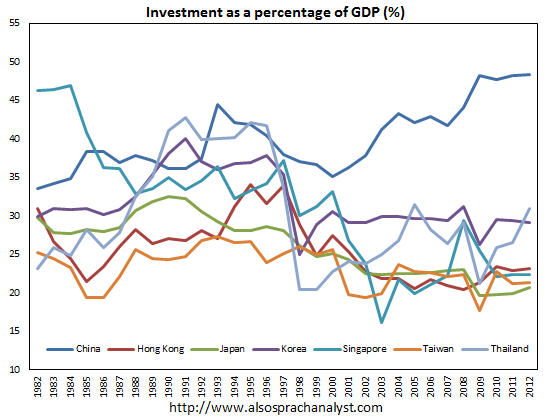
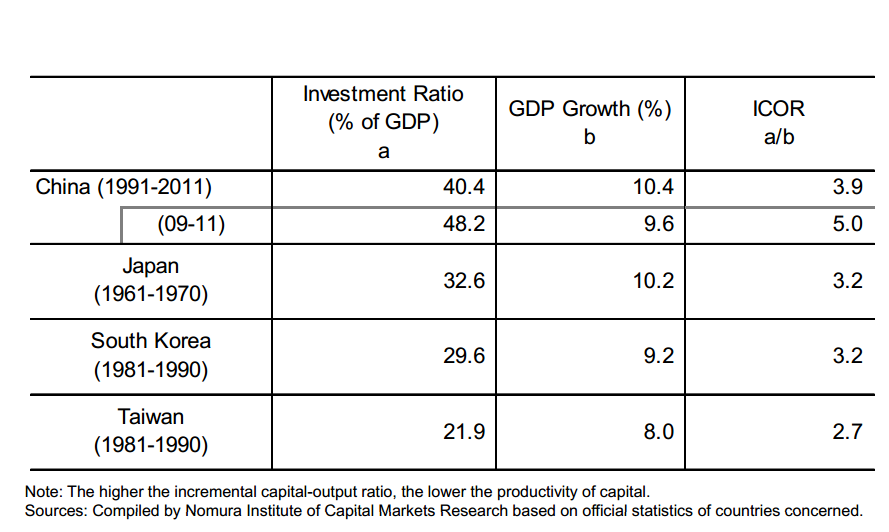
China-investment-ratio-vs-HK-Japan-Singapore-Taiwan-Thailand-AlsoSprachAnalyst-IMF China-capital-output-ratio-crop-Nomura-ICMR

It’s clear to everyone that something big is happening in China.

Double-digit growth is long forgotten and even high single-digit growth is above the consensus (for whatever that’s worth). The implications of this alone are quite massive and you could throw around any number of predictions about what it might mean for commodities, global imbalances, and more. Nomura sees a 30 per cent chance of growth falling below 7 per cent later this year, and Barclays are talking about the odds of growth slowing to as little as 3 per cent growth. Even entertaining the possibility of an outright economic contraction would not get you accused of being a crazed permabear these days. Read more of this post