As Software Takes Over, Network Gear Could Be in Jeopardy; Software-defined networking threatens hardware makers, including Cisco Systems, F5 Networks

SATURDAY, JULY 6, 2013

As Software Takes Over, Network Gear Could Be in Jeopardy

By TIERNAN RAY | MORE ARTICLES BY AUTHOR

Software-defined networking threatens hardware makers, including Cisco Systems, F5 Networks, and Juniper Networks. VMware could be a winner. How Cisco is striking back.

ago, I asked a venture capitalist in computer networking if dedicated network gear would ever be replaced by software running on a standard computer. My hypothesis was that as general-purpose computers became more powerful, they could absorb functions that previously required specialized computer hardware, the way many functions can be performed on PCs today that once required mainframes. The venture capitalist assured me it would never happen, for a variety of reasons, even if it became technologically possible. Read more of this post

How Google Flu Trends Is Getting to the Bottom of Messy Data

How Google Flu Trends Is Getting to the Bottom of Messy Data

by Nicholas Diakopoulos  |  11:00 AM July 5, 2013

Churning through, tabulating, and modeling millions of search queries every day, Google Flu Trendscan measure, a full two weeks before the CDC, the incidence of influenza-like illnesses (ILI) across the U.S. Any official response to a flu pandemic, such as vaccine distribution and timing, could be greatly enhanced with such an early warning. And while not billed as an ersatz measure, Google Flu has had an uncannily high correlation with the CDC’s own slower, yet more assiduously produced estimate of ILIs. Read more of this post

Do CEOs and Directors Get Sick of Attending Meetings?

Do CEOs and Directors Get Sick of Attending Meetings?

Stephen Gray University of Queensland – Business School; Duke University – Fuqua School of Business; Financial Research Network (FIRN)

John Nowland City University of Hong Kong

June 26, 2013

Abstract: 
This study examines whether CEO and director attendance is affected by additional board and committee meetings. Using a hand-collected Australian dataset of 21,691 observations of the number of board and committee meetings held and attended by directors from 2004 to 2007, we find that attendance rates for both outside and inside directors decrease (non-random absences increase) when they are required to attend more board meetings. The marginal effect is that the average outside (inside) director has a 14% (12%) likelihood of missing an additional board meeting. Further analysis shows that the negative relationship between board meetings and attendance rates is consistent across directorships in a range of firms, including when more meetings are associated with poor performance, M&A activity and CEO turnover. The results for committee meetings are mixed, indicating that director attendance is not consistent across different types of meetings. In summary, our analysis indicates that any benefits firms obtain from holding additional meetings are being eroded by lower director attendance, a result that should be of particular interest to shareholders and policymakers.

The Real Reason You Learn A Lesson Better When You Teach It: Nachas, pride and satisfaction that is derived from someone else’s accomplishment

The Real Reason You Learn A Lesson Better When You Teach It

ANNIE MURPHY PAUL, THE BRILLIANT BLOG JUL. 6, 2013, 8:11 AM 1,508 

Learning, and thinking, are deeply social activities. 

This is not the traditional view (Rodin’s iconic sculpture, “The Thinker,” is conspicuously alone in his chin-on-fist musings), but it’s the view that is emerging out of several decades of social science research. Our minds often work best in interaction with other people’s minds, and there are particular kinds of relationships that are especially good at evoking our intelligence. One is the master-apprentice relationship, which I wrote about here. Another, of course, is the teacher-student relationship—but today I want to talk about the benefits of this relationship for the teacher. For thousands of years, people have known that the best way to understand a concept is to explain it to someone else. “While we teach, we learn,” said the Roman philosopher Seneca. Now scientists are bringing this ancient wisdom up to date, documenting exactly why teaching is such a fruitful way to learn — and designing innovative ways for young people to engage in instruction. Read more of this post

Jim Rogers Correctly Predicted Gold Would Fall To $1200, And Now He Thinks It Could Go As Low As $900

Jim Rogers Correctly Predicted Gold Would Fall To $1200, And Now He Thinks It Could Go As Low As $900

MAMTA BADKAR JUL. 6, 2013, 6:44 AM 8,375 33

The price of gold peaked at just over $1,900 per ounce in the fall of 2011. And it was right around that time that commodities guru Jim Rogers began warning investors that the yellow metal could hit a low of $1,200 before the sell-off was over. He was right. Gold prices entered a bear market (down 20% from its high) in April. And on June 27, they touched $1,200. In a phone interview this week, Rogers explained to us how he arrived at the $1,200 figure. He also offers his outlook for gold as it continues its complicated bottoming process. Read more of this post

Global Yellow Pages CEO Stanley Tan loses $25.4m in 2 days in financial products, sues UBS

Yellow Pages CEO loses $25.4m in 2 days, sues UBS

Saturday, Jul 06, 2013, AsiaOne

acc430

SINGAPORE – Global Yellow Pages CEO Chen Bao Neng (Stanley Tan) is taking UBS to court after he suffered losses amounting to $25.4 million in just two days. According to Lianhe Zaobao, the 55-year-old executive director had invested in 16 financial products through UBS from October 2007 to August the following year. He then lost $25.4 million in the 2008 financial crisis.  Read more of this post

Amazon.com: the Hidden Empire

LinkedIn, the Serious Network

Twitter Study

Why could Google die ?

Social network websites: best practices from leading services

Business Models of Opensource and Free Software

Why APIs Are Reshaping Your Business

How Wal-Mart Became the World’s Biggest Retailer

How Wal-Mart Became the World’s Biggest Retailer

By Alex Planes
July 2, 2013 | Comments (1)

On this day in economic and business history…

The first Wal-Mart (NYSE: WMT  ) opened its doors in Rogers, Arkansas on July 2, 1962. At this point in his life, Wal-Mart founder Sam Walton had already racked up over two decades of experience as a retailer. He got his start in the industry as a management traineein one of J.C. Penney‘s (NYSE: JCP  ) Iowa stores in 1940. Penney’s focus on maximizing the value of a customer’s visit goes a long way toward explaining Walton’s lifelong obsession with making his own store experiences better through research and observation. Five years later, Walton purchased his first store, a Ben Franklin five-and-dime in Newport, Arkansas with a $20,000 from his father-in-law. Walton took the unprofitable Ben Franklin and turned it into that company’s biggest success in Arkansas, learning along the way that lower prices and proper in-store marketing techniques can make a world of difference in the brutally competitive retail industry. Read more of this post

Do Bigger Desks Make People Dishonest? Putting people in that big corner office might not be a business strategy that helps the rest of us

Do Bigger Desks Make People Dishonest?

Putting people in that big corner office might not be a business strategy that helps the rest of us.

We know that people in large corner offices sometimes do bad things. Could the size of the space actually be one cause?

If you’re skeptical about a link between office size and dishonest behavior (and we were), take a look at a new study from Columbia, MIT, Northwestern, Harvard and Berkeley. Across four experiments, it finds that certain expansive environments make people feel more powerful, and that this sense of power can lead to dishonesty. The researchers aren’t saying all people who get big offices go out and rob banks. But they do show environment is relevant, and that might be worth thinking about (for instance, if you’re moving to a new space).  Read more of this post

Fund management: The rise of smart beta

Fund management: The rise of smart beta

Terrible name, interesting trend

Jul 6th 2013 |From the print edition

INVESTORS face a quandary. Cash offers a return of virtually zero in many developed countries; government-bond yields may have risen in recent weeks but they are still unattractive. Equities have suffered two big bear markets since 2000 and are wobbling again. It is hardly surprising that pension funds, insurers and endowments are searching for new sources of return. Step forward “smart beta”, the latest bit of jargon from the fund-management industry. “Alpha” is the skill required to choose individual assets that will outperform the market; “beta” is the return achieved from exposure to the overall market, for example via an index fund. “Smart beta” is an approach that tries to enhance the return from tracking an asset class by deviating from the traditional “cap-weighted” approach, in which investors simply buy shares or bonds in proportion to their market value. The sector is still small: there is just $142 billion in smart-beta funds, compared with more than $2 trillion stashed in hedge funds. But the concept is catching on. According to State Street Global Advisors, smart-beta funds received inflows of $15 billion in the first quarter of 2013, up by 45% on the same period a year earlier. Read more of this post

Back to the drawing-board: Design companies are applying their skills to the voluntary and public sectors

Back to the drawing-board: Design companies are applying their skills to the voluntary and public sectors

Jul 6th 2013 |From the print edition

20130706_WBD000_0

THE office looks like a cross between a Starbucks and a youth club. Bicycles are piled high in racks; there is a ping-pong table in a corner. Young people sit at long pine benches, sipping coffee and poring over laptops, the males looking as if they are taking part in a beard-growing competition. But do not be deceived by the laid-back atmosphere: this is the London branch of one of the world’s most successful design consultancies, IDEO. When it started up in Silicon Valley in 1991 one of its founders, David Kelley, said he did not want to employ more people than could fit in a school bus. Today IDEO has more than 600 employees and offices in eight countries. Read more of this post

Lincoln Mastered Wisdom of Unsent Letter After Gettysburg

Lincoln Mastered Wisdom of Unsent Letter After Gettysburg

Abraham Lincoln, remembered 150 years after a “decisive” battle of the U.S. Civil War, could have excelled in modern-day Washington politics, one of the pre-eminent scholars on the American president says.

“He would be tech savvy, he would lose the beard, he would have some cosmetic surgery, he would make an asset of his height,” historian Harold Holzer said in an interview for Bloomberg Television’s “Political Capital with Al Hunt” airing this weekend. “He was so smart about working with the press, getting the press to work in his behalf, giving out exclusives, and he would have mastered any medium.”

As one measure of Lincoln’s political prowess, Holzer recited an often-told tale of Lincoln thinking twice before dispatching a letter upbraiding his general who defeated the enemy at the Battle of Gettysburg, a turning point for the Northern victory in the Civil War. It was a precursor to the dilemma of hitting the send button on a regrettable email. Read more of this post

How a failed book led to the creation of a new blogging platform

How a failed book led to the creation of a new blogging platform

BY NATHANIEL MOTT 
ON JULY 5, 2013

Claudio Gandelman wanted to write a book. He had been asked to write something about online dating and romance ever since he became the chief executive of Match.com Latin America, and so he reached out to a friend in publishing who might be able to help him get this book published. The only problem was Gandelman’s writing, which would have to be heavily revised by a ghost writer before a book would even become a real possibility. He decided to shelve the project and, like so many other writers whose writing wasn’t quite fit to print, decided to turn to the Web. Read more of this post

Fedspeak: Complex Monetary Policy Spawns Flights of Metaphors; Central Bankers Wax Poetic, Invoking Punch Bowls, Bulls and Scarlett Johansson

Updated July 5, 2013, 6:45 a.m. ET

Fedspeak: Complex Monetary Policy Spawns Flights of Metaphors

Central Bankers Wax Poetic, Invoking Punch Bowls, Bulls and Scarlett Johansson

VICTORIA MCGRANE

At a news conference in mid-June, Federal Reserve Chairman Ben Bernanke struggled to explain what the Fed is trying to do, attempting this metaphor: “We’re going to be shifting the mix of our tools as we try to land the ship in a smooth way onto the aircraft carrier.” He then turned to automobiles, a favorite of central bankers. Trying to distinguish between reducing the Fed’s monthly bond-buying and raising short-term interest rates, he said the former is “akin to letting up a bit on the gas pedal as the car picks up speed” while the latter is “beginning to apply the brakes.” There is a long tradition of explaining complex monetary policy with metaphors. Back in 1955, in a speech littered with analogies to driving, bomb shelters and school exams, then Fed Chairman William McChesney Martin made popular the line that the duty of the Fed was to take away the punch bowl just as the party gets good. Read more of this post

A third of all French restaurants serve dishes prepared largely or entirely elsewhere; Restaurateurs may be forced to draw up new, more honest menus

French restaurateurs may be forced to draw up new, more honest menus

Jul 6th 2013 | PARIS |From the print edition

GIVEN the state of France’s economy, its politicians ought to have bigger worries. But one of the hottest topics in parliament these days is how to force restaurants to reveal whether they make their boeuf bourguignon on the premises or rip open packets and warm up the contents.

On June 27th the lower house approved an amendment to a consumer-rights bill that will force restaurants to label the dishes they prepare from fresh ingredients in their own kitchens as “fait maison”, or “home-made”. This is tougher than the optional label the government proposed, but less stringent than the obligatory description of every dish on every menu as either home-made or based on industrial products, which some want. If the reform goes through, in 2014 the menus of every establishment, from little brasseries in the Dordogne to multi-starred restaurants in Paris, could be sporting truth-in-eating symbols instead of appetising but misleading tags such asfaçon grandmère—“just as grandma used to make it”. Read more of this post

On the 16th anniversary of the devaluation of the baht (July 2, 1997), which preceded the Asian financial crisis, former steel tycoon Sawad Horrungruang talks about the lessons learned

16TH CRISIS ANNIVERSARY

Asian financial crisis and the lessons learned

Nophakhun Limsamarnphun
The Nation July 6, 2013 1:00 am

30209826-01_big

Sawad: In hindsight, the biggest lesson was that if you borrowed in foreign currency, there would be multiple risk factors.

Ex-steel tycoon recalls downfall on 16th anniversary of baht devaluation

On the 16th anniversary of the devaluation of the baht (July 2, 1997), which preceded the Asian financial crisis, former steel tycoon Sawad Horrungruang said, “Back then, companies in my area of business [NTS, NSM and affiliated firms] owed as much as US$2.7 billion to foreign and Thai creditors. “The loans were denominated in foreign currencies, so the combined debt doubled overnight as soon as the baht was devalued, and then plunged from Bt25 to the dollar to more than Bt50 [debt jumped from between Bt140 billion and Bt150 billion]. “Back then, interest rates also jumped to more than 10 per cent and if you defaulted, the rate would shoot up to nearly 30 per cent. The massive foreign-exchange losses and high cost of funds meant that it was impossible for any decent business to survive. “In hindsight, the biggest lesson was that if you borrowed in foreign currency, there would be multiple risk factors. In this era of globalisation, whatever happens in the US, Europe or elsewhere is going to effect businesses in Thailand. Read more of this post

Three years ago, Andreas Vgenopoulos, a Greek lawyer-turned-tycoon, was riding high. His investment fund had just snapped up Olympic Air. Today, however, he has become a symbol of Greece’s travails

July 5, 2013, 7:22 p.m. ET

Tycoon’s Rise and Fall: A Modern Greek Drama

By DEBORAH BALL and ALKMAN GRANITSAS

BF-AF312_TYCOON_G_20130705161147

Andreas Vgenopoulos in 2009 as he discussed plans to save Olympic Air. The carrier has suffered along with the rest of Greece’s economy.

ATHENS—Three years ago, Andreas Vgenopoulos, a Greek lawyer-turned-tycoon, was riding high. His investment fund, which had €15 billion ($19.4 billion) to spend following one of the biggest private-equity fundraisings ever, had just snapped up Olympic Air. Mr. Vgenopoulos was hailed as a national hero for saving Greece’s long-suffering flag carrier—an event he celebrated with a grand soiree in an Athens airport hangar with Cirque du Soleil acrobats performing for the assembled guests. Read more of this post

A cruel, cruel summer for U.S. credit funds

A cruel, cruel summer for U.S. credit funds

7:36pm EDT

By Katya Wachtel and Sam Forgione

NEW YORK (Reuters) – It’s shaping up to be a brutal summer for bond investors as the bloodbath in the U.S. credit market shows no signs of letting up, even as nearly $80 billion has already been wiped from funds. The past six weeks have been humbling for well-known fund managers including Bill Gross of PIMCO, Jeffrey Gundlach of DoubleLine Capital and Ray Dalio of Bridgewater Associates – all victims of a violent sell-off in U.S. Treasuries, mortgage-backed securities or inflation-protected bonds.

On Friday, the yield on the benchmark 10-year Treasury note touched 2.73 percent, gaining more than a full percentage point since early May, as better-than-expected U.S. jobs data fanned speculation that the Federal Reserve could begin to scale back its $85 billion-a-month bond-buying stimulus this fall. Read more of this post

Unique Characteristics in Dental and Veterinary Distributor Markets Support Wide Economic Moats

Unique Characteristics in Dental and Veterinary Distributor Markets Support Wide Economic Moats

By Michael Waterhouse | 07-05-13 | 06:00 AM | Email Article

We have upgraded  Henry Schein (HSIC) and  Patterson Companies (PDCO) to wide-moat companies thanks to their strong competitive advantages in the dental and veterinary distribution markets. As critical intermediaries between a highly fragmented base of customers and suppliers that depend on their scale and customer services, Schein and Patterson possess competitive advantages that support a long time frame of attractive returns on capital, in our view. We also think the high out-of-pocket dental and vet markets will sustain consistent midsingle-digit growth over the long term. Both stocks are trading close to our fair value estimates of $99 and $39 for Schein and Patterson, respectively, and while valuations don’t currently suggest attractive entry points for either firm, we think investors should keep these names on their watch lists. Read more of this post

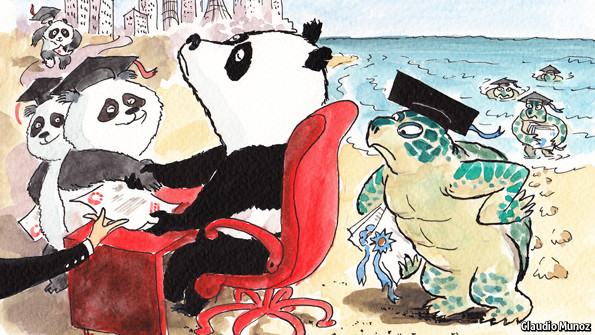
Plight of the sea turtles: Students coming back home helped build modern China. So why are they now faring so poorly in the labour market?

Plight of the sea turtles: Students coming back home helped build modern China. So why are they now faring so poorly in the labour market?

Jul 6th 2013 | SHANGHAI |From the print edition

20130706_CND001_1

“I LEFT in 1980 with only three dollars in my pocket,” recalls Li Sanqi. He was one of the first allowed to study overseas after the dark days of the Cultural Revolution. Like most in that elite group, he excelled, rising to a coveted position at the University of Texas, while launching several technology firms. Now he is a senior executive at Huawei, a Chinese telecoms giant, enticed back by the chance to help build a world-class multinational.

Mr Li seems the perfect example of a sea turtle, or hai gui (in Mandarin, the phrase “return across the sea” sounds similar to that animal’s name), long applauded in China for bringing back advanced skills. In the past such folk reliably reaped handsome premiums in the local job market, but no longer. Sea turtles are not universally praised, the wage differential is shrinking and some are even unable to find jobs. Wags say they should now be called hai dai, or seaweed. This is a startling turn, given their past contributions. Read more of this post

Home Depot Uses Cloud to Tap ‘Do-It-For-Me’ Market

July 5, 2013, 5:09 PM ET

Home Depot Uses Cloud to Tap ‘Do-It-For-Me’ Market

Rachael King

Home Depot Inc. plans to expand a service that connects shoppers who need help installing purchases like tile or ceiling fans to local contractors. That service relies on communications infrastructure from Twilio Inc. and Amazon.com Inc. “The market is moving from do-it-yourself to do-it-for-me,” Anthony Rodio, vice president of Home Depot, told CIO Journal. About 42% of home improvement projects are now done by outside help, he said. For the first time since 2008, sales to professional contractors is growing faster than sales to consumers, said Frank Blake, Home Depot CEO on a conference call with investors on May 21. Read more of this post

China’s watchdogs show they have teeth in probing infant milk, drugs and Tetra Pak

July 5, 2013 5:55 pm

China’s watchdogs show they have teeth

By Kathrin Hille and Leslie Hook in Beijing and Patti Waldmeir in Shanghai

Tetra Pak became the latest multinational to be targeted by Chinese regulators on Friday, with the launch of an antitrust investigation against the European food packaging group.The announcement followed a probe into the pricing practices of 60 drugmakers by the National Development and Reform Commission, China’s main economic planning agency, and another pricing investigation against baby formula makers. The unveiling of three probes involving foreign companies within the space of one week has led to concerns that multinationals are being targeted by the Chinese authorities – and that their high hopes of the vast Chinese market could be disappointed. Read more of this post

Why Israel should reconsider too much high-fiving over Waze

Why Israel should reconsider too much high-fiving over Waze

BY SARAH LACY 
ON JULY 5, 2013

Earlier this week our wonderful contributor from Israel, Mick Weinstein, wrote a story about a new fund launching and he lead with this: While the Israeli startup community basks in the glow of Waze’s recent $1.1 billion sale to Google, most of the discussion has focused on how Waze validates Israel’s effort to create hugely valuable, globally scaled consumer internet services — a relatively new field for an ecosystem that previously excelled in semiconductors and enterprise software.

I have no doubt that’s what people are saying but….um…what? The only thing “new” about the Israeli consumer Web scene is that it finally had a globally recognized hit. There’s been nearly a decade and thousands of attempts in the country beyond Waze that have mostly missed the mark or been acquired for less than $50 million by the West. One $1 billion hit in a decade of attempts doesn’t prove a country as a whole can do consumer. That’s the case even if it’s a monster hit; a stand alone company that redefines an industry. It’s certainly not the case when it’s a still-early, product-oriented company that many people feel was wildly over valued at just over $1 billion. Read more of this post

Chinese Web giant Tencent faces obstacles in its goal to expand in global IM market

Chinese Web giant Tencent faces obstacles in its goal to expand in global IM market

By Jia Lynn Yang, Saturday, July 6, 7:52 AM

BEIJING — With Web giants such as Facebook and Twitter blocked by the government here, an entire ecosystem of home-grown companies has flourished with names that are unfamiliar to many outside China. Tencent, one of the country’s biggest tech firms, is hoping to change that with a product that is already one of the fastest-growing mobile services in the world. The company’s instant messaging product, WeChat, has amassed more than 300 million users — nearly equivalent to the U.S. population — in less than three years. Tencent says there are more than 70 million users across southeast Asia, India and Mexico, with 30 million of those added in just the past three months. WeChat has also expanded into Saudi Arabia recently, and there are plans to open an office in the United States. But WeChat’s Chinese origins could cause problems for the company worldwide, just as Chinese telecommunications companies Huawei and ZTE have faced obstacles in the United States. Read more of this post