Mars Promotes Bite-Size Snickers, Following Hershey’s Cue

June 30, 2013

Mars Promotes Bite-Size Snickers, Following Hershey’s Cue

By JANE L. LEVERE

COPYING the strategy of the Hershey Company, its archrival Mars has introduced a bite-size Snickers, which it will begin promoting on Monday through advertising and social media. Mars began distributing the new product, Snickers Bites, in May. It is a bite-size, unwrapped cube of Snickers, sold in a 2.83 ounce bag and an eight-ounce resealable pouch, which is meant to be shared. Suggested retail prices are $1.49 and $2.99. Snickers Bites is the first new Snickers product introduced by Mars since it began selling Snickers Peanut Butter Squares in 2011; Mars has been selling the original Snickers candy bar, which it created, since 1930. Mars introduced Milky Way Bites in May, in packaging similar to that of Snickers Bites. Read more of this post
PBOC’s inaction exposes lack of money channeled to real economy; China set a world record in May after its M2 money supply surged to 104 trillion Chinese yuan (US$16.84 trillion)

PBOC’s inaction exposes lack of money channeled to real economy

Staff Reporter

2013-07-01

Though China’s banks might feel the squeeze from the central bank’s frozen accounts these days, the country is far from being out of money supply. China reported the world’s highest broad M2 money supply in May, the party-run Beijing Youth Daily reported.

China set a world record in May after its M2 money supply surged to 104 trillion Chinese yuan (US$16.84 trillion), but local banks have been struggling with a liquidity strain since late May, pushing the interbank borrowing rate higher, the newspaper said. Read more of this post

China’s President Xi Jinping said officials shouldn’t be judged solely on their record in boosting GDP, the latest signal that policy makers are prepared to tolerate slower economic expansion

Xi Says GDP Not Officials’ Sole Focus in Signal on Growth

China’s President Xi Jinping said officials shouldn’t be judged solely on their record in boosting gross domestic product, the latest signal that policy makers are prepared to tolerate slower economic expansion.

The Communist Party should instead place more importance on achievements in improving people’s livelihood, social development and environmental quality when evaluating the performance of officials, the Xinhua News Agency reported June 29, citing Xi at a meeting on personnel management on the eve of the 92nd anniversary of the party’s founding. Read more of this post

Yingluck Axes Thai Commerce Minister After Moody’s Rice Critique

Yingluck Axes Thai Commerce Minister After Moody’s Rice Critique

Thai Prime Minister Yingluck Shinawatra dropped Commerce Minister Boonsong Teriyapirom from the Cabinet following criticism that a policy to buy rice at above-market rates jeopardized the country’s fiscal position.

The move comes about a week after Yingluck cut guaranteed rice-purchase prices by 20 percent to stem losses the government estimates at about 137 billion baht ($4.4 billion) for last year. Moody’s Investors Service said on June 3 the subsidies hamper Thailand’s goal of achieving a balanced budget by 2017 and are negative for the nation’s sovereign ratings. Read more of this post

Europe Stocks Addicted to Emerging Markets Stretching Valuations as European companies are relying on emerging markets for a third of all revenue for the first time ever

Europe Stocks Addicted to Emerging Markets Stretching Valuations

For the first time ever, European companies are relying on emerging markets for a third of all revenue, stretching equity valuations as Chinese growth slows and protests turn violent from Turkey to Brazil.

Led by Swatch (UHR) Group AG and SABMiller Plc (SAB), Europe will get 33 percent of sales from developing nations in 2013, almost three times as much as in 1997, according to data compiled by Morgan Stanley and Bloomberg. While U.S. enterprises make 70 percent of their revenue at home, businesses in Europe, mired in the longest recession on record, are forecast to obtain less than 50 percent from their own economies this year. Read more of this post

Pawnbrokers Thriving as Poorest Aussies Bear Brunt of Slowdown

Pawnbrokers Thriving as Poorest Aussies Bear Brunt of Slowdown

On a sidewalk in Sydney’s Bankstown neighborhood, where unemployment is more than double Australia’s average, Dave Cox pulls the starter cord of an edge trimmer to prove it works as he tries to sell it to pawnbroker Cash Converters International Ltd. (CCV)

“The economy is pretty crap right now,” 38-year-old truck driver Cox, who’s between jobs, said after he offloaded the snipper for A$30 ($28). In the past month, he sold an iPhone and got a loan at Cash Converters, whose sales last year grew faster than any other Australian retailer that didn’t make a major acquisition. “It just feels bad out there.” Read more of this post

Who Goes to Cash Reveals Extent Bonds Will Turn Into Bear Market

Who Goes to Cash Reveals Extent Bonds Will Turn Into Bear Market

Investors who poured $1.26 trillion into bond funds in the past six years pulled out record amounts of cash last month, leaving the world’s biggest fixed-income managers struggling to stem the flow.

The funds saw $61.7 billion of withdrawals as money market mutual fund assets rose $8.17 billion in the week ended June 25, according to TrimTabs Investment Research and the Money Fund Report. Bank of America Merrill Lynch’s Global Broad Market Index dropped 2.9 percent in the past two months, the most since the inception of the daily gauge in 1996, as Federal Reserve Chairman Ben S. Bernanke laid out possibilities for reducing the $85 billion in monthly bond purchases supporting the economy. Read more of this post

Mortgage Bond Prices Collapse By Most Since 1994 ‘Bond Market Massacre’

Mortgage Bond Prices Collapse By Most Since 1994 ‘Bond Market Massacre’

Tyler Durden on 06/30/2013 10:39 -0400

“What just occurred [in the mortgage-backed-securities (MBS) market] is indicative of just how important QE is,” as government backed US mortgage bonds suffer their largest quarterly decline in almost two decades. As Bloomberg reports, the $5 trillion market lost 2% in Q2, the most since the ‘bond market massacre’ in 1994 (when the Fed unexpectedly raised rates) as wholesale mortgage rates spiked by the most on record in the last two months. The reason these bonds have been hardest hit – simple – fear that the Fed’s buying program is moving closer to an end. “The Fed, at times during this period, was the only outlet in terms of demand for securities,” explains one head-trader, as the Fed’s current buying provided demand as other investors retreated and has grown as a percentage of forward sales by originators tied to new issuance, which is set to fall as higher rates reduce refinancing. With Fed heads talking back what Bernanke hinted at, there was a modest recovery in the last 2 days in MBS but the potential vicious cycle remains a fear especially now that “what was once deemed QE Infinity is no longer viewed that way.” Read more of this post

Bear market in gold pummels Einhorn’s Greenlight fund

Bear market in gold pummels Einhorn’s Greenlight fund

Sun, Jun 30 2013

By Jennifer Ablan

NEW YORK (Reuters) – Investors in David Einhorn’s Greenlight Capital Management’s offshore gold fund were down 11.8 percent in June, bringing their year-to-date losses in the fund to 20 percent, two sources close to the matter said on Sunday.

Einhorn, one of the most widely followed hedge fund managers and known for warning about Lehman Brothers’ precarious finances before it collapsed, has also seen his flagship $8 billion Greenlight Capital fund under recent pressure though it is still up for the year. Read more of this post

It was fun while it lasted. As Debt Boom Wanes, Firms in the U.S. have lost the luxury of being able to sell bonds at will

June 30, 2013, 7:07 p.m. ET

As Debt Boom Wanes, Firms Readjust

MATT WIRZ

MI-BW879_QRATES_G_20130630142109

It was fun while it lasted.

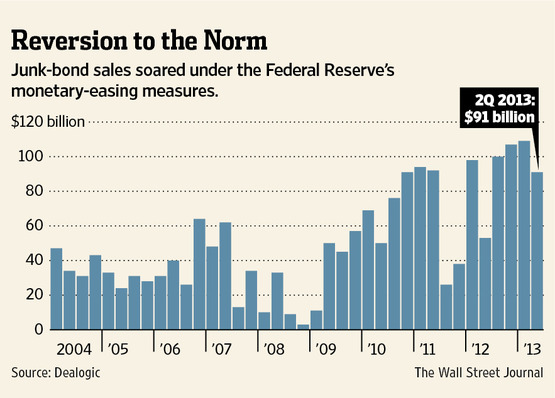
U.S. companies have borrowed unprecedented amounts in bond markets over the past four years, while the investors they sold the debt to have watched bond prices hit records courtesy of a wave of money from the Federal Reserve. All the while, borrowers and lenders have known this debt boom couldn’t last, and many responded with a paradoxical mix of angst and relief to the volatility triggered when Fed Chairman Ben Bernanke said in June that the central bank could start tapering its $85 billion-a-month bond-buying program by the end of 2013. Read more of this post

Defensive Stocks Won’t Shield Investors

June 30, 2013, 7:20 p.m. ET

Defensive Stocks Won’t Shield Investors

JUSTIN LAHART

MI-BW885_STOCKS_G_20130630172104

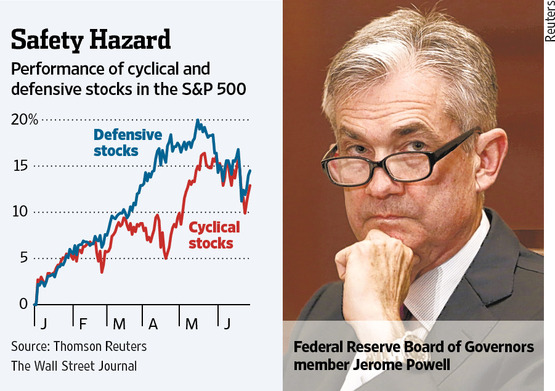
A rising stock market has always been a sign investors are taking on more risk. What made the recently stalled rally odd are the types of stocks where that risk-taking was concentrated. From the start of the year to its peak on May 21—the day before Federal Reserve Chairman Ben Bernanke intimated that the central bank might begin to scale back its bond buying program this fall—the S&P 500 rose 17%. But stocks that traditionally have been regarded as safe did better. A market-weighted index of defensive sectors of the S&P 500—which include consumer staples, health care, telecommunications services, utility and real-estate investment trust shares—rose 19.2% over the same period. An index of the remaining, more cyclically sensitive companies rose by just 16.4%. Read more of this post

For Investors, Emerging Debt Rethink After Biggest Decline in Five Years

June 30, 2013, 4:58 p.m. ET

For Investors, Emerging Rethink

TOMMY STUBBINGTON

MI-BW878_QEMDEB_G_20130630142104

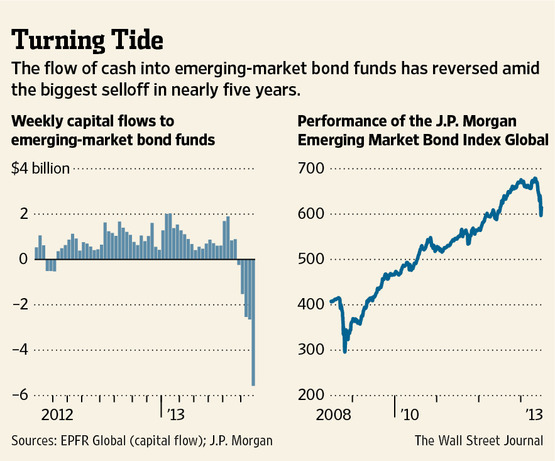
Emerging-market debt has experienced its biggest decline in nearly five years. Some investors said the selloff may not be over. And once the dust settles, money managers will have to become more discerning in figuring out which countries offer the best prospects. Prices on bonds issued in emerging economies have lost 9.5% of their value since an all-time record high hit in May, according to the J.P. MorganJPM -0.68% Emerging Market Bond Index. At their lowest point last week, they were down 12% from that peak. The pace of the selloff recalls late 2008, when emerging-market bonds fell almost 30% in less than two months. Bond prices move in the opposite direction of yields.

Read more of this post

Money Leaves Funds as Wary Investors Turn to Cash

Updated June 30, 2013, 7:22 p.m. ET

Money Leaves Funds as Wary Investors Turn to Cash

MIKE CHERNEY

Amid the recent turmoil in financial markets, investors are finding some refuge in cash, analysts say. Bond and stock mutual and exchange-traded funds saw outflows of $19.96 billion in the week ended Wednesday, according to Thomson Reuters unit Lipper. This data covers funds that report weekly. That’s the biggest outflow since August 2011, as the euro-zone debt crisis was intensifying and worries about the U.S. debt ceiling were coming to a head.

Read more of this post

Oil Benchmarks Go From Trusted to Tainted as EU Missed Warning

Oil Benchmarks Go From Trusted to Tainted as EU Missed Warning

The European Union’s top energy official ignored a warning delivered in 2009 about potential manipulation of Platts oil benchmarks “because markets trusted” them.

Andris Piebalgs, who was EU energy commissioner from 2004 to 2010, cited the confidence traders had in the pricing system when a lawmaker questioned the reliability of Platts’ prices more than three years ago. The warning went unheeded until May, when EU antitrust officials raided Platts, Royal Dutch Shell Plc (RDSA), BP Plc (BP/), and Statoil ASA (STL) as part of an investigation into the possible rigging of benchmark energy assessments. Read more of this post

Norway’s opposition consider oil fund split; Conservatives look at separating bonds and share funds

June 30, 2013 5:23 pm

Norway’s opposition mulls oil fund split

By Richard Milne in Oslo

The likely winner of Norway’s looming elections is floating the idea of splitting theworld’s largest sovereign wealth fund in two, as the $720bn oil fund grapples with the challenges of growing ever bigger. Such a move would be the most radical change to the oil fund since it was set up more than two decades ago to manage Norway’s oil and gas revenues. At the start, few expected the fund to receive much money but it has grown rapidly in the last few years on the back of rising oil revenues and is expected to reach $1tn by the end of the decade, making it by far the largest sovereign wealth fund in the world. Read more of this post

India’s jewellers become frontline in gold battle

June 30, 2013 12:48 pm

Singapore tightens tax evasion measures

By Jeremy Grant in Singapore

Singapore will from Monday make it a money-laundering offence for banks to assist tax-evaders stash their funds in the Asian city-state, in the latest move by the region’s fastest-growing wealth management hub to join the global crackdown on tax evasion and illicit funds.

The fight against tax evasion is playing out against a backdrop of rising wealth among the world’s richest people, creating a scramble by banks to offer services in tax-efficient jurisdictions such as Singapore. Read more of this post

High profile Australian-listed Phosphagenics chief executive Esra Orgu has been suspended from her duties after the discover of “irregular transactions” in relation to the company’s accounting records

Phosphagenics chief suspended from duties

July 1, 2013 – 2:52PM

Eli Greenblat

art-613082620-620x349

Phosphagenics chief executive Esra Ogru. Photo: Arsineh Houspian

High profile Phosphagenics chief executive Esra Orgu has been suspended from her duties after the discover of “irregular transactions” in relation to the company’s accounting records. Phosphagenics made the announcement to the Australian Securities Exchange this morning after entering a trading halt on Friday. In the release the company, which is developing a portfolio of cosmetics for the international beauty industry, said it believed the amount of money unaccounted for was material.

Read more of this post

Paid via Card, Workers Feel Sting of Fees; For many hourly workers, paper paychecks have been replaced by prepaid cards, which often involve fees that can quickly add up and take a bite out of their pay

June 30, 2013

Paid via Card, Workers Feel Sting of Fees

By JESSICA SILVER-GREENBERG and STEPHANIE CLIFFORD

A growing number of American workers are confronting a frustrating predicament on payday: to get their wages, they must first pay a fee.

For these largely hourly workers, paper paychecks and even direct deposit have been replaced by prepaid cards issued by their employers. Employees can use these cards, which work like debit cards, at an A.T.M. to withdraw their pay. Read more of this post

HK: A syndicate led by a woman earned at least HK$10 million over a two-year period by tampering with the electricity and gas meters of 112 restaurants

Gang collects $10m in meter-tamper racket
Staff reporter
Friday, June 28, 2013
A syndicate led by a woman earned at least HK$10 million over a two-year period by tampering with the electricity and gas meters of 112 restaurants, the District Court heard.

Between the middle of 2010 and August last year, the gang helped the restaurants save between HK$6,000 and HK$70,000 in charges each month.

CLP, Hongkong Electric and Towngas are said to have lost a total of HK$30 million, nearly a third of which went to the syndicate. Read more of this post

Exhausted Brazil; Brazilians are tired of being brutalized by public transport in the country’s metropolitan areas; tired of ghastly hospitals; tired of corruption scandals; and tired, especially, of inflation

Exhausted Brazil

Luiz Felipe Lampreia, a former foreign minister of Brazil (1995-2001), is now Vice Chairman of the Brazilian Center for International Relations (CEBRI) and Chairman of the Council on International Affairs of the Federation of Industries of Rio de Janeiro (FIRJAN).

30 June 2013

RIO DE JANIERO – The demonstrations that are shaking Brazil’s normally laid-back society are channeling a widespread sentiment: enough is enough! But, with the exception of professional agitators, there is no hatred in the street protests. Instead, there is a kind of impatient fatigue.

Brazilians are tired of being brutalized by public transport in the country’s metropolitan areas; tired of ghastly hospitals; tired of corruption scandals; and tired, especially, of inflation, which has returned like a dreaded disease, once again eroding people’s purchasing power and threatening to return millions to the poverty from which they only recently escaped. Read more of this post

Shale oil storm blows U.S. tanker trade out of doldrums

Shale oil storm blows U.S. tanker trade out of doldrums

2:18am EDT

By Anna Louie Sussman

(Reuters) – Thanks to the U.S. shale energy boom, the once-quiet niche of U.S.-flagged oil tankers is in unprecedented flux. A half-dozen vessels that typically carried gasoline to Florida are now rushing crude oil along the Texas coast. Major investment at the port of Corpus Christi, which now exports more than half of all Eagle Ford shale oil, suggests more to come even as new pipeline projects promise further market shifts. The shale oil revolution, now in its third year, has already scrambled the inland U.S. crude market, forcing pipelines to reverse direction and fuelling a revival in railway oil trade.

Read more of this post

Meet Sleepbot, the fast-growing sleep tracking app with a over a million users; it’s turned Jane Zhu’s side project into a full-time job

Meet Sleepbot, the fast-growing sleep tracking app with a over a million users

BY ERIN GRIFFITH 
ON JUNE 28, 2013

android-4avatar-2-300x300

Sleepbot started out as a joke. Jane Zhu and her friends built an Android app in college as a way to share how little they’d slept during exam week with each other. It was just a side project that they didn’t expect to go anywhere.

That is, until the app got hundreds of downloads. And then the emails came rolling in — people wrote to say it had changed their lives. “I was like, ‘How could a sleep log change your life?’” Zhu jokes. “We didn’t see that there was a market for tracking your sleep.” Read more of this post

Delivery Hero currently generates more than $400 million in annual turnover, partnering with local restaurants to deliver millions of monthly orders across the 14 international markets where it operates

Delivery Hero Tops Up Series D With $30M As Its Global Take-Out Service Heads For Profit

NATASHA LOMAS

posted 51 mins ago

20120330160834.IMG_6782.560x315

Relies on rapid growth through acquisitions: Fabian Siegel, co-head of the Berlin delivery service broker Lieferheld

While others in the online food delivery space stumble, Delivery Hero is helping itself to some fresh Series D funding today: the online take-out ordering service has announced $30 million in additional Series D funding, led  by Phenomen Ventures with support from existing investors. The follow-on funding comes almost a year after it closed a $50 million Series D led by Kite Ventures.

Delivery Hero, which is headquartered in Berlin and was founded in October 2010 by startup factory Team Europe, said it is bringing more international investors on board after confirming it will reach profitability this year. Read more of this post

Over 40 years, John C. Malone has made his name through countless displays of shrewd deal-making that transformed the telecommunications industry

JUNE 30, 2013, 8:54 PM

Talk of Mergers Stirs the Big Players in Cable TV

By MICHAEL J. DE LA MERCED and BRIAN STELTER

download (6)

Over 40 years, John C. Malone has made his name through countless displays of shrewd deal-making that transformed the telecommunications industry. Now Mr. Malone, the chairman of Liberty Media, appears to be trying to drum up a new round of consolidation in the sector where he first made his fortune.

This time, he is weighing a deal for Time Warner Cable, according to people briefed on the matter who were not authorized to speak publicly. In this deal, Charter Communications, a cable operator in which Liberty owns a 27 percent stake, would buy Time Warner Cable. Should he reach a deal, he will most likely use the combined company to roll up other cable operators, upending a status quo dominated by giants like Comcast. Read more of this post

Detroit, Embracing New Auto Technologies, Seeks App Builders

June 30, 2013

Detroit, Embracing New Auto Technologies, Seeks App Builders

By JACLYN TROP

DETROIT — After graduating from the University of Michigan in 1998, Brian Mulloy followed the path of many of his classmates, fleeing his home state for a job in a bustling city. But after 10 years of working in technology start-ups in San Francisco, he has returned as founder of a company in Detroit’s budding technology sector.

Mr. Mulloy is part of a group of workers that Detroit is suddenly hungry for — software developers and information technology specialists who can create applications for the next generation of connected vehicles. Read more of this post

What kind of problem does Oracle have exactly? The secular shift to cloud computing may mark a permanent move away from the high-margin business model that Oracle built its fortunes on (installing and maintaining suites of software) to the more utility-like, pay-as-you-go service model of most cloud-software sellers.

What kind of problem does Oracle have exactly?

June 28, 2013: 10:52 AM ET

Concern that the headwinds hitting Oracle are not cyclical but secular are growing.

By Kevin Kelleher, contributor

FORTUNE — What do you do when you are the best company in your industry, but your industry is mired in a slump of mediocre performance? That’s the dilemma faced by Oracle (ORCL), the enterprise software giant that has long been the most feared player in the competitive market for business software. Last week, Oracle reported that revenue grew to $37.2 billion in its fiscal year ended May 31, 2013. That was up from $37.1 billion in the previous fiscal year. Oracle is still growing, but just barely.

Read more of this post

Samsung’s $25 Billion Slide In Market Cap Equivalent of Sony as S4 Sales Disappoint

Samsung Slides Equivalent of Sony as S4 Sales Disappoint

Samsung Electronics Co. (005930) lost $25.3 billion in market capitalization last month, more than the value of competitor Sony Corp., as sales of its flagship Galaxy S4 smartphone fell short of investor expectations.

Since the handset was released April 26, the company that sells nearly one of every three mobile phones has plunged 9.7 percent as JPMorgan Chase & Co. and Morgan Stanley lowered sales forecasts and cut profit estimates. Fifteen analysts cut second-quarter net income estimates for Samsung in June, according to data compiled by Bloomberg. The company declined to comment on its share price and S4 sales. Read more of this post

Merck KGaA’s Oschmann Sees U.S. as New Emerging Market as competitors focus on emerging economies in Asia and South America

Merck KGaA’s Oschmann Sees U.S. as New Emerging Market

Merck KGaA (MRK), the German drugmaker whose U.S. unit was expropriated almost a century ago, is turning back to that market as competitors focus on emerging economies in Asia and South America.

“For us, the U.S. is an emerging market,” Stefan Oschmann, head of pharmaceuticals, said in an interview. “We have huge growth potential in the U.S.”

Merck KGaA is focusing on one of the world’s most profitable drug markets as sales of its best-selling medicines slow and as a late-stage drug pipeline dries up. The Darmstadt-based company hasn’t had a treatment approved since the go-ahead in 2003 for the cancer drug Erbitux, which it sells under license outside North America. Its next market candidate won’t be considered by regulators until 2016. Read more of this post

Private Banks Leave Switzerland as End of Secrecy Hurts Profits

Private Banks Leave Switzerland as End of Secrecy Hurts Profits

For European lenders with private-banking aspirations, a presence in Switzerland used to be a must. Now, with bank secrecy eroding and rising compliance costs chipping away at profits, more are saying adieu.

The number of foreign-owned Swiss banks fell to 129 by the end of May from 145 at the start of 2012, according to data from the Association of Foreign Banks in Switzerland. Assets under management slid by a quarter to 870.7 billion Swiss francs ($921 billion) in the five years through 2012 as clients withdrew money or paid taxes on undeclared accounts, the data show. Read more of this post

Brazil’s Rousseff May Skip Cup Final as Her Popularity Sinks

Brazil’s Rousseff May Skip Cup Final as Her Popularity Sinks

Brazil President Dilma Rousseff may sit out today’s Confederations Cup final match after the biggest plunge in popularity since ex-President Fernando Collor confiscated savings accounts in 1990, as protesters take to the streets for a fourth week.

Rousseff’s approval rating fell to 30 percent, down from 57 percent before protests began three weeks ago and a high of 65 percent in March, according to a survey by Datafolha published yesterday in the daily newspaper Folha. Read more of this post