Buffett declares bonds are “terrible investments”; “people could lose a lot of money if they’re in long-term bonds”

May 10, 2013 5:56 pm

Alternatives to Buffett’s ‘terrible’ bonds

By Elaine Moore

Warren Buffett, America’s best-known investor and the world’s fourth-richest person, has made his feelings about bonds clear, declaring them “terrible investments”.

Speaking on US television this week, the chief executive of Berkshire Hathaway said that many investors had been drawn to bonds because their prices tend to rise as interest rates fall. But, he warned, when the situation changes “people could lose a lot of money if they’re in long-term bonds”.

Talk of a “bond bubble” and a “great rotation” away from bonds and towards equities is not new. But bonds are still popular. The best selling sector for Individual Savings Accounts (Isa) money in the most recent tax year was the Sterling Strategic Bonds, according to the Investment Management Association. But in recent months investors have started to put more money in equities than bonds. Read more of this post

Fed Maps Exit From Stimulus

Updated May 10, 2013, 7:19 p.m. ET

Fed Maps Exit From Stimulus

Timing of Wind-Down Is Uncertain, but Focus Is on Managing Unpredictable Market Expectations

By JON HILSENRATH

P1-BL500_FED_on_G_20130510184805

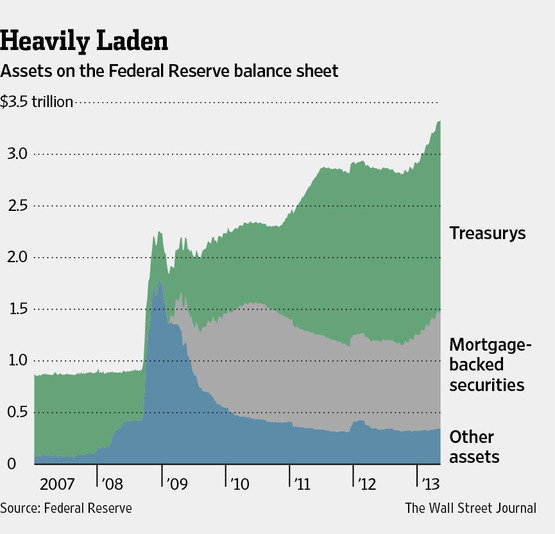
Federal Reserve officials have mapped out a strategy for winding down an unprecedented $85 billion-a-month bond-buying program meant to spur the economy—an effort to preserve flexibility and manage highly unpredictable market expectations. Officials say they plan to reduce the amount of bonds they buy in careful and potentially halting steps, varying their purchases as their confidence about the job market and inflation evolves. The timing on when to start is still being debated. The Fed’s strategy for how and when to wind down the program is of intense interest in financial markets. While the strategy being debated leaves the Fed plenty of flexibility, it might not be the clear and steady path markets expect based on past experience. Officials are focusing on clarifying the strategy so markets don’t overreact about their next moves. For example, officials want to avoid creating expectations that their retreat will be a steady, uniform process like their approach from 2003 to 2006, when they raised short-term interest rates in a series of quarter-percentage-point increments over 17 straight policy meetings. Read more of this post

How Is an IPO Like a Marriage? The Billionaire Founder of China’s Alibaba Goes Public. “I’m like a bride on her wedding day. All she knows how to do is grin.”

May 10, 2013, 8:38 p.m. ET

Weekend Confidential: Jack Ma of Alibaba

How Is an IPO Like a Marriage? The Billionaire Founder of China’s Alibaba Goes Public.

By ALEXANDRA WOLFE

OB-XK963_wolfew_DV_20130510115032

‘I want to get back to normal,’ he insists. ‘I think if you asked Bill Gates, he wants to be back to himself.’

A week before he was set to step down as chief executive of Alibaba, one of the world’s largest e-commerce companies, Jack Ma was enjoying breakfast on an outdoor patio in Santa Monica, Calif. Worth an estimated $4.2 billion, the Chinese entrepreneur may grow even richer if the company he founded 14 years ago goes public. Philanthropy has brought him to California on this trip, but he has no intention of joining the famous billionaires’ pledge and donating at least half his money to charity. “This idea of giving your money out was not created by Gates and Buffett. It was created by the Communist Party in the 1950s!” he says with a laugh.

That wasn’t the only thing that had Mr. Ma, 48, chuckling. Since he announced his transition to executive chairman in January—he handed over the reins Friday—he has stoked speculation about a potential Alibaba IPO. With an estimated value of about $60 billion, the company could be one of the year’s hottest tech offerings if it makes the move. Read more of this post

How the Rich Play the Market, making the most of their advantages—and how they mess up

Updated May 10, 2013, 7:55 p.m. ET

How the Rich Play the Market

By JASON ZWEIG

BF-AE943_INVEST_G_20130510175323

F. Scott Fitzgerald wasn’t entirely right. The very rich are different from you and me—but not by much. A new study offers a comprehensive look at the portfolios and investment decisions of several hundred of the wealthiest families in the U.S. Every investor, rich or otherwise, can learn from how these people make the most of their advantages—and from how they mess up. These households, with an average net worth of roughly $90 million, invest intelligently, for the most part, spreading their bets widely, seldom trading and keeping their investing taxes to a minimum. But the superrich also commit rookie mistakes. Their approach to diversification might not always be ideal. They chase investment fads like dogs chasing parked cars. They freeze with fear just when bravery is most likely to be rewarded. Maybe the “smart money” isn’t so different from the middle-class “dumb money” that Wall Street likes to mock. Read more of this post

Carbon dioxide in atmosphere at highest level for 5 million years

Carbon dioxide in atmosphere at highest level for 5 million years

Atmosphere rising at fastest rate since records began

TOM BAWDEN 

FRIDAY 10 MAY 2013

The concentration of carbon dioxide in the atmosphere has breached the symbolically important level of 400 parts per million (ppm) for the first time in 5 million years after rising at its fastest rate since records began. Average daily CO2 levels jumped by 2.74 ppm in the first 17 weeks of 2013, compared to last year, the biggest increase since the benchmark monitoring stations high on the Hawaiian volcano of Mauna Loa began taking measurements in 1958. Read more of this post

Mattel Continuously Innovates to Keep Barbie Alive in a Tech World

Mattel Continuously Innovates to Keep Barbie Alive in a Tech World

by Abram Brown | May 11, 2013

US_Barbie.indd

In an era when iPad apps and videogames practically demand children’s attention, Mattel continues to lead by innovating with its old-school plastic playthings

Head 10 minutes south of Los Angeles international airport on the 405, exit at El Segundo and you’ll blunder upon a 200,000-square-foot concrete bunker lurking among the strip malls in this seedy bit of Los Angeles County. The low-slung structure, surrounded by a black iron fence, was once an aircraft parts factory. It now houses the design laboratories of Mattel, Inc, the world’s largest toymaker, and deep inside the high-security facility, a crack 12-person team of screenwriters, computer animators, comic book artists and industrial designers are busy engineering the next great American toy: Max Steel.  In physical form, Steel will be a 6-inch plastic superhero action figure, with a well-developed  backstory: His mission is to harness the turbo energy he possesses to morph into different cyborg forms and save the world from monsters bearing names like Elementor and Dredd. And, just like Superman, he has a mild-mannered alter ego: Maxwell McGrath, a 16-year-old high school kid with brown hair and a square jaw. The Max Steel doll won’t be appearing on US retail shelves until August, but his launch is already well under way. Pull up maxsteel.com and you can play the Max Steel: Hero’s Journey videogame, watch videos introducing him or download a Max Steel mask. In March, a Max Steel cartoon premiered on Disney’s XD digital cable and satellite channel and will soon be available in more than 100 different markets worldwide. Toys used to spring from entertainment. Now entertainment supports the toys. “Having an action hero that’s on for a steady basis—on television, on webisodes, on digital—is going to create a more consistent demand for that product,” says Mattel’s chairman and chief executive, Bryan Stockton. Read more of this post

Markers of Schizophrenia Are Found in the Nose

May 10, 2013, 6:58 p.m. ET

Markers of Schizophrenia Are Found in the Nose

By DANIEL AKST

Mental illness isn’t like diabetes or cancer. It is usually diagnosed based on subjective evaluation rather than on definitive lab findings, which makes it hard to say for sure who has it. The result, in the eyes of critics, is a bogus epidemic and vast overmedication.

But more rigorous methods may be on the way. A recent study found telltale biological markers of schizophrenia in people’s noses. A reliable test for the disorder—which is believed to afflict 1 in 100 people—has long been a holy grail for psychiatrists, who lack a safe way to sample the living brain tissue.

As it turns out, the olfactory epithelium, which contains neurons and their stem cells, offers a window into the central nervous system—and thus access to physical indicators of the disease. Researchers who biopsied nasal tissue in 38 individuals found that, on average, the subset of 20 who met the diagnostic criteria for schizophrenia had more of a key genetic regulator, miR-382, than did the 18 normal volunteers.

The genetic difference wasn’t present in all the schizophrenic participants, but because their diagnoses were based on standard clinical assessments, without biological confirmation, it’s conceivable that some of them suffer from a different disease altogether. Read more of this post

Man vs. Machine: The Great Stock Showdown

Updated May 10, 2013, 8:25 p.m. ET

Man vs. Machine: The Great Stock Showdown

By MARK HULBERT

It has always been difficult for investors to consistently beat index funds. It has been nearly impossible lately. And there’s a double whammy: The small number of advisers who outperform the market rarely can keep doing so. One big culprit, experts say: the rise of sophisticated computer-trading programs. Consider the 51 advisers out of more than 200 on the Hulbert Financial Digest’s list who beat the market in the decade-long period that ended April 30, 2012, as measured by the Wilshire 5000 Total Market index, including reinvested dividends. Of that group, just 11—or 22%—have outperformed the overall market since then. That’s no better than the percentage that applies to all advisers, regardless of past performance. Over the past year, on average, the group has lagged the Wilshire index by 6.2 percentage points. In other words, going with a recent market beater doesn’t increase your odds of future success. Read more of this post

Wikipedia’s crystal ball: Hedge funds must raise their game to beat web analytics

May 10, 2013 6:58 pm

Wikipedia’s crystal ball

Hedge funds must raise their game to beat web analytics

First it was the factory worker who was made obsolete by technology. Now it is the hedge fund manager who looks increasingly redundant – and not just any hedgie but Wall Street’s finest. The Financial Times this week revealed that tips given by the best and brightest at last year’s Ira Sohn conference – where the industry’s stars offer their investment advice to raise money for charity – failed to outperform a passive US tracker fund. But even trackers struggle to compete with Wikipedia or Google. Academics have found a direct correlation between market movements and the number of visitors to articles on companies or financial topics. Wikipedia, the online encyclopedia, is best for predicting when the market is about to tumble, according to a paper published this week by academics from Warwick Business School, University College London and Boston University. The more page views on financial subjects, the greater the chance the Dow Jones index will fall. Last month the same team found that a trading strategy based on Google searches for the words debt, profit and loss could deliver well above average returns. Read more of this post

Cooper Union recently announced that it would begin charging tuition, a decision made after decades of bad financial choices and recent treacherous markets

May 10, 2013

How Cooper Union’s Endowment Failed in Its Mission

By JAMES B. STEWART

Since Peter Cooper’s heirs gave the Cooper Union for the Advancement of Science and Art the land under the Chrysler Building in 1902, the school’s endowment has enabled it to offer students a high-quality, tuition-free education through two world wars, the Great Depression and multiple stock market crashes and financial crises. So why does Cooper Union now find itself forced to charge tuition of an estimated $20,000 a year, abandoning what many consider its most important legacy? This week, angry students were occupying the president’s office in protest. They might be even angrier to learn that some of their future tuition dollars could be going to support wealthy hedge fund managers who oversee some of the school’s $666.7 million endowment.

Cooper Union may be an extreme example, but it’s hardly the only college suffering from a combination of decades of bad decisions and recent treacherous markets. Its endowment was typical of the many endowments and pension funds that took the plunge into so-called alternative investments like hedge funds, which have lured investors with the promise of generous and steady returns in both good times and bad. And compared with many universities, Cooper Union did a good job managing its endowment through the recent financial crisis. As recently as 2009, the school maintains, it ranked first among all American universities for endowment performance. Read more of this post

Mediocre results have raised questions about the very basis of the hedge fund industry

May 10, 2013 7:05 pm

Finance: In search of the big idea

By Dan McCrum and Sam Jones

Mediocre results have raised questions about the very basis of the hedge fund industry

Lincoln Center, home of the Metropolitan Opera and the New York Philharmonic, exchanged art for avarice this week. Taking the stage of Avery Fisher Hall, where Leonard Bernstein used to conduct, was a very select group of performers: the billionaire virtuosos of the hedge fund world. Gathered there were investors who had made big money by making bold calls. Some had made money by taking on governments: Stanley Druckenmiller made a fortune helping George Soros drive sterling out of the European exchange rate mechanism, while Paul Singer, founder of Elliott Management, last year attempted to repossess an Argentine naval vessel to settle a debt. There were also corporate agitators with ambitious ideas. David Einhorn of Greenlight Capital has spent this year fighting Apple over its cash pile. Bill Ackman of Pershing Square wants to shake up Procter & Gamble, the US consumer goods group. The investors were there to promote their latest big ideas and perhaps move markets in their favour, to gain some good publicity and to benefit a good cause. Each man – there were no women – pitched an investment idea from their portfolio to a sold-out crowd of investors, all for a charity set up to honour the late Ira Sohn, a financial analyst who died of cancer at 29. But they also came to get the next big idea, that elusive concept that will generate “alpha” – the hedge fund term for beating markets. Read more of this post

Currency Funds Falter as Policies Shift; “All the old models that said currencies should do X if Y happens are not working.”

Updated May 10, 2013, 9:40 p.m. ET

Currency Funds Falter as Policies Shift

By MATTHEW WALTER

BF-AE953_FXFUND_NS_20130510160903

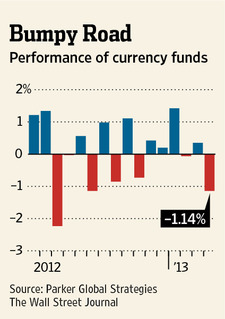
Foreign-exchange funds suffered their worst performance in 10 months in April, as currency managers struggled with a market frequently swayed by central-bank policies. The Parker Global Currency Managers index, which tracks the performance of funds in which the firm invests, fell 1.14% last month. The decline left the index up just 0.57% in the first four months of the year. Even as the easy monetary policies at major central banks have fueled a bumper year for investors in a broad range of assets, from Japanese stocks to European bonds, funds that mainly invest in currencies have underperformed, and there are signs that their clients are losing patience. Investors pulled $1.5 billion from currency funds in the first three months of 2013, even as they piled into hedge funds as a whole at their fastest clip in almost three years, according to Hedge Fund Research Inc. Foreign-exchange funds had $14.4 billion under management in March, down 58% from their peak in 2007. Investors and analysts say the outflows from currency funds are a sign that large asset managers are skeptical that financial markets have truly found their footing. Currency funds proved especially vulnerable when central banks stepped into the market to stimulate growth and calm panics, often with measures that involved printing money or deliberately weakening exchange rates. Investors say they see no sign that central banks are relaxing in their new role policing markets. Read more of this post

China’s Import Data Doubted by Nomura as Tariff Revenue Slumps

China’s Import Data Doubted by Nomura as Tariff Revenue Slumps

China’s “surprisingly strong” import growth in the first four months may have been inflated by fake invoices as companies circumvented capital controls to move funds into China, according to Nomura Holdings Inc.

A 28 percent slump in the value of import tariffs in the first quarter compared with a year earlier casts doubt over the credibility of official data that show imports (CNFRIMPY) rose 8 percent in the period, economists Zhang Zhiwei in Hong Kong and Wendy Chen in Shanghai wrote in a research note today. The two indicators have generally moved in tandem in the past, they said.

Skepticism over import figures in the world’s second-biggest economy adds to concerns that the nation’s trade data are inaccurate after analysts at Bank of America Corp. and Royal Bank of Scotland Group Plc said export figures this year were inflated by fabricated reports. Hot money flooding into China helped push the yuan to a 19-year high yesterday and regulators this week announced a crackdown on companies using trade reports to disguise speculative inflows.

“Some companies may have moved products between Hong Kong and China’s special trade zones to circumvent capital controls and move funds into China,” the Nomura economists wrote. “Such trade is free of import tariffs, so it pushes up imports and exports but not import duties.” Read more of this post

The Impact of Brand Rating Dispersion on Firm Value

The Impact of Brand Rating Dispersion on Firm Value

Xueming Luo University of Texas at Arlington

Sascha Raithel Ludwig Maximilians University of Munich – Munich School of Management

Michael Wiles Arizona State University (ASU) – Marketing Department

April 30, 2013
Journal of Marketing Research, Forthcoming.

Abstract: 
This study examines brand dispersion — variance in brand ratings across consumers — and its role in the translation of brand assets into firm value. Dispersion captures the covert heterogeneity in evaluations of brands among consumers who like or dislike the brands, which would affect an investor’s decision to buy or sell a stock. The higher the dispersion, the more inconsistent and polarized cross-consumer ratings of the brands. Multiple analyses — from simple, model-free to time-series models — on 730,818 brand-day observations provide robust evidence that changes in brand dispersion matter for stock prices. Brand dispersion has Januslike effects: it harms returns but reduces firm risk. Further, downside dispersion has a stronger impact on abnormal returns than upside dispersion, indicating an asymmetry in brand dispersion’s effects. Moreover, dispersion tempers the risk-reduction benefits of higher brand rating in both short and long runs. Without modeling dispersion, brand rating’s impact on firm value can be over- or under-estimated. Managers should consider dispersion a vital brand-management metric and add this metric to the brand-performance dashboard.

Wharton’s Wachter, Raff, Yan: Real Estate Prices in Beijing, 1644 to 1840

Real Estate Prices in Beijing, 1644 to 1840

Daniel Raff and Susan Wachter, Wharton School of Management, University of Pennsylvania

Se Yan, Guanghua School of Management, Peking University

Abstract:

This paper provides the first estimates of housing price movements for Beijing in late pre-modern China. We hand-collect from archival sources transaction prices and other house attribute information from the 498 surviving house sale contracts for Beijing during the first two centuries of the Qing Dynasty (1644-1840), a long period without major wars, political turmoil, or significant institutional change in the Chinese capital. We use hedonic methods to construct a real estate price index for Beijing for the period. The regression analysis explains a major proportion of the variance of housing prices. We find that house prices grew steadily for the first half-century of the Qing Dynasty and declined afterwards in both nominal and real terms through the late eighteenth century. Nominal prices grew starting in the late eighteenth century and declined from the early nineteenth century through 1840. But these price changes occurred with contemporaneous price changes in basic measures of the cost of living: there was little change in real terms to the end of our period.

A Brief History of LinkedIn

A Brief History of LinkedIn
by  on May 05, 2013

From a handful of guys in a living room to 225 million members around the world. Join us for a look back at where we’ve been over the last decade. Thanks to our amazing members for being a part of our journey.

Why Productive People Have Empty Schedules; Lessons on guarding your time by Warren Buffett, Peter Drucker, Charles Dickens, Reddit CEO Yishan Wong, and others. Nearly all creators spend nearly all their time on the work of creation

WHY PRODUCTIVE PEOPLE HAVE EMPTY SCHEDULES

WHAT’S THE ONE RESOURCE YOU CAN’T BORROW, INVEST, OR RECOVER? TIME. LESSONS ON GUARDING YOURS BY WARREN BUFFETT, PETER DRUCKER, CHARLES DICKENS, REDDIT CEO YISHAN WONG, AND OTHERS.

BY: DRAKE BAER

Back in 1991, Warren Buffett met Bill Gates, though as he tells Levo League, neither of them were excited to see one another. But it turned out they had a great time talking–and during the course of the conversation, Buffett pulled out the little black date book that he carries in his pocket. He flipped through it: the pages were practically empty. “You’ve gotta keep control of your time,” Buffett says, “and you can’t unless you say no. You can’t let people set your agenda in life.” Read more of this post

Berkshire CEOs Spend Quietly, Match Buffett on Heinz Deal; “Warren’s not a manager,” Iscar’s Wertheimer said. “He’s a teacher for all of us.”

Berkshire CEOs Spend Quietly, Match Buffett on Heinz Deal

Warren Buffett stole headlines when he committed $12.1 billion in a deal to take ketchup maker HJ Heinz Co. (HNZ) private this year. Managers at his Berkshire Hathaway Inc. (BRK/A) spent as much in 2012 while attracting less attention.

Executives who gathered last week for Berkshire’s annual meeting in Omaha, Nebraska, said in interviews that they plan to spend even more this year as they upgrade a rail network and energy utilities, expand manufacturing capacity and hunt for additional acquisitions.

Buffett, 82, relies on chief executive officers of the operating units to make deals and invest in plant and equipment to build the businesses and widen their competitive advantage. That helps slow the accumulation of cash and reduces the need for Buffett, Berkshire’s chairman and CEO, to find other uses for the money.

“If I don’t take my own cash flow and reinvest, all I do is add to his problems,” said James Hambrick, CEO of chemical maker Lubrizol, which Berkshire bought in 2011.

Hambrick’s unit plans to spend about $1.4 billion over the next three years as it replaces equipment and adds capacity to manufacture products like chlorinated polyvinyl chloride, a plastic that’s used for pipes in buildings. Even after similar spending and acquisitions in recent years, Lubrizol has still sent money to Omaha for Buffett to allocate, Hambrick said. Read more of this post

Bernanke Warns of ‘Important Risks’ in Wholesale Funding Markets

Bernanke Warns of ‘Important Risks’ in Wholesale Funding Markets

Federal Reserve Chairman Ben S. Bernanke said risks persist in wholesale funding markets used frequently by Wall Street brokers to finance securities trading.

“Important risks remain in the short-term wholesale funding markets,” Bernanke said today in the text of a speech at a Chicago Fed banking conference. “One of the key risks is how the system would respond to the failure of a broker-dealer or other major borrower.”

Bernanke outlined how the Fed has overhauled risk monitoring since a collapse in mortgage finance triggered a crisis in 2008 that led to the worst recession since the Great Depression.

“More work is needed to better prepare investors and other market participants to deal with the potential consequences of a default by a large participant in the repo market,” Bernanke said. He said that the “possibility of a run” on money-market funds remains. Read more of this post

Correlation between S&P 500 and Initial Jobless Claims

The Most Beautiful Correlation In The Market Continues To Work Perfectly

Joe Weisenthal | May 10, 2013, 4:52 AM | 6,664 | 18

We’ve been posting this chart for ages, and been marveling forever at how beautiful it is, and it just never ceases to amaze us. The relationship between initial jobless claims (red line) and the S&P 500 (blue line) has held remarkably strong for years now. Initial jobless claims hit a brand new post-crisis low yesterday, and of course, the S&P 500 is making brand new highs. Showing this chart is the perfect counterpoint to anyone saying that this is all a “Fed-driven” market and that there’s no real-economy improvement to back it up.

sandpvsinitialclaimsmay10

No Free Shop: Why Target Companies in MBOs and Private Equity Transactions Sometimes Choose Not to Buy ‘Go Shop’ Options

No Free Shop: Why Target Companies in MBOs and Private Equity Transactions Sometimes Choose Not to Buy ‘Go Shop’ Options

Adonis Antoniades Columbia University – Department of Economics

Charles W. Calomiris Columbia University – Columbia Business School; National Bureau of Economic Research (NBER)

Donna M. Hitscherich Columbia Business School – Finance and Economics

April 30, 2013
Columbia Business School Research Paper No. 13-25

Abstract: 
We study the decisions by targets in private equity and MBO transactions whether to actively “shop” their initial acquisition agreements prior to the shareholders’ approval of those contracts. Specifically, targets can insert a “go-shop” clause into their contracts, which permits them to use the agreement to solicit offers from other would-be acquirors during the “go-shop” window, during which the termination fee paid by the target is temporarily lowered. We consider the “go-shop” decision from the theoretical perspective of value maximization under asymmetric information, and also consider conflicts of interest on the parts of management, bankers, and attorneys that might affect the decision. Empirically, we find that the decision to retain the option to shop an offer is predicted by various firm attributes, including larger size, more fragmented ownership, and various characteristics of the firms’ legal advisory team and procedures. These can be interpreted as reflecting a combination of informational characteristics, litigation risk, and attorney conflicts of interest. We employ legal advisor characteristics as instruments when analyzing the effects of go-shop decisions on target acquisition premia and value. We find, as predicted in our theoretical framework, that go-shops are not a free option; they result in lower initial acquisition premia, ceteris paribus. Our theoretical framework has an ambiguous prediction about the effects of go-shop choice on target firm valuation. Consistent with theory, we find no significant effect on abnormal returns from choosing a “go-shop” option.

Air Pollution Raises Risk of Diabetes Precursor in Kids

Air Pollution Raises Risk of Diabetes Precursor in Kids

Exposure to air pollution raises the risk of resistance to insulin, a typical warning sign of diabetes, according to a study of almost 400 German children.

Insulin resistance climbed by 17 percent for every 10.6 micrograms per cubic meter increase in ambient nitrogen dioxide and by 19 percent for every 6 micrograms per cubic meter increase in particulate matter in the study of 10-year-olds. The findings were published today in Diabetologia, the journal of the European Association for the Study of Diabetes.

The study adds to previous research that showed a link between traffic-related air pollution and the development of diabetes in adults. Those studies have shown that exposure to fine pollution particles that invade the breathing system and get into the heart and blood vessels increases inflammation, which may be linked to insulin resistance, said Joachim Heinrich of the German Research Center for Environmental Health, one of the study authors.

“Given the ubiquitous nature of air pollution and the high incidence of insulin resistance in the general population, the associations examined here may have potentially important public health effects,” Heinrich said in the published paper.

Diabetes occurs when blood-sugar levels are too high. In the Type 1 form of the disease, the body is unable to produce insulin, the hormone used to convert blood sugar into energy. In Type 2 diabetes, the body either can’t produce enough insulin or becomes resistant to its effects. Read more of this post

Swiss Watches Unworn as China Tackles Graft: Chart of the Day

Swiss Watches Unworn as China Tackles Graft: Chart of the Day

ilhcfBeXmkFc

China’s love affair with glitzy Swiss timepieces is ending, as President Xi Jinping’s campaign against corruption makes targets of wearers.

The CHART OF THE DAY shows Chinese imports of Swiss-made watches tumbled 24 percent in the first quarter from a year earlier for a third straight decline, while shipments to Hong Kong sank 9.3 percent, according to trade data from Switzerland. The lower panel compares shares of Hengdeli Holdings Ltd. (3389) and Emperor Watch & Jewellery Ltd. (887), the biggest watch retailers traded in Hong Kong, versus the Hang Seng Index, Swatch Group AG and Cie. Financiere Richemont SA, the owner of the Cartier brand. Read more of this post

Vietnam’s Star Is Dimming; the strategy that got Vietnam this far — a China-like heavy reliance on state-owned enterprises and top-down planning — is now holding the nation back

Vietnam’s Star Is Dimming

Like other would-be tiger economies, Vietnam faces a trifecta of new threats: a crisis-paralyzed Europe, a faltering America, and a newly spendthrift Japan. Yet the biggest risk to the nation’s future may be old-fashioned nostalgia.

It has been 27 years since Hanoi launched the “Doi Moi” reforms that allowed privately owned companies to participate in the economy and opened key sectors, such as agriculture. The rapid growth that followed propelled Vietnam toward the realm of middle-income nations, transforming the onetime war zone into a case study for development and poverty reduction. Now, though, Vietnam’s 1986 blueprint for a “socialist-oriented market economy” is looking dated.

Recent data show the strategy that got Vietnam this far — a China-like heavy reliance on state-owned enterprises and top-down planning — is now holding the nation back. Vietnam is losing ground on global competitiveness league tables while growth has slowed to about 5 percent, the lowest rate since 1999. To recover, the country needs to do precisely what it has avoided doing thus far: build a truly vibrant and innovative private sector that can diversify growth and create prosperity. Read more of this post

Apple Bonds: How Much Could Happen in 30 Years?

Apple Bonds: How Much Could Happen in 30 Years?

By Nick Summers on May 03, 2013

One of the more remarkable things about Apple’s (AAPL) record debt sale on April 30 was that $3 billion of it came in the form of 30-year bonds. That’s a common duration in such sectors as financials and health care—but not so much in technology, where fortunes are made and destroyed by the constant churn of innovation. Just think of all the things that the last 30 years have brought. The Macintosh. Windows. The Internet. Google (GOOG). The iPhone and iPad. The rise, fall, rise, and fall of Apple itself. Now try to envision what might change in the tech industry between now and 2043—the same year that Ali Lohan, younger sister of Lindsay, becomes eligible for membership in AARP. (Also, try to envision how investors will feel about having lent to Apple at a rate just 1 percentage point higher than virtually riskless U.S. Treasuries.) For some context, here’s a sampling of tech-related 30-year bonds that were issued 30-ish years ago:

Recognition Equipment
Issued: April 3, 1986
Which is the same month as: the Chernobyl nuclear disaster
Maturity: April 15, 2011

How’d that work out?: REI, which made optical character recognition technology, lost a big U.S. Postal Service envelope-scanning contract, and its chief executive was indicted. (The charges were dismissed.) “After the scandal, corporate raiders took over and sold” the company, according to D magazine. The bond was called in 1997.
Crazy Eddie
Issued: July 1, 1986
Which is the same month as: the first video footage of the Titanic wreckage is shot
Maturity: June 15, 2011

How’d that work out? The electronics retailer, with its iconic advertising (“his prices are insaaaaaaaane”), declared bankruptcy in 1989. Founder Eddie Antar served hard time for fraud. Read more of this post

The Right Way for a CEO to Deliver Bad News

The Right Way for a CEO to Deliver Bad News

By Claire Suddath on May 09, 2013

How do you tell 400,000 people they’re terrible at their jobs? Do you hold a meeting? Send a mass e-mail? Tell only a few people and wait for your criticism to circulate, middle school-style? Or do you follow IBM (IBM) Chief Executive Officer Virginia “Ginni” Rometty’s example and record a video message, post it to your company’s internal blog, and then share it with the entire workforce?

After the disappointing earnings report on April 18, Rometty released a video to all 434,000 employees in which she admitted that IBM hadn’t “transformed rapidly enough.” She called out the sales staff for missing out on several big deals. “We were too slow,” she said. “The result? It didn’t get done.” The press got wind of her message, and Rometty’s now accused of the corporate equivalent of yelling at her children in public. The Wall Street Journal, which broke the story, called the outburst a “rare companywide reprimand.” IBM declined to comment on the video. Read more of this post

Innovator: Dor Givon Gives Computers and Tablets 3D Powers

Innovator: Dor Givon Gives Computers and Tablets 3D Powers

By Olga Kharif on May 09, 2013

Imagine turning a smartphone into a full-body motion controller similar to the Microsoft (MSFT) Kinect or Nintendo’s (7974) Wii remote. Dor Givon, 41, has developed software that enables a device equipped with a standard 2D camera to register movement in three dimensions. “Every camera in the world today can be transformed to 3D,” says Givon, chief technology officer of Israeli startup Extreme Reality.

Givon’s software, Extreme Motion, uses a running video feed from the 2D cameras built into most laptops and tablets to map a person’s body and recognize his movements. Its algorithms calculate angles of limbs and joints to interpret the 2D images in 3D, adding depth to them frame by frame. On a camera-equipped laptop or TV, users can adjust the volume, move the cursor, and play games with a set of hand gestures the software recognizes from across the room. On a smartphone or tablet, the software lets developers add motion commands to mobile games. Read more of this post

Netflix, Reed Hastings Survive Missteps to Join Silicon Valley’s Elite

Netflix, Reed Hastings Survive Missteps to Join Silicon Valley’s Elite

By Ashlee Vance on May 09, 2013

feat_netflixgraphic_605newfeature_netflix20__01__605inline

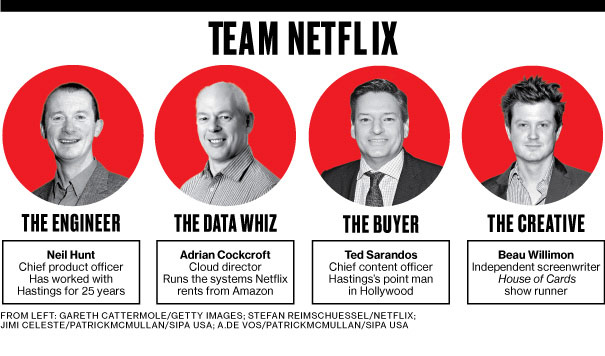
On a normal weeknight, Netflix (NFLX) accounts for almost a third of all Internet traffic entering North American homes. That’s more than YouTube, Hulu,Amazon.com (AMZN), HBO Go, iTunes, and BitTorrent combined. Traffic to Netflix usually peaks at around 10 p.m. in each time zone, at which point a chart of Internet consumption looks like a python that swallowed a cow. By midnight Pacific time, streaming volume falls off dramatically. As prime time wound down on Jan. 31, though, there was an unusual amount of tension at Netflix. That was the night the company premièred House of Cards, its political thriller set in Washington. Before midnight about 40 engineers gathered in a conference room at Netflix’s headquarters. They sat before a collection of wall-mounted monitors that displayed the status of Netflix’s computing systems. On the conference table, a few dozen laptops, tablets, smartphones, and other devices had the Netflix app loaded and ready to stream. When the clocks hit 12 a.m., the entire season of House of Cards started appearing on the devices, as well as in the recommendation lists of millions of customers chosen by an algorithm. The opening scene, a dog getting run over by an SUV, came and went. At 12:15 a.m., around the time Kevin Spacey’s character says “I’m livid,” everything was working fine. “That’s when the champagne comes,” says Yury Izrailevsky, the vice president in charge of cloud computing at Netflix, which has a history of self-inflicted catastrophes. Izrailevsky stayed until the wee hours of the morning—just in case—as thousands of customers binge-watched the show. The midnight ritual repeated itself on April 19, when Netflix premièred its werewolf horror series Hemlock Grove, and will again on May 26, when its revival of Arrested Developmentgoes live.

Netflix has more than 36 million subscribers. They watch about 4 billion hours of programs every quarter on more than 1,000 different devices. To meet this demand, the company uses specialized video servers scattered around the world. When a subscriber clicks on a movie to stream, Netflix determines within a split second which server containing that movie is closest to the user, then picks from dozens of versions of the video file, depending on the device the viewer is using. At company headquarters in Los Gatos, Calif., teams of mathematicians and designers study what people watch and build algorithms and interfaces to present them with the collection of videos that will keep them watching. Netflix is one of the world’s biggest users of cloud computing, which means running a data center on someone else’s equipment. The company rents server and storage systems by the hour, and it rents all this computing power from Amazon Web Services, the cloud division of Amazon.com, which runs its own video-streaming service that competes with Netflix. Read more of this post

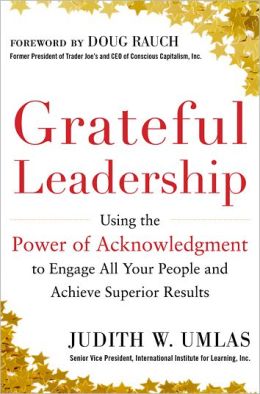
Grateful Leadership: Using the Power of Acknowledgment to Engage All Your People and Achieve Superior Results

Grateful Leadership: Using the Power of Acknowledgment to Engage All Your People and Achieve Superior Results[Hardcover]

Judith W. Umlas (Author)

9780071799522_p0_v1_s260x420

Publication Date: October 23, 2012

Go Grateful–have the courage to learn, the vision to lead, and the passion to grow.

When employees are engaged, they are passionate and feel a deeper connection to their work. Grateful Leadership is an essential approach for leaders who want to achieve the bottom line and foster a valuedriven workforce to build stronger professional relationships with customers, stakeholders, and employees.

Grateful Leadership shows how to create a more positive and meaningful connection between you and the people you lead. These skills are a catalyst for making immediate positive changes in your workplace that will enhance productivity, reputation, and overall performance.

Leadership training expert Judith W. Umlas provides the rationale, tools, and methodology to build a company culture based on the free expression of gratitude, and she reveals simple but remarkably effective ways for leaders to build a culture in which each individual employee possesses:

Courage to make important decisions

Willingness to take initiative

Trust in the organization and fellow employees

Motivation to strive for continuous improvement

Acknowledgment is a basic human need and a powerful motivator–people want to make a difference. In a culture of gratitude, employees stay; unappreciated employees leave.

Your company will benefit from the many Grateful Leadership stories from leaders such as Walter Robb, co-CEO of Whole Foods Market, that attest to the fact that when you appreciate, acknowledge, and affirm the essential contributions of employees, you unlock their potential to deliver superior results and enable your business to meet stakeholder expectations and outperform.

Grateful Leadership is a best-practices guidebook to employee engagement, staff retention, and increased productivity. Motivate and inspire your team, your organization, your customers, and, yes, yourself by following the book’s actionable next steps for implementing a culture based on acknowledgment, appreciation, and gratitude. Read more of this post

LinkedIn’s Reid Hoffman: Founding A Startup Is Like ‘Throwing Yourself Off A Cliff’; Elon Musk: “Being an entrepreneur is like eating glass and staring into the abyss of death.”

Reid Hoffman: Founding A Startup Is Like ‘Throwing Yourself Off A Cliff’

Julie Bort | May 9, 2013, 8:23 PM | 1,480 | 2

To hear successful entrepreneurs talk about it, founding a startup sounds like something no sane person should try. LinkedIn cofounder Reid Hoffman says that starting a company is like “throwing yourself off a cliff and assembling an airplane on the way down.” So he just told Bloomberg Television’s Emily Chang. This is a similar view to how his friend Elon Musk describes it. In 2010, Tesla and SpaceX founder Musk famously said, “Being an entrepreneur is like eating glass and staring into the abyss of death.”

Reid faced his almost-crash moment with LinkedIn shortly after it launched. He had hoped that people would simply see how useful it was and that the site would grow fast virally. But it didn’t. LinkedIn saw just “a trickle” of tech early adopters and not “an explosion,” he said. “So, I sat down with the team and said, if we don’t solve this, we’re dead.” He had only one idea to try: Allow people to upload their email address books to see if their friends had joined. If that failed, he would have, maybe, one more shot to get people interested in LinkedIn, but he didn’t know what else to try. Fortunately, the address book thing worked and growth spiked. This month, LinkedIn celebrated its 10-year anniversary. As of January, it had 200 million members in 200 countries.