The new, aggressive pathogens in China and Saudi Arabia may or may not carve a deadly path to the West. But sooner or later, you can be sure, one will

May 9, 2013

The Next Pandemic: Not if, but When

By DAVID QUAMMEN

TERRIBLE new forms of infectious disease make headlines, but not at the start. Every pandemic begins small. Early indicators can be subtle and ambiguous. When the Next Big One arrives, spreading across oceans and continents like the sweep of nightfall, causing illness and fear, killing thousands or maybe millions of people, it will be signaled first by quiet, puzzling reports from faraway places — reports to which disease scientists and public health officials, but few of the rest of us, pay close attention. Such reports have been coming in recent months from two countries, China and Saudi Arabia.

You may have seen the news about H7N9, a new strain of avian flu claiming victims in Shanghai and other Chinese locales. Influenzas always draw notice, and always deserve it, because of their great potential to catch hold, spread fast, circle the world and kill lots of people. But even if you’ve been tracking that bird-flu story, you may not have noticed the little items about a “novel coronavirus” on the Arabian Peninsula. Read more of this post
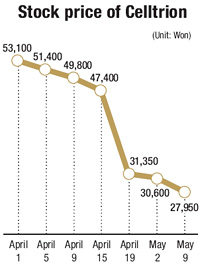
Celltrion, Korea’s largest manufacturer of biosimilars, plunged on news that its chief is under investigation for alleged involvement in stock price manipulation

013-05-09 16:53

CEO scandal hits Celltrion stocks

By Yi Whan-woo

130509_p19_CEO2 130509_p19_CEO1

The price of stock in Celltrion plunged on news that its chief is under investigation for alleged involvement in stock price manipulation.

The country’s largest manufacturer of biosimilars closed at 27,950 won per share on the tech-laden KOSDAQ, Thursday, down 2,000 won or 6.68 percent from the previous day. It closed at 53,900 on March 29. The Financial Supervisory Service (FSS) is investigating the company and its chairman Seo Jung-jin for allegedly having ties with speculative investors who have been engaged in short-selling the firm’s shares. Read more of this post

The London market only needs transparent and ethical companies; A continuing flow of bad news from former FTSE favourites, ENRC and Bumi, is raising significant questions about London’s future as stockmarket to the world’s leading growth companies

The London market only needs transparent and ethical companies

A continuing flow of bad news from former FTSE favourites, ENRC and Bumi, is raising significant questions about London’s future as stockmarket to the world’s leading growth companies.

In the eyes of some, recent developments at ENRC and Bumi are symptomatic of the LSE being too aggressive in its efforts to attract foreign companies Photo: AFP

By Dr Roger Barker

5:05PM BST 09 May 2013

The London Stock Exchange’s ambitious vision has been to attract dynamic enterprises from emerging economies onto the London market, where they can benefit from the UK’s respected corporate governance regime. This combination of growth and good governance should, in theory, represent a compelling proposition for investors.

But in the eyes of some, recent developments at ENRC and Bumi are symptomatic of the LSE being too aggressive in its efforts to attract foreign companies. Perhaps inevitably, there has been a call for tighter regulation. In contrast to most UK-listed firms, emerging market enterprises typically have large controlling shareholders rather than dispersed ownership. Such shareholders can potentially use their voting power to overrule the board of directors and disadvantage minority shareholders, particularly through related party transactions which may favour their wider business interests. This type of conflict has been at the heart of recent boardroom disputes at ENRC and Bumi. Read more of this post

The Life of Germany’s Own Walt Disney

05/09/2013 12:59 PM

Animated Success

The Life of Germany’s Own Walt Disney

By Oliver Klatt

et Fischerkoesen

Asthma forced Hans Fischerkoesen to spend most of his childhood in bed, but this period also ignited his imagination. In time, “Germany’s Walt Disney” would go on to become an animation legend. But his career almost became derailed by World War II — until Hitler stepped in. Read more of this post

How Rachel Riley built a childrenswear brand fit for David Beckham’s kids – now in its 20th year

How Rachel Riley built a childrenswear brand fit for David Beckham’s kids

With the expected arrival of a royal baby this summer, Rachel Riley’s childrenswear business – now in its 20th year – is well-placed to grow stronger, writes Emma Sinclair in her latest Biz Idol.

Rachel Riley’s shop customers have included David Beckham and Madonna.

P1040830_2556051bP1010639_1__2556902d

By Emma Sinclair

12:56PM BST 07 May 2013

May is a month of milestones for Rachel Riley, owner of the eponymously named children’s fashion brand. She’s just celebrated the fifteenth anniversary of the opening of her first shop on London’s Pont Street, and next week she celebrates her 50th birthday.

A smart child with a photographic memory, Rachel went to a girl’s comprehensive school in London.

She grew up “making stuff” for her dolls and teddies and was competent at knitting, embroidery and sewing. “I love using my hands,” she told me last week, when we caught up a few doors up from her second store, on Marylebone High Street.

She loved needlework and dress making but demonstrably intelligent, the school preferred that she focused on more academic subjects. She juggled academia and crafts, leaving school the first pupil ever to have secured a place at Cambridge University.

At the end of her first year a friend offered to lend her an apartment in Paris for the summer. Needing a job, she walked into a model agency who signed her on the spot. This was 1981 and she featured in over 20 television commercials and remembers how much she loved working with Sarah Moon, responsible for the infamous Cacharel and Anais Anais 80s adverts. Read more of this post

Too Much Trust in Local Finances: It would seem Chinese local governments didn’t get the memo about reining in credit risks

May 9, 2013, 5:57 PM

Too Much Trust in Local Finances

AM-AY442_CTRUST_NS_20130508120303

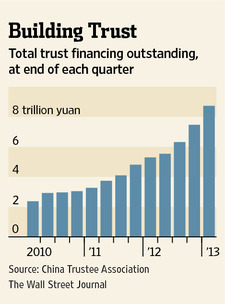
It would seem Chinese local governments didn’t get the memo about reining in credit risks.

According to data issued Wednesday by the China Trustee Association, a government-backed industry body, trust companies funneled 461 billion yuan ($75.2 billion) worth of new funding to infrastructure projects in the first three months of 2013 (here in Chinese http://www.xtxh.net/sjtj/15547.html)–-more than in the preceding six months combined.

In the third and four quarters of 2012, trusts — a type of wealth management company common in China – provided a total of 458.3 billion yuan worth of new infrastructure financing.

The massive expansion in lending to infrastructure projects – most of which likely went to investment platforms backed by local governments – comes as Beijing grows increasingly uneasy about the level of local government debt. Read more of this post

China’s Fiddled Figures: It’s hard to reform an economy you don’t fully understand

May 9, 2013, 12:49 p.m. ET

China’s Fiddled Figures

It’s hard to reform an economy you don’t fully understand.

Trade data released Wednesday painted a rosy picture of the Chinese economy. But the closer everyone looks, the more doubts emerge.

Officially, exports picked up enough to create a trade surplus worth $18.2 billion, compared to a deficit of $900 billion in March. Total exports supposedly increased 14.7% compared to April 2012, up from the 10% year-on-year growth notched in March. This sparked hopes in some quarters that disappointing GDP growth in the first three months of the year was a blip.

Yet China’s export data don’t match what other countries report they import from China. That’s because Chinese exporters overstate the value of goods to conceal the repatriation of earnings stockpiled overseas. Firms are circumventing capital controls to speculate on the rising yuan, and also to seek higher returns on risky wealth management products offered by banks at home. This inflow shows up as artificially inflated exports. Read more of this post

$58Bln Hot Money Channeled into Mainland From Hong Kong Disguised as Trade Payments

Analysis: $58Bln Hot Money Channeled into Mainland From Hong Kong Disguised as Trade Payments

05-10 13:18 Caijing

Details of April trade report and anecdotal evidence have prompted many to believe that China’s trade data was significantly inflated by companies fiddling their invoices to bring funds onshore to chase yield.

Alleged distortions on China’s export data may have dented hopes for markets starved for upbeat Chinese data, with analysis showing speculative capital inflows disguised as trade payments could hit 58 billion U.S. dollars. Details of April trade report and anecdotal evidence have prompted many to believe that China’s trade data was significantly inflated by companies fiddling their invoices to bring funds onshore to chase yield. Official data showed Wednesday that April exports grew by 14.7 percent from a year earlier, beating a market consensus of 9.2 percent gain and March’s 10.0 percent increase. Exports to Taiwan rose 49.2 percent to $4.26 billion in April, the customs said, while Taiwan data indicates imports from the Chinese mainland fell 2.7 percent year-on-year to $3.57 billion.

Read more of this post

China Should Ditch Shanzhai or the culture of knock-offs

China Should Ditch Shanzhai  

Economic Observer Online – In-depth and Independent

By EO’s Editorial Board
Issue 618, May 6, 2013
After a five-year court battle, Adidas has finally settled with Adivon (阿迪王), a Chinese sportswear company with a name and logo that is very similar to that of the global brand. Adivon has agreed to transfer its Chinese trademarks and triangular logo to the German multinational and has agreed to never use them again.

Meanwhile, another unfinished lawsuit has aroused even more attention. This one is between Qiaodan Sports Company Limited (乔丹体育) and former NBA basketball player Michael Jordan. The pronunciation of the two names in Chinese is the same. The Chinese sportswear company maintains that is has not infringed upon the Air Jordan trademark and isactually now suing Jordan for suing them two years ago just as Qiaodan was set to debut on the stock market. Qiaodan Sports argues that the Chinese name Qiaodan (乔丹) is only a translation of the common surname “Jordan.” The company also argues that the brand actually chose the name because it means “plants in the south” (南方之草木) in Chinese. As one online commentator put it, Qiaodan’s attempts to justify their use of the brand was “ridiculous” (神解释) or to put it another way, the company was “speaking blindly with eyes wide open” (睁着眼说瞎话). This kind of explanation shows both a lack of respect for the facts and is also an insult to the intelligence of consumers. For most people familiar with sport, the Chinese word “qiaodan” is clearly linked to Michael Jordan. That a Chinese company can be so bold as to claim that there is not relation is connected to the fact that up until now, Chinese culture has given too much leeway to a culture of knock-offs or shanzhai (山寨) as it’s referred to in Chinese. Read more of this post

China’s bond market regulator closed off a loophole that allowed banks that sell high-yielding wealth management products (WMPs) to evade regulatory requirements by moving money between the WMP accounts they manage and their own prop accounts

China issues new rules targeting wealth management fund pools: sources

2:30am EDT

By Yong Xu and Pete Sweeney

SHANGHAI (Reuters) – China’s bond market regulator closed off a loophole on Friday that allowed banks that sell high-yielding wealth management products (WMPs) to evade regulatory requirements by moving money between the WMP accounts they manage and their own proprietary accounts, bond traders at four Chinese banks told Reuters. The four traders, who spoke on condition of anonymity because they are not authorized to speak to media, told Reuters the China Government Securities Depository Trust & Clearing Co Ltd (CDC) and the Shanghai Clearing House had jointly notified commercial banks they could no longer trade bonds between their own proprietary accounts and the WMPs they manage for clients. The rules will go into effect Friday afternoon, the sources said. “Yesterday we could do it, today everybody has to undo it; it’s new regulation after new regulation,” said one of the traders. Read more of this post

Why Pay More? When Radosław Sikorski, Poland’s foreign minister, went to Ukraine for talks last month, his Ukrainian counterparts reportedly laughed at him because he was wearing a Japanese quartz watch that cost only $165.

Peter Singer is Professor of Bioethics at Princeton University and Laureate Professor at the University of Melbourne. He is the author ofPractical Ethics, One World, and The Life You Can Save, which is also the name of an organization that he founded.

Why Pay More?

09 May 2013

PRINCETON – When Radosław Sikorski, Poland’s foreign minister, went to Ukraine for talks last month, his Ukrainian counterparts reportedly laughed at him because he was wearing a Japanese quartz watch that cost only $165. A Ukrainian newspaper reported on the preferences of Ukrainian ministers, several of whom have watches that cost more than $30,000. Even a Communist member of Ukraine’s parliament, the Rada, was shown wearing a watch that retails for more than $6,000.

The laughter should have gone in the opposite direction. Wouldn’t you laugh (maybe in private, to avoid being impolite) at someone who pays more than 200 times as much as you do, and ends up with an inferior product?

That is what the Ukrainians have done. They could have bought an accurate, lightweight, maintenance-free quartz watch that can run for five years, keeping virtually perfect time, without ever being moved or wound. Instead, they paid far more for clunkier watches that can lose minutes every month, and that will stop if you forget to wind them for a day or two (if they have an automatic mechanism, they will stop if you don’t move them). In addition, the quartz watches also have integrated alarm, stopwatch, and timer functions that the other watches either lack, or that serve only as a design-spoiling, hard-to-read effort to keep up with the competition. Read more of this post

Jack Ma of Chinese e-commerce giant Alibaba will officially step down today as CEO

Jack Ma to step down as Alibaba CEO today

2013-05-10 02:40:42 GMT2013-05-10 10:40:42(Beijing Time)  SINA English

Jack Ma of Chinese e-commerce giant Alibaba will officially step down today as CEO, according to Chinese media reports. He will be succeeded by his right-hand man Lu Zhaoxi. Alibaba was one of the earliest entrants into the Chinese online sector and has benefited hugely from its growth. A former English teacher, Ma set up Alibaba in 1999, convincing friends to fund him with $60,000 and picking a recognisable name with the aim of helping small firms find treasure by selling through the internet. Ma has inspired a generation of young Chinese with his open, no-nonsense and humorous personality. Both Taobao and Alibaba are owned by Alibaba Group, a private company based in the eastern city of Hangzhou. For many in China, life just wouldn’t be the same without Taobao, the country’s largest online shopping platform. In late April, Alibaba Group announced it will pay US$586 million for an 18 percent stake in Sina Corp’s Weibo microblog service.

U47P5029T2D589339F31DT20130510104042

Ten-year-old Taobao,China’s largest online shopping site, shaping Chinese lifestyles: The platform has also benefited more than 30,000 disabled, who would otherwise have more difficulty in finding a job

Ten-year-old Taobao shaping Chinese lifestyles

Updated: 2013-05-09 23:46

( Xinhua) Read more of this post

While most cable networks are off chasing the next Honey Boo Boo, Scripps Networks thrills investors by sticking close to home

Scripps Networks Interactive Staying True to its Roots

by Dorothy Pomerantz | May 10, 2013

While most cable networks are off chasing the next Honey Boo Boo, Scripps Networks thrills investors by sticking close to home

US_SAFE AS HOUSES.indd

The home of cable channels Food Network, HGTV and Travel Channel is tucked between the old Brown Squirrel Furniture Store and the Dead Horse Lake Golf Course at the foot of the Great Smoky Mountains in Knoxville, Tennessee. The building curves around a lake where, on pleasant days, employees take meetings in paddle boats. You know you’ve found the right place when you see the big mural of the squirrel. Manhattan media this ain’t, and the folks at Scripps Networks Interactive are just fine with that—as are their investors. Scripps ranks No 1,572 on our Global 2000 list, jumping up 159 spots from last year, and is the best-performing media company on the list based on long- and short-term sales growth, profitability and shareholder return. Over the past five years, revenues at Scripps Networks have increased an average 11 percent per year and net income has increased 50 percent annually. The stock is currently trading at an all-time high of $68 per share. “Food Network has a 57.7 percent cash flow margin,” says Derek Baine, senior analyst at SNL Kagan. “That’s pretty impressive for any company.”
Read more of this post

Amazon Is Developing Smartphone With 3-D Screen

Updated May 9, 2013, 7:02 p.m. ET

Amazon Is Developing Smartphone With 3-D Screen

New Gadgets, Including Audio-Only Device, Is Bid to Expand Beyond Kindle Fire

By GREG BENSINGER

MK-CD116_AMAZON_NS_20130509181504

Amazon is expanding beyond its range of Kindle devices as it aims to compete more directly with Google and Apple. Photo: Associated Press.

Amazon.com Inc. AMZN +0.57% is expanding beyond its range of Kindle devices as it aims to compete more directly with Google Inc. GOOG -0.25% and Apple Inc.AAPL -0.87%

The Seattle e-commerce giant has recently been developing a wide-ranging lineup of gadgets—including two smartphones and an audio-only streaming device—to expand its reach beyond its Kindle Fire line of tablet computers, said people familiar with the company’s plans.

One of the devices is a high-end smartphone featuring a screen that allows for three-dimensional images without glasses, these people said. Using retina-tracking technology, images on the smartphone would seem to float above the screen like a hologram and appear three-dimensional at all angles, they said. Users may be able to navigate through content using just their eyes, two of the people said. Read more of this post

Colleges Soak Poor Students to Funnel Aid to Rich

Colleges Soak Poor Students to Funnel Aid to Rich

By John Hechinger and Janet Lorin – May 8, 2013

U.S. colleges such as Boston University are using financial aid to lure rich students while shortchanging the poor, forcing those most in need to take on heavy debt, a report found.

Almost two-thirds of private institutions require students from families making $30,000 or less annually to pay more than $15,000 a year, according to the report released today by the Washington-based New America Foundation.

The research analyzing U.S. Education Department data for the 2010-2011 school year undercuts the claims of many wealthy colleges that financial-aid practices make their institutions affordable, said Stephen Burd, the report’s author. He singled out schools — including Boston University and George Washington University — that appear especially pricey for poor families.

“Colleges are always saying how committed they are to admitting low-income students — that they are all about equality,” Burd said in a phone interview. “This data shows there’s been a dramatic shift. The pursuit of prestige and revenue has led them to focus more on high-income students.” Read more of this post

Tough Times Ahead for 100-Yen Stores

May 9, 2013, 3:13 p.m. ET

Tough Times Ahead for 100-Yen Stores

By MAYUMI NEGISHI

MI-BV882_YENSTO_G_20130509155407

TOKYO—Japanese investors and exporters may be cheering the dollar’s return to the ¥100 mark, but for the thousands of “100 Yen” discount stores around the country, it signals tough times ahead.

The 100-yen shops have become representative of a deflationary Japan, thriving by astonishing customers with the purchasing power of the ¥100 coin. They offer everything from cellphone chargers to fake eyelashes for the same low price. Their business model has centered on a strong yen pushing down prices of the imported goods that fill their shelves.

But now the Bank of Japan has declared a new war on deflation, and a primary side effect of its primary weapon—a massive monetary easing—has been a vastly cheaper yen. That is starting to erode already razor-thin profit margins for the discounters.

“A five yen difference is huge,” said Yasuaki Ikeda, manager of two US.Mart 100-yen stores in Tokyo. He imports 90% of his products, 80% of them from China. “When the cost of 100 chopsticks moves from ¥80 to ¥85, I have to ask suppliers to pack fewer chopsticks,” he said. Read more of this post

Heart Patient Risk From iPad2 Found by 14-Year-Old

Heart Patient Risk From iPad2 Found by 14-Year-Old

Gianna Chien is somewhat different from all the other researchers reporting on their work today to more than 8,000 doctors at the Heart Rhythm Society meeting.

Chien is 14, and her study — which found that Apple Inc. (AAPL)’s iPad2 can, in some cases, interfere with life-saving heart devices because of the magnets inside — is based on a science-fair project that didn’t even win her first place.

The research offers a valuable warning for people with implanted defibrillators, which deliver an electric shock to restart a stopped heart, said John Day, head of heart-rhythm services at Intermountain Medical Center in Murray, Utah, and chairman of the panel that reviews scientific papers to be presented at the Denver meeting.

If a person falls asleep with the iPad2 on the chest, the magnets in the cover can “accidentally turn off” the heart device, said Chien, a high school freshman in Stockton, California, whose father is a doctor. “I definitely think people should be aware. That’s why I’m presenting the study.”

Defibrillators, as a safety precaution, are designed to be turned off by magnets. The iPad2 uses 30 magnets to hold the iPad2’s cover in place, Chien said. While the iPad2 magnets aren’t powerful enough to cause problems when a person is holding the tablet out in front of the chest, it can be risky to rest it against the body, she found. Read more of this post

Quantifying Wikipedia Usage Patterns Before Stock Market Moves

Quantifying Wikipedia Usage Patterns Before Stock Market Moves
08 May 2013

Financial crises result from a catastrophic combination of actions. Vast stock market datasets offer us a window into some of the actions that have led to these crises. Here, we investigate whether data generated through Internet usage contain traces of attempts to gather information before trading decisions were taken. We present evidence in line with the intriguing suggestion that data on changes in how often financially related Wikipedia pages were viewed may have contained early signs of stock market moves. Our results suggest that online data may allow us to gain new insight into early information gathering stages of decision making. Read more of this post

Berkshire Sells Debt to Buyers Buffett Pities; “Berkshire issuing debt is effectively an efficient way to short the bond market.”

Berkshire Sells Debt to Buyers Buffett Pities: Corporate Finance

Berkshire Hathaway Inc.’s $1 billion note sale shows that while Chief Executive Officer Warren Buffett may pity investors who’ve stuck with bonds as yields fall to record lows, he’ll sell them as much debt as they want.

The company’s Berkshire Hathaway Finance Corp. sold five-and 30-year securities offering the company’s lowest coupons for those maturities ever. Berkshire, whose holdings span insurance, railroads, newspapers and manufacturing, has reduced its bond investments to $28.6 billion from $34.1 billion in the last three years, regulatory filings show.

Berkshire isn’t buying corporate bonds, Buffett, 82, said during a May 4 interview with Bloomberg Television’s Betty Liu after the company’s annual meeting in Omaha, Nebraska. With the average yield on U.S. corporate debt having fallen to a record low 3.35 percent this month from more than 11 percent in 2008, the second-richest American said at the meeting he has empathy for savers who depend on bond interest.

“Buffett’s views on current interest rates are pretty clear,” said Richard Cook, co-founder of Cook & Bynum Capital Management LLC in Birmingham, Alabama, which oversees about $270 million including Berkshire shares. “Berkshire issuing debt is effectively an efficient way to short the bond market.” Read more of this post

Insight: New York authorities in wave of pension payment deferrals

Insight: New York authorities in wave of pension payment deferrals

9:28am EDT

By Edward Krudy

NEW YORK (Reuters) – For Niagara Falls, a city in New York staring at the prospect of insolvency in the face of a weak local economy and soaring employee costs, diverting money earmarked for pensions to cover short-term spending needs seemed like the only option. “We don’t like doing it, so this is sort of a last ditch strategy for us,” Mayor Paul Dyster told Reuters in an interview. Postponing pension payments was the way to avoid cutting back on town services, he said. Dyster is not alone. A poster child for the struggling upstate economy, Niagara Falls is now one of around 200 New York municipalities, counties and other public employers that delayed more than $1 billion in pension contributions last year as they struggled to plug budget shortfalls. The delay in contributions mirrors steps taken some years ago in other states like New Jersey and Illinois, both now grappling with massive pension funding troubles. The problem is national. Nearly half of all public plans did not make their required contributions last year and had self-declared unfunded liabilities of around $834 billion, according to Wilshire Consulting. Read more of this post

Keep on, or enough already? Fed officials spar over QE3

Keep on, or enough already? Fed officials spar over QE3

Thu, May 9 2013

By Ann Saphir, Luciana Lopez and Jonathan Spicer

SAN FRANCISCO/NEW YORK (Reuters) – Little over a week after U.S. Federal Reserve policymakers overwhelmingly endorsed a plan to keep buying bonds to spur economic growth and hiring, they are airing their differences over their super-easy policy.

“I think we should try as hard as we can” to turn things around, Chicago Federal Reserve Bank President Charles Evans said in an interview on Bloomberg TV, in a forceful defense of the bond-buying program, known as QE3 because it is the Fed’s third round of quantitative easing since the Great Recession. Read more of this post

“Bond God” Gundlach says yield-seekers at risk if interest rates rise; “If interest rates rise up to 5 percent on the 10-year Treasury, you are going to get killed in a lot of these types of vehicles”

Gundlach says yield-seekers at risk if interest rates rise: CNBC

Filed 12 hours ago

NEW YORK – Jeffrey Gundlach, star bond investor and the head of DoubleLine Capital LP, said on Thursday that investors who are fleeing bonds in favor of alternatives offering higher yields could suffer losses if interest rates rise.

“If interest rates rise up to 5 percent on the 10-year Treasury, you are going to get killed in a lot of these types of vehicles,” Gundlach, the chief executive and chief investment officer of DoubleLine Capital, told cable television network CNBC. Using master limited partnerships as an example, he said such investments have a lot of leverage and interest-rate risk.

Los Angeles-based DoubleLine Capital has $59 billion in mostly fixed-income assets. Read more of this post

Voice emotion recognition developer Beyond Verbal raises $2.8m

Voice emotion recognition developer Beyond Verbal raises $2.8m

Voice Recognition has also launched a patented technology that can extract, decode, and measure a full spectrum of human emotions from a person’s raw voice.

9 May 13 13:01, Globes’ correspondent

Voice emotion recognition developer Beyond Verbal has closed a $2.8 million financing round led by t angel investor Kenges Rakishev and new venture capital fund Genesis Angels. Following the investment Rakishev is joining Beyond Verbal’s board of directors. Voice Recognition has also launched a patented technology that can extract, decode, and measure a full spectrum of human emotions from a person’s raw voice. Read more of this post

Paying for the great urbanization of China

Paying for the great urbanization of China

BY HAL HARVEY | 8 MAY 2013

Article Highlights

  • China is in a historic transformation, adding hundreds of millions of people to its urban centers, but its new cities have been built in ways that waste energy and create congestion.
  • It is in the interest of other countries that Chinese urban development decisions be well made, because they will affect resource markets and climate change worldwide.
  • To support the design, transportation and other reforms needed to create livable and healthy cities, China must change its method of financing urban infrastructure.

Consider the impact Pierre L’Enfant had when he laid out Washington, DC, or when Robert Moses worked his plans for New York, or when Daniel Burnham designed Chicago. These planners set patterns that have affected us ever since: They significantly determined how we get around, how our work and home lives connect, whether we live in welcoming neighborhoods, how much traffic congestion we suffer, and more. Their influence reaches into the industrial metabolism as well, as design choices affect our energy and material consumption. And the patterns persist for many decades. Read more of this post

Is There Political Peril in Letting China’s Cities Grow? China’s Vision for a ‘New’ Urbanization

May 9, 2013, 10:05 PM

Is There Political Peril in Letting China’s Cities Grow?

Chinese leaders since Mao Zedong have been wary of letting China’s largest cities reach megacity proportion. The usual reason cited is the fear of turning Beijing, Shanghai and other such cities into Latin American-style slums. But Ohio State University political scientist Jeremy Wallace says there may be another reason: regime survival. In a study of authoritarian regimes between 1946 and 2004 (pdf), he finds that “regimes with capital cities that dominate the urban landscape fail nearly four years sooner and face 60% greater death rates.” Read more of this post

Girl power: As the supply of female factory-workers dwindles, blue-collar women gain clout

Girl power: As the supply of female factory-workers dwindles, blue-collar women gain clout

May 11th 2013 | SHENZHEN |From the print edition

SITTING around a restaurant table, six workers discuss the progress of their labour action. Five of them are women, as are most of their several hundred colleagues who have been occupying the toy factory since mid-April. They have been sleeping on floors, braving rats and mosquitoes, to stop the owner shutting down the factory without giving them fair compensation. Those at the table are all migrants from the countryside. A couple are tearful. All are angry and determined not to give way. In Guangdong province, where nearly 30% of China’s exports are made, women usually far outnumber men on labour-intensive production lines such as those at the toy factory in the city of Shenzhen, next to Hong Kong. Rural women are hired for their supposed docility, nimble fingers and attention to mind-numbing detail. But in recent years Guangdong’s workforce has changed. The supply of cheap unskilled labour, once seemingly limitless, has started to dry up. Factory bosses are now all but begging their female workers to remain. At the same time the women who have migrated to the factory towns have become better-educated and more aware of their rights. In labour-intensive factories, stereotypes of female passivity are beginning to break down.

Read more of this post

AQR: Low-Risk Investing Without Industry Bets

Low-Risk Investing Without Industry Bets

Clifford S. Asness AQR Capital Management, LLC

Andrea Frazzini AQR Capital Management, LLC

Lasse Heje Pedersen New York University (NYU) – Department of Finance; National Bureau of Economic Research (NBER)

March 20, 2013

Abstract:      
The strategy of buying safe low-beta stocks while shorting (or underweighting) riskier high-beta stocks has been shown to deliver significant risk-adjusted returns. However, it has been suggested that such “low-risk investing” delivers high returns primarily due to its industry bet, favoring a slowly changing set of stodgy, stable industries and disliking their opposites. We refute this. We show that a betting against beta (BAB) strategy has delivered positive returns both as an industry-neutral bet within each industry and as a pure bet across industries. In fact, the industry-neutral BAB strategy has performed stronger than the BAB strategy that only bets across industries and it has delivered positive returns in each of 49 U.S. industries and in 61 of 70 global industries. Our findings are consistent with the leverage aversion theory for why low beta investing is effective.

An Exploration of the Relationship between Language Choice in CEO Letters to Shareholders and Corporate Reputation

An Exploration of the Relationship between Language Choice in CEO Letters to Shareholders and Corporate Reputation

Russell Craig Australian National University (ANU) – School of Business and Information Management

Niamh M. Brennan University College Dublin (UCD) – Quinn School of Business

2012
Accounting Forum, 36(3): 166-177, 2012 

Abstract:      
This paper proposes a taxonomy to assist in more clearly locating research on aspects of the association between corporate reputation and corporate accountability reporting. We illustrate how our proposed taxonomy can be applied by using it to frame our exploration of the relationship between measures of reputation and characteristics of the language choices made in CEO letters to shareholders. Using DICTION 5.0 software we analyse the content of the CEO letters of 23 high reputation US firms and 23 low reputation US firms. Our results suggest that company size and visibility each have a positive influence on the extent to which corporate reputation is associated with the language choices made in CEO letters. These results, which are anomalous when compared with those of Geppert and Lawrence (2008), highlight the need for caution when assessing claims about the effects on corporate reputation arising from the language choice in narratives in corporate annual reports.

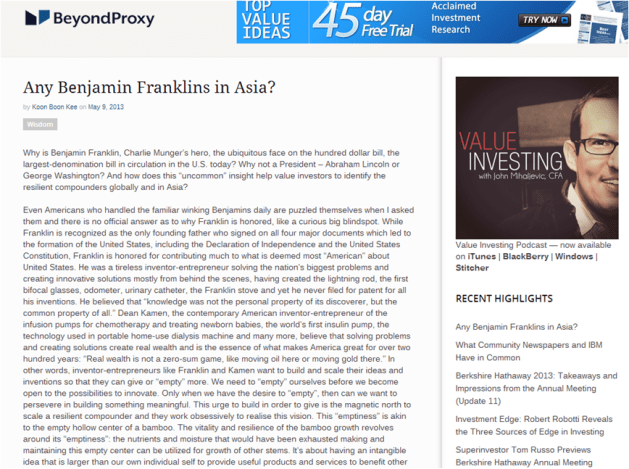
Any Benjamin Franklins in Asia? Bamboo Innovator is featured in BeyondProxy.com, where value investing lives

Bamboo Innovator is featured in BeyondProxy.com, where value investing lives:

Any Benjamin Franklins in Asia? May 9, 2013 (Weblink: BeyondProxy.com)

BenFranklinAsia