Policy battle rages in China as slowdown feeds ‘sense of crisis’

Policy battle rages in China as slowdown feeds ‘sense of crisis’

Anti-reform hardliners in China’s Communist Party have become seriously alarmed by the sharp slow-down in economic growth, creating a “task-force” to crank up production.

China’s Caixin Magazine reports that there is a growing “sense of crisis” not felt since the depths of the global banking crash in 2008-2009. Photo: Quirky China News / Rex Features

By Ambrose Evans-Pritchard

4:17PM BST 06 May 2013

China’s Caixin Magazine reports that there is a growing “sense of crisis” not felt since the depths of the global banking crash in 2008-2009. The State-owned Assets Supervision and Administration Commission (SASAC) has assembled a team to “protect economic growth” and pressure state companies to boost jobs at all costs. Read more of this post

Chinese president Xi Jinping emperor photo lands The Economist in hot water

Xi Jinping emperor photo lands The Economist in hot water

Staff Reporter, 2013-05-07

XiJinpingEmperor-161247_copy1

Xi Jinping as Qianlong, left, and a previous cover from The Economist likening Xi to an emperor in waiting in October 2010. (Photos courtesy of The Economist)

A doctored photo featuring China’s new president, Xi Jinping, wearing a traditional emperor’s robe is said to have deeply offended the Communist Party leadership. Xi, who is also the party’s general secretary and commander of the People’s Liberation Army, was featured on the front page of the May issue of The Economist magazine wearing a yellow robe with an illustrated dragon on the chest, and a glass of champagne in hand. “Let’s party like it’s 1793,” reads the magazine’s headline, a reference to the year the Qing emperor Qianlong rejected British envoy Lord Macartney’s request to open an embassy because China does not have “the slightest need for your country’s manufactures.” The title of the feature article is “Xi Jinping and the China dream,” and questions exactly what Xi means by his new doctrine, noting that it seems to “include some American-style aspiration, which is welcome, but also a troubling whiff of nationalism and of repackaged authoritarianism.” The article, which outlines the difficulties Xi faces in realizing his dream of unifying a diverse and growing China, seems to have hit a nerve with the Communist Party, as The Economist’s website was blocked in the country shortly after its publication. Detractors of Xi’s regime have said online that his “China dream” and emperor’s robe are both figments of the imagination. Despite calls for more freedom and fairness, the Chinese government continues to target free speech and rights activists and remains plagued by official excess and corruption, netizens said.

Listed companies under fire over reception costs; China Railway Construction topped the list with a total spend of 837 million yuan, or 10% of the company’s profits

Listed companies under fire over reception costs

(Xinhua)

08:36, May 07, 2013 Read more of this post

Guangzhou store front grins with 300kg of gold teeth; The building’s initiative was widely criticized as a grand waste

Guangzhou store front grins with 300kg of gold teeth

Staff Reporter

2013-05-06

goldgold-175533_copy1

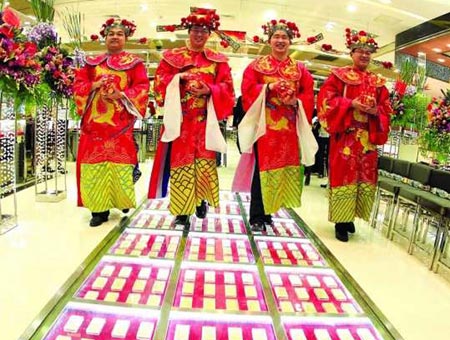
Nearly 300 kilograms in gold bars caught the glare of the sun — and the eyes of shoppers — as the yellow brick road leading the way to a jewelry store in Guangzhou in southern China. The store was laying its intentions bare for the Labor Day holiday, Chinese media reported. The building authorities used 252 gold bars, each weighing 1 kilogram, to pave the front of the building for almost five meters. Dozens of gold ingots, each weighing 10kg, were also displayed on the fourth floor of the building. The building’s initiative was widely criticized as a grand waste. The Guangzhou jewelry was apparently not alone in its decadent decor. A jewelry store in Shandong also went with the gold standard, going with 1,000 bricks of gold, each of 1 kg, for its store front display. Both buildings assured critics of adequate security when asked about the safety of broadcasting their bling. The stores were apparently bringing attention to the all-time low price of gold on the world market.

Most Chinese investors don’t trust wealth management agencies

Most Chinese investors don’t trust wealth management agencies

Staff Reporter

2013-05-06

People in China have their own system of wealth management, choosing to keep their own counsel rather than put their trust in professional organizations, valuing gains but ignoring risks, preferring to follow group sentiment and rushing to invest, and being fond of putting their eggs in one basket. These are the major findings of the newly issued Chinese Wealth Management 2013 white paper published by Golden Securities, a wealth management publication.

A survey in the white paper showed that 86.8% of the people surveyed preferred to manage their money by themselves, and only 13.2% of them would commission professional organizations to manage their assets for them. “Many wealth management professionals in financial institutions rarely put clients in an important position, and they rarely care if the products are appropriate for investments or how big the risks are,” said one woman. Even if clients are losing money, they don’t even mention it, she added. Read more of this post

What Triggers People to Reveal Too Much; Avoiding the Post-Conversation Cringe

May 6, 2013, 6:42 p.m. ET

Thank You for Not Sharing

What Triggers People to Reveal Too Much; Avoiding the Post-Conversation Cringe

By ELIZABETH BERNSTEIN

Ever shared too much information—and you weren’t even tipsy? Bonds columnist Elizabeth Bernstein joins Lunch Break with a look at why we over-share, and how to control the impulse. 

PJ-BO130_BONDS_G_20130506193703 Read more of this post

Ignore Anyone Who Tells You Insurance Is An Investment

Ignore Anyone Who Tells You Insurance Is An Investment

Michael, Bankers Anonymous | May 6, 2013, 8:48 AM | 2,886 | 8

Insurance has one purpose, and one purpose only. Remembering that purpose will keep you from expensive insurance ‘solutions.’ The purpose of insurance is risk transfer. For the rest of your life, insurance salespeople will try to sell you the idea that you can both increase your wealth and protect against risk at the same time. Not True. Buying insurance transfers your personal risk to an insurance company – and should be used only that way. Insurance does not increase your wealth and attempts to convince you otherwise end in expensive financial monstrosities. Read more of this post

“All go unto one place; all are of the dust, and all turn to dust again”: Behind the hype of high-yield corporate bonds and investors’ understandable desire to make money, bad habits are creeping back in

Updated May 6, 2013, 8:51 p.m. ET

Reaping Wisdom On ‘Junk’

By FRANCESCO GUERRERA

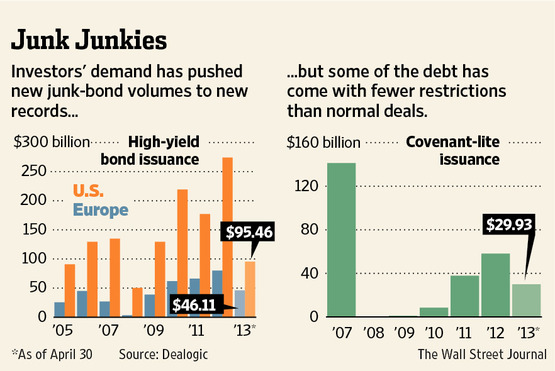
In 1977, a band of Los Angeles-based traders led by Michael Milken helped Texas International, an oil company, raise the first “junk” bond. The small issue—$30 million—opened a chapter in the history of finance. From then on, companies with less-than-pristine balance sheets were able to tap capital markets, while investors had the option of betting on securities with higher risks, and potentially higher returns, than traditional corporate bonds.

MI-BV784_GUERCO_G_20130506182703 Read more of this post

Fraud survey says bosses across much of the world ‘cook the books to meet tough targets’

Published: Tuesday May 7, 2013 MYT 7:58:00 AM

Fraud survey says world over bosses ‘cook the books to meet tough targets’

LONDON: Hard-pressed company bosses across much of the world are under so much pressure to deliver on growth that many have resorted to cooking the books, Ernst & Young says in its latest Fraud Survey published on Tuesday. One in five of almost 3,500 staff quizzed in 36 countries in Europe, the Middle East, Africa and India said they had seen financial manipulation in their companies in the last 12 months, the accounting and consultancy firm said. In addition 42 percent of board directors and top managers surveyed said they were aware of “some type of irregular financial reporting”. And despite scandals and regulatory failures in the wake of the credit crunch, almost a quarter of top financial services staff surveyed said they were aware of manipulation and almost 10 percent of all staff said their companies had understated costs, overstated revenues or used unprincipled sales tactics. Read more of this post

How the iPhone conquered Japan by winning over women; The original round plastic iPhone becomes a fashion item for Japanese women who enjoyed the huge variation of cases and ease of decoration

How the iPhone conquered Japan

May 6, 2013: 12:05 PM ET

Despite its more-or-less mundane technology, Apple’s device won over women.

FORTUNE — The Japanese were using their cellphones to watch TV, navigate with GPS, download music, make movies, pay bills, and check their emails years before American consumers were doing the same. Japan also had touchscreen phones eight years earlier than iPhone — the Pioneer J-PE01. And yet it is no surprise that Apple’s iPhone was the best-selling phone in Japan last year. After over a decade of trouncing any foreign handset looks and talent-wise, Japan’s legendary ketai are been given the heave-ho in favor of foreign models. Take NEC, once one of the world’s biggest IT and telecoms firms. Its fortunes have been typical of the other seven Japanese handset makers. After two years of losses and a stock value that has fallen over 90% in a decade, it is selling off its mobile phone sales unit and cutting 10,000 mobile related jobs. Analysts say the firm can’t compete anymore with Apple (AAPL) and Korea’s Samsung.

What happened? Japanese mobile phone guru Nobuyuki Hayashi believes there are three main reasons Japan has fallen out of love with its own handset makers. First, he says, you have to understand what a colossal and unexpected hit the iPhone was with Japanese women. “The iPhone has been very strong among women from very early on. The original round plastic iPhone 3G series soon become a fashion item for Japanese women who also enjoyed the huge variation of cases and ease of decoration. Then there is the brand loyalty of Japanese women.” Read more of this post

Adobe Moves Software Out of the Box and Into the Cloud

Updated May 6, 2013, 7:44 p.m. ET

Adobe Moves Software Out of the Box and Into the Cloud

By STEVEN D. JONES

Adobe Systems Inc., ADBE -1.11% the maker of Photoshop, Illustrator and other design tools, is getting out of the packaged-software business and will sell its biggest products only as online services.

The decision announced Monday by one of the largest software publishers underscores how the industry is adjusting to changing consumer tastes. People are buying fewer boxes of software—just as they aren’t buying as many CDs, movies and books in stores—and turning to Internet-based cloud services.

Adobe, which began selling its software in stores in 1987, will no longer offer new versions of its creative software at retailers such as Staples or allow people to download digital copies to their computers. Read more of this post

Paid YouTube channels: Would you subscribe?

Paid YouTube channels: Would you subscribe?

By Hayley Tsukayama, Tuesday, May 7, 12:00 AM

YouTube has moved swiftly in the past year to produce more original content to keep regular viewers coming back to its site, rather than simply stopping by to see the latest viral cat video. Now, the Financial Times reports that the paid model could go into effect as soon as this week, with as many as 50 subscription channels starting as low as $1.99 a month. The New York Times reported that channels could include those for children’s programming, entertainment, music and other topic areas.

We’ve been here before. Chatter about paid channels has been circulating ever since Google, which owns YouTube, made its first push to release regular, original videos on its site by paying about $100 million to fund promising talent. AdAge and the Wall Street Journal reported in January that the new paid channels could launch as soon as this spring. Read more of this post

Fortune 500 profits near record; Wal-Mart replaces ExxonMobil as biggest revenue maker

Fortune 500 profits near record; Wal-Mart replaces ExxonMobil as biggest revenue maker

By AFP | 7 May, 2013, 03.17AM IST

NEW YORK: The 500 largest US companies scored near-record profits last year and retailer Wal-Mart replaced ExxonMobil as the biggest revenue maker on the annual list,Fortune magazine said Monday. Apple cracked into the top 10 companies for the first time, vaulting into sixth place from the prior year’s number 17 slot.  The combined earnings of the Fortune 500 came in at $820 billion in 2012, slipping from the all-time high of $824.5 billion in 2011.  Earnings amounted to 6.8 percent of sales, well above the historical average of around 5.5 percent, the magazine said. “For the future the overriding question for the 500 is whether the era of abundant profits will continue,” said Fortune senior editor-at-large Shawn Tully. Tully predicted that companies would be forced to increase their staff and pay higher salaries as the economy continues to improve. “Most likely that will hold profit growth to the low single digits in the next year or two, in line with sales, as gravitational forces pull earnings back to the mean.”

Tully characterized 2012 as a year that saw the return of “animal spirits,” or an urge to action, reflected in an increase in the number of spinoffs and mergers and acquisitions.
“For several years, players have been hoarding cash and shunning expansion,” Tully said. “In 2012 they put that cash — and their rapidly appreciating shares — to work in the best year for M&A in over a decade.”

Wal-Mart reclaimed the top spot on the list from energy titan ExxonMobil after posting $469.2 billion in revenues, or $19.3 billion more than Exxon. However, Exxon’s profits of $44.9 billion dwarfed the retailer’s $17.0 billion. Exxon and Wal-Mart have traded the top two positions repeatedly in recent years. This year marks the ninth time Wal-Mart has topped the list. Energy companies continued to play a prominent role in the group, with Chevron in third place and refiners Phillips 66 and Valero Energy placing fourth and ninth, respectively. Rounding out the rest of the top 10 were Warren Buffett’s Berkshire Hathaway, ranked in fifth place, Apple (six), General Motors (seven), General Electric (eight) and Ford Motor (10).  The magazine classified financial services as the “comeback” sector of the year, leading all industry groups with $200 billion in total profits, ahead of the technology sector. JPMorgan Chase ranked 18th, Bank of America placed 21st, Wells Fargo was 25th andCitigroup finished 26th.

Is Soros shorting the Aussie dollar?

Is Soros shorting the dollar?

May 7, 2013 – 9:11AM

Mark Hawthorne

The Australian dollar fell in overnight trade on the back of rumours that billionaire US investor George Soros is betting the local currency will fall.

The Aussie dollar slipped from $US1.0284 in late local trade to as low as $US1.0222 in offshore trade as traders reacted to unconfirmed rumours that Mr Soros – who famously shorted the British pound back in 1992 – was planning a raid on the dollar ahead of today’s interest rate announcement.

The dollar has since recovered some of its overnight losses and was buying $US1.0253 this morning.

A large number trades shorting* the dollar totalling $US1 billion were placed via Hong Kong and Singapore late Monday, believed to be by Soros Fund Management.

“Someone … seems to be betting on a rate cut,” said one Sydney-based FX trader. “I’ve heard the George Soros rumour tonight. A billion dollars sounds like a lot, but it’s not enough to move the Australian dollar and it’s not a lot for George Soros, but there is a play happening  in the FX market. Read more of this post

Indian Ponzi Scheme Gets a Political Bailout

Indian Ponzi Scheme Gets a Political Bailout

As the head of the conglomerate the Saradha Group, Sudipta Sen persuaded small investors in West Bengal to entrust more than $500 million to his business between 2008 and 2013. What wasn’t to trust? After all, Sen ran a network of around 300,000 agents, owned a set of TV channels and newspapers and had influential patrons in politics, including a member of Parliament who agreed to run his media operations for him.

Last month, Sen (who so disliked being photographed that his “message” on his company’s website has a picture of an empty chair accompanying it) went AWOL after the Ponzi scheme sustained by him for five years finally went bust. He was eventually tracked down in the north Indian state of Kashmir, but not before he had embarrassed the chief minister of West Bengal, the mercurial and autocratic politician Mamata Banerjee. Sen accused two members of Parliament belonging to her party, the Trinamool Congress, of having accepted millions of dollars to buy him protection from the law.

Meanwhile, as thousands of defrauded investors thronged the offices of the Saradha Group, Banerjee’s advice to them was the austere “Ja gechchey, ta gechchey” (“What’s gone is gone”). The same might soon be said of her own political credibility. This was only the most inflammatory of a number of paranoid and perverse steps she has taken since coming to power in West Bengal two years ago, ending more than three decades of Communist rule in the state. Read more of this post

MIT: A Tale of Two Entrepreneurs: Understanding Differences in the Types of Entrepreneurship in the Economy

A Tale of Two Entrepreneurs: Understanding Differences in the Types of Entrepreneurship in the Economy

William Aulet Massachusetts Institute of Technology (MIT)

Fiona Murray Massachusetts Institute of Technology (MIT) – Entrepreneurship Center

May 1, 2013

Abstract: 
Not all startup companies are created equal. Although both innovation-driven enterprises (IDEs) and traditional small- and medium-sized enterprises (SMEs) can provide valuable products and services and create jobs, IDEs – startups focused on addressing global markets based on technological, process or business model innovation – can potentially create hundreds or even thousands of high-skill jobs if they succeed. This paper examines the distinctive differences between these two forms of entrepreneurial ventures, their importance for governments and policymakers wanting to support long-term economic growth; their roles in local, regional and global economies; and their differing needs in terms of financial and policy support.

A Lesson From Buffett: Doubt Yourself

May 5, 2013

A Lesson From Buffett: Doubt Yourself

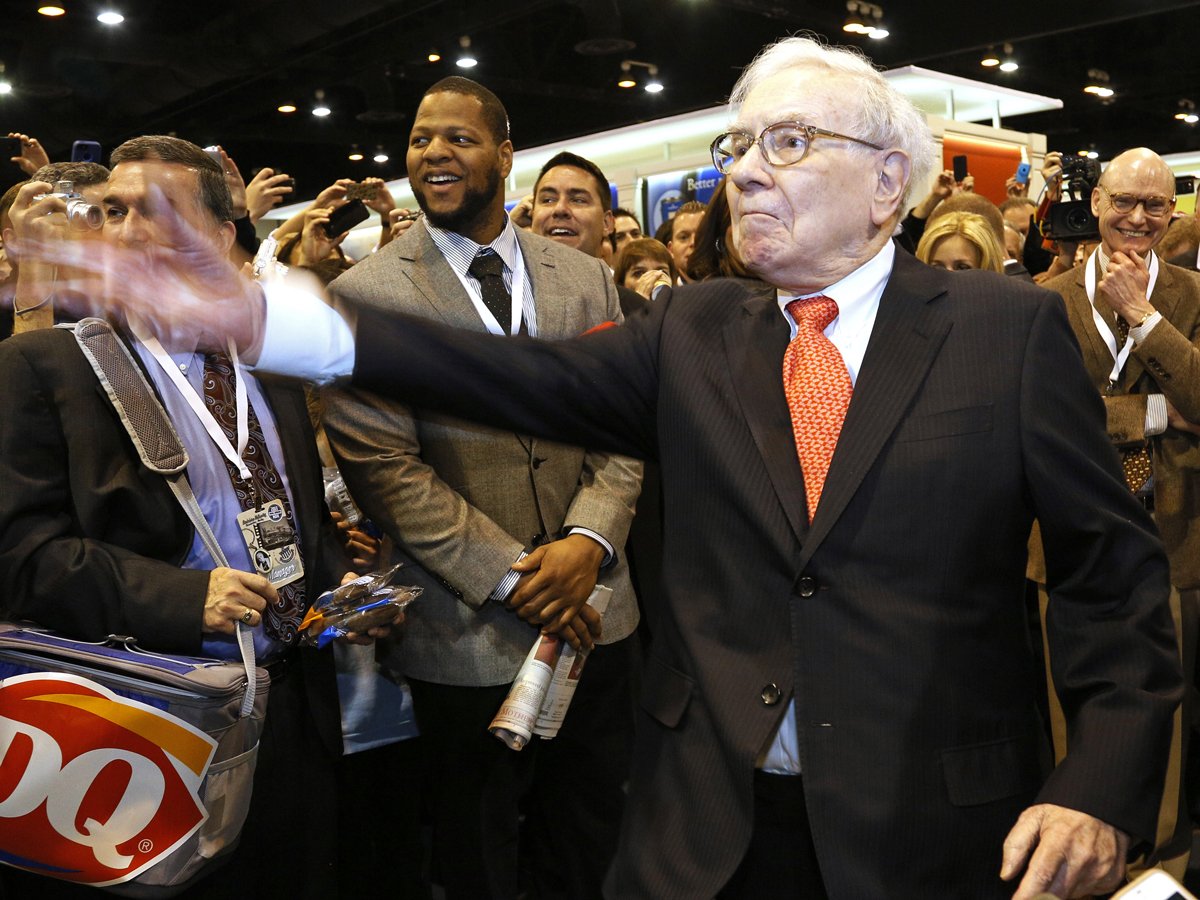
There was no big news at Berkshire Hathaway Inc.’s annual meeting this past weekend, but there was one great lesson for investors: Perhaps the most important thing you can do when everything seems to be going right in your portfolio is to listen to somebody who insists you are wrong. To spice up the annual ritual, Berkshire’s chairman, Warren Buffett, invited someone who has placed a bet against the stock—short-seller Doug Kass of hedge fund Seabreeze Partners Management—to join the panel of analysts posing questions to Mr. Buffett and vice chairman Charles Munger. Carp, if you will, that it didn’t take much bravery for Mr. Buffett to give air time to one skeptic among the more than 35,000 worshippers who would trample their grandmothers to kiss Mr. Buffett’s feet if he took his socks off. Complain, as many already have, that Mr. Kass’s questions weren’t all that tough. Then ask yourself: When is the last time the management of a major U.S. company sought out unrestricted criticism from someone betting against the stock? To get a sense of how unusual it was for Mr. Buffett to invite a bear to ask questions freely, consider a survey of more than 500 companies by the National Investor Relations Institute in 2011. The research found that 80% placed limits on who can ask questions during the quarterly ritual of the earnings conference call. Nearly 25% of the companies took questions only from “pre-approved lists” of callers. Only 11% permitted individual investors to ask questions; just 12% said the floor is open to everyone. What is more, 76% of companies prepared scripted answers to the questions they expected to get. According to the NIRI survey, the prepared comments by top executives that open the typical earnings conference call are prerecorded by about one out of 12 companies, but more than 80% of them don’t disclose that the remarks have been prerecorded. But before you start comparing U.S. corporate management to a closed system like, say, North Korea, ask yourself another question: When is the last time I tried as hard as possible to find someone to refute my own investing ideas? Mr. Buffett is “self-confident, but he’s not afraid of a challenge,” Mr. Kass told me last week. “I believe he enjoys challenges.” A deliberate, lifelong effort to find people to tell him why he might be wrong is one of the keys to Mr. Buffett’s success. It doesn’t come naturally to most investors. Mr. Buffett once noted about the scientist Charles Darwin that “whenever he ran into something that contradicted a conclusion he cherished, he was obliged to write the new finding down within 30 minutes. Otherwise his mind would work to reject the discordant information, much as the body rejects transplants. Man’s natural inclination is to cling to his beliefs, particularly if they are reinforced by recent experience.” Read more of this post

Warren Buffett and Bill Gates Looking Intense While Tossing Newspaper

Bill Gates Looks Super Intense While Throwing This Newspaper

Joe Weisenthal | May 4, 2013, 12:45 PM | 7,632 | 7

At the Berkshire Hathaway annual shareholder meeting, billionaire, Warren Buffett-buddy, and Berkshire board member Bill Gates participated in the annual, folksy tossing of the newspapers. From Reuters: Berkshire Hathaway CEO Warren Buffett (R) watches friend Microsoft Chairman Bill Gates throw a newspaper in a competition just before the Berkshire annual meeting in Omaha May 4, 2013. Buffett and the board of his conglomerate Berkshire Hathaway Inc are “solidly in agreement” on who should be the company’s next chief executive, he said at Berkshire’s annual shareholder meeting on Saturday. And here’s Warren, also looking incredibly focused post-toss.bill-gates-warren-buffett-newspaperwarren-buffett-28

Buffett Has No New Investment Plan in China, Says There’s No Competitive Advantage; The pessimistic remarks about China came as a strong contrast with five years ago when he said China has huge growth potential

Buffett Has No New Investment Plan in China, Says There’s No Competitive Advantage

05-06 13:58 Caijing

The Buffet-backed BYD in March reported a drop of over 94% in net profit for the year 2012 largely due to weakening demands in the world’s second largest economy amid a downturn.

Warren Buffett, the Berkshire Hathaway CEO, said he has no new plans to invest in China, as the Oracle of Omaha remained conservative about competitive edges of the world’s second largest economy, following disappointing performance of his once favored investment in Chinese auto-maker BYD. There’s no competitive advantage in China, said the billionaire in taking up a question from a shareholder from Shanghai as the annual meeting of Berkshire Shareholders was drawing to a close in Omaha on May 4th. The pessimistic remarks about China came as a strong contrast with five years ago when he invested in a new plant of Iscar Metalworking Companies (IMC) in Dalian, a coastal city in northeast China, saying China has huge growth potential.  Buffett purchased 1.3% stake in PetroChina, China’s largest oil and gas producer, with $488million between 2002 and 2003 before selling all the shares in November, 2011, which gained the investor as much as $4billion. Berkshire Hathaway bought 225million shares of BYD, a Chinese auto and battery maker, or just under 10% of the company’s stock at 8 HKD a share before it soared to over 80HKD in 2010. The company, however, had seen slumping businesses since then with its shares dropping as much as over 80% to 12.44HKD in October, 2011. The Buffett-backed BYD in March reported a drop of over 94% in net profit for the year 2012 largely due to weakening demands in the world’s second largest economy amid a downturn. Buffett said he would prefer Chinese companies that export quality goods, especially consumer goods at last year’s annual shareholder’s meeting for Berkshire Hathaway. Berkshire vice chairman Charlie Munger said China has a huge auto market which is BYD’s main focus, and the number of cars he expected BYD to sell in the U.S. would be very small.

Investors having tough time copying Buffett’s strategies these days; Sage of Omaha’s transition to master financier baffles some, but homey advice still rings true

Investors having tough time copying Buffett’s strategies these days

Sage of Omaha’s transition to master financier baffles some, but homey advice still rings true

BY JOSH FUNK

AP MAY 6, 2013

Israel’s inverted economic pyramid and how to flip it

Israel’s inverted economic pyramid and how to flip it

The opposing examples of IDB Group and Iscar indicate a pressing need to shift the economic narrative from financiers who specialize in gimmicks toward businessmen who build something of real value.

By Sami Peretz | May.03, 2013 | 2:20 PM

Over a hundred years ago, the socialist Zionist leader Dov Ber Borochov defined the structure of Jewish labor in the Diaspora as an inverted pyramid. The narrow base consisted of a few productive workers employed in industry and agriculture and, above them, in a much wider layer, were those dealing in “airy-fairy” jobs (“luftgescheft” in Yiddish), such as middlemen, small merchants and moneylenders.

At that time, the inverted pyramid was the result of Jews being denied access to other jobs and thus pushed into these professions by default. The need, therefore, to transform the Jew from a person dealing with such impractical or insubstantial work into a productive, industrial person was deeply embedded and an integral part of the drive to create a Jewish national home in Israel. A hundred years later, the financial news from this week may confirm this Zionist ideal.

On one hand, we have the Wertheimer family, founders of Iscar, a shining example of a productive industrial business, which just sold another 20 percent stake in the company to Warren Buffett for $2 billion, a deal that reflected a total company worth of $10 billion. On the other hand, a court has nominated an observer to supervise activity at IDB Development, one of the companies in Nochi Dankner’s collapsing pyramid.  Read more of this post

Korean chaebol forced to reduce cross-affiliate deals

2013-05-05 10:48

Chaebol forced to reduce cross-affiliate deals

Regulations feared to drive large firms out of country
By Lee Hyo-sik
05-06-22-0105-06-22-03
President Park Geun-hye’s pledge to penalize inter-subsidiary dealings has been troubling Korea’s family-controlled conglomerates. She has vowed to curb business transactions among chaebol affiliates in the name of “economic democratization,” which her advisors say seeks to correct unfair business practices by large family-run groups, as well as protect small businesses.

The government expects the National Assembly will approve the revised Fair Trade Act in July, designed to discourage intra-group transactions by imposing fines on and prosecuting those orchestrating them.

Policymakers and civic groups argue that generating the bulk of revenues from exclusive dealings with affiliated companies is tantamount to unfair business practices. Such transactions, they say, deprive unrelated firms, most of which are small- and medium-sized enterprises, of potential business opportunities.

They also say the exclusive intra-group dealing is misused, serving to boost the wealth of offspring and other family members of group chairmen. These family members often hold substantial stakes in the benefiting entities. Read more of this post

More chaebol children stock-rich

2013-05-05 6:49 p.m.

More chaebol children stock-rich

By Cho Mu-hyun

The number of parents and grandparents transferring stocks worth more than 100 million won ($ 91,300) to childrens names has soared to a record high, according to a report released Sunday.Chaebul.com, which tracks large conglomerates and their owners said, as of April, there were 118 102 children under the age of 12 who had stocks worth 100 million won The figure was a year ago, thirty one such offspring had stocks worth more than 1 billion won, and two had more than 10 billion won The richest child in Korea is the 12-year-old son of Huh Yong-soo, senior vice president of GS Energy and cousin of GS Group Chairman Huh Chang-soo. The boy had 42.9 billion won worth of stocks. Huhs son topped the list last year as well, when his stocks were valued at 45.3 billion won. He received 259,000 of stocks GS Holdings when he was four years old in 2004, and currently has 740,341 His nine-year-old younger brother was runner-up with 17.4 billion won worth of stocks Relatives Lim Sung-Gi, chairman and CEO of Hanmi Pharmaceutical, hold seven spots in the top ten aged between five and ten, they each own stocks valued at more than 8.44 billion won in the company’s subsidiaries Hanmi Science and Hanmi Pharm LB Investment CEO Koo Bon-chuns two sons, aged 12 and 10, had stocks worth 6.05 billion won and 55.5 billion won. The elder son first appeared on the annual list two years ago, when his stocks were worth 7.5 billion won. Koo is the son-in-law of Lee Sang-deuk, a former lawmaker of The Saenuri ruling Party and the elder brother of former President Lee Myung-bak, Seoul Pharma CEO Hwang Woo-sungs two 9-year-old sons both had stocks valued at 4.25 billion won four of the grandchildren of Hankook Tire Chairman Cho Yang-rae appeared on the list. The 7-year-old son and 10-year-old daughter of sis son and Hankook Tire President Cho Hyun-bum, who is also the son-in-low of former president Lee Myung-bak, owned stocks worth 810 and 800 million won, respectively, there are also stock-rich Infants The granddaughters of Koo and the Korea Watos Chairman Song Gong-suk, both just turned 1 who own stocks valued at 160 and 100 million won Critics say owners of conglomerates have been transferring stocks larger to relatives so they can accumulate fortunes by receiving dividends or making it easier for them to control their BUSINESSES One example is the Hyosung Group, whose Chairman Cho Suk-Raes three grandchildren owned stock in the company worth around 80 million won in 2008. When the stock price quadrupled in 2010, it was sold for a profit of 300 million won each. Another advantage of the ploy includes avoiding heavy taxes.

China-only Iron Man 3: whatever it takes to profit

China-only Iron Man 3: whatever it takes to profit

Staff Reporter

2013-05-06

The special edition of Hollywood blockbuster Iron Man 3 made exclusively for Chinese audiences reflects the compromises that movie producers are willing to make to crack the lucrative Chinese film market, reports the Commercial Times, our Chinese-language sister paper.

Iron Man 3, co-produced by US Marvel Studios and China’s DMG Entertainment Group, debuted in China last week with four minutes of additional footage and featuring the so-called “Chinese elements” required by Beijing to satisfy tight controls designed to protect the domestic film industry. This highly anticipated China-exclusive version, however, has been widely panned for coming across as awkward and adding nothing to advance the flow and plot points of the film.

According to Chinese viewers, the extra four minutes of footage were dominated by domestic product placement, including the milk product Guo Li Duo and domestic electronics makers TCL and Zoomlion. Veteran Chinese actor Wang Xueqi, who made a five-second cameo in the international version of the film, was given more screen time as a doctor prescribing Chinese medicine to aid Iron Man, while Chinese superstar Fan Bingbing, who did not appear at all in the international version, played Wang’s nameless assistant. Iron Man is also seen on a television screen with cheering Chinese school children. Read more of this post

China Intensifies Scrutiny of Importer, Exporter Capital Flows

China Intensifies Scrutiny of Importer, Exporter Capital Flows

China’s currency regulator said it will increase scrutiny of cross-border capital flows by importers and exporters to prevent speculative funds entering the country disguised as trade bills. The State Administration of Foreign Exchange will send out risk-warning notices to companies whose goods and capital flows do not match, as well as those that are bringing big amounts of cash into China, it said in a statement on its website. Recipients of such notices have 10 days to explain the need for their transactions and those that fail to comply or are unable to provide satisfactory proof will then be placed on SAFE’s so-called B list, which means their activities will be closely monitored for a period of at least three months. A return to SAFE’s A list can only take place once relevant indicators return to a normal range, the statement said. SAFE said it would finalize the B list and send out the first batch of warnings before May 10. It also ordered banks to adjust their foreign-exchange positions to comply with regulations. The yuan fell 0.03 percent to 6.1572 per dollar as of 12:01 p.m. in Shanghai, after earlier touching a 19-year high of 6.1521.

–Judy Chen. Editors: James Regan, Robin Ganguly

To contact Bloomberg News staff for this story: Judy Chen in Shanghai at xchen45@bloomberg.net.

German euro founder calls for ‘catastrophic’ currency to be broken up

German euro founder calls for ‘catastrophic’ currency to be broken up

Oskar Lafontaine, the German finance minister who launched the euro, has called for a break-up of the single currency to let southern Europe recover, warning that the current course is “leading to disaster”.

Mr Lafontaine said on the parliamentary website of Germany’s Left Party that Chancellor Angela Merkel will “awake from her self-righteous slumber” once the countries in trouble unite to force a change in crisis policy at Germany’s expense. Photo: Reuters

By Ambrose Evans-Pritchard, International Business Editor

9:30PM BST 05 May 2013

“The economic situation is worsening from month to month, and unemployment has reached a level that puts democratic structures ever more in doubt,” he said.

“The Germans have not yet realised that southern Europe, including France, will be forced by their current misery to fight back against German hegemony sooner or later,” he said, blaming much of the crisis on Germany’s wage squeeze to gain export share. Read more of this post

Buffett worries about Fed’s ‘huge experiment’, thinks the Fed chief may have overplayed his hand

Buffett worries about Fed’s ‘huge experiment’

By Stephen Gandel, senior editor May 4, 2013: 3:17 PM ET

Says he admires Ben Bernanke, but thinks the Fed chief may have overplayed his hand.

Warren Buffett

FORTUNE — Warren Buffett has a piece of advice for Ben Bernanke: It’s easier to buy than it is to sell.

Buffett, speaking on Saturday at Berkshire Hathaway’s (BRKA) annual meeting in Omaha, said he is worried about what will happen when the Federal Reserve tries to wind down its recent efforts to stimulate the economy. Via a program nicknamed QE, short for quantitative easing, the Fed in recent years has bought up over $2 trillion in bonds in order to lower interest rates and promote borrowing and investment.

Some have warned that when the Fed decides to sell its trove of bonds, or even just stops adding to it, stock markets could tank. Rising interest rates could cause banks to lose billions, perhaps igniting another financial crisis. Buffett says we don’t know what will happen, but he is concerned.

“QE is like watching a good movie, because I don’t know how it will end,” says Buffett. “Anyone who owns stocks will re-evaluate his hand when it happens and that will happen very quickly.” Read more of this post

Google set to unveil subscriptions for specialist YouTube videos

May 5, 2013 2:52 pm

Google set to unveil subscriptions for specialist YouTube videos

By Matthew Garrahan in Los Angeles and Andrew Edgecliffe-Johnson in New York

Google is on the verge of unveiling an à la carte subscription service for some of YouTube’s specialist video channels, to finance a broader range of content and add a second revenue stream to the digital video market leader.

The move, which has been in the works for months, could be announced as early as this week. It will apply to as many as 50 YouTube channels, people familiar with the plan say. Viewers will be able to subscribe to each channel for as little as $1.99 a month. Read more of this post

Marketers Must Understand The Power Of Three

Marketers Must Understand The Power Of Three

Ira Kalb, Marshall School of Business, USC | May 5, 2013, 6:37 AM | 2,369 | 

Good marketing follows certain universal truths. To succeed in an increasingly skeptical and fragmented marketplace, therefore, it behooves marketers to learn and apply these universal truths to marketing their products. One of the most important “truths” is the “power of three.”

Third rock from the sun

Most of us learned in science class that the Earth is the third rock from the sun. Relating to another story we learned in school, Goldilocks and the Three Bears, life as we know it evolved on Earth because it is not too hot and not too cold. The climate is just right, or what scientists call the habitable zone of a solar system. While it may be difficult to prove that the power of three comes from this coincidence, there is no doubt that three derives its power from the evolution of the human brain.

People like choice but not too many choices

Our brains evolved in a way protect us from harm. As part of our protection system, we like to have choices. We know that if we don’t have a choice in a dangerous situation, we may not find a way out of it. On the other hand, our brains also know that if we have too many choices, we often get confused. If we are confused, we may make the wrong choice, which could cause us serious harm. This means that the brain likes to have choices, but not too many choices. That brings us back to Goldilocks. Three choices enable us to avoid the ones that are too hot and too cold, too big and too small, and select the one that is just right. To tap into this protection mechanism in the human brain, marketers should recognize this power of three that is built into almost everything. Read more of this post

The Chinese Are Freaking Out About A Potential Drop In Housing Prices

The Chinese Are Freaking Out About A Potential Drop In Housing Prices

The Economist | May 4, 2013, 5:54 PM | 10,113 | 9

ASK ordinary people about their own Chinese dream, and you find owning a home is high on the list.

But years of rising house prices have put that dream out of reach of many. A slowing economy appeared to take some of the heat out.

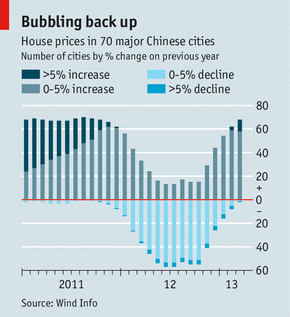
Now, alas, the residential property market is soaring again (see chart). A new survey of developers and property firms on May 2nd showed average house prices up more than 5% in April on a year earlier.

20130504_cnc511 Read more of this post