Have We Evolved to Be Nasty or Nice?

March 29, 2013, 9:15 p.m. ET

Have We Evolved to Be Nasty or Nice?

It is futile to ask whether people are naturally cooperative or selfish. They can be either, in different circumstances.

By MATT RIDLEY

RV-AK078_RIDLEY_DV_20130329180224

A new study by Dirk Helbing at ETH Zurich in Switzerland and colleagues has modeled the emergence of “nice” behavior in idealized human beings. It’s done by computer, using the famous “prisoner’s dilemma” game, in which a prisoner has to decide between cooperating with a comrade to get a mutual reward or avoiding a punishment by being the first of the two to defect to the other side. The Zurich team found that so long as players in the game stay near their (modeled) parents, the birth of a nice guy predisposed to cooperate can trigger “a cascade” of generous acts.

In other words, more togetherness and physical proximity across the generations allows the development of more prosocial behavior. “The clustering of friendly agents, which promotes other-regarding preferences, is not supported when offspring move away.” They also argue that networking via social media can promote niceness, which might surprise regular users of Twitter. Read more of this post

Does Blame Predict Performance of Investment Managers?

Does Blame Predict Performance?

March 2013 | Jason Hsu

As an econometrician and a fund-of-funds portfolio manager, I spend much time researching quantifiable metrics to help me identify managers who can outperform consistently. There is, in fact, a rich body of literature exploring different manager selection criteria. Academic papers have considered portfolio manager attributes, such as tenure, the CFA designation, advanced degrees, and even SAT scores; they have also examined fund characteristics, such as portfolio turnover, expense ratios, and assets under management. Practitioners, especially investment consultants, have additionally focused on more nuanced and qualitative elements such as investment philosophy, compensation scheme, turnover of key professionals, ownership structure, and succession planning.

Ironically, perhaps, most people have given up on the hope that past positive alpha can predict future outperformance with any reliability.1 Some might even go as far as asserting that manager outperformance is mean-reverting due to cyclicality in styles and “luck.”

Some of the above-mentioned attributes may provide very incremental information on the true quality of the manager. However, most econometricians, asset owners, and investment consultants confess (although not all publicly) that effective methods for picking top quartile performers remain elusive. As one of my friends at a large Middle Eastern sovereign wealth fund famously proclaimed, “We are convinced that managers who can consistently deliver alpha exist. We are, however, also convinced that we do not know how to find them.” Perhaps, then, the science of manager selection really is about winning what Charley Ellis calls “the loser’s game.” Read more of this post

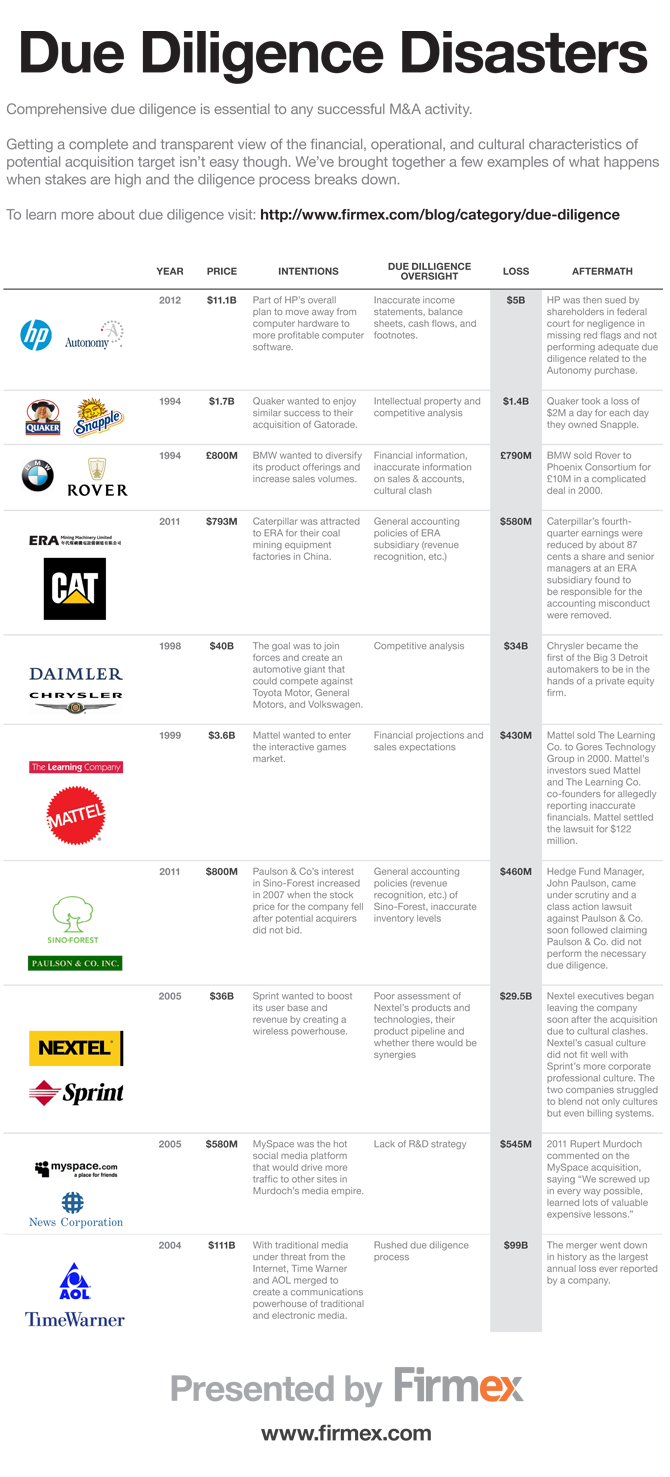
Due Diligence Disasters

Top-Due-Diligence-Disasters

Bing Gordon’s Founder Checklist: Animal Energy, Blind Confidence, And A Toupee.

Bing Gordon’s Founder Checklist: Animal Energy, Blind Confidence, And A Toupee.

DEREK ANDERSEN

posted 1 hour ago

Editor’s note: Derek Andersen is the founder of Startup Grind, a 40-city community bringing the global startup world together while educating, inspiring, and connecting entrepreneurs.

screen-shot-2013-03-30-at-12-09-31-am1

As an Electronic Arts’ intern eight years ago, I asked Bing Gordon then the chief creative officer and the only remaining early founding team member, a question about vision. “How can I know where the puck is going to be?” While he delivered a satisfactory response, two weeks later I received an email from Bing saying, “I answered that question poorly a few weeks and I wanted to try again.” A few weeks ago Bing joined me at Startup Grind in Silicon Valley where he delivered some videogame history and founder advice. In 2010 Mark Pincus called KPCB general partner Bing Gordon (look for a bald guy on the front row) one of the world’s “great CEO coaches” supporting founders on the boards of companies like Amazon, Zynga, Klout, and Zazzle. Here are some excepts from our recent interview. Read more of this post

Sequoia Capital In Singapore After A Year, Has Yet To Invest In A Local Startup

Sequoia Capital In Singapore After A Year, Has Yet To Invest In A Local Startup

VICTORIA HO

posted yesterday

When Sequoia Capital India landed in Singapore quietly in 2012, the buzz around town was that a big-name US fund being in the country was going to really jolt the market and provide serious cred to the startups here.

The Indian team running operations here, however, appears to have spent the last year of its time in the island state helping startups in its India portfolio expand into Singapore, rather than directly investing in startups here. Read more of this post

How Digital Technologies Change the Game: A Discussion with Five Leaders

How Digital Technologies Change the Game: A Discussion with Five Leaders

MARCH 25, 2013

During the dot-com era, “The Internet changes everything” was a popular refrain. The line was not wrong—just premature. Today, the Internet finally is changing everything.

The way we learn, form friendships, communicate, and do business has been permanently altered. Major industries, such as traditional media, have been disrupted, but all industries have felt the effects of big data, Internet connectivity, and social media. The Internet does not just change everything. It is everywhere, too. Asia and now Africa are quickly catching up with the rest of the world in terms of connectivity.

To understand what has changed and how businesses can respond, The Boston Consulting Group hosted a breakfast panel called “Digital Game Changers” at the World Economic Forum’s annual meeting in Davos, Switzerland. The august group of panelists included the following:

  • Marc Benioff, the founder of Salesforce.com, a leader in enterprise cloud computing
  • Matt Brittin, Google vice president of Northern and Central Europe
  • Arianna Huffington of The Huffington Post 
  • Steve Mollenkopf, president of Qualcomm, an innovator in wireless and next-generation technologies
  • Jimmy Wales, founder of Wikipedia

The quintet discussed the disruptive force of the Internet on industry economics and the transformative effect of connectivity on organizations and customer interactions. They also ranged over the rapid entry of emerging markets into the connected world, the delivery of mobile health care, the dangers of cyber attacks—and the need to unplug from it all from time to time. In short, the panelists knew how to pack a punch. Read more of this post

How Laithwaites turns wine into gold; Laithwaite is the biggest wine merchants in the world, excluding supermarket retailers.

How Laithwaites turns wine into gold

Charles Vallance and David Hopper meet a man who has made his fortune, and a company employing over 1,000 people, from his lifelong passion.

laithwaite_2523291b

The Laithwaites make wine at their collection of vineyards and wineries in Bordeaux and Australia. Photo: Ben Cawthra / Rex Features

By Charles Vallance and David Hopper

9:42PM GMT 29 Mar 2013

Were you to bump into Tony Laithwaite at the post office or at an airport check-in you would probably guess that he is a wine maker; put him in a vineyard and he looks like he belongs there — in the way that French existential philosophers look like they belong in street cafes on the Boulevard Saint-Germain.

The UK’s biggest wine company is eponymously named after Laithwaite and his wife, Barbara. In fact, according to some calculations, they are the biggest wine merchants in the world, excluding supermarket retailers.

Trading under his own name and several other subsidiaries, Laithwaite and his wife have built up a company with turnover in excess of £350m annually — which works out at around 50m bottles — with usually at least 2,500 wines in stock, and directly employing more than 1,000 people worldwide. Read more of this post

Tan Sri Andrew Sheng: Financial crises a result of governance failures

Saturday March 30, 2013

Financial crises a result of governance failures

THINK ASIAN By ANDREW SHENG

ROMAN emperor Julius Caesar was famously warned by a seer about the Ides of March, traditionally March 15.

On March 15 this year, banks in Cyprus were closed to allow politicians time to decide how to raise 5.8 billion euros so that the country could qualify for 10 billion euros in bailout funds from the rest of eurozone and the International Monetary Fund (IMF). The solution suggested was to levy a tax on depositors, sparking a realisation that finally, the Europeans had decided to “bail-in” investors and depositors, rather than using public funds to “bail-out” everyone else.

The Cyprus crisis caused a stir in global financial markets, because it punctured expectations that the worst was over. Instead, it demonstrated another episode of muddling through. Read more of this post

Meet Cyro, The Robotic Jellyfish That Will Haunt Your Dreams

Meet Cyro, The Robotic Jellyfish That Will Haunt Your Dreams

Matthew Shaer, Christian Science Monitor | Mar. 29, 2013, 11:26 PM | 1,354 | 1

If you’re frightened of the ocean, or the creatures that lurk beneath the waves, we recommend that you read no further. According to the Los Angeles Times, engineers at aVirginia Tech lab are working on a giant, synthetic, robo-jellyfish, which one day could autonomously patrol the high seas. The project, which is funded by a $5-million grant from the US Naval Undersea Warfare Center and the Office of Naval Research, has already yielded one workable prototype: a 170-pound monster nicknamed Cyro. Geek.com reports that Cyro measures more than five feet in length, and behaves very much like its organic counterpart. Cryo consists of a central core of components in a waterproof shell connected to eight moving arms. Draped over this is a large and soft piece of white silicone, which comes into contact with each of the arms and remains flexible. Combined, the arms and silicone act as a propulsion system mimicking how real jellyfish move around. A video produced by Virginia Tech indicates that Cyro could eventually be used to keep tabs on ecologically-sensitive underwater areas or to help clean up oil spills. Jellyfish, after all, are extremely efficient swimmers – they require less energy than, say, a large fish to keep moving. Still, we stand by our original point. Regular jellyfish are scary enough. Robotic jellyfish? The stuff of horror flicks – or at least spy movies. “Imagine,” writes Matt Peckham of Time Magazine, “a fully-realized version of such a robot running underwater surveillance missions for the U.S. Navy – the marine version of a weaponless drone, in other words, perhaps poking around someone’s oceanfront property (or, heaven forbid, employed in a civilian capacity by ignoble paparazzi to stalk celebrities).” In related news, here’s a compendium of horror movies that include jellyfish. Among them: The 1965 epic “Sting of Death.”

Demand for ‘dislike’ button grows; Facebook users want icon to warn of swindling

2013-03-29 19:16

Demand for ‘dislike’ button grows

Facebook users want icon to warn of swindling
By Kwon Ji-youn

“The opposite of ‘like’ is not ‘un-like,’” said Choi Jung-hwan, 23, a technician. “It’s dislike.” On Facebook, users can “like” friends’ comments, photos, or statuses by clicking on a blue “thumbs-up” icon, to express agreement or interest. But users have been, for the past few years, calling for the introduction of a “dislike” button as well. It is technically possible to “un-like” a friend’s comment or photo. But in order for this to be effective, the profile owner must be aware the friend has first liked, then “un-liked,” the comment, which calls for careful monitoring of one’s Facebook profile page. Facebook surprised its user base with a “dislike” icon in 2010. However, the icon was a scam, which directed users’ to an existing Firefox add-on that allowed Facebook users to “dislike” posts.   Read more of this post

Making Robots Mimic the Human Hand

March 29, 2013

Making Robots Mimic the Human Hand

By JOHN MARKOFF

http://bcove.me/733p3d03

As part of a national research project to develop low-cost artificial hands, the Pentagon has released a video of a robot that can change a tire — almost. In the video, the two-armed robot uses a tool to remove a tire from a car. “We’re almost on the stage where we can put the the nuts back onto the bolts,” said Gill Pratt, a program manager at the Pentagon’s Defense Advanced Research Projects Agency, or Darpa.

The goal of the program, now in its third phase, is to develop robots and prosthetic devices for wide use. Until now, high cost as well as limits on dexterity and machine vision have been major obstacles to advanced robotic systems. Robotic hands that mimic the capabilities of the human hand have cost $10,000 or more, and computer vision systems have worked only in highly structured environments on a very limited set of objects. But it is becoming feasible to make hands that will cost less than $3,000 in quantities of 1,000. Two teams — from iRobot, a robot maker in Bedford, Mass., and the government’s Sandia National Laboratories in New Mexico — are working on the hand project; they employ a variety of widely available technologies, like cellphone cameras and sensors, to help lower costs. Read more of this post

Q&A: Upworthy CEO Eli Pariser on the unpredictable nature of viral

Q&A: Upworthy CEO Eli Pariser on the unpredictable nature of viral

By Hayley Tsukayama, Saturday, March 30, 2:48 AM

Upworthy, a site that tries to make meaningful videos, graphics and pictures go viral, recently celebrated its first anniversary by announcing that it now has 1.2 million fans on Facebook. The project is the brain child of Eli Pariser, formerly of the political publication MoveOn, and former Onion managing editor Peter Koechley. Pariser, now Upworthy’s chief executive officer, took some time to chat about what the company has learned from its first year and what’s on the horizon. An edited version of our conversation appears below:

Let’s start with a big question. What have you learned from this first year?

I think when we started we sat down with investors and partners and looked them in the eye and said people want substantive content on the Internet– secretly we wondered if that was really true. We were not sure if that was how it was going to turn out, you know, a lot of people said that thing about how you can lead a horse to water but you can’t make it drink. But we’ve found, yes, there’s an appetite. It doesn’t have to be all celebrities and pet tricks.

What kinds of things have you seen blow up that you weren’t expecting? What trends have you noticed?

It’s always surprising to us why things take off. The post about the GoldieBlox tool kit [a building toy set for girls, created by a female engineer] was such as huge hit, when other content about when girls becoming engineers wasn’t. In general, I would say we focus on the things that are visual, meaningful and shareable — that’s our triad and I think that’s served us well. Read more of this post

Wal-Mart is examining a groundbreaking plan to use shoppers in its stores to make deliveries to consumers who have ordered the retailer’s items online. The retailer could potentially offer a discount to entice shoppers to make the deliveries on their way home from stores.

Wal-mart to use its customers to deliver products

Wal-Mart is examining a groundbreaking plan to use shoppers in its stores to make deliveries to consumers who have ordered the retailer’s items online.

Wal-Mart is forecasting online sales of about $9bn (£5.9bn) this year

By Richard Blackden

8:58PM GMT 28 Mar 2013

The world’s biggest retailer is making a big push to drive online sales as more Americans stay connected to the internet throughout the day through phones and tablet devices. A small number of its more than 4,000 stores have begun delivering orders directly to consumers, rather than sourcing the items from warehouses. Using consumers in its stores would take that one step further. “I see a path to where this is crowd sourced,” Joel Anderson, who runs Walmart.com in the US, told Reuters. He said the retailer could potentially offer a discount to entice shoppers to make the deliveries on their way home from stores.

Read more of this post

Jim Rogers: Depositors Globally Should ‘Run for the Hills’

Jim Rogers: Depositors Globally Should ‘Run for the Hills’

Friday, 29 Mar 2013 08:35 AM

By Dan Weil

The losses imposed on Cyprus bank depositors by the European Union, European Central Bank (ECB) and International Monetary Fund (IMF) bailout should be a warning shot to bank depositors around the world, says investment legend Jim Rogers, chairman of Rogers Holdings. “What more do you need to know? Please, you better hurry, you better run for the hills. I’m doing it anyway,” Rogers tells CNBC. “I want to make sure that I don’t get trapped. Think of all the poor souls that just thought they had a simple bank account. Now they find out that they are making a ‘contribution’ to the stability of Cyprus. The gall of these politicians.”

Rogers’ idea is that the risk of a confiscation of bank deposits now exists anyplace on the globe. “I, for one, am making sure I don’t have too much money in any one specific bank account anywhere in the world, because now there is a precedent,” he says. The IMF and European Union have told Cyprus, “loot the bank accounts,’” Rogers adds. “So you can be sure that other countries when problems come, are going to say, ‘well, it’s condoned by the EU, it’s condoned by the IMF, so let’s do it too.’” As for what is a good investment right now, Rogers said he owns Swiss francs and some other long-term European investments, but has been investing in Russia and Japan recently, not the United States. “I’m certainly not investing in the U.S., because the U.S. is making all-time highs based on money printing,” he explains. “If you give me a trillion dollars, I’ll show you a good time too and a lot of people are having a good time. I’m somewhat skeptical because I know it’s going to end badly.”

The Cyprus crisis could ultimately affect the United States by infecting broader Europe, David Sterman, senior market analyst at StreetAuthority.com, tells Newsmax TV in an exclusive interview. “The real threat to the U.S. is concern that things like Cyprus start to impact bigger and bigger dominoes in Europe, whether it’s Italy or Spain, and messes up all the financing mechanisms we’re desperately trying to arrange to keep things moving forward there,” he explains. “So it’s really what Cyprus means for Europe and what Europe means for the U.S.”

South Korean President Park’s fund a drop in country’s debt ocean; South Korea’s much-hyped household debt relief program launched with far less money than planned in the latest sign the leader was struggling to gain traction

South Korean President Park’s fund a drop in country’s debt ocean

5:29am EDT

By Somang Yang

SEOUL (Reuters) – South Korea’s much-hyped household debt relief program, a key policy pledge from new President Park Geun-hye, launched on Friday with far less money than planned in the latest sign the leader was struggling to gain traction.

Park took power in February after a bruising election campaign fought largely over the economy and identified debt relief and narrowing rising income inequality as key policy platforms.

She pledged 18 trillion won ($16.18 billion) for the fund which debuted with just 800 million won and which will target 324,000 people, a tenth of the 3.2 million people Park had promised would benefit from the plan.

“I’m disappointed in Park Geun-hye, I really thought she would do more to solve the debt crisis,” said Kim Shin-hong, a 51-year-old man waiting in line at the Credit Counselling & Recovery Service offices in downtown Seoul on Thursday. South Korean household debts are 156 percent of disposable income and act as a major drag on Asia’s fourth-largest economy, which the government expects to grow just 2.3 percent this year. Park’s approval rating slipped to 41 percent in a poll conducted by Gallup, making her the nation’s most unpopular leader in the early weeks on the job. Read more of this post

The Real Exit: Selling Strategies Subsequent to Private Equity Backed IPOs

The Real Exit: Selling Strategies Subsequent to Private Equity Backed IPOs

Nikolai Visnjic Goethe University Frankfurt

March 4, 2013

Abstract: 
This study examines the exit strategy of private equity investors after they take their portfolio companies public. Recent empirical studies considering private equity exit channel and timing generally fail to expose the investor’s strategy after the IPO. For this purpose I use a comprehensive set of PE backed IPOs from 1996 to 2005 in the United States and subsequently track governance characteristics until investors exit their controlling stakes. I find strong evidence that PE investors strategically choose whether to sell their position en bloc in a trade sale or gradually to dispersed shareholders on the secondary market. Severe governance differences between the two groups of exit strategies at IPO and evolving from IPO to exit suggest that PE investors anticipate and actively plan an eventual trade sale well in advance.

Hole in the Wall: A Study of Short Selling and Private Placements

Hole in the Wall: A Study of Short Selling and Private Placements

Henk Berkman University of Auckland – Faculty of Business & Economics

Michael D. McKenzie University of Sydney – Discipline of Finance; University of Cambridge – Cambridge Endowment for Research in Finance (CERF); Financial Research Network (FIRN)

Patrick Verwijmeren Erasmus University Rotterdam (EUR) – Erasmus School of Economics (ESE)

March 23, 2013

Abstract: 
Companies planning a private placement typically gauge the interest of institutional buyers before the offering is publicly announced. Regulators are concerned with this practice, called wall-crossing, as it might invite insider trading, especially when the potential investors are hedge funds. We examine privately placed common stock and convertible offerings and find widespread evidence of pre-announcement short selling. We show that pre-announcement short sellers are able to predict announcement day returns. The effects are especially strong when hedge funds are involved and when the number of buyers is high.

Making Sense of CEOs’ Facebook Pages and Corporate Wikis: Drivers of Enterprise 2.0 Success in TMT Industries

Making Sense of CEOs’ Facebook Pages and Corporate Wikis: Drivers of Enterprise 2.0 Success in TMT Industries

Jacques R. Bughin Université Libre de Bruxelles (ULB) – European Center for Advanced Research in Economics and Statistics (ECORE) ; McKinsey & Company

March 5, 2013

Abstract: 
This paper investigates whether, and if yes, under what conditions, cloud-based collaboration technologies have improved company performance in the high-tech, media and telecom (TMT) industries. Two results stand out. First, while adoption of collaboration technologies in TMT is ahead of other industries, collaboration technologies diffusion is correlated with improved company performance. Second, the extent of performance impact is strongly firm-specific, but common factors to all firms explain success, such as the intensity of collaboration within employees, and through suppliers and customers; and the extent to which organizational changes have been made to effectively leverage those technologies.

Aristotelian Accounting

Aristotelian Accounting

Gerhard Michael Ambrosi Jean Monnet Chair ad personam

November 1, 2012

Abstract: 
Aristotle’s analysis of economic exchange in the Nicomachen Ethics involves two paradigms which he addresses separately but then stresses that there is no difference between them: barter and monetary exchange. Each one of them can be rendered separately but in a mutually consistent way by using geometrical methods which were well established and widely used at Aristotle’s time, namely by the ‘algebra of areas’. In this framework Aristotle’s ‘monetary equivalence’ in exchange appears as an application of Euclid’s proposition Elements I,43 about the equality of complements. Aristotle insists that the analysis of exchange must account also for the artisans’ respective ‘own production’. In modern parlance this is their (yearly) income. Comparing, say, farmer and shoemaker in these terms leads to the accounting statement: as farmer to shoemaker, so shoes to food, namely in terms of percentage sold out of own production. The explanation of this relation solves one of the major puzzles of Aristotle’s text. But this analysis deals with accounting and not with justice. Indeed, it is Aristotle’s central critique against the Pythagoreans that they wrongly take the formal conditions of exchange as the essence of justice. But justice is a topic which goes beyond the scope of the present paper. The paper shows that Aristotle used a consistent and interesting system of geometrical accounting in exchange. It definitely merits his listing as one of the ancestors of economic analysis.

It’s not just long winters that push Swedes to innovate

It’s not just long winters that push Swedes to innovate

By Nathan Hegedus — 4 hours ago

Nathan Hegedus is a Stockholm-based journalist and communications consultant.

Innovation is a difficult quality to measure, but, by all accounts, Sweden is an innovative place and only getting more so, with top rankings in innovation surveys from the Legatum Institute, the World Intellectual Property Organization, and theWorld Economic Forum. The foundation for this economic strength seems to transcend the absolute terms by which many people view Sweden—either as socialist nightmare or a capital of cool or a place scarred by long winters and Lutheran angst.  In fact, Swedes seem to be pragmatically pulling from their entire heritage—a culture of entrepreneurship going back a century, the social stability of the welfare state, and that sense of pop culture—to reach forward into a globalized future. This is most obvious in a recent slew of stories on the vibrant Stockholm startup scene, headlined by Skype and Spotify, but now including hot companies likeiZettle, Klarna and Wrapp.

But innovation in Sweden is not limited to techy startups. Sweden is a world leader in life sciences, with clusters in both the Stockholm area and in southern Sweden, in conjunction with Denmark. And it’s also long been considered on the cutting edge of clean tech, largely inspired in practice and principle by its vast natural resources—meaning its rivers, wind, seas and forests. The country actually imports800,000 tons of trash a year to fuel efficient waste-to-power plants and gets more of its energy from biomass than oil, has set a goal to be oil-free by 2020, and is the leader within the EU in renewable energy. All this creates a welcoming ecosystem for Swedish clean tech companies like gasification firm Chemrec and solar company ClimateWell. In the World Wildlife Fund’s 2012 Clean Tech rankings, Sweden ranked third behind only Denmark and Israel. From the report: Sweden and the USA show a common pattern, scoring well on “evidence of emerging cleantech companies” and “general innovation drivers”. Sweden edged out the USA by scoring stronger (on a relative basis) on the “evidence of commercialised cleantech innovation” factor mainly due to its relatively strong deployment of renewable energy. But Sweden and other Nordic countries across the board need to raise their manufacturing rate and be careful to avoid getting stuck as boutique innovators who never reach a larger scale.

So why does Swedish business “punch above its weight” in terms of innovation, as Skype founder Niklas Zennström recently put it? Read more of this post

The real Disney: The wonderful world of ESPN, the sports network which outmints Mickey Mouse; ESPN is probably responsible for 40% of Disney’s operating income, 60% of its free cashflow and as much as half of its share price

The real Disney: The wonderful world of ESPN, the sports network which outmints Mickey Mouse

Mar 30th 2013 |From the print edition

0225bz_0288dr

IN 1996 Warner Brothers released “Space Jam”, a film starring Bugs Bunny and Michael Jordan, a basketball star. It drew sniffy reviews from curmudgeonly critics but made pots of money. The plot was wildly implausible: Mr Jordan and Mr Bunny beat a team of evil aliens at basketball, thus saving everyone from having to work at an alien theme park called Moron Mountain. But that’s fiction. In real life, sports stars and cartoon characters would never work well together.

Or would they? In fact, at Warner Brothers’ great rival, they do. Disney is best known for cartoons that enchant children, from “Snow White” to “The Lion King”. But its most valuable asset is ESPN, a cable sports network beloved by beer-guzzling grown-ups. Disney owns 80%; Hearst, a privately-held media firm, controls the rest. Disney does not disclose the numbers, and estimates vary, but ESPN is probably responsible for 40% of Disney’s operating income, 60% of its free cashflow and as much as half of its share price. Read more of this post

Brands that have died in Britain live on elsewhere

British brands abroad

Going native

Brands that have died in Britain live on elsewhere

Mar 23rd 2013 |From the print edition

20130323_BRP003_0

BRITONS were fond of A.1. sauce until the 1950s, when it stopped being widely sold in the country that created it. But like other products the natives have wearied of, A.1. is still avidly consumed elsewhere. American omnivores prize it as a complement to steak.

There are many such commercial expatriates, brands born in Britain but now more at home abroad. Rinso is the top detergent in Indonesia. Italian bambini grow up on Mellin, the distant descendant of a Victorian producer of concentrated milk. Peardrax and Cydrax, fruit-based fizzy drinks sold in Britain until the 1980s, are still popular in Trinidad & Tobago.

The ultimate expatriate power brand is Lifebuoy. William Lever concocted the soap in 1894 and sold it as a means to combat cholera. By the 1930s Lifebuoy marketers had turned their guns on British body odour. It “knocks out B.O.”, the packages promised. Lifebuoy eventually lost its allure in Britain, perhaps because buying it came to be seen as an admission of smelliness. Now Unilever, Lever’s corporate heir, uses it to fight diarrhoea, a menace that kills 1.5m children a year. Hand-washing can cut that toll (and move a lot of soap), the multinational reckons. At this year’s Kumbh Mela, a triennial gathering of tens of millions of Hindus, Lifebuoy seared its hand-washing slogan into unleavened rotis, the pilgrims’ staple.

Empire gave brands “the ability to get global quickly”, notes Robert Opie, a consumer historian whose collection forms the basis of the Museum of Brands, Packaging and Advertising. Some stayed after the sahibs went home. Peek, Frean started baking biscuits in Britain in 1857 and in India in 1924. The Bermondsey factory closed in 1989 but Peek Freans (now comma-less) still take a big bite of the market in Pakistan, where they are baked by the nostalgically named English Biscuit Manufacturers. Mondelez, a food giant, continues to sell them in Canada. Read more of this post

A banking scandal highlights the problem of black money in India

India’s shadow economy

Evasive action

A banking scandal highlights the problem of black money in India

Mar 23rd 2013 | MUMBAI |From the print edition

20130323_FND002_0

THE videos were set to the James Bond theme tune and labelled as a “shocking mega-exposé”. They were released by an investigative website called Cobrapost on March 13th, and have hit the share prices of India’s biggest private-sector banks. The sting consisted of a journalist with a secret camera walking into bank branches, where he claimed to be linked to an unnamed politician whose house could no longer contain his cash. Staff in many branches were only too willing to help launder the money, usually by fiddling the rules for setting up accounts and insurance policies. “Yes, yes, don’t worry, sir, all people do this,” replied one bank official.

The lenders and their regulator are looking into the allegations. Even if they are bogus, they tap into a well of mistrust. A 2009 e-mail claimed that Indians held more money in Swiss banks than people from all other countries combined. It was a hoax, but still went viral.

Gauging the scale of the problem is hard. A 2010 World Bank study of 151 countries concluded that India’s shadow economy, defined as legal activity concealed from the authorities, was equivalent to a fifth of official GDP (confusing matters, it is unclear to what extent India’s official GDP already captures the black economy). That is roughly double the level of the best rich countries, but below the global average and most other emerging nations. The last vaguely official study was in 1985 and had a similar answer—19-21% of official GDP. Read more of this post

Communicating Private Information to the Equity Market before a Dividend Cut: An Empirical Analysis

Communicating Private Information to the Equity Market before a Dividend Cut: An Empirical Analysis

Thomas J. Chemmanur Boston College – Carroll School of Management

Xuan Tian Indiana University – Kelley School of Business

February 2013
Journal of Financial and Quantitative Analysis (JFQA), Forthcoming 

Abstract: 
This paper presents the first empirical analysis of the choice of firms regarding whether or not to release private information (“prepare the market”) in advance of a possible dividend cut, and the consequences of such market preparation. We use a hand-collected data set of dividend cutting firms that allows us to distinguish between prepared and non-prepared dividend cutters and test the implications of two alternative theories: the “signaling through market preparation” theory and the “stock return volatility reduction” theory. We document several important differences between prepared and non-prepared dividend cutters. Overall, our empirical results are consistent with the signaling theory.

The Manual of Ideas: The Proven Framework for Finding the Best Value Investments

The Manual of Ideas: The Proven Framework for Finding the Best Value Investments [Hardcover]

John Mihaljevic (Author)

51Kfbwn7N9L._SY300_

Book Description

Publication Date: August 19, 2013

Reveals the proprietary framework used by an exclusive community of top money managers and value investors in their never-ending quest for untapped investment ideas

Considered an indispensable source of cutting-edge research and ideas among the world’s top investment firms and money managers, the journal The Manual of Ideas boasts a subscribers list that reads like a Who’s Who of high finance. Written by that publication’s managing editor and inspired by its mission to serve as an “idea funnel” for the world’s top money managers, this book introduces you to a proven, proprietary framework for finding, researching, analyzing, and implementing the best value investing opportunities. The next best thing to taking a peek under the hoods of some of the most prodigious brains in the business, it gives you uniquely direct access to the thought processes and investment strategies of such super value investors as Warren Buffett, Seth Klarman, Glenn Greenberg, Guy Spier and Joel Greenblatt.

  • Written by the team behind one of the most read and talked-about sources of research and value investing ideas
  • Reviews more than twenty pre-qualified investment ideas and provides an original ranking methodology to help you zero-in on the three to five most compelling investments
  • Delivers a finely-tuned, proprietary investment framework, previously available only to an elite group of TMI subscribers
  • Step-by-step, it walks you through a proven, rigorous approach to finding, researching, analyzing, and implementing worthy ideas

Next Facebook May Be Chinese as Sites Innovate, Not Copy

Next Facebook May Be Chinese as Sites Innovate, Not Copy

Instagram, the photo-sharing app bought by Facebook Inc. (FB) last year, offers special effects that can give pictures a weathered black-and-white cast or retro tints. In Beijing, Xu Chaojun’s PaPa app does that, too. In addition, it lets users attach voice messages that can sound like robots or cats. PaPa notched 10 million downloads in five months from iPhone and Android users and the company released an English- language version, Wave, on Apple Inc. (AAP)’s iTunes on March 10. Chinese Internet companies, such as Alibaba.com Ltd. (1688), have been dismissed as imitators of successful U.S. enterprises like EBay Inc (EBAY) (EBAY). Some have been content to profit from their vast home market. Yet Xu’s firm and others aim to compete globally and many Chinese entrepreneurs are improving on the Western products that inspired them, said Kai-Fu Lee, the former head of Google Inc. (GOOG)’s China operation and founder of venture capital fund Innovation Works.

“Innovation, if it’s defined as inventing the light bulb, might still be a stretch for China,” said Lee, who helped fund PaPa. “To be the first to conceive of the next iPhone may be still a little difficult, but the prospect of making a Facebook, a Twitter or an Instagram, I think that is now, for the first time ever, within reach for the Chinese startup.” Read more of this post

Eaton Vance Files to Start Active ETFs Using New Model that wouldn’t disclose their holdings daily

Eaton Vance Files to Start Active ETFs Using New Model

Eaton Vance Corp. (EV) asked U.S. regulators for permission to start a series of actively managed exchange-traded funds that wouldn’t disclose their holdings daily. Eaton Vance filed with the U.S. Securities and Exchange Commission to open what it calls exchange-traded managed funds, or ETMFs, the Boston-based company said today in a statement. The funds would mirror existing Eaton Vance mutual funds and the firm seeks to license the model to other fund providers, according to the statement. Active ETFs typically combine the security selection of a fund manager with the intra-day trading and cost-saving characteristics of ETFs. Companies interested in that hybrid have so far been largely discouraged from opening products, especially those focused on equities, by the SEC’s requirement for daily disclosure of ETFs holdings. Active ETFs in the U.S. hold $12.3 billion, less than 1 percent of assets in the $1.4 trillion ETF industry, according to data compiled by Bloomberg. “By removing the requirement for daily portfolio transparency, ETMFs can enable investors to access a broad range of active strategies through a vehicle that provides the investor benefits of an exchange-traded fund,” Eaton Vance said in the statement. Eaton Vance, the manager best known for selling products designed to minimize taxes, managed about $248 billion in assets as of Jan. 31. Read more of this post

On the Fortunes of Stock Exchanges and Their Reversals: Evidence from Foreign Listings

On the Fortunes of Stock Exchanges and Their Reversals: Evidence from Foreign Listings

Nuno Goncalves Gracias Fernandes IMD International

Mariassunta Giannetti Stockholm School of Economics; Centre for Economic Policy Research (CEPR); European Corporate Governance Institute (ECGI)

March 16, 2013
Journal of Financial Intermediation, Forthcoming 

Abstract: 
Using a sample that provides unprecedented detail on foreign listings for 29 exchanges in 24 countries starting from the early 1980s, we show that although firms list in countries with better investor protection, they are less likely to list in countries with excessively stronger investor protection. We provide evidence based on ex ante firm and market characteristics and ex post listing outcomes that our findings are due to lack of investor interest in firms from environments with much weaker investor protection. We also argue that our findings, together with a general trend of improvement in investor protection in many firms’ countries of origin, can explain why U.S. and U.K. exchanges have attracted an increasing number of foreign listings during our sample period.

The Supercharged IPO; A new innovation on the IPO landscape has emerged in the last two decades, allowing owner-founders to extract billions of dollars from newly-public companies

The Supercharged IPO

Victor Fleischer University of Colorado Law School; University of San Diego

Nancy C. Staudt USC Gould School of Law

March 26, 2013
Vanderbilt Law Review, 2014
USC CLEO Research Paper No. C13-6
USC Law Legal Studies Paper No. 13-6 

Abstract: 
A new innovation on the IPO landscape has emerged in the last two decades, allowing owner-founders to extract billions of dollars from newly-public companies. These IPOs — labeled supercharged IPOs — have been the subject of widespread debate and controversy: lawyers, financial experts, journalists, and Members of Congress have all weighed in on the topic. Some have argued that supercharged IPOs are a “brilliant, just brilliant,” while others have argued they are “underhanded” and “bizarre.”

In this article, we explore the supercharged IPO and explain how and why this new deal structure differs from the more traditional IPO. We then outline various theories of financial innovation and note that the extant literature provides useful explanations for why supercharged IPOs emerged and spread so quickly across industries and geographic areas. The literature also provides support for both legitimate and opportunistic uses of the supercharged IPO. With the help of a large-N quantitative study — the first of its kind — we investigate the adoption and diffusion of this new innovation. We find that the reason parties have begun to supercharge their IPO is not linked to a desire to steal from naïve investors, but rather for tax planning purposes. Supercharged IPOs enable both owner-founders and public investors to save substantial amounts of money in federal and state taxes. With respect to the spread of the innovation, we find that elite lawyers, especially those located in New York City, are largely responsible for the changes that we observe on the IPO landscape. We conclude our study by demonstrating how our empirical findings can be used to 1) advance the literature on innovation, 2) assist firms going public in the future, and 3) shape legal reform down the road.

The Psychology of Tail Events: Progress and Challenges

The Psychology of Tail Events: Progress and Challenges

Nicholas Barberis Yale School of Management; National Bureau of Economic Research (NBER)

March 11, 2013

Abstract: 
Over the past decade, there has been a surge of interest in “tail events” – rare, high-impact events. In this article, I start by summarizing some recent progress in our understanding of the psychology of tail events. I suggest that much of this progress has centered on the concept of “probability weighting” and, in particular, on applications of this concept in various fields of economics. I then describe some major open questions in this area.