A Chinese Hearing Implant Takes Aim at Cochlear; At 98,000 yuan ($16,000), the price of its devices is less than half that of imported implants

A Chinese Hearing Implant Takes Aim at Cochlear

By Bruce Einhorn and Natasha Khan on March 28, 2013

www.nurotron.com

After suddenly going deaf at age 30, Ke Liu, a civil servant in China’s eastern Jiangxi province, didn’t have many options. A cochlear implant might’ve restored his hearing, but the imported device cost tens of thousands of dollars. In 2010, Ke learned about a clinical trial for an implant made by a Chinese company, Hangzhou Nurotron Biotechnology. That year he had one surgically implanted and has since recovered nearly all of his hearing. “I have my old life back,” says the 38-year-old.

Unlike hearing aides, which simply amplify sound, cochlear implants translate soundwaves into signals sent directly to the brain. Nurotron has received approval from China’s health regulators to sell its implant on the mainland. At 98,000 yuan ($16,000), the price of its devices is less than half that of imported implants, says Nisa Leung, a board member who is a partner at Qiming Ventures Partners, a venture capital firm and an investor in Nurotron.

That price gap threatens companies that dominate the estimated $1 billion market for cochlear implants. The leader is Australia’s Cochlear (COH), which sold more than $600 million of the devices in its 2012 fiscal year ended June. Cochlear has enjoyed “a virtual monopoly,” says Stuart Roberts, an analyst with Bell Potter Securities in Sydney. He notes the price of cochlear implants has barely budged over the years, while other sophisticated electronics—such as computer chips—have gotten less expensive even as quality has improved. Read more of this post

Businesses Bet on Iron Man-Like Exoskeletons; Taking a nod from Iron Man, bionic suits are available for almost $70,000. About 20 individuals in Europe have bought them so far.

Businesses Bet on Iron Man-Like Exoskeletons

By Thomas Black on March 28, 2013

comp_ironsuits14__01__630x420

In the 1960s, the Incredible Hulk rose to fame as Marvel Comics’ green mutant antihero with superhuman strength and some serious anger issues. Now Lockheed Martin (LMT) is betting that a modern-day hulk—make that HULC—will one day bring it supersize sales. Lockheed, the world’s largest defense contractor, envisions a leap forward in battlefield mobility with its Human Universal Load Carrier (HULC), a wearable exoskeleton intended to let a soldier lug a 200-pound pack with minimal effort over a 20-kilometer (12.4-mile) hike. That’s no small feat, since back strain is the military’s most common noncombat injury because of the heavy packs soldiers carry. Exoskeletons hold “tremendous potential” to ease those burdens, says David Accetta, a spokesman for the U.S. Army Natick Soldier Research, Development, and Engineering Center, in an e-mail. The Army is planning a field demonstration of the device in May, and the HULC device is being refined to be more easily worn under a uniform. Neither Lockheed nor the Army would disclose funding details.

Lockheed, Parker Hannifin (PH), and a handful of startups are vying to find practical—and profitable—uses for the kind of bionic suits inspired by novelist Robert Heinlein’s 1959 novel Starship Troopers and Marvel editor Stan Lee’s Iron Man comic-book character. Wearable machines that enhance human muscle power may not only lighten soldiers’ loads but help factory workers hoist heavier tools and even enable some paraplegics to walk. “We’re now seeing a golden age in which we can produce this technology and derive benefit from it,” says Keith Maxwell, business development manager for Lockheed’s program. “There’s a host of industries where this works.” Read more of this post

8 business lessons from the birds and the bees; So-called biomimicry, in which scientists copy nature to solve human problems, is taking hold in industries from energy to consumer goods

8 business lessons from the birds and the bees

So-called biomimicry, in which scientists copy nature to solve human problems, is taking hold in industries from energy to consumer goods. Imagine a day when bees provide inspiration for energy efficient buildings and cars that drive themselves, sharks offer the promise to reduced hospital infections and geckos give ideas for hanging big-screen TV sets. It’s already here. The burgeoning field of biomimicry, in which scientists copy nature to solve human problems, has drawn interest across industries — from energy to consumer goods. “There is a whole pipeline of people inventing by looking to the natural world,” says Janine Benyus, founder of Biomimicry 3.8, a consultancy that has helped Colgate-Palmolive (CL, Fortune 500), Levis, Nike (NKE, Fortune 500) and Boeing (BA, Fortune 500) reformulate products using biomimicry Here’s a look at how nature is breeding new ideas.

Geckos

Amherst University scientists studied how geckos cling flat to surfaces to develop a copycat reusable fabric for hanging heavy loads. The gravity-defying secret: a unique arrangement of tendons and skin. The fabric, called “geckskin,” could be on the market in 2014. A piece the size of an index card could hold everything from glass to a 42-inch TV screen — anything up to 700 pounds — on a flat surface.

Bees

Bees coordinate to do amazing tasks like building nests and chasing off invaders. Now Toronto-based Regen Energy has applied that “swarm logic” to develop software that lets heating and cooling units in big box stores work together wirelessly to decide when and how often units run to maximize energy efficiency. Target (TGT, Fortune 500) and Sears (SHLD, Fortune 500)rely on Regen Energy to manage energy at their stores.

Lotus Leaf

Germany’s stucco and coating company Sto AG created a unique kind of exterior paint modeled after the lotus leaf’s ability to dry quickly and stay clean after a rainstorm. Sto copied the plant’s bumpy microstructure to come up with Lotusan paint, designed to stay cleaner and last twice as long as traditional paint.

Lotus Leaf II

Mussels

Northwestern University researchers studied the sticking power of mussels and found that they have unique protein-based adhesives that works well in wet environments. They then copied that makeup to create polymer surgical glue that one day could repair fetal membranes and hopefully prevent preterm labor.

Termites

Termite mounds inspired African architect Michael Pearce when designing a Zimbabwe shopping center. The finished Eastgate Centre copies the mounds’ natural thermal design, using ducts and 48 huge chimneys to move hot daytime air out. The building uses 60% less energy than traditional buildings.

Fish

Nissan is researching how schooling fish and bumblebees can work together to change direction, traveling side-by-side at the same speed and navigating intelligently to avoid obstacles. The goal: mimic that system in cars that drive themselves, avoiding traffic jams and collisions.

Sharks

A University of Florida professor discovered that the tiny microscopic diamond-shape patterns on a shark’s skin actually allow the animal to stay free of marine bacteria. Now Sharklet Technologies in Aurora, Colo., mimics those mathematical patterns to create antibacterial surface textures for medical devices and hospital countertops. Depending on the pathogen, the textures can cut bacteria by 90% to 99.9%.

Fireflies

The inspiration behind better light bulbs in your home? Fireflies. Scientists in Belgium, France, and Canada studied then copied the firefly’s jagged pattern on its reflector panels to come up with a new coating for brighter LED lights. The result: a 55% boost in efficiency compared to traditional LED lights. Researchers hope the innovation will lead to better LEDs in camera phones, televisions, cars, and residential lighting.
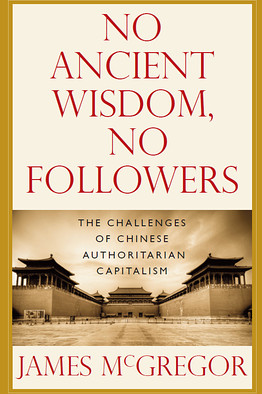
NO ANCIENT WISDOM, NO FOLLOWERS: The Challenges of Chinese Authoritarian Capitalism

NO ANCIENT WISDOM, NO FOLLOWERS: The Challenges of Chinese Authoritarian Capitalism [Paperback]

James McGregor (Author)

Publication Date: November 6, 2012

OB-UU147_mcgreg_DV_20121001022644

In the past three decades, China has risen from near collapse to a powerhouse — upending nearly every convention on the world stage, whether policy or business. China is now the globe’s second largest economy, second largest exporter, a manufacturing machine that has lifted 500 million of its citizens from poverty while producing more than one million US dollar millionaires. Then why do China’s leaders describe the nation’s economic model as “unstable and unsustainable”? Because it is.

James McGregor has spent 25 years in China as a businessman, journalist and author. In this, his latest highly readable book, he offers extensive new research that pulls back the curtain on China’s economic power. He describes the much-vaunted “China Model” as one of authoritarian capitalism, a unique system that, in its own way, is terminating itself. It is proving incompatible with global trade and business governance. It is threatening multinationals, which fear losing their business secrets and technology to China’s mammoth state-owned enterprises. It is fielding those SOEs – China’s “national champions” — into a global order angered by heavily subsidized state capitalism. And it is relying on an outdated investment and export model that’s running out of steam. What has worked in the past, won’t work in the future. The China Model must be radically overhauled if the country hopes to continue its march toward prosperity. The nation must consume more of what it makes. It must learn to innovate. It must unleash private enterprise. And the Communist Party bosses? They must cede their pervasive and smothering hold on economic power to foster the growth, and thus social stability, that they can’t survive without. Government must step back, the state-owned economy must be brought to heel, and opportunity must be freed.

During the Tang Dynasty, an official in the imperial court observed: “No ancient wisdom, no followers.” He was lamenting that regime was headed alone into dangerous and uncharted waters without any precedent for guidance. Again today – as McGregor makes clear – this is China’s greatest challenge.

The Limits of China’s Market Model; An interview with James McGregor, whose book “No Ancient Wisdom, No Followers” argues that the long-term prospects for China’s economy are being hurt by state dominance and protectionism.

MARCH 27, 2013, 10:00 AM

The Limits of China’s Market Model

By DAVID BARBOZA

In his book “No Ancient Wisdom, No Followers,” the author James McGregor delivers a sharp critique of China’s recent development path, and what he calls “authoritarian capitalism.” In Mr. McGregor’s China, the government plays too large a role in the economy, and big state-owned entities dominate because of government subsidies and preferential treatment. Private entrepreneurs and multinational corporations are at a distinct disadvantage, one that he argues is likely to damage China’s prospects in the long run. With China determined to create its own global brands, he says, the government is putting rules and regulations in place that seem increasingly protectionist.  Read more of this post

How China’s exploding market for apps is exactly like Hollywood

How China’s exploding market for apps is exactly like Hollywood

By Christopher Mims — 11 hours ago

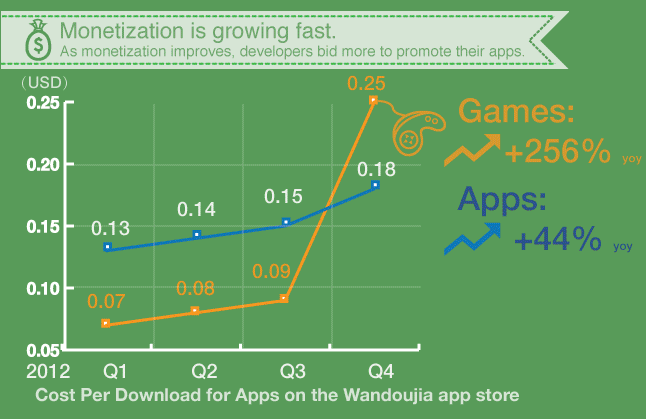
If you want to know how to make money on mobile apps in China, you should probably look at how Hollywood makes money on its films in that country. The parallels are uncanny: In movies, it’s action films that do best; in apps—or more specifically games—it’s the same. Simplicity, a conspicuous absence of plot, and lots of violence and/or explosions are, it seems, the DNA of popular entertainment. Check out this chart from Chinese app store Wandoujia. In apps, as in love, we are often surprised by what is chosen by others. As in the US, apps are dominated by social media and utilities, and companies from outside China represent just 1 in 10 of the most downloaded apps (i.e., Google Maps). But games are a completely different story, with 7 of 10 game apps coming from outside China, and primarily US development studios.

china_top_apps

in-china-devs-pay-app-stores-for-downloads Read more of this post

China: gold before swine; Should gold traders be paying attention to Chinese pork prices?

China: gold before swine

Mar 28, 2013 8:24am by Leslie Hook

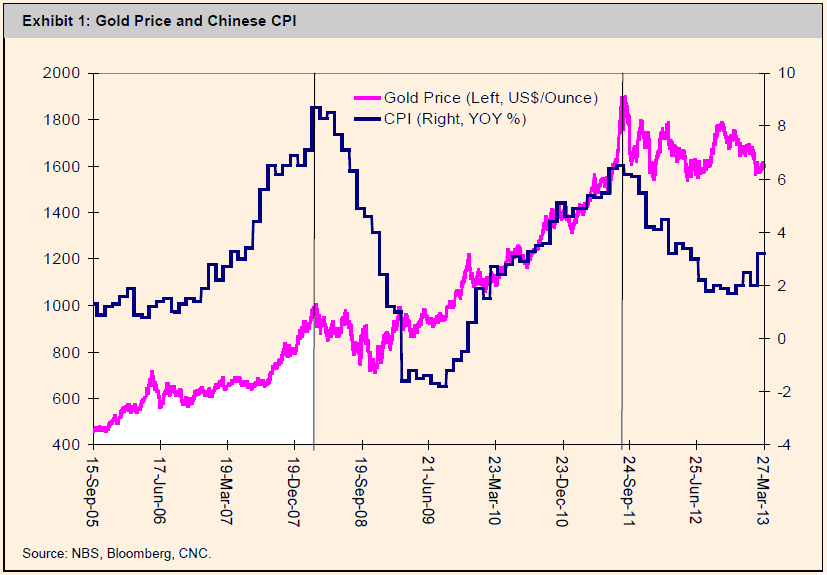
Should gold traders be paying attention to Chinese pork prices? It may sound outlandish, but new research has uncovered an interesting link between global gold prices and Chinese inflation (which in turn is often driven by pork prices). China accounts for a quarter of the world’s physical bullion demand so it’s no surprise to find it has a big role in setting global prices. But just how its influence works is not always clear, especially when weighed against other factors like crude prices, quantitative easing, or the strength of demand from India, the world’s biggest gold buyer. Now there is evidence to suggest a strong correlation between bullion prices and Chinese inflation, according to Na Liu, head of CNC Asset Management. He wrote in a recent note to clients: We have reviewed many Chinese macro indicators to detect their correlation with the gold price, and we are basically brought down to the very basics: the gold price is highly correlated to China’s inflation and real interest rate… This makes intuitive sense. Over the past few years, China’s jewellery demand shows only steady growth. The key driver for demand volatility comes from investment demand, and investment demand was driven by the need for purchasing power preservation and therefore varies as inflation expectation surges and ebbs. Last year, as China’s inflation cooled, gold demand did not increase in China at all. His chart illustrates how peaks in the gold price match peaks in Chinese inflation, while rising inflation is correlated with rising gold prices:

gold-price1

Source: CNC Asset Management

So what does this mean for gold bugs? Officials have warned that China faces inflationary pressures this year, with central bank governor Zhou Xiaochuan saying this month that China should be on “high alert” against inflation. Inflation for the first two months of this year came in at 3.2 per cent, its highest level in 10 months. The fear is that inflation could be pushed even higher by rising prices for pork, which is heavily weighted in the consumer price index because it is so widely consumed. As Rahul Jacob noted on beyondbrics, pork prices are expected to rise sharply this year, by as much as 16 per cent according to some estimates. If that happens, it could be good news for gold bugs.


Henan farmers on potentially toxic wheat: “They are all sold to you. We don’t eat them.”

Henan farmers on potentially toxic wheat: “They are all sold to you. We don’t eat them.”

Alia | March 28th, 2013 – 10:56 pm

Farmers in Xiaokuai village, Henan province, have recently been found to use unprocessed paper mill wastewater to irrigate their wheat farms. Admittedly, these wheat, if harvested, are more likely to be toxic than not. But questionable grain in China due to water and soil pollution isn’t exactly news. What surprises a lot of people in this case is the farmers’ reaction. Dongfeng Paper Mill was set up in 1982 in the village, currently with an annual production of 500 thousand tons of paper. To meet growth needs, the mill has been digging deeper and deeper wells over the past 30 years, slowly draining away local underground water. Unable to afford wells as deep, local farmers turned to a convenient source – the wastewater pipe located just a few yards from their farmlands. They cut it open and use unprocessed wastewater for irrigation directly. As a result, local farmlands are covered with a thick, grey, cardboard-feel layer, as if the wheat is growing out of concrete. When asked about whether they themselves dare to eat wheat harvested from such farmlands, one farmer thus responded…with a big smile on his face: “They are all sold to you. We don’t eat [wheat soaked in wastewater]. There are still wheat farms irrigated by [clean] water from the wells. We eat those.” This is not the first time when we observe similar “not me” effect when it comes to food safety problems in China. Every so often we hear about news exposing small food workshops or factories that use excess chemicals, toxic addictives or questionable ingredients to produce food products. For example, the countless underground gutter oil shops, and the businesses that send out the following card to purchase dead pigs. The people behind these businesses must very well know that their products may endanger people’s health or even life, but it’s “the other” people. The assumption is somehow that they themselves, or their family and friends, are not subject to the risk of toxic food. The irony is, China has way too many people in the food industry who think the same way that nobody is safe. Like a popular online saying goes: “China has become a country where pig farmers don’t eat pork, and cow farmers don’t drink milk.” And wheat farmers no longer eat wheat…Netizen 原味呼吸 asked: “When “you” think “you” have nothing to do with “us”, an era of people killing people comes. If you don’t care about others, who would care about you?” Most netizens viewed it as a lose-lose situation due to China’s at-all-cost development model. Like netizen 亚当孙今生  commented: “This is beyond a conflict of the poor and the rich. To farmers, urban residents are rich, who, at the same time, have no choice but to eat toxic rice.” Netizen 书剑2002 commented: “The cities have been exploiting the farmers. And the farmers are poisoning urban dwellers. At the end, no one survives.” When things deteriorate to this level, everyone is guilty. Like netizen 123zzq强 pointed out: “I blame the government for doing nothing. I blame the paper mill for dumping unprocessed wastewater. I blame the farmers for using wastewater for irrigation with knowledge. “ The paper mill has already been close for investigation. But the same story is probably happening somewhere else in China, right now.

“All sold to you.”

511

Why is American health care so absurdly expensive?

Why is American health care so absurdly expensive?

By Derek Thompson — March 28, 2013

Derek Thompson is a senior editor at The Atlantic, where he oversees business coverage for TheAtlantic.com.

The U.S. medical system is absurdly expensive. You knew that already. But you probably didn’t realize just how absurdly expensive it is compared to other countries. These 21 graphs (one of them you’ll see above) from the International Federation of Health Plans, via Ezra Klein, start to paint the picture. The average routine office visit in the U.S. is three-times more expensive than in Canada. The average CT scan is five-times more expensive than in Canada. And as a share of GDP, our health care costs are an ignominious colossus towering over the rest of the world:

2012-physican-fees Read more of this post

The end is nigh’ for global oil demand growth: Citi; global oil demand would plummet by 18%, to around 74 million barrels a day from the current 90 million

Citi: ‘The End Is Nigh’ For Oil

Rob Wile | Mar. 26, 2013, 11:21 AM | 5,312 | 10

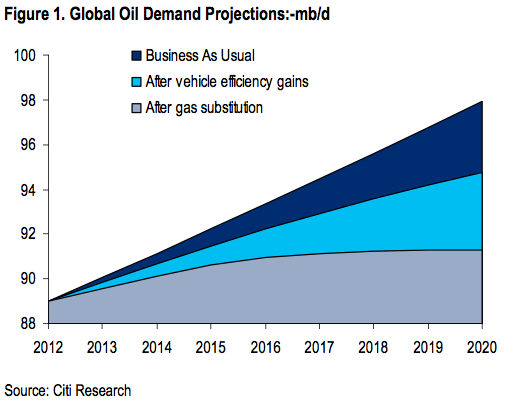
Citi‘s Seth Kleinman has a pretty sweeping note today, titled “The End Is Nigh,” in which he argues crude oil demand — and with it, prices — are is set to fall dramatically in the coming decade thanks to the rise of natural gas and more advanced fuel economies.  And the trend is worldwide. Kleinman on gas: One of the many unforeseen ripple effects of the US shale revolution is a push to substitute natural gas for oil. This is set to accelerate with LNG already challenging diesel’s 13 mb/d heavy duty truck use globally but especially in China, bunker’s 3.7 mb/d seaborne market, and CNG and propane set for exponential growth not only in markets such as Brazil, Egypt, Iran and India, but in Russia and the US as well. Oil-based power generation is increasingly being replaced by gas-fired generation. As much as 2 mb/d of power generation demand in the Middle East in total could be switched to natural gas by the end of the decade, and the increasing availability of LNG towards end-decade could back out other oil for power generation needs in India and Latin America amongst others. And on fuel economy: Higher prices, the removal of many fuel subsidies and rising fuel economy mandates have dramatically improved the outlook for fuel efficiency in global automotive and truck fleets. Citi’s automobiles team estimates that new car fuel efficiency is now improving by 3-4% p.a., with trucks managing 1-2%. As cars make up ≈60% of the total global road fleet we conservatively estimate that new vehicles (cars and trucks combined) fuel economy increases by 2.5% p.a. Here’s the key chart showing global demand forecasts.

demand projections

Kleinman concludes that the oil price spikes of the late ’00s were basically a fluke: The structural bull market of the previous decade was a result of surging global oil demand and consistently disappointing non-OPEC supply growth, compounded by a collapse in Iraqi and Venezuelan production. The outlook for each of these factors has now reversed, reinforcing Citi Research’s long term view that by the end of the decade Brent prices are likely to hover within a range of $80-90/bbl. The shale boom’s effects are still rippling across the globe.  Read more of this post

16 Secrets To Creating Breakthrough Ideas; Culturematic: How Reality TV, John Cheever, a Pie Lab, Julia Child, Fantasy Football . . . Will Help You Create and Execute Breakthrough Ideas

16 Secrets To Creating Breakthrough Ideas

Mariana Simoes | Mar. 28, 2013, 2:08 PM | 18,954 | 1

What do Arianna Huffington, Jay-Z and the founders of Twitter all have in common?

They changed the face of American culture forever.

They have enabled us to “see ourselves, or something in the world, differently,” explains author Grant McCracken. In his book  “Culturematic,” McCracken discusses how these and other innovators came up with revolutionary concepts that helped shape the way we see the world today.

McCracken describes “culturematic” as “a little machine for making culture. It’s an ingenuity engine.” The cultural innovators practicing this art form all get one key thing right: They challenged the traditional order in which our world is run. “They speak to us because they go against the grain of expectation,” McCracken shares.

We chose 16 of the most valuable secrets from their successes.

Twitter Founders: Don’t do it for others, do it for yourself

“In the early days, the founders of Twitter — Biz Stone, Jack Dorsey and Evan Williams — thought Twitter might appeal to ‘technical geeks’ in San Francisco, who would use it ‘to fool around with and to find out what each other’s up to.’ … At this early stage they were driven by personal passion. So it didn’t especially bother them that, as Stone recalls, ”for the first nine months or so everyone just thought we were fools [and that Twitter] was the most ridiculous thing they’d ever heard of…’ First we make the tech, then the tech makes up.”

Jay-Z: Always be versatile and willing to reinvent yourself

“Many hip-hop artists are unabashedly in it for the money. Some of the point of the exercise is, in the words of 50 Cent, ‘to get rich [or] die trying.’ In 1998 Jay-Z released Vol.2: Hard Knock Life, [which] went to the top of the charts. …The song in question, ‘Hard Knock Life’ attracted immediate attention for its use of a refrain from the Broadway musical ‘Annie.‘ This looked like a deliberate effort to make Jay-Z look less threatening and more accessible, less gangsta more pop. … His choice was, in the words of one critic, ‘completely unexpected.'” Read more of this post

New York City Subways Are Getting A New Touchscreen Network

New York City Subways Are Getting A New Touchscreen Network

Megan Rose Dickey | Mar. 28, 2013, 3:27 PM | 2,664 | 6

New York City is planning to install at least 77 new touchscreen kiosks in subway stations throughout its five boroughs. In 2011, the MTA installed similar high-tech touchscreens, dubbed “On the Go!” travel stations, at five subway stations throughout Manhattan, Brooklyn, and Queens. Now, the MTA has partnered with Control Group and CBS Outdoor to deploy up to 90 additional digital kiosks in New York subway stations. The new displays will feature subway planning tools, information about service updates and delays, as well as advertisements.  Each 47-inch touchscreen will be packed with sensors, video cameras, microphones, and Wi-Fi to facilitate communication between subway riders and the MTA. In the future, Control Group envisions sponsored experiences making their way to the touchscreens, like streaming media or even a networked game of Jeopardy, Control Group Partner Colin O’Donnell recently told Fast Company’s Mark Wilson. The goal is to change the face of the New York commuting experience as we know it. Eventually, the map will feature points of interest to further drive tourism in the city. Third-party developers will also be able to build additional features into the system.

With the new kiosks, you’ll be able to quickly figure out where you are and where you need to go. Now, scheduled service changes shouldn’t catch you off guard. If they do, the kiosks will help you plan accordingly. The kiosks will also keep you up to date with train delays and out-of-service escalators.

the-kiosks-will-also-keep-you-up-to-date-with-train-delays-and-out-of-service-escalatorsnow-scheduled-service-changes-shouldnt-catch-you-off-guard-if-they-do-the-kiosks-will-help-you-plan-accordingly

To plan your trip, tap any two places on the map to receive directions.

to-plan-your-trip-tap-any-two-places-on-the-map-to-receive-directions

And voila!

and-voila

Invest in Proprietary Data for Competitive Advantage; Without such data it is simply too easy for competitors to let you do the hard work of innovation, then copy your insights and erode your competitive advantage.

Invest in Proprietary Data for Competitive Advantage

by Thomas C. Redman  |   2:00 PM March 28, 2013

Nearly 30 years ago, Stephen Brand made one of the more prescient observations about the unfolding data revolution: “On the one hand, information wants to be expensive, because it’s so valuable. The right information in the right place just changes your life. On the other hand, information wants to be free, because the cost of getting it out is getting lower and lower all the time. So you have these two fighting against each other.”

This assessment is spot on. Data promises a lot of new value, from insights that lead to better-targeted advertising, to ideas for new products, to “this changes everything” discoveries — the “expensive” half of Brand’s observations. But realists fully appreciate the “free” half. Translating those insights into profitable new and improved services and sustained competitive advantage is another matter altogether.

So how can a company spend more time on the valuable, expensive side and less on the free side? The key lies in developing and exploiting “proprietary data” — data that you and you alone possess. Without such data it is simply too easy for competitors to let you do the hard work of innovation, then copy your insights and erode your competitive advantage. Read more of this post

Samsung Tests Whether Three Heads Are Better than One

Samsung Tests Whether Three Heads Are Better than One

by David Heenan  |  10:00 AM March 28, 2013

The announcement last week that the Samsung Electronics is elevating two executives, Boo-Keun Yoon and J. K. Shin, to the CEO role was met with interest in leadership circles. We have seen this kind of co-CEO arrangement grow over the years. All the more interesting: the South Korean giant’s current CEO and vice chairman Oh-Hyun Kwon isn’t even vacating the seat. All three men will now share the role.

“We can do as partners what we cannot do as singles,” the great orator Daniel Webster once proclaimed. That seems to be the belief in a growing number of boardrooms that have decided that power will not reside in a single person in the corner office. Shareholders evidently support the idea of “co-leadership.” Research at the University of Missouri suggests that the mere announcement of a co-CEO structure produces a positive reaction from the market. Read more of this post

China’s Crackdown On $2.1 Trillion Of Wealth Management Products

screen shot 2013-03-28 at 7.34.05 pm

Japan’s Investors Are GungHo for iPhone Game; Tokyo-based GungHo Online Entertainment has seen a 23-fold increase in its share price this past year, with its market capitalization swelling to $4.9 billion

March 28, 2013, 11:57 a.m. ET

Japan’s Investors Are GungHo for iPhone Game

By JOHN JANNARONE

image_thumb75MI-BV002_Gungho_NS_20130328173604

gungho-online_kazuki-morishita_450

Kazuki Morishita in playful mood with dragon friend

The Japanese may love videogames, but some look downright smitten.

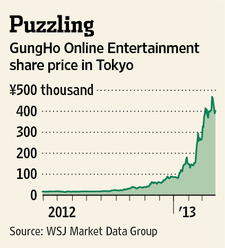
Tokyo-based GungHo Online Entertainment has seen a 23-fold increase in its share price this past year, with its market capitalization swelling to $4.9 billion.

The excitement centers on GungHo’s smartphone game “Puzzle & Dragons.” While free to download, a fraction of users spend freely on extra virtual items that enhance play. It became Japan’s top iPhone game within several days of its February 2012 launch and remains No. 1, with GungHo’s revenue rising each of the last few quarters. Read more of this post

Driving the Asian Century Beyond Clans, Cliques, Clones in Indonesia

Driving the Asian Century Beyond Clans, Cliques, Clones in Indonesia
Michael L. Bak | March 27, 2013

Dynamic Asia. Amazing Asia. Rising Asia. Wherever you turn, wherever you read, wherever you tweet, facebook or youtube, nothing could be as clear; Asia is where it’s at.  Action. Growth. Change. If Asia is the future, then welcome to the mothership: Indonesia.

China is dominating the world’s headlines and cover pages; are we now witnessing the fall of the West and the rise of the rest, or as The Economist most recently put it: “is America ready to be Number 2”? We’d be forgiven for instantly gazing China-ward. Even the OECD says China will become the number one economy in 2016; but there’s a whole lot of Asia out there that’s not the Middle Kingdom. It’s the Asian Century after all, and Indonesia is leading the charge.

Indonesia’s democratic credentials bolster its confidence in regional security and economic matters, from Myanmar’s transition to a more engaged and engaging Association of Southeast Asian Nations. Growing economically by leaps and bounds — many predict the land of the mystic Garuda will outpace China and India in 2013, barreling along at 6.3 percent this year. But the story of the Asian Century goes well beyond markets, per capitas, and growing middle classes.

Crucial to our story, Indonesia brings a seriously democratic (if not messy) government, fiercely independent (and wildly free) press, one of the world’s most diverse countries (in so many aspects), and a super-active civil society (masters of multi-platform activism). Malaysia may have staked a claim to “Truly Asia,” but Indonesia definitely gets the Oscar for animating the Asian Century.

With Indonesia’s colorful democracy leading, the Asian Century will tell the story of Southeast Asia breaking the bonds of socio-economic imperialism, ditching patronage and growing through enlightened governance.  Read more of this post

As the Pace of China’s Junk Bond Sales Grows, So Do Worries. Chinese junk bonds also have a unique structure, which could leave investors vulnerable. Chinese bonds are issued through offshore holding companies and tend not to be backed by the actual businesses and underlying assets in mainland China. That means foreign bondholders may have little legal recourse if a company defaults on its debt

MARCH 28, 2013, 2:53 PM

As the Pace of China’s Junk Bond Sales Grows, So Do Worries

By NEIL GOUGH

HONG KONG — It has an all-too-familiar ring. Investors in search of better interest rates rush to risky, high-yield bonds, raising worries that the market is overheated. But the concerns — which have already been voiced about the $120 billion of European and American junk bonds issued this year — are now being applied to the fledgling Chinese market. While American and European companies have been selling high-yield debt for decades, Chinese businesses only recently started to tap into the junk bond market in earnest. It’s a sign that Chinese companies are growing up. As the country’s economy continues to open up, private sector businesses have looked to foreign investment to finance their expansion efforts, rather than relying on hard-to-get loans from the state-controlled banks. The junk bond market in China took off this year. Although the deals still account for a small share of the global total, Chinese companies have sold $8 billion of high-yield bonds to overseas investors since January. That’s up from $2.3 billion during the same period a year earlier, according to figures from Dealogic. “Bond markets are booming because companies have had difficulty getting the level of debt they want out of banks onshore or offshore, and in tapping equity markets,” said Nick Gronow, a senior managing director atFTI Consulting in Hong Kong and an expert in Chinese bankruptcies. “So bonds have really taken up the slack.”

But the pace of growth is troubling to some analysts. As investors have plowed into junk bonds across the globe, yields have plummeted. In the United States, rates on junk bonds have dipped below 6 percent, compared with historical payouts of roughly 10 percent or more. The trend is similar in China. Country Garden, a builder based in the southern city of Guangzhou, raised $750 million in January by selling 10-year bonds that paid 7.5 percent a year. In 2011, the company sold $900 million of seven-year bonds at a much higher 11.125 percent. The borrowing costs for Kaisa Group Holdings, a commercial real estate company in the southern city of Shenzhen, have also dropped rapidly. In September, it sold $250 million of five-year bonds at 12.875 percent. By January, it was able to sell $500 million of bonds at 10.25 percent. This month, it issued new bonds at 8.875 percent. “Chinese real estate issuance is happening for structural reasons: 50 percent of the population needs to be urbanized and housed, traditional funding from banks may be more restricted now, and global appetite for yield is on the rise,” said Gregorio Saichin, the London-based head of emerging markets and high-yield, fixed-income portfolio management at Pioneer Investments. “When you combine all the above factors with a massive refinancing exercise by Chinese property developers, you get this type of outcome.” But it’s a slim difference in yields for such disparate markets. Chinese high-yield bonds have many of the same characteristics — and risks — as American debt. They tend to be sold by companies looking to finance ventures in new or untested areas or businesses that compete in industries where earnings are subject to volatile swings.

But the Chinese market has its own set of potential problems, and some analysts worry that investors aren’t being properly compensated for the added layer of risks. For one, the bulk of the high-yield bonds in Asia this year — roughly half — come from Chinese real estate companies. The fear is that the housing market, which has been booming, is a bubble that will eventually burst. The industry is especially uncertain, given the periodic government intervention. On March 1, Beijing announced new measures to curb excess in the market, including the strict enforcement of a 20 percent capital gains tax on the sale of preowned homes. “With the new leadership in China, people are still not sure which way things will go in terms of property policies,” said Suanjin Tan, an Asia fixed-income portfolio manager based in Singapore at BlackRock. “That also adds to the desire among these guys to remain cashed up, so they can take advantage of any wobbles in the market to pick up land on the cheap.”

Chinese junk bonds also have a unique structure, which could leave investors vulnerable. Mainland China’s domestic bond market remains largely off limits to foreign buyers. So most investors buy offshore Chinese bonds, which are issued through holding companies headquartered in places like the Cayman Islands. The bonds tend not to be backed by the actual businesses and underlying assets in mainland China. That means foreign bondholders may have little legal recourse if a company defaults on its debt, especially if local banks or other Chinese creditors make claims. Bondholders are now facing such difficulties with the bankruptcy of Suntech Power.

Read more of this post

Buchheit On Cyprus: “The Situation Is Spiralling Down”, And Why A Second Bailout May Be Needed

Buchheit On Cyprus: “The Situation Is Spiralling Down”, And Why A Second Bailout May Be Needed

Tyler Durden on 03/28/2013 17:05 -0400

When the world’s leading expert on Sovereign debt restructurings believes that the endgame for Cyprus might be another round of restructuring, adding that “I’m not sure this is over,” it is important to listen. With the calmness in Cyprus today more reflective of paralysis than confidence,  Lee Buchheit senses that the parameters of how much money will be needed to recapitalize the banks have changed. He tells Bloomberg TV’s Lee Pacchia in this brief clip, “the situation is spiraling down… they’ll need more money because the economy is worse, tax collections less, deposits will flow out when they can flow out.” As for which European nation will be next in need of assistance with its sovereign debt burdens? Buchheit agrees with us that while many are looking to Slovenia, he sees real economic and political problems in both Italy and Spain remaining especially since the EU “have certainly changed the rules of the game.”

Read more of this post

Food Fraud Hits New Low: Dog Meat In British Curry

Food Fraud Hits New Low: Dog Meat In British Curry

03/28/2013 15:34 -0400

Submitted by Michael Krieger of Liberty Blitzkrieg blog,

The food fraud story has now progressed from somewhat humorous with the undersized Subway footlong subs, to the highly disturbing with the revelations of horse meat and fake tuna, to the really creepy with the now potential emergence of dog meat in UK lamb curry.  No you can’t print lamb folks, which is exactly why many humans are now eating worse than their pets in the Western world.

A mystery meat, which has defied the best efforts of scientists to identify it, has been found in a lamb curry as part of an investigation into food fraud. The discovery raises new questions about just what is going into the nation’s takeaways and processed foods. The meat in a Beef in Black Bean Sauce dish turned out to contain high levels of chicken material including blood, while a burger contained no beef at all, other than blood and heart. However, most alarming of all was a curry. A spokesman for the programme said: ‘Just when we thought things couldn’t get any worse, the results came in for an Indian Lamb Curry. ‘It did contain meat, but that meat was not lamb, not pork, nor was it chicken or beef. Not horse, and not goat either. All of the many tests to date by the lab used by the programme have failed to identify exactly which animal was the source of the meat. The revelation raises many grim possibilities. There is evidence from Spain, for example, of meat from dog carcasses being processed for use in pet food. At the same time, a meat cutting plant in Wales has been accused of supplying horsemeat from an abattoir in Yorkshire to companies making kebabs and burgers for hundreds of independent take-aways. Read more of this post

Small companies struggling to repay loans in Italy and Spain signal bigger problems on the horizon for the euro zone after the dust has settled on Cyprus’s last-ditch bailout

Small businesses spell big problems for Italy and Spain

2:10am EDT

By Silvia Aloisi and Sarah White

MILAN/MADRID (Reuters) – Small companies struggling to repay loans in Italy and Spain signal bigger problems on the horizon for the euro zone after the dust has settled on Cyprus’s last-ditch bailout this week.

Defaults by small and medium-sized enterprises (SMEs), easily the biggest employers in Spain and Italy, are rising at a worrying clip, spelling trouble for the banks and two countries at the heart of Europe’s debt crisis.

“You can be sure that if these companies’ bad debts rise, you’re going to see more bad loans to families, and credit card bills that won’t be paid,” said Javier Santoma, finance professor at Spain’s IESE business school.

The ability of Italy and Spain, which account for 28 percent of the euro zone economy compared with Cyprus’s 0.2 percent, to pull themselves out of crisis and avoid full-blown bailouts depends on the health of their banks; weak banks conserve capital rather than lend to get the economy moving. Read more of this post

Student loan write-offs hit $3 billion in first two months of year as many graduates remain jobless, underemployed or cash-strapped in a slow U.S. economic recovery

Student loan write-offs hit $3 billion in first two months of year

By Elvina Nawaguna | Reuters – Mon, Mar 25, 2013

By Elvina Nawaguna

WASHINGTON (Reuters) – Banks wrote off $3 billion of student loan debt in the first two months of 2013, up more than 36 percent from the year-ago period, as many graduates remain jobless, underemployed or cash-strapped in a slow U.S. economic recovery, an Equifax study showed. Read more of this post

Missing Tycoon Mars Overseas Push of China’s Private Businesses; Liu’s rise to riches and sudden disappearance aren’t just the makings of a made-for-Hollywood potboiler. They’re a warning of the risks investors take when dealing with opaque private businesses in China, where fortunes depend on political ties and the favors of state entities, and even the wealthiest entrepreneurs can vanish if they lose the patronage of powerful government allies

Missing Tycoon Mars Overseas Push of China’s Private Businesses

Even by the standards of China’s rough and tumble breed of entrepreneurs, billionaire Liu Han’s brushes with death mark him out.

After dodging a hitman’s bullets in 1997, which led to the execution of a rival tycoon and two of his relatives almost a decade later, Liu, 47, finds himself ensnared in more killings. This time, his own brother is the suspect, and the Sichuan Hanlong Group founder is being held by police for helping him evade capture over a 2009 triple murder, state media reported.

The arrest throws into jeopardy Hanlong’s planned mining investments, casting doubt on the future of Sundance Resources Ltd. (SDL)’s $4.7 billion iron-ore project in West Africa and General Moly Inc. (GMO)’s Mt. Hope, Nevada, molybdenum mine. His detention still hasn’t been confirmed by authorities and there has been no official indication of who is now running Liu’s empire, which spans energy, real estate, chemicals and technology.

Liu’s rise to riches and sudden disappearance aren’t just the makings of a made-for-Hollywood potboiler. They’re a warning of the risks investors take when dealing with opaque private businesses in China, where fortunes depend on political ties and the favors of state entities, and even the wealthiest entrepreneurs can vanish if they lose the patronage of powerful government allies. Read more of this post

Emerging Stocks Head for Worst First Quarter Since 2008

Emerging Stocks Head for Worst First Quarter Since 2008

Emerging stocks fell, extending the biggest first-quarter slump since 2008, as China’s banking regulator tightened rules on wealth-management products and the cabinet called for new measures to deregulate interest rates. Read more of this post

Hunt Brothers Becomes Billionaire on Bakken Oil After Bankruptcy from Silver Manipulation 33 Years Ago

Hunt Becomes Billionaire on Bakken Oil After Bankruptcy

William Herbert Hunt was once one of the wealthiest men on Earth. With his brother, Nelson Bunker Hunt, the billionaire bought more than 195 million ounces of silver — 60 percent of the U.S. market — in the 1970s. By early 1980, their stake was valued at more than $9 billion.

The Hunts’ position imploded when silver prices plummeted 80 percent over the course of a few weeks in March 1980, culminating 33 years ago this week on what traders called Silver Thursday. The crash rattled Wall Street and sent the Texas brothers into bankruptcy.

Hunt is once again a billionaire, this time with oil. In October, he sold 43 percent of the North Dakota petroleum assets owned by his closely held Petro-Hunt LLC for $1.45 billion to Houston-based Halcon Resources Corp. (HK) The cash and stock deal made Hunt Halcon’s largest shareholder and boosted his net worth to $4.2 billion, according to the Bloomberg Billionaires Index. Read more of this post

Matthew 25 Fund Inspired by Scripture Returns 27%

Matthew 25 Fund Inspired by Scripture Returns 27%

When the Matthew 25 Fund fell 40 percent in 2008, it kept Mark Mulholland awake at night.

Mulholland, the founder and sole manager of the mutual fund — named after a Bible passage — says he would lie in bed thinking about the damage he had done to his investors, particularly the elderly whose nest eggs might not recover before they died. The assets he managed dwindled to $22 million from $115 million, Bloomberg Markets will report in its May issue.

What Mulholland didn’t worry about were the stocks in his portfolio.

“The companies we owned were so cheap that barring a total collapse of the economic system, I knew at some point we were going to make a lot of money,” he says.

That time has come. Mulholland, 53, bought smartphone maker Apple Inc. (AAPL) in 2008 for $80 to $128 a share. He also hung onto his investment in companies such as Sidney, Nebraska-based Cabela’s Inc., (CAB) a retailer of hunting and fishing products, and Medina, Minnesota-based Polaris Industries Inc. (PII), which makes all-terrain vehicles.

The rebound in those stocks helped propel the now-$452 million fund to gains that beat the Standard & Poor’s 500 Index by a wide margin. The fund returned 13.1 percent annualized during the five years ended on Feb. 15 compared with 4.7 percent for the S&P 500 (SPX). Matthew 25 (MXXVX) gained 26.8 percent over three years and 25.4 percent in one year. Read more of this post

Aberdeen, Manulife Seek More Independent Boards: Southeast Asia

Aberdeen, Manulife Seek More Independent Boards: Southeast Asia

Southeast Asia’s companies need to add more independent directors to their boards and boost diversity to attract foreign investors including Aberdeen Asset Management Plc (ADN) and Manulife Asset Management.

One of the biggest obstacles is strengthening the roles of independent directors because many publicly traded companies in the region are family-owned, Stephen Schuster, a financial sector specialist at the Asian Development Bank, said in an interview yesterday from Manila. Other challenges include disclosure and cross-border dispute resolution, he said. Read more of this post

Hong Kong Drops New Law Restricting Access to Directors’ Details

Hong Kong Drops New Law Restricting Access to Directors’ Details

Hong Kong’s government dropped legislation that would restrict public access to the personal details of company directors, following opposition from unions, small businesses and journalists.

The Financial Services and Treasury Bureau removed provisions obscuring company directors’ residential addresses and full identification numbers from an overhaul of the city’s companies ordinance, according to a legislative briefing document sent by e-mail from Shirley Wong, the department’s spokeswoman.

Opponents of the change said it would protect bosses from scrutiny and erode the city’s reputation by making it easier to launder money and cheat on taxes. Trade unions have used the database to track down runaway employers who owed wages, and small businesses use the information to conduct background checks on trading partners. Read more of this post

Zoomlion, China’s second-biggest construction equipment maker, Misses Estimates on Finance Costs, Demand Weakness; The stock has slumped 21 percent since Ming Pao reported on Jan. 8 that it had received an unsigned letter alleging that Zoomlion’s sales are exaggerated

Zoomlion Net Misses Estimates on Finance Costs, Demand Weakness

Zoomlion Heavy Industry Science and Technology Co., China’s second-biggest construction equipment maker, posted profit that missed analyst estimates as government measures to cool the property market damped demand while finance costs and provision for bad debts increased.

Net income in 2012 fell 9.1 percent to 7.33 billion yuan ($1.18 billion) from 8.07 billion yuan in the prior year, according to a filing to the Hong Kong stock exchange today. That compares with the 8.49 billion yuan average of 26 analysts’ estimates compiled by Bloomberg. Sales climbed 3.8 percent to 48 billion yuan.

Zoomlion, based in Changsha, Hunan province, and bigger rival Sany Heavy Industry Co. face a drop in orders as slowing economic growth and government curbs on the property market sap demand. Zoomlion is also seeking to boost investor confidence after its shares slumped following a January report in Hong Kong’s Ming Pao newspaper that the company’s sales may have been exaggerated.

“Economic growth in China remained slackened with low investment in infrastructure,” the company said in today’s statement, “The construction machinery industry was also under severe challenges brought by the sluggish growth of production and sales and the increase in credit risks.”

Shares (1157) of Zoomlion rose 0.9 percent to HK$9.37 at the close in Hong Kong trading, before the earnings were released. The stock has slumped 21 percent since Ming Pao reported on Jan. 8 that it had received an unsigned letter alleging that Zoomlion’s sales are exaggerated. Read more of this post

When Will Deposit Haircuts Take Place In Other European Countries?

When Will Deposit Haircuts Take Place In Other European Countries?

Tyler Durden on 03/28/2013 11:55 -0400

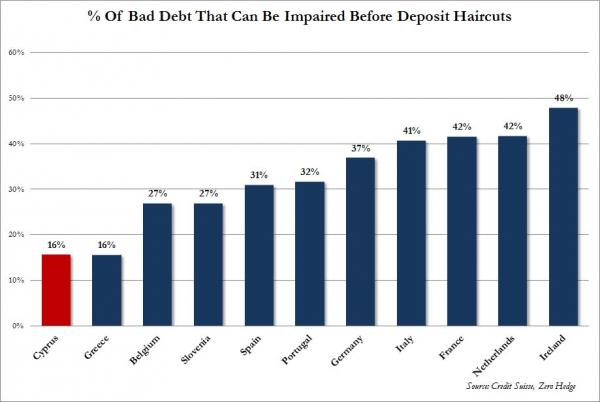
When all is said and done, what happened in Cyprus over the past two weeks, is nothing but the culmination of re-marking the “assets” in the country’s financial system (which as noted previously, were a preponderance of worthless Greek bonds and countless other non-performing loans), long priced at assorted “myth” levels, to a long overdue reality. As a result of delaying resolving the mismatch between non-performing assets and liabilities for years, the resolution was one which saw some €16 billion of the total asset base impaired, which in turn necessitated the impairment of billions of deposits: the primary liability funding the Cypriot financial system. Furthermore, as a result of the “Freudian Slip” by the Eurogroup’s new head earlier this week, we know that Cyprus will be the template for all future bank resolutions, which seek to avoid a democratic popular vote of depositor self-impairment (a vote which is now known will never actually pass) and proceed to restructuring the banking sector a la carte, by liquidating bad banks and impairing liabilities to the point where the balance sheet is once again viable (however briefly).

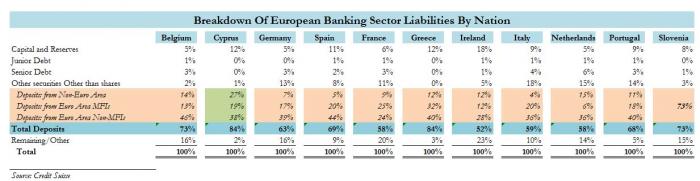
The bottom line is that at its core, it is all simply a bad-debt problem, and the more the bad debt, the greater the ultimate liability impairments become, including deposits. Which means that the real question in Europe is: how much impairment capacity is there in the various European nations before deposits have to be haircut? Thanks to Credit Suisse we now know the answer. The chart below shows the liability breakdown for various Eurozone nations, of which the key line item is the Total Deposits, and which in Europe comprises the bulk of bank funding. It becomes obvious why Cyprus had no choice but to crush depositors: they make up a whopping 84% of all liabilities (the highest in Europe and matched only by Greece), so assuming all other liabilities are liquidated, there still would be impairments if the total bad assets (assuming all bank assets are loans which in Europe, unlike the US, is more or less the case) pushed above 16% which in Cyprus they did. So applying some simple balance sheet equality math, one can quickly calculate how much of a “Bad-Debt Impairment” assorted European financial systems can withstand before they too have no choice but to follow in Cyprus’ footsteps and begin crushing depositors, who in bankruptcy court are known by a different, less friendly term: General Unsecured Claims.

Euro Financial Liabilities_2_0

Bad Debt Capacity_0 Read more of this post