Big Players Cash Out of Hong Kong Property

March 26, 2013, 3:00 p.m. ET

Big Players Cash Out of Hong Kong Property

By ISABELLA STEGER

HONG KONG—With the government growing confident that it has halted the meteoric rise in property prices, some of this city’s biggest real-estate investors are getting out.

Several of Hong Kong’s wealthiest families are planning initial public offerings of hotels, offices and other real-estate assets in coming months, while others are lowering prices on luxury apartments to entice buyers.

“Developers are selling assets at the very top of the market, when appetite is big, and interest rates are low,” said Christopher Wong, senior investment manager at Aberdeen Asset Management ADN.LN +4.03% in Singapore. Read more of this post

Europe’s financial crisis costing lives, suicides and infectious diseases on the rise

Published: Wednesday March 27, 2013 MYT 8:49:00 AM

Europe’s financial crisis costing lives, suicides and infectious diseases on the rise

LONDON: Europe’s financial crisis is costing lives, with suicides and infectious diseases on the rise, yet politicians are not addressing the problem, health experts said on Wednesday.

Deep budget cuts and growing unemployment are tipping more people into depression, and falling incomes mean fewer people can see their doctors or afford to buy medicines.

The result has been a reversal since 2007 of a long-term decline in suicide rates, coupled with worrying outbreaks of diseases including HIV – and even malaria – in Greece, according to an major analysis of European health in The Lancet journal.

Countering these threats requires strong social protection schemes, researchers argue. But the austerity measures imposed after a string of crises in southern Europe – most recently in Cyprus – has shredded such safety nets. Read more of this post

Abandoned gold loans are India’s “jingle mail”

Abandoned gold loans are India’s “jingle mail”

MARCH 25, 2013

By Andy Mukherjee

The author is a Reuters Breakingviews columnist. The opinions expressed are his own.

The myth that Indians’ love for gold is driven by tradition rather than financial self-interest has been dashed. Falling prices have prompted borrowers who took out loans secured against the yellow metal to break a cultural taboo and abandon their collateral. It’s the Indian equivalent of American homeowners who walked away from their underwater mortgages by mailing the keys to their homes to the bank.

India’s version of the “jingle mail” came to light when Manappuram Finance, a lender against gold, recently warned that defaulting borrowers would force it to report a quarterly loss. The lender’s Mumbai-listed shares tanked 31 percent over just three days. The precipitous fall was partly due to concerns the company had selectively leaked its guidance — a charge Manappuram denies. But clearly the lender, which was forecasting a profit as recently as February, had underestimated the borrowers’ response. Read more of this post

India Plans New Rules for Companies Pawning Shares to Borrow after uneven disclosures resulted in some small companies plunging 80 percent last month.

India Plans New Rules for Companies Pawning Shares to Borrow

By Pradipta Mukherjee and Santanu Chakraborty – Mar 26, 2013

India’s capital market regulator will frame stricter rules for companies and owners pledging shares as collateral to borrow funds after uneven disclosures resulted in some small companies plunging 80 percent last month. The Securities & Exchange Board of India is also planning to overhaul regulations for insider trading, as well as share repurchases, Chairman U.K. Sinha said in Kolkata today. The regulator set up a panel on March 5 to review insider trading rules. Indian companies had pledged as much as 1.5 trillion rupees ($28 billion) of shares to lenders as of Dec. 31, Morgan Stanley said in a report on Feb. 21.

“People have come out with creative solutions with some instruments through which they are pledging shares and they are not informing the stock exchange,” Chairman U.K. Sinha said today in Kolkata, without elaborating. “Very soon we will take measures to ensure that all kinds of encumbrances are reported well in time so the market knows about it.”

Sinha is reviewing regulations to raise corporate governance standards in the $1.2 trillion market. A dozen companies on the S&P BSE500 index plunged last month amid speculation the shares pledged by company’s founders in return for loans have been sold. Core Education & Technologies Ltd. (CETL) crashed 80 percent, Gravita India Ltd. (GRAV) 38 percent and ABG Shipyard Ltd. (ABGS) 17 percent in the period. Founders who have pledged a large chunk of their shares risk losing control of their companies should a drop in equity prices erode the value of the collateral, according to CNI Research Ltd. (CNIR) Borrowing costs in the $1.8 trillion economy are among the highest in Asia. Read more of this post

Integrating foreigners isn’t a lost cause

Integrating foreigners isn’t a lost cause

On a recent trip to present a research paper in Tokyo, I was surprised to not hear a single mobile phone ringing or a commuter talking loudly on the subway. Despite the train coach being notoriously crowded, the quiet was deafening.

Zhang Jianlin is a Senior Lecturer in Economics at SIM Global Education.

5 HOURS 1 MIN AGO

On a recent trip to present a research paper in Tokyo, I was surprised to not hear a single mobile phone ringing or a commuter talking loudly on the subway. Despite the train coach being notoriously crowded, the quiet was deafening.

Just as I was starting to wonder why the Japanese were behaving so considerately towards others, I heard announcements, first in Japanese then in English, over the sound system that all mobile phones must be switched to silent mode inside the coach.

What can we learn from the Japanese subway management to help our foreign friends better integrate in Singapore? Our Government has in recent times been sounding the refrain that foreigners whom Singapore welcomes to its shores must do their part in learning and adapting to our culture. Will this be a call in vain?

From a behavioural economist’s view, I believe not. It is in one’s self-interest not to deviate from the social norms of the society we live in. Read more of this post

Shadow Loans Hard to Squelch in China City Hit by Suicide

Shadow Loans Hard to Squelch in China City Hit by Suicide

Zhou Xiang is playing with his mobile phone in a room just big enough for a desk and chairs at the year-old Wenzhou Private Lending Registration Center. Not a single prospective customer has shown up for hours.

As a government-sanctioned loan broker seeking to match cash-strapped business owners with private investors, Zhou is one of the few people who can even be found inside the two-story building in a high-end residential district of Wenzhou, a city of 9 million people in China’s southeastern Zhejiang province. Rows of airport-like seats are empty.

“Only those who are really out of options would come here for loans,” says Zhou, a manager at Sudaibang, one of five independent brokers operating out of the center. “Most of the time, you would find these firms so weak financially that they can be literally crushed by a straw. The volume of lending is so low that we ourselves won’t be here long without expanding into some other businesses.”

One year after China’s leaders picked Wenzhou to start a pilot program designed to curb and regulate the city’s informal shadow-lending networks, it’s clear, based on a recent trip to the country’s epicenter of private lending, that the plan isn’t working. Small firms it intended to benefit still can’t access loans because they lack collateral and are struggling to stay afloat. At least one broker, Beijing-based CreditEase, has given up, citing a gap between the center and targeted borrowers. Read more of this post

Foxconn Plant in Peanut Field Shows Labor Eroding China’s Edge; “China’s advantage in low-cost manufacturing will end much sooner than expected, I believe within five years,”

Foxconn Plant in Peanut Field Shows Labor Eroding China’s Edge

Standing on a street corner near Foxconn Technology Group’s (2038) plant in central China that makes iPhone 5 handsets, employee Wang Ke says he’ll quit if his wage doesn’t double.

“I don’t have high expectations, I know I’m a migrant worker,” said Wang, 22, who earned 1,600 yuan ($258) in December, after deductions for lodging. “But I want to make 3,500 yuan a month, net. That’s a fair price.”

Wang’s attitude springs from a labor-market squeeze across the country after China’s pool of young workers shrank by almost 33 million in five years at the same time as industry added 30 million jobs. The resulting wage pressure means Foxconn, Apple Inc.’s (AAPL) biggest supplier, pays the same basic salary at the Zhengzhou plant it built in 2010 among the corn and peanut fields of Henan province, as it does in Shenzhen, the southern city that spawned the nation’s industrial boom.

“China’s advantage in low-cost manufacturing will end much sooner than expected, I believe within five years,” said Shen Jianguang, Hong Kong-based chief economist at Mizuho Securities Asia Ltd. “Wages are rising faster inland than on the coast. More companies will consider moving to countries such as Vietnam, Indonesia and the Philippines.” Read more of this post

Malaysian PM Najib Uses Public Humiliation With Graft Gallery: Southeast Asia

Najib Uses Public Humiliation With Graft Gallery: Southeast Asia

Malaysia’s government is using public humiliation in its war on graft as Prime Minister Najib Razak seeks to show voters that he’s getting tough on corruption ahead of an election that may be held within weeks.

An online gallery shows the names and photographs of more than 1,000 convicted offenders, including former Selangor state Chief Minister Mohamad Khir Toyo, who was sentenced to a year in jail in 2011.

Najib is trying to bolster his graft-fighting credentials to counter criticism from the opposition that companies from power producers to toll-road operators have unfairly benefited from their ties to a government that has ruled Malaysia since independence from Britain in 1957.

“The opposition will use corruption and financial irregularities in government spending to try and help win the election,” Ibrahim Suffian, a political analyst at Merdeka Center for Opinion Research, said by phone on March 15. “They will present a picture of pervasive corruption in government, including trying to link Najib himself.” Read more of this post

Academic castes that dog us for life

Academic castes that dog us for life

Our school years hold many memories. Some of us remember playing football every day after school; others cringe at the memory of their younger, awkward selves. It was a mixed package for me.

FROM OLIVER MICHAEL –

26 MARCH

Our school years hold many memories. Some of us remember playing football every day after school; others cringe at the memory of their younger, awkward selves. It was a mixed package for me.

School was a stage for the drama of academic caste life. Hailing from a school with over a century of tradition and history, there were Express pupils who mocked Normal (Academic) pupils who, in turn, would sometimes look down on Normal (Technical) pupils.

Even within the Express stream today, there is a constant race to be the best. Secondary schools have a system where being first is more important than doing well.

Some would argue that such is school life. Unfortunately, these formative years have a lasting influence. Some pupils never outgrow their shell, and carry the burden of being called “stupid” into adulthood, lacking self-esteem. Read more of this post

Reforming MediShield to be truly national; “Cancer treatment can be very, very expensive. This is something our health system will have to deal with. It is not surprising if some patients have to sell their house.”

Reforming MediShield to be truly national

Every now and then, Singaporeans come across a media report of a medical bill in the hundreds of thousands of dollars, and everyone seems to know someone struggling financially after a prolonged illness.

Jeremy Lim has held senior executive positions in both the public and private healthcare sectors. He is writing a book on the Singapore health system.

4 HOURS 51 MIN AGO

Every now and then, Singaporeans come across a media report of a medical bill in the hundreds of thousands of dollars, and everyone seems to know someone struggling financially after a prolonged illness.

In fact, the late Dr Balaji Sadasivan, previously a junior minister in the Health Ministry, while undergoing treatment for cancer commented: “Cancer treatment can be very, very expensive. This is something our health system will have to deal with. It is not surprising if some patients have to sell their house (sic).”

In dealing with the financials of catastrophic illness, Singaporeans are likely most concerned about two issues: The uncertainty of illness severity with an attendant massive hospital bill, and their share of the bill. Read more of this post

How Stiglitz weakens change in S’pore; From an outsider’s standpoint, the “model” Singapore pitch is perhaps meant as praise. People who care about Singapore should reject this cheap thrill.

How Stiglitz weakens change in S’pore

Mr Joseph Stiglitz’s commentary, “Singapore’s lessons for an unequal America” (March 20), does disservice to both Singaporeans and Americans.

FROM TEO YOU YENN –

4 HOURS 34 MIN AGO

Mr Joseph Stiglitz’s commentary, “Singapore’s lessons for an unequal America” (March 20), does disservice to both Singaporeans and Americans. Graduate student Kirsten Han points out in news publication Quartz that Singapore’s Gini coefficient is the second-highest among developed countries; that exploitable migrant labour has allowed employers to suppress wages; that workers’ rights to collective action are curtailed. Mr Stiglitz mistakes these realities and overlooks the cost of inequality on social well-being here. More importantly, because he is a Nobel economist, a position of legitimacy, his claim that Singapore is a model for dealing with inequality diminishes Singaporeans’ calls on the state to reform the welfare regime, address inequalities and ensure social inclusion. In praising, for example, the Central Provident Fund (CPF) system for compelling individuals to save, he affirms the Singapore state’s claim that individuals should ultimately be responsible for themselves. As various civil society members have pointed out in recent years, this individualised view of solutions leaves many needs unresolved and generates inequalities across groups. The healthcare system, heavily dependent on individuals’ “responsibility” in ensuring lifelong employment and hence on their CPF savings, disadvantages those who are unable to have continuous, full employment. As the CPF is tied to an individual’s income, wage differentials translate into unequal access. The Association of Women for Action and Research has been particularly concerned that women doing unpaid domestic and care labour have greater difficulty accessing this basic need. Like Mr Stiglitz, various civil society groups, scholars and citizens are interested in drawing comparative lessons from cases. We have come to different conclusions about “the Singaporean model”. We have pointed out differences from the Nordic countries, in principles and outcomes. For example, the Singapore model is premised on women being responsible for fertility decisions and child support; men have limited rights to be carers. In education, while Singaporean children do test well, this has come about at significant cost for certain classes of parents; that enrichment and tuition centres are thriving signals the large private investments going into education. In considering reform, Americans would be better served by looking at social policies in Scandinavia that generate greater equality across class or gender, as various scholars do in books such as Gender Equality: Transforming Family Divisions of Labor.

From an outsider’s standpoint, the “model” Singapore pitch is perhaps meant as praise. Given that Singaporeans often read about chewing gum and caning as if these define our nation, reading a positive piece can evoke some feel-good sentiments. Yet, the failings of the piece are harmful. People who care about Singapore should reject this cheap thrill. Americans who care about reform in their case should not be thrown off by the use of a case that is closer to theirs than to genuinely desirable alternatives. Given ongoing debates regarding the future we want, and given that tensions in world views exist between state and society and within society, the rush to declare Singapore as a coherent, stable model for others undermines the very project to reform.

ABOUT THE WRITER:

Teo You Yenn is a board member at the Association of Women for Action and Research, assistant professor in sociology at the Nanyang Technological University and author of the book, Neoliberal morality in Singapore: How Family Policies Make State and Society.

The Long March – Transitioning from a Start-up to a Growth Stage Company with Big Ambition; The Growth Stage Recipe – Ingredients Required to Build a Big Winner

The Long March – Transitioning from a Start-up to a Growth Stage Company with Big Ambition

Glenn Solomon (@glennsolomon) is a Partner with GGV Capital. Some of his recent investments include Pandora, Successfactors, Isilon, Square, Zendesk, Quinstreet and Nimble Storage. This post is part of a series for growth stage entrepreneurs who are thinking big; the full series can be found at www.goinglongblog.com.

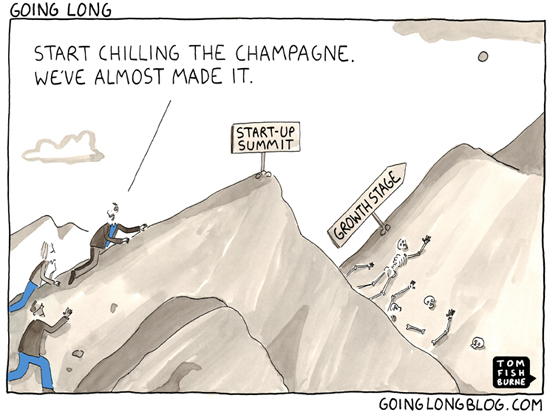
Congratulations Ms. Entrepreneur. After years of toiling and challenging insurmountable odds, you’ve finally moved through the gates of start-up hell. You’ve established product/ market fit, you’re 10x better that your competition and you’ve begun to scale customers and revenues. You’ve also assembled a talented and passionate team who is bought into your culture. Take a breath. Take a bow. Now, come to the frightening realization… if you want to build a big company, you’ve got much more work ahead. The moves you make at the growth stage are increasingly important. Different challenges emerge and the bets become bigger, the stakes higher.

GGV.550.fourthpostGGV.550.firstpost

GGV.550.secondpost Read more of this post

A College Dropout Sophia Amoruso Turned Her eBay Page Into The Fastest-Growing Retailer with US$100M Sales

A College Dropout Turned Her eBay Page Into The Fastest-Growing Retailer

Ashley Lutz | Mar. 25, 2013, 10:28 AM | 4,167 | 3

sa

Sophia Amoruso started selling vintage clothing on her eBay page in 2006.

Seven years later, the 28-year-old runs Nasty Gal, an e-commerce site with $100 million in annual sales.

“‘People say: ‘Nasty Gal? What’s that?'” Amoruso said in an interview with Nicole Perlroth The New York Times. “I tell them, ‘It’s the fastest-growing retailer in the country.'”

Amoruso had considered going to photography school, but didn’t want to go into debt. So instead, she dropped out of community college and started buying vintage clothing at stores like the Salvation Army, selling them at a big profit.

Eventually, she moved Nasty Gal over to its own domain.

Her site caught on quickly because of her constant social media presence, according Perlroth. Amoruso used MySpace, and later Facebook, to engage with customers and market new merchandise.  Read more of this post

CalPERS is weighing taking its massive $255 billion assets under management and moving it to an all-passive portfolio

A Gigantic Pension Fund Is Reportedly Considering A Change That Should Make Investment Managers Freak Out

Julia La Roche | Mar. 25, 2013, 2:13 PM | 7,432 | 13

Investment News reports that California CalPERS, the second biggest U.S. public pension fund, is weighing taking its massive $255 billion assets under management and moving it to an all-passive portfolio. Why would this matter? Well, it would matter a lot for active managers who receive management fees from CalPERS, Josh Brown, who runs the popular financial blog the Reformed Broker, points out on Twitter. The California Public Employees’ Retirement System already has more than half of its investible assets in passive strategies. CalPERS is expected to make the decision in about five months, the report said.

Passive investing: If it’s good enough for CalPERS …

Giant pension plan’s possible full-on switch to index funds speaks volumes

Mar 24, 2013 @ 12:01 am (Updated 2:24 pm) EST

Passive investing has reached a watershed moment. The second-largest pension fund in the United States is considering a move to an all-passive portfolio while at the same time, the largest brokerage firms are falling over themselves to push passively managed exchange-traded funds.

Read more of this post

Focus: Use Different Ways of Seeing the World for Success and Influence

Focus: Use Different Ways of Seeing the World for Success and Influence [Hardcover]

Heidi Grant Halvorson Ph.D. (Author), E. Tory Higgins Ph.D. (Author)

Release date: April 18, 2013

419SARVcDJL._SY320_

We all want to experience pleasure and avoid pain. But there are really two kinds of pleasure and pain that motivate everything we do. If you are promotion-focused, you want to advance and avoid missed opportunities. If you are prevention-focused, you want to minimize losses and keep things working. And as Tory Higgins has found in his groundbreaking research, if you understand how people focus, you have the power to motivate yourself and everyone around you.

Showing how promotion/prevention focus applies across a wide range of situations from selling products to managing employees to raising children to getting a second date, Halvorson and Higgins show us how to identify focus, how to change focus, and how to use focus exactly the right way to get results. Short, punchy, and prescriptive, Focus will help you see not just what’s going on around you— but what’s underneath. Read more of this post

Decisive: How to Make Better Choices in Life and Work

March 25, 2013 3:44 pm

Decide and make your move

By Philip Delves Broughton

Good management is about nothing if not good decision making. Unfortunately, decisiveness has been seen as a character trait like courage: there are those who can pull the trigger – the great executives – and those who can’t – the armies of wafflers who are terrified of being forced to accept the consequences of their actions.

A new wave of social scientists, however, is upending this view by digging into the psychological and social factors that influence our decisions. By developing better processes, they hope to make decision making less like voodoo and more like carpentry.

Chip Heath, a professor at Stanford’s business school, and his brother Dan Heath, a fellow at Duke University’s Center for the Advancement of Social Entrepreneurship, have already written two excellent books of pop social science: Made to Stick and Switch . Their latest, Decisions: How to Make Better Choices in Life and Work digs into the latest findings on decision making.

“Being decisive is itself a choice,” they write. “Decisiveness is a way of behaving, not an inherited trait. It allows us to make brave and confident choices, not because we know we’ll be right but because it’s better to try and fail than to delay and regret.” Read more of this post

When going gets tough, spicy foods become popular; the pain-relieving effects of capsaicin, the substance that makes peppers hot.

2013-03-25 17:40

When going gets tough, spicy foods become popular

By Rachel Lee

A popular belief, backed by a sense of economics, would have it that in an economic slump, women wear shorter skirts and opt for lipsticks of vivid colors. Here is one more myth to be added: when the going gets tough, people prefer spicier food. Take this new maxim with a hint of skepticism because the “fact” is provided by related industries but don’t dismiss it outright, considering the pain-relieving effects of capsaicin, the substance that makes peppers hot. According to Sun At Food, a leading food and dining company, sales of its Sichuan House restaurant’s popular Spicy Chili Beef Hotpot have gone up three–fold from November of last year to the end of January. Another dish, Sichuan Chili Chicken, saw a six-fold increase in sales.

Read more of this post

What Would Steve Do? 10 Lessons from the World’s Most Captivating Presenters

Why America Is Called America

March 25, 2013

Why America Is Called America

By JOHN NOBLE WILFORD

26SCIB-popup-v2

A plate of the 1507 world map made by the clerics Martin Waldseemüller and Mathias Ringmann

A DECADE AGO, the Library of Congress paid $10 million to acquire the only known original copy of a 1507 world map that has been called “the birth certificate of America.” The large map, a masterpiece of woodblock printing, has been a star attraction at the library ever since and the object of revived scholarly fascination about the earliest cartography of the New World. The research has also rescued from obscurity a little-known Renaissance man, the 16th-century globe maker Johannes Schöner, who was responsible for saving the map for posterity.

We call ourselves Americans today because of the map’s makers, Martin Waldseemüller and Mathias Ringmann, young clerics in the cathedral village of St.-Dié, France. By incorporating early New World discoveries, their map reached beyond the canonical descriptions of Old World geography handed down from Ptolemy in the second century. On a lower stretch of the southern continent, the mapmakers inscribed the name “America” in the mistaken belief that Amerigo Vespucci, not Columbus, deserved credit for first sighting a part of that continent, South America. Read more of this post

Pursuing a passion into a career change may bring the success you dream of. But disaster is also a possibility; “Suffering comes from being attached to the outcomes. If you stop worrying about the outcomes, you will achieve a better outcome.”

March 25, 2013

Following Your Bliss, Right Off the Cliff

By KAI RYSSDAL and MEGAN LARSON

JOBS-articleLarge

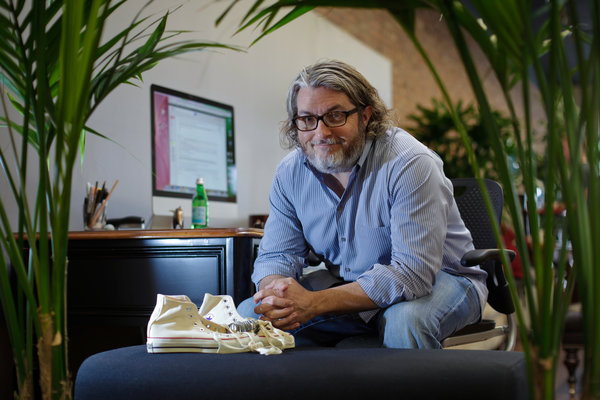
Michael Dearing with the last pair of shoes from his former shoe business, which he called a “splat-against-the-wall failure.” 

SO you want to be a writer. Or an artist. Or to open a cupcake shop. What you’ll hear, often, is that you should pursue your dream. Follow your passion. Quit your job and live the life you want.

That advice should come with a bright yellow warning sticker: your dream may end in disaster. Read more of this post

Ravi Jaipuria: India’s Pepsi Bottler-Billionaire

Ravi Jaipuria: India’s Bottler-Billionaire

by Naazneen Karmali | Mar 26, 2013

images (3)

PepsiCo bottler Ravi Jaipuria’s insatiable thirst for growth earned him a fortune

I like to be near water,” says Ravi Jaipuria, seated in his office on the top floor of a building that bears his initials and is situated in Gurgaon, a bustling township adjacent to Delhi. The ocean is nowhere close so the chairman of the privately held RJ Corp—revenues in excess of $1 billion—has to make do with an artificial waterfall in the terrace adjoining his office.

Water of the flavoured kind has made Jaipuria, 58, a fortune: PepsiCo’s largest franchise bottler in India. He claims to be among the multinational giant’s top three globally—is among India’s new crop of billionaires, with a fortune estimated at $1.4 billion.

Jaipuria gets a chunk of that wealth from bottling unit Varun Beverages, which accounts for over half of RJ Corp’s revenues. Named after his son, who works with him, Varun Beverages has 10 bottling plants in India plus an international footprint that includes Sri Lanka, Nepal, Morocco, Mozambique and Zambia. It claims to have close to a third of Pepsi’s business in India. A PepsiCo India spokesman says that half of its beverage volume is from seven franchise bottlers, of which Varun Beverages is the biggest. Read more of this post

Following your gift: Dietary coffee producer shakes off slum upbringing to rake it in. NatureGift claims a 50% market share in dietary coffee in Thailand

Following your gift

Dietary coffee producer shakes off slum upbringing to rake it in.

Published: 26 Mar 2013 at 00.00

485350

Life was a slog for Kritsada Jangchaimonta, growing up in a slum for 23 years. But the 3-by-4 metre room he lived in together with seven others in Bangkok failed to discourage him from dreaming of becoming a millionaire one day.

Mr Kritsada claims white bean supplements are the key to losing weight because they offer an energy boost.

With an engineering degree from Chulalongkorn University, he started work at the Metropolitan Electricity Authority before joining a private company. Then in 1976, Mr Kritsada set up a company selling electrical appliances, before experimenting with other products ranging from shrimp feed to hydroponic vegetables.

In 2002, his company NatureGift launched food supplement capsules. But it wasn’t an immediate success so he thought of trying other products such as coffee, soap and toothpaste.

“At that time, I had debts of 20 million baht. While it took 30,000 baht to produce toothpaste, coffee required around 50,000 baht,” recalled the 66-year-old. Read more of this post

Pakistan’s Army of Overseas Workers Keeps Economy From Collapse; Almost 10 million Pakistanis work overseas and the sum they’ve sent home has doubled in the four years through June, to a record $13 billion.

Pakistan’s Army of Overseas Workers Keeps Economy From Collapse

Living in poverty in a mud shack in Pakistan, Mazhar Ali dropped out of school, sold the family’s two buffalo and bought a visa to work in Dubai. The money he sends home is paying for a new house.

“We’re going to build three rooms with bricks and cement, plus a courtyard and a washroom,” said his younger brother Azhar in Larkana, home town of the ruling People’s Party about 300 kilometers north of Karachi. “We will then start marrying one by one, starting with Mazhar sometime this year.”

The family’s change in fortunes reflects a rising trend of rich nations with aging workers tapping poorer ones for labor — total remittances to developing economies will rise 7.9 percent this year, and reach $534 billion by 2015, the World Bank says. For Pakistan, the income offers a source of stability, with the country poised for its first civilian handover of government in May even amid power shortages, bombings and a Taliban insurgency.

“This is our savior for keeping Pakistan out of the oxygen tent,” Farooq Sattar, former Minister for Overseas Pakistanis said in an interview in Karachi last month before his party quit the government alliance. “It has kept us from a complete economic collapse.”

Almost 10 million Pakistanis work overseas and the sum they’ve sent home has doubled in the four years through June, to a record $13 billion. Read more of this post

Your Survival Instinct Is Killing You: Retrain Your Brain to Conquer Fear, Make Better Decisions and Thrive in the 21st Century

Updated March 25, 2013, 7:23 p.m. ET

Healthy Reader

By LAURA LANDRO

Your Survival Instinct Is Killing You: Retrain Your Brain to Conquer Fear, Make Better Decisions and Thrive in the 21st Century

Marc Schoen
Hudson Street Press, $25.95

From primitive times, the survival instinct has enabled mankind to handle major threats to existence. In the modern world, we have become such creatures of comfort that even the slightest annoyance—such as facing a long line at airport security—sends our self-preservation programming into overdrive, resulting in dangerous levels of stress.

‘Discomfort may very well be the most powerful change agent we have in our arsenal for becoming all that we can be.’

Think Differently

Dr. Schoen’s tips for quelling uncomfortable ‘inner survivalist’ feelings

Expand your comfort zone: Drive to a less-familiar location without GPS or a map.

Embrace discomfort: Delay or refrain from use of medications to fall asleep or cope with pain (if medically safe to do so).

Commit to the present: Fully engage with people without responding to texts or emails.

Delay gratification: Sit with hunger before reaching for food; forgo that drink after work sometimes. Read more of this post

Computing Looks to the Eyes; Eyeballs are poised to emerge in coming years as a legitimate tool for controlling everything from handsets to games

Updated March 25, 2013, 11:38 p.m. ET

Computing Looks to the Eyes

Technology That Tracks Eye Movement Could Cut Down on Mouse Use

By SVEN GRUNDBERG

MK-CB895A_EYETR_G_20130325183604

Touch screens have removed some of the need for clunky hardware extras long associated with personal computing. But the biggest technical challenge to wean computers off the age-old keyboard and mouse may rest on the two sockets in our heads.

Eyes are poised to emerge in coming years as a legitimate pointing tool for computers and mobile devices to accompany other methods of interacting with personal gadgets.

State-of-the-art eye tracking is mostly found in the health-care industry, as aids for disabled people with impaired mobility. Now the race is on to incorporate the technology into mass-market consumer electronics for games and everyday applications. Read more of this post

Science Fiction Comes Alive as Researchers Grow Organs in Lab

March 22, 2013, 10:36 p.m. ET

Science Fiction Comes Alive as Researchers Grow Organs in Lab

By GAUTAM NAIK

OB-WU659_BODYPA_DV_20130322173513P1-BK796_BODYPA_OR_20130322192503P1-BK794_bodypa_DV_20130322191355

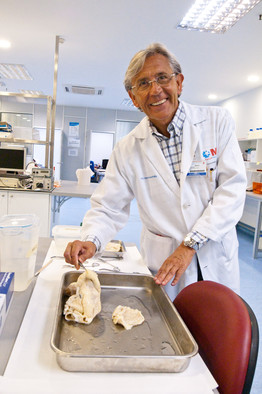
Francisco Fernandez-Aviles with a human heart that is devoid of its cells.

Building a complex human organ in the lab is no longer a dream of science fiction. At London’s Royal Free Hospital, a team of 30 scientists is manufacturing a variety of body parts, including windpipes, noses and ears. WSJ’s Gautam Naik reports. Photo: Gareth Phillips

MADRID—Reaching into a stainless steel tray, Francisco Fernandez-Aviles lifted up a gray, rubbery mass the size of a fat fist.

It was a human cadaver heart that had been bathed in industrial detergents until its original cells had been washed away and all that was left was what scientists call the scaffold.

Next, said Dr. Aviles, “We need to make the heart come alive.”

P1-BK792_BODYPA_G_20130322221602 Read more of this post

Progress Fighting Parkinson’s Drug Side Effects; “I’m basically going to be incapacitated by the drug that’s helping me, and that’s terrifying,”

March 25, 2013, 6:38 p.m. ET

Progress Fighting Parkinson’s Drug Side Effects

By SHIRLEY S. WANG

As they continue to wait for a cure, patients with Parkinson’s disease may soon see more consistent relief from side effects of the drugs that treat it.

One of the most pressing problems facing patients today is that the most effective treatment available wears off over time and may induce often severe involuntary movements. A number of new treatments are being developed to address the wearing-off effect or attenuate the movement side effects, called dyskinesia, that come with the drug, levodopa.

PJ-BN319A_LAB_G_20130325175416 Read more of this post

Mortimer Zuckerman: The Great Recession Has Been Followed by the Grand Illusion; Don’t be fooled by the latest jobs numbers. The unemployment situation in the U.S. is still dire

March 25, 2013, 7:07 p.m. ET

Mortimer Zuckerman: The Great Recession Has Been Followed by the Grand Illusion

Don’t be fooled by the latest jobs numbers. The unemployment situation in the U.S. is still dire.

By MORTIMER ZUCKERMAN

The Great Recession is an apt name for America’s current stagnation, but the present phase might also be called the Grand Illusion—because the happy talk and statistics that go with it, especially regarding jobs, give a rosier picture than the facts justify.

The country isn’t really advancing. By comparison with earlier recessions, it is going backward. Despite the most stimulative fiscal policy in American history and a trillion-dollar expansion to the money supply, the economy over the last three years has been declining. After 2.4% annual growth rates in gross domestic product in 2010 and 2011, the economy slowed to 1.5% growth in 2012. Cumulative growth for the past 12 quarters was just 6.3%, the slowest of all 11 recessions since World War II. Read more of this post

For One Chinese Student, a Tough Job Hunt; Grateful son and “Iron Chicken” Gao Yueqing is set to graduate this June with a degree in accounting, the most practical major he and his father could agree upon. But the younger Mr. Gao, like many Chinese college students, is finding it hard to nail a job

March 25, 2013, 10:33 p.m. ET

For One Chinese Student, a Tough Job Hunt

By BOB DAVIS

SHIJIAONAO, China—Four years ago, Gao Shangming was convinced that his son Yueqing needed to remain in the family’s one-room apartment and help harvest corn rather than go to college. “Our financial situation wasn’t good,” the 50-year-old peasant farmer says.

But Gao Yueqing was determined to escape the dusty north China mountain village of 200 households where nearly all young people either become farmers or migrate to nearby cities to work in restaurants. His father’s relatives talked up young Gao’s case, as did a respected high-school teacher who told the elder Gao how hardworking his son was.

The clincher: “He told me, ‘If I let him get a college degree, he’d make more money,'” the elder Gao recalls.

So the father put in extra hours in nearby coal mines to pay his son’s 10,000 yuan ($1,600) annual tuition and expenses at Shanxi University’s business school in Taiyuan, in the heart of China’s coal country. His grateful son was so frugal that his roommates nicknamed him “Iron Chicken,” because it was as hard to separate him from a yuan as it would be to pluck a feather from an iron fowl.

Gao Yueqing is set to graduate this June with a degree in accounting, the most practical major he and his father could agree upon. But the younger Mr. Gao, like many Chinese college students, is finding it hard to nail a job, especially one that pays decently. Read more of this post

Chinese College Graduates Play It Safe and Lose Out; Chinese college graduates say they want to work for the government or big state-owned firms, which are seen as recession-proof, rather than the private companies that have powered China’s economic climb

March 25, 2013, 10:32 p.m. ET

Chinese College Graduates Play It Safe and Lose Out

By BOB DAVIS

BEIJING—Xie Chaobo figures he has the credentials to land a job at one of China’s big state-owned firms. He is a graduate student at Tsinghua University, one of China’s best. His field of study is environmental engineering, one of China’s priorities. And he is experimenting with new techniques for identifying water pollutants, which should make him a valuable catch. But he has applied to 30 companies so far and scored just four interviews, none of which has led to a job. Although Mr. Xie’s parents are entrepreneurs who have built companies that make glasses, shoes and now water pumps, he has no interest in working at a private startup. Chinese students “have been told since we were children to focus on stability instead of risk,” the 24-year-old engineering student says.

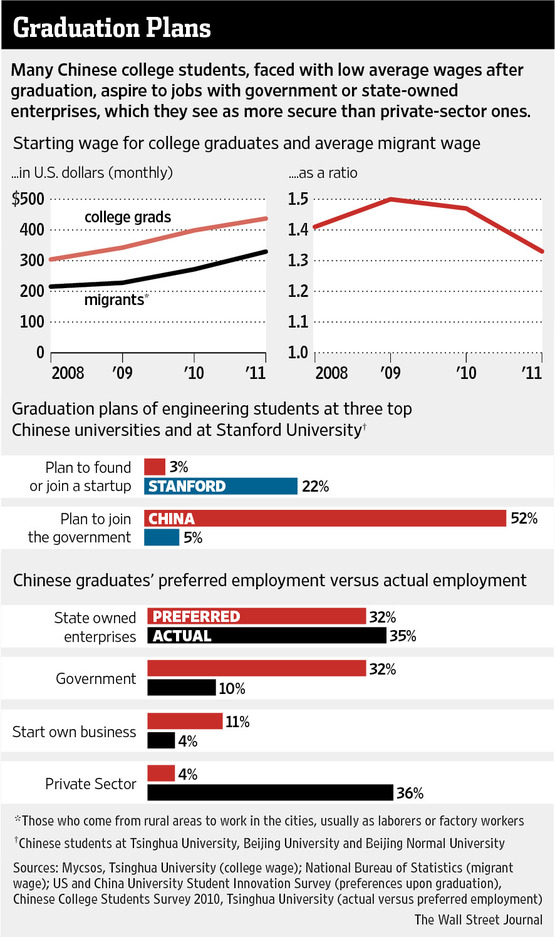
Over the past decade, the number of new graduates from Chinese universities has increased sixfold to more than six million a year, creating an epic glut that is depressing wages, leaving many recent college graduates without jobs and making students fearful about their future. Two-thirds of Chinese graduates say they want to work either in the government or big state-owned firms, which are seen as recession-proof, rather than at the private companies that have powered China’s remarkable economic climb, surveys indicate. Few college students today, according to the surveys, are ready to leave the safe shores of government work and “jump into the sea,” as the Chinese expression goes, to join startups or go into business for themselves, although many of their parents did just that in the 1990s.

Chinese economists worry that waning entrepreneurial zeal could hobble China’s ability to remake its economy and reach the ranks of wealthy nations. “The current education system does not produce people who are innovative,” says Li Hongbin, a Tsinghua University economist who specializes in education and conducted some of the surveys. “That makes it harder for the country to reach its long-term goal of building an innovative society.”

P1-BK828_CCOLLE_NS_20130325175703

P1-BK829_CCOLLE_G_20130325183608 Read more of this post