Norway Becomes Petro-State as Investors Balk at Hidden AAA Risks

Norway Becomes Petro-State as Investors Balk at Hidden AAA Risks

Norway, home to the world’s biggest sovereign wealth fund, is betting it can afford to ignore investor outrage.

After shocking global credit markets in 2011 by pulling support from the once AAA and now junk-rated lender Eksportfinans ASA, the government unveiled plans in January to cut tariffs on gas transport by 90 percent, sapping income for those funding the venture by as much as $7 billion.

Investors are now asking themselves how much risk they’re willing to accept to gain access to western Europe’s biggest oil and gas reserves. And while Norway boasts a stable AAA rating and the world’s smallest default risk, the government’s decision to ride roughshod over investors is starting to resemble actions seen in less stable democracies such as Venezuela and Russia.

The planned tariff cut “undermines Norway’s reputation as a stable and predictable country for investments,” Solveig Gas Norway AS and Silex Gas Norway AS, two of the companies backing the pipeline network that charges the tariffs, Gassled, said in a March 15 letter. It “represents an unauthorized intervention in the infrastructure owners’ legally protected rights and expectations,” they said. Read more of this post

Hong Kong’s Real-Estate Brokers Feel the Chill; Hong Kong is home to more than 6,000 real estate offices, whose numbers eclipse even that of the city’s 7-Elevens and McDonald’s

March 25, 2013, 6:24 AM

Hong Kong’s Real-Estate Brokers Feel the Chill

The armies of young real-estate agents that flood Hong Kong’s shopping malls on weekends could see their ranks thinning out in the coming months, the chief analyst at Hong Kong’s largest listed real-estate broker says.

Thanks to the government’s latest round of cooling measures, transactions across the city have dropped dramatically, Midland Realty’s Buggle Lau said Thursday. Since late February, when the government doubled the stamp duty on most property purchases, transactions on the secondary market at the city’s 10 most popular housing estates have plummeted to as few as four or five on recent weekends, Mr. Lau said. By contrast, a year ago, there were closer to 100 transactions per weekend, he said.

As property prices have ballooned by 120% in recent years, Hong Kong’s real-estate offices have become even more common a sight than the city’s 7-Elevens and McDonalds, as thousands of salesmen have jumped in on the bonanza. There are more than 6,000 such offices in Hong Kong, with 300 of them opening their doors in just the past year. Read more of this post

Singapore’s ex-HDB CEO: During my time, HDB flats were 3X median annual salary

ex-HDB CEO: During my time, HDB flats were 3X median annual salary

March 24th, 2013 |  Author: Editorial

ex-HDB CEO, Dr Liu Thai Ker

At a lecture on the Singapore Public Housing Story, organised by the Centre for Liveable Cities on 20 Mar, Dr Liu Thai Ker, who was the ex-CEO of HDB and URA, made the call for Public Housing to return to the basics. Dr Liu said the end goal should be affordability. Dr Liu’s call was also backed by former Senior Minister of State and HDB Chairman Aline Wong, who reiterated that the purpose of public housing is to “provide a shelter over everybody’s heads”. Dr Aline Wong said, “The asset part comes along because … property appreciates over a long time. But that is not our primary objective. People make money, accumulate savings … but we cannot promise that they will not lose (value in their property), depending on the property cycle.” Dr Liu said, “Maybe we should go back to the basics in the sense that we should not, say, emulate condominiums — that require more expensive materials, extra this, extra that … go back to basics, keep housing prices affordable, let residents embellish the houses, embellish the interiors.” He reiterated that the “core mission” of the HDB is to “provide affordable housing”. “And in the process of providing that, we try to use whatever budget available to create the biggest possible floor area for the people and with minimum frills, minimum decorations and so on. By minimum decorations, it doesn’t mean that the buildings are not beautiful … if the buildings are well-proportioned, they are beautiful.”

Dr Liu added, “When I was CEO, we looked at the per capita GDP (gross domestic product) growth, the sector of people eligible for public housing, their income … and then matching that to our selling price and to our flat sizes. It was really a very detailed study.” Dr Liu noted that in those days, flats typically cost about three years of an owner’s annual salary. Read more of this post

Prices of Chinese medicine in Yunnan province have increased over 10-fold after four years of persistent drought

High heat and speculation set Chinese medicine prices ablaze

Staff Reporter  2013-03-24

Prices of Chinese medicine in Yunnan province have increased over 10-fold after four years of persistent drought, which has severely limited the scale of Chinese herb and tea production. Increasing demand for the disappearing herbs has only added upward pressure.

Low rainfall, high temperatures and strong wind in the spring have affected the production output of multiple tea-producing cities, especially Pu’er and Dali. Prices of green tea, pu’er tea and dianhong black tea have surged by 10%, 20% and 30% respectively since last spring, according to Chinese-language Henan Economic News.

The droughts have also driven up the prices of Chinese medicines such as dong quai, pseudo ginseng and other plants that belong to the genus panax. Dong quai fetched a market price of 34 yuan (US$5.4) a kg in Aug. 2012 but now goes for 90 yuan (US$14). The pseudo ginseng also doubled from 300-400 yuan (US$48-64) a kg in 2012 to 700-800 yuan (US$112-128) this year. Other panax plants have increased by 40% to around 400 yuan (US$64) a kg.

Chinese medicine businesses said speculators in recent years have caused herb prices to fluctuate and are using some medicines as their investments tools. Some Chinese medicines practitioners said the value of a prescription has gone up from a dozen yuan a few years ago to up to 400-500 yuan (US$64-80) now. Read more of this post

Former PetroChina chairman detained for corruption: Boxun

Former PetroChina chairman detained for corruption: Boxun

Staff Reporter 2013-03-24

Jiang Jiemin, the former chairman of PetroChina, China’s biggest oil producer, has been detained by central discipline authorities for corruption, reports Boxun, a citizen journalism website that often makes claims that are difficult to prove.

According to Boxun, a “reliable source” inside the Commission for Discipline Inspection claims that Jiang, who was also the former general manager of PetroChina’s state-owned parent China National Petroleum Corporation and a former vice governor of Qinghai province, was placed under “double regulation” shortly after stepping down as PetroChina chairman last week.

Under the Communist Party’s investigation ordinance, double regulation is one of several strategies disciplinary authorities may employ when conducting an investigation into a government official, and requires that the subject appear at a specified time and location to answer allegations of misconduct.

The source added that the chairman of state-owned oil and gas giant Sinopec, Fu Chengyu, and the company’s general manager, Wang Tianpu, are also being targeted by authorities for corruption. Read more of this post

“Poison rice incidents” have led to surge in closures of 70% of rice mills in China’s Hunan province; “毒大米”事件引发湖南米厂停工潮

“毒大米”事件引发湖南米厂停工潮

担忧后期卖粮难,部分农民考虑弃种

2013-03-25   作者:记者 周勉 白田田/长沙 北京报道  来源:经济参考报

xin_27031025042107902961

全国最大的水稻主产区湖南省正遭受“毒大米”事件影响。《经济参考报》记者近日调查了解到,受不久前关于湖南上万吨大米重金属镉含量超标的事件影响,湖南省米厂出现“停工潮”,在湖南最大的米市“兰溪米市”,当地企业反映已有70%的米厂停工。 Read more of this post

“Egg-house” resident finds his new home outside Beijing

“Egg-house” resident finds his new home outside Beijing

2013-03-23 06:10:01 GMT2013-03-23 14:10:01(Beijing Time)  Global Times

U158P5029T2D574556F24DT20130323141001U158P5029T2D574556F26DT20130323141001

After years of living in humbler dwellings, Dai Haifei, 27, finally owns his own house, joining tens of millions of Chinese who are paying off mortgages. But Dai is not your average new homeowner. Back in 2010, he drew headlines nationwide for living in an egg-shaped house of his own design, a move which many took to be a silent protest against skyrocketing housing prices, but Dai says that’s all nonsense.

For many, Dai’s ovular abode, and its relative the “capsule apartment,” represented the struggle that the average person on the lower strata of society must face, and the memory that his famed homestead has imprinted on millions of Chinese has long outlived the two months he actually lived there. Read more of this post

The end of Indian IT staffing as we know it; India’s IT outsourcers are promoting “mini CEOs” capable of running businesses on their own, while trimming down on the hordes of entry-level computer coders they normally hire as they try to squeeze more profits out of their staff.

Analysis: The end of Indian IT staffing as we know it

By Harichandan Arakali and Tony Munroe 5:22pm EDT

BANGALORE/MUMBAI (Reuters) – India’s IT outsourcers are promoting “mini CEOs” capable of running businesses on their own, while trimming down on the hordes of entry-level computer coders they normally hire as they try to squeeze more profits out of their staff.

The shift by Infosys Ltd and others is symptomatic of a maturing industry that wants more revenue from its own intellectual property instead of providing only labor-intensive, lower-margin information technology and back-office services.

For young graduates who see the $108 billion IT industry as a sure pathway to modern India’s growing middle class, the transformation is unsettling. Read more of this post

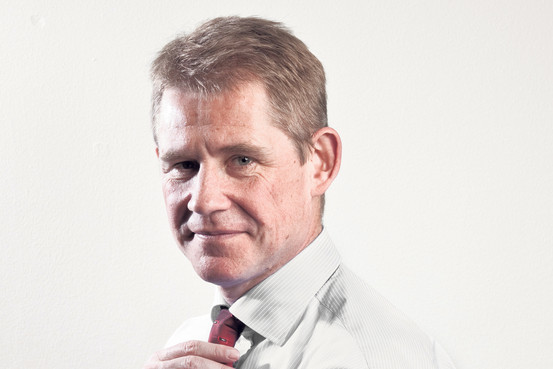
Warren East is leaving UK tech success story ARM and Simon Segars is taking over. “Failing on the way towards success is seen there as a credible path to success. Failing once isn’t something that dooms you forever.”

Sunday Interview: ARM’s Warren East and Simon Segars

Warren East is leaving UK tech success story ARM and Simon Segars is taking over. They speak to Andrew Cave about how the firm will stay ahead in chip design

ARM2_2518426b

Warren East (L) is stepping down as chief executive at ARM after 12 years at the helm. His replacement is to be Simon Segars (R), who is moving up from president and had been at ARM for even longer than East.

By Andrew Cave

9:30PM GMT 23 Mar 2013

Last Tuesday, staff and shareholders of ARM Holdings received a surprise. Warren East the chief executive, announced that he was stepping down after 12 years running the British technology darling whose computer chip designs are in almost all of the world’s mobile phones.

His replacement is to be Simon Segars, who is moving up from president and had been at ARM for even longer than East.

Segars was employee number 16 when he arrived just four months after the company was spun out from Acorn Computers in November 1990.

“The day I joined, my boss was soldering together a computer for me to use,” he laughs. “The company had only just been formed.” Read more of this post

The Index Liquidity Riddle: More Is Less

Updated March 22, 2013, 1:27 p.m. ET

The Index Liquidity Riddle: More Is Less

By JUSTIN LAHART

BF-AE637_INDEXH_G_20130322172406

You would think that the whole point of a stock index is to be, well, an index of the stock market’s performance.

But thanks to the popularity of exchange-traded funds, or ETFs, stock indexes have in recent years been doing double duty as investment vehicles. At the same time, there have been subtle but important changes in the way indexes are constructed.

Bottom line: The indexes aren’t measuring exactly what they used to.

It is a lot easier to manage an ETF if the stocks that underlie it are easily traded. If, instead, the stocks are illiquid, there is a risk their prices will get artificially inflated when money flows into the ETF. The opposite can happen when money flows out. Read more of this post

While many business people see the economy as badly performing and badly managed, our econocrats see it as having performed quite well and better than could have been expected. Why such radically different perspectives on the same economy?

State of economy all comes down to perspective, really

March 23, 2013

Ross Gittins

While many business people see the economy as badly performing and badly managed, our econocrats see it as having performed quite well and better than could have been expected. Why such radically different perspectives on the same economy?

Partly because business people – particularly those from small businesses – view the economy from their own circumstances out: If I’m doing it tough the economy must be stuffed. By contrast, macro economists are trained to ignore anecdotes and view the economy from a helicopter, so to speak, using economy-wide statistical indicators.

A bigger difference, however, is that business people are comparing what we’ve got with what we had, whereas the economic managers are comparing what we’ve got with what we might have got, which was a lot worse.

Business people know everything was going swimmingly in the years leading up to the global financial crisis of 2008-09, but in the years since many industries – manufacturing, tourism, overseas education, retailing, wholesaling – have been travelling through very rough waters.

The econocrats, however, have a quite different perspective: whereas the rest of us love a good boom, those responsible for managing the economy view them with trepidation. Why? Because they know they almost always end in tears and recriminations. Read more of this post

Malaysia’s Mahathir steps out of the shadows

Malaysia’s Mahathir steps out of the shadows
Posted: 24 March 2013 1109 hrs

KUALA LUMPUR: Four years after leading a charge to oust Malaysia’s previous prime minister, ex-leader Mahathir Mohamad is making his sizeable influence felt again as a close election looms.

Mahathir, who towered over Malaysia for 22 years with his grand development projects and hard-nosed politics, is 87 but has peeled back the years to step from the shadows and whip up support for the long-ruling regime he moulded.

Through his blog and visits to key constituencies, Mahathir has sounded off in typically blunt style, warning that a loss by the 56-year-old government would bring chaos.

In shades of four years ago, he told AFP that Prime Minister Najib Razak could face a ruling-party leadership putsch like his predecessor if he does not improve on a 2008 polls setback that shocked the Barisan Nasional ruling coalition. Read more of this post

My favorite quotes from Oprah’s “Super Soul Sunday” with Brene Brown, author of “Daring Greatly: How the Courage to be Vulnerable Transforms the Way We Live, Love, Lead”

http://www.oprah.com/own-super-soul-sunday/Full-Episode-Oprah-and-Brene-Brown-on-Daring-Greatly-Video

Brene Brown: “… perfectionism is not about striving for excellence, or healthy striving, which I’m for. It’s a cognitive behavioral process, a way of thinking and feeling that says this: ‘If I look perfect, do it perfect, work perfect, and live perfect, I can avoid or minimize shame, blame, and judgment.”

Oprah Winfrey: “Perfectionism is the ultimate fear… that the people who are walking around as perfectionists, who have to have everything so perfect, that they are ultimately afraid that the world is going to see them for who they really are and they won’t measure up. It’s fear. It’s very different from trying to be excellent and working hard and doing your best.”

Brene: “I call perfectionism the 20-ton shield. We carry it around thinking it’s gonna protect us from being hurt. But it protects us from being seen.”

Oprah: “I love cultivating a resilient spirit: letting go of numbing and powerlessness. A lot of people are numb to life… the key element that you discovered from people who are successful or not, who live a whole-hearted life or not, is that they feel a sense of worthiness.”

Brene: “That is the absolute bottom line… they engage the world from a place of worthiness.”

Oprah: “… the cultivation of joy and gratitude is the way home. There is no joy without gratitude.”

Brene: “If you ask me what is the most terrifying, difficult emotion that we experience as humans, I would say ‘Joy’… When we lost our tolerance for vulnerability, joy becomes forboding. I’m not gonna feel you. I’m not gonna soften into this moment of joy. Because I’m scared. I’m scared it’s gonna be taken away. The other shoe’s gonna drop. And so what we do in moments of joyfulness is, we try beat vulnerability to the punch. I interviewed a man who told me, ‘My whole life, I never got too excited, too joyful about anything. I just kind of stayed right in the middle. That way, if things didn’t work out, I wasn’t devastated. And if they did work out, it was a pleasant surprise.’ He said in his 60s, he was in a car accident. His wife of 40 years was killed. And he said, ‘The second I realized that she was gone, the first thing I thought was I should have leaned harder into these moments of joy. Because that did not protect me from what I feel right now.’ In a culture of scarcity, we’re all chasing the extraordinary. When I interviewed people who went through horrific things.. the loss of children, genocide, violence, trauma.. And I talked to them about what’s the hardest loss. They never talked about the extraordinary things. They said, ‘I miss the ordinary moments. I miss hearing the screen door slam and knowing my husband’s home from work. I miss hearing my kids fighting in the backyard. I miss the way my wife set me table.’ And those are the moments that are in front of all of us every day that we could stop and say, ‘God, I’m grateful for this.””


How Not To Worry: A 1934 Guide to Mastering Life; Many of life’s hard situations cannot be explained. They can only be endured, mastered, ad gradually forgotten

How Not To Worry: A 1934 Guide to Mastering Life

“We must gain victory, not by assaulting the walls, but by accepting them.”

As far as vintage finds go, they hardly get more fortuitous than You Can Master Life (public library) – a marvelous 1934 compendium of sort-of-philosophical, sort-of-self-helpy, at times charmingly dated, other times refreshingly timeless advice on cultivating “the power to think, to create, to influence and be influenced by others, and to love,” in the spirit of the 1949 gem How To Avoid Work. Though written by a Christian pastor named James Gordon Gilkey and thus a little too God-heavy for these corners of the internet, the slim volume shares a good amount in common with Alain de Botton’s modern-day advocacy of the secular sermon.

Read more of this post

Big Data Is Opening Doors, but Maybe Too Many

March 23, 2013

Big Data Is Opening Doors, but Maybe Too Many

By STEVE LOHR

IN the 1960s, mainframe computers posed a significant technological challenge to common notions of privacy. That’s when the federal government started putting tax returns into those giant machines, and consumer credit bureaus began building databases containing the personal financial information of millions of Americans. Many people feared that the new computerized databanks would be put in the service of an intrusive corporate or government Big Brother.

“It really freaked people out,” says Daniel J. Weitzner, a former senior Internet policy official in the Obama administration. “The people who cared about privacy were every bit as worried as we are now.”

Along with fueling privacy concerns, of course, the mainframes helped prompt the growth and innovation that we have come to associate with the computer age. Today, many experts predict that the next wave will be driven by technologies that fly under the banner of Big Data — data including Web pages, browsing habits, sensor signals, smartphone location trails and genomic information, combined with clever software to make sense of it all. Read more of this post

World’s Best CEOs: Morris Chang, Founder/Chairman of TSMC (Market Cap $85 Billion) Rides the Train

Rich Taiwanese Businessman Morris Chang Rides the Train

by Stuart Dingle on Thursday, October 11, 2012

From Yahoo Taiwan:

Taiwan_Morris_Chang_Rides_Train_021

Morris Chang riding the train to work? Its true. Photo spreading on internet like wildfire

TSMC chairman Morris Chang also rides the train to work? Today a photo rapidly spread around the internet, showing TSMC Chairman Morris Chang surprisingly riding the train with the general public, the big boss gave up his luxury car to ride on the general public transit system, leading to widespread discussion among netizens, who rapidly spread the news. Because a ‘big boss riding the train’ is truly too difficult to imagine, when this photo was exposed on Facebook, it was first suspected to have been photoshopped, or simply showed someone who ‘looks a lot like Morris Chang’ riding the train. However, some attentive netizens compared the photos with others, and discovered that this March, ‘Commonwealth magazine’s‘ 492nd edition featured Morris Chang on the cover page,and both the tie worn by Morris Chang on the cover,and the tie worn by Morris Chang in the photo, had an identical style and colour, meaning that the man in the photo is unmistakeably Morris Chang.

It’s understood that when Morris Chang attended this year’s TSMC shareholder meeting, he was worried about being delayed by traffic, so the punctual Morris Chang took the train before getting on the High Speed Rail to Taipei, not only reducing carbon emissions but also ensuring he won’t be delayed. The female student pictured in the photo sitting next to Morris Chang was immersed in her study on the train, with some netizens jokingly saying that if this student would just raise her head and talk to Morris Chang for ten minutes, it would be worth 10 years of study.

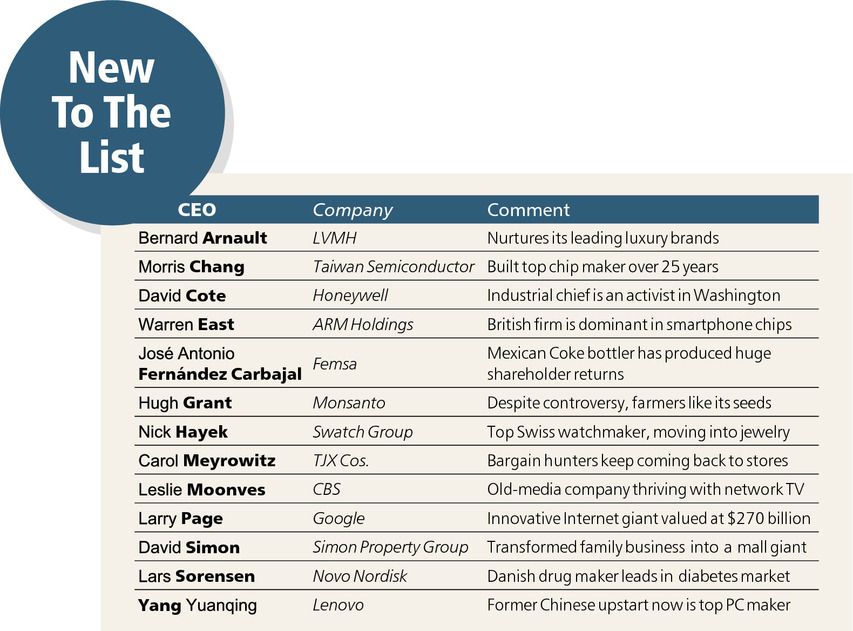
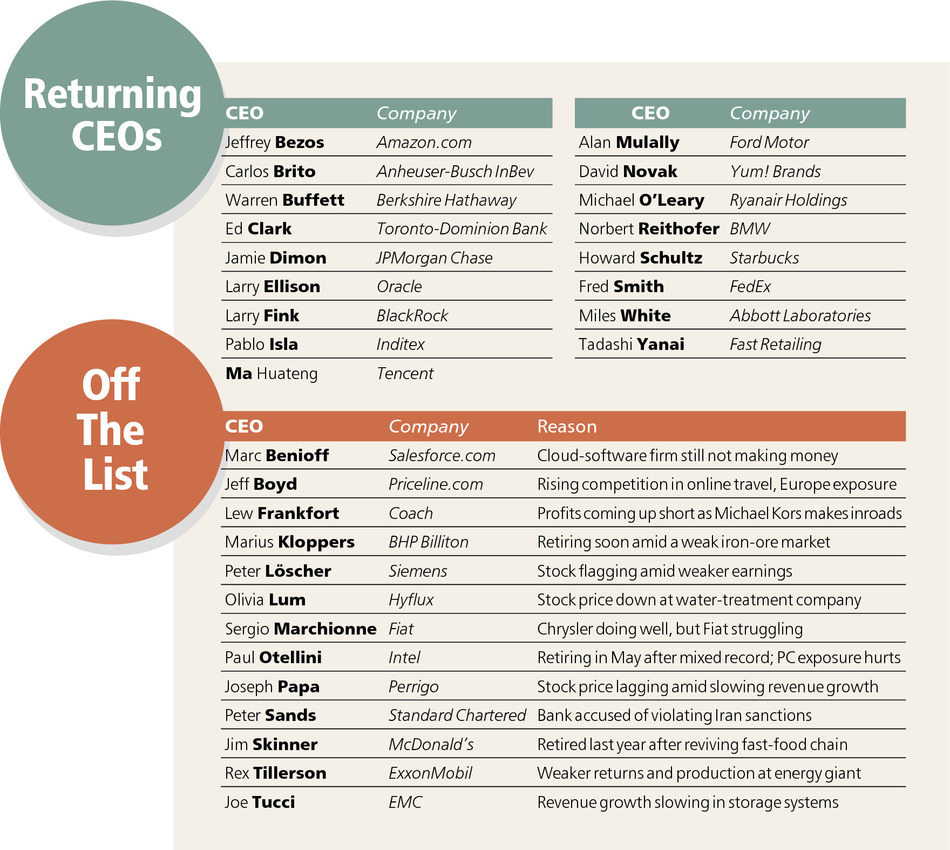
World’s Best CEOs; Profiles of the World’s Best CEOs — Many Paths to Greatness

SATURDAY, MARCH 23, 2013

Profiles of the World’s Best CEOs — Many Paths to Greatness

Profiles of our 30 superstars at Google, BlackRock, BMW — and more.

BA-BB432_ceo_so_G_20130323003833BA-BB369_ceo_ch_G_20130322235543

ON-BA406_NEWCEO_G_20130323013610

ON-BA405_CEOs03_G_20130323013605 Read more of this post

This Young Woman Escaped From North Korea And Gave An Incredible TED Talk About It; “I saw something terrible that I can’t erase from my memory. A lifeless woman was lying on the ground, while an emaciated child in her arms just stared helplessly at his mother’s face. But nobody helped them, because they were so focused on taking care of themselves and their families.”

This Young Woman Escaped From North Korea And Gave An Incredible TED Talk About It

Paul Szoldra | Mar. 22, 2013, 4:04 PM | 4,857 | 11

Growing up in North Korea, Hyeonseo Lee believed her life — witnessing public executions, studying the history of Kim Il-Sung with vigor — was totally normal. Lee had no idea that people were suffering, until one day when she walked past a train station.

From TED:

I saw something terrible that I can’t erase from my memory. A lifeless woman was lying on the ground, while an emaciated child in her arms just stared helplessly at his mother’s face. But nobody helped them, because they were so focused on taking care of themselves and their families. At the age of 14, she was able to escape and became a refugee in China. But her life there was not easy. She had no family, and at one point, she was picked up for a harsh interrogation by Chinese police — and if it was found she was North Korean, she would’ve been sent back. She gave a TED Talk about her incredible experience, which was published online March 20.

What Extremely Successful People Were Doing At Age 25; Warren Buffett was working as an investment salesman in Omaha.

What Extremely Successful People Were Doing At Age 25

Vivian Giang and Max Nisen | Mar. 22, 2013, 1:33 PM | 586,853 | 27

Some people know what they want to do from an early age and focus on it relentlessly.

Others reinvent themselves, changing careers and industries until they find something that works.

Billionaire Mark Cuban struggled when he first started, writing in “How To Win At The Sport Of Business“ that “when I got to Dallas, I was struggling — sleeping on the floor with six guys in a three-bedroom apartment.”

As a reminder that the path to success is not always linear, we’ve highlighted what Richard Branson, Arianna Huffington, and 17 other fascinating and successful people were doing at age 25.

Warren Buffett was working as an investment salesman in Omaha.

In his early 20s, Buffett worked as an investment salesman for Buffett-Falk & Co. in Omaha before moving to New York to be a securities analyst at age 26. During that year, he started Buffett Partnership, Ltd., an investment partnership in Omaha.

New York just wasn’t for him, Buffett told NBC. “In some places it’s easy to lose perspective. But I think it’s very easy to keep perspective in a place like Omaha.” Read more of this post

Experts warn of untreatable TB risk; “With ease of international travel and increased rates of MDR tuberculosis… the threat and range of the spread of untreatable tuberculosis is very real,”

Experts warn of untreatable TB risk
Posted: 24 March 2013 0827 hrs

PARIS: Disease experts called on Sunday for decisive leadership and more research funding to fend off the “very real” risk of an untreatable strain of tuberculosis (TB) emerging as more people develop resistance to existing drugs.

In a series of papers in the Lancet medical journal to mark World TB Day on Sunday, they warned that health systems risked being overwhelmed by increasing numbers of drug-resistant TB patients.

Already, more than 30 percent of newly-diagnosed patients in parts of eastern Europe and central Asia have multi-drug resistant (MDR) TB, a form of the disease which does not respond to the two most potent drugs — isoniazid and rifampin.

There were believed to be about 630,000 MDR cases out of some 12 million TB cases in 2011.

Extensively drug resistant (XDR) TB, thus far reported in 84 countries, does not respond to an even wider range of drugs.

“The widespread emergence of XDR tuberculosis could lead to virtually untreatable tuberculosis,” wrote the authors of one study, led by Alimuddin Zumla, director of the Centre for Infectious Diseases and International Health at University College London Medical School.

“With ease of international travel and increased rates of MDR tuberculosis… the threat and range of the spread of untreatable tuberculosis is very real,” they said. Read more of this post

The Cambrian explosion: Chinese palaeontologists hope to explain the rise of the animals

The Cambrian explosion

Chinese palaeontologists hope to explain the rise of the animals

Mar 23rd 2013 | Nanjing |From the print edition

AMONG the mysteries of evolution, one of the most profound is what exactly happened at the beginning of the Cambrian period. Before that period, which started 541m years ago and ran on for 56m years, life was a modest thing. Bacteria had been around for about 3 billion years, but for most of this time they had had the Earth to themselves. Seaweeds, jellyfish-like creatures, sponges and the odd worm do start to put in an appearance a few million years before the Cambrian begins. But red in tooth and claw the Precambrian was not—for neither teeth nor claws existed.

Then, in the 20m-year blink of a geological eye, animals arrived in force. Most of the main groups of the animal kingdom—arthropods, brachiopods, coelenterates, echinoderms, molluscs and even chordates, the branch from which vertebrates went on to develop—are found in the fossil beds of the Cambrian. The sudden evolution of this megafauna is known as the Cambrian explosion. But two centuries after it was noticed, in the mountains of Wales after which the Cambrian period is named, nobody knows what detonated it.

A group of Chinese scientists, led by Zhu Maoyan of the Nanjing Institute of Geology and Palaeontology, plan to change that with a project called “From the Snowball Earth to the Cambrian explosion: the evolution of life and environment 600m years ago”. The “Snowball Earth” refers to a series of ice ages that happened between 725m and 541m years ago. These were, at their maxima, among the most extensive glaciations in the Earth’s history. They alternated, though, with periods that make the modern tropics seem chilly: the planet’s average temperature was sometimes as high as 50°C. Add the fact that a supercontinent (illustrated above, viewed from the Earth’s south pole) was breaking up at this time, and you have a picture of a world in chaos. Just the sort of thing that might drive evolution. Dr Zhu and his colleagues hope to find out exactly how these environmental changes correspond to changes in the fossil record. Read more of this post

Mixing bricks with clicks: Some online retailers are venturing onto the high street

Mixing bricks with clicks

Some online retailers are venturing onto the high street

Mar 23rd 2013 |From the print edition

20130323_WBD001_020130323_WBC300

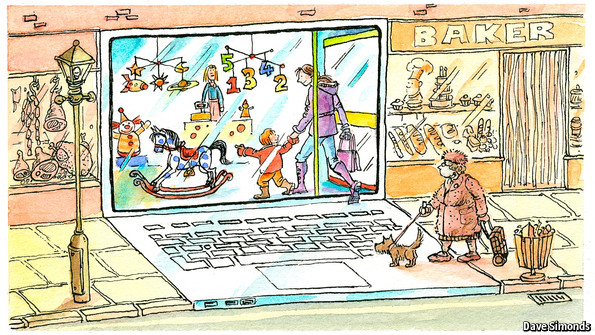
KIDDICARE wants to be as disruptive as the little monsters who use its products. Traditional sellers of baby gear, laden with too many stores and creaky technology, have all the perkiness of sleep-deprived parents. Internet-based Kiddicare should run rings around them. So it seemed odd last year when the British merchant took over ten “superstores” from Best Buy, itself an erstwhile disrupter (in electronics). Far from weighing Kiddicare down like overstuffed nappy bags, the shops will give customers “a true multichannel experience”, the retailer vowed.

“Multichannel” (or even better, “omnichannel”) is something almost every self-respecting retailer wants to be. It means letting customers shop with smartphones, tablets, laptops and even in stores as if waited upon by a single salesman with an unfailing memory and uncanny intuition about their preferences. Pure-play internet vendors are good at this. But most resist the idea that actual stores, with their rents, payrolls and security cameras, ought to be one of those channels. The thought of having the same costs as bricks-and-mortar competitors “scares the living daylights out of me,” says Charles Hunt, owner of Duvet and Pillow Warehouse, a fast-growing online retailer.

Yet Kiddicare, owned by Morrisons, a British grocer, is not the only retailer to shed its online purity. Screwfix, a British supplier to plumbers and electricians, has opened Read more of this post

The world’s greatest bazaar Alibaba, a trailblazing Chinese internet giant, will soon go public

The world’s greatest bazaar

Alibaba, a trailblazing Chinese internet giant, will soon go public

Mar 23rd 2013 | HANGZHOU AND HONG KONG |From the print edition

20130323_FBD001_0

IN 1999 Trudy Dai used to spend all night sending e-mails from her friend Jack Ma’s apartment, trying to answer queries from American customers without letting on that she was Chinese. Ms Dai was one of the first dozen employees of Alibaba, an online listings service Mr Ma, a teacher, had just started. It was already having some success connecting small Chinese manufacturers to potential customers, including the overseas ones Ms Dai was reassuring over e-mail. But the friends and students who made up the workforce were earning just 550 yuan (then $66) a month.

Mr Ma, though, already had big dreams. That year he said: “Americans are strong at hardware and systems, but on information and software, all of our brains are just as good…Yahoo’s stock will fall and eBay’s stock will rise. And maybe after eBay’s stock rises, Alibaba’s stock will rise.”

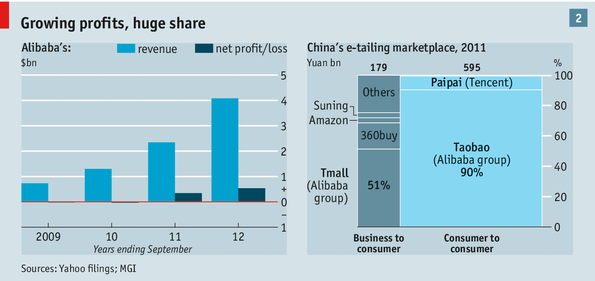
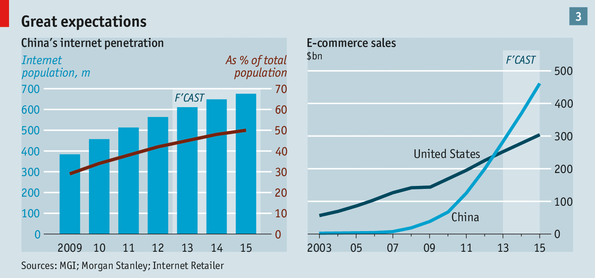
Since then, Alibaba has come to dominate internet retailing in China, which will soon be the biggest e-commerce market in the world. It has moved beyond its original remit of connecting businesses to each other to ventures that let companies sell directly to the public (Tmall) and enable members of the public to sell to each other (Taobao). Between them, Taobao and Tmall processed 1.1 trillion yuan ($170 billion) in transactions last year, more goods than passed through Amazon and eBay combined (see table 1).

20130323_FBC28020130323_FBC285

20130323_FBC284

Read more of this post

The Fall of the “Taobao Village”

The Fall of the “Taobao Village”

By Tracey Xiang on March 22, 2013

The Shanghai-based Xin Wen Chen Bao (Morning News) visited Qing Yan Liu, the village that has been referred to as “Taobao Village” since 2008 when it was crowded with thousands of Taobao sellers who were making a good living. But this time the journalist finds some store owners there having a hard time and some left. Golden times are gone.

Liu Wengao, a Qing Yan Liu villager and current deputy head of Zhejiang e-commerce merchants association, says currently only a dozen out of one hundred entrepreneurs can survive in the Taobao ecosystem. But years back almost every Taobao store set up ran by people in the village was successful.

Qing Yan Liu, with about two hundred local households, is located in Yiwu, a city in central Zhejiang province and where  has been known as one of the biggest small commodity wholesale markets in the world. For years merchants from all over the world flied into this city. There was a wholesale market next to Qing Yan Liu till 2008 when merchants doing business in the market were asked to move to a bigger and farther commercial area, leaving with rental village houses empty.

At that time several young villagers set up Taobao stores. Liu Wengao saw potential in it reasoning that most goods sold on Taobao then were what Yiwu markets could provide with at low prices.

To make their stores look fancier, Liu got designers from Yiwu Industrial & Commercial College. Later, the help of Liu and support from the school, students at Yiwu Merchant School were encouraged to run Taobao stores. They were allowed to do business at school time or move out of campus altogether to register companies for their Taobao stores. The school even provided a classroom with Internet access and inventory warehouse for those students. Even better, students can get a credit for running a Taobao store.

Those empty houses were filled in and crowded again. It is said that the Yiwu Industrial & Commercial College alone, with an accumulated two thousand students involved, have set up fifteen hundred stores since 2008.

Liu Wengao said that they created a variety of marketing approaches and got well experienced in operating online stores. Then everyone made a fortune from it.

Now  the village accommodates over eight thousand people who run a total of one thousand Taobao stores.

Even local grocery stores feel the decline in business and find the familiar faces disappeared. Read more of this post

72% Of Professors Who Teach Online Courses Don’t Think Their Students Deserve Credit

72% Of Professors Who Teach Online Courses Don’t Think Their Students Deserve Credit

GREGORY FERENSTEIN

posted 13 hours ago

This is not a good sign for online education: 72 percent of professors who have taught Massive Open Online Courses (MOOCs) don’t believe that students should get official college credit, even if they did well in the class. More importantly, these are the professors who voluntarily took time to teach online courses, which means the actual number of professors who discount the quality of MOOCs is probably much (much) higher. The survey reveals the Grand Canyon-size gap between the higher-education establishment and the coalition of tech companies and lawmakers that are mandating college credit  for online courses. Read more of this post

E-gadgets distract from literacy, critical thinking

E-gadgets distract from literacy, critical thinking

Created: 2013-3-21

Author:Wan Lixin

20130321_526492_01

THE other day I was going down the elevator in my apartment building. It stopped at another floor, where a boy of about five was busy touching the panel of an iPad, with his mother beside him.

The mother shouted: “Get in!” The boy marched in without taking his eyes off the panel.
While the elevator was going down, the mother gave the boy a severe dressing-down, but there was no knowing if the boy heard the diatribe, for he was so concentrated on his toy.
Then the elevator stopped at the ground floor, and the mother shouted: “Get out!” and the boy exited, his eyes still glued to the screen. Read more of this post

Watch Nokia CEO Stephen Elop Throw A Reporter’s iPhone On The Floor

Watch Nokia CEO Stephen Elop Throw A Reporter’s iPhone On The Floor

Steve Kovach | Mar. 22, 2013, 1:12 PM | 4,673 | 9

In an interview with a Finnish television reporter, Nokia CEO Stephen Elop took a moment to verbally and physically bash the iPhone. A lot of people are passing the clip around today, so we thought we’d share it with you too. The reporter asked Elop about the Lumia 928, a device that’s rumored to launch on Verizon soon. Elop refused to comment on the rumor, so the reporter pulled out his iPhone and said he’s rooting for Nokia to make a new phone.

“I don’t want to have an iPhone,” the reporter said. “Oh, how embarrassing,” Elop said when he saw the iPhone. “I can take care of that for you.”

Then he snatched the iPhone from the reporter’s hand and chucked it off camera. You can hear the iPhone make thud on the floor. The reporter, to his credit, didn’t even blink. He kept asking about the rumored Lumia 928. Elop said he’d replace the discarded iPhone with a Nokia phone.

Lockheed Martin Says This Desalination Technology Is An Industry Game-Changer; The problem is that current filters use plastic polymers that require an immense amount of energy (800 to 1,000 pounds per square inch of pressure) to push water through. Lockheed has developed a special material (graphene) that doesn’t need as much energy to drag water through the filter.

Lockheed Martin Says This Desalination Technology Is An Industry Game-Changer

Dina Spector | Mar. 22, 2013, 12:45 PM | 9,777 | 33

The latest technology for removing salt from seawater, developed by Lockheed Martin, will be a game-changer for the industry, according to Ray O. Johnson, senior vice president and chief technology officer of the jet and weapons manufacturer.

Desalination technology is used in regions of the world, particularly developing countries, where fresh water is not available. Water from oceans or rivers is diverted into treatment plants where the salt is removed and clean drinking water is produced through a process called reverse osmosis.

Imagine a tank with seawater on one side and pure water on the other, separated by a filter with billions of tiny holes. Lots of pressure on the salty side pushes water through faster than the salt, so fresh water comes out the other end.

The problem is that current filters use plastic polymers that require an immense amount of energy (800 to 1,000 pounds per square inch of pressure) to push water through.

Lockheed has developed a special material that doesn’t need as much energy to drag water through the filter.

Graphene is a substance made of pure carbon. Carbon atoms are arranged in a regular hexagonal or honeycomb pattern in a one-atom thick sheet. Read more of this post

Apple is finally making money on content

Apple is finally making money on content

By Christopher Mims — 11 hours ago

screen-shot-2013-03-22-at-3-22-2-39-55-pm-620x516

A few percent of a huge volume of transactions is a tried and true business model.Asymco

Apple has long said that it wants to run its its app and media stores at break-even, but the volume of transactions on iTunes has become so huge (check out the graph, above) that even at a tiny margin, Apple appears to be making a substantial profit on content. This data comes from mobile analyst Horace Dediu. Here’s his breakdown of Apple’s profits on bits, not atoms:

  • Apple’s iTunes revenue has quintupled in the past seven years. (Mind you, its overall revenue has quintupled in just the last four.)
  • 23 billion items were sold sold through iTunes in 2012.
  • At a hypothetical (and not unlikely) margin for Apple of 2% on apps and 1% on music, Apple could be making $150 million a year on content alone.
  • Throw in Apple’s software business (it’s easy to forget that Apple also makes its own, from Pages and OS X to Final Cut Pro) which is now sold entirely through the company’s desktop and mobile app stores, and Dediu estimates that “iTunes inclusive of Apple’s own Software generates as much as 15% operating margin on gross revenues. That’s over $2 billion a year.”

Now, next to a net income of over $40 billion in 2012, that’s still hardly game-changing. But it appears that the well-worn trope—that Apple is a hardware company that practically gives away everything else—is no longer true.

Rakuten: The biggest e-commerce site you haven’t heard of with a market cap of $13.5 billion and annual sales of over $4 billion

Rakuten: The biggest e-commerce site you haven’t heard of

March 22, 2013: 10:50 AM ET

130322100643-hiroshi-mikitani-rakuten-614xa

Rakuten CEO Hiroshi Mikitani heads one of the oldest and largest e-commerce sites in the world. He stopped by Fortune to talk about its unique model, plans for expansion and its battle with Amazon in the global market.

By Omar Akhtar, reporter

FORTUNE —  Hiroshi Mikitani, CEO of the Japanese e-commerce site Rakuten stopped by theFortune offices to promote his new book Marketplace 3.0: Rewriting The Rules Of Borderless Business, where he outlines his company’s strategy for globalization.  Founded by Mikitani in 1997, Rakuten is the largest e-commerce site in Japan and with a market cap of $13.5 billion and annual sales of over $4 billion; it is one of the biggest Internet companies in the world.  In the U.S., it bought Buy.com for $250 million and rebranded it to “Rakuten.com Shopping” earlier this year. Read more of this post