Better Colleges Failing to Lure Talented Poor, Study Shows

March 16, 2013

Better Colleges Failing to Lure Poorer Strivers

By DAVID LEONHARDT

IncomeCollege

Most low-income students who have top test scores and grades do not even apply to the nation’s best colleges, according to a new analysis of every high school student who took the SAT in a recent year.

The pattern contributes to widening economic inequality and low levels of mobility in this country, economists say, because college graduates earn so much more on average than nongraduates do. Low-income students who excel in high school often do not graduate from the less selective colleges they attend.

Only 34 percent of high-achieving high school seniors in the bottom fourth of income distribution attended any one of the country’s 238 most selective colleges, according to the analysis, conducted by Caroline M. Hoxby of Stanford and Christopher Avery of Harvard, two longtime education researchers. Among top students in the highest income quartile, that figure was 78 percent.

The findings underscore that elite public and private colleges, despite a stated desire to recruit an economically diverse group of students, have largely failed to do so. Read more of this post

Coffee’s Economics, Rewritten by Farmers; Some coffee farmers are taking control of more of the supply chain, roasting and marketing their own beans for greater profit

March 16, 2013

Coffee’s Economics, Rewritten by Farmers

By NICOLE LaPORTE

IN 2005, Kenneth Lander, a lawyer in Monroe, Ga., moved with his wife, stepdaughter and the youngest three of his seven children to a coffee farm in San Rafael de Abangares, Costa Rica. He always “had a heart,” he said, for Latin America, and after a vacation to the lush cloud forests near Monteverde in 2004, he was determined to return on a more permanent basis.

He was also looking for more balance in his work-driven life. And so, after buying a coffee farm from a farmer he’d met on his earlier trip, he packed up his life and moved.

“It was like Swiss Family Robinson,” Mr. Lander jokes. “We just left.”

In Costa Rica, Mr. Lander, who is now 46, didn’t have to worry about making money. He had received a cash windfall from selling a portion of a residential subdivision he had helped develop in Georgia; the plan was to keep selling more lots and live off the proceeds. So he grew coffee for fun.

Then, in 2008, the financial crisis hit. The value of his subdivision plummeted. Suddenly, he had to support himself as a coffee farmer. Very quickly, he realized how difficult that was going to be. He had just 12 acres that produced 6,000 pounds of specialty-grade coffee beans a year.

He belonged to a “fair trade” co-op, which guarantees farmers a minimum price, but was making only $1.30 a pound on coffee that retailed in the United States for $12 a pound. His net profit was so low that at one point he was down to $120 that had to last two weeks.

“I was at the register debating whether or not to buy shampoo or a bag of rice,” Mr. Lander recalls.

Why wasn’t he seeing more of that final price?

That question has been asked by farmers throughout history, particularly in developing countries, where growers of commodity crops like coffee and cocoa often live in poverty. Over the last few decades, a worldwide movement under the broad banner of fair trade has tried to rectify that imbalance.

In exchange for receiving “fair” prices for their products, fair trade farmers must adhere to environmental and labor standards set by certification groups, the largest of which is Fairtrade International, a nonprofit organization based in Bonn, Germany. It represents 1.24 million farmers and workers in industries including coffee, bananas and honey.

But Mr. Lander started to think that he might improve on the idea. He began to experiment. Using a roaster he had bought in better times, he started roasting his beans and selling them on Facebook to friends in the United States. He also opened a coffee shop, called the Common Cup, in Monteverde, and sold his coffee to tourists.

When he ran out of beans, he teamed up with two other area coffee farmers, Jorge Fonseca and Alejandro Garcia — who also had a coffee shop, the Colibri — and began shipping greater volumes. Suddenly, he was making money. Read more of this post

IMF Says EU Banks Face Further Losses

March 15, 2013, 12:18 p.m. ET

IMF Says EU Banks Face Further Losses

By PAUL HANNON

With anemic economic growth likely to lead to more losses on loans, risks to the financial stability of the European Union remain “elevated,” and urgent action is needed to adequately capitalize the bloc’s banks and establish a shared system for closing down or restructuring failing institutions, the International Monetary Fund said Friday.

In its first-ever review of the health of the financial system across all 27 EU members, the IMF said the bloc has made some progress in addressing the weaknesses that have exacerbated its fiscal crisis and stalled its economic recovery.

But it said much work remains to be done, with banks likely to face higher losses on loans to households and businesses to add to the losses they have suffered on their holdings of government bonds. The Fund added that low economic growth and low interest rates may also weaken insurance companies and pension funds.

“Risks remain elevated, especially in a context of low growth and fiscal retrenchment,” the IMF’s board of directors said. “Regulatory and policy uncertainty, and gaps in policy frameworks also continue to pose vulnerabilities. Further ambitious steps are thus necessary to rebuild confidence and achieve long-lasting financial stability in the region.” Read more of this post

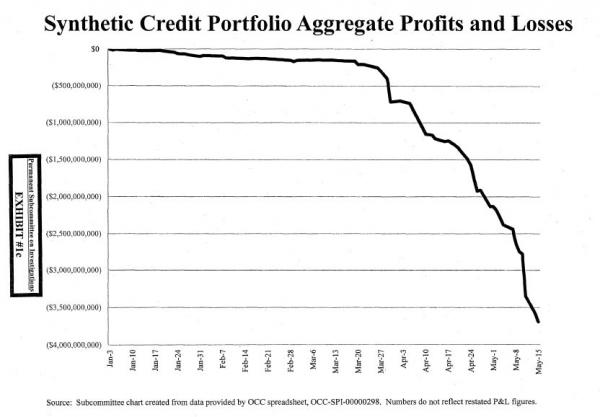
JPMorgan… Or Long-Term Capital Management?

JPMorgan… Or Long-Term Capital Management?

Tyler Durden on 03/15/2013 10:57 -0400

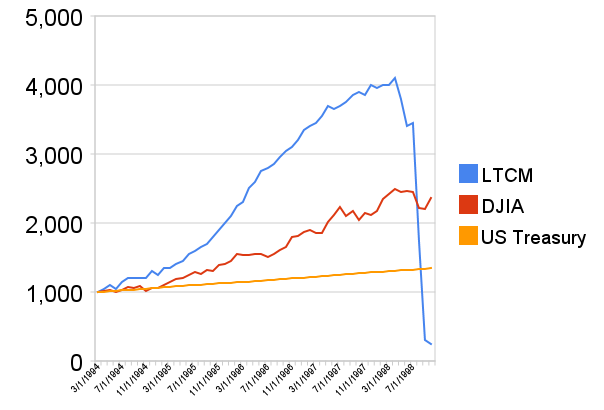
Compare and contrast to the performance of LTCM just before it had to be bailed out, ushering in the modern era of of Too Big To Fail.

CIO P&L_0LTCM P&L

Europe Does It Again: Cyprus Depositor Haircut “Bailout” Turns Into Saver “Panic”, Frozen Assets, Bank Runs, Broken ATMs, Bulldozer Parks Outside Bank; After Cyprus, Who Is Next?

Europe Does It Again: Cyprus Depositor Haircut “Bailout” Turns Into Saver “Panic”, Frozen Assets, Bank Runs, Broken ATMs

Tyler Durden on 03/16/2013 10:33 -0400

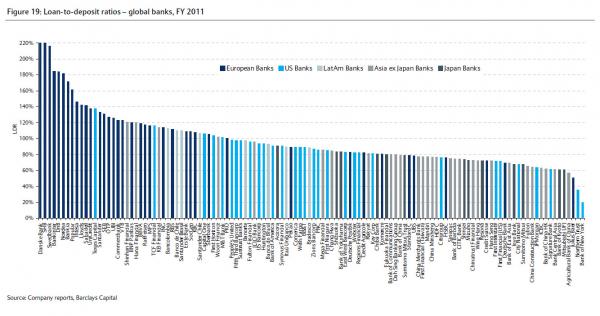
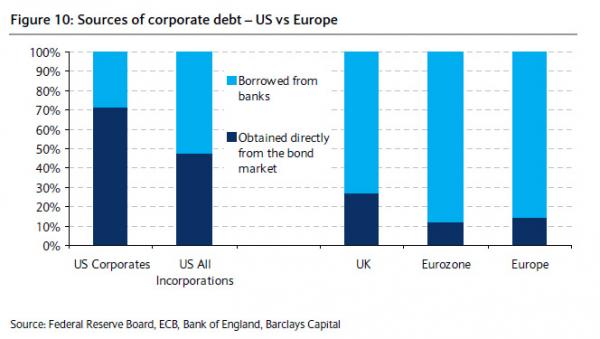
Loan to Deposit ratio_0Euro Banks Loans vs Total vs US_0

Europe has done it again.

Late last night, after markets closed for the weekend, following an extended discussion the European finance ministers announced their “bailout” solution for Russian oligarch depositor-haven Cyprus: a €13 billion bailout (Europe’s fifth) with a huge twist: the implementation of what has been the biggest taboo in European bailouts to date – the  impairment of depositors, and a fresh, full blown escalation in the status quo’s war against savers everywhere.

Specifically, Cyprus will impose a levy of 6.75% on deposits of less than €100,000 – the ceiling for European Union account insurance, which is now effectively gone following this case study – and 9.9% above that. The measures will raise €5.8 billion, Dutch Finance Minister Jeroen Dijsselbloem, who leads the group of euro-area ministers, said. Read more of this post

Poultry farmer Ho Seng Choon, 90, is still the prince of quails; “We should be billionaires,” said the younger Mr Ho. “But while dad is an excellent and passionate farmer, he has never been a good businessman.”

Poultry farmer, 90, is still the prince of quails

20130314.143953_poultry-farner_st

He has tried his hand at goat, turtle and crocodile farming – but at the age of 90 he is now rearing quails with his son. -ST
Melody Zaccheus
Sat, Mar 16, 2013
The Straits Times

SINGAPORE – He has tried his hand at goat, turtle and crocodile farming – but at the age of 90 he is now rearing quails with his son.

Meet Mr Ho Seng Choon, a poultry farmer credited with modernising farming techniques in Singapore over six decades.

Together with son William Ho, 48, he runs Lian Wah Hang, one of two quail farms here. It provides Singapore with 11 million quail eggs every year.

These come from their brood of 130,000 quails and are sold at supermarkets or served at restaurants such as Crystal Jade.

But this could be the “last frontier” for their 2.7ha farm in Lim Chu Kang, said the younger Mr Ho. “Just two years remain on our tenancy and we cannot expand our business on such terms. We are worried about our future.”

The older Mr Ho, who features in the National Heritage Board’s Trading Stories exhibition, has been credited with introducing the battery system for livestock in the 1950s. Born in China’s Fujian province, Mr Ho came to Singapore in 1929. His father ran a provision shop but business was disrupted by World War II.

Mr Ho saw poultry farming’s potential as the population grew, so he sold his dad’s shop and headed to Japan and the Netherlands to pick up livestock techniques.

“Farming techniques in Japan were very modern compared to Singapore where chickens would roam freely and farmhands would have to run around with their baskets in search of eggs,” said Mr Ho. He has published a series of journals on poultry farming and in 1963, he led a rally fighting for a three-cent tax on imported chicken eggs to benefit local farmers.

Two years later, he organised a farming exhibition at Kallang Airport and played host to then Prime Minister Lee Kuan Yew.

“We should be billionaires,” said the younger Mr Ho. “But while dad is an excellent and passionate farmer, he has never been a good businessman.” Read more of this post

Private Equity’s $36 Billion Retail Bet Not Going So Well

Private Equity’s $36 Billion Retail Bet Not Going So Well

In the years before the recession, private-equity firms put so much faith in the future of U.S. brick-and-mortar retailers that they spent $36 billion on them.

That hasn’t worked out so well, especially for the era’s biggest spender, Bain Capital LLC. The firm started by Mitt Romney inked four deals valued at $17 billion from 2004 to 2007 and still owns all of the purchases. The largest of the bunch was Toys “R” Us Inc., which posted a drop in sales during the holidays, followed by Chief Executive Officer Gerald Storch stepping down.

The private-equity model — load up an acquisition with debt, cut costs and take it public — hasn’t gone according to the usual script with most of Bain’s retail acquisitions. That’s largely because the firm, which has $67 billion in assets under management, doubled down on specialty retailers just as they were about to be pummeled by the likes of Amazon.com Inc. (AMZN)

“There isn’t anything special about specialty anymore,” said Leon Nicholas, an analyst for Kantar Retail in Boston. Their advantages on product assortment, expertise and price have disappeared, he said. Read more of this post

China firms desert US stock markets amid scrutiny by US regulators and short-sellers

China firms desert US stock markets

More than two dozen US-listed Chinese companies have retreated from the US stock market in the past 15 months, amid scrutiny by US regulators and short-sellers. -China Daily/ANN
Michael Barris

Sat, Mar 16, 2013
China Daily/Asia News Network

NEW YORK – When 7 Days Group Holdings Ltd announced in September that it had received a buyout proposal to be taken private, the Chinese budget hotel operator’s US-listed shares soared to a four-month high.

Prior to the announcement, the shares, which trade on the New York Stock Exchange, had tumbled 23 per cent in 12 months, amid investor worries over corporate governance that hurt valuations of Chinese companies.

Last week, 7 Days became the latest US-traded Chinese company to go dark, after a group that included Washington-based private equity firm Carlyle Group LP and the company’s co-chairmen sweetened its offer to $688 million (S$854.7 million).

More than two dozen US-listed Chinese companies have retreated from the US stock market in the past 15 months, amid scrutiny by US regulators and short-sellers and shrinking advantages from US listings. Read more of this post

Why some think China is approaching a political tipping point

The old regime and the revolution

Why some think China is approaching a political tipping point

Mar 16th 2013 |From the print edition

20130316_CND000_0

FOR some of China’s more than 500m internet users the big news story of the week has not been the long-scheduled one that their country has a new president, Xi Jinping, who already has more important jobs running the Communist Party and chairing its military commission. Rather it was the unscheduled, unwelcome and unexplained arrival down a river into Shanghai of the putrescent carcasses of thousands of dead pigs, apparently dumped there by farmers upstream. The latest in an endless series of public-health, pollution and corruption scandals, it is hard to think of a more potent (and disgusting) symbol of the view, common among internet users, that, for all its astonishing economic advance, there is something rotten in the state of China, and that change will have to come.

Many think it will. According to Andrew Nathan, an American scholar, “the consensus is stronger than at any time since the 1989 Tiananmen crisis that the resilience of the authoritarian regime in…China is approaching its limits.” Mr Nathan, who a decade ago coined the term “authoritarian resilience” to describe the Chinese Communist Party’s ability to adapt and survive, was contributing, in the Journal of Democracy, an American academic quarterly, to a collection of essays with the titillating title: “China at the tipping point?” Read more of this post

How cricket has lost its working class tradition; The game is better for having its working-class heroes

Class and cricket

A lower-order collapse

Mar 12th 2013, 19:54 by B.R.

20130316_woc227_0

IT USED to be said that when England needed a fast bowler, all it had to do was whistle down a Nottinghamshire coal mine. Harold Larwood (pictured), the most fearsome bowler of his generation, was destined for a life in the pits before he was spotted while playing for his village team and offered a contract by Nottinghamshire in 1923. Nuncargate, the tiny mining village in which he was born, unearthed four further England cricketers, including Bill Voce, who shared the new ball with Larwood during the 1932-33 bodyline tour of Australia.

England’s great batsmen, too, often came from humble beginnings. Jack Hobbs, one of the country’s most revered players, grew up in poverty in Cambridge. Herbert Sutcliffe’s father was a pub landlord in Yorkshire. Indeed, from Fred Trueman, the first bowler to take 300 Test wickets, whose father spent time in the coal mines, to Ian Botham and Freddie Flintoff, working-class heroes have always bestrode the game.

This is not to say that English cricket has not been subject to class division. On the contrary, it is enshrined in its history. The first recorded games, in the 17th and 18th centuries, were often between teams playing under the patronage of the landed gentry, such as the Second Duke of Richmond, who employed local farm hands in fixtures convened for toffs to bet on. Until 1962, England’s first-class cricketers were formally divided into two categories, gentlemen and players—the nobs who could afford to play cricket as amateurs, versus working-class professionals who needed to be paid. At Lord’s, the home of the game, teammates entered the field through separate gates dependent on this distinction. There was even an annual fixture between the two which was, for a while, the highlight of the domestic season (and in which the professionals usually prevailed). It was not until 1952 that a non-gentleman, Len Hutton, captained the Test side.

Class is even enshrined in the game’s aesthetic. Some shots—particularly front foot drives—are to this day considered more elegant, to be purred over by purists. This may be because they are also associated with the upper classes. In “More Tales from a Long Room”, a satire of the game, Peter Tinniswood relates the story of an aristocrat who undertakes “a missionary crusade to the dourlands of the north to preach to the working classes his fervent belief that the cover drive, the late cut and the wristy leg glance were not the sole province of the upper classes.” In contrast, brutal, clubbing back foot shots, such as pulls and cuts, were considered professionals’ shots, born of those who cared little about art and much about efficacy.

Yet if there was once a class battle in cricket, it is on the verge of being conceded. Today, fewer working-class players reach the top of the English game than probably at any time in the sport’s history. If one takes a very broad measure of class—whether a player attended a state or private school—the majority of England’s Test cricketers since the second world war could be said to have come from relatively modest backgrounds (see chart). In 1993, nine of the starting XI who played in the first Test against Australia had been to a state school. By the 2009 series, only half did (one, Monty Panesar, attended both types). In the last Test match England played, against New Zealand last week, that proportion had gone down to a third. Read more of this post

China’s ‘new farmer:’ an investor, manager and & decision maker; mass exodus from the countryside has left China asking, “Who will till the farmlands and feed 1.4 billion Chinese people?”

China’s ‘new farmer:’ an investor, manager and & decision maker

  • Xinhua

2013-03-15

China is going to great lengths to foster a “new type” of professional farmer to inhabit the empty farmhouses across its vast rural areas and entice more migrant workers to return home to till fields and feed the world’s largest population.

If it succeeds, China will solve a major problem that cropped up after its urbanization process resulted in a population split 50:50 between rural and urban areas. Decades ago, nine in 10 people lived in rural areas, where their lives were not as good as that of their urban peers.

As large numbers of farmers, especially young farmers, have flocked to cities and towns, they have left the countryside largely inhabited by the elderly, women and children.

This mass exodus from the countryside has left China asking, “Who will till the farmlands and feed 1.4 billion Chinese people?” Read more of this post

Tinkering key to innovation

Tinkering key to innovation

Created: 2013-3-16

Author:Wang Yong

DESPITE the global success of Apple iPhones, the US suffers a stasis in technological innovation – at least in the eye of American journalist Alec Foege, author of “The Tinkerers: The Amateurs, DIYers, and Inventors Who Make America Great.” While Thomas Edison (1847-1931) tinkered with projects in an unstructured way, the author says that a modern-day American would more often than not be enslaved by standardized test scores that leach creativity. American children today are also less creative, observes the author, who believes that many busy parents deprive their children of any opportunities for unstructured play – the setting where taking old things apart and creating new things used to be part of growing up. Partly because of this rigid education that suppresses the spirit and skills of tinkering, the US is no longer the biggest producer of engineers and scientists. As the author points out, it has fallen behind many other countries in filing new patents. “True tinkering is all about risk and unusual behavior. The far-flung fanaticism that world-class tinkering requires rarely thrives in an institutional setting,” says the author. Because the education system cannot be overhauled any time soon – most universities and colleges in America still survive and will continue to survive on mass-producing standard graduates and diplomas – one way to improve the nation’s creative spirit and capacity is for the government and corporations to fund pure experiments.  Read more of this post

Crisis bodes grim for Dutch housing market

Crisis bodes grim for Dutch housing market

by Christien van den Brink

English.news.cn   2013-03-15 21:36:28

THE HAGUE, Mar. 15 (Xinhua) — The happily married young couple Petra and Bert live in a suburban area of the fourth biggest city of the Netherlands, Utrecht.

Bert has just signed a long term contract at the ministry of Infrastructure, while Petra holds a part time job. They would be in the perfect position to buy their dream house, and yet, they rent it.

“Jobwise, it is really difficult to predict where we will be in 3, 4 years. We could be sent to other regions by our employers. Or we could even lose our job. This makes it hard to chose a location for our future house. We don’t want to commit to something until we are more financially stable,” Petra said.

Petra and Bert are not the only ones who have opted for renting in the Netherlands. According to figures published by CBS on Friday, 2.9 million dwellings of the 7.1 million households are rented apartments and houses.

Due to a growing incertainty at the job market, flexibility has become the main argument for renting. Renting offers the ability to pick up and leave if you have to take a job in an other region of the Netherlands. Read more of this post

The man who once saved New York City from bankruptcy explains why Detroit may go under; “We couldn’t do this today,” says Felix Rohatyn. “The various stakeholders are no longer around the same table.”

The man who once saved New York City from bankruptcy explains why Detroit may go under

By Tim Fernholz — 10 hours ago

The US city of Detroit is in deep financial trouble. Years of fiscal mismanagement and a shrinking population have left it with $14 billion in debt and a $300-million deficit last year, the auto capital of the country is headed toward bankruptcy. Michigan Governor Rick Snyder just appointed Kevyn Orr, a Washington bankruptcy attorney, to be the city’s “emergency manager,” a role with the power to implement budget measures without the consent of local officials.

Orr led the 2010 restructuring of Chrysler, the US automaker based in Detroit, during the the American government’s rescue of the auto industry. But his current challenge is what he calls “the Olympics of restructuring.” It might very well be: If the city doesn’t get back on its feet soon, it will become the largest municipal default in US history.

Felix Rohatyn faced similar problems in 1975, when he chaired a commission that extricated New York City from its financial crisis, a similar $14 billion debt load and an astounding $2.2-billion operating deficit (pdf). Rohatyn and a deputy were referred to as the “Batman and Robin of New York.” The legendary Lazard bankertalked to Quartz about his worries that the same tools he used might not be available in Detroit.

“We couldn’t do this today,” says Rohatyn. “The various stakeholders are no longer around the same table.” Read more of this post

Craig Winkler on a winner at NZ cloud-accounting software Xero which cracks the billion dollar mark in market cap

Winkler on a winner at Xero

March 16, 2013

Brian Robins

EBL-art353-craig-winkler-20130315190507269540-200x0

Craig Winkler Photo: James Davies

II is more than most of us can expect to make in a lifetime, but entrepreneur Craig Winkler’s worth has risen a stunning $20 million just over the past week alone. Mr Winkler made his first $100 million from accounting software company MYOB and then put part of his gains into Xero, a start-up New Zealand rival, when he sold. With an internet cloud-based product, it claims to have a lower cost offering than its competitors. Xero listed on the stock exchange in October. Since then its share price has nearly doubled, surging 7 per cent on Friday to hit a record $8.60, before closing up 49¢ at $8.48. It first traded on the ASX around $4.50. It listed on the New Zealand Stock Exchange in 2007. The rally in Xero’s share price has more than doubled Mr Winkler’s worth, even though the company is yet to make a dollar. He holds 16 million Xero shares after selling 2.5 million shares at $NZ6 in December, only to watch the share price surge. Part of the reason for the rally in recent weeks has been a series of product promotions in Australia, coupled with optimism about the incorporation of new product features.

But with Xero’s market valuation topping $1 billion on Friday, it seems investors are pricing in success not just in Australia, but in the US market as well, where it has established a presence. Last month Xero said monthly revenue was running at $NZ4 million ($3.2 million), up from December quarter revenue of $NZ10 million, with revenue in the year to March to double from the $NZ19 million booked last year. Xero is challenging market incumbents MYOB and Reckon in the Australian market. Since selling out of MYOB, Mr Winkler has spent most of his time working in the not-for-profit sector.

Dr Reddy’s Laboratories Founder Anji Reddy Dies; Considered as a pioneer of reverse engineering, Dr Reddy made significant contributions in making pharmaceutical products globally competitive and also affordable to the common man

March 15, 2013, 12:50 p.m. ET

Dr Reddy’s Laboratories Founder Anji Reddy Dies

By DHANYA ANN THOPPIL

BANGALORE–K. Anji Reddy, the founder and chairman of drug maker Dr. Reddy’s Laboratories Ltd., 500124.BY +0.29% died Friday in the southern Indian city of Hyderabad. Mr. Reddy was ailing for some time, the company said in a statement, but didn’t give details. Mr. Reddy founded Dr. Reddy’s Laboratories in 1984. The Hyderabad-based company, which is listed in India and on the New York Stock Exchange, is now one of India’s largest drug makers.

Founder chairman of Dr Reddy Laboratories Anji Reddy dead

Indo-Asian News Service | Updated: March 15, 2013 21:20 IST

Hyderabad: Kallam Anji Reddy, the founder chairman of Dr Reddy’s Laboratories, died today at a hospital in Hyderabad following brief illness. He was 73. He is survived by wife Samrajyam, daughter Anuradha and son K Satish Reddy, who is managing director and COO of the pharma giant. One of the most well-known faces of Indian pharma industry, Dr Reddy was suffering from lung disorder for last few months and was admitted to a private hospital 10 days ago. The technocrat-turned-entrepreneur, who started Reddy’s Laboratories with a meagre outlay of Rs. 25 lakh in early 1980s, transformed it into $1.6 billion global entity. Considered as a pioneer of reverse engineering, Dr Reddy made significant contributions in making pharmaceutical products globally competitive and also affordable to the common man. Read more of this post

China’s Top E-Commerce Sites Saw 600% Growth in Mobile Shopping Last Year; An average of 220,000 products were sold every hour through mobile devices in 2012 on Alibaba’s Tmall and Taobao

China’s Top E-Commerce Sites Saw 600% Growth in Mobile Shopping Last Year

Mar 15, 2013 at 22:18 PM by Steven Millward, in Business, E-commerce, Mobile

We know that China’s netizens love shopping online – and collectively spend about $40,000 per second on local e-commerce sites – but most of that has been happening on desktop computers and laptops. Finally that’s changing. China’s top online stores, Tmall andTaobao, have revealed that purchases made via mobile devices soared 600 percent last year on the two sites. Alibaba, the company that runs those two e-stores, says that the number of unique visitors to Taobao last year on its apps or on any mobile browser reached 300 million last year. The company’s blog says that, of those mobile visitors, 57 million (19 percent) made purchases on their phones. While that’s a sizable shift to m-commerce, mobile purchases still made up just 6.87 percent of all Taobao transactions in 2012. At least that’s way up from a mere 1.77 percent in 2011.

Indeed, as we noted previously in iResearch data for 2012 Q2, Taobao and Tmall lead the way in mobile commerce in China, punching above their general market share by accounting for 75.6 percent of mobile e-shopping buys. A few other sites also perform better than average, such as fashion e-tailers Vancl and MaiBaoBao. But quite a number of others are underrepresented on mobile, such as Amazon China. “The speed of mobile adoption has been much faster than we thought it would be,” says Alibaba’s general manager for the mobile business unit, Alex Qiu. With booming smartphone adoption in China – now accounting for 73 percent of all phones sold – there’s still a lot of market share to be won and lost in the transition to greater m-commerce. Read more of this post

Former Thai deputy premier Supachai Panitchpakdi warned that there were signs of a “bubble” in the Thai economy, with massive fund inflows heading mostly to the property sector.

Supachai sees signs of a bubble

March 16, 2013 1:00 am

Unctad chief urges officials to monitor property prices and bank lending

Former deputy premier Supachai Panitchpakdi warned yesterday that there were signs of a “bubble” in the Thai economy, with massive fund inflows heading mostly to the property sector.

Supachai, secretary-general of the UN Conference on Trade and Development (Unctad), expressed concern over a bubble in Thailand’s property sector, which he said could expand and create problems for the economy in the future. 

He called on the responsible agencies to pay attention to property prices, such as for condominiums, and to closely monitor bank lending. Expressing concern over overheated lending by banks, he said asset prices in some sectors are likely to exceed reasonable levels. Read more of this post

Tan Sri Andrew Sheng: The wonton vs sushi story; So what is the right business model for small businesses in the age of massive social and technological change?

Saturday March 16, 2013

The wonton vs sushi story

Think Asian by ANDREW SHENG

MY friends know that I am a noodle foodie. Everywhere I go throughout Asia, I try the noodles, from laksa in Penang, pad thai in Bangkok, beefpho in Hanoi to mohinga in Yangon; each bowl showcases the culture and flavour of the place, through the different texture, spices, and taste. Somehow, I remember a place by the quality of its noodles.

There is nothing quite like the great wonton and noodle shops in Hong Kong. They are not fancy places, but have been in the same location for ages, and have become beloved local institutions with lifetime customers. In the past few months. several historic Hong Kong noodle shops and cafes have closed from rising rents. The closure of the 42-year-old Lei Yuen Congee Noodles in Causeway Bay this January made the South China Morning Post. Hundreds of tourists and residents flocked to the shop in its last days, waiting in hour-long queues at lunch time for their last chance to eat there.

Rising rent in Hong Kong is nothing new. Hong Kong competes with Tokyo as one of the world’s most expensive real estate markets. Yet Tokyo is full of small ramen and sushi shops that have been around for decades brought to international attention recently by the film Jiro Dreams of Sushi about a dedicated Michelin star sushi shop in the Tokyo subway. Tokyo sushi shops also have to pay the high rent demanded by landlords, but perhaps their landlords realise that Japanese culture is poorer if there is no local sushi and ramen shop around. Read more of this post

Information innovator

Saturday March 16, 2013

Information innovator

By JENNIFER LO

INFORMATION technology (IT) is all about innovation. Vish Iyer can’t agree more.

Mobility, social media and big data are all hot-button topics. Cloud computing frees up people from the desk, so an IT system can be managed even on the road. “For a bank, it could be payment via Internet banking or mobile phone,” says the high-flying corporate executive.

“For an insurance company, it could mean enabling an agent to get quotations and conduct transactions on his or her mobile.” For an airline, pilots no longer carry huge bags with heavy operating manuals. “We put that on an iPad,” he adds.

Few would believe the president for Asia Pacific at Tata Consultancy Services (TCS) has neither training in IT nor a background in engineering. He learns by doing.

Born and raised in Kolkata around the time when India’s first computer arrived, Iyer graduated from St Xavier’s College, one of the city’s best-known educational institutions with a major in taxation and economics.

Now the head of the largest service provider in the Asia-Pacific region based in Singapore, he manages 10,000 employees in 13 countries including Australia, Japan, China and South Korea.

The 45-year-old Indian company, whose clients include Microsoft andING Group, is the provider of IT services and business solutions, with a turnover exceeding US$12bil and market capitalisation of US$45bil on the Bombay Stock Exchange.

It is part of the Tata group, India’s largest conglomerate in seven sectors including communications, engineering and energy, with a revenue of more than US$100bil in the fiscal year 2011-12. Read more of this post

Money Advice for People in Boom-or-Bust Fields; Jay Reynolds borrowed heavily to buy the company in 1980. He then struggled for nearly two decades as demand suffered until the business finally revived

March 8, 2013

Money Advice for People in Boom-or-Bust Fields

By PAUL SULLIVAN

09wealth-articleLarge

Jay Reynolds, president and chief executive of Rod Ric Drilling in Midland, Tex., borrowed heavily to buy the company in 1980. He then struggled for nearly two decades as demand suffered until the business finally revived. 

MORE financial advisers are focusing on a single clientele, say, doctors or athletes. That would seem to make sense, since concentrating on a single group of people gives advisers greater insight into the needs of those people. And if the advisers do a good job, they will get that client’s colleagues as clients.

Advisers can, of course, organize their practices in other ways. Many focus on a dollar amount. They promise to give good advice to any client with more than $1 million, $5 million or more, regardless of where that money came from. By taking this tack, they are also eliminating the need to have more, less wealthy clients.

And some advisers organize a practice around a life event, like retirement or divorce. But what does a divorced woman with three young children and a deadbeat former husband have in common with Elaine Wynn, who received nearly $1 billion when she divorced Steve Wynn, the casino mogul?

Still, is managing money for a group of lawyers, say, any different from managing money for another high earner? A dollar is a dollar, after all. Or is it just a way for advisers to market themselves? Read more of this post

What Should Business Schools Teach Managers?

What Should Business Schools Teach Managers?

Martin Parker University of Leicester

Gordon Pearson Keele University

Spring 2013
Business and Society Review, Vol. 118, Issue 1, pp. 1-22, 2013 

Abstract: 
This article is the fourth dialogue in a series in which two characters, a pro‐business experienced manager and a critical management academic idealist, debate contemporary management. In this dialogue, the discussion concerns the curriculum of business and management courses. Though as usual there is little agreement between the two participants, the discussion clearly shows just how difficult it will be to change business education without also changing the market position of business schools. Other topics concern the sort of economic assumptions embedded in much of the curriculum, and the relationship between practical skills and political descriptions of capitalism.

Is China’s ‘Real’ Economy Crashing?

Is China’s ‘Real’ Economy Crashing?

Tyler Durden on 03/15/2013 09:55 -0400

20130314_ChinElec_0

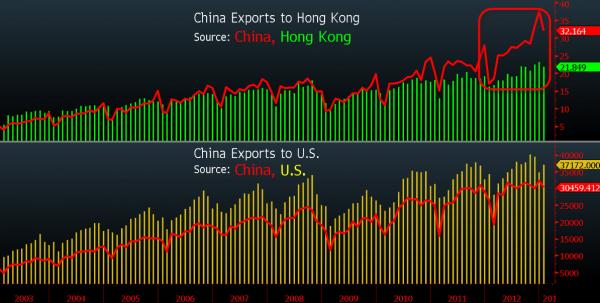
As Marc Faber noted, we hardly expect China to report GDP growth rates that do not perfectly fit the goal-seeked solution for utopian society, but under the covers, there appears to be some considerably more ugly real data. One of the hardest to manipulate, manage, or mitigate for a centrally planned economy is Electricity production. The year-over-year drop in China’s electricity production is the largest since the slump in Q1 2009; and the seasonal drop (associated with the New Year) is the largest on record at 25.3%! So on one hand China is discussing tightening monetary policy amid inflation anxiety and a potential real estate bubble – thanks to the rest of the world pumping free money – and on the other hand Chinese officials are faced with the reality of a drastically slowing ‘real’ economy. At the same time, we note that it appearsChina’s export-import data appears overstated. Rock meet hard place. Biggest seasonal drop ever in China electricity production and worst YoY drop since the crash in 2009… And as Bloomberg notes today: Widening differences in bilateral trade data reported by China and Hong Kong suggest export-import activity is being overstated by the mainland as companies report inflated figures, according to Mizuho Securities Asia Ltd. The chart below compares China’s data on monthly exports to Hong Kong the past two years, with counterpart figures from the city on imports.  

20130314_ChinElec1_0

China’s numbers were 47 percent higher than Hong Kong’s in January, compared with a 13 percent difference two years earlier. The lower panel shows reports during the same period for China’s overseas shipments to the U.S., using each nation’s official statistics, where the differential has remained more consistent. Exaggerated trade figures would mean that China’s new leaders, who take over the government at the National People’s Congress this week, are failing to get the boost from global demand that the data indicate as they try to sustain a rebound in the world’s second-biggest economy. Hong Kong passed the U.S. in November to become the biggest export market in China data. Exports to Hong Kong from China rose 60.9 percent in the first two months of 2013 from a year earlier, compared with last year’s 20.7 percent gain for the full year. “This seems inconsistent with the pictures of the final demand in both Hong Kong and the countries for Hong Kong re-exporting,”  Read more of this post

Innovator: Martin Riddiford’s Gravity-Powered Lamp to replace hazardous kerosene lamps still used in many developing countries

Innovator: Martin Riddiford’s Gravity-Powered Lamp

By Caroline Winter on March 14, 2013

tech_innovator1213__01__630x420

Hazardous kerosene lamps, still used in many developing countries, are a major expense for many of the world’s estimated 1.5 billion families without electricity. Poor households typically spend at least 10 percent of their income on kerosene, as much as $36 billion a year worldwide, according to the World Bank. So far, efforts to use solar energy to power lights in developing nations have run up against cost and technical challenges. Attempts to use hydroelectric microgrids or repurpose old car batteries have also been problematic, says Joe Hale, president of the nonprofit Global BrightLight Foundation. Gravity could help. British industrial designer Martin Riddiford has created a pineapple-size lamp powered by a 25-pound weight that falls about six feet in a half-hour. That may not sound like much, but it’s enough to drive a silent motor at thousands of rotations per second. The GravityLight, which shines slightly brighter than most kerosene lamps, requires a certain amount of elbow grease: Once the weight reaches bottom, it must be manually lifted to repeat the process.

Riddiford, 57, a co-founder of London-based product design firm Therefore, got the idea four years ago after leaving a meeting with a charity interested in solar tech. “I just sort of had this vision of, well, why can’t you use human power and store it as potential energy rather than in a battery,” he says. The designer, whose Brinlock Abacus calculator was the first with number-shaped buttons, and whose firm has developed products for Toshiba, Samsonite, and Nike (NKE), says he regrets not having done charitable work overseas in his youth and hopes to make up for it with his light. The first prototype, a large-scale contraption involving a bicycle wheel and a windup LED flashlight, was refined over four years into its current cheap yet durable plastic version. “It’s technically quite tricky to get it so it doesn’t jam, but we solved that problem through lots of experimentation,” Riddiford says. GravityLight will have its first field tests this summer in Africa, Asia, Latin America, and the Middle East. Once Riddiford’s team works out the final kinks, the basic model will retail for about $5. Therefore is also weighing development of a brighter version with more settings for camping and emergencies, and may eventually use its gravity-based technology to develop a cell phone charger. In December, Therefore pitched the lamp on crowdfunding site Indiegogo to help cover production costs, and in a month received $400,000, far more than the $55,000 it sought. Bill Gates called GravityLight “a pretty cool innovation,” and Therefore says donors and potential partners range from soda companies to the U.S. Department of Defense. “It’s such a clean source of light, and it’s easy to operate,” says Global BrightLight Foundation’s Hale. “The market is unlimited for them.” Still, before GravityLight goes to market, Riddiford says, “It will have to stand the test of four continents trying to kill it, trying to stamp on it, destroy it, and use it and abuse it.”

Problem: Kerosene light is a big cost for 1.5 billion families worldwide

A solution: A $5 lamp powered by a 25-pound falling weight

Early response: Plaudits from Bill Gates, interest from the Pentagon

History Channel’s ‘The Bible’ Is a Marketing Miracle

History Channel’s ‘The Bible’ Is a Marketing Miracle

By Bilge Ebiri on March 14, 2013

It’s a tense night in Sodom. God’s judgment has arrived, and fire rains down from the skies. The beleaguered, henpecked Lot, a nephew of Abraham, shuffles two mysterious Jedi-like figures into his home. A group of armed Sodomites soon bursts through the door and demands that the men be given up. One of the “Jedis” unsheathes two swords and swiftly dismembers the men.

The scene ends the first episode of a new, 10-part miniseries on the History Channel called The Bible, which garnered 14.1 million viewers last week—more than any other show on cable television in 2013. Produced by Mark Burnett, the reality-TV pioneer best known for Survivor, The Apprentice, and Shark Tank, and his wife, Touched by an Angel actor Roma Downey (who also plays the Virgin Mary), the miniseries appears to have been conceived primarily for religious audiences—or at least those knowledgeable of scripture. It’s also packaged with enough bloodlust to capture channel surfers. In that regard, the series resembles Mel Gibson’s 2004 film, The Passion of the Christ, a movie bloggers called The Jesus Chainsaw Massacre—and which raked in more than $600 million at the box office. Read more of this post

Men’s Nail Polish Joins the Cosmetics Market; Former Ultimate Fighting Championship star Chuck Liddell famously sported dainty pink fingernail polish in fights

Men’s Nail Polish Joins the Cosmetics Market

By Joel Stein on March 14, 2013

A few years ago, Josh Espley, a former marketing exec for a sex toy company called Fleshlight, noticed that his kickboxing friends were wearing polish to cover their banged-up nails. The practice was becoming popular, he noted, with the mixed martial arts crowd: Former Ultimate Fighting Championship star Chuck Liddell famously sported dainty pink fingernail polish in fights. Espley occasionally reads Us Weekly—to help him chat up women, he says—and saw polish on male celebrities such as Zac Efron, Jared Leto, Dave Navarro, and Johnny Depp. So in 2009, as a way to supplement his income, he created Blakk Cosmetics. Its first product was Alpha Nail paint, which the company sold in $12 pens in colors like “cocaine” (creamy white), “burnin’ rubber” (dark navy), and “gasoline” (charcoal gray). Read more of this post

Sparking Innovation and More: “Eureka moments are overrated. ‘Innovations must assume that their plans are partly right and partly wrong. And then work hard at figuring out which part of the plan is wrong.”

etc_cc12lineup_950

HE SHOULD HAVE FINISHED HIS SMOOTHIE: How One VC Passed On A 2,500X Return; At SXSW, Brian Chesky, co-founder and CEO of Airbnb, reminisced about the difficulties of building a business.

HE SHOULD HAVE FINISHED HIS SMOOTHIE: How One VC Passed On A 2,500X Return

Megan Rose Dickey | Mar. 15, 2013, 8:51 AM | 1,908 | 1

Airbnb CEO Brian Chesky InterviewAt SXSW, Brian Chesky, co-founder and CEO of Airbnb, reminisced about the difficulties of building a business.

Airbnb, an online marketplace for renting out rooms and homes, is a $2.5 billion company, according to Bloomberg.

But in the company’s early days, Airbnb founder and CEO Brian Chesky had a hard time convincing investors to back his company.

At one point, Chesky was asking for $100,000 in exchange for a 10 percent stake in the company, Bloomberg’s Adam Satariano reports. But Chesky couldn’t seem to get anyone to bite. In fact, one investor even walked out mid-pitch, leaving his half-finished smoothie behind.

Today, that investment would be worth roughly $250 million — a 2,500x return.

Earlier this year, Wedbush Securities analyst Michael Pachter estimated that Airbnb booked 12 million to 15 million nights in 2012. He thinks that could increase to 100 million nights, whereby Airbnb could generate $1 billion a year in revenues. Read more of this post

Before growing into a global fashion business with high-profile collaborations and over $112m in revenue, Acne Studios began as a boutique creative consulting firm that played by a few counterintuitive rules—ones it still stands by today.

March 14, 2013, 2:08 p.m. ET

How to Succeed in Fashion Without Trying Too Hard

Before growing into a global fashion business with high-profile collaborations, its own culture magazine and an ever-evolving product line, Acne Studios began as a boutique creative consulting firm that played by a few counterintuitive rules—ones it still stands by today.

By LYNN YAEGER

OB-WN334_mag041_G_20130228154859

THE BRAND PLAYED ON | Mikael Schiller, left, the executive chairman of Acne Studios, and creative director Jonny Johansson, at the Acne store in Tokyo, which opened in December.

WHILE HE WAS WORKING ON Acne’s spring 2013 collection—the long, floaty parachute-fabric skirts and T-shirts emblazoned with the word “music” that are in stores now—Jonny Johansson listened to a lot of Emmylou Harris. “It was a bit surreal. She talks about women, the difference between a woman who has experience and a woman who is young and free. She was painting pictures in a sense,” he says dreamily. “I could see this woman, in a white dress.”

Johannson, the cofounder and designer of Acne Studios, is sharing this reverie in a lofty room in the company’s world headquarters, a spectacular art nouveau former bank building on an almost ridiculously picturesque cobblestone street in Stockholm’s Old Town. Vintage copies of Flair are enshrined under plexiglass near the entrance; a grand staircase still shows off its original gilded wood paneling and stained glass. The uniformly youthful staff is clad in the kind of clothing that has become the company’s hallmark: edgy and slightly twisted, managing to walk a tightrope between slightly avant-garde and eminently wearable—or, put another way, unthreateningly bohemian.

In an era when every high street from Altoona to Zanzibar is crammed with identical chain stores selling identical merchandise, Acne is perceived as different: Its legions of fans think of it as a brand with integrity, a company that makes principled aesthetic decisions and never resorts to marketing tricks, even though they have hundreds of outlets.

If the most difficult challenge in the fashion industry is to remain relevant and desirable in an ever more crowded marketplace—and the whole project of predicting what customers will want in any given season is at best an ephemeral enterprise—Acne’s ability to play the game while appearing to remain mysteriously above the fray is a deeply impressive accomplishment. The company was founded in 1996 by four guys who threw 10,000 euros into a pot and launched a multidisciplinary digital film–design–creative consulting collective in Stockholm, an enterprise that, by a combination of frankly nutty decisions and shrewd business practices, has become a highly profitable business—$112 million in revenue last year alone—encompassing men’s and women’s ready to wear, footwear, accessories and premium denim. Read more of this post

Why Companies Like Groupon, Yelp And ReachLocal Aren’t Dominating The Local Space

3/14/2013 @ 8:19AM |1,929 views

Why Companies Like Groupon, Yelp And ReachLocal Aren’t Dominating The Local Space

The local newspaper and the yellow pages have been slowly dying for more than a decade, leaving small businesses and merchants few options for local advertising. In its place, Internet companies like Groupon, Yelp, and ReachLocal arrived on the scene to reinvent local advertising online – but none has proved to be a digital nirvana for local businesses, because these solutions do not provide a simple and scalable way to connect with consumers who have a real-time need for their services. Read more of this post