Singapore’s Darwinian Budget Sparks Employer Ire: Southeast Asia; Singapore to Raise Property Tax Rates for Luxury Homeowners

Singapore’s Darwinian Budget Sparks Employer Ire: Southeast Asia

Singapore tightened curbs on foreign labor for a fourth straight year and unveiled measures that will raise wage costs for companies through 2015, as the government steps up efforts to increase productivity among businesses.

Companies must pay higher levies for lower-skilled foreign employees over the next two years and cut the proportion of overseas workers in some industries, Finance Minister Tharman Shanmugaratnam said in his budget speech yesterday.

“This is really killing a lot of businesses, many companies are dying,” said Max Lee, managing director of Plasma Precision Technology Pte., which makes and repairs equipment used by offshore marine companies. His wage costs have risen 15 percent in the past year. “We are losing competitiveness and productivity.”

After years of letting firms bring in thousands to work at hotels, shipyards and restaurants, the push by Prime Minister Lee Hsien Loong’s government to reduce dependence on imported labor has forced some companies to delay expansion plans. The clampdown, in part because of voter unhappiness over the influx of foreigners, has led the government to warn that such curbs will hurt growth in Southeast Asia’s only advanced economy.

“This is a Darwinian budget for businesses in Singapore,” said Adrian Ball, head of tax services at Ernst & Young Solutions LLP. “Survival of the fittest!” Read more of this post

Just a week of inadequate sleep can alter the activity of hundreds of genes, which may help scientists explain how wakeful nights can lead to ailments such as diabetes, obesity and heart disease

Sleep Loss Alters Genes While Raising Risk of Disease

Just a week of inadequate sleep can alter the activity of hundreds of genes, which may help scientists explain how wakeful nights can lead to ailments such as diabetes, obesity and heart disease.

Blood samples taken from patients revealed genetic changes that, with further research, may help answer why sleepless nights are so harmful to health, according to the study published today in the Proceedings of the National Academy of Sciences. While not all of the altered genes have known functions, some are involved in metabolism and stress response.

More than one-third of Americans sleep fewer than seven hours a night, affecting their ability to concentrate, according to the U.S. Centers for Disease Control and Prevention. When people don’t get enough sleep, have poor-quality rest, or sleep at the wrong times of day, they are at a higher risk of heart disease, kidney disease, high blood pressure, obesity, diabetes and depression, according to the National Institutes of Health. Read more of this post

Shocking Aerial Views Of Hong Kong’s Tiny ‘Cage’ Apartments

Shocking Aerial Views Of Hong Kong’s Tiny ‘Cage’ Apartments

Adam Taylor | Feb. 25, 2013, 3:00 PM | 94,004 | 27

Over the past few decades, Hong Kong has become one of the world’s most important cities and a global financial hub.

However, increased prosperity hasn’t trickled down to everyone. According to the Gini co-efficiency, which measures inequality, Hong Kong is the least equal city in the developed world.

Local advocacy group Society for Community Organization says that hundreds of thousands of people are still living in caged homes and wood-partitioned cubicles. What’s worse, the number of people living this way appears to be increasing, as economic migrants arrive in the city from mainland China.

To highlight the struggle, SoCO took shots of the homes to show just how tight these living quarters are.

The apartments were so small that they had to be photographed from the ceiling to capture them.

this-is-the-smallest-apartment-shown-it-is-28-square-feet-with-proportions-of-around-4-x-7 8090hkd-103115usd-per-square-foot-per-month-is-common

Richard Branson Says That Marissa Mayer Got It Wrong About Remote Employees; Ex-Yahoos Confess: Marissa Mayer Is Right To Ban Working From Home; Marissa Mayer, Who Just Banned Working From Home, Paid To Have A Nursery Built At Her Office; Not all Yahoo have that kind of money or clout

Richard Branson Says That Marissa Mayer Got It Wrong About Remote Employees

Aimee Groth | Feb. 25, 2013, 5:24 PM | 5,563 | 21

Last week Yahoo CEO Marissa Mayer sent out a controversial memo telling remote employees that they either had to start working from a Yahoo office or quit.

Since then, everyone has been weighing in, including Virgin Founder Richard Branson. In a post this morning titled, Give People The Freedom Of Where To Work, he wrote:

To successfully work with other people, you have to trust each other. A big part of this is trusting people to get their work done wherever they are, without supervision. It is the art of delegation, which has served Virgin and many other companies well over the years.

We like to give people the freedom to work where they want, safe in the knowledge that they have the drive and expertise to perform excellently, whether they at their desk or in their kitchen. Yours truly has never worked out of an office, and never will.

So it was perplexing to see Yahoo! CEO Marissa Mayer tell employees who work remotely to relocate to company facilities. This seems a backwards step in an age when remote working is easier and more effective than ever.

If you provide the right technology to keep in touch, maintain regular communication and get the right balance between remote and office working, people will be motivated to work responsibly, quickly and with high quality.

Working life isn’t 9-5 any more. The world is connected. Companies that do not embrace this are missing a trick.

Ex-Yahoos Confess: Marissa Mayer Is Right To Ban Working From Home

Nicholas Carlson | Feb. 25, 2013, 3:16 PM | 85,571 | 63

Last Friday, Yahoo HR boss Jackie Reses sent out a memo telling all remote employees that they needed to find a way to be working in an office by June.

This upset lots of Yahoo employees – including some working mothers, who say they wish they could afford to build a nursery at the office the way CEO Marissa Mayer has.

But we’ve just heard from a former Yahoo engineer who tells us Mayer is making the exact right call.

“For what it’s worth, I support the no working form home rule. There’s a ton of abuse of that at Yahoo. Something specific to the company.”

This source said Yahoo’s large remote workforce led to “people slacking off like crazy, not being available, spending a lot of time on non-Yahoo! projects.” Read more of this post

INTUIT FOUNDER: ‘Success Makes Companies Stupid’

INTUIT FOUNDER: ‘Success Makes Companies Stupid’

Max Nisen | Feb. 25, 2013, 6:35 PM | 854 | 3

Intuit is one of the unsung success stories of Silicon Valley. The maker of software like Quicken, TurboTax, and QuickBooks has been around for 30 years and made $4.15 billion in revenue last year.

Intuit’s founder, Scott Cook, believes that success can actually be dangerous to the company. At a seminar with Harvard Business School faculty, he said that “Success is a powerful thing, it tends to make companies stupid, and they become less and less innovative.”

According to Harvard Business School Working Knowledge, Cook argues that companies need to adopt the lean startup model pioneered by Eric Ries. That means “launching as quickly as possible with a “minimum viable product,” a bare-bones creation that includes just enough features to allow for useful feedback from early adopters. The company then releases a quick succession of product upgrades, forming hypotheses and conducting experiments with each new version along the way.”

Getting feedback early and often means the product improves quickly, picking up new users along the way.

That’s the polar opposite of the way many successful companies come up with new products. They spend years developing things, many of which are only minor improvements on what already exists. Once something’s set into motion, it has a great deal of inertia and can take a long time to stop, even if it’s not working.

That’s an easy way for a company to stagnate. However, adopting something like the lean startup model takes a significant cultural shift. It’s not easy to take product teams used to taking years and get them to take ideas from birth to execution in months. It also takes creating a culture that’s OK with failure and starting again, which is the opposite of what you see in many large companies.

Some companies choose to have a small part of their company, like a skunk works, to constantly try to innovate. But when it’s a small part of the company, you see small benefits. Far more effective is forcing a whole company to constantly experiment and innovate.

JCPenney COO: ‘I Hated The JCPenney Culture, It Was Pathetic’

JCPenney COO: ‘I Hated The JCPenney Culture, It Was Pathetic’

Kim Bhasin | Feb. 25, 2013, 11:51 AM | 16,278 | 13

P1-BK427_PENNEY_NS_20130224170304P1-BK428_PENNEY_G_20130224170604

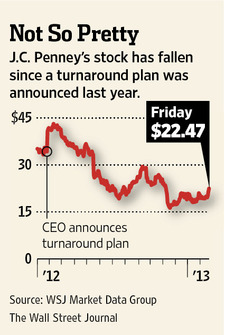
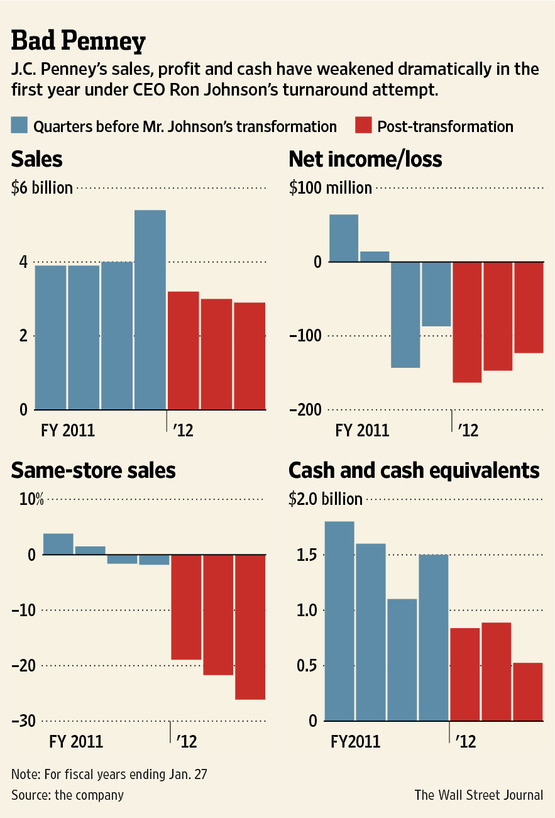
JCPenney experienced a seismic shift on corporate culture when CEO Ron Johnson took the helm of the company more than a year ago.

The new guard didn’t like JCPenney’s old way of doing things at headquarters.

Not one bit.

Dana Mattioli at The Wall Street Journal spoke with JCPenney COO Michael Kramer about the company’s culture and the mass layoffs at the company’s headquarters. He’s one of the execs brought in by Johnson, who he’d previously worked with at Apple.

“I hated the JCPenney culture,” Kramer told the WSJ. “It was pathetic.” Read more of this post

Lee Kuan Yew, A Wise Man for the World: Singapore’s philosopher-king on an ascendant China, the threat of Islamism and America’s entitlements crisis

February 25, 2013, 4:19 p.m. ET

A Wise Man for the World

Singapore’s philosopher-king on an ascendant China, the threat of Islamism and America’s entitlements crisis.

By KAREN ELLIOTT HOUSE

China already dominates Asia and intends to become the world’s leading power. The United States is not yet a “second rate power,” but the inability of its political leaders to make unpopular decisions bodes poorly. Russia, Japan, Western Europe and India are, for the most part, tired bureaucracies. If Iran gets the bomb, a nuclear war in the Middle East is almost inevitable.

These are among the many frank forecasts laid out in a slim volume based on the experiences and insights of Lee Kuan Yew, the founder of modern Singapore, its prime minister from 1959 to 1990, and Asia’s ranking philosopher-king for much of the past half-century. Tiny Singapore has always been too small a stage for a leader of Mr. Lee’s intellect and ego. His interests have extended across the globe, as has his influence. For decades, world leaders, corporate CEOs, scholars and journalists have made the pilgrimage to Singapore to seek his views.

“Lee Kuan Yew: The Grand Master’s Insights on China, the United States, and the World” forms a kind of last testament of the ailing, 89-year-old Mr. Lee. It is based on interviews with Mr. Lee by the authors—Graham Allison, a professor of government at Harvard’s Kennedy School, and Robert Blackwill, a former U.S. diplomat—to which the authors add a distillation of Mr. Lee’s speeches, writings and interviews with others over many years. Read more of this post

Olive Oil Diet Curbs Strokes

Updated February 25, 2013, 7:07 p.m. ET

Olive Oil Diet Curbs Strokes

By ANDREA PETERSEN

Until now, evidence was weak that the Mediterranean diet reduced the risk of heart disease. But a New England Journal of Medicine study reveals startling new findings that will silence skeptics for good. WSJ’s Andrea Petersen has the details on Lunch Break. Photo: AP.

A diet common in coastal areas of Southern Europe, particularly one with lots of olive oil and nuts, cuts the risk of stroke and other major cardiovascular problems by 30% among high-risk people, according to a new study.

There’s a large body of research linking a Mediterranean diet—one heavy on fruits, vegetables, fish and beans—to heart health. But this study, published Monday in the New England Journal of Medicine, is significant both for its size—it followed 7,447 people in Spain over almost 5 years—and its scientific rigor. Few previous studies have succeeded in proving a direct link between a diet and a reduction in life-threatening events like strokes, instead assessing the diet’s impact only on weight loss or certain cardiovascular risk factors, like blood pressure or cholesterol. Read more of this post

East Meets West in Class

Updated February 25, 2013, 5:02 p.m. ET

East Meets West in Class

Pericles Lewis is founding president and professor of humanities at Yale-NUS College, a joint venture between Yale University and National University of Singapore, to open in August.

IV-AA332A_LEWIS_G_20130225140903 Read more of this post

Stress-Busting Smiles: A Genuine Grin Can Help the Heart; Is Polite Faking Enough to See Benefits?

Updated February 25, 2013, 9:29 p.m. ET

Stress-Busting Smiles

A Genuine Grin Can Help the Heart; Is Polite Faking Enough to See Benefits?

By SUMATHI REDDY

Smiling could be good for your health.

Researchers are finding that wearing a smile brings certain benefits, like slowing down the heart and reducing stress. This may even happen when people aren’t aware they are forming a smile, according to a recent study. The work follows research that established that the act of smiling can make you feel happier.

Some research suggests only a full and genuine smile affects the body in positive ways. Other studies, though, indicate even a polite smile may be beneficial. Frowning also may have a health effect: Preventing people from frowning, such as with the use of Botox, can help alleviate depression, a recent study found.

“You can influence mental health by what you do with your face, whether you smile more or frown less,” says Eric Finzi, a dermatologic surgeon and co-author of the study on frowning. Read more of this post

How to Best Protect Your Brand From a Coup d’Etat; Soon, a Singapore court will decide a lawsuit involving one of Indonesia’s most well-known brands, with not only millions of dollars at stake but also ownership of the brand itself

How to Best Protect Your Brand From a Coup d’Etat
Commentary | Prudence Jahja & Andrew Diamond | February 25, 2013

Soon, a Singapore court will decide a lawsuit involving one of Indonesia’s most well-known brands, with not only millions of dollars at stake but also ownership of the brand itself.

How Ku De Ta, the long-standing Bali beach club and an establishment known for its chic and laid-back demeanor, became embroiled in a hotly contentious, multiparty lawsuit 1,600 kilometers away from its sublime beachfront location in Seminyak is a story that every Indonesian brand owner should learn by heart.

It is a story that has important implications for doing business in this increasingly globalized world. And while this decision is eagerly anticipated by the parties and intellectual property lawyers who focus on trademarks and brand protection, for everyone else the decision itself does not matter, as the lessons to be learned from this case have been clear for quite some time, however the court rules.  Read more of this post

China Has Its Own Debt Bomb; Not unlike the U.S. in 2008, China is at the end of a credit binge that won’t end well

February 25, 2013, 7:04 p.m. ET

China Has Its Own Debt Bomb

Not unlike the U.S. in 2008, China is at the end of a credit binge that won’t end well.

By RUCHIR SHARMA

Six years ago, Chinese Premier Wen Jiabao cautioned that China’s economy is “unstable, unbalanced, uncoordinated and unsustainable.” China has since doubled down on the economic model that prompted his concern.

Mr. Wen spoke out in an attempt to change the course of an economy dangerously dependent on one lever to generate growth: heavy investment in the roads, factories and other infrastructure that have helped make China a manufacturing superpower. Then along came the 2008 global financial crisis. To keep China’s economy growing, panicked officials launched a half-trillion-dollar stimulus and ordered banks to fund a new wave of investment. Investment has risen as a share of gross domestic product to 48%—a record for any large country—from 43%.

Even more staggering is the amount of credit that China unleashed to finance this investment boom. Since 2007, the amount of new credit generated annually has more than quadrupled to $2.75 trillion in the 12 months through January this year. Last year, roughly half of the new loans came from the “shadow banking system,” private lenders and credit suppliers outside formal lending channels. These outfits lend to borrowers—often local governments pushing increasingly low-quality infrastructure projects—who have run into trouble paying their bank loans. Read more of this post

Brick-and-Mortar Stores Are Snapping Up Existing Web Firms to Try to Catch Up to eBay, Amazon; Home Depot is buying a startup that uses algorithms to set Web prices

February 25, 2013, 7:56 p.m. ET

Targeting Tech-Savvy Startups

Brick-and-Mortar Stores Are Snapping Up Existing Web Firms to Try to Catch Up to eBay, Amazon

By SHELLY BANJO

Three months ago, Rodrigo Carvalho and Lukas Bouvrie were working 20-hour days to raise money and attract clients for Black Locus Inc., a 20-person Austin, Texas, startup that uses algorithms to help retailers sell their wares on the Web.

Now, the recent graduates of Carnegie Mellon University’s business school work for the world’s largest home-improvement retailer, Home Depot Inc. HD -2.53%

The company, which is expected to publicly address the acquisition of Black Locus Tuesday, is the latest traditional brick-and-mortar retailer to buy a startup and launch a “technology lab” to try to catch up to online retailers like Amazon.com Inc.AMZN -2.09% and eBay Inc. EBAY -2.56%

Home Depot says the startup, renamed the Home Depot Innovation Lab, will help it compete in an online environment where prices change by the second and are determined by algorithms rather than merchants. The company declined to disclose terms of the purchase. Read more of this post

Innovation is the fuel of economic growth, and the Holy Grail for companies and countries around the globe; Israel’s Innovation Formula

February 25, 2013, 4:49 p.m. ET

In Search of the Spark…and the Next Big Thing

Innovation is the fuel of economic growth, and the Holy Grail for companies and countries around the globe

By JOHN BUSSEY

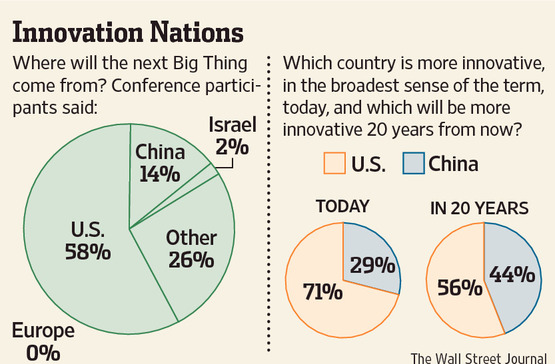
What makes a company innovative? An individual? A country? Why is Silicon Valley still such an exceptional—and singular—example of self-propelled creativity? And what will happen when India and China finally learn to mix the magic sauce of innovation in bulk?

Innovation isn’t just at the center of human creativity and corporate profit. It’s fuel for economic growth and one reason hundreds of millions of people in developing countries have leapt up the income curve over the past two decades. Governments, especially authoritarian ones, understand that without it, growth may slow, jobs may get scarce and instability may rise.

“There are already areas of entrepreneurial ferment across Asia,” Tarun Khanna of the Harvard Business School told a group of entrepreneurs, CEOs and industry executives at The Wall Street Journal’s conference on Unleashing Innovation in Singapore last week. The key question, Mr. Khanna counseled the delegates from 25 countries, “is how do we take these little sparks and scale them up in some way that’s meaningful.”

That’s the same question corporate chiefs—from General Electric GE -2.48% toNokia NOK1V.HE +0.98% to Sony 6758.TO -2.31% —are asking every day. How can they generate the spark that ignites the next big thing? Executives at the conference heard some familiar advice: cultivate creativity, a dynamic workplace, irreverence, risk-taking and cross-discipline networking. Read more of this post

Priceline Founder Jay Walker: Imagination Drives Innovation

February 25, 2013, 4:59 p.m. ET

The Power of Imagination

Jay Walker on the fuel that drives innovation

Jay S. Walker founded Priceline.com and is curator of TEDMED, a group dedicated to improving the future of health and medicine. Here are edited excerpts from his remarks at the Unleashing Innovation conference. 

Tedmed curator Jay Walker talks about the history of great ideas and shows off an illustrated book woven entirely in silk–a breakthrough marketing tool pitching an 18th-century revolution in loom technology.

On why imagination has been undervalued for so long: For most of human history, there was a ruling class and then there was everybody else. If you were part of everybody else, it wasn’t your job to imagine a different future, different ways of doing things. So, imagination is a fairly modern phenomenon. It really only takes force in the 1800s in the way we think of it today, where you can make a living and not get killed for being imaginative.

On encouraging imagination: People talk about wanting more innovation. But innovation is a process result. Imagination is the fuel. You’re not going to get innovation if you don’t have imagination. Most organizations do not value imagination, do not encourage it, do not reward it. In many cases, they don’t even think about it. But if you’re not thinking about imagination, I guarantee you’re not going to have meaningful innovation.

On why imagination is crucial for business: Imagination drives good problem formation because imagination thinks about customers. What might my customers want tomorrow? What might my customers want in six months, a year, two years that they don’t want today? That’s imagination. And that’s hard work. There’s no right or wrong answer, there’s nobody there to say, “You did it perfectly. Here’s your bonus for that.”

The issue is not to ask your customers what they want today, but to try to imagine what the customer is going to want in a world where, for instance, their cellphone is in their glasses. What is my customer going to want in a world with transparency, where they are able to talk to every one of my other customers? If you ask your customers what they want, you will not get disruptive innovation. Read more of this post

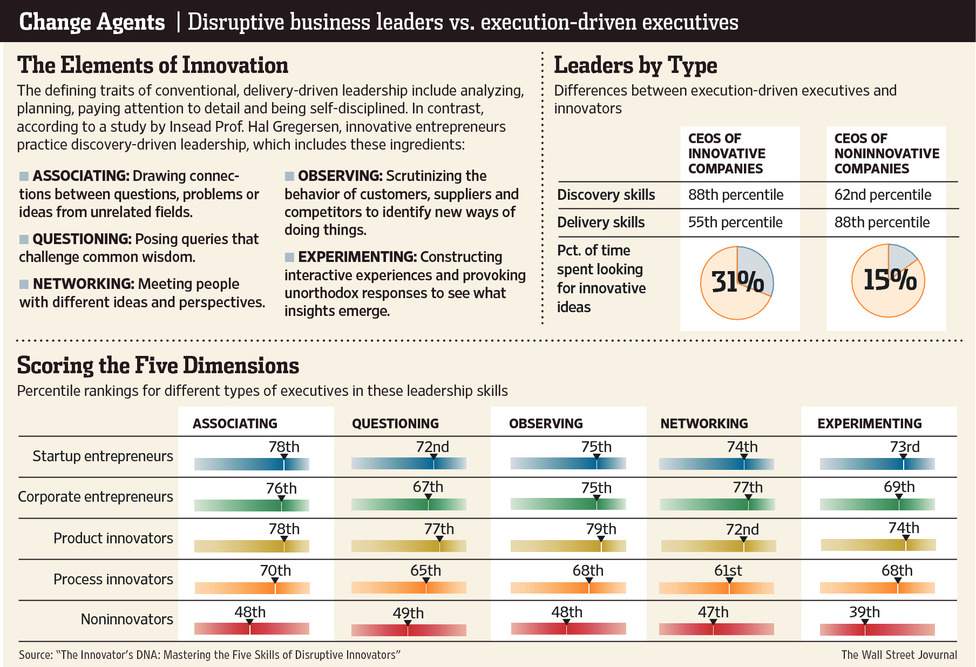
The Entrepreneur’s DNA: Hal Gregersen on what makes a successful entrepreneur

Updated February 25, 2013, 5:00 p.m. ET

The Entrepreneur’s DNA

Hal Gregersen on what makes a successful entrepreneur

Hal Gregersen is an author and professor of innovation and leadership at graduate business school Insead. What follows are edited excerpts from his discussion at the Unleashing Innovation conference.

IV-AA310_GREGER_G_20130225132405 Read more of this post

China Is No Silicon Valley

February 25, 2013, 4:49 p.m. ET

China Is No Silicon Valley

Duncan Clark is the chairman of BDA China, an investment-advisory firm specializing in China’s technology, Internet and e-commerce sectors.

IV-AA325_CLARK_G_20130225132104

ON WHETHER CHINA CAN BECOME THE NEXT SILICON VALLEY:Innovation is born, not made. It isn’t something that you can fast-forward. When you do try to fast-forward it, you get copying.

This is China’s challenge. There’s a clear desire to move up the value chain from the “Made in China, Designed in California,” to flipping that around. Read more of this post

China Austerity Drive Becomes a Joke

February 25, 2013, 8:38 PM

China Austerity Drive Becomes a Joke

China’s leaders have been talking tough about graft, greed and gross extravagance again. One sign they’re serious this time: Their willingness to have a little fun with it.

Up until recently, the austerity campaign was suitably severe. There was tough talk from Communist Party chief Xi Jinping, who told a gathering of party heavyweights in November that corruption threatened their grip on power. He called for less pomp and ceremony for officials touring the countryside and urged comrades to make do with a little less banqueting. They should stick to four dishes and a soup and finish their food or else, he said.

Similar refrains have regularly appeared in the party mouthpiece, the People’s Daily. A recent commentary (in Chinese) said cadres need to avoid waste, hold only meetings that have a real purpose and observe the New Year holiday in a simple and modest fashion. “The people are looking forward to this – and they will be watching critically,” it warned.

But to help spread the party gospel even further, Beijing recently decided to take a more populist approach — making these themes part of the entertainment on CCTV’s widely watched Lunar New Year’s Eve gala – or the “Chun Wan Hui.”

In one of the CCTV New Year skits, comic Guo Degang took a swipe at the ex-Shaanxi work safety official Yang Dacai, dubbed the “Brother Watch” after photos of him appeared on the Internet sporting an array of expensive watches that normally would exceed a government salary. Mr Guo, who didn’t mention the sacked official by name, bragged he wore a hefty gold watch on his right wrist and a dozen more all the way up his left arm. Asked if it wasn’t risky wearing them he said: “I’m not afraid of wearing them and I’m not afraid of letting people see them,” he said, adding he had shortened his left suit sleeve so he could show them all off (in Chinese).

Still in character, he bragged of splashing out on a wedding banquet, inviting enough guests to fill 100 tables. He feigned outrage at apparently being upstaged by a banquet next door with 200 tables. On closer inspection, that banquet was paid for with public money, so it wasn’t a fair contest, he insisted. Read more of this post

China’s riskiest property market just collapsed. Is this how it starts?

China’s riskiest property market just collapsed. Is this how it starts?

By Max Fisher , Updated: February 25, 2013

The real estate market in Phoenix Island, a development project in the Chinese island province of Hainan, was so inflated, so outrageously expensive and unsustainable, that it became known as the Dubai of China. With its palm tree-lined streets, glimmering high-rises and ostentatious sports cars, it even looked a little like Dubai. And now, also like Dubai but maybe more in the vein of south Florida, the Phoenix Island real estate market that drove so much local economic growth has imploded.

Phoenix Island is an extreme case, but it’s in many ways symptomatic of China’s skyrocketing real estate market, which is both a blessing and a curse for China. A blessing because it helps to drive economic growth and domestic consumption, which the country’s economy needs more of to be healthy. It’s a curse because, as Americans are well aware, it can burst, pulling down much of the national economy with it.

If the national real estate market collapses in China, it would be disastrous not just for China but for the entire world economy, risking a third wave of the global crisis that began with the U.S. financial collapse and worsened with the Euro crisis. Is Phoenix Island an outlier, a crazy market so extreme that it tells us little about China? Is it the start of a major but recoverable setback? Or, in the worst-case scenario, is it the beginning of the end for China’s astounding 20 years of miraculous economic growth? Read more of this post

Your business model is obsolete; Assume this: Everything you think you know about staying competitive doesn’t work anymore

Your business model is obsolete

February 25, 2013: 5:00 AM ET

Assume this: Everything you think you know about staying competitive doesn’t work anymore.

By Geoff Colvin, senior editor-at-large

FORTUNE — When Carlos Ghosn announced last year that Nissan, which he runs, will start making ultracheap cars for emerging markets under the revived Datsun brand — and will make a profit on them — the mainstream response was contemptuous. “A big mistake,” a Toyota (TM) executive told the Wall Street Journal; “another blunder,” said a Japanese professor. Make a profit on a $3,000 vehicle? Everyone knows the profits are in pickup trucks and luxury cars.

No one can predict if Ghosn’s new vision will work. His previous rethinking of the business, the all-electric Leaf, hasn’t amounted to much so far. But applaud Ghosn for this: He is trying to develop the most crucial competency for every company today, innovating the business model.

“Innovation” is the hottest word in business, but most of the discussion centers on products and services. The more profound challenge for most companies now is imagining a new business model, a new answer to the fundamental question, How do we make money? Read more of this post

Wombs for rent: Indian surrogate mothers tell their tales

Published: Monday February 25, 2013 MYT 1:51:00 PM

Wombs for rent: Indian surrogate mothers tell their tales

NEW DELHI: As baby Lili celebrates her first birthday in Australia, far away in India her surrogate mother recalls the day the child was born – and on whom she never laid eyes.

“I averted my gaze,” says Seita Thapa, recounting her experience of giving birth at the Surrogacy Centre India clinic in New Delhi last February on behalf of a gay male couple who used an egg donated from another woman.

“Why would I want to see the child? – I have my own children,” said the mother of two teenagers aged 16 and 18, adding that the clinic gives courses that “prepare us mentally for the fact it’s not our baby”.

Commercial surrogacy is a booming industry in India with legions of childless foreign couples looking for a low-cost, legally simple route to parenthood.

While the Indian government has been pushing the country as a medical tourism destination, the issue of wealthy foreigners paying poor Indians to have babies has raised ethical concerns in many Indian minds about “baby factories”.

The Confederation of Indian Industry, a leading business association, estimates the industry now generates more than $2 billion in revenues annually. Read more of this post

Do Managers Tacitly Collude to Withhold Industry-Wide Bad News?

Do Managers Tacitly Collude to Withhold Industry-Wide Bad News?

Jonathan L. Rogers 

University of Chicago – Booth School of Business

Catherine M. Schrand 

University of Pennsylvania – Accounting Department

Sarah L. C. Zechman 

University of Chicago – Booth School of Business
February 1, 2013
Chicago Booth Research Paper No. 13-12

Abstract: 
That managers would choose to withhold firm-specific bad news is not only intuitive, but supported by theory, observed disclosure patterns, and survey responses. When the bad news is industry-wide, however, explaining withholding as a sustainable equilibrium is more complicated. If any one firm chooses to disclose, the news effectively becomes public, creating incentives for other firms to disclose. Withholding is only sustainable if all firms cooperate (“tacitly collude”), which depends on their own incentives, and their conjectures about the incentives of other firms in the industry to cooperate. We document cases of increased intra-industry opacity in the annual 1’2K, controlling for changes in fundamentals, consistent with tacit collusion to hide news. Tacit collusion is more likely in industries with more significant equity incentives and more concentrated industries, and less likely in industries in which observable/public macro-economic data relevant to firm valuation is available. The collusion episodes are followed by abnormally poor industry level accounting and market performance two to three years out. The results have implications for understanding when market forces are sufficient to generate voluntary disclosure of industry-wide news.

Wang Wei’s journey from deliveryman to logistics tycoon of SF Express with over US$2.4 billion in revenue

Wang Wei’s journey from deliveryman to logistics tycoon

Staff Reporter
2013-02-19

wang wei-153655_copy1

A rare photo of SF Express founder Wang Wei. (Internet photo)

Wang Wei is the low-key founder of SF Express, one of China’s two leading express delivery companies.

The 41-year-old Wang started SF Express nearly 20 years ago and has since developed the company into an delivery giant that recorded 15 billion yuan (US$2.4 billion) in revenue in 2011. Despite the extraordinary success of his company, Wang has said SF Express does not advertise and that he does not intend to take the company public or use it to make strategic investments. It is an attitude that has made Wang well-respected among China’s leading entrepreneurs, including Alibaba founder and chairman Jack Ma. Read more of this post

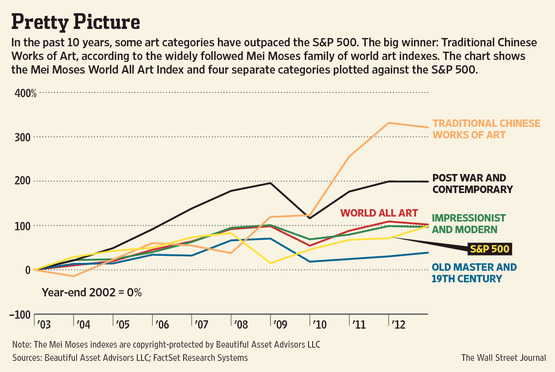
The Ways Art Investors Blow It; Adding art to your portfolio can be a lot trickier than putting it on your wall.

February 25, 2013

The Ways Art Investors Blow It

Three common mistakes novices fall prey to—and how to avoid them

By DANIEL GRANT

Adding art to your portfolio can be a lot trickier than putting it on your wall.

With regular investments looking uncertain these days, individuals and financial pros are snapping up artwork to diversify their holdings—and, with any luck, realize big returns.

WE-AA434_FINEAR_G_20130221154803

But with more competition for desired pieces, prices are soaring ever higher and the chances of making a costly mistake are rising too. Here’s a look at some of the pitfalls of art investors face and how to avoid them. Read more of this post

Comic-book investing is a funny business—and sometimes a profitable one

February 25, 2013

Wham! Ka-Pow! Zounds!

Comic-book investing is a funny business—and sometimes a profitable one

By STEVE ROSENBUSH

In August 2008, comic-book dealer Metropolis Collectibles Inc. auctioned a copy of Action Comics No. 1—which introduced the character of Superman in 1939—for $317,200. At the time, it was the largest sum ever paid for a comic book.

When the real estate and stock markets tanked in 2008, some savvy investors turned to the so-called “golden age” comic books, and the market has continued to boom. WSJ’s Steve Rosenbush talks to Vincent Zurzolo, COO of Metropolis Collectibles.

Last November, Metropolis sold another copy of Action Comics No. 1. The price this time: $2.2 million.

While some other asset classes withered in the wake of the recent financial crisis, comic books have emerged triumphant. They’re not all investment superheroes, but overall demand has risen steadily in recent years, says Ed Jaster, a senior vice president and comic-book specialist at Heritage Auctioneers & Galleries Inc. in New York. Read more of this post

Chief Taste Tester, Innovator and Boss Behind the Tabasco Brand

Updated February 24, 2013, 7:24 p.m. ET

PAUL MCILHENNY | 1944-2013

Chief Taste Tester, Innovator and Boss Behind the Tabasco Brand

By MARK PETERS

One of Paul McIlhenny’s favorite roles as leader of the Louisiana-based family company that makes Tabasco was taste tester.

The chairman and chief executive of McIlhenny Co., who died Saturday at the age of 68, was heavily involved in recent years with the development of new products that went beyond the company’s iconic pepper sauce. It was part of Mr. McIlhenny’s love of the food business that also included befriending celebrity chefs and cooking Louisiana Creole dishes, said Tony Simmons, president of McIlhenny Co. and Mr. McIlhenny’s cousin. Read more of this post

1 Corinthians 13:4: Love is patient, love is Kind

This verse from the Bible is shared to me by a kind friend and investment veteran this morning after reading my “Bamboo Innovator” article, saying he particularly “like the statement : ‘To trust is to be kind to others – & making ourselves vulnerable’.” Thank you for your kind encouragement.

1 Corinthian 13:4: “Love is patient, love is kind. It does not envy, it does not boast, it is not proud. it does not dishonor others, it is not self-seeking, it is not easily angered, it keeps no record of wrongs. Love does not delight in evil but rejoices with the truth. It always protects, always trusts, always hopes, always perseveres.”

love-is-patient-Print1

President Park: The Republic of Korea as we know it today has been built on the blood, toil, and sweat of the people. I have faith in the Korean people. I believe in their resilience and the potential of our dynamic nation.

2013-02-25 11:25

“Opening a New Era of Hope”

My fellow Koreans and seven million fellow compatriots overseas,

As I take office as the 18th-term President of the Republic of Korea, I stand before you today determined to open a new era of hope.

I am profoundly grateful to the Korean people for entrusting this historic mission to me. I also thank President Lee Myung-bak, former Presidents, dignitaries who have come from abroad to celebrate this occasion, and other distinguished guests for their presence.

As President of the Republic of Korea, I will live up to the will of the people by achieving economic rejuvenation, the happiness of the people, and the flourishing of our culture.

I will do my utmost to building a Republic of Korea that is prosperous and where happiness is felt by all Koreans.

Fellow citizens,

The Republic of Korea as we know it today has been built on the blood, toil, and sweat of the people. Read more of this post

Mobile Revolution Buffets Taiwan PC Rivals; Two computer-making neighbors in the technologically inclined economy of Taiwan seem headed in opposite directions.

February 24, 2013

Mobile Revolution Buffets Taiwan PC Rivals

By LIN YANG

TAIPEI — Two computer-making neighbors in the technologically inclined economy of Taiwan seem headed in opposite directions.

Personal computer sales have slumped worldwide as smartphones and tablets have proliferated and gained in popularity. One Taiwan heavyweight, Acer, has shared in the suffering: It is expected to report a second straight annual loss in 2012 after losing 6.6 billion Taiwan dollars, or $223 million at the current exchange rate, in 2011.

But another Taiwan-based PC company, Asustek, which sells computers under the Asus name, grew 43 percent in the quarter that ended in September, to 6.7 billion dollars in net income. The company’s PC sales rose 6.4 percent even as industrywide PC shipments declined 4.9 percent in the last three months of 2012, according to the research firm Gartner.

The companies’ divergent fortunes expose both the mistakes and the opportunities for PC makers in an epic shift in the way consumers use technology. Read more of this post

‘Bloodless’ Lung Transplants Offer Hint at Surgery’s Future

February 24, 2013

‘Bloodless’ Lung Transplants Offer Hint at Surgery’s Future

By KEVIN SACK

HOUSTON — Last April, after being told that only a transplant could save her from a fatal lung condition, Rebecca S. Tomczak began calling some of the top-ranked hospitals in the country.

She started with Emory University Hospital in Atlanta, just hours from her home near Augusta, Ga. Then she tried Duke and the University of Arkansas and Johns Hopkins. Each advised Ms. Tomczak, then 69, to look somewhere else.

The reason: Ms. Tomczak, who was baptized at age 12 as a Jehovah’s Witness, insisted for religious reasons that her transplant be performed without a blood transfusion. The Witnesses believe that Scripture prohibits the transfusion of blood, even one’s own, at the risk of forfeiting eternal life.

Given the complexities of lung transplantation, in which transfusions are routine, some doctors felt the procedure posed unacceptable dangers. Others could not get past the ethics of it all. With more than 1,600 desperately ill people waiting for a donated lung, was it appropriate to give one to a woman who might needlessly sacrifice her life and the organ along with it? Read more of this post